CARV enables user-led data ownership and monetization through the CARV Protocol and CARV ID, its solutions for identity aggregation and data management.
CARV Protocol is a decentralized Identity and Data Layer (IDL) that allows users, especially gamers, to securely and privately control, share, manage, and monetize their data.
With CARV ID, users can interact across Web2 and Web3 platforms using a single NFT-based profile built on CARV’s custom ERC-7231 standard.
Since its launch, CARV’s flagship application, CARV Play, has registered over 9.5 million users and nearly 3 million CARV IDs onchain through various in-game campaigns. As of September 2024, the CARV Protocol has seen over 2.1 million unique active wallets interacting with the across supported networks.
One of Carv Labs' early successes was the launch of BANANA, a TON-based idle clicker game that has attracted over 8 million users as of writing.
Introduction
Data ownership and digital identity management have historically been controlled by centralized entities that continue to monopolize the value captured from user data. These entities silo user data leading to:
Fragmented identities across platforms.
Heightened privacy concerns.
Limited user control over personal data.
This problem is particularly acute in the gaming sector, where gamers' achievements, profiles, and social connections are scattered across different platforms. As such, gamers cannot own and monetize the data they generate through their interactions.
The transition between Web2 and Web3 further exacerbates these challenges as users’ digital footprints are spread across multiple blockchains. For example, a gamer’s achievements on one blockchain can’t be transferred to a different game on another chain. This fragmentation restricts composability and prevents users from consolidating their onchain records into a comprehensive Web3 identity, leaving valuable data trapped in isolated platforms.
CARV aims to address these issues with CARV protocol, a decentralized Identity and Data Layer (IDL) that empowers users to securely and privately control, share, and monetize their digital identities across Web2 and Web3 platforms. The IDL’s identity aggregation properties are enabled by Carv ID, a unique identifier that unifies Web2 and Web3 identities into a single NFT-based profile based on a custom ERC-7231 token standard.
This solution lets users aggregate fragmented identities across Web2 and Web3, control their data, and benefit from improved privacy and value capture. Through CARV, gaming brands can access valuable insights from high-quality user-owned data to provide tailored user experiences.
Background
CARV was founded in 2022 by Chloe Gu and Victor Yu to give users control over their identity and data across Web2 and Web3. Initially inspired by Vitalik Buterin’s ideas on decentralized society (DeSoc) and Soulbound Tokens (SBTs), CARV aimed to integrate these concepts into Web3 but later narrowed its focus to the gaming and AI sectors.
In May 2022, after completing the UPenn Wharton Cypher Blockchain Accelerator, CARV launched Carv Play, a platform offering a unified interface for multiple games. The project quickly gained traction and raised over $50 million in various funding rounds from investors. To address identity and data fragmentation in gaming, CARV proposed the ERC-7231 token standard in June 2023, which merges Web2 and Web3 identities into a single NFT-based profile. ERC-7231 was approved in February 2024.
In December 2023, CARV introduced CARV ID, its ERC-7231-powered identity solution that allows users to merge their Web2 and Web3 identities into a single profile. The same month, CARV launched the Data-to-Earn initiative, enabling users to manage and monetize their data through participation in opt-in data acquisition campaigns. In June 2024, ahead of the mainnet launch, CARV released Alphanet, the protocol’s testnet. The team also held a node sale the same month, offering 100,000 verifier nodes to the public, enabling community participation in the protocol’s data validation process. As of writing, the project team has raised over $35 million, selling 38,000 verifier nodes through the node sale.
CARV’s Alphanet has seen nearly 200,000 verifications in less than a quarter and almost 2,000 data attestations. Meanwhile, nearly 3 million CARV IDs have been minted onchain, and the project continues to support access to more than 900 games through its suite of identity solutions. To boost adoption, Carv launched CARV Labs, an incubator and accelerator for CARV-powered projects. In July 2024, CARV Labs released the Ton-based Banana Game, attracting over 8 million users. CARV’s ecosystem continues to grow, with more than 20 blockchain integrations and partnerships across mainstream Web2 and Web3 gaming sectors.
Technology
The CARV Protocol functions as a decentralized Identity and Data Layer (IDL) with CARV ID at its core, offering trustless on-chain identity management. Beyond identity, the IDL supports permissionless computation, verification, and secure data storage, providing a scalable and secure infrastructure for the ecosystem.
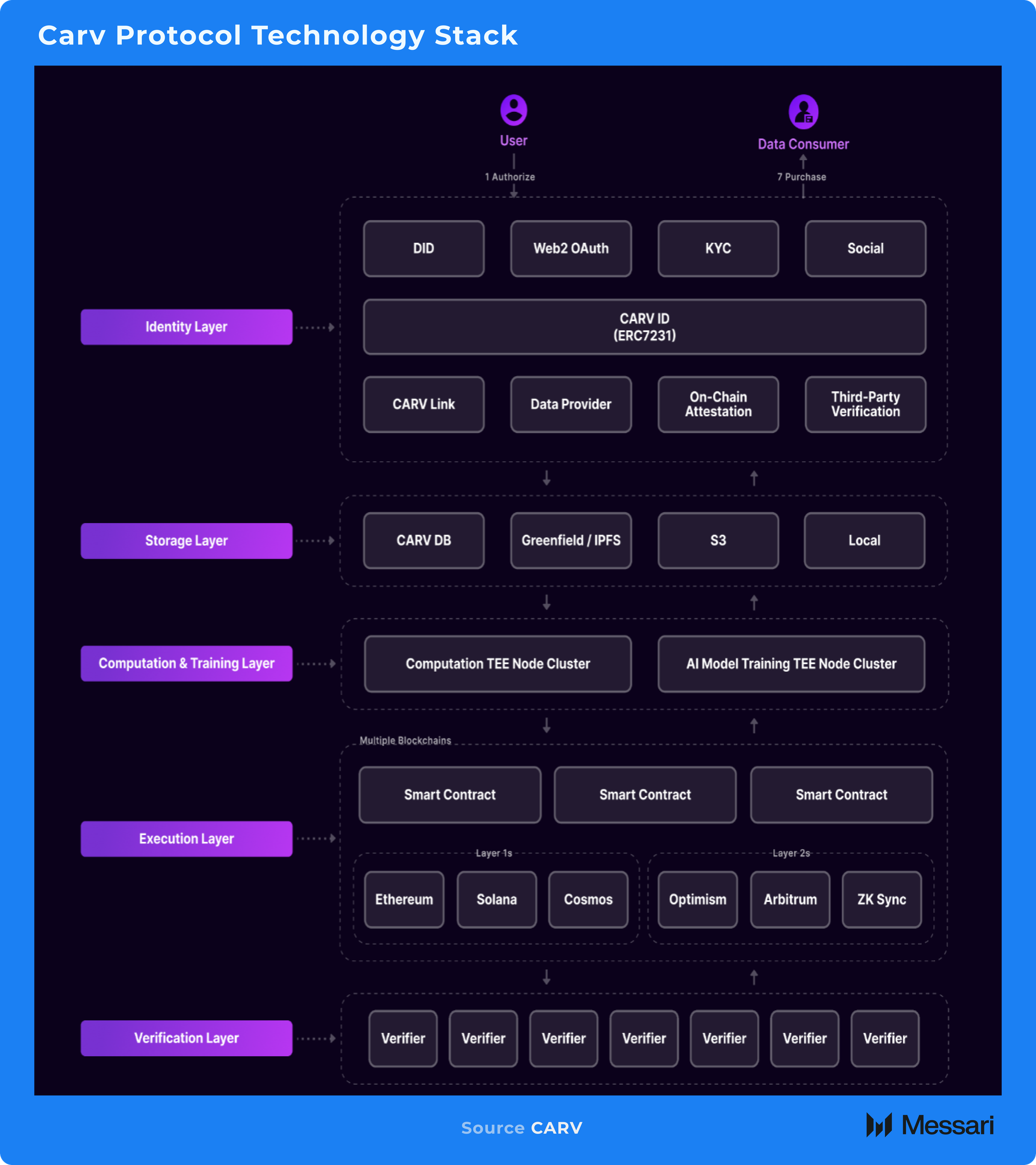
In place of a traditional blockchain model, the IDL adopts a lightweight multichain approach, with smart contracts deployed across several Layer-1 and Layer-2 networks. The protocol also operates a modular framework comprising four customizable layers that specialize in managing the end-to-end data flow.
Identity Layer
The identity layer is the core entry point for user identity and data aggregation, leveraging the ERC-7231 standard. This standard extends the ERC-721 token standard by binding Web2 and Web3 identities—like social profiles, blockchain wallets, and DIDs—to non-fungible tokens (NFTs) and soulbound tokens (SBTs). To interact with the protocol, a user’s Web2 and Web3 identity is first merged into a CARV ID, a unified NFT profile issued as an ERC-7231 token onchain. This unified NFT profile allows users to manage their identity across platforms, enabling user-led data ownership and monetization. The identity layer also supports customizable data authentication through decentralized oracles like CARV Link oracle service or third-party offchain and onchain verifiers and data providers.
Data Storage Layer
The storage layer offers users flexibility in data storage, supporting decentralized and centralized options. Data aggregated on the identity layer is encrypted by default and persists in the storage layer. Users can opt for the protocol’s native storage solution, Carv DB, based on Eigenlayer AVS, decentralized solutions like BNB-based Greenfield, or centralized options like AWS S3. IDL’s customizable approach to natively encrypted storage allows users to balance privacy, cost, and availability.
Computation and Training Layer
This layer handles the processing and analysis of aggregated data, unlocking real-time insights from the data, which can also be used for training AI models. To ensure data is processed securely and privacy-preserving, this layer employs Trusted Execution Environments (TEE) like Intel SGX and Zero-Knowledge proof (zk-SNARK) for verification. The protocol operates a TEE node cluster that coordinates the computation process using Intel SGX to offer verifiable attestations. To defend against vulnerabilities to the computation process, the SGX Trusted Computing Base (TCB) is regularly updated, while network participation is limited to hardware compliant with DAA protocol standards. This layer also supports AI training within TEEs, allowing AI companies to securely access high-quality data while preserving privacy and protecting user data and model parameters.
Execution Layer
The execution layer functions as the operational backbone of the protocol, comprised of smart contracts deployed on multiple Layer-1 and Layer-2 networks. This layer coordinates all interactions between users, nodes, and other protocol components. It manages the protocol’s core business logic, interpreting and executing the data output from the computation layer while distributing rewards based on the results of verified node operations. Its core functions include:
Recording TEE attestations and verifier reports onchain
Overseeing verifier consensus on the verification layer
Distributing onchain rewards to data providers and infrastructure
Charging data consumers.
Verification Layer
The verification layer provides additional security for the protocol’s operations, ensuring that the protocol remains decentralized. This layer comprises community-operated verifier nodes that validate the attestations generated by TEE nodes on the computation and training layer. The following actions occur once TEE nodes submit verification results and attestations to the execution layer:
The protocol’s smart contracts randomly select verifier nodes to validate the attestation using a verifiable random function (VRF).
If an attestation is invalid, the responsible TEE node is penalized, redistributing a portion of its stake to the associated verifiers.
When verified as valid with over 50% consensus, accrued rewards and fees are distributed among TEE nodes, verifiers, and data providers, ensuring decentralized and fair value allocation.
By cross-checking results and penalizing malicious behavior, the verifier nodes also ensure that all attestations and computations are correct before they are recorded onchain.
Verifier Nodes
Verifier nodes validate TEE attestations for the protocol, ensuring data flows through the protocol’s layers in a secure and privacy-preserving manner. To run a verifier node, users must first acquire a node license or receive delegations from a licensed node holder. Each license is represented as an NFT, granting holders the ability to operate verifier nodes and earn rewards within the CARV protocol. The first node sale began on June 3, 2024, with a whitelist phase, followed by a public sale on June 5, 2024. The sale is ongoing as of writing, with over 38,000 verifier nodes acquired and actively running on Carv’s Alphanet. Of the active verifier nodes, a little over 29,845 nodes were delegations.
The protocol’s node configuration is currently as follows:
Node capacity is capped at 100,000 node licenses
Each node has a delegation limit of 100.
Only active nodes randomly selected via VRF can publish verifications.
When a TEE submits an attestation, the service contract requests a random number from Chainlink VRF to select up to 200 nodes from the active online node list for verification. The number of selected nodes depends on the current online node count, ranging from 10% of nodes for more extensive networks to all nodes if fewer than 10 are online. The selected nodes must submit their verifications within a set time frame, and if over half validate the attestation as accurate, it is approved.
Carv Play
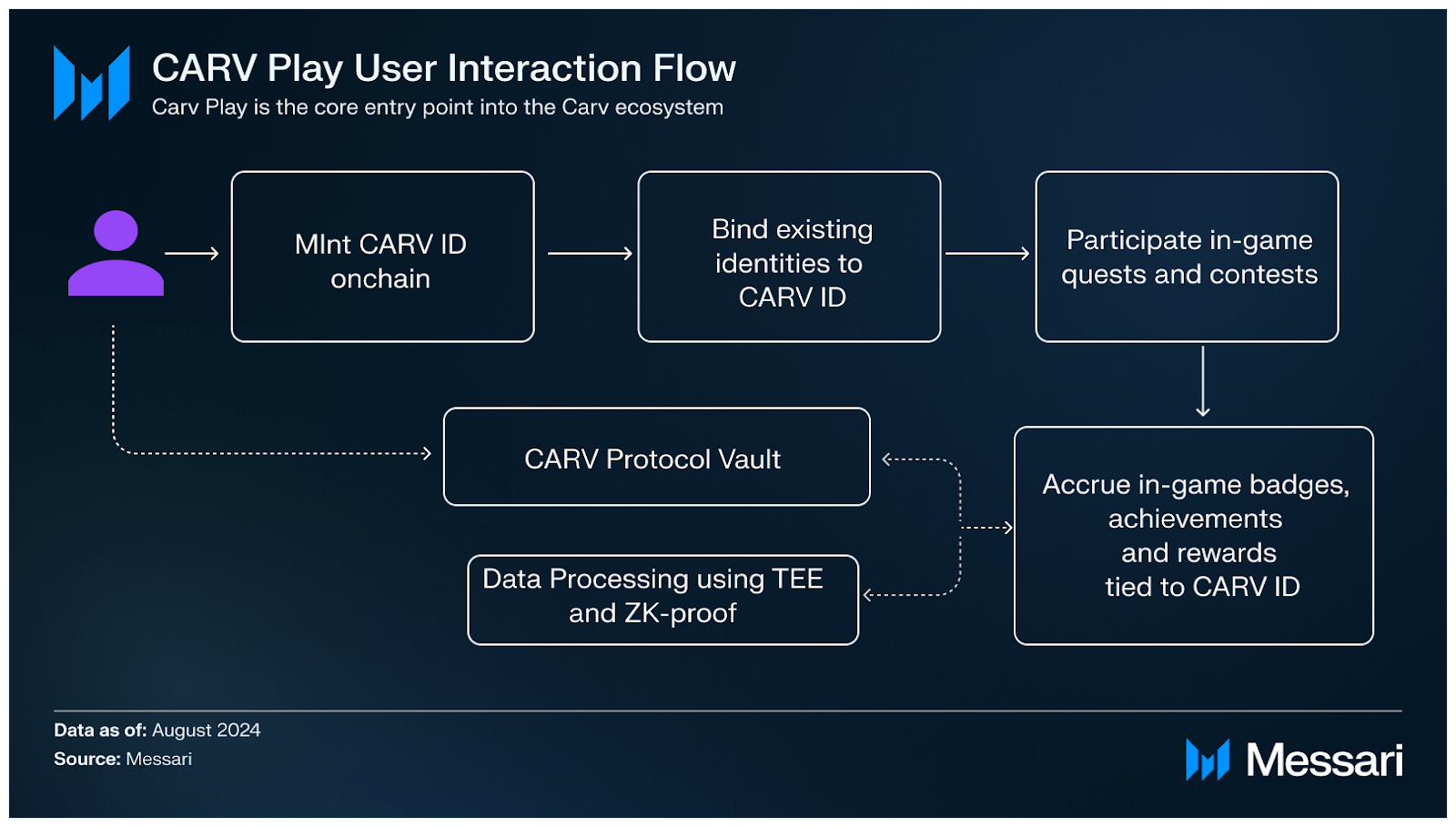
CARV Play is CARV's flagship product, a gamified mobile application powered by the CARV protocol. It streamlines the gaming experiences across Web2 and Web3 platforms into a unified, credential-based system. To interact with CARV Play, users must first mint CARV IDs onchain, which bind their Web2 and Web3 gaming identities to a single profile. Users may also acquire personalized human-readable names linked to their CARV IDs through CARV’s .play Name Service. This integration allows users to link their gaming accounts (such as Steam or Epic Games) to their CARV profile, enabling them to showcase and verify their achievements across multiple games. CARV Play offers a variety of in-game activities and quests, where users can earn rewards like GEMs (CARV Play’s in-platform currency) and credentials like Achievement Badges and Generative Archive Tokens (GATs). These badges signify a player's accomplishments and provide access to exclusive events and special rewards within the ecosystem. With over 900 gaming titles and campaigns available, CARV Play allows users to earn rewards such as USDT, in-game items, and physical goods by participating in gaming events and social activities.
CARV Portal
CARV Portal is an out-of-box tool kit for gaming partners within the CARV ecosystem, offering a centralized platform that streamlines the management of their integration with CARV Play. Carv Portal enables gaming partners and developers to acquire, onboard, and retain gamers on CARV Play while accessing insights from high-quality user data. With Carv Portal, gaming partners can seamlessly integrate their games with the CARV Protocol and manage in-game events, rewards, and player interactions. Carv Portal also allows partners to design and execute exclusive quests and events, leveraging CARV’s user base to deepen player involvement across Web2 and Web3 environments.
Additionally, CARV Portal equips gaming partners with data analytics tools to track player engagement, optimize game features, and refine reward systems based on data-driven insights. These analytics help partners deliver more engaging experiences while exploring monetization opportunities, such as selling digital assets and premium content.
CARV AI
CARV AI is an AI agent built to enhance the gaming and data management experience within the Carv ecosystem by leveraging advanced artificial intelligence tools. As a personalized AI assistant, CARV AI integrates deeply with CARV Play, offering users tailored recommendations for games, quests, and events based on gaming history and preferences. CARV AI also provides users with real-time support within games, offering tips, strategies, and in-game analytics that improve player performance and overall experience. As a core element of CARV’s AI strategy, CARV AI also supports gaming partners with data-driven insights to refine and develop more user-tailored gaming offerings.
Tokenomics
CARV protocol’s token, CARV, is scheduled for a Q4 2024 release alongside the protocol’s upcoming mainnet. Once live, the token will serve as the medium of exchange within the CARV ecosystem and be used to bootstrap participation among users ahead of the protocol’s mainnet.
Infinite Play
CARV’s Infinite Play adapts Curve Finance's model by creating a competitive, gamified system where player activity, game rewards, and token utility align. Like Curve's voting escrow and liquidity wars, Infinite Play allows players to stake tokens, vote on games, and earn rewards, integrating gameplay with governance and tying engagement to game outcomes and token value.
Currently, users who have earned Carv’s in-game rewards, called SOUL, participate in monthly Infinite Play campaigns to earn additional rewards. These campaigns allocate a prize pool, and users can earn a share by:
Staking SOUL to accrue additional yield and receive voting tickets.
Using acquired tickets to vote for featured games, influencing the allocation of the prize pool.
Earning in-game points by completing game-specific tasks.
At the end of the campaign, rewards are based on two factors: insights on gaming preferences generated from voting and actual in-game activity. Games with the highest votes receive larger portions of the prize pool, which is distributed to users who engage with those games. Players who actively vote and complete tasks earn the most from the prize pool.
To date, 486,016 players have participated in Infinite Play across three seasons, leading to over 1 million new CARV ID holders, representing around 50% of all CARV ID mints. The model appears to be effective in promoting user interaction while generating valuable data for game developers to provide more tailored offerings to users.
Infinite Play offers two key opportunities:
Serving as an advertising platform for gaming brands to reach engaged users.
Allowing users to monetize their gaming data by sharing preferences in exchange for rewards.
The veCARV model
Carv will feature a voting-escrow model where users lock CARV at a 1:1 ratio to receive veCARV, a non-transferable token. veCARV will be applied to Infinite Play, replacing SOUL and requiring users to stake veCARV to their chosen games. This system allows players to influence game development and boosts long-term ecosystem participation, driving demand for CARV through staking and rewards. For example, with SOUL, over the past three seasons, over 50% of SOUL rewards generated by users have been locked through Infinite Play staking campaigns.
The impact of Infinite Play on CARV’s tokenomics would be multifaceted. First, as players stake CARV to earn veCARV, which grants governance power, the demand for CARV increases, directly tying the token’s utility to its staking and voting functions. This system mirrors Curve’s liquidity wars, where strategic voting plays a central role in determining the flow of rewards. As a result, game developers can leverage this model to boost game visibility and engagement by timing their incentives around voting cycles, which could create additional demand for CARV. Secondly, CARV’s ecosystem benefits from the data flows generated through Infinite Play. As player data is generated through the protocol, it could provide AI training and data monetization opportunities for users and gaming brands, adding another layer of demand for CARV.
CARV will launch with a total supply of 1 billion fully released over four years. The token allocation is as follows:
Nodes & Community (50.00%) - Set aside to incentivize node participation and community engagement through various campaigns.
Founding Team & Advisors (~19.46%) - Reserved for the founding team, contributors and advisors
Early Investors (~9.25%) - Allocated to seed and early strategic investors in CARV.
Ecosystem & Treasury (9.00%) - Earmarked for the CARV community treasury
Private Fundraising (8.30%) - Allocated to Series A investors and future private investors
Liquidity (4.00%) - Will be used to seed liquidity at TGE
Node Operations
Upon mainnet launch, TEE nodes will be required to stake CARV to process data and generate attestations. Verifier nodes will also earn CARV rewards for validating TEE attestations. Specifically, up to 25% of CARV’s total token supply (half of the community allocation) will be distributed to verifier node operators over a four-year period. The emission schedule will decrease by 25% every six months, with about 50% of the tokens expected to be released in the first year. Initially, the protocol will distribute node rewards as veCARV, which will be redeemable for CARV subject to a predetermined vesting schedule.
Buyback Program
Six months after the TGE, Carv intends to launch the “Up-to-100% Buyback Program”, an initiative to reward node license holders who demonstrate long-term commitment and active participation within the CARV ecosystem. Under this program, node license holders maintaining a 70% or higher participation rate without redeeming accrued veCARV rewards would qualify. Eligible node license holders may either receive a 100% node buyback in CARV or an 80% immediate buyback in ETH.
CARV has reserved 10 million CARV from its treasury allocation to facilitate the buyback program, with a 30-day linear vesting period for eligible participants and node operators. Some bought-back nodes will be reallocated to active node operators to promote node participation. The rest will be remitted to the CARV treasury, which may be used to reward CARV stakers, node resale, or burned.
Ecosystem Growth Strategy
Data-To-Earn
Carv unveiled the Data-to-Earn model in December 2023 as part of its broader strategy to empower users to take ownership of their digital identities. Since its unveiling, the model has been rolled out through several campaigns incentivizing users to monetize their data. The campaign is centered around enabling users to earn rewards, such as the SOUL token, by participating in different data mining activities like CARV ID minting, sharing gaming data, and engaging in Web3 events. SOUL token rewards will be redeemable for the CARV token airdrop distributed at TGE. One example of the Data to Earn initiative is the "SOUL Drop" campaign, where users can earn tokens by mining personal data across multiple chains like Ronin, opBNB, zkSync, and Linea. Another notable Data-to-Earn campaign is the three-phased Infinity Play campaign that allowed users to boost their SOUL rewards and earn third-party tokens by engaging in staking and voting-based programs.
Users can also generate rewards by participating in gaming events on CARV Play or interacting with specific Web3 applications integrated into the CARV ecosystem. The program supports multichain engagement and allows daily reward mining, encouraging continuous participation. Additionally, users benefit from enhanced data privacy and control while they engage in monetization activities.
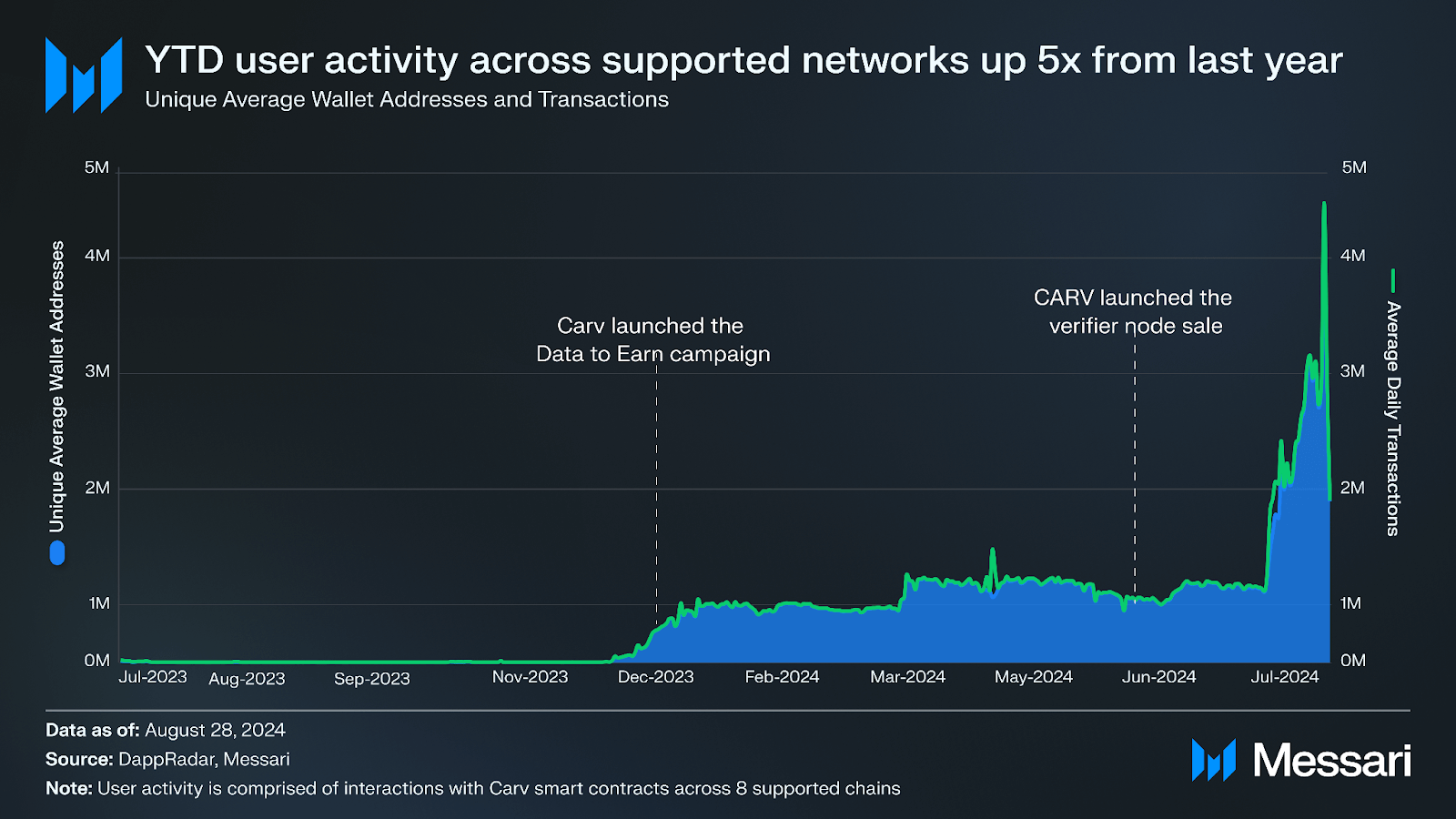
User activity measures users' interactions with the protocol’s smart contracts deployed on all supported blockchains. These interactions include CARV ID mints onchain, data mining activities for ongoing airdrop campaigns, and node license purchases. Year to date, CARV-related transactions and unique wallet addresses have surged 5x from under 1 million in early 2024 to over 5 million as of writing.
By August 2024, the ecosystem saw its average daily unique active wallets (UAW) reach 2.1 million as users engaged with CARV’s smart contracts across various chains. However, the majority of the protocol’s user activity is largely driven by CARV ID mints on opBNB, which accounts for 93% of the protocol’s transactions and unique average wallet addresses. CARV's "Data-to-Earn" initiatives may have also been a significant driver of this growth as users were incentivized through various campaigns to mint CARV IDs.
Lastly, CARV has held and continues to partner with other projects to launch airdrop campaigns in anticipation of CARV TGE. One such partnership is the BNB Airdrop Alliance with CARV. 100 million SOUL tokens were allocated for distribution within the BNB Chain’s Airdrop Alliance Program. The alliance facilitated a series of airdrop campaigns where participants could earn SOUL tokens redeemable for CARV airdrops at TGE and other rewards by completing specific tasks like minting CARV IDs.
Carv Labs
Carv Labs was launched in 2024 as part of a strategic initiative to expand the CARV ecosystem by driving mass adoption of the IDL. The $50 million accelerator aims to incubate and fund projects that leverage CARV’s modular data protocol for gaming and AI. With the new fund, Carv Labs will provide comprehensive support, including funding, infrastructure, and growth strategies, to developers building within the CARV ecosystem.
TON-based Banana Game - One of the early successes from Carv Labs is the launch of BANANA, a TON-based idle clicker game. CARV Labs released the Banana game on July 26, 2024, signaling a strategic entry into TON’s rapidly growing gaming ecosystem, particularly within the mini-app space on Telegram. Banana allows players to collect and interact with various bananas, each with unique attributes while earning rewards like USDT through in-game points (PEELs). These points can then be traded within the game’s marketplace. Since its launch, the game’s idle-play model as a mini app on TON has successfully attracted over 8 million users as of writing.
Telgather Development Partnership - In August 2024, CARV Labs partnered with Telgather to enhance the gaming experience on Telegram. This collaboration integrates the CARV protocol with Telgather’s minigame platform, creating a seamless Play-to-Earn and Social-to-Earn environment. The partnership began with the launch of Fintastic, a fishing-themed minigame on Telgather powered by CARV’s data infrastructure. It allows players to engage in endless progression, compete for real rewards, and connect with fellow gamers.
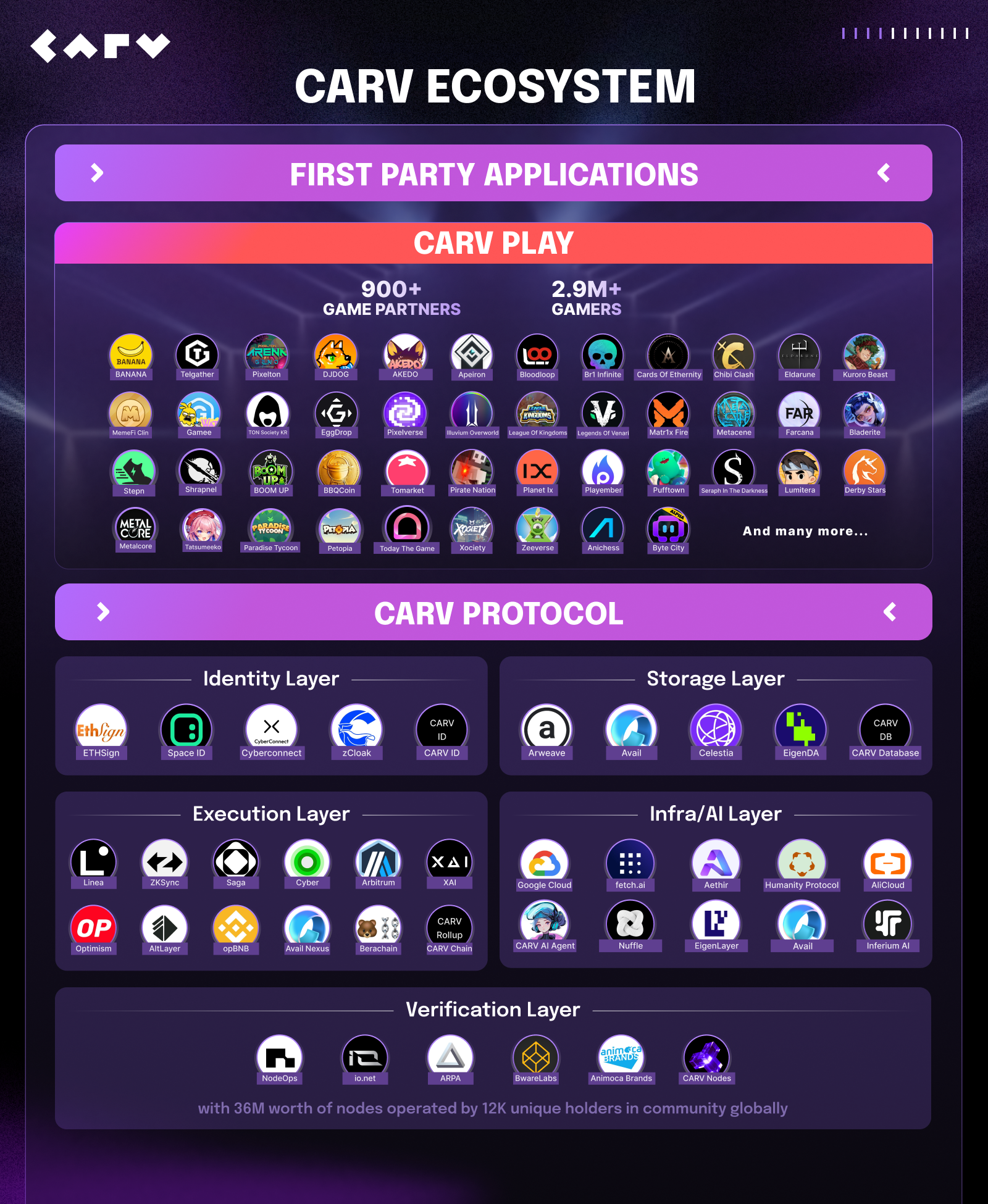
CARV is establishing itself as a critical data and identity aggregation layer for Web3 gaming and AI by forming strategic partnerships across various sectors. These collaborations are designed to bring CARV's unified identity solution to users on additional networks and beyond the Web3 ecosystem. Some of these partnerships are highlighted below:
Ronin Integrations - In January 2024, CARV announced the integration of its data infrastructure with Ronin. This integration allows CARV Play to support Ronin Wallet logins, enabling gamers to mint SBT badges and participate in CARV's Data-to-Earn campaigns on Ronin.
MarbleX Partnership - In April 2024, CARV announced a strategic partnership with MARBLEX, the blockchain gaming subsidiary of Netmarble Corp. Through this partnership, MARBLEX intends to leverage CARV’s data infrastructure to gain deeper insights into user behavior across Web2 and Web3 gaming platforms, driving higher engagement and satisfaction among gamers. Overall, the partnership could strengthen MARBLEX’s gaming offerings as CARV’s ecosystem expands.
Aethir Integration - In July 2024, CARV announced a strategic partnership with Aethir to integrate CARV’s data infrastructure with Aethir’s decentralized cloud computing network. CARV reserved dedicated verifier nodes for the Aethir community as part of the partnership and launched an airdrop campaign to incentivize user engagement, offering reciprocal rewards between both ecosystems.
Infinity Ground Partnership - In late July 2024, CARV announced a partnership with Infinity Ground, an AI-native Entertainment Appchain built on SVM Rollup, to advance gaming experiences through AI and blockchain integration. The collaboration aims to enhance data and asset interoperability within the AI gaming ecosystem, leveraging CARV’s infrastructure. This partnership will enable the development of advanced AI models that adapt in real-time, providing personalized gaming experiences while leveraging blockchain’s security and transparency.
Inferium AI Partnership - In late August 2024, CARV announced a strategic partnership with Inferium AI to drive innovation in data solutions for gaming and AI-driven applications. The collaboration will leverage CARV’s data infrastructure to enhance Inferium’s AI models, improving user insights and engagement across gaming ecosystems. This joint effort is expected to benefit both platforms, allowing Inferium to access CARV’s extensive network of gamers while enabling CARV to refine its AI data solutions and strengthen its ecosystem, driving deeper synergies between data, AI, and gaming.
Competitive Landscape
XAI
XAI operates a decentralized gaming platform focusing on self-published games. Its approach centers on building a more controlled and focused gaming environment, offering structured experiences for players. In contrast, CARV emphasizes flexibility and scalability, supporting third-party integrations and a more diverse gaming ecosystem across Web2 and Web3. While XAI's gaming scope is limited to its platform, CARV's broader infrastructure promotes deeper user engagement and participation across multiple gaming environments.
GALA
GALA is centered around a closed gaming ecosystem where all in-game assets and governance rely on the GALA token. This approach provides a unified experience for developers and players but only within the GALA platform. CARV, on the other hand, focuses on creating a more open ecosystem that supports integration across different platforms. CARV’s infrastructure allows third-party developers to seamlessly integrate their games and services, benefiting from features such as CARV ID, custom built for cross-platform interactions.
MOCA
MOCA ID is part of the Animoca Brands ecosystem, offering decentralized identity solutions that are deeply integrated with its ecosystem. MOCA excels in its ability to streamline identity management within its ecosystem, while CARV ID supports broader identity aggregation across Web2 and Web3 platforms. CARV's use of the ERC-7231 standard allows for comprehensive cross-platform data validation, enabling a seamless user experience across different gaming environments. Both MOCA and CARV focus on identity and data aggregation, but CARV’s wider scope across diverse gaming ecosystems provides more expansive opportunities for developers and players.
Roadmap
For the rest of 2024, CARV's development roadmap focuses on its upcoming mainnet release and the following key initiatives:
CARV Consensus Layer: Extending the Identity and Data Layer (IDL) by introducing decentralized sequencers and data verification through the CARV Verifier network. The verification nodes will begin verifying CARV DB, an Autonomous Virtual Storage system built on Eigenlayer, to ensure reliable data storage. In the same quarter, these nodes will also secure CARV Link, an onchain Oracle/Attestation service that imports data from both Web2 and Web3 into the CARV protocol.
Merkle Trees: Enhancing the ERC-7231 standard by incorporating Merkle trees to improve data processing efficiency and privacy protections, solidifying CARV’s position as a user-centric data infrastructure.
CARV ID Integration: Offering an on-chain database solution for instant identity integration, supporting high throughput and low-cost cross-chain communication for identity and data.
Layer 3 as a Service: Powering gaming and AI solutions as a data source, integrating CARV into applications requiring scalable, decentralized infrastructure.
Closing Summary
In roughly three years, CARV has solidified its position as an influential player in the decentralized identity and data management space, particularly within the gaming and AI sectors. The protocol enables users to control, share, and monetize their data through CARV ID. Its decentralized identity and data layer, powered by the custom ERC-7231 standard, unifies Web2 and Web3 profiles, offering a seamless user experience across platforms. With over 9.5 million users and nearly 3 million CARV IDs minted, the project continues to demonstrate growing adoption in the gaming sector. Carv Labs has contributed to this expansion with projects like the TON-based Banana Game, which has attracted over 8 million users, indicating notable traction in user engagement.
Looking ahead, Carv’s roadmap is focused on the upcoming mainnet launch and enhancements to its core infrastructure. These include the introduction of CARV DB, a decentralized data storage solution, and an expanded verification layer to improve the security and scalability of the protocol, among others. Carv Labs will continue to support ecosystem growth through its accelerator, focusing on incubating projects that utilize the CARV protocol. With these developments, Carv is positioned to advance its capabilities in identity and data aggregation across Web3 gaming and AI sectors.
This report was commissioned by GEMI Foundation All content was produced independently by the author(s) and does not necessarily reflect the opinions of Messari, Inc. or the organization that requested the report. The commissioning organization may have input on the content of the report, but Messari maintains editorial control over the final report to retain data accuracy and objectivity. Author(s) may hold cryptocurrencies named in this report. This report is meant for informational purposes only. It is not meant to serve as investment advice. You should conduct your own research and consult an independent financial, tax, or legal advisor before making any investment decisions. Past performance of any asset is not indicative of future results. Please see our Terms of Service for more information.
No part of this report may be (a) copied, photocopied, duplicated in any form by any means or (b) redistributed without the prior written consent of Messari®.
Jennifer Obem is a Research Analyst at Messari. Previously, she worked full-time as a corporate finance professional in the Nigerian fintech industry. She enjoys dissecting concepts relating to Blockchain Interoperability and Web3 Infrastructure.
Jennifer Obem is a Research Analyst at Messari. Previously, she worked full-time as a corporate finance professional in the Nigerian fintech industry. She enjoys dissecting concepts relating to Blockchain Interoperability and Web3 Infrastructure.