0G is a modular infrastructure stack for AI centered around the0G Chain. The chain coordinates payments and receipts for 0G Data Availability (DA), 0G Storage, and 0G Compute, allowing builders to source everything through a single settlement surface.
0G reports ~11,000 transactions per second (TPS) per shard with sub-second finality. The design uses multi-consensus sharding to separate workload types, isolating DA publication and compute settlement from general-purpose chain activity.
0G splits data into two layers: 0G DA for publication and 0G Storage for persistence and retrieval. Together, they target large AI artifacts that do not fit on typical L1 storage and need to remain accessible across operators.
0G Compute is a usage-metered marketplace for inference and fine-tuning that settles on 0G Chain. Providers return signed receipts for completed jobs, which standardizes payment and accounting across operators.
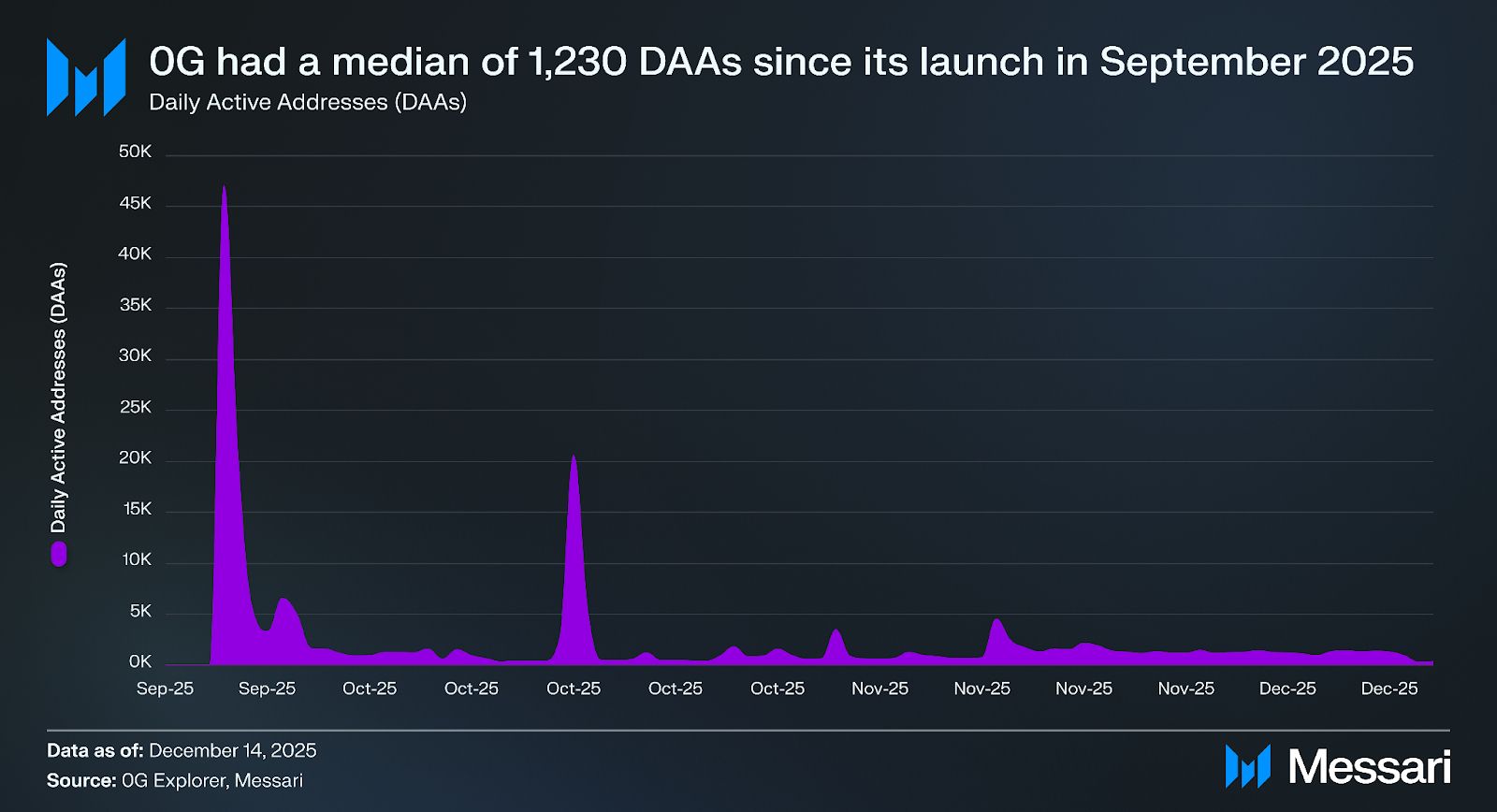
Median daily active addresses were 1,230 as of Dec. 14, 2025. Early onboarding is being supported by the $88.88 million ecosystem program and node incentives.
Introduction
AI workloads are outpacing the infrastructure that stores, serves, and verifies training data and model outputs. Historically, most production AI runs inside a single organization’s cloud, concentrating compute supply and making results difficult to audit or reproduce outside the original environment.
When AI outputs need third-party verification, the bottleneck becomes the data and execution pipeline, rather than model quality. While blockchains excel at ordering state changes, they are not designed to handle large amounts of data, maintain it at low latency, or verify what happened during offchain computation. Teams can combine data availability (DA), storage, and compute from separate vendors. In practice, reliability, billing, and trust guarantees fragment across systems. Due to this lack of integration, costs become harder to predict, which makes it difficult to price an AI feature or guarantee margins as usage scales.
0G Labs’ AI-focused Layer-1 (L1) network is a modular infrastructure stack that covers this entire pipeline, including:
An L1 for settlement (0G Chain),
A data availability layer for publishing large blobs (0G DA),
Storage for keeping data and model files available (0G Storage),
A compute network to run inference and fine-tuning (0G Compute).
Together, these components transform the AI data and execution pipeline into an integrated stack, designed to enable outputs to be served and independently verified outside a single cloud.
Background
0G is building a modular stack for AI workloads, starting with data availability (DA). Currently, AI pipelines stress systems less on compute and more on moving, serving, and verifying large volumes of data across parties. 0G’s approach is to make DA a first-class layer so availability and verification do not depend on a single provider, even when large blobs, frequent writes, and high read demand push most systems into a latency, throughput, or cost tradeoff.
0G was founded by Michael Heinrich, Thomas Yao, Ming Wu, and Fan Long. Heinrich previously founded Garten (a workplace meals startup that raised over $100 million), and later shifted attention toward Web3. Yao went into early-stage investing and was involved with Conflux, where he worked alongside cryptography-focused teams. During the pandemic, Yao reconnected with Heinrich and introduced him to Ming Wu and Fan Long (both Conflux co-founders), and the group came to the conclusion that data availability was the main bottleneck after many discussions with infrastructure players across blockchain and AI. The company originally operated as Zero Gravity Labs before rebranding as 0G.
Since its inception, 0G has shipped major network releases and expanded DA, storage, and compute participation through incentives and node distribution. Galileo (V3 testnet) replaced the Cosmos SDK with an Ethereum Engine API-based architecture that separates consensus from execution and pulls in recent Ethereum upgrades. On the ecosystem side, the Foundation launched an $88.88 million program as the primary funding channel, alongside a separate AI Alignment Node sale, which distributed license monitoring roles.
Technology
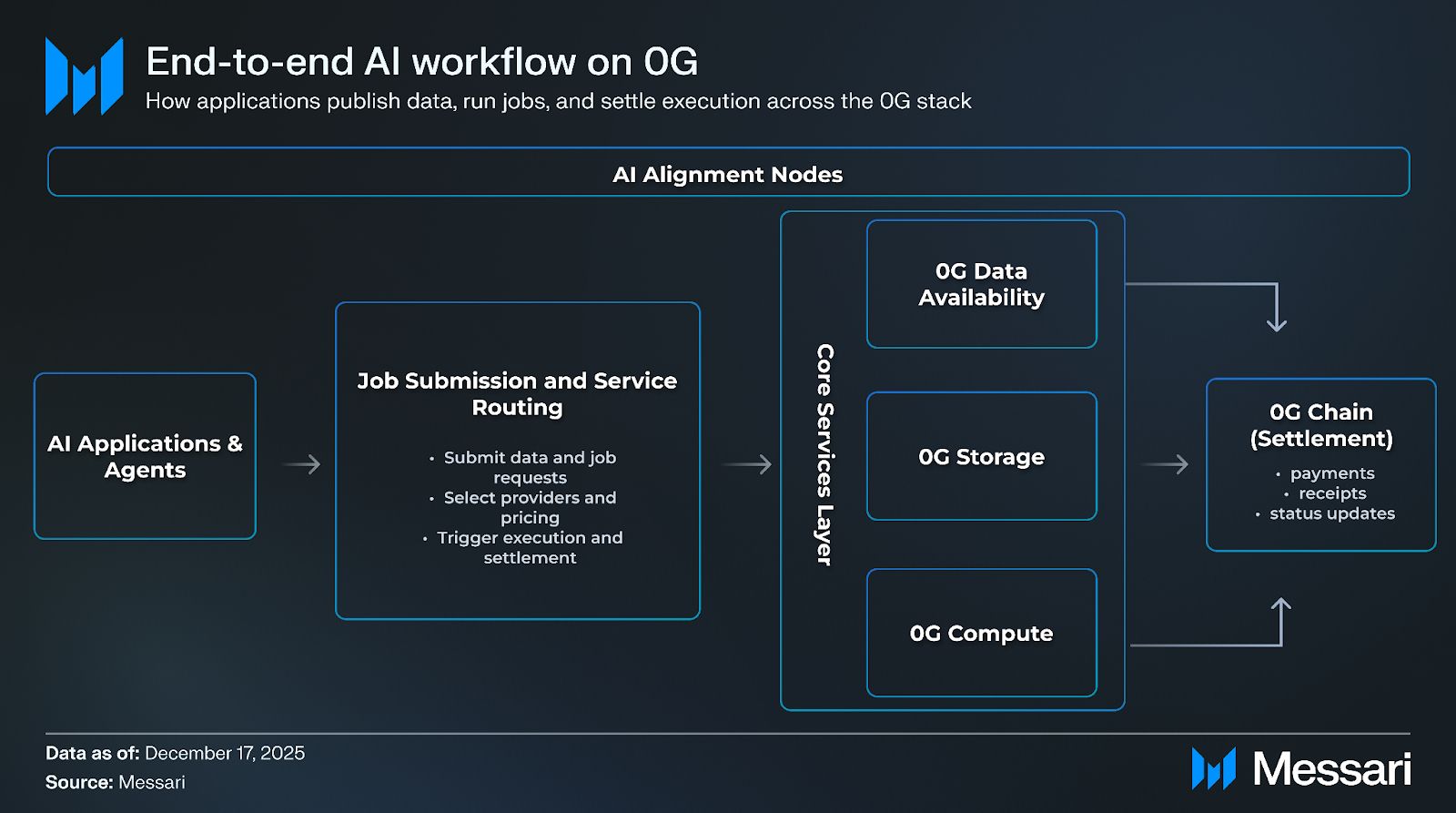
0G is a vertically integrated infrastructure stack for AI workloads, including an EVM chain for settlement, a DA layer for publishing large datasets, a storage network for data retrieval, and a compute network that facilitates inference and fine-tuning. The network’s goal is to avoid a fragmented pipeline where data publishing, storage, and compute each have their own tokens, fees, and failure modes.
In a representative flow, a user publishes a dataset to 0G DA, keeps it retrievable via 0G Storage, runs inference or fine-tuning through 0G Compute, and settles payments and receipts on 0G Chain.
0G Chain
0G Chain is the settlement layer for the infrastructure stack. 0G Chain uses an optimized version of CometBFT (formerly Tendermint) for consensus. The chain is EVM-compatible, with execution separated from consensus to support higher throughput.
The mainnet, known as Aristotle, launched on Sept. 21, 2025. 0G reports benchmark throughput of ~11,000 TPS per shard and sub-second finality via an optimized consensus mechanism with transaction parallelization. A shard can be thought of as one of several parallel lanes of 0G Chain, each processing its own set of transactions and data. Since shards run simultaneously, “TPS per shard” is the throughput of a single lane, not the total network. For 0G’s stack, this is important for spreading DA postings, compute receipts, and settlement traffic across shards to reduce congestion during heavy usage periods.
Validator eligibility is gated by both native staking and the stake registered in Symbiotic’s Ethereum contracts. Nodes can run the client without those stakes, but they do not enter the active validator set. Active validators must read the Ethereum contract’s state during operation. As a result, validator infrastructure spans two environments. 0G Chain, where blocks are produced, and transactions settle, and Ethereum, where Symbiotic contracts track staking state and validator eligibility. Users and applications can transact on 0G Chain without interacting with Symbiotic, as the Ethereum dependency is limited to validators.
0G Data Availability (0G DA)
0G DA is a publication layer for large, encoded data blobs that users can verify and retrieve when needed. Submissions typically flow through a DA client and encoder to erasure-code the payload, while retrieval can reconstruct the original data from a sufficient subset of slices. The encoding supports partial sampling and recovery, letting external verifiers confirm that data is truly available without downloading it in full. Used as a shared publication layer, 0G DA can reduce reliance on single publishers and simplify cross-provider handoffs.
All data in the 0G ecosystem is erasure-coded and split into "data chunks", commonly known as blobs. Currently, blobs on 0G have a maximum of 32,505,852 bytes (~32.5 MB) per blob. DA blobs are redundantly encoded and split into slices, which are signed by DA nodes staking 0G tokens. A blob is considered confirmed once more than two-thirds of eligible DA nodes have verified and signed their assigned slices. Ongoing sampling rewards nodes that continue to retain blob slices within each epoch window. Notably, 0G’s documentation also distinguishes DA nodes from the validator set that verifies and finalizes DA proofs.
External chains can leverage 0G DA for their batch data. For rollups, this means posting sequencer batch data to 0G DA so the chain can reference it later. Integrations with OP Stack and Arbitrum Nitro allow chains to post data to 0G DA and make data available. Inference and fine-tuning providers can also use 0G DA to publish datasets, checkpoints, or model snapshots so others can verify the data, while 0G Storage handles serving the files, and 0G Compute runs jobs.
0G Storage
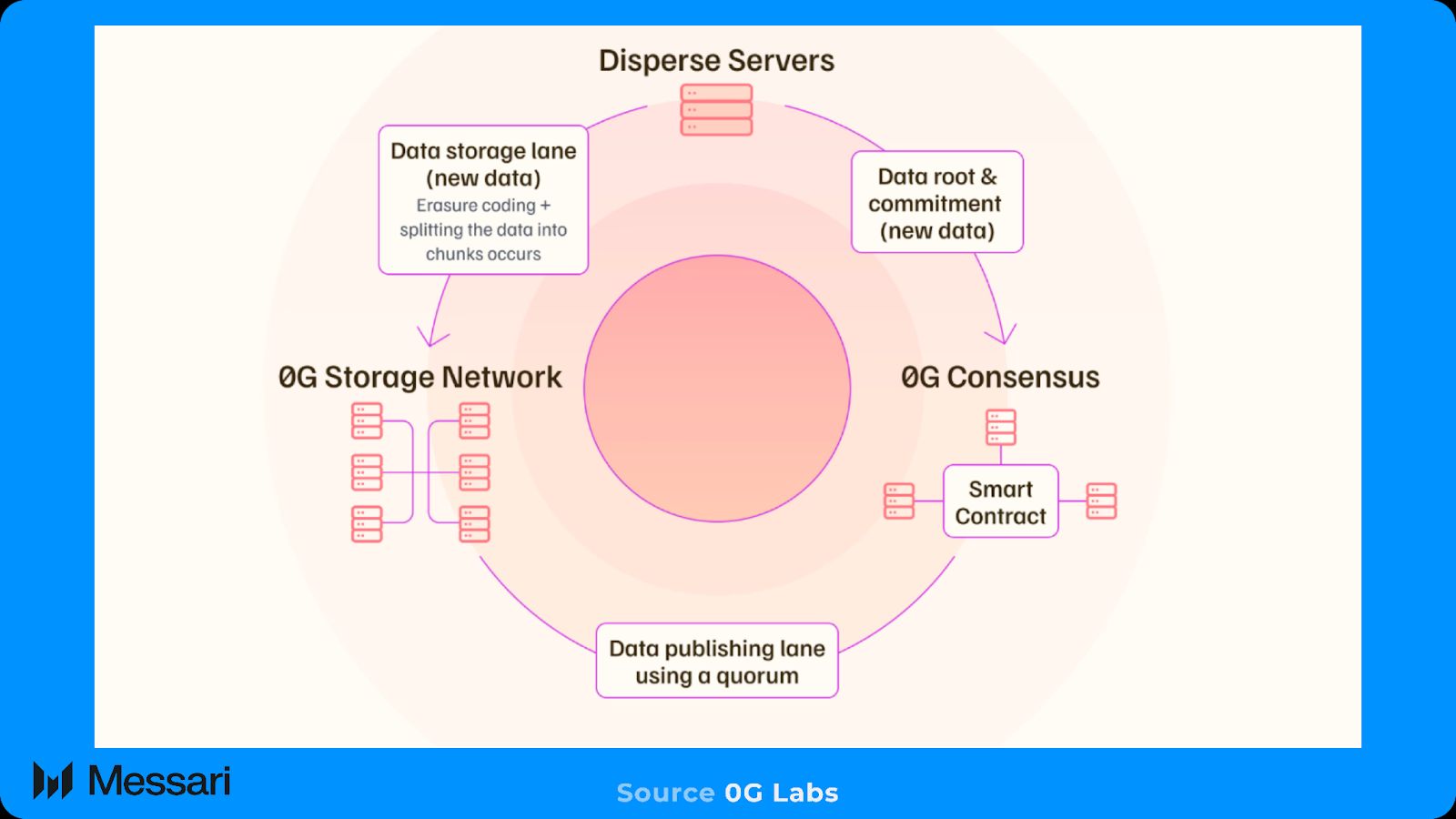
0G Storage is a distributed layer that stores and serves datasets, checkpoints, and outputs across independent providers. The system separates a data publishing lane (metadata and availability proofs) from a data storage lane (the actual data), with the publishing lane verified through 0G’s consensus network. Users use standard APIs, while the network maintains redundancy as nodes churn, and 0G claims that data remains accessible even if 30% of nodes fail. This way, pipelines can move between operators or regions without breaking state, shared datasets don’t depend on a single host, and history remains auditable and reproducible.
0G Storage exposes two storage layers. The Log Layer is append-only (immutable storage) and positioned for large, immutable files such as AI training datasets and archives. The Key-Value (KV) Layer supports mutable states with key-based retrieval for application data. Clients select storage nodes via an Indexer and identify files by a Merkle-root hash. The indexer maintains node lists (trusted and discovered) and can act as a gateway for uploads and downloads. The client can also download files via HTTP GET, by transaction sequence number, or by file Merkle root. Downloads can include a Merkle proof to verify data correctness. Storage providers are randomly challenged to prove they still hold specific pieces of stored data. Providers that respond successfully earn rewards, and the mining range is capped at 8 TB per mining operation. SDKs are available in Go and TypeScript, with starter kits and a CLI for basic operations.
Storage pricing is implemented through onchain modules. In storage contracts, a user submission can be verified by a Market contract that reverts if fees are insufficient, and fee payment can be separate from data submission, depending on the implementation. The contracts also define reward modules that can release paid fees over time and can restrict which data is eligible for mining within a defined time window.
0G Compute Network
0G Compute is a marketplace where providers run inference and fine-tuning on already-trained AI models, and in the future, it is planned to support model pre-training. The compute network is composed of (i) smart contracts for accounts, service registration, and settlement, (ii) a provider network run by GPU operators, (iii) client SDKs for request routing, and (iv) a verification layer that validates provider attestations and settlement proofs. Jobs route through contract-controlled accounts that escrow funds until service delivery, then settle based on signed provider responses and settlement proofs. 0G also describes “compressed” settlement via a proof-based mechanism intended to reduce onchain settlement overhead relative to per-request settlement.
Inference providers optimize for low latency and compatibility, while fine-tuning providers optimize for longer training runs that output new weights/adapters. In the current implementation, verification is primarily achieved when providers sign responses, and the settlement contracts validate those signed interactions and proofs. However, 0G also lists Trusted Execution Environment (TEE) support as part of its trust model for secure processing.
Users typically pre-fund an account, request an inference or fine-tuning service, receive a response from a selected provider, and then settle payment based on metered usage. For example, an application team such as an agent platform or analytics service can call a supported model endpoint (such as Llama-3 70B or a domain-tuned variant). They then send inputs, receive a signed result, and settle payment onchain. Because inference outputs can vary with hardware, software, and decoding parameters, teams that need reproducible behavior should log the provider identity, model version, and runtime parameters alongside the signed response, and treat cross-provider checks as an application-level QA step rather than a protocol guarantee. Signed responses and transparent settlement make compute auditable in the sense that a third party can verify who served a request and how the payment settled, even if they cannot deterministically re-execute the job.
Signed responses and usage-based settlement allow teams to compare providers on latency and price and switch providers without changing the application’s settlement and receipt flow. In practice, portability is highest for workflows where outputs are tolerant to small variance, or where teams standardize decoding parameters and acceptance checks. Examples of agent-driven applications in the 0G ecosystem include identity-addressable agents via SPACE ID, private data access for agents with Beacon Protocol, and consumer agents that train and serve personal models from Flashback Labs.
Notably, 0G is positioning itself as a coordination layer for DePIN-style infrastructure, especially GPU supply. In their H1 2025 update, the team mentions DePIN-style GPU and AI infrastructure projects building around 0G, including Aethir and Hyperbolic. The protocol documentation was also updated with a dedicated DePIN Providers section and provider onboarding guides aimed at bringing DePIN compute capacity onto the network.
Intelligent NFTs
0G’s Intelligent NFTs (INFTs) are NFTs meant to represent an AI agent as something that can be owned and transferred without handing over the agent’s private configuration in plaintext. The underlying standard is ERC-7857, which extends ERC-721 with support for encrypted metadata and access control tied to token ownership.
While the NFT represents the usage rights, the agent’s private configuration and state are stored as encrypted metadata that only the owner (or approved users) can decrypt. ERC-7857 adds workflows for authorized usage (granting use rights without transferring ownership) and cloning (minting a new token that references the same underlying agent metadata). AIverse, launched on Oct. 16, 2025, is a marketplace for ERC-7857 INFTs on 0G Chain where creators mint and list agent INFTs.
.0G Domains
.0G Domains are human-readable names on 0G Chain, developed with SPACE ID, and designed to resolve to EVM wallet addresses across supported chains for users and AI agents. 0G announced .0G domains on Oct. 29, 2025, and directed users to SPACE ID for registration and secondary-market listings. However, 0G’s announcement also states that broader minting will begin in Q1 2026.
These names standardize addressing and service discovery to identifiable entities, which shortens setup, reduces misroutes, and ties disputes to a specific party. In practice, users discover providers by name, apply allowlists and roles, and settle to the same named entity regardless of which chain a workflow touches. Workflows may start on another chain but still call 0G Compute, Storage, or DA, with work and payment for these services occurring on 0G Chain. The cross-chain resolution ensures consistency with the counterparty when a workflow spans multiple ecosystems. Used together, the 0G Chain and .0G Identity give DeAI participants a common surface to find each other, agree on work, and complete payment without relying on intermediaries.
For 0G, the naming layer serves as an address book for agents and services, designed to make service endpoints, payment destinations, and agent identities portable across the ecosystem. .0G identity supplies the naming needed for that routing with names resolving across chains, so permissions and payments attach to a persistent entity instead of a raw address. This reduces setup time, cuts misroutes, and ties any dispute to a specific counterparty with an auditable history.
Node Roles
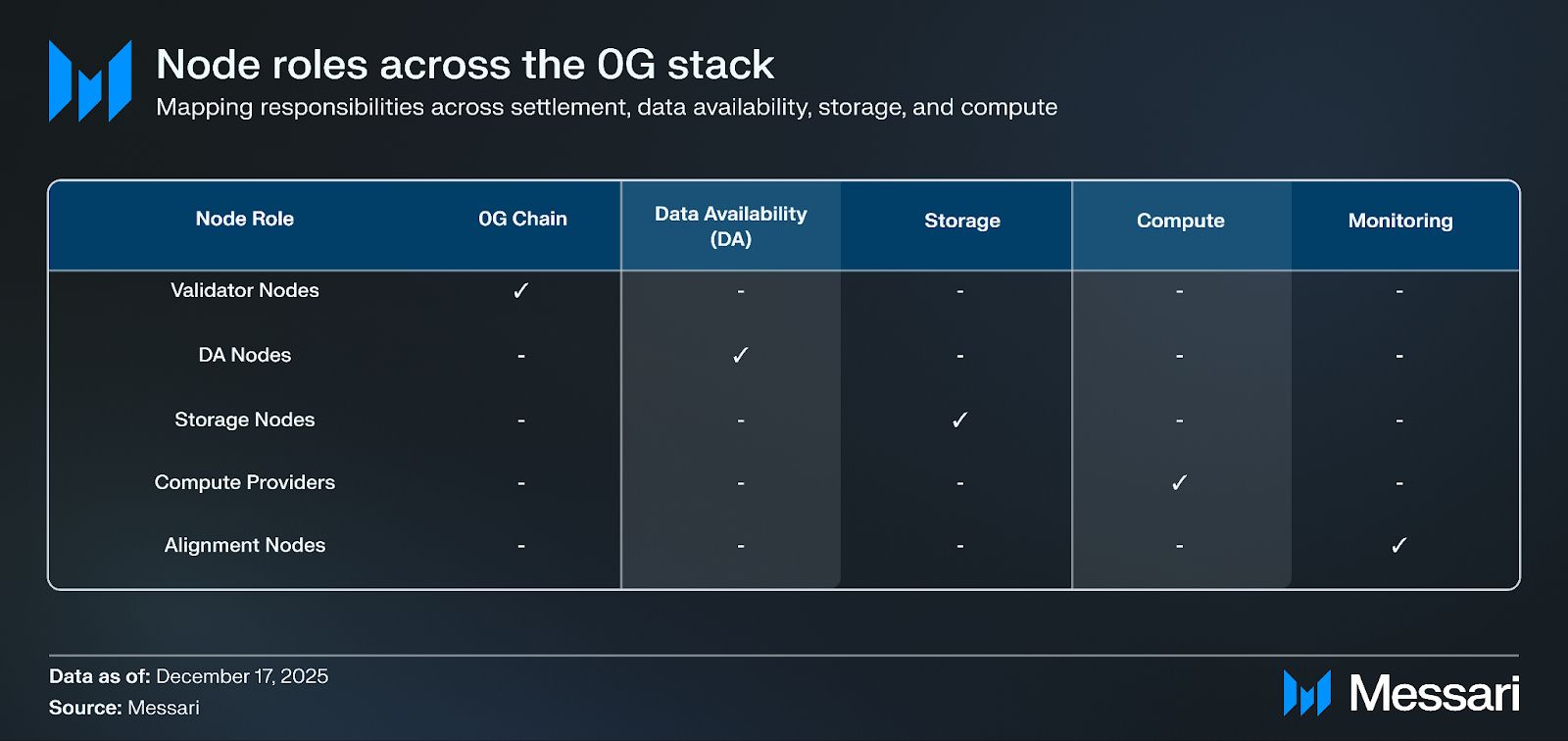
0G runs a modular stack where settlement, data availability, storage, and compute have distinct operational requirements. As a result, participation splits across specialized node roles rather than a single node type:
Validator Nodes (0G Chain): Produce blocks on 0G Chain and reach consensus. Participation is conditional on stake tracked in Symbiotic’s Ethereum contracts, and the validator setup requires access to Ethereum state (node or RPC) to read those contracts during normal operation.
Storage Nodes (0G Storage):Store and serve data for retrieval. In 0G’s design, storage providers also participate in challenge-response mechanisms (Proof of Random Access, PoRA) intended to verify that nodes continue to hold data and to route rewards toward active storage and serving.
DA Nodes (0G DA):Verify, sign, and store encoded blob slices used for data availability. DA nodes return attestations for assigned slices, which contribute to confirming the publication of blobs.
Archival Nodes: Maintain the full historical state of the chain. Their primary functions include historical analysis, compliance, and serving as a backup of the network’s complete history.
AI Alignment Nodes:A licensed node program that sits alongside validators, storage nodes, and DA nodes. License holders can run an alignment node or delegate to a Node-as-a-Service provider, and the role involves monitoring core node behavior and onchain AI activity, such as validator, storage, and DA operations.
Payment for Network Services: 0G is the payment token for work performed across 0G. Developers and end users pay with 0G tokens for core infrastructure and application-layer services. On the infrastructure side, payments cover storage of datasets, compute for fine-tuning or inference, and data availability publication and retrieval. All payments settle onchain to providers’ .0G name with metering by usage unit. For example, per 1,000 AI model tokens processed, per GPU hour, per GB stored, or per GB published. For Storage, 0G describes a one-time storage fee plus a storage endowment streamed to storage miners over time, with additional royalties tied to data serving.
Payment for Gas: 0G is the gas token for transactions on the 0G Chain. Every onchain action incurs a fee in 0G. Gas fees compensate validators for processing and recording transactions, and anchor demand for the token beyond marketplace payments. As workloads on 0G involve large artifacts or high-frequency model calls, gas pricing and throughput will be central to whether applications scale cost-effectively compared to centralized methods.
Staking: 0G secures the network through staking. Validators stake to participate in network consensus and operate the DA pipeline, while delegators can allocate stake to validators. Stake being delegated across validators raises the cost of coordinated failure. Staking rewards stem from transaction fees and ongoing block emissions drawn from the ecosystem allocation, while misbehaving validators can be slashed. The emissions are scheduled unlocks that route to the staking module and supplement fees in early mainnet, then decline over time. Managed access options allow users to delegate while retaining control of 0G tokens. Notably, AI Alignment Nodes earn from a separate reward pool and do not draw from staking emissions.
Upon mainnet launch, 0G token holders could stake or delegate, resulting in stake being spread across 63 validators as of Dec. 18, 2025, while more continue to come online and raise the bar against coordinated control or censorship. Jobs can settle through independent endpoints, block production is less likely to bottleneck at a single provider, and localized slowdowns are less likely to disrupt the network as a whole.
Tokenomics
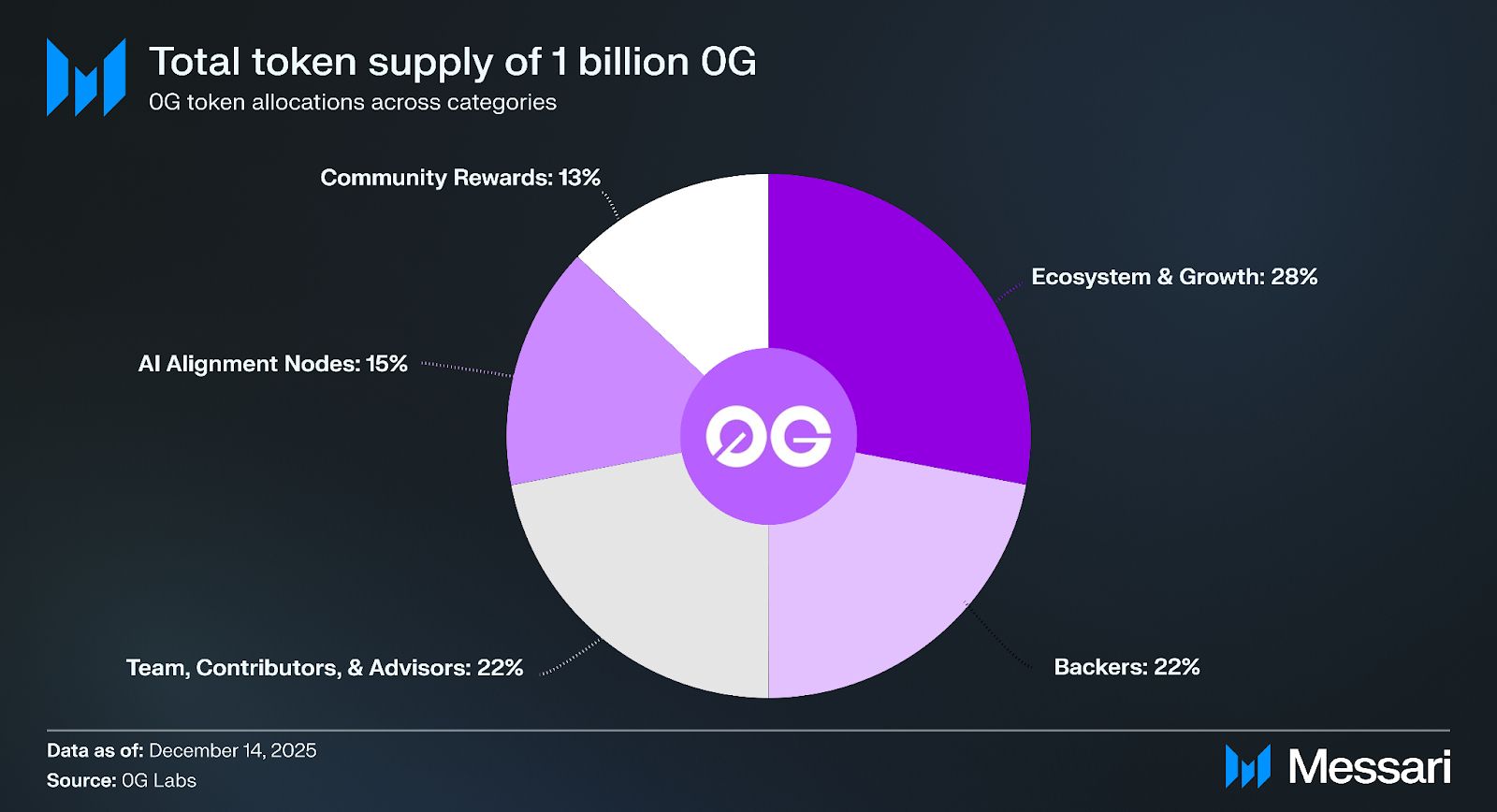
While the core team has not specified how each token allocation will be used specifically, the total supply of 1 billion 0G tokens was distributed in the following manner:
Community and ecosystem (56%)
Ecosystem Growth (28%)
AI Alignment Node (15%)
Community Rewards (13%)
Team and early backers (44%)
Team, Contributors, Advisors (22%)
Backers (22%)
0G aims to generate active participation across staking, delegation, and regular use of its compute, storage, and DA services. To grow the supply side, the core team supported testnet validators in transitioning to mainnet, added providers through managed access, and expanded Alignment Node participation through the license program. To grow the demand side, 0G is attempting to convert tokenholders into stakers, delegators, and job submitters, supporting partner apps with SDKs, and utilizing community and ecosystem allocation for incentives that target recurring workloads rather than one-off campaigns. Since mainnet launch, 0G has maintained a core base of transactors, as median daily active addresses were 1,230 as of Dec. 14, 2025.
A share of the community and ecosystem allocation funds the Ecosystem Growth Fund and the Guild on 0G program and accelerator. Incentives prioritize recurring jobs, dataset publication and retrieval, and provider onboarding over one-time campaigns.
At TGE, 21.3% of the total supply was unlocked, entirely from the community allocation, to fund Alignment Nodes, ecosystem development, and participation rewards. Team and investor allocations are locked for 12 months after TGE, followed by linear vesting over 36 months. The remaining 62% of the Community allocation vests gradually over 24 to 36 months.
The emissions schedule is intended to support long-term network usage by aligning token distribution with measurable activity. Near-term unlocks fund onboarding and early workloads. Deferred unlocks and multi-year vesting concentrate incentives on sustained contributions, such as validator uptime and performance, delegated stake participation, job submission frequency, and storage under management.
Competitive Landscape
0G competes with single-layer providers across DA, storage, and compute, and with a smaller set of bundled DeAI stacks that try to integrate two or more of those layers:
Data Availability: Providers compete on publish cost, confirmation latency, and the strength of availability guarantees for rollup batches and other large payloads. The relevant peers include dedicated DA networks (e.g., Celestia, Avail), restaking-based DA services (e.g., EigenDA), and general-purpose chains offering DA modes.
Decentralized storage: Storage networks compete on cost, retrieval performance, and durability assumptions. The relevant peers are long-term archival networks (e.g., Filecoin, Arweave) and retrieval-oriented systems that trade data retention for speed.
Decentralized compute: Compute markets compete on GPU supply, pricing, reliability, and developer experience. The closest comparables are GPU marketplaces and schedulers (e.g., Akash, Render, io.net), as well as projects attempting to make offchain GPU work verifiable.
Bundled DeAI (AI 3.0) stacks: A smaller set of projects bundles two or more of compute, storage, DA, identity, and distribution. The closest peers are Autonomys, which positions itself around permanent storage, data availability, and decoupled (EVM-compatible) execution; AIOZ, which combines a DePIN-style contributor network for AI compute and storage with its chain; and Irys, which can be thought of as a programmable data chain that pairs storage with computation.
How 0G Competes
0G differentiates itself as an integrated workflow. A team that needs to publish large datasets, keep them available, and pay for offchain execution can stay inside one coordinated system, instead of wiring together three vendors with three fee models and three operational surfaces.
That integration can win on speed of shipping, simpler accounting, and fewer failure points during production incidents. However, it can also lose if one layer underperforms. For example, teams will not adopt the bundle if they still need to route compute elsewhere or keep critical data in a different storage network.
0G’s differentiation is testable on pricing, compute verification, and service performance under load:
Pricing: Can a builder estimate the cost of a real workflow that touches DA, storage, compute, and gas, or do fees swing with congestion, incentives, and token volatility?
Proof: DA and storage provide verifiable publication and retrieval via commitments, attestations, and Merkle proofs, but compute still needs a solution for how a third party can verify a job wasn’t spoofed or tampered with. Compute can only prove who served a request and how the payment was settled. It does not, by itself, prove the provider actually ran the model correctly, so teams typically validate this by logging the model version and runtime parameters, and running periodic re-runs or cross-provider comparisons on a set of requests.
Real-World Performance: Do publish times, retrieval latency, and inference latency stay reliable at p95 as usage grows, and how do those numbers compare with both centralized clouds and top point solutions in crypto?
Risks and Challenges
0G’s biggest risk is fragmented adoption across its own stack. DA, storage, and compute reinforce each other, but they can also fail independently. A strong L1 and active DA do not guarantee sustained storage retrievals or paid compute demand. Early mainnet activity may be incentive-led, so usage needs to be monitored against repeat fee payers and paid service volume. Compute verification is another challenge that 0G is actively addressing. While there are proofs for request and payment settlement, there is no general method for proving that an output reflects correct model execution across providers. Additionally, validator security depends on Symbiotic restaking on Ethereum, adding an external dependency.
Roadmap
0G’s scaling roadmap relies on its multi-consensus design, where multiple consensus networks can run in parallel while sharing a single staking status and add shards without spinning up separate validator sets. For 0G, shared staking is the mechanism that maintains consistent security across networks while expanding throughput horizontally. On the service side, compute is expected to move from “inference-first” into broader coverage. Fine-tuning is currently documented as testnet-only, and is positioned as a future expansion of the compute marketplace, which implies larger provider capacity, stricter scheduling, and clearer verification primitives than basic inference.
The current go-to-market strategy is leveraging the $88.88 million ecosystem program and related accelerator tracks to fund teams that ship workloads (e.g., agents, apps, integrations) that repeatedly consume DA, storage, and compute.
Conclusion
0G Chain is an EVM-compatible, Layer-1 network with three service layers: 0G Data Availability (DA) for publishing large blobs, 0G Storage for persistence and retrieval, and 0G Compute for metered inference and fine-tuning. 0G Chain settles fees and receipts for these services, while validator eligibility is gated by staking 0G tokens with Symbiotic on Ethereum.
0G Chain’s Aristotle mainnet launched on Sept. 21, 2025, and the 0G token launched on Sept. 22, 2025. As of Dec. 14, 2025, 0G stake was spread across 54 validators, and the median daily active addresses on 0G Chain were 1,230. Early usage is being supported by the $88.88 million ecosystem program and Alignment Node rewards. The question in 2026 will be whether 0G can use incentives to accelerate user acquisition and partner onboarding, and then convert that into repeat workloads across DA, storage, and compute.
This report was commissioned by 0G Labs. All content was produced independently by the author(s) and does not necessarily reflect the opinions of Messari, Inc. or the organization that requested the report. The commissioning organization may have input on the content of the report, but Messari maintains editorial control over the final report to retain data accuracy and objectivity. Author(s) may hold cryptocurrencies named in this report. This report is meant for informational purposes only. It is not meant to serve as investment advice. You should conduct your own research and consult an independent financial, tax, or legal advisor before making any investment decisions. Past performance of any asset is not indicative of future results. Please see our Terms of Service for more information.
No part of this report may be (a) copied, photocopied, duplicated in any form by any means or (b) redistributed without the prior written consent of Messari®.