Trader Joe Liquidity Book: The Next Chapter in AMM Evolution

Two months ago, Trader Joe** **launched Liquidity Book, a new AMM model aiming to improve Uniswap V3’s concentrated liquidity model. On the surface, the two AMMs appear similar, but after a deeper dive the subtle differences potentially make Liquidity Book a better product for liquidity providers and traders. The two main differences between Liquidity Book and Uniswap V3 are:
1. It uses a constant sum function within a bin (equivalent to a tick in Uniswap V3).
2. It introduces a dynamic volatility fee that aims to compensate liquidity providers.
A Brief Intro to Concentrated Liquidity
In a traditional AMM model, liquidity is distributed across the entire price range [0, ∞]. This model enables liquidity providers to easily deposit liquidity within a pool and calculate simple swap projections. In general, an asset does not trade at a price of $0 and a price of $∞ simultaneously. If it does, it is likely that market manipulation is occurring. An extreme example of this would be a stablecoin liquidity pool. A stablecoin should normally trade within a relatively tight range, around $1. For theoretical purposes, let us fix this range as [0.99, 1.01]. This means that liquidity in the ranges [0, 0.99) and (1.01, ∞] is “inefficient”. Uniswap V3’s innovation allows liquidity providers to concentrate their liquidity within a fixed range, and in this case for a stablecoin liquidity pool, within a range of [0.99, 1.01].
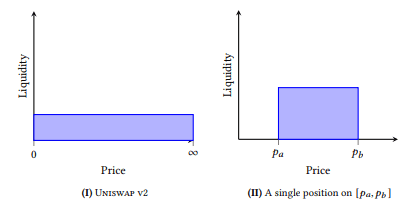
Source: Uniswap V3 Whitepaper

Ren leads coverage on Options, Structured Products, Money Markets, and AMMs. Previously worked at a crypto hedge fund managing DeFi strategies.