Three Ways to Value a Layer-1: REV, Monetary Premium, and Security Demand


Despite being one of crypto’s most prominent verticals, Layer-1 (L1) valuation remains largely unresolved. Most approaches default to comparing networks directly to one another, useful for relative positioning but insufficient for understanding what an L1 is truly worth. Recently, the conversation has picked up again with a longer-term lens: how should markets value L1s in the first place? So far, three core frameworks have emerged.
Framework 1: Real Economic Value (REV)
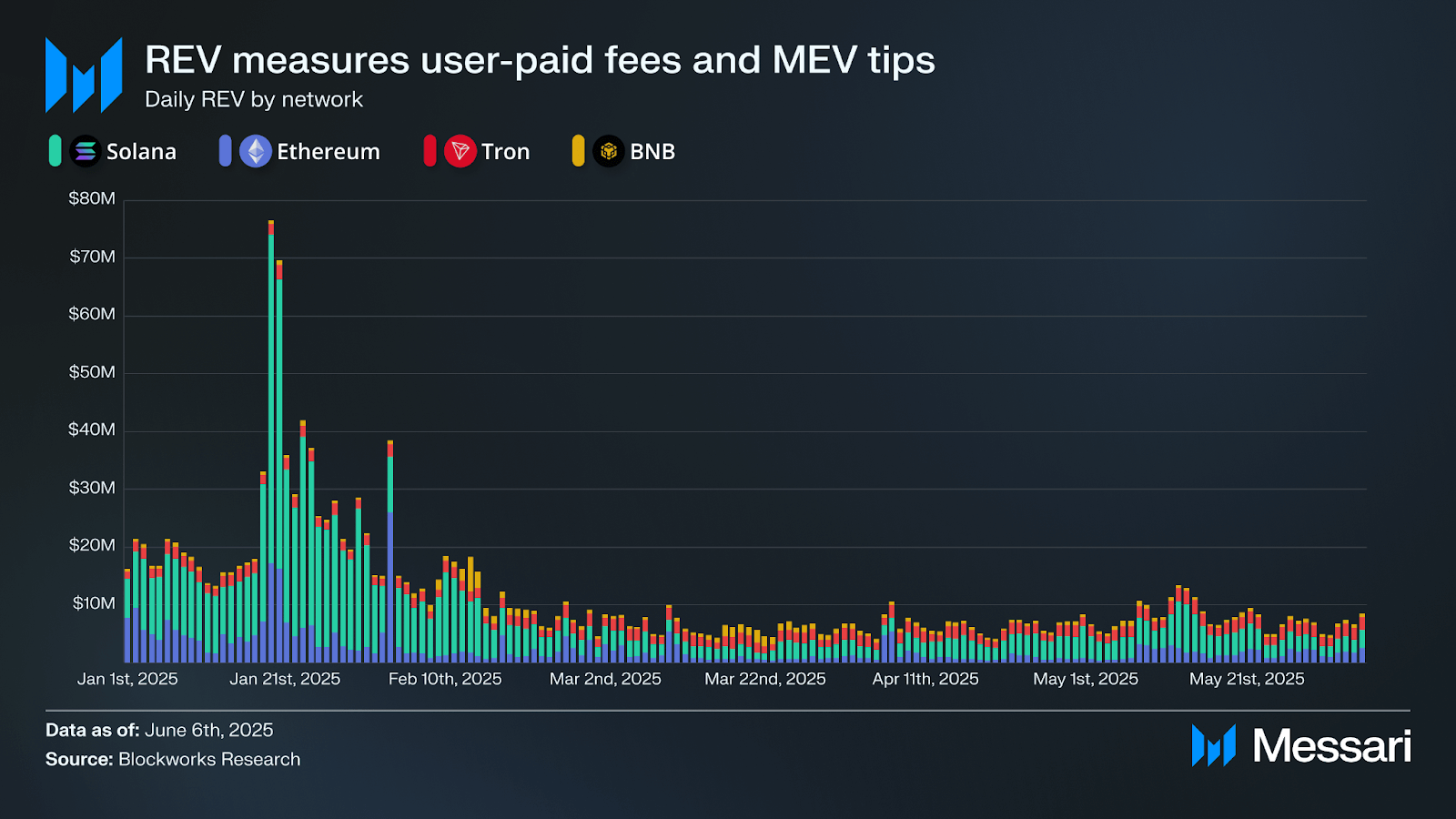
The first emerging framework is the Real Economic Value (REV) multiple. REV is typically defined as the sum of transaction fees and MEV tips. Blockworks puts it more precisely: “Network REV (Real Economic Value) is a standardized metric that tracks blockchain value accrual generated by user activity. REV consists of both in-protocol transaction fees and out-of-protocol tips that users pay for transaction execution, so it measures the monetary demand to transact onchain.”
The core idea is that REV is the closest analog to traditional cash flows, offering a concrete, quantifiable measure of network-level economic activity. Under this model, L1 tokens should trade on a multiple of expected future REV, much like equities are valued based on discounted future earnings. In this view, L1s are not fundamentally different from conventional businesses and can be assessed using familiar financial valuation tools.
Framework 2: Monetary Premium
The second framework argues that L1 tokens should command a monetary premium based on their perceived likelihood of becoming future monetary assets. In this context, the monetary premium refers to the value an asset accrues beyond its immediate utility, driven by its potential to serve as a store of value or medium of exchange over time.

Kinji formerly covered crypto at Morgan Stanley. His primary interests are DeFi, Ponzi's and unstable stablecoins.

Dylan is a Sr. Enterprise Research Analyst focusing on DePIN, DeFi, AI, and RWAs. He previously worked as a digital assets investment analyst at T. Rowe Price and in venture capital. Dylan is a graduate of Princeton University and co-founded the Princeton Blockchain Club.