Thoughts on Token Supply

This post was originally published on February 04, 2019, and sent to Messari Pro subscribers.
There are only a couple of hills I’m willing to die on in this industry. The need to fix crypto investors' misuse of the term “market cap” is one of them. For illustration of the scope and perniciousness of the problem, take this explanation from Forbes CryptoMarkets re how they calculate circulating supply:
Traditionally as a financial term, market capitalization is total supply multiplied by the price. Market capitalization measures what a company is worth as valued by the free and open market, which encapsulates the market's perception of its future prospects, because it reflects what investors are willing to pay for each “unit” whether it be a share, token, or currency. Circulation supply in crypto is typically roughly defined as the “float” in the traditional financial classification. The "float" is the number of outstanding units for trading by the general public. The free-float method of calculating market cap excludes locked-up shares, such as those held by company executives, restricted investors, governments or other entities that have clear, defined restrictions on the units preventing them from being arbitrarily released or sold. To restrict sale or trading of units, there must be clear guidelines & legal clarifications. The units cannot be arbitrarily declared “restricted.” The units could just as easily be determined “unrestricted” immediately thereafter. In order to be removed from the circulating supply or float calculations, one needs to know how long and under what circumstances do they have the opportunity to enter the float. Now, this brings us to how FCM is currently classifying XRP, and the reasons behind it: On the XRP website, and in the XRP API, three segments of XRP's supply are disclosed: escrow, undistributed and distributed. All three segments of their supply fluctuate periodically. None of these supply categories are genuinely frozen. There is no clear rules or guidelines as to what, if any, of these buckets are truly or legally restricted. Consequently, based on this, FCM is concluding (for now) that any of these buckets can be available for sale to enter free float at any given time. We are not making any speculative guesses or assumptions beyond that point, as we are actively trying not to inject “opinion” into the determination. Therefore, until we are presented clear contrary evidence, FCM will continue to include all three supply segments: escrow, undistributed and distributed in the total circulating calculation, thus XRP's circulating value on our site may be significantly larger than when compared to some other sites.
While there’s nothing flawed in the FCM logic, this post was written in reaction to our XRP supply study. So it’s noteworthy that FCM claims not to make any "speculative guesses" or “inject opinion” into their determination, as that’s basically an insinuation that “it’s too hard to figure out crypto’s equivalent of float, so f*ck it. ¯\_(ツ)_/¯” No, actually. It’s not that hard. It’s not that hard to define inputs to a liquid supply formula for a token supply curve. In fact, we’re actively trying to complete formulas for the entire asset class at Messari. Because there are really only five supply curve inputs (although each have subcomponents):
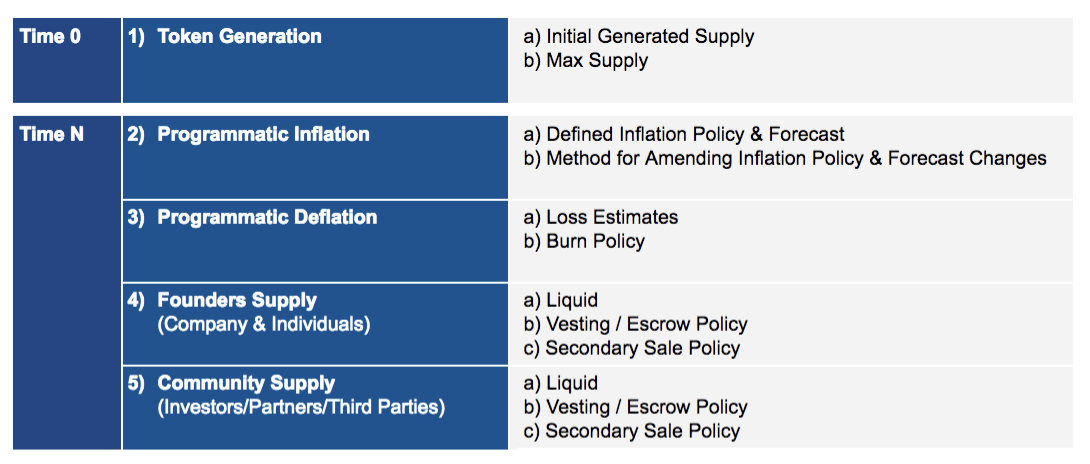
Token Generation:
Regardless of which asset we’re talking about, there’s always an initial token generation event. Whether it’s fully generated upfront or includes a predictable mining schedule, whether it’s inflationary or deflationary, whether it’s a scam or a legitimate project, every token has a genesis with an initial supply, and a prescriptive future maximum supply. For Bitcoin, total issuance was capped *at its creation* and limited to 21 million units. For XRP, 100% of the token supply was created at generation to be allocated over time. For Ethereum? Trick question of course. It didn’t have a maximum prescribed supply at genesis. Instead, the core team argued it would be inflationary for a while, and trend to “disinflationary” over time. That is, the rate of newly issued tokens would trend to zero, but the supply would be (at least technically) infinite.