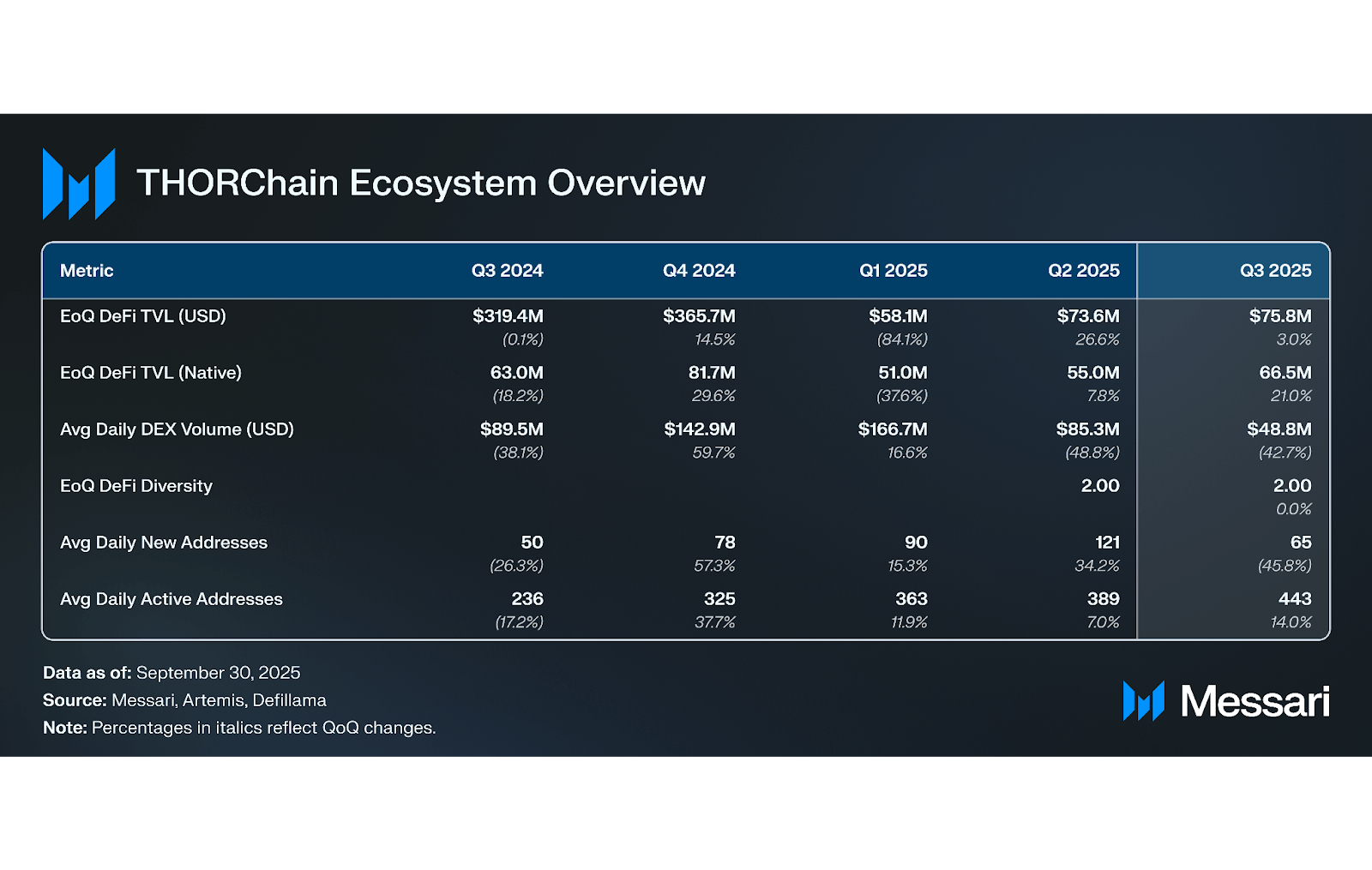
RUNE-denominated TVL rose 20.9% QoQ despite a 14.9% decline in the price of RUNE. TVL in native terms grew from 54.9M to 66.5M RUNE, signaling increased confidence in the protocol’s fundamentals and liquidity depth.
Total swap volume dropped 42.1% QoQ, but average daily unique swappers rose 16.9%, showing that more users are turning to THORChain for cross-chain swaps despite market headwinds.
THORChain added support for TRX and USDT on TRON, bringing access to $32 billion in liquidity and enabling native swaps with high-demand assets like BTC, expanding its presence in non-EVM ecosystems.
The launch of THORChain’s Enshrined Oracle enables real-time, block-by-block price feeds embedded in consensus, improving accuracy for swaps and powering future products, such as perpetuals
Upcoming Q4 priorities include memoless swaps, limit orders, integrating Solana, reducing block times, Noble USDC support, and a suite of UX and protocol enhancements that prepare THORChain for broader scaling and asset coverage.
Primer
THORChain (RUNE) is a Layer-1 (L1) network designed to facilitate cross-chain DEX swaps without the need for wrapped assets. The blockchain is developed on the Cosmos SDK and uses the BFT Tendermint consensus engine. Native assets are managed directly in onchain vaults, and funds are secured by the node’s bonding or staking RUNE.
The network employs Threshold Signature Schemes (TSS) requiring a two-thirds majority of nodes for the movement of funds to and from vaults. The average node has 929k RUNE bonded (staked) to it, which acts as a deterrent against node collusion.
THORChain uses continuous liquidity pools (CLP) where all pools are paired with RUNE and provide consistent liquidity to all assets in the network. Furthermore, fees are adjusted according to the liquidity depth of the pool. Additionally, THORChain’s Savings Product for yield on synthetic assets (synths) and Lending Product for 0% interest loans with no liquidations or expiration, were sunset in Q1 2025.
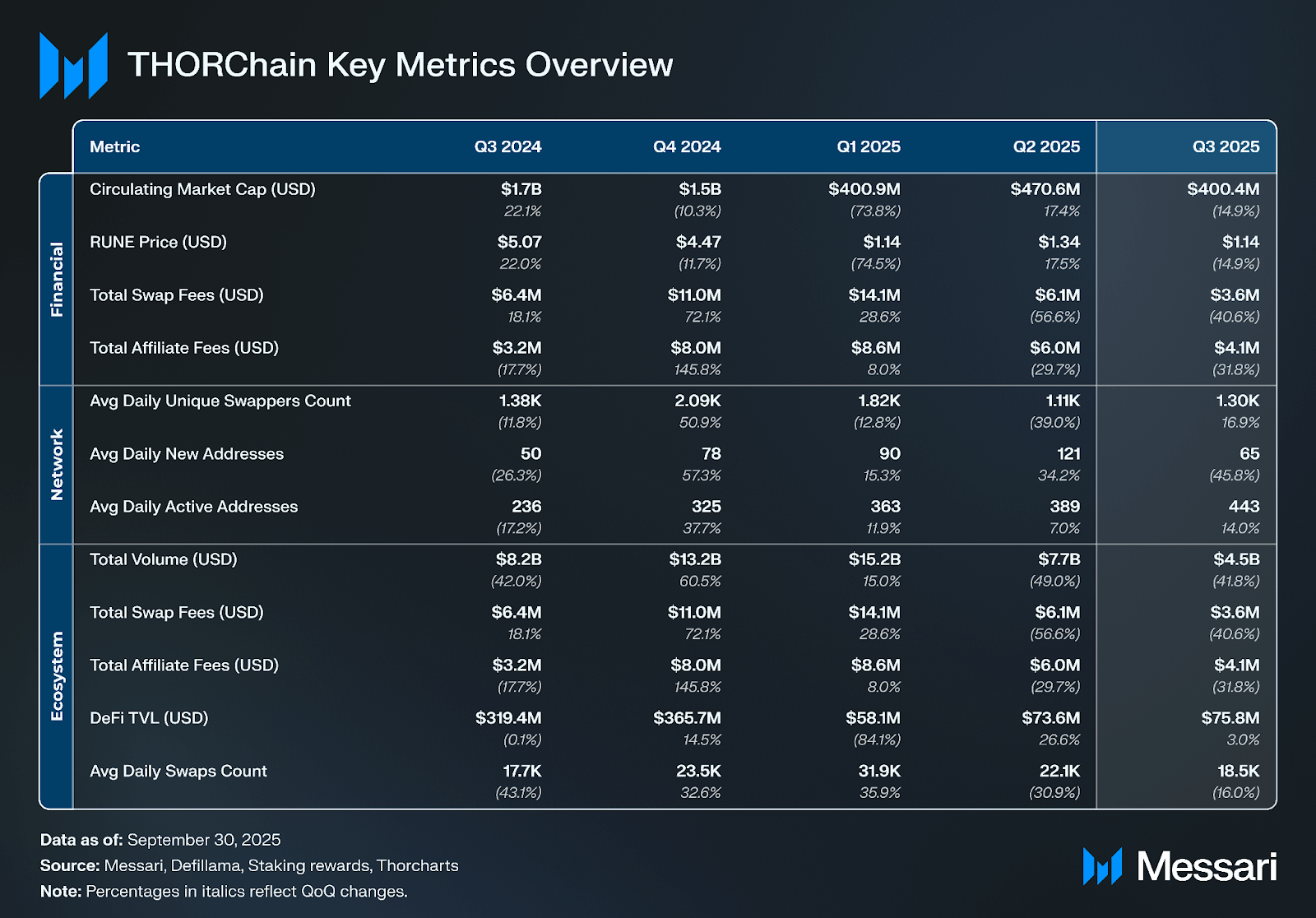
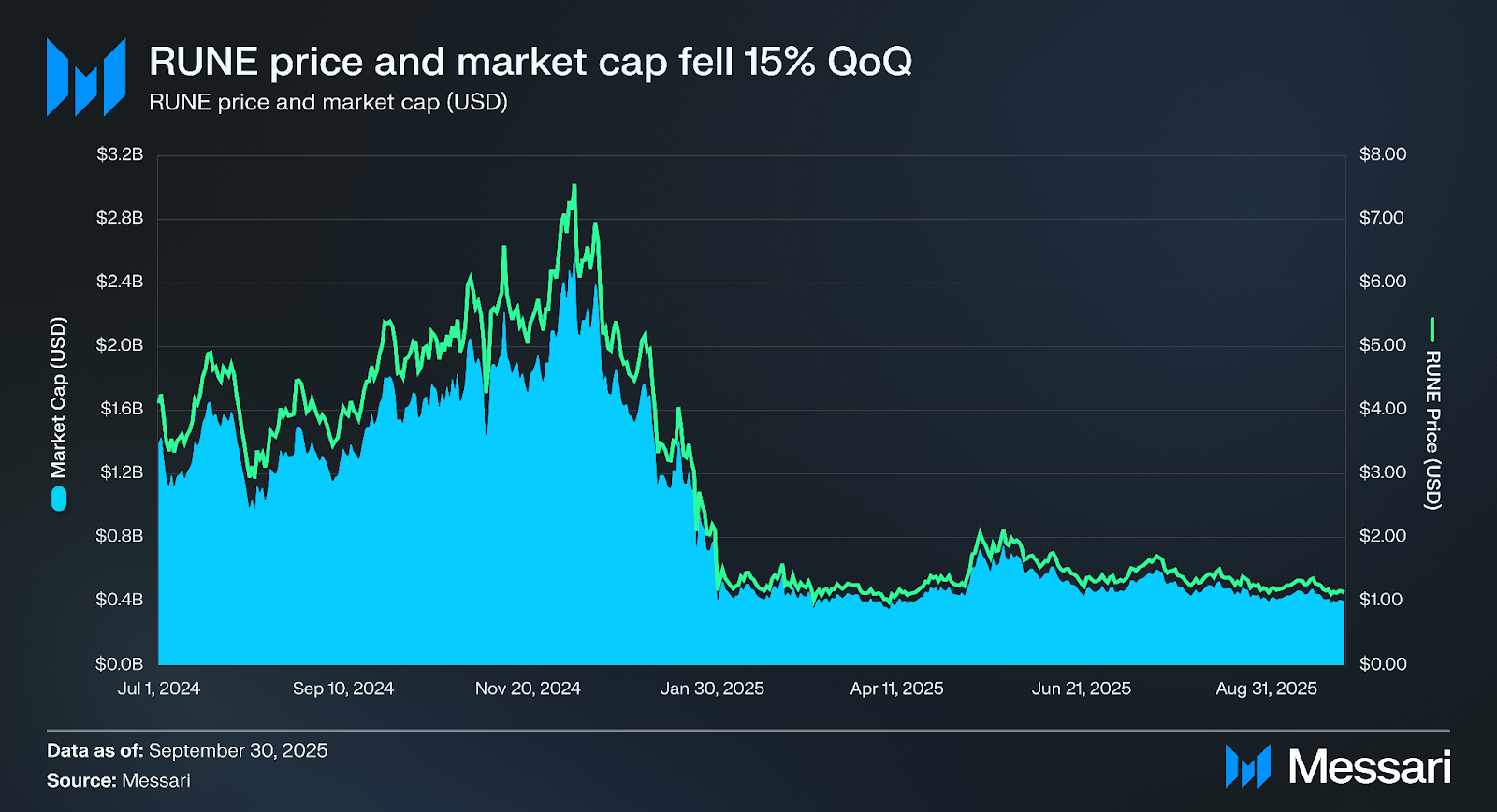
Following a rebound in Q2, THORChain’s native asset, RUNE, corrected slightly in Q3 2025. RUNE finished the quarter at $1.14, down 14.9% QoQ, underperforming BTC, which increased 8.2% in Q3. RUNE market capitalization matched the performance of price, as there was virtually no change in circulating supply, decreasing 14.9% from $470.6 million to $400.4 million. RUNE now ranks 134th among all digital assets, down from 111th in Q2.
Despite price weakness, RUNE’s circulating supply actually decreased slightly, from 351.5 million to 351.3 million RUNE, a 0.1% QoQ decrease. This decrease is attributed to THORChain’s burn mechanism, which was set to 5% of protocol revenue in November 2024. With 5% of the revenue going towards burning tokens, the RUNE token supply has been deflationary for two consecutive quarters.
Activity metrics were varied across Q3 2025, with average daily active addresses growing 14.0% QoQ from 389 to 443. In contrast, average daily new addresses fell 45.8% from 121 to 65 QoQ. Although new address creation decreased in Q3, the increase in daily active addresses shows an engaged user base that continues to interact with protocols on THORChain.
DeFi
THORChain DeFi Total Value Locked (TVL) grew for the second consecutive quarter in Q3 2025, finishing the quarter at $75.8 million, up 3.0% QoQ from $73.6 million. Although relatively small, this increase is more significant when the RUNE price is taken into account, which fell 14.9% QoQ. This is illustrated clearly when examining RUNE-denominated TVL, which increased 20.9% from 54.9 million to 66.5 million RUNE.
The growth in RUNE-denominated TVL, amid declining token prices, points to long-term confidence in the protocol's fundamentals and the utility of THORChain’s cross-chain capabilities.
Swap Volume
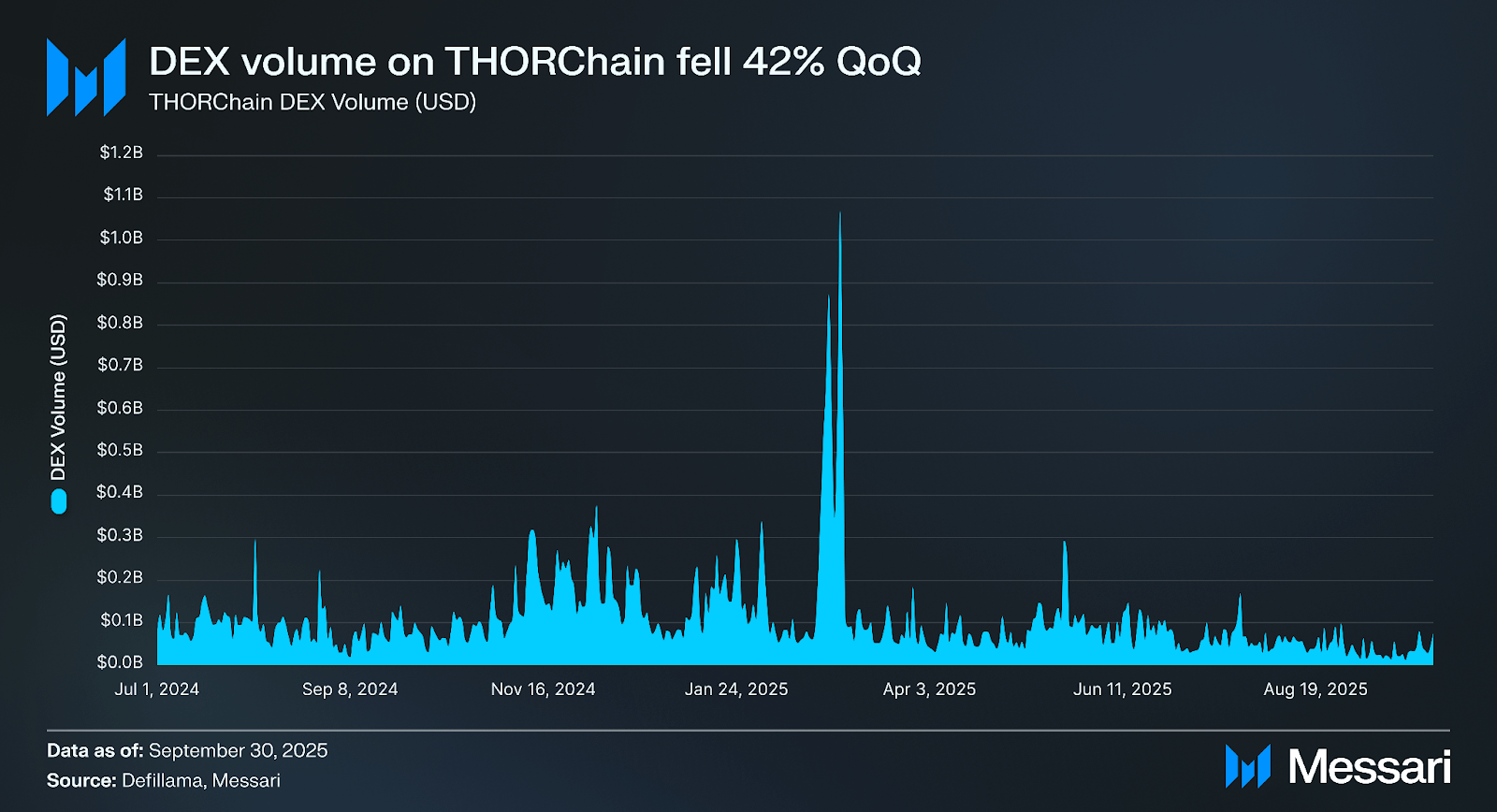
Q3 2025 marked the second quarter of decreased swap volume following a record high $15.00 billion in volume in Q1 due to bad actors using THORChain to swap ETH for BTC following the exploit of the Bybit exchange.
Total swap volume fell 42.1% in Q3 from $7.76 billion to $4.49 billion QoQ. Q3 averaged $48.8 million in daily volume, compared to $85.3 million in Q2. The number of daily average swaps showed a similar trend, decreasing 16.0% QoQ from 22,100 to 18,500.
However, despite the decrease in dollar-denominated and usage volume, average daily unique swappers showed a significant increase, rising from 1,100 to 1,332, a 16.9% increase QoQ. The growth in unique addresses utilizing THORChain for swaps reflects the protocol’s continued role as a backend settlement layer for multichain swaps, even in the aftermath of the Bybit exploit and weakness in RUNE’s price.
Protocol Revenue
THORChain makes fee revenue from every cross-chain swap and transfer that utilizes the protocol. Those fees are distributed in the following way:
75% - Nodes and liquidity providers. This breakdown is further determined by the Incentive Pendulum.
10% - TCY holders
5% - Marketing
5% - Developer Fund
5% - Burned
The Incentive Pendulum is THORChain’s dynamic mechanism that shifts rewards between node operators and liquidity providers to maintain a healthy 2:1 bond-to-stake ratio. When the network leans too far toward either excess security or excess liquidity, rewards are rebalanced to restore equilibrium and protect protocol efficiency and safety.
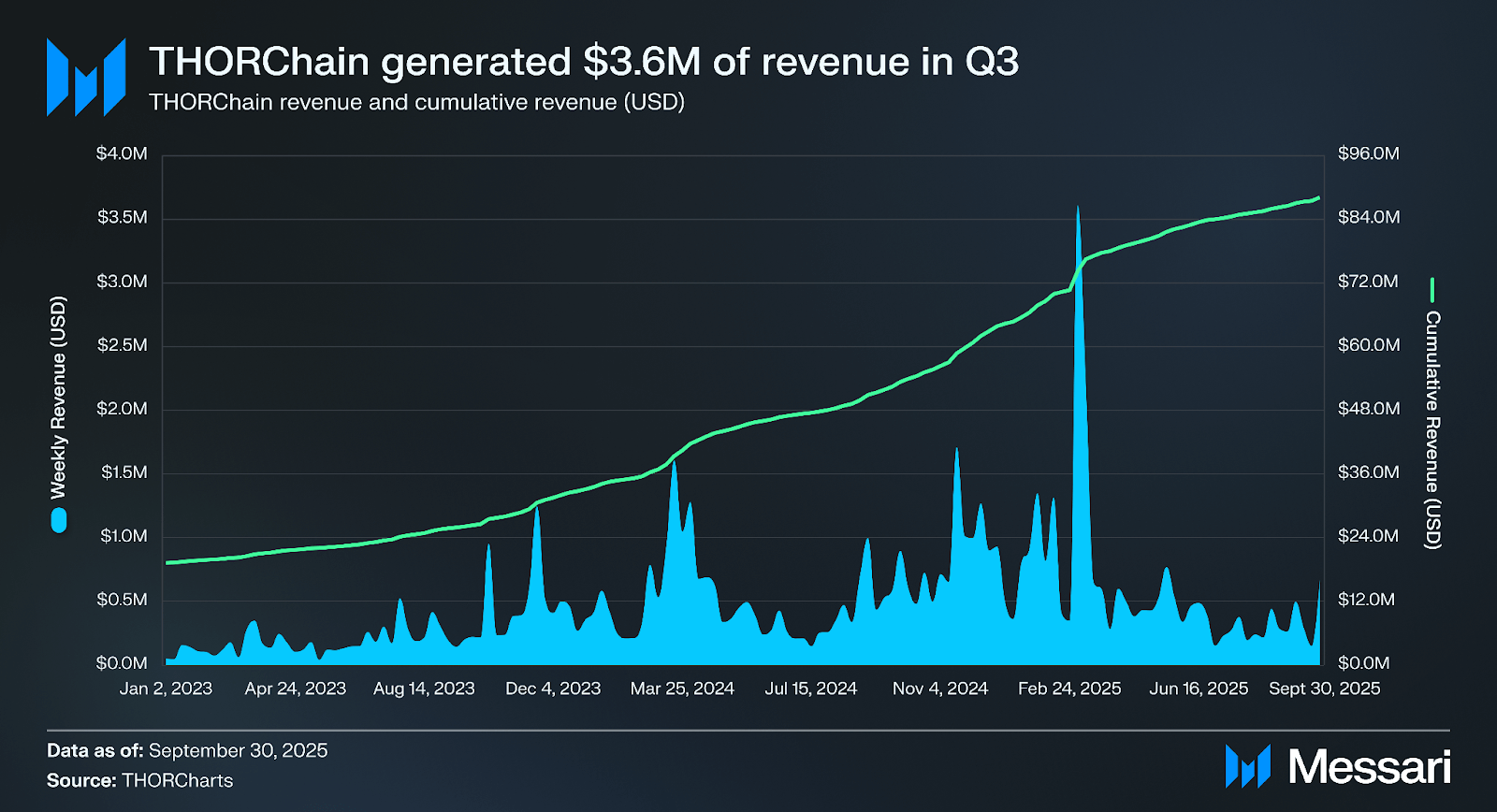
In Q3, THORChain generated $3.6 million in protocol revenue, bringing its cumulative earnings to $88.1 million. Over the past 12 months, the network has earned $35.7 million, reflecting strong fee capture from sustained onchain activity despite market volatility. Based on its Q3 closing market capitalization of $400.4 million, THORChain has a trailing P/E ratio of 11.21, a relatively low multiple that may indicate undervaluation compared to traditional and crypto-native infrastructure projects.
Affiliate Revenue
THORChain users typically interact with interfaces to broadcast transactions, rather than directly engaging with THORNodes. To incentivize these integrations, THORChain allows wallet developers to include an affiliate address and a custom fee rate ranging from 0-1,000 basis points. The protocol collects these affiliate fees on every transaction processed and sends them to the affiliate address in a non-custodial and transparent manner. These affiliate fees are not included in the protocol's revenue; they are separate and distinct.
THORChain affiliate revenue dropped for the second consecutive quarter, falling 31.8% QoQ from $6.0 million to $4.1 million. This was due to a 51.3% decrease in total affiliate swap volume, from $2.52 billion in Q2 to $1.23 billion in Q3. Although volume and revenue decreased, THORChain’s affiliate model still provides significant incentivization for external protocols to integrate swaps.
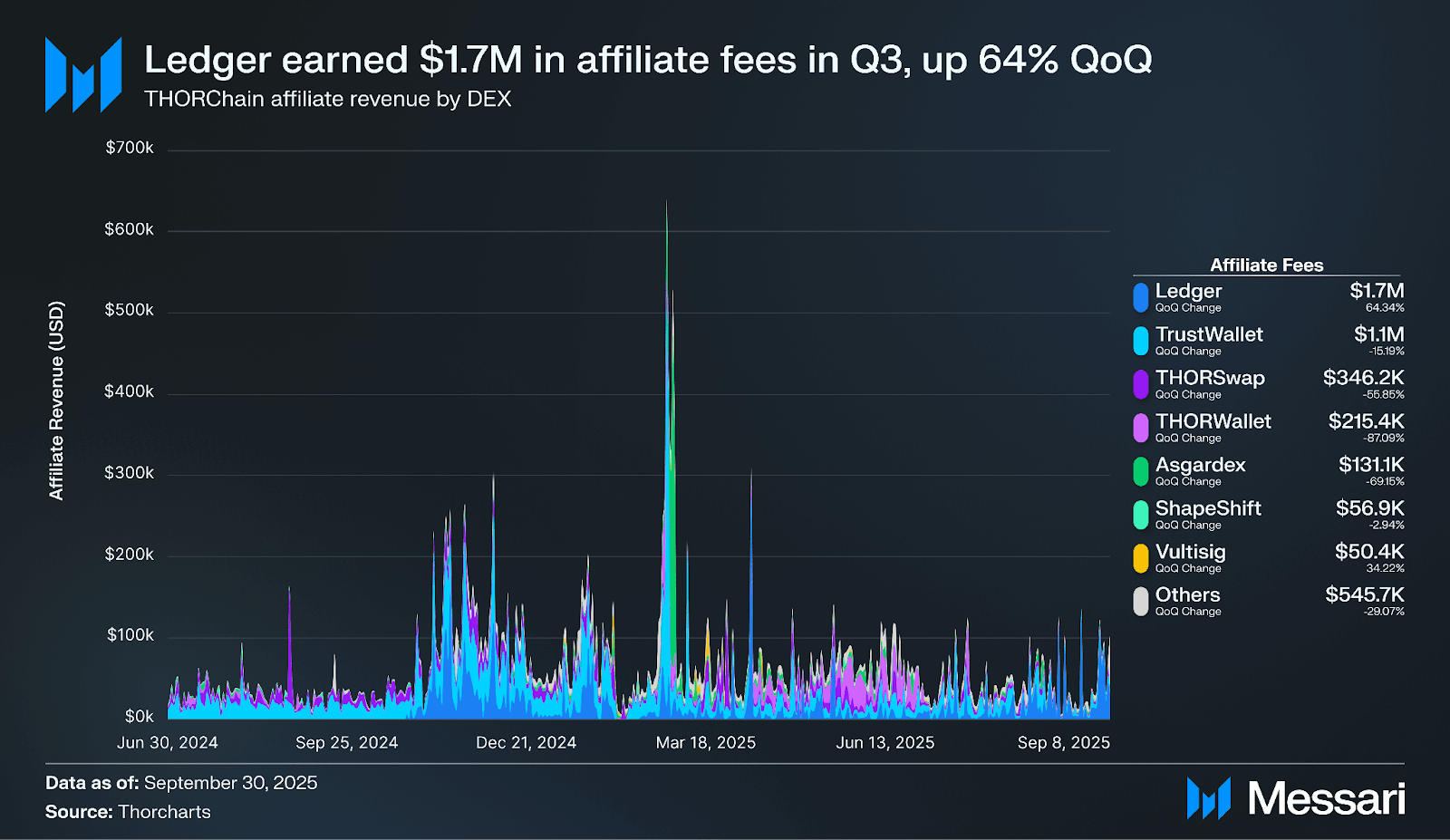
When broken down by affiliate, Ledger led in fee revenue with $1.7 million, up 64.3% from $1.0 million in Q2. Although Ledger integrated THORChain directly into Ledger Live in October 2022, Q3 marked the first quarter in which Ledger led all affiliates by fee revenue. TrustWallet also brought in significant revenue in Q3, with $1.1 million in fees, down 15.2% QoQ. THORSwap, THORWallet, and Asgardex all saw significant decreases in fee revenue, falling 55.9%, 87.1%, and 69.2% QoQ, respectively. Although relatively small in comparison, Vultisig saw a 34.2% increase in affiliate revenue in Q3, up from $37,503 in Q2 to $50,449 in Q3.
Q3 Developments
TRON Integration Expands THORChain’s Liquidity and Reach
In Q3 2025, THORChain completed its integration of TRON, unlocking native cross-chain swaps for TRX and USDT directly within the protocol. This milestone brings over $32.24 billion in TRX liquidity into THORChain’s decentralized liquidity network, significantly expanding its footprint across high-volume, non-EVM ecosystems.
TRON is one of the most transacted blockchains globally, processing over 2,000 transactions per second and serving as the home of the largest circulating supply of USDT. With the addition of TRON, THORChain now supports direct, onchain swaps between assets, such as native Bitcoin and TRON-based USDT, opening up some of the most in-demand trading routes in crypto.
This integration also introduced new liquidity pools for TRX and USDT, enabling LPs to earn yield on TRON-native assets and further deepening the protocol’s multichain utility. From a technical standpoint, the integration required core improvements to THORNode’s chain client logic, merged inMR #3913, ensuring seamless support for TRON's UTXO model and token standards.
THORChain Launches Enshrined Oracle for Accurate Onchain Pricing
In Q3 2025, THORChain deployed its Enshrined Oracle, a native price feed system integrated directly into the protocol via the Bifrost gossip layer. This upgrade replaces reliance on external oracles and introduces a decentralized, protocol-level mechanism for sourcing and broadcasting real-time USD-denominated prices.
The system aggregates data from a diverse set of price providers, each of which polls centralized exchanges for live asset prices. These feeds are combined into a unified USD rate per asset, which is then gossiped across the network every second. Each new block proposal includes the most recent prices as a single, batched transaction, ensuring fast and synchronized pricing across the protocol. Prices are valid for only one block, minimizing the opportunity for manipulation.
This oracle is enshrined, meaning it’s an embedded part of THORChain’s consensus logic, not a third-party dependency. The data is used not only for internal pricing but also for applications like Rujira, which will leverage the oracle for upcoming perpetuals and derivatives markets, where accurate and tamper-resistant pricing is critical.
Q4 2025 Roadmap: Performance, Chain Expansion, and UX Upgrades
THORChain’s Q4 development roadmap emphasizes performance upgrades, chain expansion, and developer flexibility, laying the groundwork for faster settlement, broader asset support, and more efficient infrastructure.
The most immediate priority is memoless swaps. Memoless swaps enable any wallet worldwide to swap BTC, ETH, XRP, BNB, TRON, DOGE, BCH, LTC, AVAX, and ATOM without needing to connect the wallet to a website.
Limit orders are next. Users will be able to place a limit order on any trading pair that exists on THORChain. This feature is expected to increase the market depth on the network and improve price discovery in the liquidity pools.
The mainnet rollout of Solana is now possible following the addition of support for EdDSA signatures. This will unlock native swaps for SOL and SPL assets, connecting THORChain to one of the highest-throughput chains in crypto. Additional chains under active consideration include TON, Sui, Cardano, and Arbitrum, with node operators encouraged to signal support as scaling continues.
To prepare for increased throughput, THORChain is targeting a major performance milestone: reducing block times from 6 seconds to 2 seconds. While approved and production-ready, this change will be implemented after higher-priority rollouts, given its complexity and impact on chain stability.
On the stablecoin front, integration of Noble USDC (NOBLE.USDC) is in progress. As Circle’s native issuance on Cosmos, this upgrade enables pools to accept canonical USDC without bridge risk, strengthening TOR redemptions and stablecoin-backed features across App Layer protocols like Rujira.
Under-the-hood improvements are also being made to THORNode architecture. A key change is the introduction of opt-in chain clients, which allow only a subset of nodes to support specific chains. This reduces the operational burden on node operators and allows the protocol to scale more flexibly, though at the cost of reduced redundancy for less-supported chains.
To address long-tail asset support, THORChain is developing intent-based markets. This enables liquidity providers to facilitate swaps for assets outside of traditional pools, utilizing third-party pricing while still generating protocol fees. The approach boosts asset coverage without bloating the RUNE-paired CLP model.
Several UX-focused upgrades are also in flight:
Custom affiliate payout thresholds, giving integrators more control over when and how they receive rewards.
Router V6, a stateless EVM router that improves gas efficiency and supports smart contract wallets like Safe.
Rapid Swaps will enable swaps to be crossed with each other, rather than settling independently.
Outbound memo removal, a gas and space saving optimization that eliminates redundant memo data on outbound transactions.
Finally, work is underway to upgrade THORChain’s cryptography from GG-20 to DKLS threshold signatures. This change will improve signing performance, increase churn reliability, and reduce costs by enabling fewer, more secure Asgard vaults.
Closing Summary
Q3 2025 was a transitional quarter for THORChain, marked by declining headline volumes but significant growth in protocol utility and infrastructure. While swap volume and affiliate revenue declined, key indicators such as RUNE-denominated TVL and unique swappers increased, indicating a rise in user commitment despite price pressure.
Major protocol advancements went live, including the TRON integration and the launch of the Enshrined Oracle, both of which expand THORChain’s reach and resilience. With Solana integration, faster block times, and stablecoin upgrades on deck for Q4, THORChain is positioning itself to scale across chains, assets, and use cases, focusing on performance, developer flexibility, and long-term sustainability.
This report was commissioned by THORChain. All content was produced independently by the author(s) and does not necessarily reflect the opinions of Messari, Inc. or the organization that requested the report. The commissioning organization may have input on the content of the report, but Messari maintains editorial control over the final report to retain data accuracy and objectivity. Author(s) may hold cryptocurrencies named in this report. This report is meant for informational purposes only. It is not meant to serve as investment advice. You should conduct your own research and consult an independent financial, tax, or legal advisor before making any investment decisions. Past performance of any asset is not indicative of future results. Please see our Terms of Service for more information.
No part of this report may be (a) copied, photocopied, duplicated in any form by any means or (b) redistributed without the prior written consent of Messari®.
Drexel is a Research Manager at Messari for the Protocol Reporting team with a focus on base layers and DeFi. He is a strong follower of the crypto mullet thesis of diligence in the front and degen in the back.
Drexel is a Research Manager at Messari for the Protocol Reporting team with a focus on base layers and DeFi. He is a strong follower of the crypto mullet thesis of diligence in the front and degen in the back.