The State of Open Marketplaces

This post was originally published on September 12, 2019, and sent to Messari Pro subscribers.
“Money […] grants four freedoms: You are free to buy what you want, from whom you want, when you want, and can accept or reject the conditions under which you buy.” – The Sociology of Money (Wayne Baker and Jason Jimerson, 1992)
Bitcoin and other digital currencies were created with the intent to confer absolute financial sovereignty on their users. But a crucial complement to censorship-resistant monies is censorship resistant marketplaces - after all, money needs to be spent. One of the most iconic pioneering attempts at an open market place was the Silk Road. Launched in early 2011, Silk Road infamously hosted markets for almost anything you could imagine, most including drugs and other illegal goods. The party ended in 2013 when the FBI took advantage of the Silk Road’s centralized infrastructure, arresting founder Ross Ulbricht, and shuttering the site. Dozens of imitations cropped up afterward, but the teams running these sites on centralized services have consistently watched government agencies swoop in to shut them down and (often) arrest their founders and major market participants. Many of these markets have gained the reputation of being seedy due to the illegal goods sold on them, but there are plenty of reasons that open marketplaces should and arguably must exist. Allowing users to freely transact removes the need for middlemen that can charge fees or block access to platforms. Today, an artisan in Cuba is unable to sell goods on eBay, solely because the U.S. government prevents it. Peer-to-peer marketplaces could change that. Today, the digital asset industry hosts a plethora of decentralized open marketplaces. Let’s take a look at some of the big ones...
Particl
Particl launched its open marketplace most recently - in August 2019 - with a focus on complete transactional decentralization. The marketplace is built on the Particl blockchain, a codebase fork of Bitcoin focused on base-layer privacy enhancements. Currently, the Particl marketplace supports $PART, the Particl blockchain’s native asset, but the team plans for the marketplace to serve as the first of many privacy-focused dapps built on the Particl blockchain.
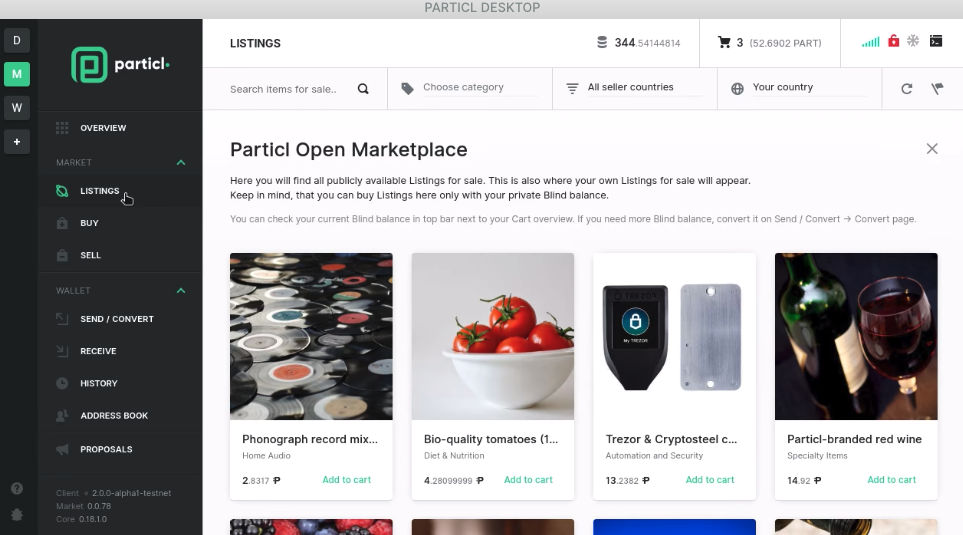
Unlike other decentralized marketplaces, Particl opted to exclude third-party escrow integrations, choosing instead to execute buys and sells exclusively between the merchant and customer.
