The State of LSTFi

Liquid Staking Tokens (LSTs) have emerged as a powerful instrument in the Ethereum DeFi ecosystem, enabling users to unlock the full potential of their staked assets. By representing staked assets as liquid, tradeable tokens, LSTs allow users to access the yields associated with staking while simultaneously leveraging the liquidity of their assets.
While LSTs have been around for years, they initially saw relatively slow adoption as there was no way to inherently keep the LST’s price in-line with ETH’s price, causing them to trade at significant discounts and with high volatility. Following Ethereum’s Shapella upgrade and the ability to withdraw staked ETH from the beacon chain, the ability to more easily arbitrage prices should help alleviate these price differences as protocols implement withdrawals into their infrastructure.
Since Shapella, LSTs have grown by roughly 1.3M ETH, or 17% in total, with Frax and Rocket Pool seeing the largest jumps in adoption with 54% and 46% growth respectively.
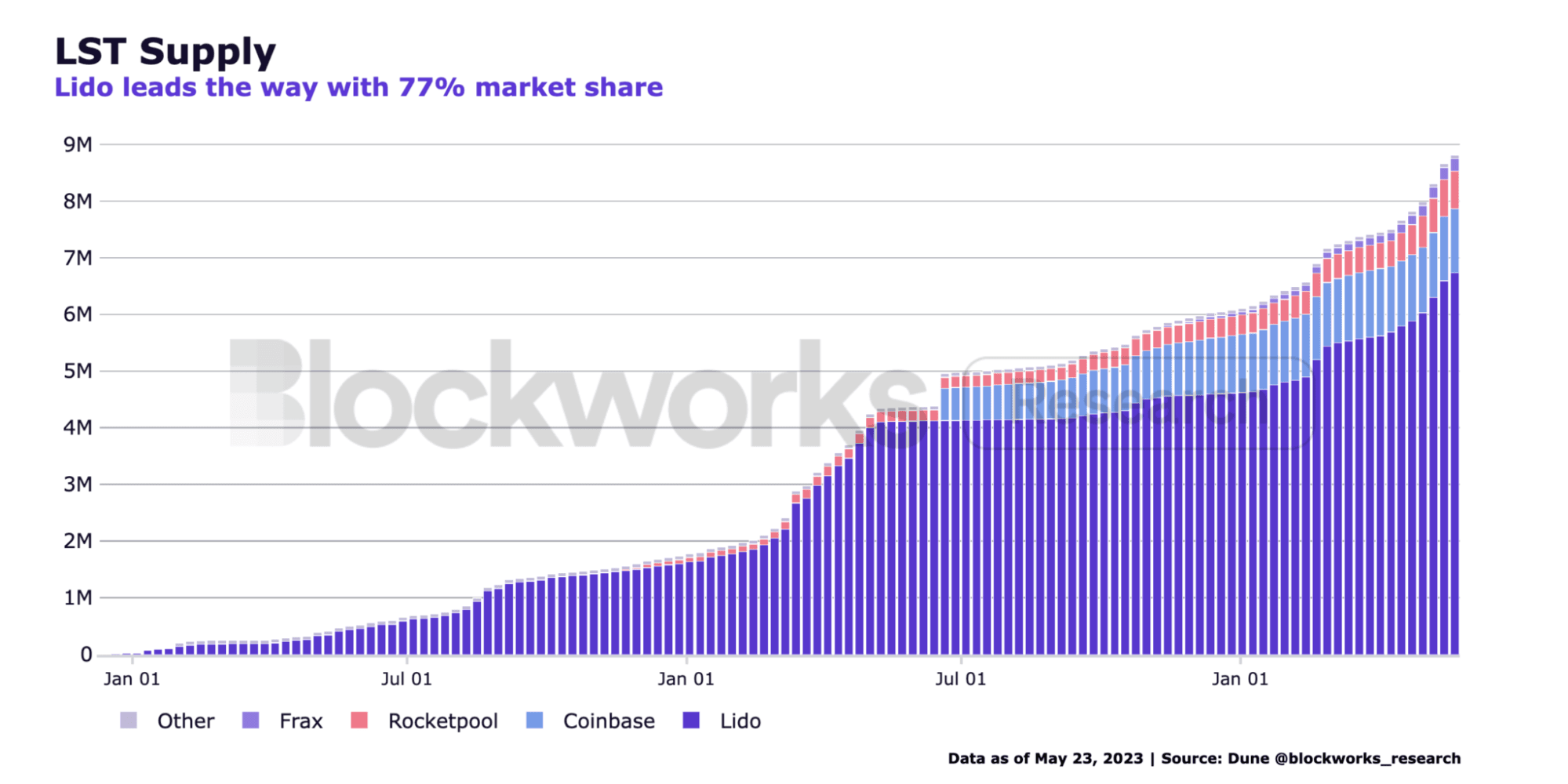
With the increase in trust and growth of LST supply, there is also an increase in the number of use cases of LSTs within DeFi. Given that LSTs are the largest share of TVL within Ethereum, and represent a token with native yield, all DeFi protocols are fighting for their share.
There are five broad use cases for LSTs that are gaining traction, and could benefit from a continued rise in LSTs: leverage farming, liquidity providing, LST baskets, stablecoin collateral, and interest rate derivatives.
Leverage Farming

Westie leads coverage on Ethereum, L2s, and Synthetix. Previously he worked in public sector technology Consulting at Guidehouse.