The State of DeFi lending

This post was originally published on August 27, 2019, and sent to Messari Pro subscribers.
Robust credit markets are necessary to sustain a healthy financial system. Lending and borrowing leads to more efficient price discovery (thanks to short selling), better liquidity for OTC desks and market makers, and opportunities for investors to earn yield on otherwise non-productive assets. That’s why fixed income is the largest asset class in the legacy realm - with over $200 trillion of debt outstanding worldwide. In cryptoland, we are still in the early days of credit markets, but we’re starting to see more development. The majority of volume today occurs through centralized providers like Genesis and BlockFi, however decentralized alternatives are gaining steam.
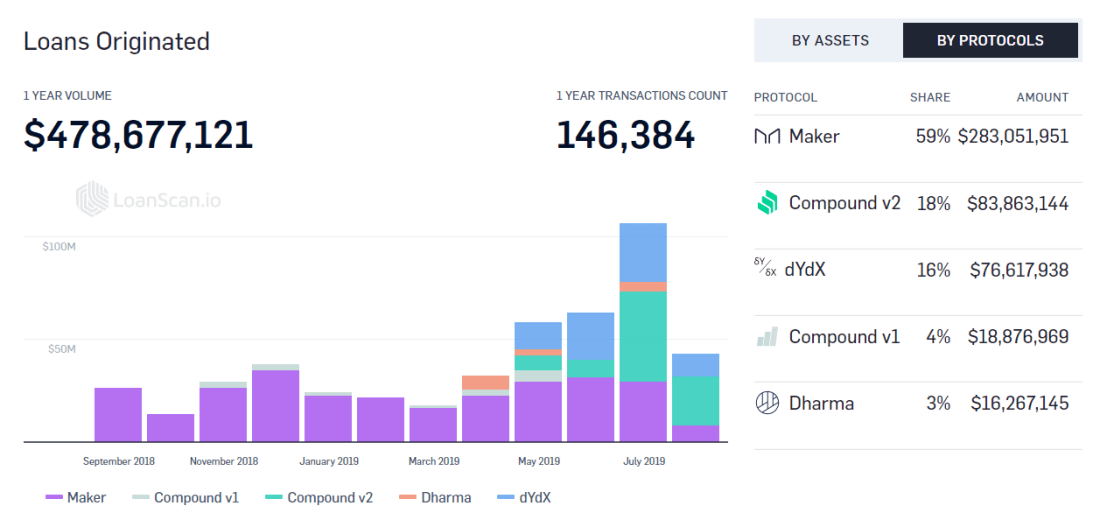
What separates, and inherently limits DeFi from centralized alternatives, though, is the need to over-collateralize loans. By maintaining the properties of trust minimization and censorship resistance, you eliminate the ability to assess creditworthiness in the process. While getting around this hurdle is difficult, DeFi applications have found unique ways to provide credit.
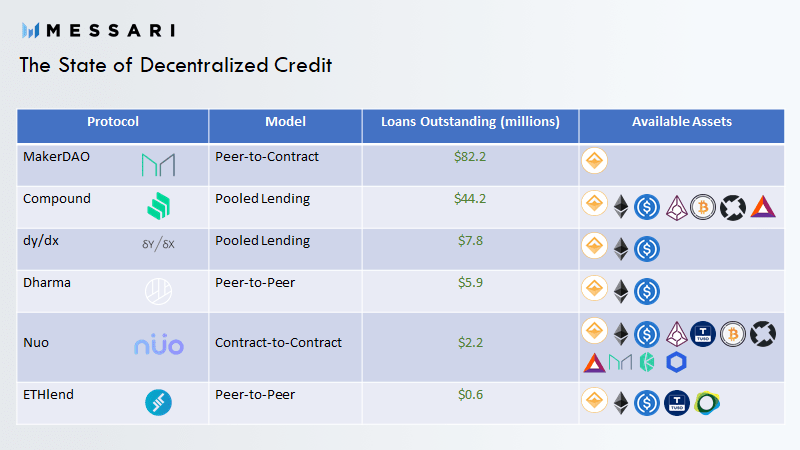
There are four predominant models, each with their own tradeoffs that impact the economics, liquidity and user experience. Understanding the differences between these models is key to explaining the current state of DeFi credit markets and offering insight into where it is going.
Peer-to-Contract (P2C)
The first model pioneered by Maker has proven to be the most successful so far with over 50% of all the ETH locked in DeFi. P2C, in theory, provides “infinite” liquidity. Anyone can lock $ETH to receive $DAI without someone else needing to provide the asset being loaned. This supply-side automation of loans is powerful, particularly given we’re in the early days of attempting to solve the chicken and egg problem of P2P markets. MakerDAO as it exists today is a one-way market without the ability to loan funds. But the launch of multi-collateral $DAI will change that; a $DAI savings rate will be implemented offering this option. Another unique characteristic of the P2C model is that the interest rate is not directly determined by market forces but rather through a voting process by Maker holders. This means borrowers are subject to somewhat arbitrary changes in their cost of capital, and we’ve seen the ugly side of this in the form of changes to the “stability fee” from just over 0% at the beginning of the year to 20.5%.
Peer-to-Peer (P2P)
The P2P model differs in that every loan has a distinct borrower and lender. If you want to provide a loan you have to wait for a borrower to take the other side, and vice versa, making it harder to attract initial liquidity to the platform. Dharma tried to incentivize initial liquidity by subsidizing users in the form of better (evidently unsustainable?) rates, but deposits on the platform are currently on hold. One reason this model may not have caught on is because of the inflexibility of the loans. Once you accept the terms of a P2P loan you are generally locked in for the loan’s duration. If you agree to pay a certain amount of interest over a period of time you are obligated to pay the full interest, and if you lend money out you cannot redeem it early. The lack of initial liquidity and flexibility around terms is a reason why P2P lending protocols haven’t seen as much volume as alternatives.
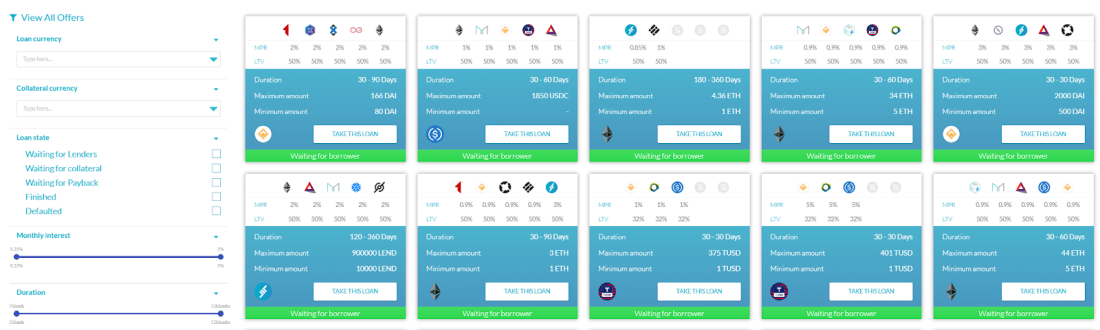
That said, there is a broader range of options because as long as two parties can agree to terms you can have a wider variety of loans in terms of maturity, interest rates and optionality vs one-size-fits-all loans (as you can see below with ETHlend)
Pooled Loans
Compound operates a model that practically sits between P2C and P2P. The protocol does not offer infinite liquidity like Maker, but nor are lenders and borrowers directly matched. Instead, lenders pool their capital and borrowers are then free to draw down those reserves. Interest rates are determined algorithmically based on market factors surrounding the demand for credit. From a user’s perspective, this is a great model since they are free to enter/exit as they wish while having a more predictable interest rate. This also provides interoperability as we’ve seen with InstaDapp’s convertibility from Maker CDP’s into Compound.
Contract-to-Contract
This is another hybrid model that is used by Nuo. Lenders provide capital to a pool, and whatever proportion they make of the total, they receive the pro-rata share of interest payments. Similar to Compound, lenders are free to enter and exit whenever. What differentiates C2C is that the lending pool interacts with various fixed-term contracts on the borrowing side. This means borrowers are obligated to pay the full interest amount for however long the contract specifies, but they do not need to worry about fluctuating interest rates.
Future of DeFi Lending
The majority of loan volume will likely continue to come from Maker ($MKR) for the foreseeable future as the automated supply side provides the needed liquidity for those looking for instant collateralized debt. As we’ve seen in the last few months with the growth of Compound and dy/dx, once pooled models bootstrap initial liquidity, they could become a more meaningful part of the crypto credit markets. While P2P lending likely won’t take-off anytime soon, it could one day as users look for more bespoke loan products. DeFi loans today comprise 0.000225% of the global lending markets….so we’re early.
But as the aggregate pool of available collateral increases, or if over-collateralization becomes unnecessary as a result of decentralized identity and credit scoring, then we will start seeing an explosion of new products and services offered.
