The rsETH exploit was not an isolated failure, but a systemic event that exposed how risk now propagates across an increasingly interconnected Ethereum ecosystem, where assets, liquidity, and infrastructure are deeply interdependent.
The two dominant Ethereum narratives of the past cycle, restaking and the L2 roadmap, failed to deliver on their core promises, instead introducing additional layers of complexity and trust assumptions that made risk harder to identify and easier to transmit.
Over 42% of total value secured (TVS) on major L2s relies on external trust assumptions, meaning a significant portion of the ecosystem no longer inherits Ethereum’s security and is exposed to bridge, validator, and infrastructure-level risks.
The rsETH exploit demonstrated that risk in modern DeFi is no longer isolated to individual assets or protocols; when assets with different security assumptions are treated as fungible, vulnerabilities can propagate across the entire system through shared liquidity and composability.
The industry is approaching a structural inflection point, where teams must choose between decentralization and centralization as competing design priorities, with incentives, market demand, and revenue models increasingly favoring centralized systems.
Introduction
Over the past year, large-scale exploits tied to North Korean actors have become an increasingly frequent feature of the crypto landscape. What were once isolated, headline-grabbing events now occur with a regularity that suggests something deeper than opportunistic attacks. These exploits are not just testing individual protocols, but the resilience of an increasingly interconnected system, one where assets, liquidity, and risk move fluidly across chains, applications, and infrastructure layers.
This report examines the rsETH exploit through that lens. It begins with a detailed timeline of events, reconstructing how the attack unfolded in real time. It then turns to the broader conditions that made such an exploit possible, focusing on structural developments within the Ethereum ecosystem. Finally, it explores how the industry may evolve in response, and the trade-offs between decentralization and centralization that will shape that path forward.
Timeline
The following is a full timeline of events, last updated on April 21, 2026, at 11:04 UTC. For all subsequent events, please refer to Messari Intel.
The Kelp DAO team has published an incident response statement, stating that its own systems were not involved in building or operating the compromised LayerZero infrastructure. The team states that a subsequent exploit attempt targeting an additional 40,000 rsETH via a falsely verified phantom packet was fully mitigated by Kelp's contract pausing and wallet blacklisting.Regarding the 1-of-1 DVN configuration, the Kelp team claims this is the default setup documented in LayerZero's quickstart guide and is shipped with any new OFT deployment. Kelp has operated on LayerZero infrastructure since January 2024, and the default configuration was "affirmatively confirmed as appropriate" by LayerZero during Kelp's L2 expansion. The team notes it is working with Aave, LayerZero, and other ecosystem partners on impact assessment, protocol unpausing, and mitigation.
Apr 20, 2026, 4:28 AM UTC
The LayerZero team has released a statement identifying the attack vector on the rsETH exploit as an RPC poisoning attack targeting the LayerZero Labs-operated DVN. According to LayerZero Labs, attackers compromised two independent RPC nodes used by the DVN, replaced their binaries to forge transaction confirmations, and conducted DDoS attacks against uncompromised RPCs to force the DVN to fail over to the poisoned nodes. The LayerZero team attributes the attack to the Lazarus Group (TraderTraitor), a DPRK-linked threat actor, describing this as a "preliminary attribution." No vulnerability was identified in the LayerZero protocol itself.The attack was limited to rsETH due to KelpDAO's use of LayerZero Labs as its sole verifier in a 1-of-1 DVN configuration. The LayerZero team states that it had previously communicated multi-DVN best practices to KelpDAO before the incident. All affected RPC nodes have been deprecated and replaced, and the LayerZero Labs DVN is now operational. Going forward, the LayerZero Labs DVN will not attest messages from applications using a 1-of-1 DVN configuration. LayerZero is coordinating with law enforcement agencies and Seal911 to track funds.
Apr 19, 2026, 3:16 AM UTC
The LayerZero team has acknowledged the rsETH exploit, stating that "all other applications remain safe." The team has committed to publishing a post-mortem as more information becomes available.
Apr 18, 2026, 8:27 PM UTC
The Kelp DAO team has confirmed that it "identified suspicious cross-chain activity involving rsETH," and has paused rsETH contracts across Ethereum and "several L2s" while it investigates. The team is actively collaborating with the LayerZero and Unichain teams, along with auditors and security experts.Certik has reported that stolen funds can be traced to 0x5d3919F12bCc35c26Eee5F8226A9bee90c257Ccc (approximately $250 million) and 0xCBb24A6B4DAfaAA1a759A2F413eA0eB6AE1455CC (approximately $2.5 million). Notably, Aave Labs has disclosed that all rsETH markets on Aave v3 and v4 have been frozen, and the team will explore paths to offset the deficit if the protocol accumulates bad debt from the incident.
Apr 18, 2026, 6:44 PM UTC
The Arbitrum Security Council has announced emergency action to freeze the 30,766 ETH held in the exploiter's address on Arbitrum One connected to the KelpDAO rsETH exploit. The Security Council stated it acted with input from law enforcement regarding the exploiter's identity, and implemented a technical approach to move the funds without affecting other chain state or Arbitrum users.As of 3:26 UTC on Apr. 21, the funds have been transferred to an intermediary frozen wallet and are no longer accessible to the original address. Further movement requires action by Arbitrum governance, which the Security Council stated will be coordinated with relevant parties.
Apr 18, 2026, 6:44 PM UTC
Security researcher ZachXBT has reported a potential exploit of the KernelDAO Bridge, with the suspected attacker appearing to have extracted ~116,500 rsETH on Ethereum and Arbitrum. The suspicious transaction appears to have originated from the Kelp DAO Unichain OApp.
The Aave team has provided an update stating that WETH reserves on the Ethereum Core V3 market have been unfrozen. Meanwhile, the WETH reserves on Ethereum Prime, Arbitrum, Base, Mantle, and Linea remain frozen. Users can now supply WETH to the Ethereum Core V3 market with WETH LTV remaining at 0.
Apr 20, 2026, 8:37 PM UTC
Aave service providers, including LlamaRisk, have published a joint incident report detailing the protocol's exposure to the Kelp DAO rsETH bridge exploit. Of the 116,500 rsETH obtained in the exploit, the attacker deposited 89,567 rsETH ($221.4 million) as collateral on Aave across Ethereum Core and Arbitrum, borrowing approximately 82,650 WETH ($190.9 million) and 821 wstETH ($2.3 million) across seven addresses. Aave's smart contracts were not compromised at any point during the incident.Between April 18 and April 20, the Protocol Guardian and Risk Steward executed a series of defensive actions. The Protocol Guardian froze all rsETH and wrsETH reserves across 11 Aave V3 deployments, set LTV to 0, and subsequently froze WETH on Core, Prime, Arbitrum, Base, Mantle, and Linea. The Risk Steward reduced WETH borrow rates at 100% utilization from a range of 8.5 to 10.5% down to 3.0% APR across non-Core markets, then applied the same adjustment to Core with Slope 1 set to 2%, Slope 2 set to 3%, and optimal utilization set to 94%.The report models two bad debt scenarios, as Kelp has not confirmed how losses will be allocated. Under Scenario 1, losses are socialized uniformly across all rsETH, resulting in a 15.12% depeg and an estimated $123.7 million in total bad debt. Ethereum Core would absorb $91.8 million (1.54% of its WETH reserve) and Mantle $10.4 million (9.54% shortfall). Under Scenario 2, losses are isolated to L2 rsETH only, applying a 73.54% haircut and producing an estimated $230.1 million in bad debt concentrated entirely on L2 chains. Mantle would face a 71.45% WETH shortfall ($77.7 million), Arbitrum 26.67% ($88.4 million), and Base 23.28% ($47.5 million), while Ethereum Core would be unaffected.Regardless of which scenario materializes, service providers have recommended pausing the Umbrella WETH staking module as a precautionary measure, noting that 18,922 of 23,507 staked aWETH (~80%) are already in unstaking cooldown. A pause of at least 22 days would allow all existing cooldowns and withdrawal windows to expire, restoring the full staked balance as effective coverage. Under Scenario 1, where Ethereum Core absorbs bad debt, the Umbrella WETH module (23,507 aWETH, ~$54 million) would become a direct coverage source against the $91.8 million Core shortfall. Under Scenario 2, where losses are isolated to L2s, the Umbrella module would not be triggered, as it currently covers Ethereum Core reserves only, and L2 bad debt would need to be addressed through the DAO treasury or other means.All WETH reserves across Ethereum, Arbitrum, Base, Linea, and Mantle are currently at 100% utilization. The attacker's seven positions have health factors between 1.01 and 1.03, placing them near the liquidation threshold, but at full utilization, liquidators would receive aWETH rather than underlying WETH, reducing liquidation throughput and increasing the likelihood that shortfalls crystallize as bad debt.
Apr 20, 2026, 1:18 PM UTC
Aave has published an update on the Kelp DAO rsETH bridge exploit, confirming that Aave's own contracts were not compromised and that the incident is isolated to the rsETH bridge. Aave claims that rsETH on the Ethereum mainnet is fully backed.rsETH has remained frozen across Aave V3 and Aave V4, preventing new deposits and borrowing against rsETH collateral while the situation is assessed. rsETH has no borrowing power on either deployment, and Aave states that neither version has further exposure to rsETH. WETH reserves have also been frozen across affected markets on Ethereum, Arbitrum, Base, Mantle, and Linea.
Apr 19, 2026, 7:22 PM UTC
Aave Labs has provided an update stating that, according to its analysis, "rsETH on Ethereum mainnet is fully backed." The team is actively assessing potential resolutions; rsETH remains frozen across Aave V3 and V4, along with WETH reserves.
Apr 19, 2026, 2:30 AM UTC
LlamaRisk has shared an update stating that the Protocol Guardian has frozen WETH on Core, Prime, Arbitrum, Base, Mantle, and Linea, preventing new borrows against WETH collateral as a precautionary measure.
Apr 18, 2026, 10:26 PM UTC
LlamaRisk has shared a forum post confirming that the Aave Guardian initiated freezes on rsETH and wrsETH markets across all deployments starting at 18:52 UTC on Apr. 18, 2026, with the Protocol Security Council applying the equivalent protective measures on Aave V4. LlamaRisk confirmed that "all Aave pools remain safe and fully operational," and disclosed that it is actively coordinating with the Kelp, LayerZero, and other relevant teams.
Apr 18, 2026, 8:05 PM UTC
The Aave team has provided an update stating that rsETH reserves have been paused on Ethereum Core, Arbitrum, Base, Mantle, and Linea. The team states that the action was taken "with the objective of recovering additional funds" as recovery efforts continue.
Apr 18, 2026, 8:05 PM UTC
Aave Labs has announced that the rsETH markets on Aave V3 and V4 have been frozen in response to the ongoing Kelp DAO bridge exploit, temporarily preventing new deposits and borrows against rsETH collateral. The move follows community reports that the attacker posted a portion of the stolen rsETH as collateral on the Aave V3 Ethereum instance and borrowed WETH.
April 18
DDoS Event - 17:20 UTC
From approximately 17:20 to 18:40 UTC, a DDoS attack targets the uncompromised RPC endpoints in the LayerZero Labs DVN's RPC pool, forcing a failover.
According to LayerZero's incident statement, the attacker had previously gained access to the DVN's RPC list, swapped op-geth binaries on two independent nodes for malicious versions, and used the DDoS to push verification onto the poisoned endpoints. The malicious binaries reported false source-chain data only to the DVN while continuing to serve correct data to other observers. The malicious binaries were designed to self-destruct, deleting binaries, local logs, and configuration after the attack.
Exploit - 17:35 UTC
Kelp's rsETH OFTAdapter on Ethereum releases 116,500 rsETH against a forged inbound LayerZero packet from Unichain.
No corresponding source-side burn was executed. The OFTAdapter balance dropped from 116,723 rsETH one block prior to 223 rsETH immediately after. The released rsETH (~18% of rsETH circulating supply, valued at ~$292 million at then-market prices) went to attacker-controlled address `0x8b1b6c9a6db1304000412dd21ae6a70a82d60d3b`.
The attacker immediately proceeds to spread out the 116,500 rsETH to seven branch addresses, with a portion of the funds swapped for wstETH and the remainder posted as collateral to borrow ~$236 million in assets from Aave V3, Compound V3, and Euler. Lending protocol exposure is broken down as follows:
Euler: 11 WBTC and 198 WETH borrowed (~$1.3 million)
Kelp Pauses rsETH Activity - 18:21 UTC
Kelp's emergency pauser multisig executes `pauseAll` on the protocol's LRT configuration contract, cascading Paused events across downstream contracts, including the LRT Deposit Pool, Withdrawal contract, LRT Oracle, and the rsETH token.
The freeze on the rsETH token blocks the attacker's follow-on forged packets from being delivered. An additional inbound packet from Unichain (nonce 309, for 40,000 rsETH) is verified by the same compromised DVN but reverts during `lzReceive` execution because the recipient address has been frozen on the rsETH token contract. The adapter balance consequently settles at 40,373 rsETH, representing the only confirmed backing for the 152,577 rsETH in remote-chain claims across all L2 deployments.
Aave Freezes rsETH Markets - Around 19:00 UTC
The Aave Protocol Guardian initiates freezes on rsETH and wrsETH markets across all V3 deployments where the asset is listed, setting LTV to 0. The Aave Protocol Security Council disables new supply and borrow activity for rsETH via the Aave Core Hub and Kelp E-Spoke.
Aave Labs Public Disclosure - 19:55 UTC
Aave Labs confirms that rsETH markets on Aave V3 and V4 have been frozen, and highlights that Umbrella assets can be used to offset the incident should the protocol accumulate bad debt. The post was later edited to replace the note on tapping into Umbrella assets with a more vague statement indicating that the team will “explore paths to offset the deficit” should any bad debt arise.
Compound Pauses Exposed Comets - 20:07 UTC
Compound’s Security Partners confirm that all Comets with rsETH exposure have been paused.
Kelp Team Public Disclosure - 20:10 UTC
The Kelp team discloses that it has identified suspicious cross-chain activity involving rsETH, paused rsETH contracts across mainnet and several L2s, and is working with LayerZero, Unichain, its auditors, and outside security experts on root-cause analysis.
Fluid Pauses Exposed Markets - 20:25 UTC
The Fluid team confirms that it has paused all markets with potential exposure to rsETH, noting that it “has no material exposure to rsETH on L2s and [that] no new borrowings against rsETH happened after the Kelp DAO rsETH bridge exploit.”
Euler Freezes rsETH Markets - 21:01 UTC
Euler Labs discloses that its instances on Ethereum and Linea were briefly paused to prevent the usage of rsETH as collateral, and the origination of new loans using rsETH as collateral has been disabled across three relevant Euler Prime pairs.
Euler Labs later identified Euler’s total rsETH exposure at ~$1.7 million.
Initial LlamaRisk Report - 22:24 UTC
LlamaRisk publishes the initial incident summary to the Aave governance forum, confirming the Guardian's freezes and stating that all Aave pools remain safe and fully operational.
April 19
Aave Protocol Guardian Freezes WETH - Around 2:00 UTC
The Aave Protocol Guardian freezes WETH on Core, Prime, Arbitrum, Base, Mantle, and Linea, preventing new borrows against WETH collateral as a precautionary measure to contain stress spreading to other reserves.
Compound Foundation Update - 20:18 UTC
The Compound Foundation shares an update on Compound's response to the rsETH exploit, noting that Compound Security Partners have submitted four governance proposals (568, 569, 570, 571) to adjust risk parameters on affected Comets, with the goal of unpausing the markets that were halted while mitigating follow-on protocol risk.
Fluid Launches aWETH Redemption Protocol - 21:27 UTC
The Fluid team introduces the aWETH Redemption Protocol, which allows Aave ETH lenders to exit into wstETH or weETH immediately.
April 20
LayerZero Incident Report - 4:20 UTC
The LayerZero team publishes its incident statement attributing the attack with "preliminary confidence" to North Korea's Lazarus Group, specifically the TraderTraitor subunit.
LayerZero identifies the root cause as RPC poisoning of the “downstream” infrastructure used by the LayerZero Labs DVN, specifies that two op-geth nodes in the DVN's RPC pool were swapped with malicious binaries, and that uncompromised RPCs were DDoSed to force failover. LayerZero indicates it will no longer sign messages for any application using a single-verifier setup, that it has confirmed "zero contagion to any other cross-chain assets or applications," and that the LayerZero Labs DVN is operational on the replaced RPC infrastructure.
Aave SP rsETH Incident Report - 20:12 UTC
Aave Service Providers formally present an incident report confirming ~$221.39 million in tainted rsETH collateral has been used to borrow ~$190.86 million in WETH and ~$2.33 million in wstETH across Aave V3's Ethereum and Arbitrum instances. The report models two loss-allocation scenarios, with the outcome dependent on Kelp's treatment of unbacked rsETH and any update to the LRTOracle exchange rate:
Scenario 1 (uniform socialization): The 112,204 rsETH shortfall is spread across the entire rsETH supply, producing a 15.12% haircut on every token regardless of chain. Estimated bad debt is ~$123.71 million, concentrated in absolute terms on Ethereum Core ($91.79 million, a 1.54% shortfall against the WETH reserve) but proportionally largest on Mantle (9.54% shortfall). The Ethereum Core Umbrella WETH module (23,507.63 aWETH, ~$54.06 million) could offset part of the shortfall.
Scenario 2 (L2-isolated): Ethereum mainnet rsETH retains full value as it is backed by underlying ETH staking deposits, while remote-chain rsETH is repriced to the 26.46% adapter backing ratio (a 73.54% haircut). Estimated bad debt is ~$230.11 million, all on L2s. Mantle absorbs a 71.45% WETH shortfall, Arbitrum 26.67%, and Base 23.28%. The Umbrella Safety Module covers Ethereum Core only and would not trigger.
The report flags two operational risks, independent of which scenario materializes. First, of the 23,507 aWETH currently staked in the Ethereum Core Umbrella WETH module, 18,922 have entered the 20-day unstaking cooldown, and this share is likely to rise if Kelp is slow to update its exchange rate. Second, WETH reserves on Ethereum, Arbitrum, Base, Linea, and Mantle are all at 100% utilization with idle balances below $20 on every chain, meaning liquidators seizing WETH-collateralized positions would receive aWETH rather than underlying WETH until utilization drops, slowing liquidation throughput.
On coverage capacity, the report states the Aave DAO treasury holds ~$181 million in assets as of April 20 ($62 million ETH-correlated, $54 million AAVE, $52 million stablecoins), with $145 million in 2025 revenue and $40 million YTD 2026 operating cash flow. The report notes that DAO service providers are coordinating with ecosystem participants on a bad-debt response and have received indicative commitments from multiple parties, without naming them.
Immediate priorities are defined as preserving Umbrella WETH coverage against the potential Ethereum Core shortfall by pausing the module, monitoring WETH reserve utilization on Arbitrum, Base, Linea, and Mantle to preserve liquidation capacity, and advancing discussions around loss allocations.
Kelp Incident Response - 20:55 UTC
The Kelp team shares an incident report classifying the exploit as “an attack on LayerZero's infrastructure,” stating that “two RPC nodes hosted by LayerZero were compromised,” and “a simultaneous DDoS attack was launched against the 3rd RPC node.”
The Kelp team states it maintained an open communication channel with the LayerZero team since it began operating on LayerZero infrastructure in January 2024, and when the question of DVN configuration came up during Kelp’s L2 expansion, “defaults were affirmatively confirmed as appropriate at that time.”
Aave Labs Proposes Pausing Umbrella Coverage on Ethereum - 22:36 UTC
Aave Labs shares a direct-to-AIP proposal to halt deposits, withdrawals, transfers, and slashing of the stkwaWETH Umbrella stake tokens on the Ethereum instance while the situation is assessed. Should governance approve the pause, any use of stkwaWETH tokens, including slashing, will require explicit governance approval.
April 21
Arbitrum Security Council Steps In - 3:35 UTC
The Arbitrum Security Council seizes the attacker’s balance of ~30,766 ETH on Arbitrum. The Arbitrum team explains that the Security Council “acted with input from law enforcement as to the exploiter’s identity, and, at all times, weighed its commitment to the security and integrity of the Arbitrum community without impacting any Arbitrum users or applications.”
Aave Core WETH Reserve Unfrozen - 6:12 UTC
The Aave Protocol Guardian unfreezes the WETH reserve on the Aave Core instance.
Aave Prime WETH Reserve Unfrozen - 11:04 UTC
The Aave Protocol Guardian unfreezes the WETH reserve on the Aave Prime instance.
The Bill Comes Due
The rsETH exploit was the culmination of years of misalignment within the Ethereum ecosystem, where risk had accumulated to the point that a contagion event was inevitable. While it was not predetermined that Kelp, LayerZero, or Aave would be the point of failure, it was only a matter of time before the fragility of the system was exposed.
The root cause of this exploit lies in the failures of two of the most prominent narratives in Ethereum over the past few years: restaking and the Layer-2s (L2) roadmap. These were not peripheral developments, but central pillars of the ecosystem’s growth, attracting billions of dollars in capital, significant venture funding, and a disproportionate share of developer talent and infrastructure investment.
Restaking was positioned as a new driver of demand for ETH, turning it into a more productive asset and increasing its attractiveness to hold. The L2 roadmap, meanwhile, was framed as Ethereum’s path to scale. Neither delivered on those promises, and instead, both introduced additional layers of complexity, new trust assumptions, and fragmented the system in ways that made risk harder to identify and easier to propagate.
To understand how this fragility emerged, it helps to break down each of these developments individually.
Restaking
Restaking was the defining Ethereum narrative of early 2024. Liquid restaking tokens (LRTs) grew from essentially zero in October 2023 to nearly 12% of all staked ETH by June 2024, peaking at 3.9 million ETH, worth roughly $13 billion at the time. At one point, EigenLayer (since rebranded to EigenCloud) had the second-largest DeFi TVL of any protocol, and most major LRT issuers (Ether.fi, Renzo, Kelp, Puffer, etc.) drew billions of dollars worth of ETH in deposits. While initial growth was driven by points programs and airdrop incentives, the core bet underpinning all of it was that real demand for restaking services would eventually follow suit and replace the incentives used to bootstrap the system.
Two years after the restaking mania, the demand has yet to materialize. The first month with live rewards from EigenCloud was October 2024. $22.8 million in rewards were distributed in October ($273.6 million annualized), and at the end of the month, EigenCloud TVL was $11.28 billion. This past March, $1.9 million in rewards were distributed ($22.8 million annualized), against a TVL of $8.59 billion. Over this time period, monthly rewards fell nearly 92%, while TVL only fell 24%. TVL has come down, but not nearly enough to match the decline in rewards. In other words, an outsized pool of capital is chasing a shrinking pool of rewards, compressing the risk-reward profile of holding LRTs over time. What began as a mechanism to increase ETH’s productivity instead created a system where capital scaled faster than underlying demand, introducing systemic risk without meaningful underlying demand.
While incentive-driven yields made holding LRTs justifiable in 2024, that case is much harder to make in 2026. The three largest LRTs, weETH, rsETH, and ezETH, have only offered a marginal yield pickup over stETH, with average APY spreads of just 0.21pp, 0.19pp, and 0.17pp, respectively.
With the benefit of hindsight post-exploit, a few extra basis points aren’t enough to offset the added smart contract, centralization, and liquidity risks of restaking. Given current demand, restaking introduces additional layers of risk into DeFi without corresponding returns. Rather than unlocking new sources of value, it has largely redistributed and amplified existing risks across the system.
L2s
The L2 roadmap also shares blame for the exploit. L2s were positioned as Ethereum’s path to scale while preserving its core properties, security, decentralization, censorship resistance, etc. It is difficult to argue that the L2 roadmap has delivered on that vision. Instead, the current system is fragmented, with L2s operating as siloed chains and introducing risks that are difficult to identify, let alone quantify.
At the core of this failure is the lack of native interoperability between L2s. L2s cannot communicate with each other natively, and as such, they are effectively siloed chains. While each L2 has a canonical bridge to Ethereum, allowing assets to move between Ethereum and the L2 while inheriting Ethereum’s security, this model breaks down when moving assets across L2s.
For example, if a user wants to move assets from Arbitrum to Base while preserving Ethereum’s security, they must first bridge back to Ethereum, wait through the optimistic rollup withdrawal period, and then bridge to Base. This process takes days and is unusable for most applications.
As a result, the ecosystem has defaulted to third-party bridges as a workaround. These allow users to move assets directly between L2s quickly, but in doing so introduce entirely new trust assumptions that sit outside of Ethereum. Once assets are bridged this way, they no longer inherit Ethereum’s security; they instead depend on the security of the bridging infrastructure itself.
These additional trust assumptions introduce multiple layers of risk. There is custodial risk, where assets depend on external validator sets or messaging systems that can fail or be compromised. There is smart contract risk, as these systems rely on more complex and often less battle-tested infrastructure. There is redemption risk, where assets may not be redeemable 1:1 if the underlying system breaks. While these risks apply at the asset level, their impact does not remain isolated.
This workaround has become so prevalent that over 42% of assets on L2 rollups with more than $100 million in total value secured (TVS) rely on trust assumptions that sit outside of the rollup’s standard security model. The two most active DeFi L2s, Arbitrum and Base, are no exception, with 47% and 41% of their respective TVS carrying additional trust assumptions. These are not trivial figures either, as they amount to $7.52 billion on Arbitrum, $4.88 billion on Base, and $14.47 billion in total.
When assets with different underlying security assumptions are treated as fungible, vulnerabilities in one pathway can propagate across the entire system. The rsETH exploit demonstrated exactly this dynamic as assets created through a compromised bridging pathway were able to interact with broader DeFi primitives, ultimately impacting users and capital with no direct exposure to the initial risk. As such, risk is no longer confined to “risky assets.” Even users who attempt to avoid these pathways cannot fully isolate themselves, as the system aggregates and redistributes that risk.
Most importantly, these third-party systems are not uniform. They introduce a wide range of configurations and trust models, often layered on top of one another. The result is a system where risks are not only higher, but increasingly opaque and difficult to reason about. In practice, this makes it harder for both users and markets to accurately assess and price those risks.
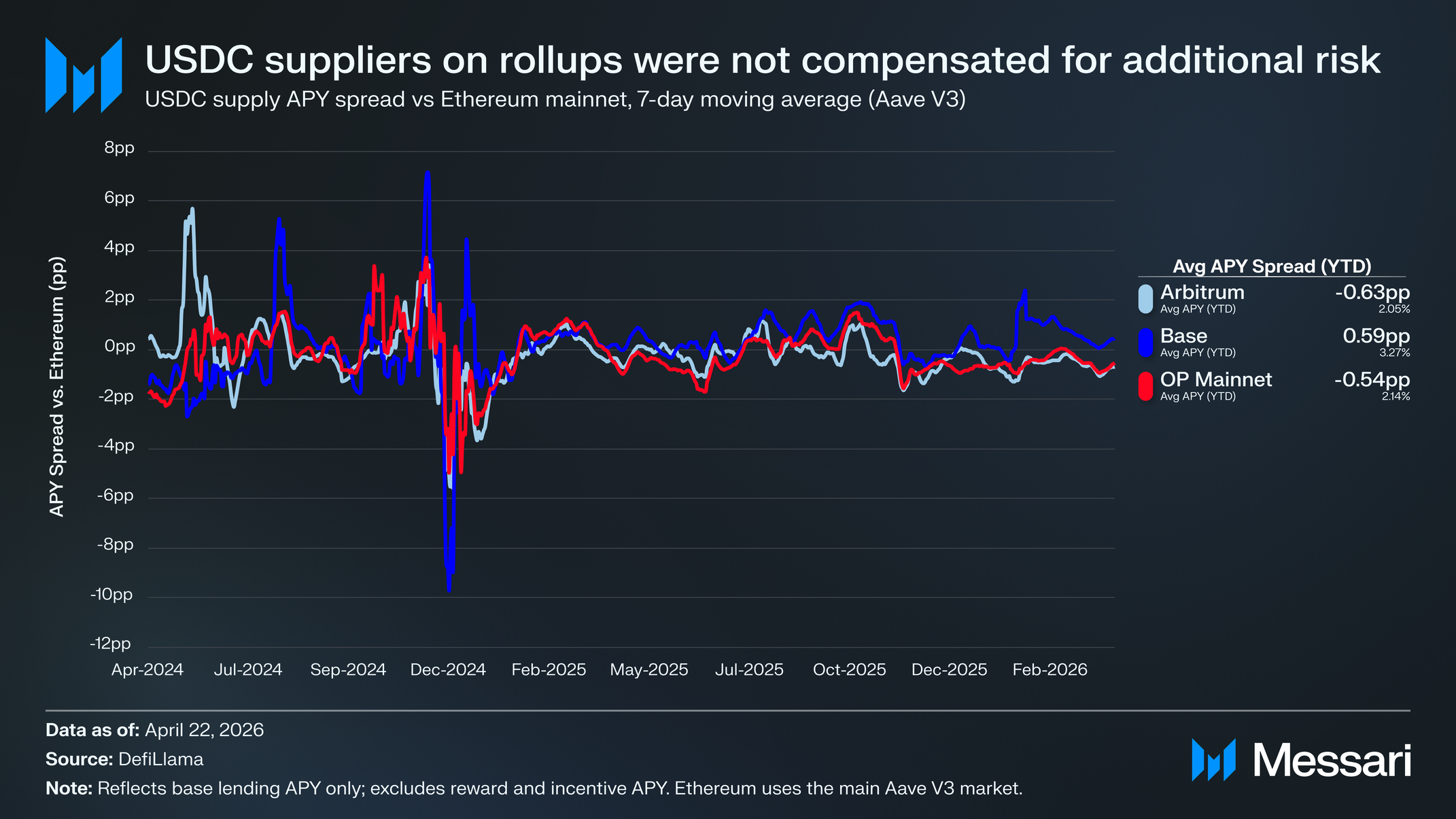
Given how opaque these risks are, it is perhaps no surprise that the market has struggled to price them in. Using USDC supply rates on Aave V3 as a proxy for the baseline DeFi returns, the data suggests that L2-related risks have been consistently underpriced. In 2026, USDC supply rates on Arbitrum averaged a 63 basis point discount to Ethereum, while OP Mainnet saw a 54 basis point discount. Base was the exception, trading at a 59 basis point premium; however, its average APY of 3.27% still fell below the federal funds rate of 3.64%. Across the board, returns have not meaningfully compensated for the additional risk embedded in L2 markets. If anything, the market has at times priced L2 DeFi as less risky than Ethereum mainnet.
Ultimately, the L2 ecosystem has evolved into a system where interoperability is achieved not through shared security, but through a growing web of external dependencies and trust assumptions. Rather than simplifying Ethereum’s scaling model, this has introduced new layers of complexity and fragility. The result is a system where risk is no longer clearly defined or contained, but instead distributed, obscured, and increasingly difficult to manage.
A Time for Choosing
For many years, the industry has been slowly parting ways with the cypherpunk ideals it was founded upon, and in their place has gradually crept a more centralized reality. The embrace of crypto by the world’s most powerful governments, the rise of tokenized offchain dollars, and the appealing prospect of onboarding trillions in capital and millions of users through institutional adoption have made centralization an increasingly difficult tradeoff to refuse.
Because the shift away from decentralization towards centralization does not happen overnight, the industry has effectively been able to “eat its cake and have it too,” reaping the benefits of gradual centralization while maintaining a public-facing image of decentralization.
The events of the past week have shattered that illusion and revealed that many of the things the industry has built and claimed are decentralized are, in fact, not decentralized at all. It is now time for the industry to confront reality and reckon with the veneer of decentralization that masks a system built on centralized control. This middle ground, trying to be both decentralized and centrally controlled, has proven unstable.
The challenge is that while centralization and the trust assumptions it enabled created these risks, further centralization may also be used to mitigate them. The Arbitrum Security Council’s (SC) handling of the rsETH exploit demonstrated such. The SC was able to recover a meaningful portion of the hacked funds by exercising explicit, centralized control over the network, pushing an upgrade that required approval from only 9 of 12 multisig signers. If there were no SC with the ability to push unilateral changes to the network, then those funds would’ve never been recovered.
Importantly, Arbitrum represents something close to a best-case scenario for this model. Its Security Council has defined membership, term limits, and a governance process in which ARB tokenholders vote on participants. Even with those safeguards in place, the exercise of that power raises difficult questions. What, then, should users expect from the rest of the ecosystem? Most multisigs offer far less transparency into who controls them, operate under looser thresholds than 9 of 12, and exist entirely outside of any meaningful form of user or tokenholder oversight.
While this decision was undoubtedly the correct one (if any team or protocol has the power to stop North Korea, they should exercise it), the question now becomes when else that power should be used. Only for nation-state hacks? What about money laundering, petty scams, or even something like an inheritance dispute?
And, even if a protocol can establish a clear, rules-based approach to when the multisig can exercise “God Mode,” what happens when the U.S. government comes knocking? If a court order mandates a multisig to take an action that goes against its rules, will it abide? These were once rhetorical questions, but now must be answered. If centralized control can be exercised, users have the right to know when and how that power will be used.
In the coming weeks and months, teams and protocols will be forced to make a choice: accelerate down the path of centralization, or attempt to reverse course and rebuild around decentralization. In isolation, neither path is inherently right or wrong; each represents a different set of trade-offs. The risk emerges if the industry converges in one direction. If most teams opt for centralization, the system as a whole begins to lose the very property that distinguishes it in the first place.
Unfortunately, there are strong reasons to believe that most teams will opt for more centralization. The incentives are simply too aligned in that direction. Centralization makes it easier to integrate with the existing financial system, respond to incidents, comply with regulatory pressure, and offer users a level of safety and recourse that fully decentralized systems may not be able to.
More importantly, the market has shown far more demand for centralized crypto products than decentralized alternatives. Take Liquity’sLUSD and BOLD stablecoins as an example. These are arguably the two most decentralized stablecoins (if not the only meaningful ones left for that matter) running on immutable smart contracts. There is no issuer, no multisig, or no entity that can alter the contracts governing these systems.
Yet, amidst the greatest period of stablecoin adoption to date, they have been shrinking in size. On July 1, 2025, the market caps of BOLD and LUSD were $43.0 million and $41.1 million, respectively. Since then, their market caps have declined by 25% and 29%. Meanwhile, USDC and USDT have grown by 28% and 18% over the same period. It’s difficult to come away with any conclusion other than that the demand for decentralized stablecoins is limited to a niche portion of the market. Users have shown a clear preference for stability, liquidity, and issuer guarantees over immutability.
Centralization may also be better for a blockchain’s bottom line. If the primary users of blockchains are large financial institutions, then building a more centralized system becomes the winning path. This may already be playing out in practice.
L2s, which currently straddle the line between centralized systems and a stated path toward decentralization, have seen a collapse in revenues. By contrast, Canton Network, a permissioned blockchain built specifically for regulated institutions, has seen a significant increase in revenues in 2026. Throughout April, L2s generated a combined $4.5 million in revenue, while Canton brought in $49.1 million, more than 10x the revenue of the entire L2 complex.
If incentives are destiny, then it does not bode well for those who still believe in a decentralized, cypherpunk future. In the areas where the industry is finding product-market fit, stablecoins, RWAs, and infrastructure for existing financial applications, decentralization often gets in the way of building a successful product. While the exact path forward remains uncertain, one thing appears increasingly likely: crypto is trending toward greater centralization, not less.
Closing Thoughts
Throughout this report, the focus has been on risk: how it is introduced, how it propagates, and how it might be managed going forward. But underlying all of these questions is a more fundamental one: what is crypto actually useful for?
If the goal of this industry is to build an alternative financial system, one that operates independently of traditional institutions and gives individuals greater autonomy, then decentralization is the foundational principle upon which it is built. Without it, there is no meaningful distinction between crypto and the system it was meant to replace.
But if the goal is something else, if crypto’s role is to improve and complement the existing financial system, to make it faster, more efficient, and more accessible, then decentralization becomes far less critical. In that world, speed, composability, security, and integration matter more than strict adherence to decentralization as an ideal.
This distinction becomes clearer when looking at how blockchains are being increasingly used today. A significant portion of activity across major networks is driven by stablecoins like USDC and USDT, which are tokenized representations of offchain assets. By design, these assets require centralized control. They can be frozen, confiscated, or altered by their issuers because the underlying dollars exist outside of the blockchain.
If blockchains are primarily being used to move assets like these, then it raises an uncomfortable question: what role does decentralization actually play? If the assets themselves are subject to centralized control, does it matter whether the underlying infrastructure is decentralized? Or is the value instead coming from something else entirely, such as having a public, global ledger that anyone can access and build on?
The rsETH exploit was not just another hack, nor was it simply the result of a single point of failure. It was a reflection of the system as it exists today, one shaped by competing priorities, layered trust assumptions, and an unresolved tension between decentralization and control. In that sense, the exploit was not an outlier, but a consequence.
And that ultimately is the question facing the industry. The debate between centralization and decentralization is not just about architecture or risk management, but about purpose. What is crypto actually for? Until that question is answered, the system will continue to produce outcomes that reflect its own unresolved contradictions.
All content was produced independently by the author(s) and does not necessarily reflect the opinions of Messari, Inc. Author(s) may hold cryptocurrencies named in this report. This report is meant for informational purposes only. It is not meant to serve as investment advice. You should conduct your own research and consult an independent financial, tax, or legal advisor before making any investment decisions. Nothing contained in this report is a recommendation or suggestion, directly or indirectly, to buy, sell, make, or hold any investment, loan, commodity, or security, or to undertake any investment or trading strategy with respect to any investment, loan, commodity, security, or any issuer. This report should not be construed as an offer to sell or the solicitation of an offer to buy any security or commodity. Messari does not guarantee the sequence, accuracy, completeness, or timeliness of any information provided in this report. Please see our Terms of Service for more information.
No part of this report may be (a) copied, photocopied, duplicated in any form by any means or (b) redistributed without the prior written consent of Messari®.
AJC is a Research Manager at Messari for the Enterprise team. His primary focuses are on Bitcoin and Consumer. Prior to joining Messari, AJC wrote an independent crypto blog.
AJC is a Research Manager at Messari for the Enterprise team. His primary focuses are on Bitcoin and Consumer. Prior to joining Messari, AJC wrote an independent crypto blog.