The Role of IP in the Age of Abundance


Primer
On March 25, OpenAI released a new image generator for GPT-4o, sparking what could be described as the “Ghiblification” of everything. Images in the style of Studio Ghibli, a Japanese animation studio best known for films like Spirited Away and Princess Mononoke, flooded the internet. Social media was awash with users Ghiblifying photos of themselves, iconic memes, and scenes from popular movies and TV shows. In every post, the style was unmistakably Ghibli, and the quality of the art was impressive.

Although the cultural moment was largely lighthearted and fun, it also sparked serious debates about AI and intellectual property (IP). Amid the Ghibli-style craze, Story Protocol CEO Jason Zhao posted a long-form tweet outlining his thoughts. In it, Zhao argued that the current relationship between creators and AI companies is essentially negative-sum: creators receive no compensation when AI models generate content based on their work, while AI companies face legal challenges from rights holders trying to protect their IP. However, Zhao suggested that this dynamic could become a win-win, positive-sum scenario if there were market infrastructure in place to facilitate compensation for creators.
Reactions to Zhao’s post were mixed. On the milder side of the debate, some commenters argued that while no direct compensation was given, Studio Ghibli benefited enormously from the event through what amounted to a global marketing campaign that significantly boosted the studio’s brand awareness. On the spicier end, Kyle Samani of Multicoin offered a sharply contrasting perspective in a quote tweet.
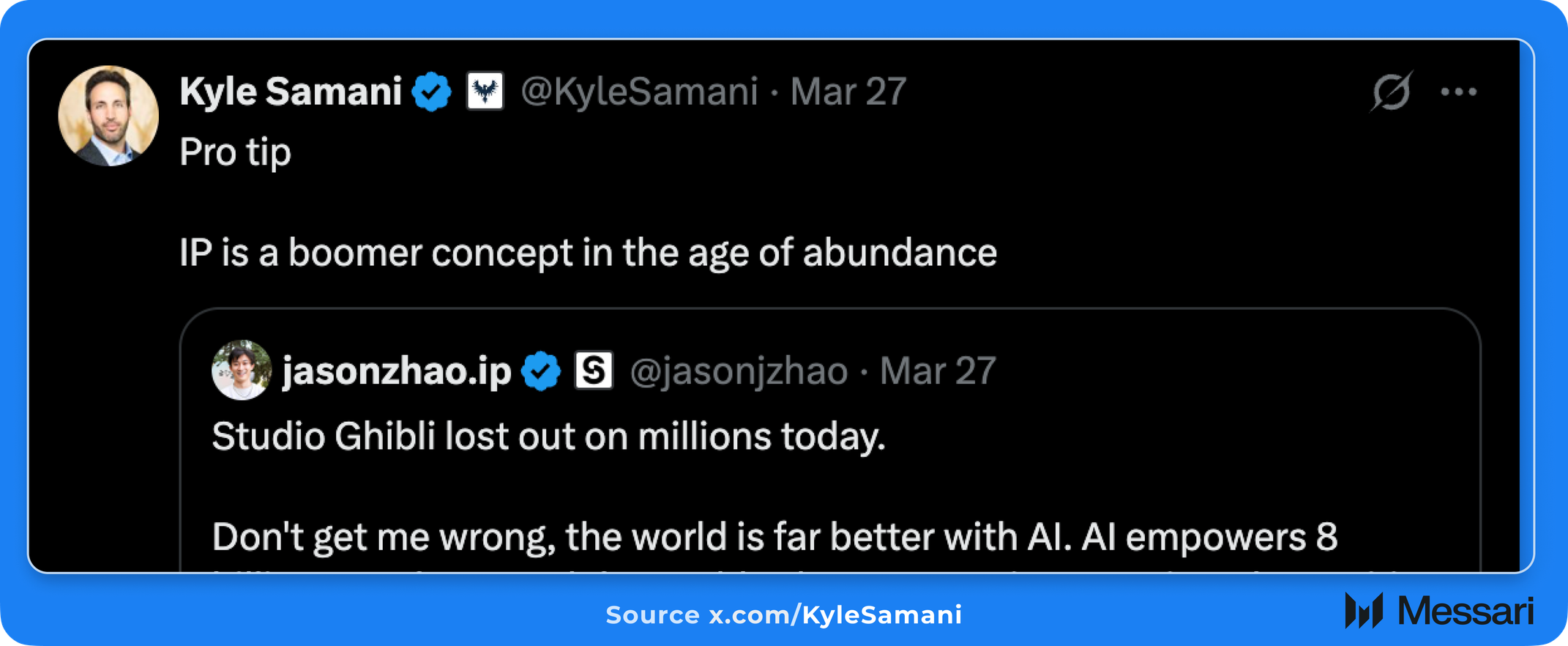
From Samani’s view, IP is an outdated concept in a world where the marginal cost of creation is effectively zero. This pushed the conversation further, broadening the debate to the very foundation of IP and its relevance in the age of AI.

Prior to joining Messari, Chris was the Growth Lead at a Paradigm and a16z-backed gaming startup called LootRush. His primary focus is Consumer Products, Music x Crypto, Gaming, Digital Art, and market buying local tops.

Sam was previously a product manager at ether.fi, as well as LifeMed AI. He graduated from Ohio State University, where he founded the Ohio State Blockchain Club. He is now an Enterprise Research Analyst at Messari focused on finding the next best applications and protocols in internet finance.
Armita is a protocol researcher with a robust background in technology and blockchain. Before her role at Messari, she distinguished herself as a tech entrepreneur, executive, and advisor for various blockchain startups. Armita holds two master's degrees, one in Computer Engineering and another in Business Management, as well as a double major undergraduate degree in Physics and Pure Mathematics.

Austin is a Research Analyst on the Protocol Services team. Before joining Messari, he studied IT and Global Commerce at the University of Virginia.