The Rise of DeFi on Cosmos and Relative Valuations: Part Two


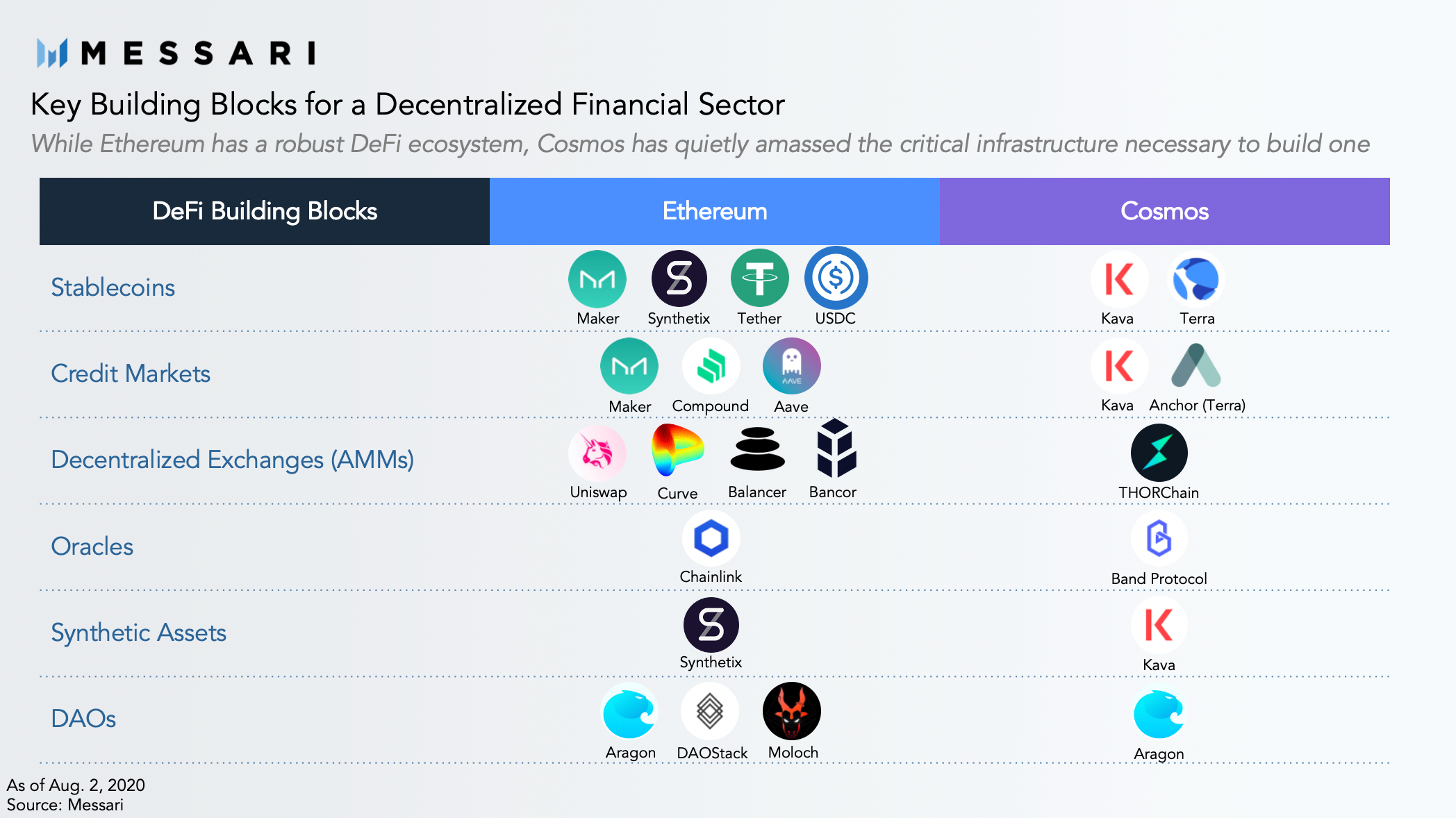
In part one of “Relative Valuations and the Rise of Defi on Cosmos” we illustrated how Cosmos is building a parallel DeFi ecosystem, assembling the likes of Band, Kava, Terra, & THORChain to provide many of the critical building blocks to do so. We further laid out the trade-offs between Ethereum and Cosmos’ approach to building a DeFi ecosystem and the potential differences in outcomes for ETH and ATOM respectively.
Part two of this series fleshes out how Cosmos-based DeFi projects could offer viable investment opportunities as concerns over Ethereum’s scalability and interest in DeFi continue to bubble. We employ relative valuation analysis and qualitative analysis to lay out the bullish and bearish characteristics for each of the DeFi assets we considered the basic building blocks for Cosmos’ DeFi ecosystem. Lower relative valuations do not necessarily imply undervaluation, and there are many valid reasons why these projects are valued below their Ethereum counterparts. However, in an inefficient market like crypto, these lower relative valuations could imply mispricings.
Terra
Terra is a seigniorage shares stablecoin blockchain built using the Cosmos SDK. Unlike crypto collateralized stablecoin systems such as MakerDao and Kava, the seigniorage shares model scales with demand for stablecoins. And unlike fiat-collateralized stablecoins, which do scale with demand, the seigniorage shares model does not sacrifice decentralization.
Historically a significant issue with seigniorage share stablecoins was that what ultimately backstopped the system was belief in the future growth of its stablecoins. If shareholders do not believe the system will grow, then their shares which derive their value from the future seigniorage of the system are worthless. In times when stablecoins fall below their peg this could cause death spirals as auctions would become illiquid and lack participation.
Two major ways Terra mitigates this issue is through transaction fees and counter-cyclical policy. The value of LUNA – Terra’s native asset – is ultimately derived not just from the future seigniorage of the system, but from the transaction fees the Terra blockchain generates. The cash flows from transaction fees give LUNA intrinsic value that provides confidence even if the system needs to auction a significant amount of new LUNA to defend its stablecoin pegs. Furthermore, Terra can raise transaction fees on the network in times of an economic slowdown to ensure the predictability of rewards and further drive value to LUNA.
Ryan Watkins was a Senior Research Analyst at Messari. Previously, he worked at Moelis & Company as an Investment Banking Analyst where he worked on deals in the technology, telecom, and fintech sectors. Ryan graduated Magna Cum Laude from the Gabelli School of Business at Fordham University.

Wilson Withiam was a Senior Research Analyst at Messari. Previously, he worked at Circle Research where he conducted research on cryptoassets. He graduated with a B.Sc. in Kinesiology and Exercise Science before studying computer science and economics at UConn.