The Past, Present, and Future of Decentralized Exchanges

This is a guest post from the Messari community. Rahul is currently Managing Partner at Gamma Point Capital, a hedge fund focused on digital assets and Decentralized Finance. He was previously on the FX Hedge Funds team at Morgan Stanley and graduated with a B.S in Economics from the Wharton School.
Market makers play a crucial role in the smooth functioning of financial markets. By continuously quoting prices at which they stand ready to buy ('bid") and sell ("ask" or "offer"), they increase liquidity for other market participants, enabling them to trade the underlying asset at tight prices with minimal slippage. In addition, by providing liquidity across various exchanges and arbitraging away inter-market price discrepancies, they increase overall market efficiency and enable price discovery.

Source: Towards Data Science
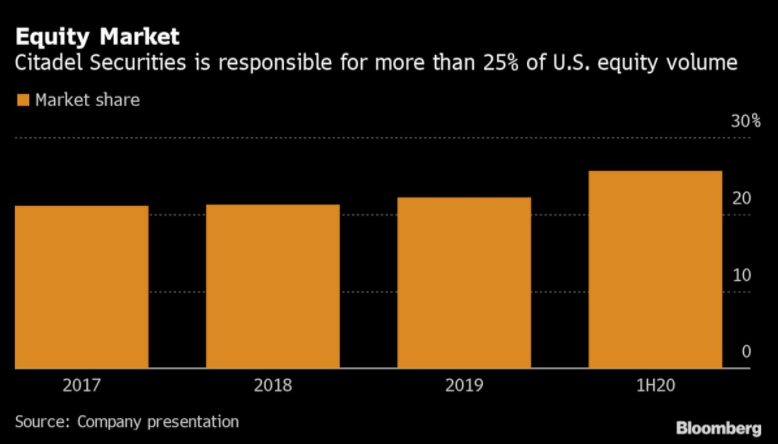
Market making is ultimately a complex optimization problem, in which participants leverage proprietary statistical models and low-latency technology to build sustainable long-term moats. All of this results in the market maker distribution being power-low dominated and fat-tailed, with only a few top participants capturing a lion's share of trading volume. In U.S equity markets, for example, Citadel Securities and Virtu together capture almost 50-60% ofmarket share.Citadel Securities in particular trades approximately 25% of U.S equities volume and 39% of all U.S listed retail volume, across more than 8,000 listed securities and over 16,000 OTC securities.
In stark contrast to traditional finance, where regulatory and competitive barriers prohibit individuals and smaller shops from filling the market maker role, crypto markets provide direct market access to all participants. Individual traders have full access to the technology stack of centralized exchanges, enabling them to provide quotes and trade algorithmically using the same APIs and servers as professional firms. Decentralized Finance (DeFi) has taken this one step further and fully democratizes access to market-making and liquidity through the implementation of Automated Market Maker (AMM) based Decentralized Exchanges (DEXs).
