The New BCH Civil War

This was originally sent to subscribers of Messari's Unqualified Opinions. Click here to become a subscriber and access all of our historical content.
Qiao Wang - November 14, 2019
Bitcoin Cash (BCH), which sprung from Bitcoin’s 2017 civil war, is gearing up for a battle of its own. We’ve most likely got another hard fork on our hands tomorrow.
Bitcoin SV, a fork supported by Craig Wright (the self-proclaimed Satoshi Nakamoto [TBI Note: and bona fide ass hole]), aims to restore the protocol to a version similar to his original vision when he launched Bitcoin in 2009.* BCH “Satoshi’s Vision” currently has a sizable 70%+ advantage in hash rate according to CoinDance.
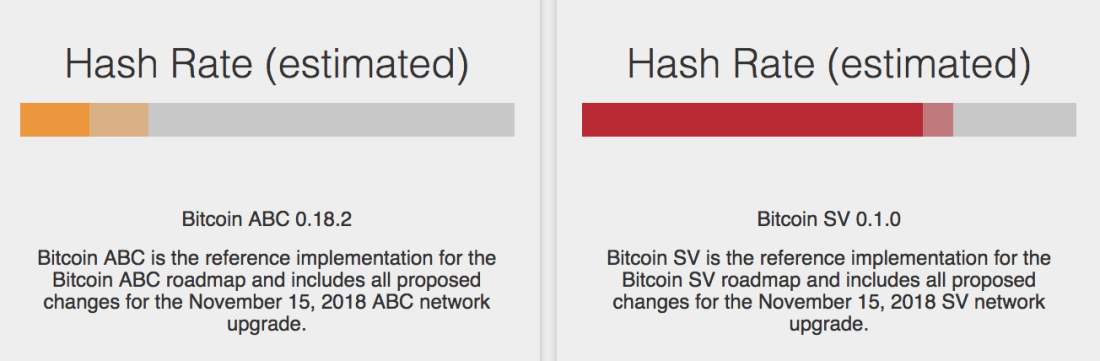
Meanwhile, Bitcoin ABC, a fork supported by Bitmain CEO Jihan Wu, Roger Ver, and a seemingly much larger percentage of the BCH community has a slight edge in market price at the exchanges that are offering trades of the potentially split asset. The ABC team wants to make upgrades to support smart contract oracles and transaction re-ordering. Reasonable upgrades, maybe, but not “Satoshi’s Vision.”
At 11:30pm ET, BCHSV was at $178 to BCHABC’s $210 on Poloniex.
No need to reinvent the wheel summarizing the history of the BCH saga, and how we got to where we are today—Aaron at Bitcoin Magazine wrote an exceptional piece on the topic earlier today with everything you need to get started.
The Block also covered the current status of all major bitcoin market players, as well as an intriguing profile of the man in the middle of the fork, Calvin Ayre, owner of the largest BCH mining pool operator, Coingeek.
Read those pieces and come back if you choose.
So what should I think about before tomorrow’s festivities?
We’ve seen this movie before. Last year during the Bitcoin civil war, Bitcoin Cash (BCH) had a significant hash rate, at times even higher than that of Bitcoin’s (BTC), yet BTC had broader ecosystem support, and eventually “won” with what is now a 10x more valuable network.
Will this time play out any differently? Or will the BCH whales’ battle continue to spill over into the rest of the asset class?
I mean look at this bloodbath:
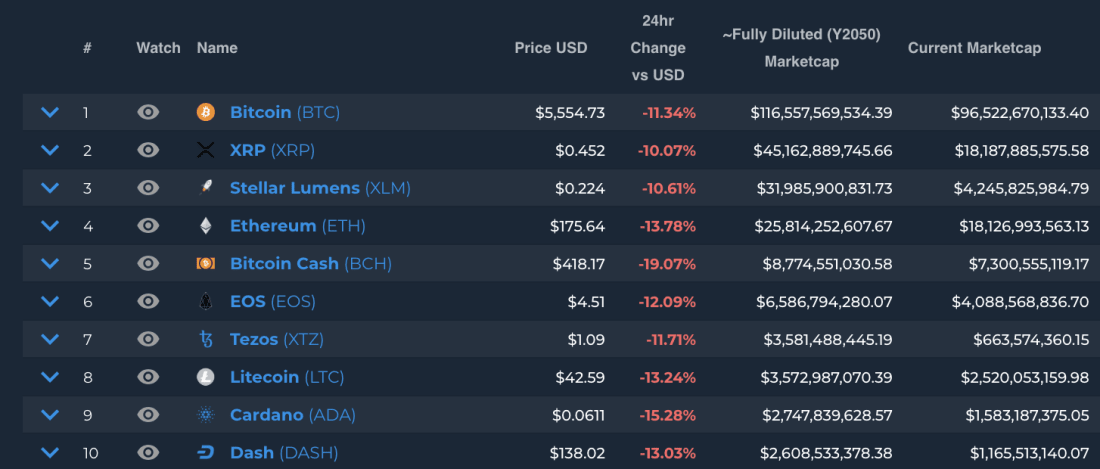
Believe it or not, I find I’m not even looking at the price right now. Instead, I’m thinking about the more interesting, long-term abstract structural challenge of crypto governance. One of the most important unknowns in the asset class.
Forks are governance problems. Coordination problems. How can a decentralized network make good, fast, long-term decisions that keep the community aligned? How can global stakeholders network make decisions without splitting themselves?
I don’t have good answers. Maybe no one does. But there are three interesting debates you should mull over.
1. Governance is the killer feature vs. Minimize argument surface
One of the main theses at New York-based crypto VC firm Placeholder is that good governance allows crypto networks to quickly resolve arguments and adopt new features. “With good governance, you can have any feature you want.”
On the other hand, Elaine Ou beautifully commented on Bitcoin’s advantage when it comes to governance. “The more functions a currency has, the more things there are to argue over. Bitcoin’s uncompromising focus allows it to serve a broader user base.”
In theory, I agree with Chris and Joel. In practice, it’s extremely difficult to judge a priori how good a governance system is. One can only draw conclusions a posteriori, after many years, decades, or even centuries of empirical evidence. I’m a big fan of the thesis that a crypto network that does not require much governance, such as Bitcoin, is one that actually has good governance.
2. On-chain governance vs. off-chain governance
On-chain governance refers to the idea that a network’s blockchain nodes automatically upgrade through an on-chain decision process, e.g., votes by block producers.
Proponents of on-chain governance like that it 1) makes collective decision-making more efficient, and 2) does not require a hard fork.
Detractors like Ethereum’s Vlad Zamfir argue against on-chain governance on the grounds that it shifts the balance of power to block producers from full node operators and every day users, disenfranchising the latter. (It didn’t take long for his argument to play out publicly, in the form of alleged collusion amongst EOS block producers.)
In off-chain governance systems like Bitcoin and Ethereum, full node operators provide an important check and balance to block producers. This is how BCH ABC can have a lower hash power than BCH SV, while the market still believes it will win.
It’s a balance. Onchain governance and offchain governance simply make a tradeoff between efficient decision-making and decentralization of power. While on-chain governance doesn’t require hard forks, it also won’t be able to prevent network splits when there is a strong enough disagreement.
3. Centralized governance vs. decentralized governance
This leads to the third debate. What is the right balance between centralization and decentralization when it comes to governance? Decentralization is, after all, a spectrum, rather than a binary state.
Decentralization ensures monetary policy is harder to change, transactions are tougher to censor, assets are harder to seize. But decentralization comes with drawbacks. It’s harder to reach consensus around network upgrades.
Should everyone vote their stake? Should we elect philosopher kings? Run these protocols more like companies?
We’ll get back to you when we have an answer. What do you think?