The most valuable currency is trust

Written by Jeffrey Wernick
Part I
I have no plans to either sell or spend my bitcoin. My intention is to accumulate more.
When bitcoin first emerged. It was in the depths of a global financial and economic crisis where payment systems, national currencies and financial institutions were all extremely fragile. The interbank market, where banks borrow and lend to each other became dysfunctional. Banks did not trust each other’s balance sheet. Investors did not trust the banks balance sheets.
Global trade contracted. Economies contracted. Unemployment grew.
Hayek has asserted that busts are a consequence of bubbles. An assertion I agree with. And I believe it is a consequence of how Central Bank interventions pervert the time preference for money.
In a free market, without any manipulation of monetary policy nor change in fiscal policy. Where both are constant and predictable. The interest rate adjusts to reflect our preferences for consumption today and saving to consume tomorrow or at some later date.
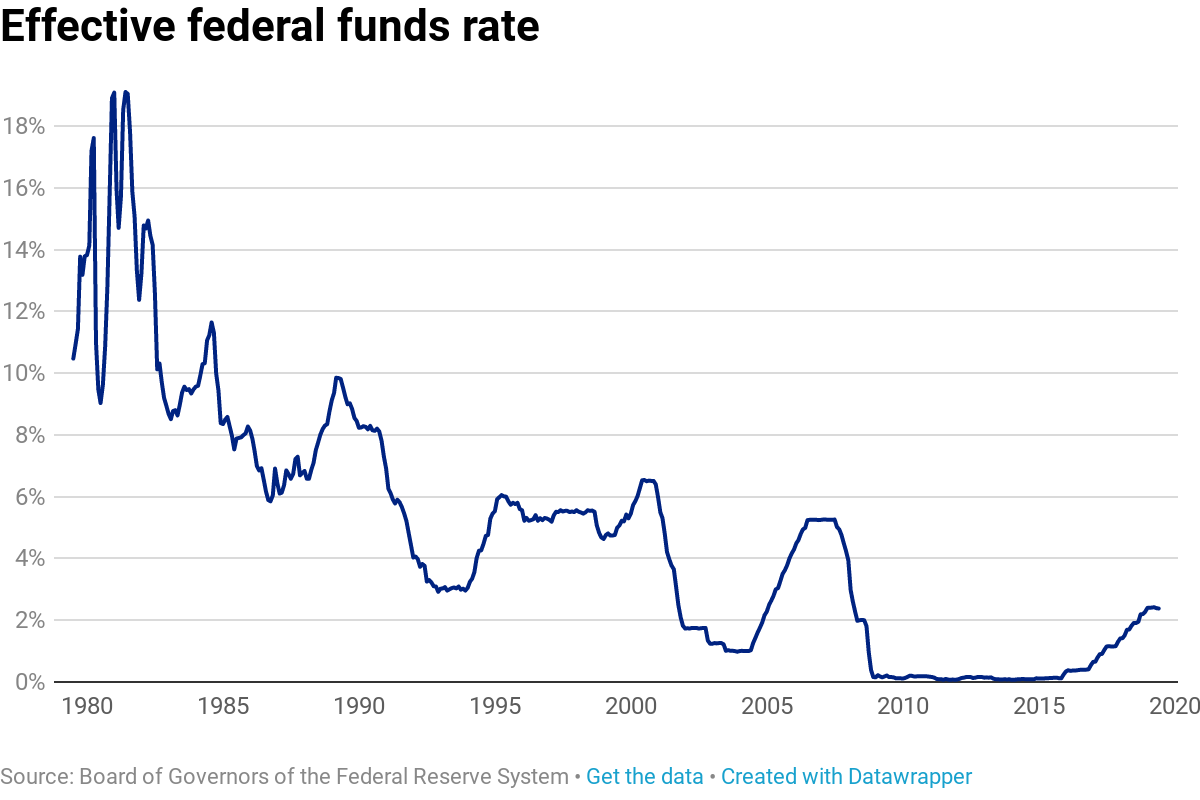
Previously in the USA, as an example, before the Fed was created. The government did not spend much as a percentage of GDP. And the private saving rate was high. So people consumed what they valued for today. And they saved so they could spend more tomorrow. To create more wealth for themselves. They bought real estate. They bought stocks. They bought bonds. And they saved by making deposits in banks. For most, they accumulated wealth through the power of compound interest. Albert Einstein once described compound interest as “the eighth wonder of the world”. “He who understands it, earns it; he who doesn’t, pays it”.
For the most part, real interest rates were positive. And there was no inflation. During the 19th Century, in the USA, prices actually deflated except during wartime. It is a myth that deflation is bad. Deflation should be the norm. If a society is productive and productivity is increasing through time. And we innovate. That means we keep making more for less. We allocate resources more efficiently. Or we produce better things. Deflation is natural. We have been tainted by the deflation which occurred during the Depression of the 1930s and lost a broader, deeper and more historical perspective.
An economist forgotten today, Jean Baptist’s Say wrote:
It is worthwhile to remark that a product is no sooner created than it, from that instant, affords a market for other products to the full extent of its own value. When the producer has put the finishing hand to his product, he is most anxious to sell it immediately, lest its value should diminish in his hands. Nor is he less anxious to dispose of the money he may get for it; for the value of money is also perishable. But the only way of getting rid of money is in the purchase of some product or other. Thus the mere circumstance of creation of one product immediately opens a vent for other products.
And further stated that:
Money performs but a momentary function in this double exchange; and when the transaction is finally closed, it will always be found, that one kind of commodity has been exchanged for another.
The interest rate, without manipulation of either the money supply or the interest rate itself, equilibrated saving and investment.
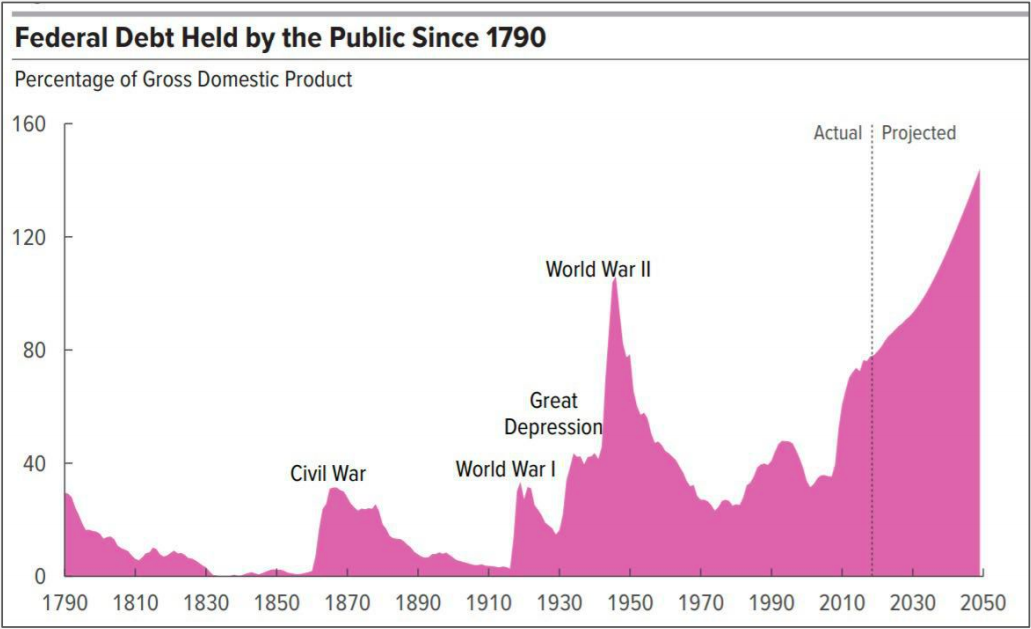
Since 1971, we abandoned any sense of market discipline and substituted Central Bank discretion. And fiscal policy, no longer encumbered by honest money but dishonest discretionary money, became significantly more interventionist, activist and and expanded is presence with respect to how economic activity is organized. Governments borrowed more. Companies borrowed more. People borrowed more.
John Exter, a NY Fed Vice President, wrote, as a consequence of our abandonment of gold and Bretton Woods in 1971:
Today no money in the world fully performs all three services. National currencies are being used as means-of-payment and standard-of-value money, but none in this inflationary age is an assured store-of-value money.
In fact, a foremost concern to voters and politicians everywhere is that so many currencies are so rapidly losing their value in terms of commodities and services. Commodities like gold and silver, which are being used as store-of-value money, are not being used as either means-of-payment or standard-of-value money.
Thus the world we have so long known, in which most currencies were redeemable at a fixed price in a store-of-value money like gold, is in disarray. People are confused and wondering what money they can trust.
So today all currencies in the world are saying, 'I do not owe anybody anything.' Each one says, in effect, 'IOU nothing' in the way of any commodity that is a store-of-value money.
Governments will always try to shore up IOU-nothing money with laws making it legal tender, or even laws prohibiting the holding of store-of-value money like gold, but such laws cannot for very long add value to something that is losing value in the marketplace. Gresham's Law, which is really a special form of the law of supply and demand, will override man-made laws. In fact, there would be no Gresham's Law if governments did not persistently try by man-made laws to over-value their IOU-nothing money in terms of store-of-value money.
So it is a 'Who owes you nothing?', and 'When?', and it does not even pay a market rate of interest, only l½%. If central banks ever monetize them in significant amounts, they will have moved from days when they issued their IOUs principally to buy enduring store-of-value money like gold, to these days when they issue their IOU-nothings principally to buy government IOU-nothings, to days when they would issue their IOU-nothings to buy who-owes-you-nothings.
In days to come, international monetary reformers will have to consider whether these new kinds of money will produce a stable monetary world. In the world's marketplaces will they hold their value against goods and services in general?”
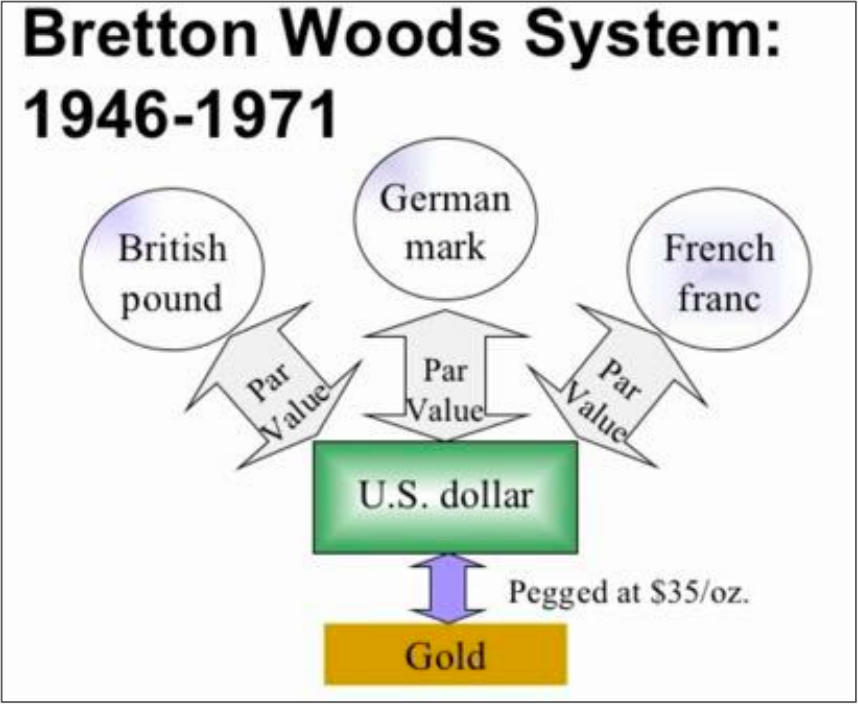
I quote John Exter at length. An article he published in 1972 to point out how prescient he was. You would think that someone who so accurately predicted the consequence of our abandonment of gold would be more prominent to those studying economics and finance. Unfortunately the academic curriculums have practically erased any history that questions the Central Bank monopoly control over money. Fiat paper money.
What replaced Bretton Woods? The petrodollar and dollar hegemony. We substituted a system that required the USA to practice both monetary and fiscal discipline. So everyone would be indifferent to whether they had gold or dollars or where gold was as good as dollars and dollars as good as gold. The global economy was predicated upon that assumption. That the dollar would be trusted if its purchasing power with respect to gold was maintained and preserved. The USA breached that trust. And replaced it with dollar hegemony. The Petrodollar.
The Petrodollar meant that all oil produced would be invoices exclusively in dollars. So all oil-importing nations would need to hold dollars to purchase oil. Wherever oil traveled, the US dollar was attached. John Connally, then Treasury Secretary under Nixon as we exited and abandoned Bretton Woods famously told the Europeans and Japanese that “The dollar is our currency, but it’s your problem”.
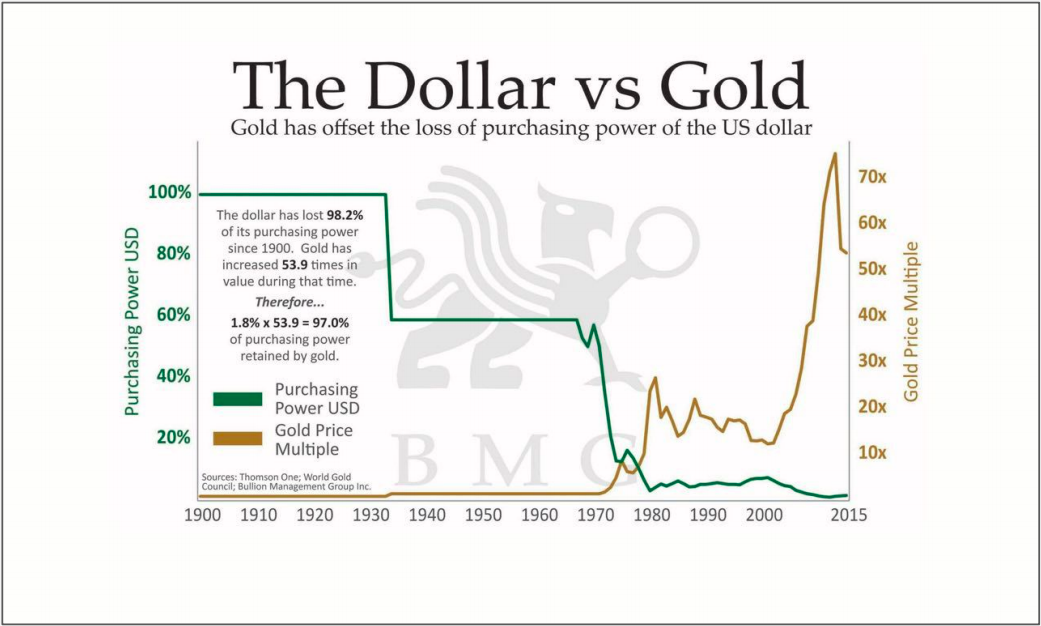
Then fiscal policy got expansionary in the USA. Government debt grew. Money supply grew. Inflation emerged. And the world implicitly acknowledged what Exter said, fiat paper money is equivalent to IOU Nothings. The gold price went from the Bretton Woods fix of $35 in 1971 to $600 in 1980. Oil rose, during the same period of time, from about $4/barrel to $40/barrel. Oil rose less as a result of OPEC but more of a result to the USA debasement of the dollar versus gold due to inflationary policies now that the USA was no longer encumbered by a fix to gold. And as Connally correctly bragged, it became everyone else’s problem.
The Japanese referred to him as “Typhoon” Connally. He was Governor of Texas when JFK was assassinated in Texas. He was Treasury Secretary when Nixon assassinated Bretton Woods.
Inflation had many bad effects on the economy. I think the best way to illustrate that impact is a measurement called Tobin’s Q. It is the ratio of a physical asset’s market value and it’s replacement value. At the establishment of Bretton Woods, Tobin’s Q was approximately 0.40 and rose to about 1 during the 1960s. Once both monetary and fiscal policies threatened the credibility of the gold dollar fix, Tobin’s Q started going down. And by 1980, is was under 0.40. A huge drop in a short period of time. There are many flaws in the use of Tobin’s Q as a proxy for firm value. But the general point is still valid, the 1970s, when the world lost faith in the dollar. As Americans did as well. There was a significant decline in the marginal productivity of capital and a reduced incentive to invest. The 1970s also witnessed an aggressive use of Keynesian policies. Maybe, in some respects, a misapplication.
As a side note, when many say the USA interferes in the Mideast because it is about oil. I believe it is not about oil but about the Petrodollar and the preservation of dollar hegemony.
The decade of the 1980s ushered in a paradigm shift away from Keynesian and embracing economic freedom. The Reagan-Thatcher partnership. Reagan, advised by Milton Friedman. Thatcher, advised by Hayek. In less than 2 years, gold went from over $650 to under $350. Oil went during a similar period of time from about $40/barrel to about $10/barrel. And Tobin’s Q rose from approximately 0.30 to 1.00.
The severe recession that occurred during the beginning of the Reagan Administration in the USA was deep but short. There was no Keynesian remedy applied but a return to the wisdom prevailing before Keynes and articulated by Jean Baptiste Say. Supply side economics. Not demand side economics. Anchored by a strong dollar.
Real economic growth in 1983, 1984 and 1985 were, respectively 7.90%, 5.58% and 4.18%. To put that in perspective, since the end of the Reagan Administration the USA has never had annual growth of 5.00%. During the 8 years of the Reagan Administration, annual economic growth exceeded 4% four times. Since then, now 31 years later, real economic growth has exceeded 4% only seven times, five of which occurred during the Clinton Administration during his second term when gold prices went from about $400 to $250. Again, low tax rates, fiscal discipline, the government budget went from deficit to surplus and anchored by a strong dollar. Clinton acknowledged that the era of big government was over and scholars have argued that Clinton extended the economic policies of Reagan. With low inflation and a government surplus, Greenspan became concerned about the consequences of a dearth of risk-free assets (USA Government bonds) and deflation. Greenspan added significant liquidity into the financial system. In 2000, gold averaged $280. In 2012, gold averaged $1669.
During this period of time, the global economy has created a huge increase in debt on all levels; governments, corporations, consumers. Wage stagnation. Poor productivity growth. We are borrowing significantly more to stay even or progress incrementally. We have experienced government debt defaults, bank bailouts, bank bail-ins. Central Banks have expanded their balance sheets in a way without precedent. Not only in the size of its balance sheet, but the capital market instruments being bought. We are significantly more leveraged today than we were in 2007.
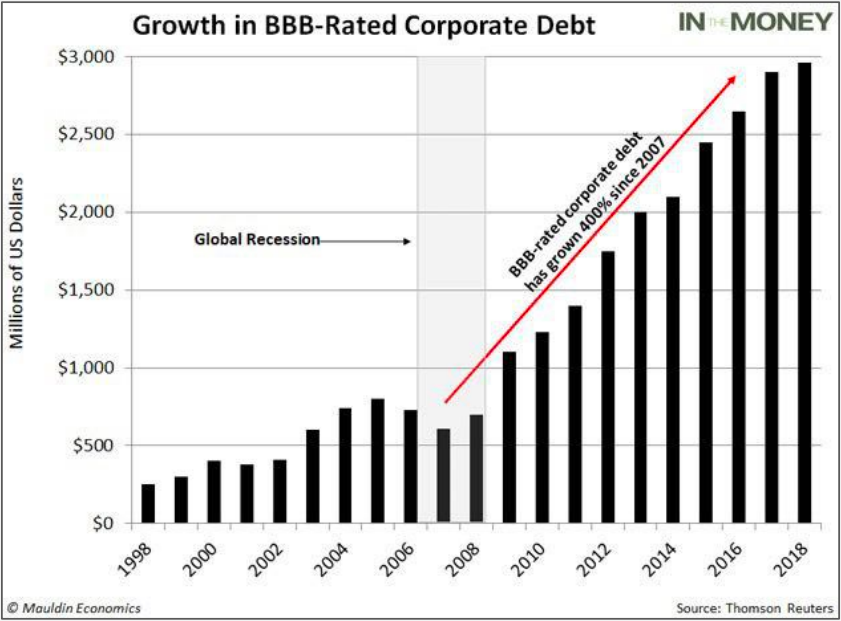
Government institutions have failed us. Financial institutions have failed us. The enormous fines they have paid as a result of the various ways they have cheated. Rating agencies have failed us. Regulators have failed us. Accounting firms have failed us. Law firms have failed us.
We had a system designed for checks and balances and empowered third parties as trusted intermediaries.
All these institutions and centralized, third party intermediaries have violated our trust. Have lost our trust. Establishment candidates are being defeated everywhere. Nationalism grows. Populism grows. The pre-existing paradigm is no longer accepted.
The most valuable currency is trust. It is the foundation of all exchange, however denominated. It is the foundation for all relationships. A system of third parties intermediating that trust was established and failed. It’s failure, in my opinion, is unequivocal!
A white paper written by Satoshi Nakamoto in 2008 proposed a trust revolution. Money would now be issued without nationality and travel anywhere and everywhere. Its monetary policy well defined and immutable. Predictable. Not subject to discretion. It’s proof of work consensus mechanism works if enough believe in the value of bitcoin. Otherwise no one would make the required capital investment and put the effort into mining or being a node in the system. People contribute work. The work is performed to validate the ledger, a trustless ledger as trust is embedded in the protocol. What is required of the ledger. To confirm each transaction as real. That no counterfeit currency exists. The trust issue is solved through incentives. Analogous to the invisible hand described by Adam Smith.
We fill our wants and needs only by fulfilling the needs and wants of others. When exchange is purely voluntary, it meets the test of coincident wants and needs. Otherwise, exchange would not occur. No force. No violence. No coercion. No asymmetry of power. No cronyism. No political influence. No border. No gender. No religion. No nationality. No ethnicity. Identity is irrelevant.
Martin Luther King talked about a world where freedom and liberty only existed if we are judged not by the color of our skin but by the content of our character. To me, that means we are not judged by by any innate quality that is inherited or circumstantial but we are judged by our deeds, actions, attributes the derive from the choices we make. Individual choices. No other aspect of our identity is irrelevant. I think MLK might have been dreaming about bitcoin.
Part II
Thomas Jefferson is my favorite Founding Father. The principle author of the Declaration of Independence. So as I expand, Part 2, I want to cite Jefferson. Why do I think the Founding Fathers are so interesting is because the USA first presented to the most powerful monarchy at the time a formal list of grievances. And asserted that since those grievances were deemed by them to be legitimate yet ignored, that the colonies had no other option but to declare its independence. The last sentence of the Declaration of Independence reads as follows:
And for the support of this Declaration, with a firm reliance on the protection of divine Providence, we mutually pledge to each other our Lives, our Fortunes and our sacred Honor.
After defeating the British, the colonies started with a blank slate. There were 13 independent colonies All with a healthy distrust of centralized power and authority. The Articles of Confederation were ratified in 1781 conveying very little authority to the Federal government nor the ability to claim resources through taxation.
Between the time of ratification of the Articles of Confederation in 1781 and the implementation of the Constitution in 1789, there were 10 Presidents of the Continental Congress during those 8 years. And the money printing produced a currency that was deemed so worthless, hence the expression “not worth a Continental.”
The Constitutional Convention produces a discussion and a final document as a consequence to that discussion addressing the issue of governance, centralized and decentralized, checks and balances. A concern about the inefficiency of decentralization but the abuses that were prone in centralized systems. And how dishonest money would was such a dangerous corrupting force.
Please consider the following from Jefferson.
I am convinced that those societies (as the Indians) which live without government, enjoy in their general mass an infinitely greater degree of happiness than those who live under the European governments. Among the former, public opinion is in the place of law, and restrains morals as powerfully as laws ever did anywhere. Among the latter, under pretense of governing, they have divided their nations into two classes, wolves and sheep. I do not exaggerate... Experience declares that man is the only animal which devours his own kind; for I can apply no milder term to the governments of Europe, and to the general prey of the rich on the poor." --Thomas Jefferson to Edward Carrington, 1787. ME 6:58
Further. Again Jefferson.
Mankind soon learn to make interested uses of every right and power which they possess, or may assume. The public money and public liberty, intended to have been deposited with three branches of magistracy, but found inadvertently to be in the hands of one only, will soon be discovered to be sources of wealth and dominion to those who hold them… They [the assembly] should look forward to a time, and that not a distant one, when a corruption in this, as in the country from which we derive our origin, will have seized the heads of government, and be spread by them through the body of the people; when they will purchase the voices of the people, and make them pay the price. Human nature is the same on every side of the Atlantic, and will be alike influenced by the same causes. The time to guard against corruption and tyranny, is before they shall have gotten hold of us. It is better to keep the wolf out of the fold, than to trust to drawing his teeth and talons after he shall have entered.
And,
The sheep are happier of themselves than under the care of the wolves. --Thomas Jefferson: Notes on Virginia Q.XI, 1782. ME 2:129
My preference is to avoid being under the care of the wolves.
Economics and politics do not fall under natural science but social sciences. Natural science relies upon what we can physically observe and measure. Thinks that are naturally occurring. Social science study interactions among people, human action and behaviors.
Adam Smith not only wrote The Wealth of Nations but Lectures on Jurisprudence and The Theory of Moral Sentiments. And Mises, On Human Action.
Economics has perverted itself from its roots as a moral science regarding wealth creation through voluntary exchange and human interaction into a quantitative exercise in resource allocation, as if economics has transformed itself into an engineering problem or a natural science, not a social science. A Newtonian world, a clockwork universe. Where we pretend we can measure and observe everything, precisely define and measure cause and effect, perform experiments and have perfect predictability. That we have successfully modeled the consequences of all human interactions and can control just by passing some laws and having the enlightened few use their discretion and proprietary models to eliminate the business cycle, preserve price stability and remove risk from our lives. As a result, economists basically have become noise, incoherent and without insight. The hubris of presumed omniscience.
Frederic Bastiat wrote:
I cry out against money, just because everybody confounds it, as you did just now, with riches, and that this confusion is the cause of errors and calamities without number. I cry out against it because its function in society is not understood, and very difficult to explain. I cry out against it because it jumbles all ideas, causes the means to be taken for the end, the obstacle for the cause, the alpha for the omega; because its presence in the world, though in itself beneficial, has nevertheless introduced a fatal notion, a perversion of principles, a contradictory theory which in a multitude of forms, has impoverished mankind and deluged the earth with blood. I cry out against it, because I feel that I am incapable of contending against the error to which it has given birth, otherwise than by a long and fastidious dissertation to which no one would listen. Oh! if I could only find a patient and right-thinking listener!
The essential attributes money must have are divisibility, portability, durability, recognizability and scarcity. Money was not created by the State. A committee did not originate money. A committee was not and is not needed to maintain money. A monopoly over money is a dangerous grant of power by the State. An honest money emerges by consensus, not force. Otherwise is violates nature. It is unnatural.
As early as the Book of Genesis in the Hebrew Bible, the first time money is mentioned is a purchase Abraham made with silver. Gold and silver have been the most common forms of money throughout history. At the origins of the USA, the dollar that circulated was the Spanish Milled Dollar. Defined in units of gold and silver. Fixed quantities of gold and silver. The dollar was divided into “pieces of eights”. For several centuries it was the most stable and least debased coin. It is also why the New York Stock Exchange traded in denominations of eighths.
And Adam Smith said the “All money is a matter of belief.” And as Exter said regarding fiat paper money, IOU nothings. Recently the former CEO from Credit Suisse stated that “…money is not worth anything anymore. That “negative interest rates are crazy”. Further, a recent BIS Report concluded that the unprecedented growth in central banks’ balance sheets have had an adverse impact regarding the functioning of capital markets. To put it more simply, financial markets are dysfunctional, no longer price risk appropriately and pervert the allocation of capital. Exacerbating inequality while, as a whole, making us poorer on an economic basis after considering the accumulation of what I refer to as odious debt.
In 1927, jurist Alexander Sack described odious debt as debt issued by the State strengthen its power and repress the population. Hostile debts and profligate debts have been included in the definition of odious debt. And that the debtor and creditors are aware of its odious purpose.
The Central Bank is quite aware, as are banks and Wall Street, that the spending is profligate and much has been spent on endless wars, hostile acts.
Few, if any believe we will grow our way of the debt. Some believe we can both increase it and roll it over into perpetuity. I think few would actually being willing to attest to that under oath and subject to perjury charges. There are some though who are in the eternal free lunch school of economic theory where there is no limit to debt issuance by sovereign nations and that the market can absorb an infinite supply without any use of the Central Bank balance sheet.
I guess they would argue that independent of economic growth, there is no limit to debt that could be issued and that future taxes would never have to be raised in order to sustain the debt already outstanding plus the incurrence of additional debt.
It seems evident to me that if we are issuing debt today that will require tax increases in the future. If that spending is not of an investment nature like infrastructure projects or others whose revenues would offset the spending, like a capital budget, but used for current operations like wars, surveillance, transfer payments, entitlements. That seems clear to be a case of taxation without representation. Hostile debts. Profligate debts. And that those who did not have the opportunity to vote for the debt incurred should have no liability for its amortization or repayment.
Ben Franklin wrote: “The refusal of King George to allow the colonies to operate an honest money system, which freed the ordinary man from clutches of the money manipulators was probably the prime cause of the revolution.”
Howard Buffet, father of Warren Buffet, when he was a Congressman argued that “paper money systems have always wound up with collapse and economic chaos”.
James Madison warned us that “If Congress can employ money indefinitely, for the general welfare, and are the sole and supreme judges of the general welfare, they may take of religion into their own hands; they may appoint teachers in every state, county, and parish, and pay them out of the public treasury; they may take into their own hands the education of children, the establishing in like manner schools throughout the union; they may assume the provision of the poor.... Were the power of Congress to be established in the latitude contended for, it would subvert the very foundations, and transmute the very nature of the limited government established by the people of America."
Alexis de Tocqueville described democratic socialism: “That power is absolute, minute, regular, provident, and mild. It would be like the authority of a parent, if, like that authority, its object was to prepare men for manhood; but it seeks on the contrary to keep them in perpetual childhood; it is well content that the people should rejoice, provided they think of nothing but rejoicing. "For their happiness such a government willingly labors, but it chooses to be the sole agent and the only arbiter of that happiness; it provides for their security, foresees and supplies their necessities, facilitates their pleasures, manages their principal concerns, directs their industry, regulates the descent of property, and subdivides their inheritances -- what remains, to spare them all the care of thinking and the trouble of living." "After having thus successively taken each member of the community in its powerful grasp, and fashioned them at will, the supreme power then extends its arm over the whole community. It covers the surface of society with a network of small complicated rules, minute and uniform, through which the most original minds and the most energetic characters cannot penetrate, to rise above the crowd. "The will of man is not shattered, but softened, bent, and guided -- men are seldom forced by it to act, but they are constantly restrained from acting. Such a power does not destroy, but it prevents existence; it does not tyrannize, but it compresses, enervates, extinguishes, and stupefies a people, till [the] nation is reduced to be nothing better than a flock of timid and industrious animals, of which the government is the shepherd."
We are living in a low interest rate trap. Counterintuitively and perversely, this trap is not only exacerbating wealth inequality but adversely and negatively impacting economic growth. Reducing incentives to invest in productivity growth. Industries will become more monopolistic over time. As markets get less contestable and the dominant, monopolistic firms no longer face any intense competition they will evolve into lazy monopolists.
An inflationary monetary policy regime suffers from the ramifications of the Cantillon Effect. A regressive tax. Those who can create the most leverage at the lowest cost and quickest, win. Everyone else loses.
Economic growth is a result of human creativity, the freedom and liberty we have to organize ourselves, on a voluntary basis, to innovate, use our mind, our imagination, our skills and talents in serving ourselves through serving others. Liberty, not power. Exchange, not aggression.
In my opinion, the current global regime is unsustainable. Fiat paper money will fail, as it always has. And for the same reason it always has. Unfortunately so many have a perception that anything that happened prior to their birth is ancient history and not worth knowing. They lack perspective. They lack wisdom.
Money being debased is a consequence of debasement and abuse of trust. The intermediation of trust through supposed trusted third parties. It is only force, legal tender rules that keep fiat paper money in circulation. And most either have tunnel vision or believe this time will be different. That there is no limit to indebtedness. No limit to the growth of central banks’ balance sheets. That somehow increased market concentration, further concentration of economic and political power, little investment and low to non existent productivity growth will make us wealthy.
Or maybe, we will get better socialists managing the allocation of resources than Maduro, Castro, Chavez. That we pursue the path to serfdom.
I bet on the trust revolution. On bitcoin. Immutability. Decentralization. Trustless. Scarce. Easy to divide. Easy to transfer. No need for intermediary. The ledger does not lie. No one can debase it. No controlling authority. I believe we are in the beginning of forming a new social consensus. It will be a global one. Independent of geography. Independent of religion. Independent of nationality. Independent of culture. Independent of ethnicity. Independent of gender, however gender is defined.
Denationalized money, tokens, circulate though social consensus and trust. Voluntary. Organic. Emergent. Market process. And as a consequence of economic activity.
Fiat paper money exists only through the monopolistic force of the State. Legal tender laws. The subsidization of financialization where the production of money is delinked from economic activity and its production and transmission is non neutral and perversely transfers wealth even in the absence of wealth creation. Even during wealth destruction. Without social consensus. Without consent. Odious money. Odious debt. In violation of natural law.
I will sell everything else before I sell my bitcoin. If you believe in freedom. Liberty. Personal sovereignty. And a society predicated upon trust. Where individuals are empowered. Where liars and cheaters no longer prevail. Where we value cooperation. Transparency. Then buy bitcoin. Mine bitcoin. Hold bitcoin. It is permissionless. And it is yours. And you retain some sense of privacy.
Fiat paper money is dishonest, corrupt, deceitful and managed by a cartel. Distrust and power are its currency. The use of fiat requires permission. It is subject to confiscation. You surrender all privacy. It enslaves. Not liberates. So if you are a liar and a cheater. And corruption and malfeasance is your game. Fiat paper money is your currency.
Community posts are hand selected contributions from our network. To have your work featured here please contact us at research@messari.io.