DeFi's Invisible Revolution

Key Insights
- Despite a bleak short-term outlook, DeFi’s early successes have made it clear that software will replace the world’s analog financial plumbing.
- DeFi’s Invisible Revolution will be characterized by several macro-industrial shifts including socialized operating expenses, embedded financial services, and deep market liquidity.
- Crypto’s distributed nature will allow users to check nation-state powers while real-time verifiability will give DeFi the tools needed to comply with nation-state regulators.
Crypto experienced a historic bull run during the last 24 months. Its opening and closing chapters were marked by DeFi’s promise to usher in a global economy, accessible to anyone with an internet connection. Between these two ends, DeFi experienced steady adoption while the market’s attention shifted to NFTs, Web3, and play-to-earn games. Despite periods of volatility, the supply of stablecoins grew in tandem with the ratio of total value locked (TVL) / market cap. This ratio adjusts for prices and serves as a better proxy for the value held in DeFi than the standard TVL measurement.
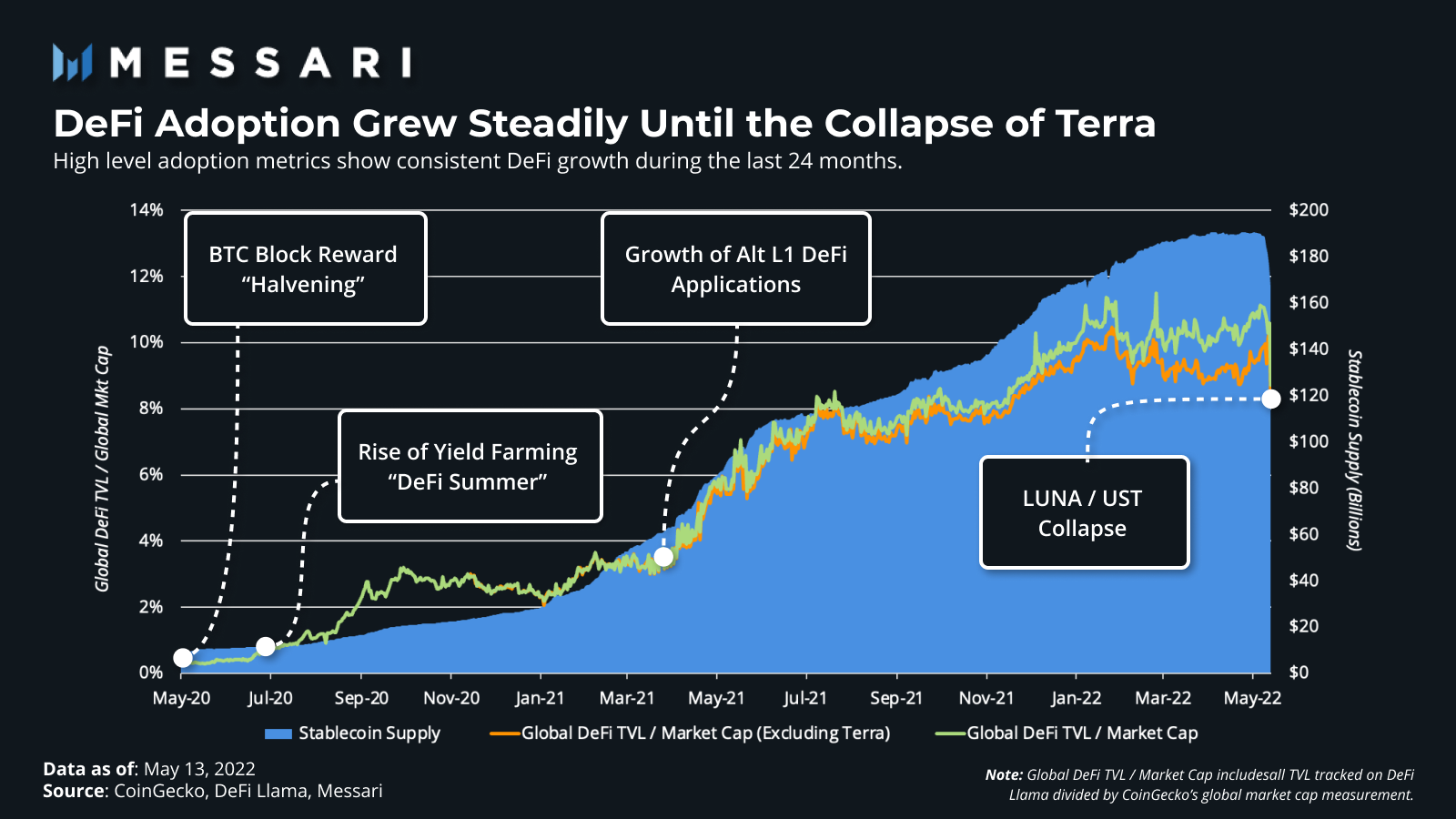
The recent bank run on Terra’s UST stablecoin returned DeFi to the public eye as $28 billion worth of value evaporated from the network in a matter of days. Just two years after the world discovered its programmable building blocks, DeFi finds itself careening into a trough of disillusionment. Hopes for a mass-scale, decentralized stablecoin have been temporarily crushed. Scaling and interoperability solutions are still in early-stage development and can’t support crypto’s global user base en masse. It’s also likely that hawkish nation-state regulations are on the horizon.

Chase's interest in crypto lies at the intersection of economics, psychology, and social coordination.