The impact of negative rates on the economics of DeFi

The price of money, or what you're willing to pay at some point in the future for money now, is a simple concept, and yet the means for which it is derived is much less intuitive. It doesn’t require a master’s in finance and economics to understand that the rate you pay on an overdue credit card or a home loan is more or less a result of how likely you are to pay it back, but you may need to go deeper to wrap your head around the levers that the Federal Reserve uses to alter overnight borrowing rates.
Without getting into too much detail, the Fed sets a price floor (interest on excess reserves) that member banks can deposit money and earn interest on and a price ceiling (discount rate) that they can pay in order to borrow funds overnight. The difference between these two rates is known as the Federal Funds Rate, and it is the rate member banks pay each other to borrow funds overnight. The Fed Funds rate has implications on virtually every economic transaction in the world. As Qiao put it, it’s
“arguably the most important interest rate in the world, as it propagates throughout the rest of the economy. To business loans. To mortgages. To auto loans. To credit cards. Even to the stock market. Lowering this benchmark rate means cheaper borrowing costs, and therefore potentially more willingness to spend and to invest”
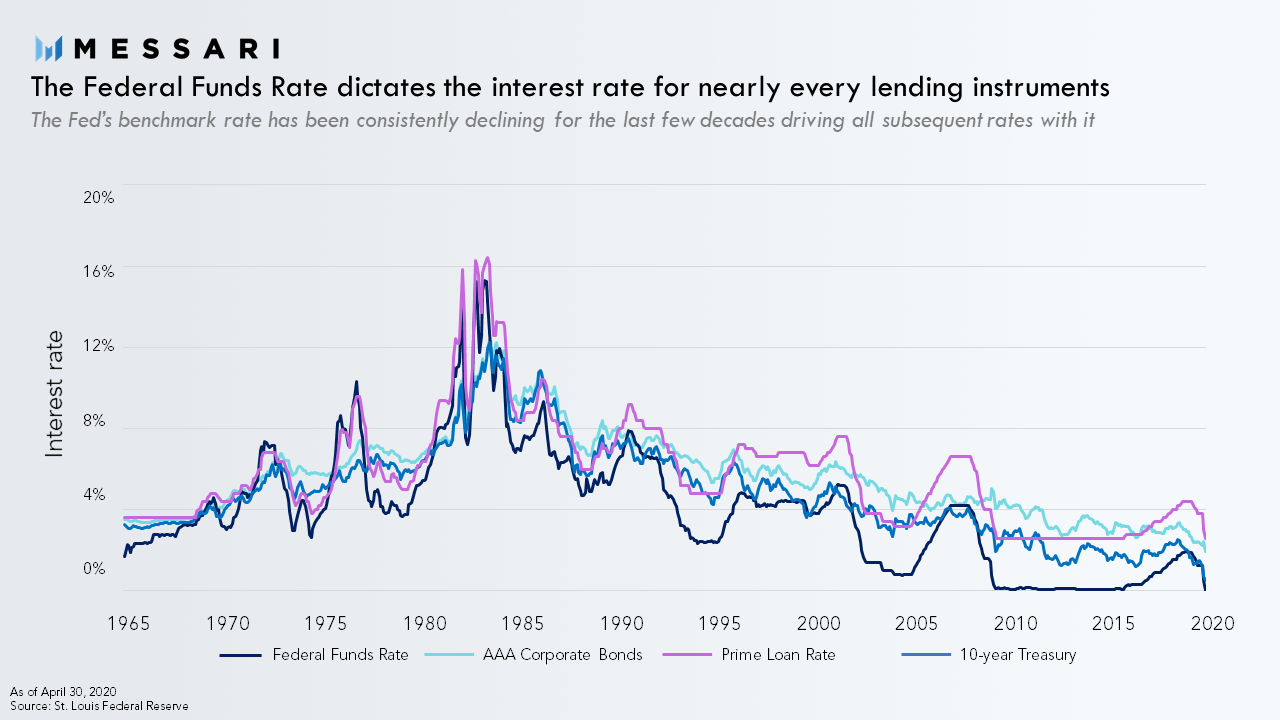
And over the last 40 years, the Fed Funds Rate has steadily declined, bringing with it rates on practically every lending instrument, increasing this propensity to borrow and spend. The few blips up were the Fed’s attempt at cooling down credit markets but without fail they always seemed to continue this downward trend.
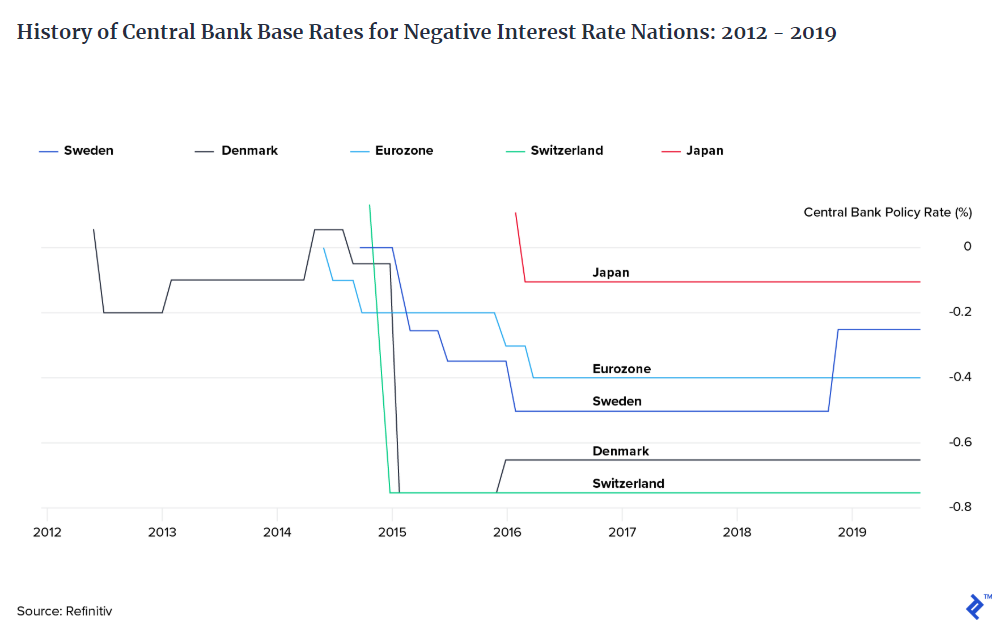
As we’ve been accustomed to for the better part of the last decade, overnight rates in the U.S. are now back at zero while the dire economic situation brought on by this pandemic has jump-started discussions to enter negative territory. The rationale is that negative interest rate policy (NIRP) is needed to spur the necessary credit creation required to fend off runaway unemployment. Historically there has been a delicate balancing act between the lowering of rates and fighting off inflation, but as we’ve seen in the last five years of negative rate experimentation, this has not become a problem in the countries it has been implemented.