The global response to the economic ice age

The Economic Ice Age
Many economies around the world are frozen as governments look to prevent the spread of the coronavirus through widespread lockdowns and social distancing measures. These measures have disrupted global supply chains, halted global trade, and brought many industries to their knees due to an overnight demand shock.
Economic time is stopped, but financial time keeps ticking. While bills still need to be paid and income remains depressed if not completely eliminated, governments have stepped in to help bridge the gap from now until the economy reopens. The response so far has been enormous both in nominal and relative terms.
The Fiscal Response
Fiscally, governments have spent ~$5 trillion dollars or 5.9% of global GDP on relief to individuals, small businesses, and corporations in the form of loans, tax breaks and direct payments.
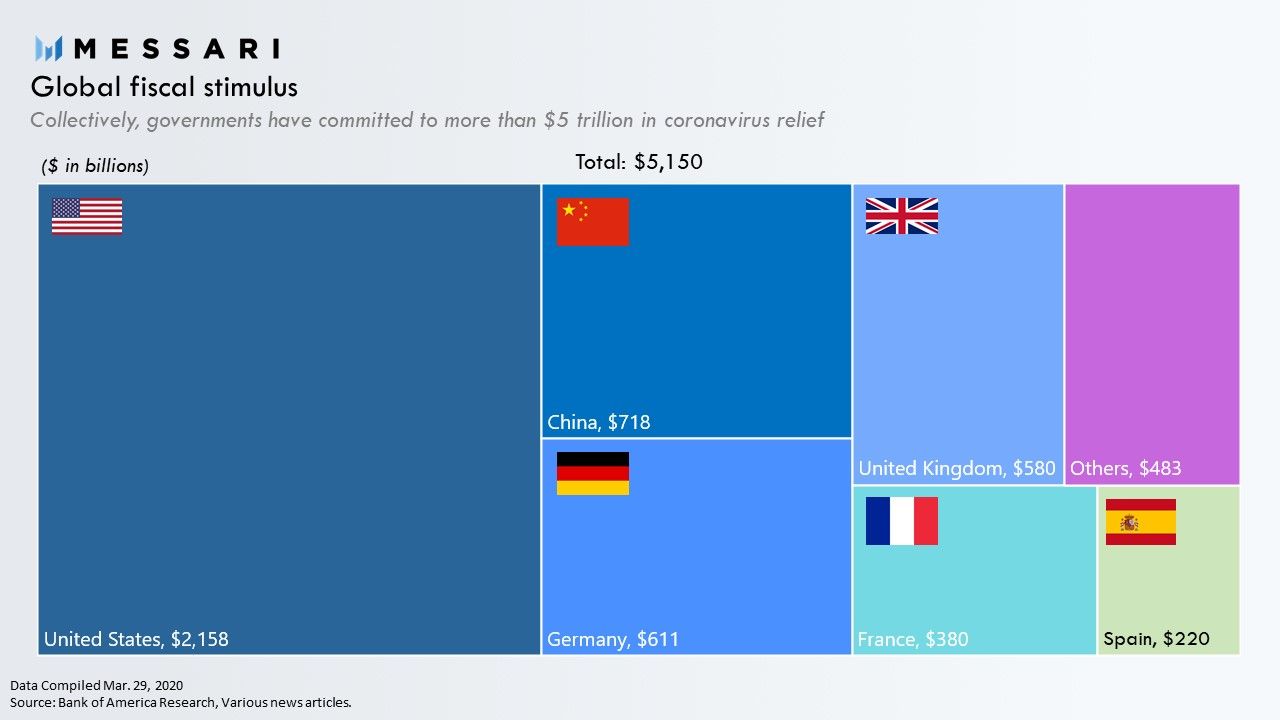
While the US takes the crown for the largest relief measures so far, in relative terms, some governments have gone far beyond what the US has provided. Singapore, for example, has committed a substantial portion of what it typically spends in a year on its economy to fight the coronavirus.

Ryan Watkins was a Senior Research Analyst at Messari. Previously, he worked at Moelis & Company as an Investment Banking Analyst where he worked on deals in the technology, telecom, and fintech sectors. Ryan graduated Magna Cum Laude from the Gabelli School of Business at Fordham University.