The Future of L1s Is NEAR: An Analysis of an Emerging Protocol

Layer-1 blockchains have become a crowded and competitive arena. When Bitcoin was first introduced in 2008, it had the space all to itself for years before any real challengers emerged. Today there are over 100 different Layer-1 blockchains competing for the nearly $2 trillion dollars allocated across the broader crypto ecosystem. Despite this enormous market size, just two players, Bitcoin and Ethereum, control over 50% of the total market. Most new entrants have focused on the smart contract space where Ethereum historically has held market dominance. The slew of new players have successfully gained impressive traction over the past 18 months. Looking at Total Value Locked (TVL), a measure of assets deposited in a protocol, Ethereum held 97% of the total smart contract market at the start of 2021. As of March 2022, that figure has fallen below 60%.
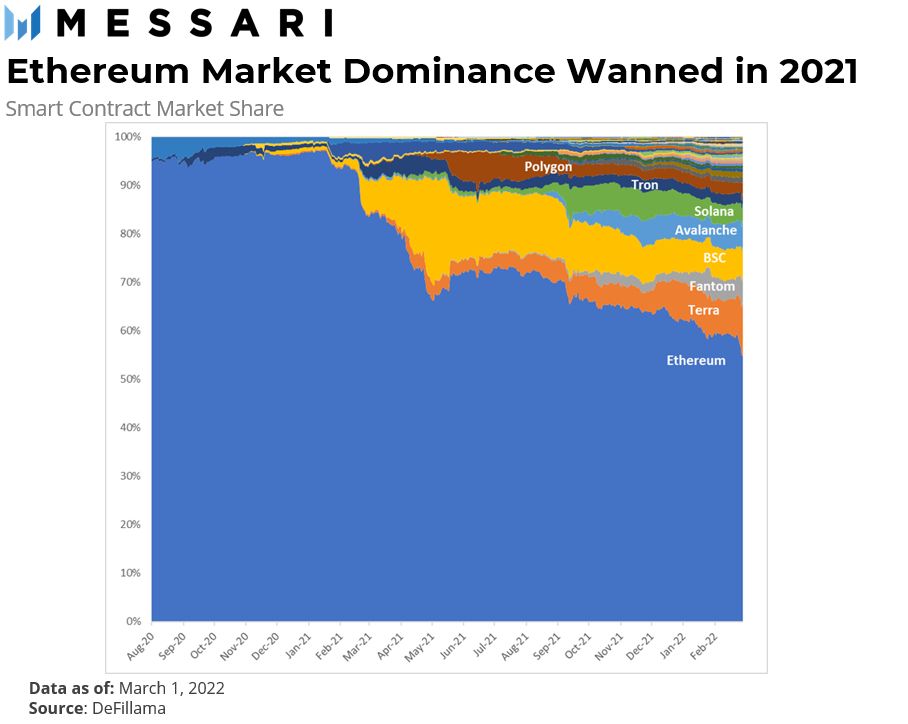
New market entrants have tried to improve on whatever Ethereum currently lacks: namely, they are faster, cheaper, or provide a more attractive reward structure. Because the smart contract space has become so large and has continued to grow so rapidly, it is no surprise that competition has increased. But how many winners can there be?
As highlighted in the Messari’s Crypto Theses for 2022, technology platforms trend towards duopolies. Ethereum and the Ethereum Virtual Machine (EVM) have such a head start that it would be hard to overtake them completely. Moreover, there is a legion of developers and builders building on the EVM already. The EVM’s advantage has been so great that major competitors use or bridge to the EVM, rather than try to compete head-to-head without this capability. Even competitors that held out like Solana and Cardano have recently added or are adding EVM compatibility (Terra being the notable exception). In many cases, the EVM has already cemented itself through its network effects.
So, what will be the next major platform if we think the smart contract space will be dominated by two players? Solana, Avalanche, and Terra made strong cases in 2021, each growing in market share (measured by TVL) at 4%, 5%, and 8%, respectively. Cardano had long been the number two smart contract platform by total market value, before recently being passed by Terra and BNB. After a multi-year delay, Candano’s smart contract capabilities were finally enabled on the network in September 2021. Since then, Cardano has only managed to capture an additional 0.05% of the smart contract market share.
A new protocol entered the fray in mid-2020 to try and lay claim to the throne. With an impressive team, strong funding, and novel underlying technology, NEAR Protocol rapidly grew to a $10B+ market cap within a year of its public launch. This report serves as an introduction and critical analysis of this new Layer-1.
Protocol and Team Overview

Tom is a Sr. Research Analyst at Messari. His primary focus is on Layer-1's as well as the relationship between traditional finance and crypto. Prior to joining Messari, Tom worked in Investment Consulting at Meketa and Investment Management at SSGA. Tom studied Finance at Bentley University and earned his CFA and CAIA Charters.