The EIGEN Token: Powering the EigenLayer Ecosystem

Token Distribution
The much anticipated EigenLayer airdrop was finally announced on the 29th of April 2024, however, it was received relatively controversially by the wider community. The Eigen Foundation allocated 15% of the initial EIGEN token supply to its stakedrops (airdrops) and split it into different seasons. Season one intends to give away 5% of the total supply to those staking before May 15th, 2024. However, there was major pushback from the community on the high gas costs associated with restaking, hence an additional 100 EIGEN tokens were awarded to everyone who interacted with EigenLayer before April 29th, 2024. This updated token allocation was not an increase in the initial airdrop allocation, rather tokens were moved forward from later seasons to season one. The breakdown of the initial token distribution is shown below.
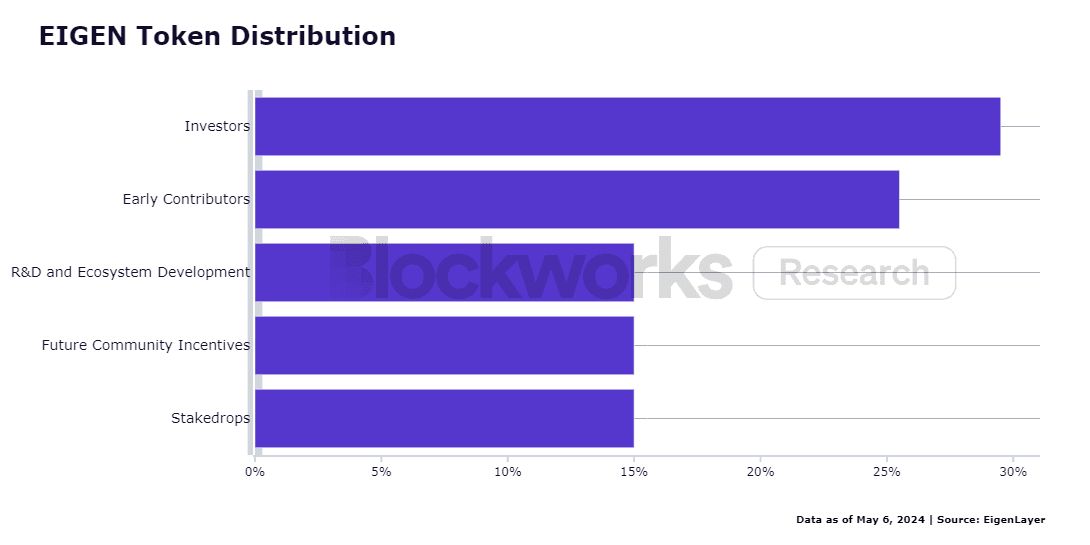
The breakdown roughly translates to an even split between the community (45%) and investors & early contributors (55%). In the past, efforts to grow blockchain ecosystems have typically focused on funding the development of protocols and applications that build on the network's infrastructure. This approach prioritizes directly rewarding users for participating rather than attracting developers and creating new tools. Investors and early contributors are subject to a three-year lock-up period on their investments with a one-year cliff and two-year vesting period. During the first year they cannot withdraw any funds while during the following two years, there will be a gradual release of 4% each month. Notably, the lockup period for investors and the team doesn’t start until sometime after September 30th, 2024. Interestingly, the total number of EIGEN tokens was set at 1,673,646,668 - a number chosen by encoding the phrase “Open Innovation” onto a classic telephone keypad. However, it is important to note that this is not the maximum supply as EigenLayer, like Ethereum, will have a dynamic token supply. While the EigenLayer team hasn't finalized the emission schedule, the token supply will be inflationary in the early years, possibly around the +5% mark. These new tokens will be given out through the EigenLayer protocol, to reward and benefit the EigenLayer participants. Applications with an uncapped token supply are not a common design so this is one of a few differentiating aspects of the EigenLayer launch.
Transferability on Hold
Claiming begins on May 10th, 2024, but there is a key restriction: the tokens will be non-transferable until new features are live and further decentralization is achieved. These new features are targeted for mainnet by September 30th, 2024, and would enable transferring power to the community. This extended period of non-transferability marks yet another distinct feature of the EigenLayer airdrop. This decision by the Eigen Foundation stems from establishing a strong social foundation before enabling open trading. According to the Eigen Foundation, this decision also prioritizes broader distribution of EIGEN tokens, including those reserved for future stakedrop seasons, before enabling full transferability. They aim to create a more decentralized foundation for community participation in protocol governance. The non-transferable period also functions as a "setup period" for the community. This allows everyone involved to come to a shared understanding of the unique features and functionalities of the EIGEN token before it's freely traded. Given that the 1-year lockup period doesn’t start until after EIGEN becomes transferable, the users of the protocol will get transfer powers well before any core contributors can. Allowing the community to decide on transferability could have also been a decision that was made for regulatory reasons. Regulatory comfort has been front of mind for all crypto-startups, especially those based in the USA as the EigenLayer foundation is. However, the stakedrop also faced criticism, as it excluded users from certain countries like the US, Canada, China, and Russia despite allowing these same users to deposit or restake within the protocol.
The Roles of EIGEN vs ETH

Marc covers Ethereum, Bitcoin and their L2s. Previously led Ethereum and DeFi research at CoinShares.