The Economics of Proof-of-Stake rewards

The war for attention (and stake) is heating up as PoS blockchain communities attempt to entice new investors to join their ecosystems. A couple of weeks ago, Prysmatic Labs (a major Ethereum 2.0 ($ETH) contributor) released its Public Testnet for ETH 2.0’s proof-of-stake “beacon” chain. This followed a proposal from Vitalik that argued for an increase in the issuance rate in ETH’s new PoS, something the Ethereum community had been clamoring for to remain competitive amidst a sea of new, and often more lucrative, staking options. With a variety of staking protocols now launched in the wild, we took a closer look at the ETH 2.0 proposals, and how they compare to other PoS and DPoS protocols.
ETH 2.0 issuance specs:
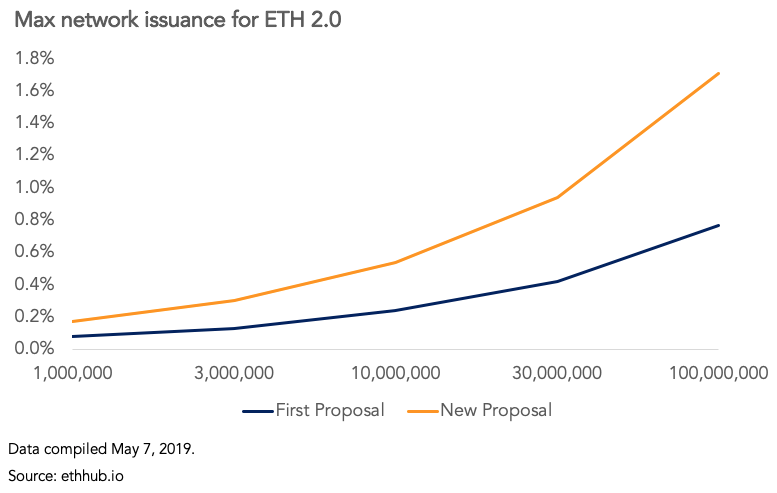
As a reminder, the Ethereum blockchain is still secured via proof-of-work mining. Just like bitcoin. However, in ETH 2.0, the blockchain will be maintained via a new proof-of-stake system, where rewards will be distributed on a sliding scale based on the total amount staked on the network. The more total supply that’s staked, the higher the system-wide issuance rate (to incentivize high cumulative participation). Although individual yields will decline as the percentage of network stakers increases. The most recent proposal more than doubles the staking reward rate:
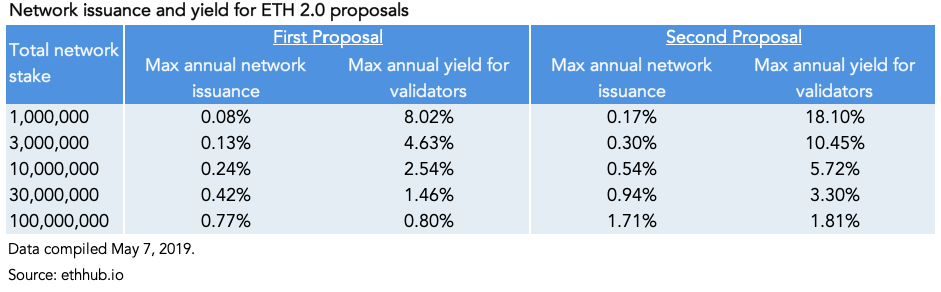
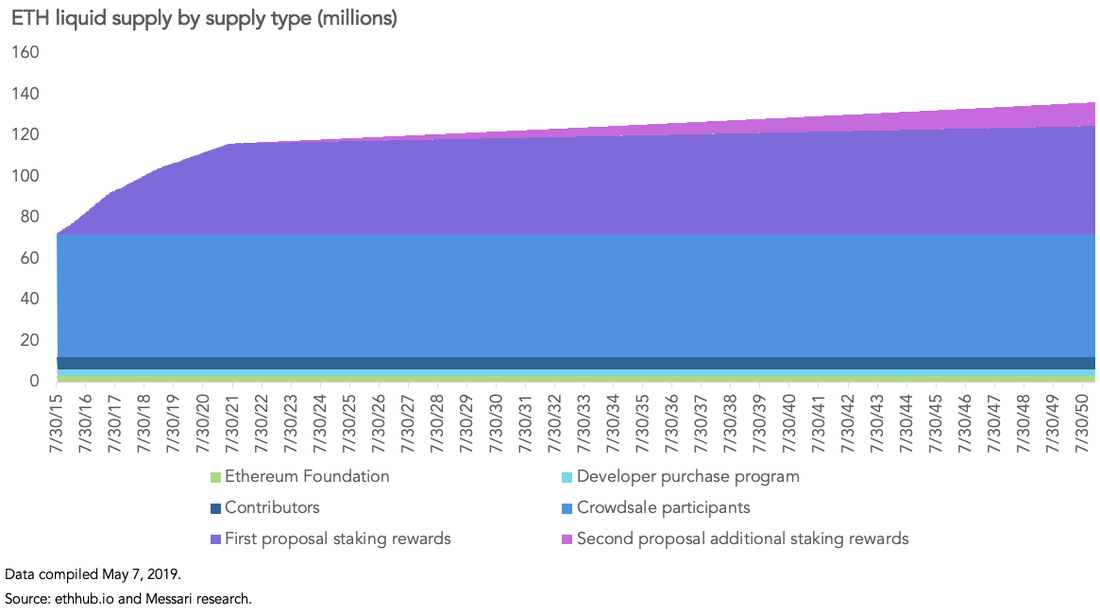
Justin Drake, a researcher at the Ethereum Foundation, has argued that targeting 30,000,000 ETH at stake, long-term, “seems about right for strong security.” That would represent about 30% of the network, and result in ~3% annual inflation. To illustrate how this new proposal would impact the ETH supply curve, we modeled out distributions considering only inflationary events (PoS rewards) while setting aside potential deflationary mechanisms (slashing, penalties, transaction fees burning, etc.) which should be much lower. For this simulation, we’ve used a more conservative 10,000,000 ETH total stake (just above the minimum required stake according to Ehhub.io) and assumed a transition to Serenity in July 2021.