The Disruption Factor

The Disruption Factor
A Proof-of-Concept Framework for Evaluating L2s
Crypto has never suffered from a shortage of activity. New chains, new tokens, new narratives - every cycle brings an explosion of innovation and noise. However, one question has remained stubbornly difficult to answer: Which projects truly have the chance to make a lasting impact?
Messari has spent years applying the best available frameworks, from traditional valuation thinking to network and market-structure models, in search of a reliable, concise way to evaluate projects. Each time, the same flaw surfaced: protocols do not win the same way traditional companies do, and no single legacy lens has reliably measured whether a project is compounding their durable advantage over time. The signals that actually matter are scattered across various onchain and offchain metrics. Individually, they’re easy to cherry-pick or dismiss; collectively, they’ve lacked a consistent, transparent way to be weighed and compared. This proof-of-concept, which we’re calling the Disruption Factor (DF), attempts to solve exactly that.
In this POC, we score 13 Layer 2s to validate the DF within a sector that offers rich, comparable adoption data. We chose to begin with the L2 sector due to consistent onchain activity, clear competitive dynamics, and widely accessible metrics - making it an ideal proving ground for a standardized framework. Over time, we can expand the DF to other sectors, tailoring metrics and weights while maintaining the same core pillars.
The Disruption Factor offers a simple, intuitive framework that cuts through volatility and speculation to clearly identify which projects have made the most progress towards achieving a long-lasting fundamental impact in a given sector. In an environment where narratives move faster than fundamentals, the Disruption Factor helps us ask and quantify the only question that really matters:
Which projects are likely to drive lasting, fundamental progress over the long-term, and why?
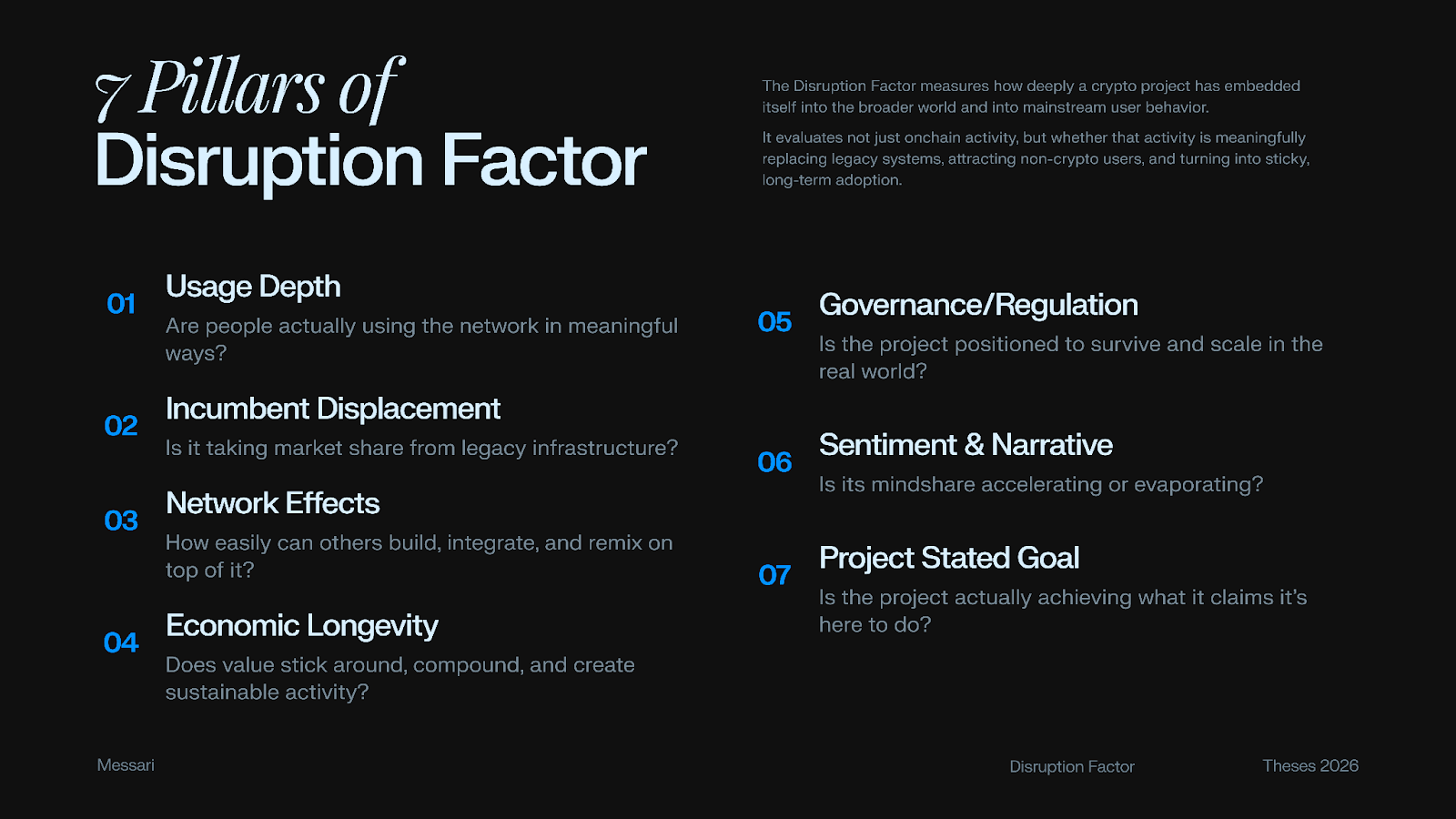
At its core, the Disruption Factor measures how deeply a crypto project has embedded itself into the broader world and into mainstream user behavior. It evaluates not just onchain activity, but whether that activity is meaningfully replacing legacy systems, attracting non-crypto users, and turning into sticky, long-term adoption.
To quantify this, we built a composite scoring model grounded in seven pillars:
Why We Built the DF
Crypto doesn’t suffer from a lack of metrics; it suffers from a lack of synthesis. Adoption is multidimensional, spanning usage, integrations, economics, reliability, and mindshare, yet these signals are often trapped in separate silos that make conviction feel like guesswork for both enterprises and allocators. The Disruption Factor was built to fix this, and to do so, it has four guiding principles:
- Transparency
- Every metric, weight, and transformation is fully open. No black-box scoring. No hidden levers. Analysts, institutions, and builders can audit, critique, or fully recreate the DF themselves.
- Customizability
- Different stakeholders have different evaluation criteria. Builders see the world differently from institutions. So the DF is modular; users can adjust pillar weights to satisfy their own needs and inputs based on their worldview. Messari provides a default version, but the framework is yours to reshape.
- Long-Term Thinking
- The DF prioritizes durable metrics through its seven pillars. Virality, noise, and speculative flows matter, but they don’t dominate.
- Open-Source & Evolving
- Just like crypto, the DF is designed to evolve. Inspired by frameworks like ESG scores or credit ratings, it invites community input and improvement. As the industry matures, the scoring model will adapt alongside it.
The Disruption Factor serves as a compass for durability, rather than a signal for short-term trades. Here’s how enterprises, allocators, and retail users can put it to work:
- Enterprise Adopters: Use the DF to quickly benchmark Layer 2s and identify which networks exhibit the most strength in your areas of interest, before committing engineering resources. It’s a practical starting map for chain selection and deeper diligence.
- Investors/Fund Managers: Use the DF as a repeatable diligence layer to compare L2 networks on adoption quality, not just narrative strength. Because the pillars and weights are customizable, you can apply your own investment lens, whether you prioritize revenue durability, ecosystem depth, or enterprise traction, and see which projects rise under your thesis.
- Retail: Use the DF to zoom out and focus on networks building durable traction rather than short-term spikes in attention or incentives. It turns scattered fundamentals into a simple peer-relative score to support clearer long-term decisions.
Methodology Overview
Within each pillar, the DF evaluates multiple quantitative and qualitative metrics. To generate a single comparable score, we follow three steps:
- Normalize the data: Each metric is converted into a percentile rank (0–1) relative to sector peers.
- Adjust for gamability: Metrics that are easier to manipulate are discounted so they carry less influence.
- Weight and aggregate: Adjusted metrics are weighted, rolled up into pillar scores, and then summed into the final DF score.
Disruption Factor Formula: DF = Σ (Wi × Pi × (1 − Gi))
Where:
- Wi = weight of the metric
- Pi = percentile rank (0-1)
- Gi = gamability score (0-1)
The DF score (0–100) benchmarks each project against its sector peers:
- < 50 → Mostly crypto-native adoption; limited external embed
- 50–75 → Disruption is material; expanding beyond crypto-native users
- > 75 → Infrastructure-grade, culturally sticky, systemically relevant
For the debut of the DF we took a deep look at the Layer 2 ecosystem, yielding the following results:
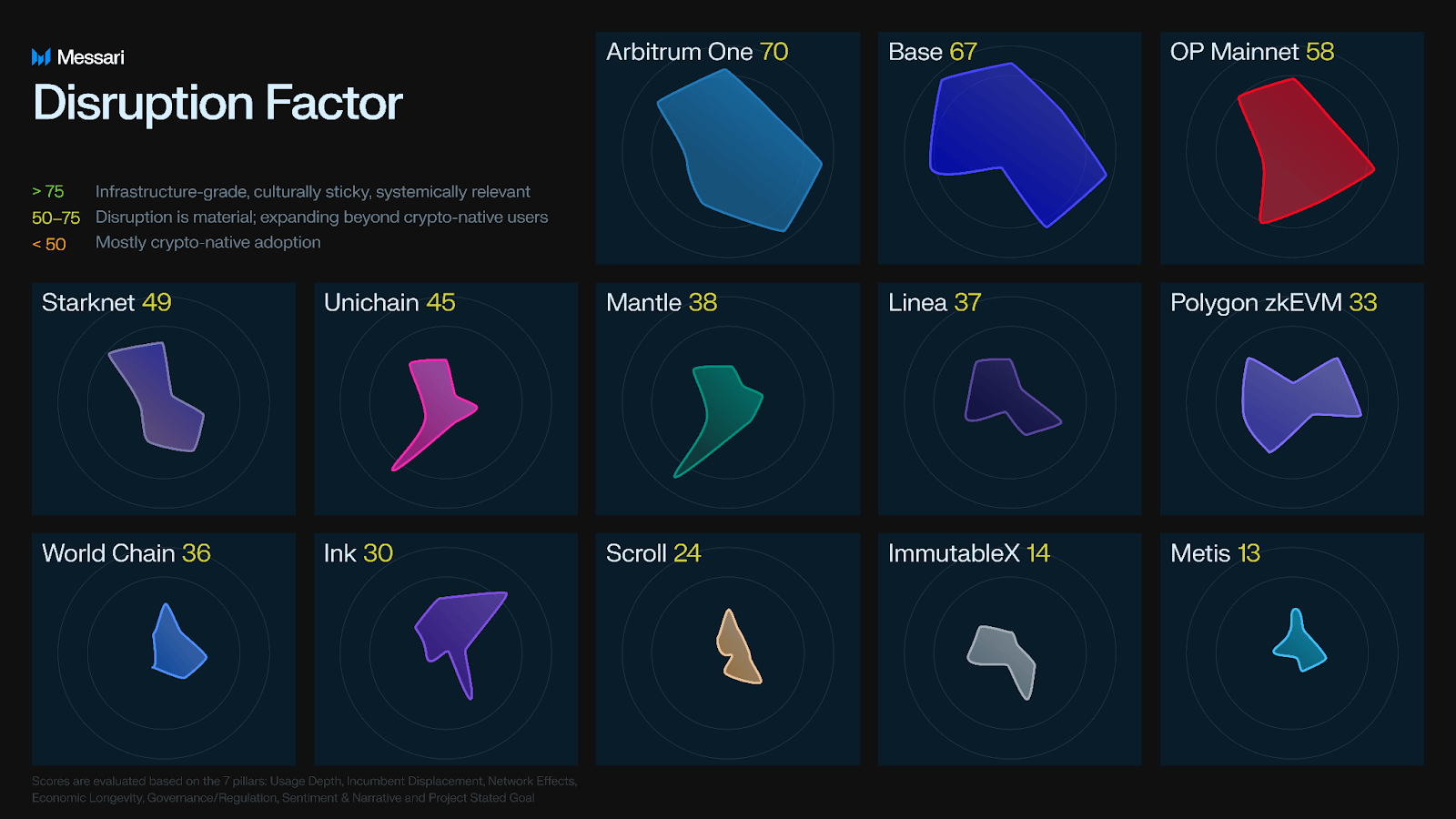
The results reveal a clear barbell in the Layer 2 landscape: Arbitrum (69.5) and Base (67.1) are pulling away as the leaders, with OP (58.2) alone in the next tier. Below that, the field compresses under 49, suggesting that many L2s remain early, sector-specific, or are still proving durability. The DF shifts the conversation from “who has the best narrative?” to “what are this chain’s current strengths or areas of opportunity?”, pinpointing the pillar gaps that separate tiers and making progress trackable as fundamentals improve.
Arbitrum
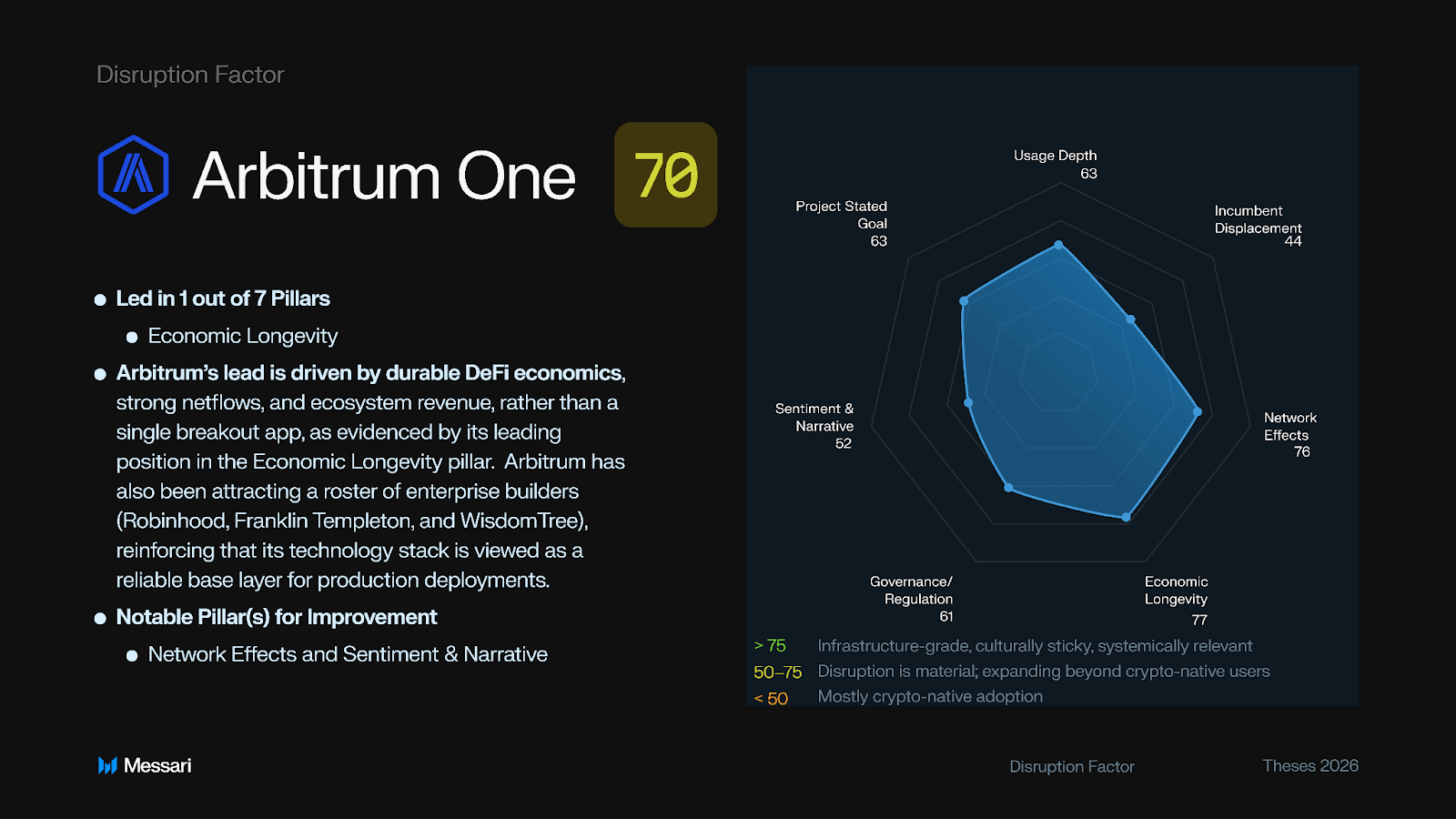
As of December 8, Arbitrum has the highest DF score of 69.5. Leading in only 1/7 pillars, but is the runner-up in 2 others, and ranks as the leader in 3/28 individual metrics. Arbitrum’s lead is driven by durable DeFi economics, strong netflows, and ecosystem revenue, rather than a single breakout app, as evidenced by its leading position in the Economic Longevity pillar. Arbitrum has also been attracting a roster of enterprise builders (Robinhood, Franklin Templeton, and WisdomTree), reinforcing that its technology stack is viewed as a reliable base layer for production deployments. In DF terms, that combination, economic durability and credible adoption pathways, is exactly what separates a top-tier L2 from the long tail still proving staying power.
Base
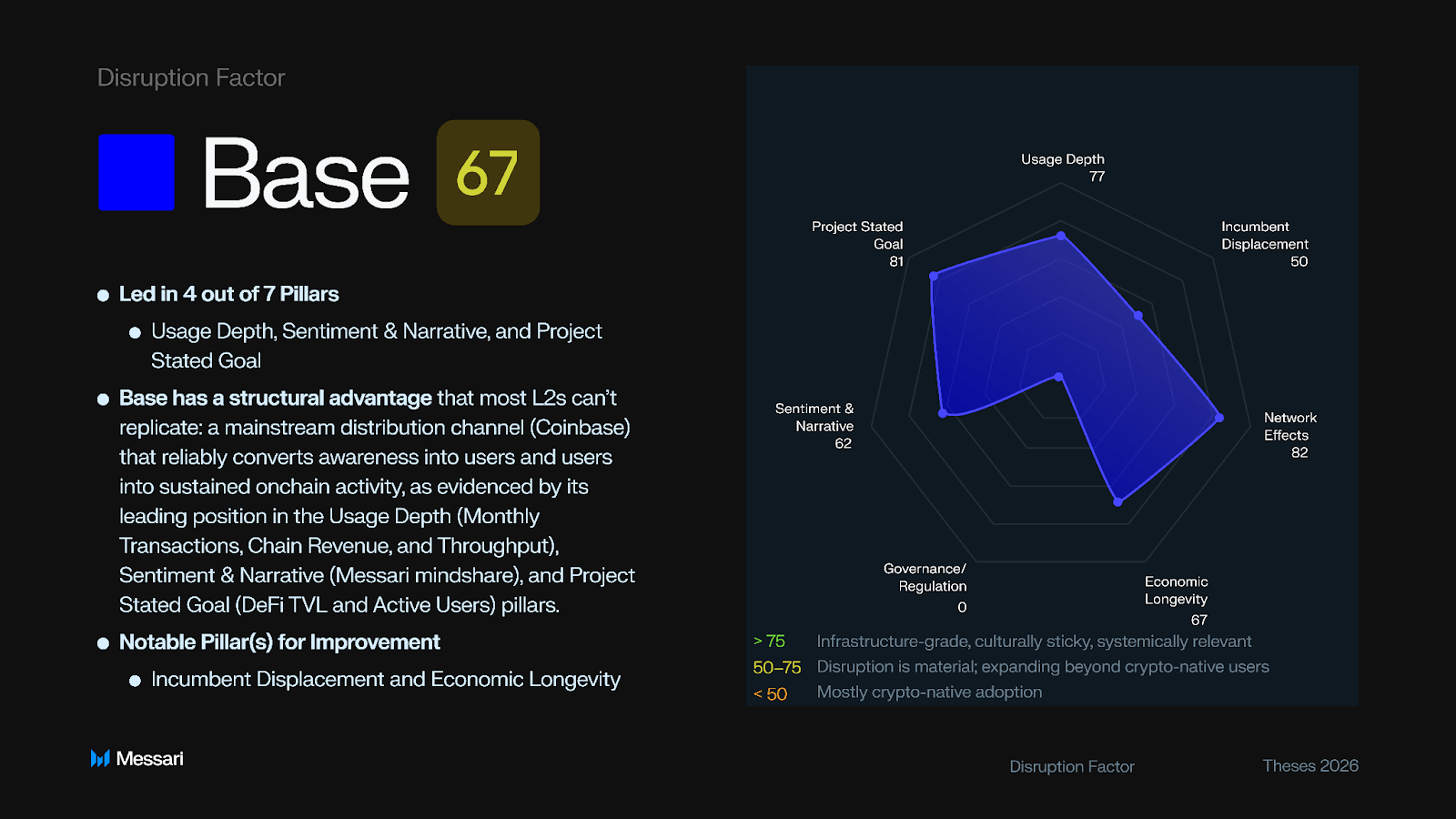
As of December 8, Base holds the second-highest DF score of 67.1. Leading in 4/7 pillars and ranking as the leader in 10/28 individual metrics. Base has a structural advantage that most L2s can’t replicate: a mainstream distribution channel (Coinbase) that reliably converts awareness into users and users into sustained onchain activity, as evidenced by its leading position in the Usage Depth (Monthly Transactions, Chain Revenue, and Throughput), Sentiment & Narrative (Messari mindshare), and Project Stated Goal (DeFi TVL and Active Users) pillars. From the app thesis perspective, Base continues to be the chosen chain to deploy on first and houses large DeFi and Consumer apps, such as Aerodrome, responsible for ~46% of its chain TVL, and Zora, the leading SocialFi app.
OP Mainnet
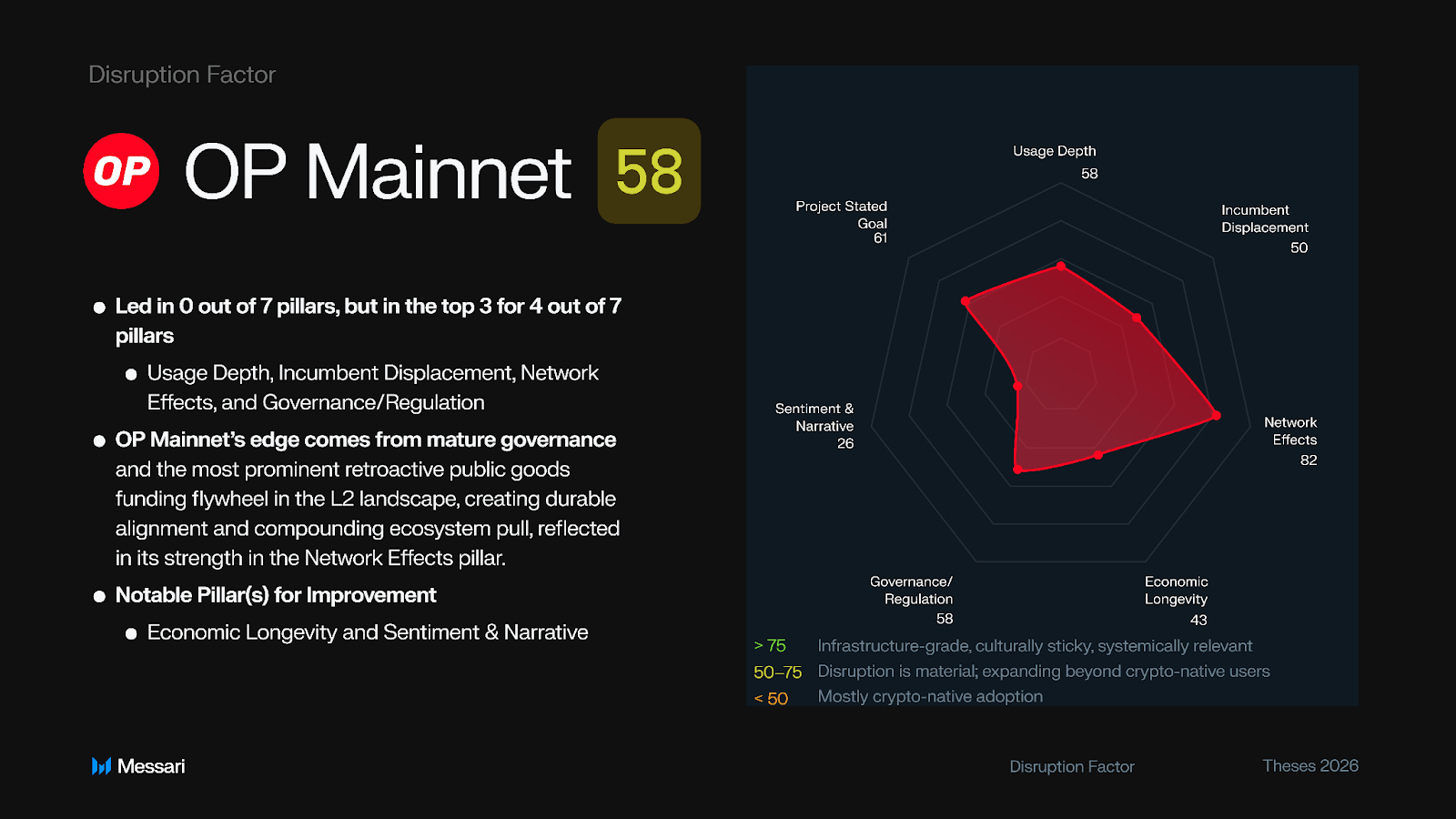
As of December 8, OP Mainnet holds the third-highest DF score (58.2), leading in 0/7 pillars, and ranking in the top three for 4/7 pillars, as well as for 7/28 individual metrics. Its edge comes from mature governance and the most prominent retroactive public goods funding flywheel in the L2 landscape, creating durable alignment and compounding ecosystem pull, reflected in its strength in the Network Effects pillar. While the Optimism Superchain thesis is defined by shared OP Stack standards and alignment across many OP Chains, we score OP Mainnet on a standalone basis because the DF measures observable, chain-level durability today; any Superchain-wide upside should only lift OP Mainnet’s score once it shows up in OP Mainnet’s own usage, economics, and integrations.
Honorable Mentions
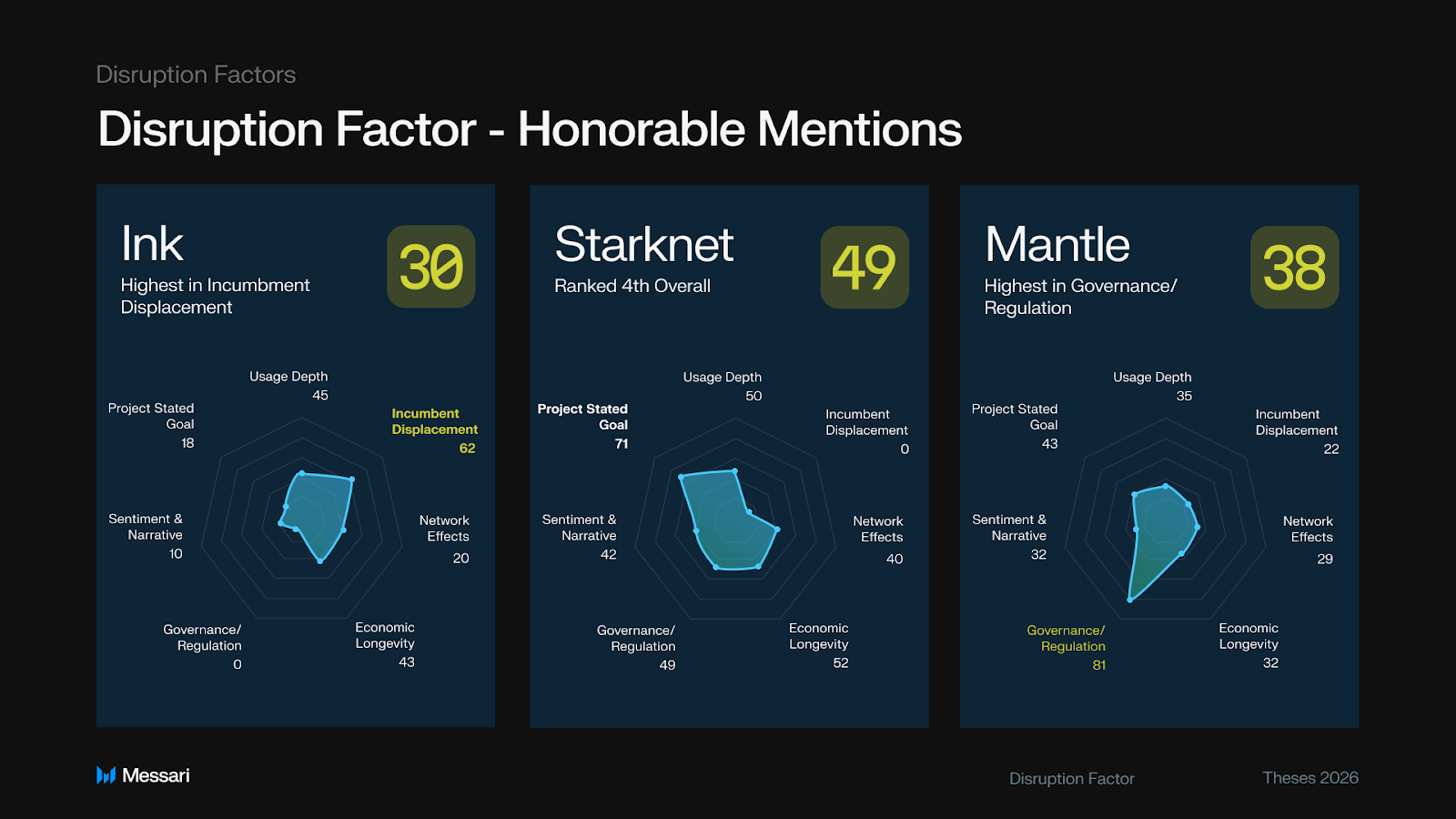
Coming Soon: A live Disruption Factor dashboard enabling you to re-weight pillars, drill into the drivers, and track how fundamentals evolve month to month.
Resources & Links

Jeremy is a research analyst at Messari with interests in Infra, DeFi, and Enterprise adoption. Prior to joining Messari, Jeremy worked as an analyst at Fidelity Digital Assets.