The Digital Land Debate

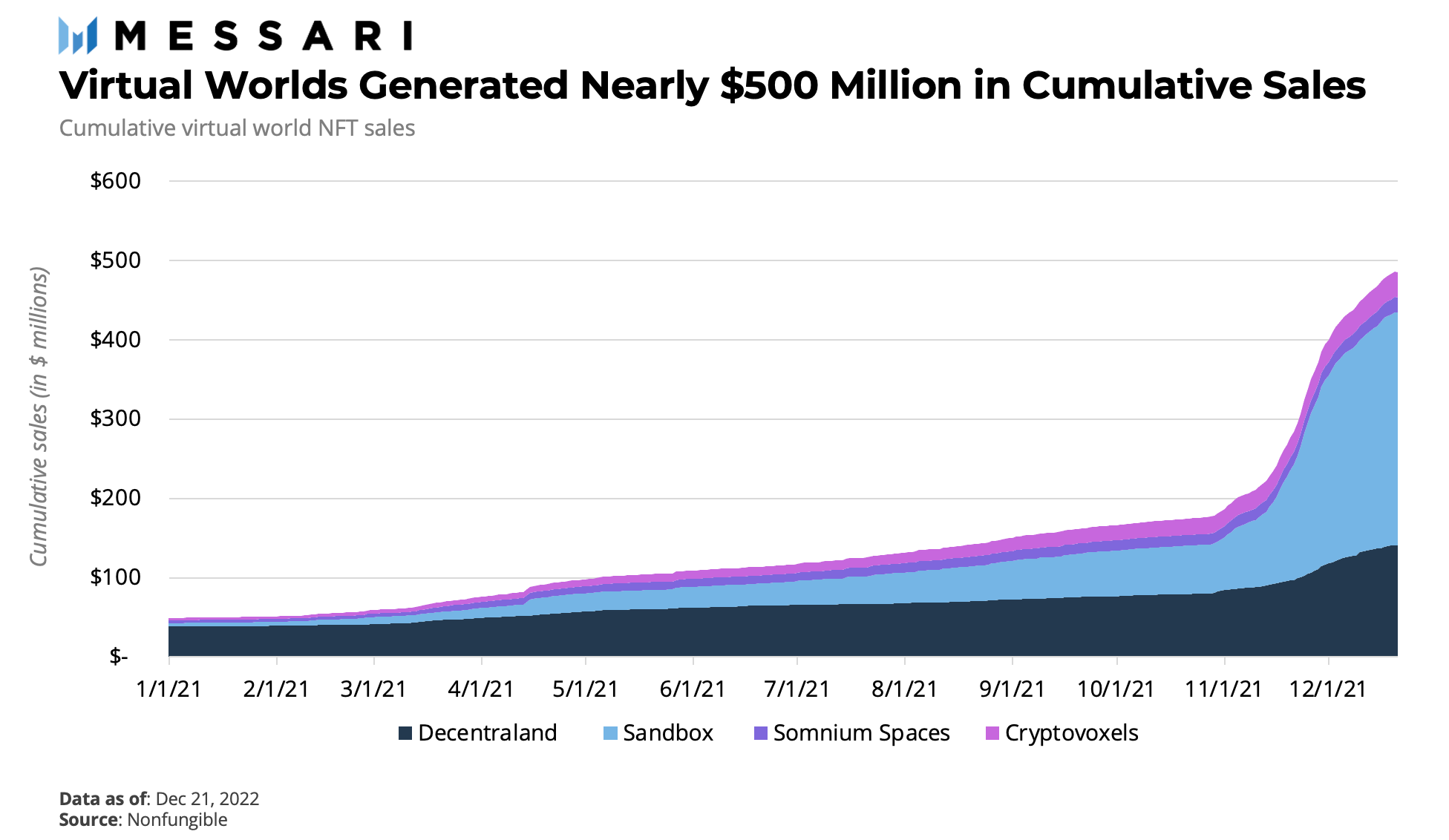
Since Decentraland’s ICO in August 2017, virtual worlds have been widely discussed as a potential application within the metaverse, generating over $500 million in cumulative NFT sales. And like most topics in crypto, the topic of scarce, digital land is hotly debated. On one side of the debate are the bulls who see virtual land and hear echoes of manifest destiny that promise an untapped, claimable resource. On the other side of the argument are the bears who see a future wasteland of unnecessarily scarce digital plots that possess none of the same benefits of physical real estate.
A Brief Intro to Digital Land
In 2021, virtual world NFT sales witnessed their largest growth, generating over $320 million in NFT sales.
These virtual worlds are often designed to be sandbox games (e.g., Minecraft, Roblox, etc.) where players can buy and build their own assets and experiences (e.g., games) as well as socialize with other players.
An important feature – arguably the core feature – of these virtual worlds is that the land is scarce or limited to a certain number of parcels, each individually ownable and customizable.
But, even among crypto investors, there remains mixed sentiment whether scarce, digital real estate will be valuable.

Mason was a Senior Research Analyst at Messari focused on Web3 protocols and cryptoassets. Before Messari, Mason worked at ConsenSys as a Content Marketer focused on marketing strategy. Mason obtained his Master’s in Business Management at Hong Kong Baptist University.