The DeFi Trinity: Frax Finance's Quest for DeFi Dominance

Key Insights
- Frax Finance is the first DeFi protocol to offer a combined stablecoin, liquidity, and lending service on Ethereum.
- The advent of Fraxswap and Fraxlend gives the Frax protocol more customizability over the monetary policy of the FRAX stablecoin.
- While Fraxswap and Fraxlend were created for Frax’s specific needs, the services can be composed freely into other applications.
According to Sam Kazemian, a Co-Founder of Frax Finance, DeFi’s core services can be broken down into three categories: stablecoins, liquidity systems, and lending markets. Rather than specialize in one category and outsource the rest, as is the status quo, Sam believes protocols will begin to offer this “Holy Trinity” of DeFi services as a single combined stack. With the recent rollouts of Fraxswap and Fraxlend, Frax has become the first DeFi protocol to offer stablecoin, liquidity, and lending services under one umbrella on Ethereum. By controlling the full stack, Frax is further expanding its ability to conduct arbitrary monetary policy to support the FRAX stablecoin.
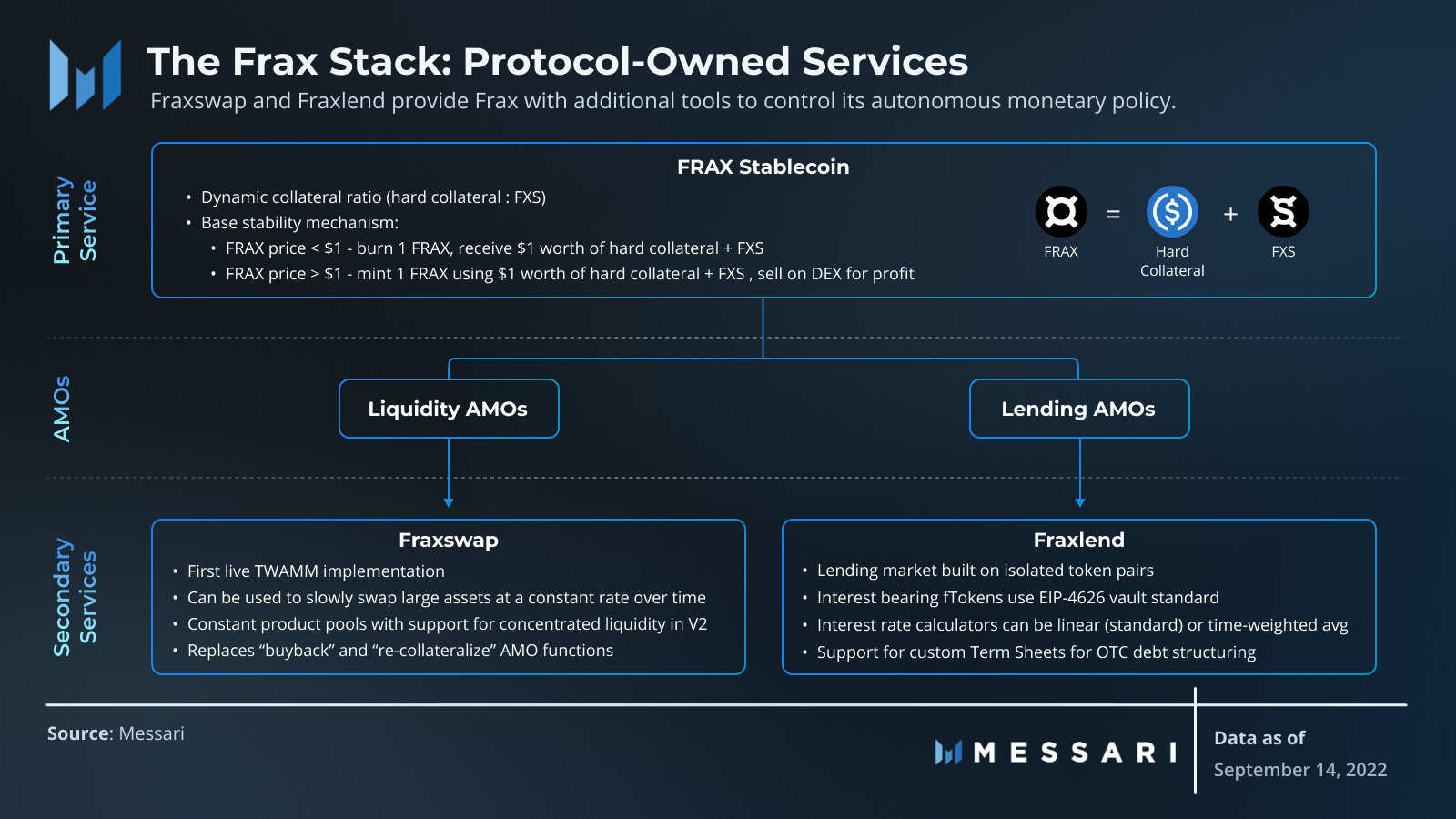
FRAX: The Stablecoin
In December 2020, Frax Finance launched FRAX as a partially collateralized algorithmic stablecoin backed by USDC and FXS, the protocol’s native governance token. The system is designed so that 1 FRAX can always be redeemed for $1 worth of USDC and FXS. While the minting and redemption value is held constant, the proportion of USDC to FXS backing FRAX depends on its dynamic collateral ratio (measured as the percentage of USDC per unit of FRAX). As described in detail in previous reports (The Art of Central Banking on Blockchains and FRAX: A Fractional Algorithmic Stablecoin), the collateral ratio adjusts automatically depending on two factors: FRAX’s price on the open market and the amount of FXS liquidity available across all DeFi AMMs relative to the overall supply of FRAX.
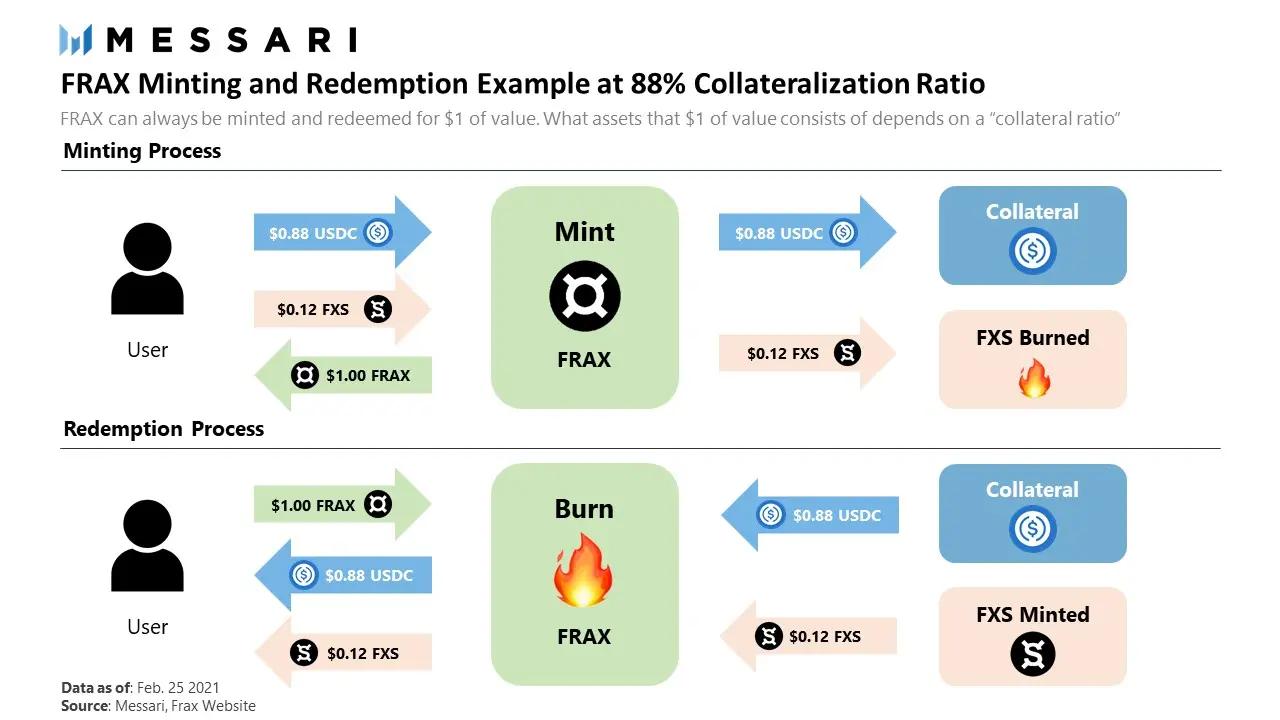
Frax V1 solidified the idea of an Algorithmic Market Operations (AMOs) controller that could serve as the protocol’s base stability mechanism through FRAX collateral ratio adjustments. In March 2021, Frax V2 introduced a set of generalized AMOs that could build on top of this base stability mechanism. These AMOs can carry out arbitrary FRAX monetary policy on the open market so long as their actions don’t lower the collateral ratio or change the FRAX price. Examples of AMOs created from Frax V2 include:
- Investor AMO: earns yield on idle USDC in Aave, Yearn, etc.
- Curve AMO: deploys USDC and/or new FRAX to Curve, Convex, and StakeDAO
- Liquidity AMO: provides liquidity to FRAX-based pairs on Uniswap and other AMMs
- Lending AMO: mints FRAX into overcollateralized lending markets for a fee
Frax’s AMOs have allowed the protocol to adapt to its surrounding market conditions. When the price of FXS exploded in the latter half of 2021, the protocol could mint more FRAX autonomously into DeFi AMMs without impacting the collateral ratio. This may not have decreased the supply of FXS (as is the case when FRAX is minted natively by users), but it did increase farming rewards and trading fees that ultimately accrue to the protocol.
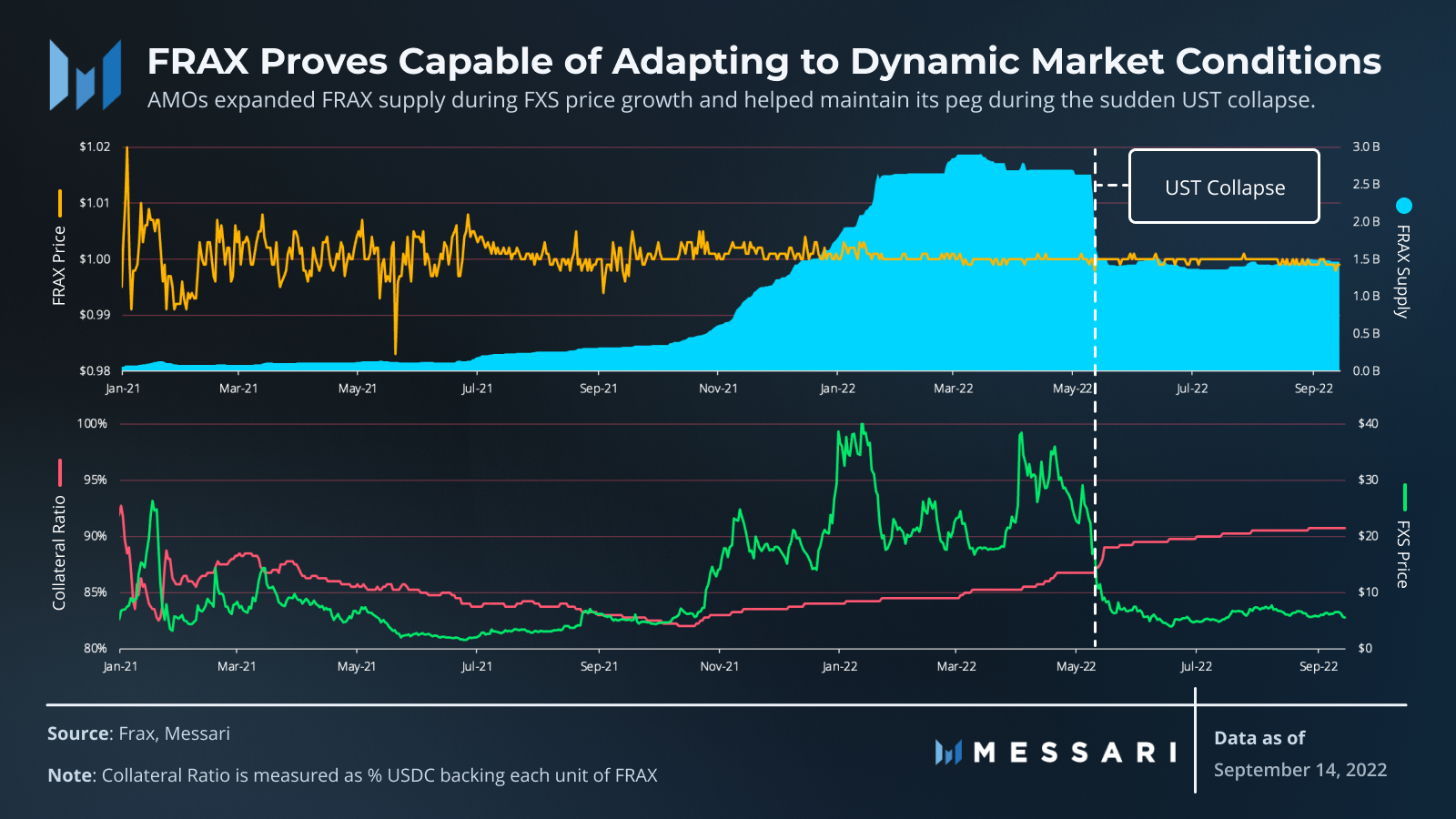
FRAX also demonstrated its resilience to the downside during the May 2022 unwind and subsequent collapse of Terra’s UST, another algorithmic stablecoin. The FRAX peg held tight to its $1 target thanks to its flexibility and partial collateral backing that prevented a UST-like bank run. The price of FXS fell sharply, but Frax’s AMOs responded by removing excess FRAX from the market to maintain the collateral ratio and $1 peg.
It’s clear that the mechanics underpinning the FRAX stablecoin can work as intended. However, Frax’s reliance on other DeFi protocols limits its ability to have full autonomy over its monetary policy. The existing AMO strategies employed by Frax depend on the infrastructure and decisions of other protocols. AMM designs, interest rates, and fee structures are just a few examples of variables that influence how Frax’s AMOs can interact with liquidity systems and lending markets. As such, Frax created Fraxswap and Fraxlend to realize the full potential of its autonomous monetary policy.
Fraxswap
The concept of a time-weighted average market maker (TWAMM) was first outlined by Paradigm in a July 2021 whitepaper alongside Uniswap’s Hayden Adams. In the words of its creators, a TWAMM “breaks long-term orders into infinitely many infinitely small virtual orders and executes them against an embedded constant-product AMM over time.” In layman’s terms, a TWAMM is used to slowly and reliably exchange assets over time.
Fraxswap is the first live implementation of a TWAMM. The Fraxswap TWAMM contains an embedded AMM based on the famous Uniswap V2 constant product pools. This AMM functions the same as a standard Uniswap AMM, allowing anyone to permissionlessly trade against it or provide liquidity. However, the addition of the TWAMM wrapper allows traders to also process long-term orders in a gas-efficient manner while minimizing slippage (the core AMM relies on arbitrageurs to continually rebalance its prices over time). The following diagram provides a helpful visual to understand the order flow of a trade routed through a Fraxswap TWAMM:
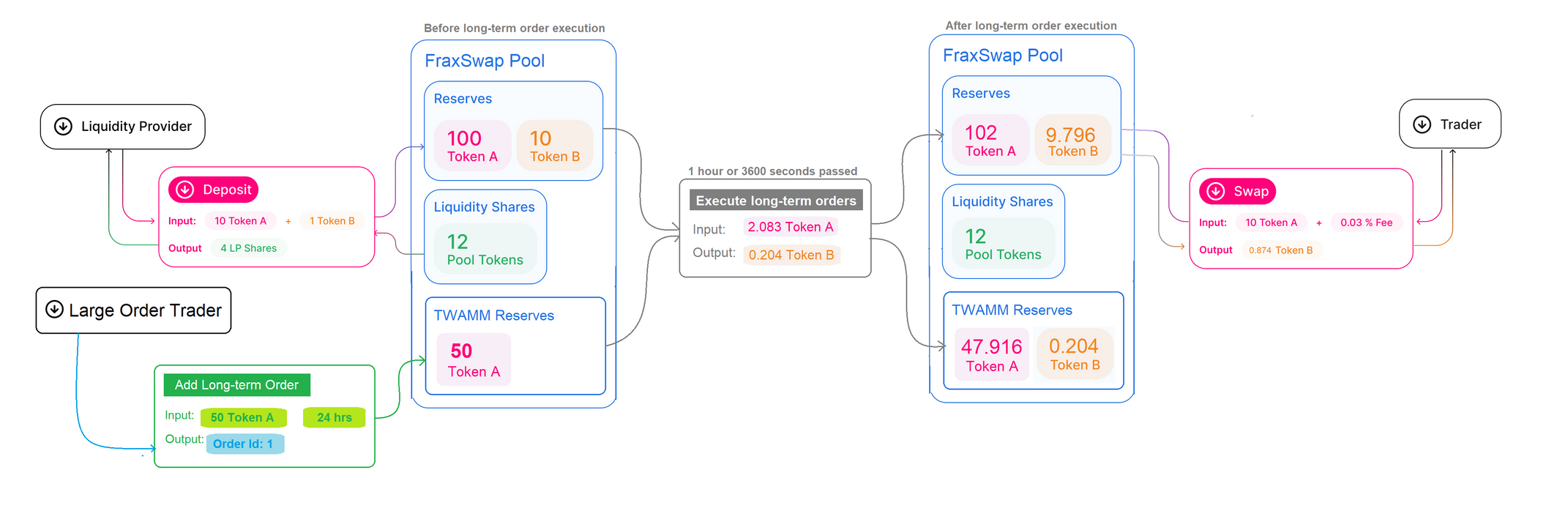
Source: Frax Finance
At first, Fraxswap may sound like a niche service offering — how often do you need to stream multimillion dollar buy or sell orders on-chain? Unlike most other DeFi protocols, however, Fraxswap wasn’t built to serve a wide audience; it was specifically designed for Frax itself.
Leveraging Fraxswap gives Frax more granular control over its monetary policy. The existing “buyback” and “re-collateralize” functions used in all AMO functions have been deprecated and replaced with a separate AMO that uses Fraxswap. Using the Fraxswap TWAMM, the protocol now processes ongoing buy-and-sell orders for collateral, FRAX, and FXS in an effort to support the peg, maintain the collateral ratio, and distribute protocol profits. Altogether, Fraxswap enables Frax to conduct ongoing monetary policy and forward guidance like the U.S. Federal Reserve but in an automated and transparent manner.
Going forward, Frax can benefit from other protocols that may need to tap into Fraxswap’s TWAMM offering. Examples of Fraxswap use cases for external protocols include:
- Slowly selling governance tokens to purchase a treasury asset
- Buying back governance tokens with DAO revenues and reserves
- DAO-to-DAO token swaps
- Defending pegs and “risk free” values for tokens with a socially guaranteed backing (ex: Olympus and Temple)
Frax has plans to implement concentrated liquidity (similar to Uniswap V3 pools) in the future as a part of Fraxswap V2. This approach could potentially provide a native alternative to using Curve for establishing FRAX / stablecoin liquidity pairs. However, since Frax successfully added FRAX / USDC as a base pool on Curve, the protocol is in no rush to exit the fabled Curve Wars.
Fraxlend
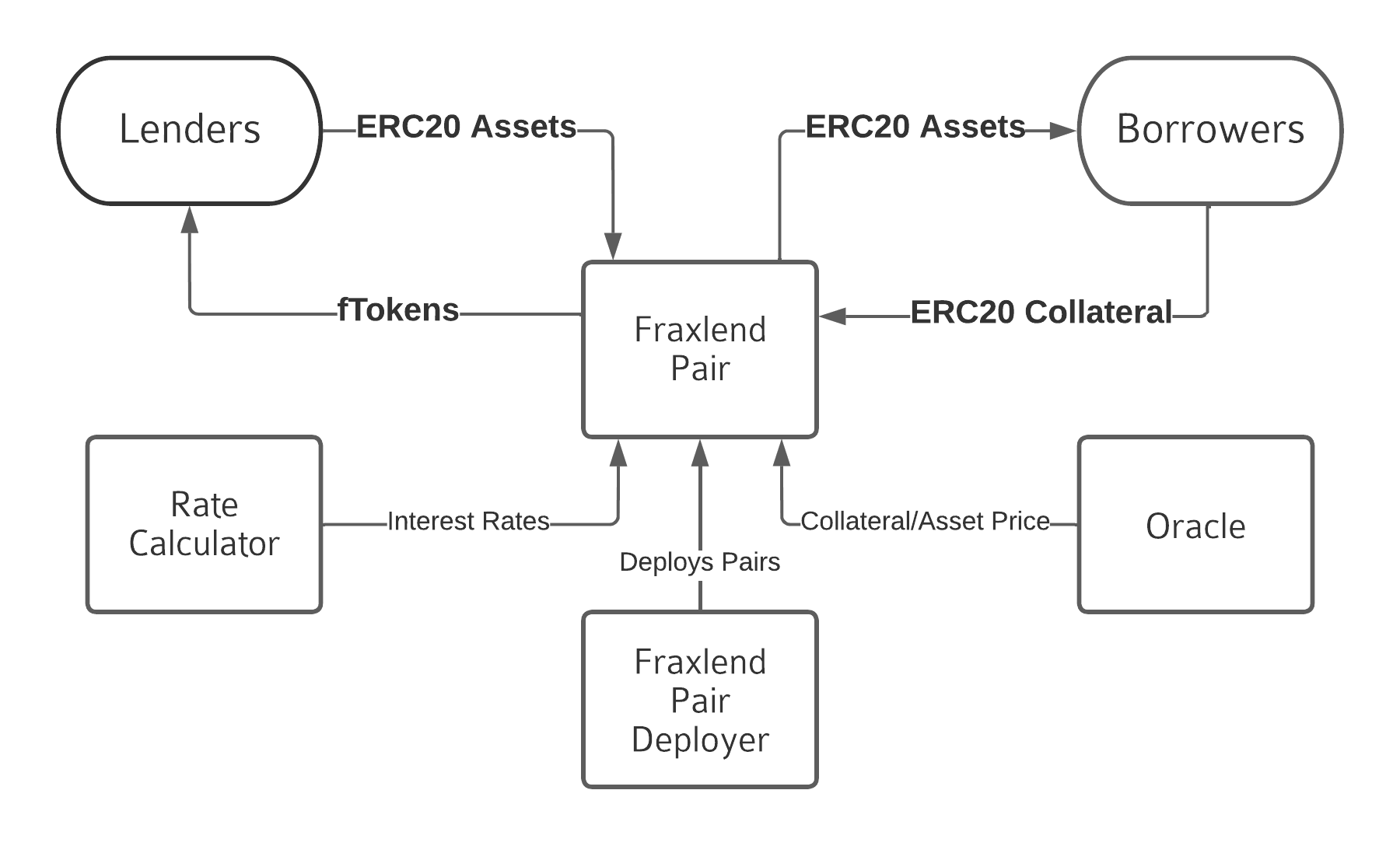
Given its use of AMOs, Frax has historically been an active partner across the DeFi ecosystem. Strong business development allowed Frax to scale, but it also introduced risk vectors in the form of additional smart contract exposure and increased systemic complexity. In April 2022, Rari Capital’s Fuse lending protocol was drained of $80 million. The exploit resulted in a $13 million loss for Frax stemming from the protocol’s Lending AMO. With the recent launch of Fraxlend, Frax now has a custom lending market for satisfying stablecoin borrowing demand without exposing itself to other protocols’ risk sets.
Source: Frax Finance
Fraxlend allows users to create a borrowing market between any pair of ERC-20 tokens that have a Chainlink data feed. This approach contains risk to individual asset pairs without impacting the safety of other pools. For lenders, fTokens are used as interest-bearing receipts of deposits. Ironically, fTokens are built on the EIP-4626 vault standard, an open-source standard originally developed by the Fei-Rari teams before the hack.
While Fraxlend markets can be created between any two compatible assets, it’s likely that the service will be predominately used for FRAX-based pairs. The existing Lending AMO already allows FRAX to be minted on demand into overcollateralized lending markets. Since borrowers must post an equal or greater amount of collateral to make this process work, the FRAX collateral ratio doesn’t decrease when more FRAX is minted. As such, any user with supported collateral can access a revolving line of FRAX credit without needing to source a counterparty. In a way, this setup could end up looking very similar to Maker’s CDP vaults.
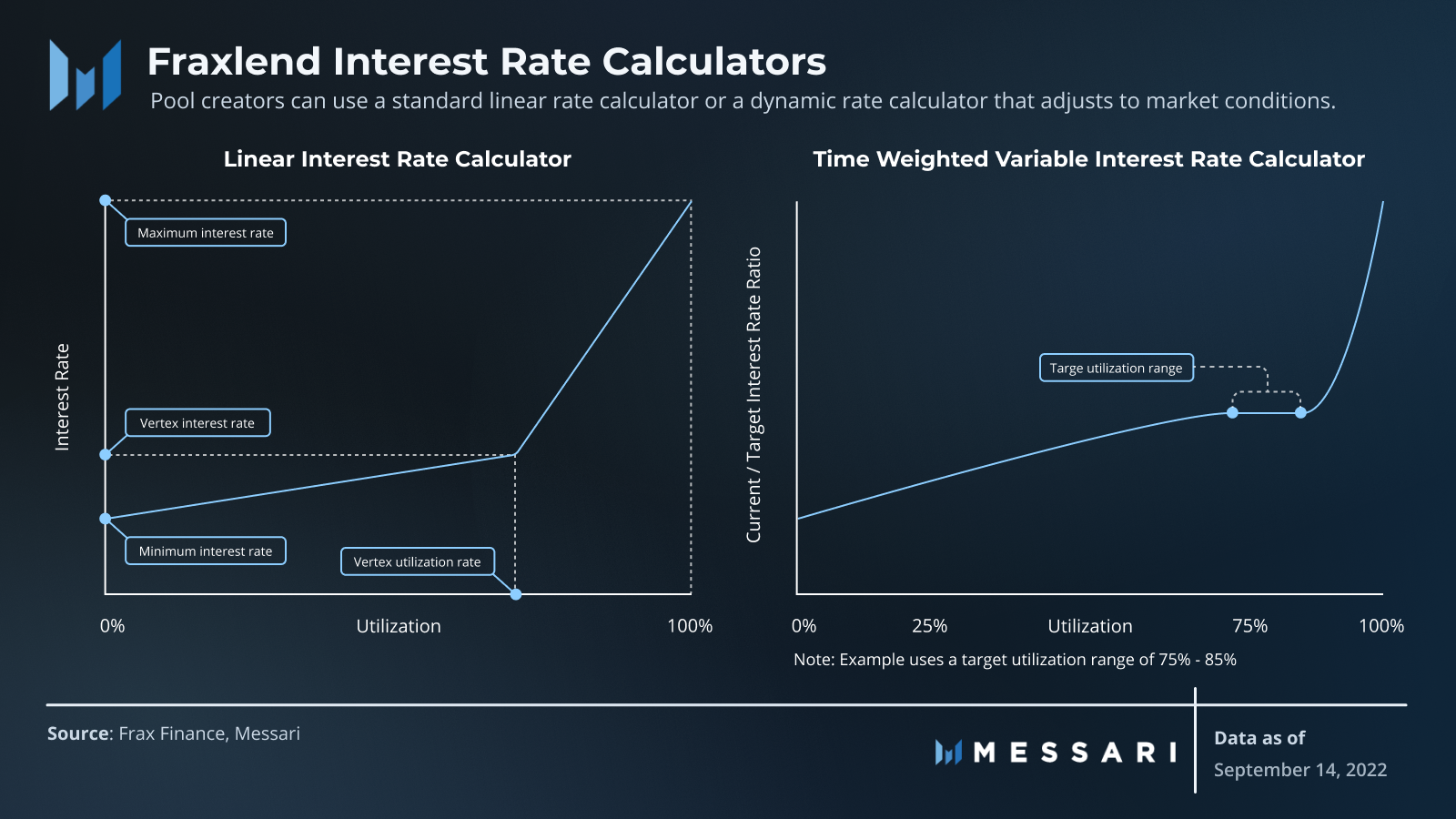
Each Fraxlend pair uses one of two specific Rate Calculators to determine interest rate curves. A simple Linear Rate Calculator calculates the interest rate solely as a function of borrowing utilization. Alternatively, a Time-Weighted Variable Rate Calculator can be used to change the interest rate relative to a target utilization rate.
Source: Frax Finance
Like the core peg stability mechanism, the dynamic Time-Weighted Variable Rate Calculator is designed to adapt to changing market conditions. In the future, it would make sense to see some form of AMO created for pools with these Rate Calculators so that Frax could further influence the borrowing demand for FRAX against individual markets.
Fraxlend can also create custom Term Sheets for over-the-counter debt structuring. This allows individual Fraxlend pairs to be created with maturity dates, whitelisted borrowers and lenders, undercollateralized loan promises, and liquidation restrictions. The customizability of these pools will create more flexibility for FRAX credit lines issued to trusted parties such as DAOs. While these deals could already be carried out behind closed doors (see Terra’s BTC purchases to back LUNA), enacting them on-chain preserves the transparent nature of Frax’s market operations and creates the basis for social credit scoring. Theoretically, these term sheets could be used in the future as a portion of the hard collateral backing FRAX.
Fraxlend may have been created to fulfill Frax’s own monetary policy needs, but the infrastructure is free for anyone to use. Not only can Fraxlend markets can be created permissionlessly, but Frax doesn’t extract any value from Fraxlend users unless the protocol itself is lending FRAX to borrowers. As a public utility built on a network-wide vault standard, Fraxlend holds immense potential as a composable service for the wider DeFi ecosystem.
The Big Picture
Frax is ushering us into the next big shift in how DeFi operates. Specifically, DeFi protocols are beginning to recognize their need for control over stablecoin issuance, liquidity systems, and lending markets. The Frax team may be first to market on this new trend, but others are close behind. Aave and Curve will soon launch their stablecoins, and it’s only a matter of time until Sushi’s next Head Chef also decides a stablecoin is the key to reviving the project. As more protocols attempt to tackle the Trinity, the differentiating factor will no longer be a protocol’s final business model, but rather the starting point it used to reach this final form.
Let us know what you loved about the report, what may be missing, or share any other feedback by filling out this short form.
Author(s) may hold cryptocurrencies named in this report and each author is subject to Messari’s Code of Conduct and Insider Trading Policy. Additionally, employees are required to disclose their holdings, which is updated monthly and published here. This report is meant for informational purposes only. It is not meant to serve as investment advice. You should conduct your own research, and consult an independent financial, tax, or legal advisor before making any investment decisions. Messari does not guarantee the sequence, accuracy, completeness, or timeliness of any information provided in this report. Please see our Terms of Use for more information.

Chase's interest in crypto lies at the intersection of economics, psychology, and social coordination.