SUSHIPOWAH to the people: An assessment of Sushi’s governance

One of the most exciting things about blockchain technology is that it enables decentralized governance… at least in theory. But is this the case in practice? Decentralized governance comes in different forms and for this report, we dive into SushiSwap. Concretely, we look at its governance process, voting turnout and voting power to get a sense of the community’s engagement and ability to drive the direction of the project.
It's all about SUSHIPOWAH
Any change to Sushi and use of its treasury requires the signature of multisig addresses. Although these are controlled by just a few individuals, the project remains governed by the community. Members actively discuss ideas on a forum and can post proposals for a vote on snapshot.
Sushi's voting metric is SUSHIPOWAH. There are three ways to get SUSHIPOWAH: own SUSHI tokens (each token is worth 1 SUSHIPOWAH), stake SUSHI (each xSUSHI is worth 1 SUSHIPOWAH) or provide liquidity to Sushi’s SUSHI-ETH pool (each SUSHI token is worth 2 SUSHIPOWAH).
Voting turnout
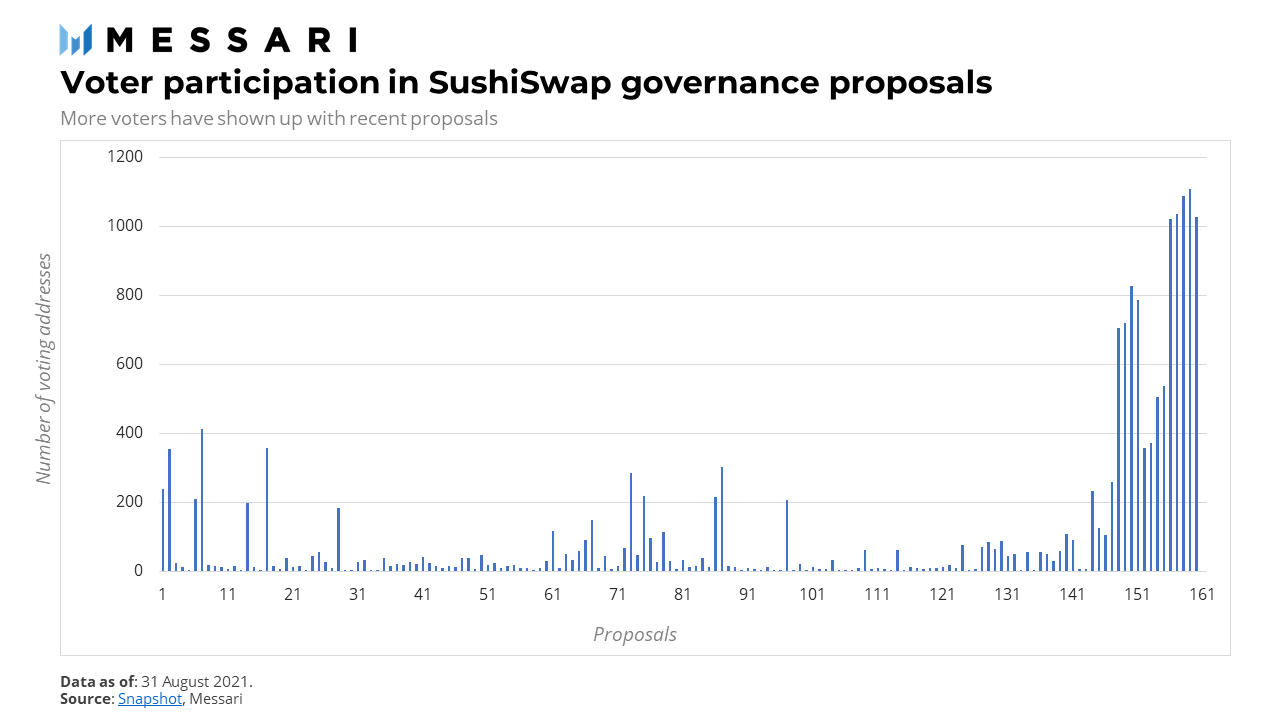
More than 160 proposals have been submitted on snapshot since Sushi’s launch in late August 2020. Proposals range from the onboarding of new developers to the release of grants, and design choices. Sushi had a tumultuous start and the majority of proposals date from around that time. The number of individuals (addresses) that voted was low during the first four months of the project. Since January, however, the turnout has picked up notably.