Sushi Governance Update

Following the start of Sushi’s new Head Chef, Jared Grey, in October, the DAO’s governance has seen an increase in lively ideation and debate for critical protocol changes. Over the past two months, several discussions and votes have significantly changed the investment thesis around the protocol’s token. The passed Kanpai proposal and pre-voting tokenomics redesign directly impact the token’s mechanisms for value accrual and should be on every crypto investor’s radar.
Kanpai 2.0 [Passed]
Jared Grey proposed Kanpai 2.0 on December 5, and it officially passed for implementation on January 23. The proposal redirects all protocol revenue to the treasury rather than market-buying SUSHI to return to xSUSHI stakers. Since the DEXs inception, 5 basis points taken from the 30 basis points swap fee have gone toward buying SUSHI tokens on the open market and returning them pro-rata to SUSHI holders who stake their tokens for xSUSHI. In April 2022, the first iteration of Kanpai passed, which reallocated 10% of protocol revenue to the treasury, leaving 90% of the 5 basis points for market buying SUSHI. Kanpai 2.0 changed the 10% treasury allotment to 100%.
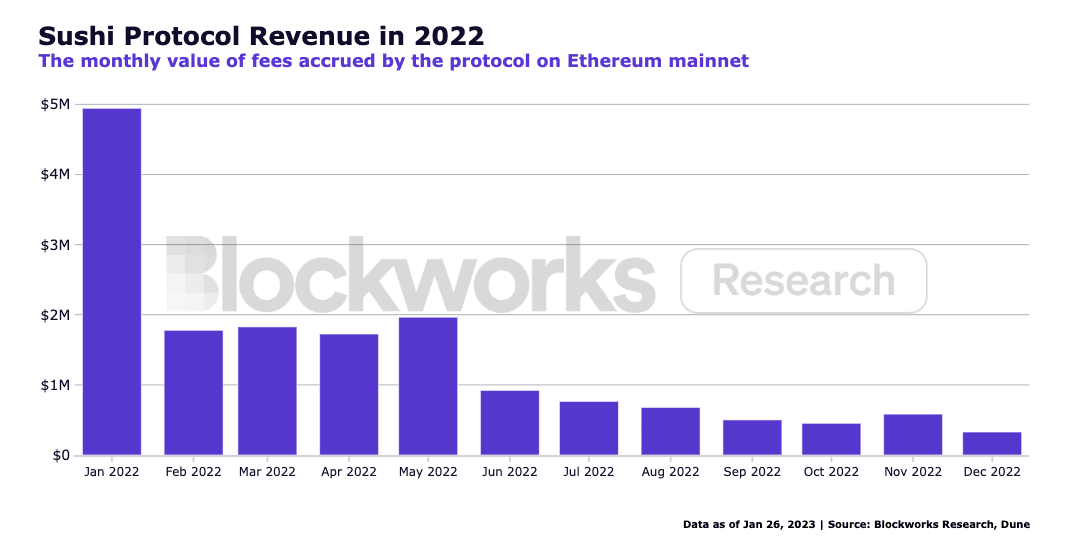
The revenue distribution to SUSHI token holders created a source of demand for the token. It was the only fundamental mechanism in place to tie SUSHI’s value to the protocol’s growth. The change is materially harmful to SUSHI’s short-term bull case; however, in our opinion, it was necessary. The Sushi DAO treasury is approximately $16M in SUSHI; $1.8M in USDC; $4.4M in SUSHI HOUSE, a token set comprised of mainly WETH, WBTC, and DAI; and about $1M in other assorted tokens. According to Jared Grey, even after significant budget cuts, the non-SUSHI tokens would have only provided 1.5 years of runway for the team. With no other viable source of runway, Kanpai 2.0 gave the team some breathing room to build a product to better compete with Uniswap and Curve.
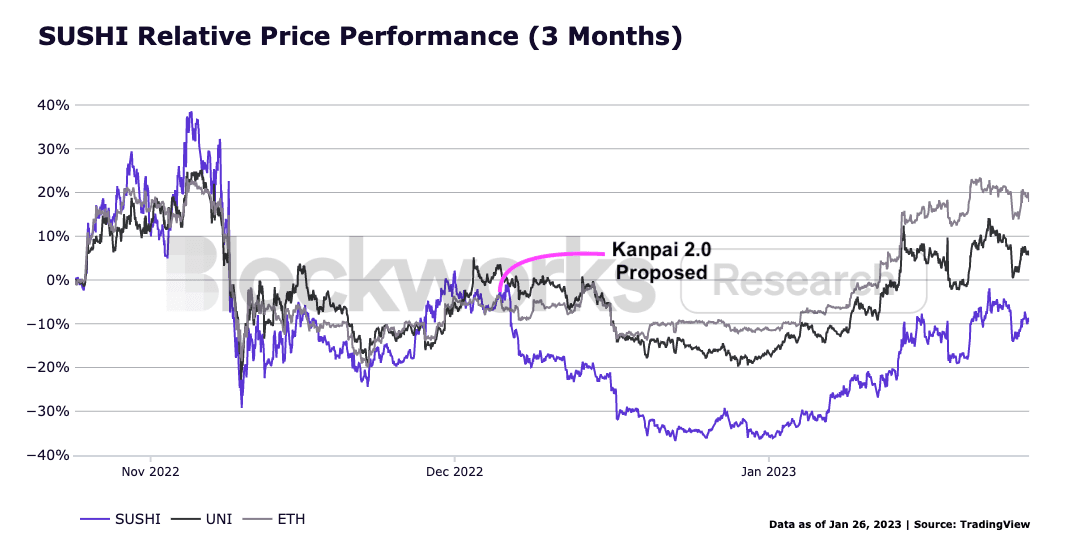
Notably, Kanpai was the second most discussed post ever in Sushi’s governance forum. There was an immense negative price impact on the token post-proposal. The vote leaned towards a no until Golden Tree swayed its passing with a yes vote at the last minute. The proposal states that the 100% treasury allocation will be enabled until new tokenomics are voted in or after one year.

Matt leads coverage on DEXs, derivatives, governance, and the Avalanche ecosystem. Previously he worked as an Analyst at Ikigai Asset Management and Teller Finance.