Stride: Unlocking Interchain Liquidity

Unlocking Interchain Liquidity
Liquid staking has recently become a major narrative in the post-Shapella Ethereum ecosystem, although it has existed for over two years. The ability for PoS token stakers to secure the network while also partaking in DeFi gives ETH money-like properties and unlocks liquidity for a healthier DeFi ecosystem.
Interchain DeFi growth has been slow compared to other ecosystems due to the meaningful opportunity cost of not staking ATOM, OSMO, and other Cosmos assets to receive high inflationary staking rewards. Historically, ATOM staking rewards have been over 15% APR, and OSMO over 20% APR, setting a high baseline yield that DeFi protocols would need to compete with in order to incentivize users to provide liquidity. Higher liquidity incentives have often led to down-only price action from mercenary capital dumping accrued rewards, threatening the security of PoS networks where market cap is a major component of chain security.
Stride, the first liquid staking appchain in the Cosmos ecosystem, launched in September 2022 to unlock this staked liquidity. Stride supports seven of the top Cosmos assets (ATOM, OSMO, STARS, JUNO, LUNA, EVMOS, and INJ) with plans to integrate all chains that pass an onchain governance vote. Stride uses interchain accounts (ICAs) to seamlessly liquid stake unstaked assets, claim staking rewards, and auto-compound 90% of the rewards every six hours. Here is a good technical overview of Stride’s architecture and use of ICAs. With Stride’s recent announcement that it will use Axelar’s GMP technology, it will even be able to offer liquid staking to non-Cosmos assets in the future.
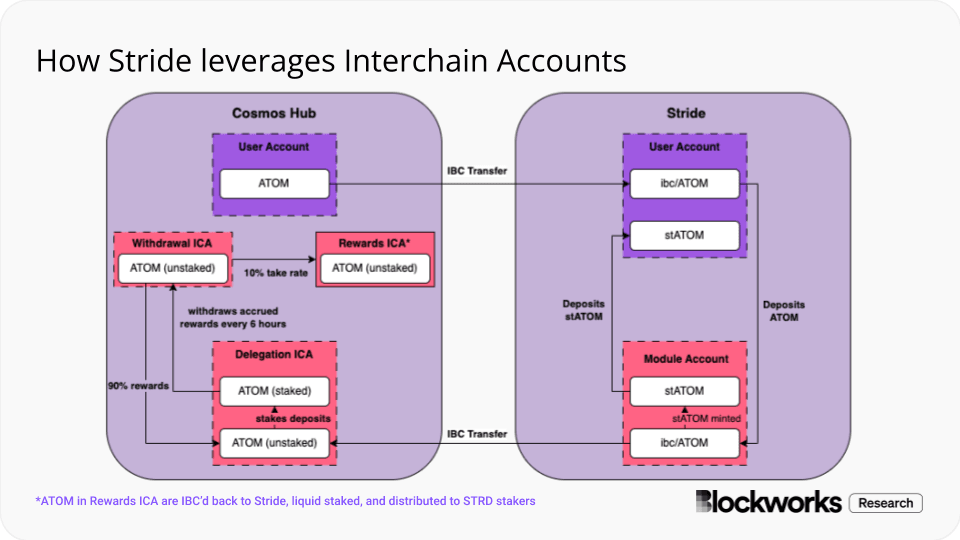
Similar to Lido Finance and other liquid staking providers, Stride takes a portion (10%) of staking rewards for its service. Unlike other providers that direct the protocol take rate to the DAO, Stride gives 100% of its protocol revenue to STRD stakers for securing the network. Because Stride supports the seven protocols listed above, that means STRD stakers are earning both STRD inflation for securing the network, as well as an index of Cosmos assets. As more Cosmos chains launch, they will likely seek to create a liquid staking token on Stride. This could make the STRD token an Interchain Index, allowing holders to bet on the Cosmos ecosystem without directly having to bet on an individual chain. If Cosmos asset prices appreciate, STRD staking rewards will increase, potentially leading to increased demand for the token. While many see ATOM as a call option on the Cosmos ecosystem, in reality, STRD might be better suited for the narrative.
Liquid Staking Growth

David leads coverage on the Cosmos ecosystem, MakerDAO, and emerging DeFi protocols. Previously worked as an Analyst and Trader at Lightning Capital.