Stride: It is Lonely at the Top

Since the beginning of 2023, Stride has traded at a considerable premium compared to Lido and Marinade Liquid Staking based on an FDV / Net Deposits multiple. Stride’s net deposits would have to grow by ~27x to ~$4B to reach parity with Lido’s multiple, meaning that the project is not particularly cheap when valued as such. The high multiple could be driven by the fact that, unlike LDO holders, the STRD token directly accrues revenue when staked.
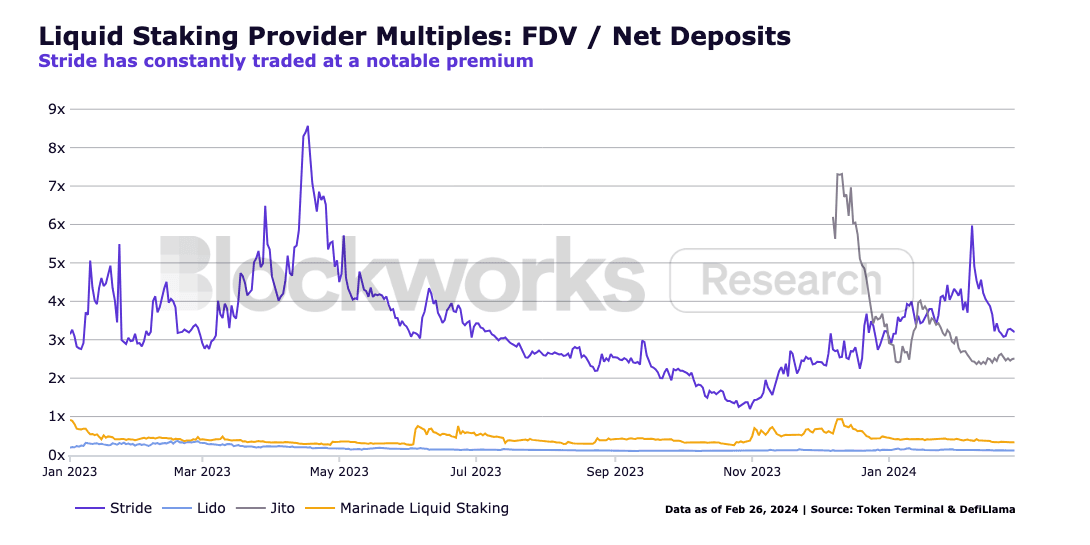
Stride is also able to create more revenue with less staked capital than the other protocols shown above. This is because blockchains within the Cosmos ecosystem have considerably higher staking APRs than Ethereum and Solana. For example, Celestia’s staking APR is currently ~14.6%. Moreover, Stride has the largest effective take rate of staking fees across these LST protocols. Even when making the simplifying assumption that all Stride Governors charge a commission of 10%, it leads to an effective protocol take rate of ~7.7%. In comparison, Lido DAO’s take rate is 5%, Marinade has a 6% protocol take rate on liquid staked rewards, and Jito charges a management fee of 4%.
The growth story for Stride is quite clear. It has a dominant market position, and the liquid staking market within Cosmos is posed to expand notably on the back of a few significant drivers:
- New token launches – This has already started taking effect, with Stride’s TVL having grown by ~81% since stTIA was launched at the beginning of February. TIA is the largest asset on Stride based on deposits, accounting for ~34% of TVL, and it is likely that the token’s short-term impact on deposits is not over. ~4.9M TIA worth ~$85M will be unstaked on February 29. Most of the unstaked TIA seems to belong to one entity or custodian, as ~4.5M TIA will be released at exactly the same time and unbonded from one validator. It seems likely that once released, at least some of this TIA will be staked through Stride. Stride also announced an incentive program for stDYDX (150K STRD over 120 days) at the end of January. Similarly to TIA, a notable amount of DYDX will be released around 30 days (dYdX unbonding period) after the stDYDX incentives were announced. In the near future, Stride is likely to begin issuing LSTs for projects such as Berachain, Dymension, and Initia. The aforementioned projects have attained high mindshare and should be expected to accelerate Stride’s growth significantly.
- Liquid staking as a percentage of native staking growth – Liquid-staked ETH as a percentage of staked ETH is at ~47%, compared to ATOM at ~2% and OSMO at ~7%. Blockchains within the Cosmos ecosystem offer in-protocol stake delegation and high staking yields. This has partly been the reason for lackluster DeFi activity and LST usage within the ecosystem, as users can easily stake their tokens and have been happy to park their capital to earn significant passive returns. Now, with new Cosmos-related projects launching and market conditions continuously becoming more favorable, it is likely that Cosmos users are more willing to participate in cross-chain DeFi activities by actively leveraging their capital (e.g., collateral to borrow against) and swapping between tokens. One further friction for LST adoption is Cosmos blockchains’ relatively long unbonding periods (OSMO: 14 days; ATOM & TIA: 21 days; DYDX: 30 days). Someone who wants to liquid-stake their tokens but has already natively staked needs to wait until the unbonding period elapses. To combat this, the Cosmos Hub has implemented the Liquid Staking Module (“LSM”), which, among other things, enables the instant conversion of native stake to liquid stake. The LSM can, and likely will, be implemented by other Cosmos blockchains as well, with the main LSM parameters being adjustable. It is worth noting that in its current form, Cosmos Hub’s LSM limits liquid-staked ATOM as a percentage of staked ATOM to 25% as a security measure, which restricts Stride’s total addressable market for the token. It is likely that if other Cosmos blockchains adopt the LSM, similar restrictions will be applied.
Through Stride’s monopolistic/oligopolistic status, it is well-positioned to continue its recent growth on the back of an expanding Cosmos LST market. One risk to this is Lido’s potential market entry. The project might be able to gain significant market share through its brand and incentives. Lido has previously issued bLUNA, but has not been active within the Cosmos ecosystem since the Terra crash in May 2022. However, plans have historically been floated for the project to launch on top of Neutron.

Brick leads coverage on Aevo, Chainlink, and MakerDAO. Previously he worked in investment banking as a sector-agnostic M&A and ECM advisor.