U.S. Bank is testing custom issuance of its own stablecoin on Stellar, underscoring the network’s institutional appeal due to its reliability (>99.99% uptime), affordability (settlement at <$0.01 USD, and built-in asset controls for regulatory compliance.
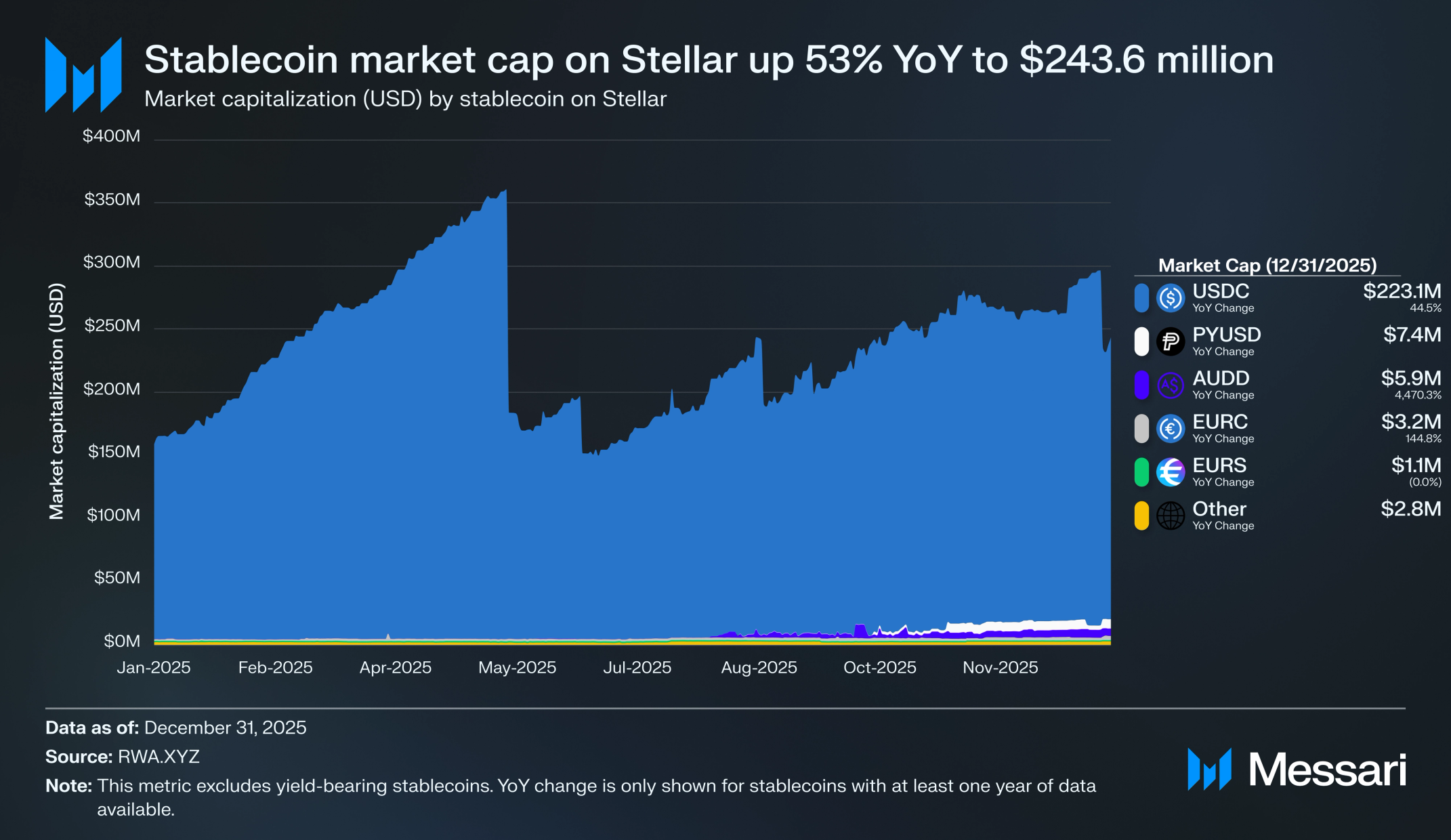
Stellar’s stablecoin market cap increased 53% year-over-year from $159 million to $243.6 million, driven by PayPal’s PYUSD launch on the network in September, and USDC’s 45% YoY increase in market cap to $223.1 million.
In December, the Marshall Islands completed the world’s first onchain universal basic income disbursement by a national government on Stellar.
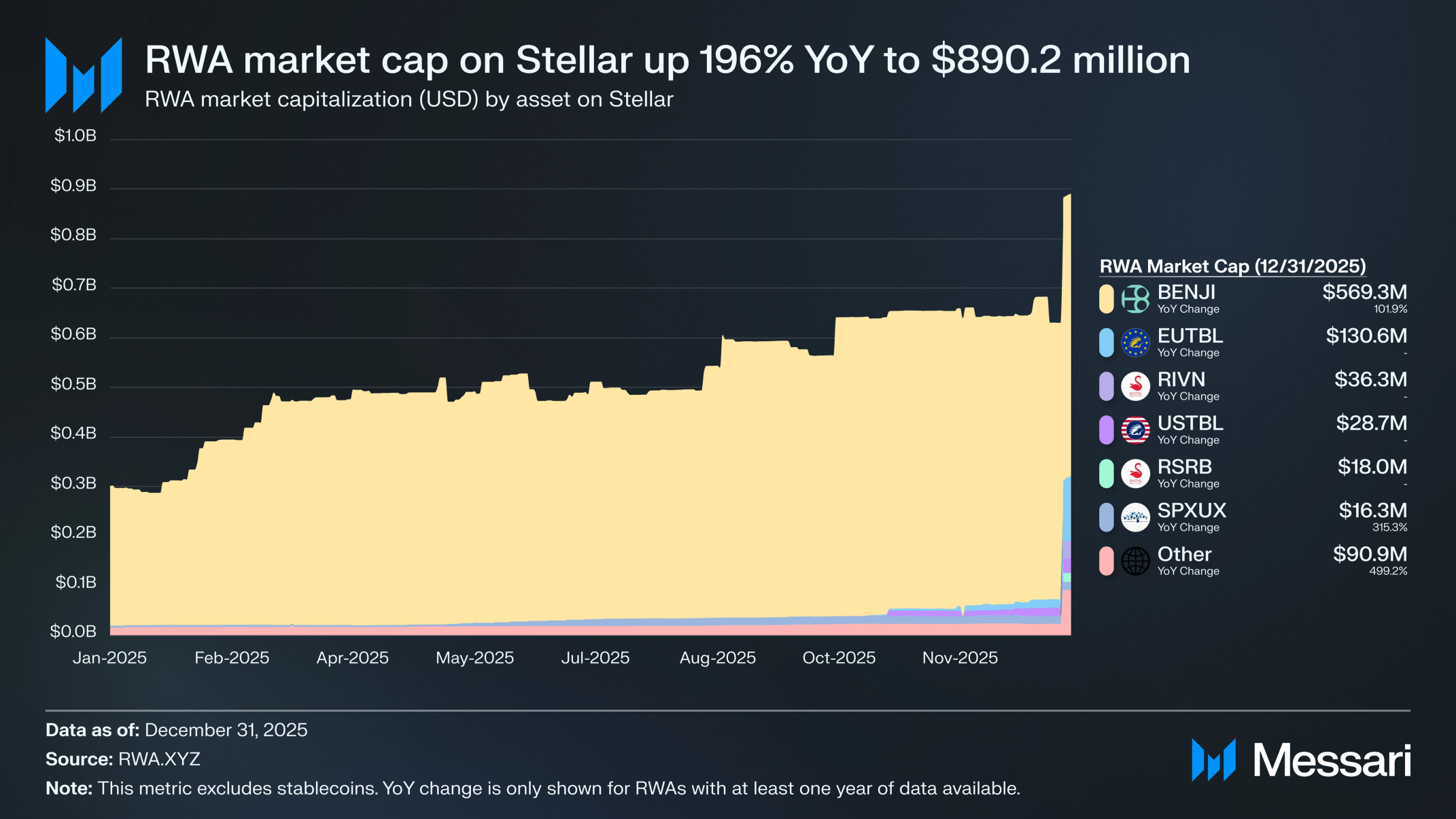
In 2025, the market cap of RWAs on Stellar increased 196% from $301.1 million to $890.2 million, driven primarily by the issuance of new assets such as treasuries from Spiko and real estate from Red Swan, alongside the growth of Franklin Templeton’s U.S. Government Money Fund (BENJI) and Etherfuse’s government debt offerings.
Stellar is realizing increased DeFi composability, thereby achieving greater capital efficiency and DeFi TVL, as more protocols are launched and issued assets are adopted on the network.This includes lending and borrowing protocol Templar, which will soon support native crypto assets, stablecoins, and freely transferable RWAs.
Primer
Stellar (XLM) is a Layer-1 blockchain for creating applications and smart contracts, issuing assets, and connecting to existing financial rails.
The network has been running for over a decade since its launch in 2014 and has operated via the Stellar Consensus Protocol (SCP) since November 2015, after briefly running on a modified version of the Ripple Protocol Consensus Algorithm.
Development of Stellar and growth of the Stellar ecosystem are supported by the Stellar Development Foundation. A number of key features, products, and tools built on the network focus on everyday financial services use cases. A global network of Anchors, such as MoneyGram International, provides the on and off-ramps that connect Stellar to traditional financial rails, while the Stellar Disbursements Platform (SDP) is a turnkey solution for sending digital payments. Network features for assets include multi-signature accounts and authorization flags to control access, while Stellar’s Asset Sandbox includes no-code tools for asset issuance and management. Additionally, Path Payments, powered by Stellar’s Decentralized Exchange (SDEX), enable a different asset to be sent than what is received by the recipient address.
In November 2025, U.S. Bank announced that it is testing custom issuance of its own stablecoin on Stellar. Mike Villano, Senior Vice President and Head of Digital Asset Products at U.S. Bank, cited Stellar’s built-in clawback feature, which allows the issuer of an asset to reclaim it, as key, given the bank’s legal requirements for customer protections. In addition to this, the network’s other built-in asset controls, 99.99% uptime over a decade, billions in annual payment volume, and 3-5 second settlement at the cost of a U.S. cent provide the reliability and configurability required by regulated institutions like U.S. Bank.
In 2025, Stellar’s stablecoin market cap increased 53% year-over-year from $159 million to $243.6 million, driven by USDC’s 44.5% YoY increase to $223.1 million and PayPal’s PYUSD launch on the network in September 2025. The launch of PYUSD is particularly useful for those already familiar with and directly using PayPal’s existing financial infrastructure integrated with PYUSD. It also marks the second major U.S. dollar stablecoin offered on the network, delivering near-immediate settlement and reduced friction for everyday transactions as well as access to PayFi solutions for small businesses.
In October 2025, Visa announced support for USDC, EURC, PYUSD, and USDG on Stellar. In November, digital payments provider Wirex, a principal member of Visa, announced support for stablecoin settlement using USDC and EURC on Stellar. Card payment settlements made via Wirex are now settled directly onchain in stablecoins with Visa without reliance on intermediary banks or legacy fiat systems. Instead, Wirex Pay, the company's onchain stablecoin infrastructure, enables real-time card and banking payments directly from self-custody wallets. Benefits include faster, near real-time settlement, lower fees, and 24/7 availability.
Beyond USDC and PYUSD, the market cap of the Australian digital dollar (AUDD) increased 44x in 2025 from $128,950 to $5.9 million. Other notable stablecoins on Stellar include Circle’s EURC and STASIS’s EURS.
Payments
There have been several payment milestones on Stellar in recent months. Arguably the most notable was the Marshall Islands’ onchain universal basic income disbursement in December 2025 using a tokenized bond (USDM1) on Stellar. This was the first onchain disbursement of universal basic income by a national government, underscoring that the same factors that make Stellar attractive to regulated institutions also make it attractive to governments. The initiative is part of the ENRA program and replaces physical cash deliveries with digital transfers to citizens across dispersed islands.
Other notable recent payments catalysts on Stellar include:
Hana: Hana partnered with MoneyGram in November to bring USDC on Stellar to Southeast Asia.
SDF x BPC: In November, the Stellar Development Foundation (SDF) announced the formation of the Blockchain Payments Consortium (BPC), an initiative to enable frictionless, compliant transactions across networks and borders, in partnership with Fireblocks, Polygon Labs, Mysten Labs, Monad Foundation, Solana Foundation, and TON Foundation. The consortium's mission is to define safe, common standards to shape better payment experiences for everyone.
Crossmint x Stellar: In October, Crossmint launched its Stellar Smart Wallets V2, enabling easy launch of stablecoin applications by developers using chain-agnostic web2 APIs. Notably, Crossmint powers MoneyGram’s cross-border stablecoin infrastructure.
Cartwey: In October, Cartwey, a grocery store self-checkout application powered by Stellar and Beans payments SDK, was announced as a recipient of Stellar Community Fund 38.
Real World Assets
In 2025, the market cap of RWAs on Stellar increased 195.7% from $301.1 million to $890.2 million. The majority of this gain came from BENJI, which grew 101.9% YoY from $282.0 million to $569.3 million. Each BENJI token represents one share of Franklin Templeton’s onchain U.S. Government Money Fund (FOBXX). The majority of the remainder of the growth came from the 19 newly issued RWAs in 2025. Standouts include:
Spiko: In November, Spikointegrated Stellar and closed 2025 with $130.6 million in EU T-Bills Money Market Fund (EUTBL) and $28.7 million in US T-Bills Money Market Fund (USTBL) issued on the network. Spiko also launched its Cash and Carry Dollar (SPKCC) and Cash and Carry Euro (eurSPKCC) on the network at the end of December.
RedSwan: In September, RedSwan Digital Real Estate announced that it had tokenized $100 million in commercial real estate on Stellar, comprising multifamily and hospitality properties. These include ownership interest in Hotel on Rivington (RIVN), a 107-room hotel in Manhattan, R&B Oak Park (RSRB), a 104-unit multifamily property in suburban Chicago, and Sedona Ranch (RSR), a 268-unit multifamily property in Odessa, Texas.
Etherfuse:Etherfuse issues “stablebonds,” where each stablebond is a tokenized fund of short-term government-issued treasury bonds from a given country or jurisdiction. These include Mexico (CETES), the European Union (EUROB), Brazil (TESOURO), and the United States (USTRY). Additionally, Etherfuse offers MXNe, a peso-dominated stable value issued with Brale and backed by CETES. While the stablecoin market is currently dominated almost exclusively by U.S. dollar stablecoins, like USDC and USDT, Etherfuse aims to bring 100 sovereign currencies onchain as yield-bearing assets, acting as the “AWS of sovereign debt.” Existing use cases for these stablebonds include acting as yield-bearing stablecoins composable in DeFi and being tradable with one another for approximately 4 basis points (bps), an institutional-grade foreign exchange (FX) fee not accessible to retail users elsewhere.
DeFi
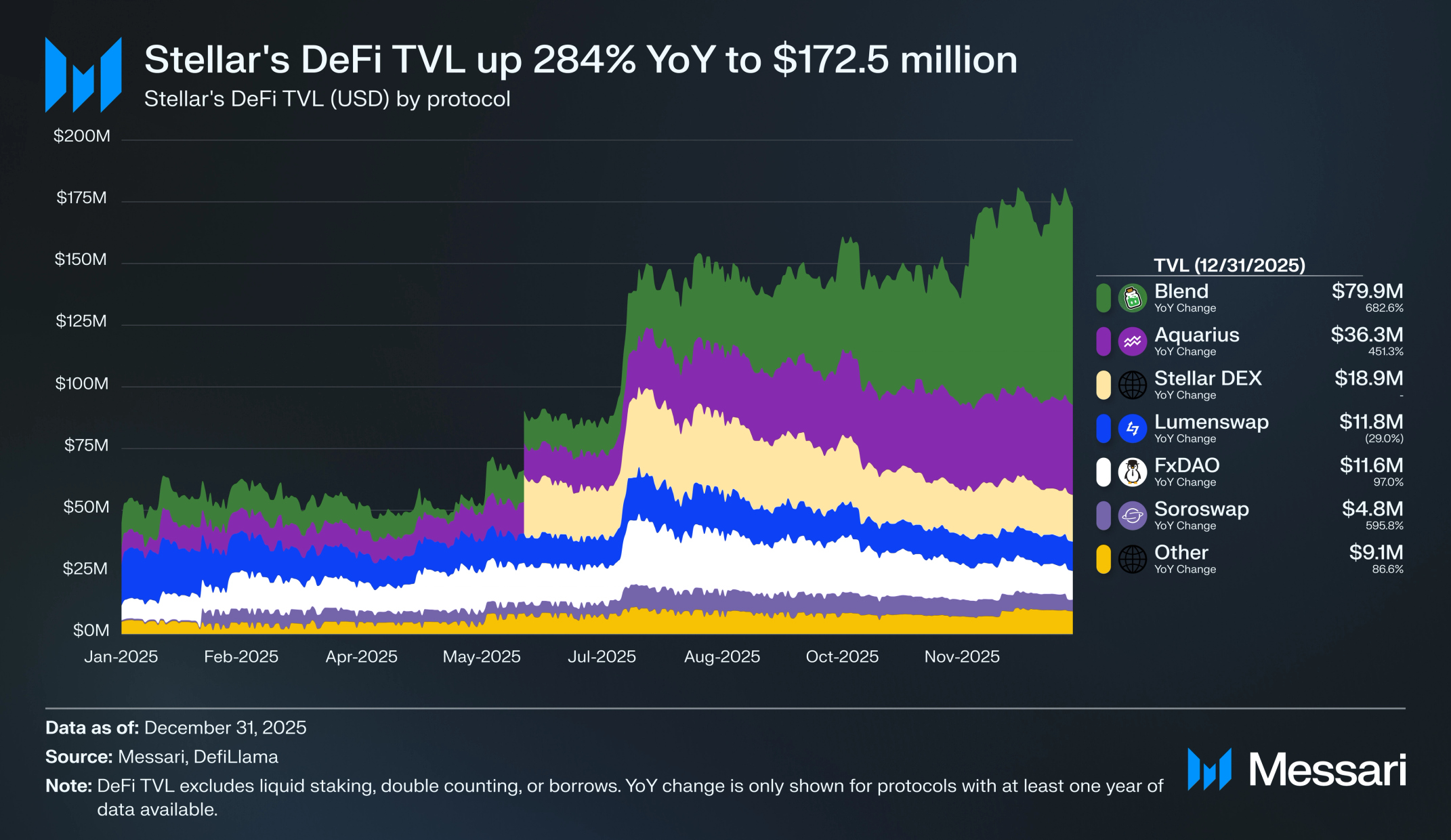
DeFi total-value locked (TVL) on Stellar increased 284% in 2025 from $44.9 million to $172.5 million. The majority of growth came from overcollateralized lending and borrowing protocol Blend, which grew 7.8x YoY from $10.2 million to $79.9 million. USDC APY on Blend has ranged between 12-18% in recent months, a very attractive rate compared to established overcollateralized lending and borrowing protocols like Aave V3 and SparkLend, which have ranged between 2-7% APY.
Blend has two main lending and borrowing pools, Fixed Pool V2, where lending and borrowing parameters are immutable after deployment, and Yieldblox V2, which is managed by YBX DAO and allows parameters to be adjusted dynamically and can receive additional yield from BLND rewards, the project’s token. Tokens with notable liquidity on Blend include XLM, AQUA, stablecoins USDC, EURC, USDGLO, PYUSD, and Etherfuse stablebonds USTRY, CETES, and TESOURO.
Other notable protocols that had outstanding TVL growth in 2025 include the DEX Aquarius (+451% YoY to $36.3 million), overcollateralized XLM lending and stablecoin borrowing protocol FxDAO (+97% YoY to $11.6 million), and DEX Soroswap (+86.6% YoY to $4.8 million).
DeFi Composability
Composability in DeFi refers to the permissionless ability of assets, protocols, and their underlying smart contracts to seamlessly interact and integrate with each other. In doing so, collective capital efficiency and TVL of the DeFi ecosystem increase as assets are productive in nested strategies. For example, depositing XLM into a Stellar AMM generates LP tokens, which could then be used as collateral on an overcollateralized lending and borrowing protocol like Blend. Liquidity, capital efficiency, and TVL increase further as new protocols and assets are launched.
A prime example of this is Templar, an interoperable, permissionless overcollateralized lending and borrowing protocol that launched on Stellar in November. Currently, users on Stellar can deposit XLM to borrow USDC. The protocol is interoperable via NEAR’s multi-party computation (MPC) network, allowing users to supply an asset on one network to borrow an asset on another, like for example, depositing native BTC to borrow U.S. dollar stablecoins on Ethereum. Support on Templar for many additional assets on Stellar is planned, including Franklin Templeton’s BENJI, PayPal’s PYUSD, freely transferable wrapped RWAs (deRWAs) via Centrifuge, and solvBTC via Solv Protocol.
In November 2025, a proposal was made to introduce Token for Regulated Exchanges (T-REX), to enable permissioned exchange for regulatorily compliant tokens. Requirements for these tokens include, but are not limited to, KYC and AML, identity verification, investor accreditation, freezing for regulatory enforcement, recovery mechanisms for lost or compromised wallets, and compliance hooks for regulatory reporting. Once released, T-REX will enable DeFi composability within a permissioned environment for regulatorily compliant tokens separate from Stellar’s permissionless DeFi ecosystem.
In October 2025, Stellar joined the Chainlink Scale Program to integrate Chainlink’s Data Feeds, Data Streams, and the Cross-Chain Interoperability Protocol (CCIP), expanding the network’s capacity to support RWAs in DeFi.
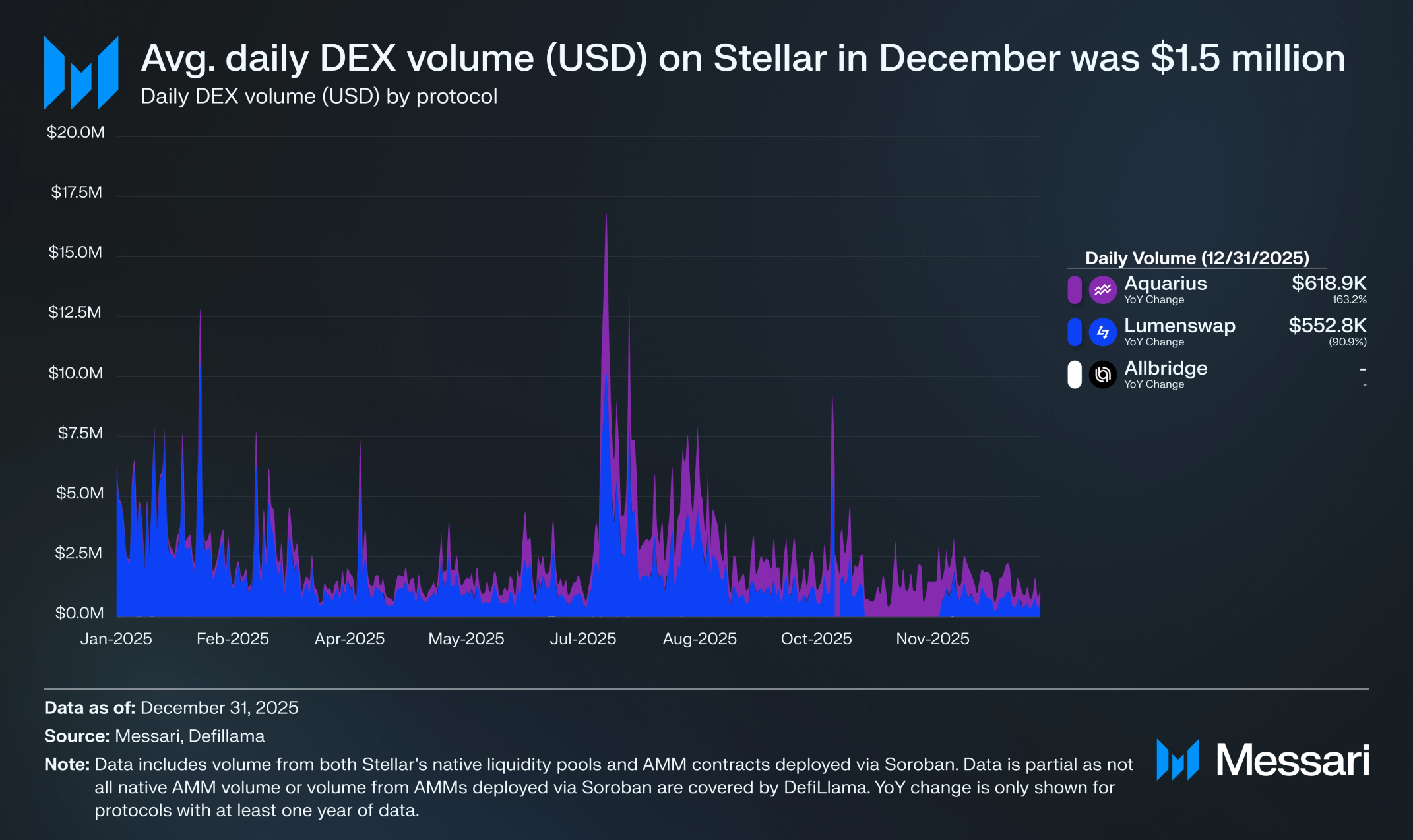
Average daily DEX volume (USD) on Stellar in December 2025 was $1.5 million. Notably, Aquarius had $104.8 million in volume in Q4’25, 63.9% more than Lumenswap’s $63.9 million, though Lumenswap outpaced Aquarius in the first, second, and third quarters of 2025. LumenSwap is a front-end interface for Stellar’s Decentralized Exchange (SDEX) and native liquidity pools, while Aquarius is a Soroban-deployed DEX on Stellar.
Closing Summary
Stellar’s financial ecosystem expanded significantly in 2025 and is poised for further growth in 2026 amidst a myriad of catalysts. Stellar’s stablecoin market cap increased 53% year-over-year from $159 million to $243.6 million, driven by PayPal’s PYUSD launch on the network in September, and USDC’s 45% YoY increase in market cap to $223.1 million. This expansion is being validated by institutional adoption, as U.S. Bank is testing custom issuance of its own stablecoin on Stellar, underscoring the network’s appeal due to its reliability (>99.99% uptime), affordability (settlement at <1 U.S. cent), and built-in asset controls for regulatory compliance. On top of this, in December, the Marshall Islands completed the world’s first onchain universal basic income disbursement by a national government on Stellar.
Moreover, in 2025, the market cap of RWAs on Stellar increased 196% from $301.1 million to $890.2 million, driven primarily by the issuance of new assets such as treasuries from Spiko and real estate from Red Swan, alongside the growth of Franklin Templeton’s U.S. Government Money Fund (BENJI) and Etherfuse’s government debt offerings.
Finally, Stellar is realizing increased DeFi composability, thereby achieving greater capital efficiency and DeFi TVL, as more protocols are launched and issued assets are adopted on the network. This includes lending and borrowing protocol Templar, which will soon support native crypto assets, stablecoins, and freely transferable RWAs. With the foundation of Stellar’s Financial Ecosystem laid in 2025, further expansion in stablecoin and real world asset adoption, payments, and DeFi is inevitable in 2026.
This report was commissioned by the Stellar Development Foundation. All content was produced independently by the author(s) and does not necessarily reflect the opinions of Messari, Inc. or the organization that requested the report. The commissioning organization may have input on the content of the report, but Messari maintains editorial control over the final report to retain data accuracy and objectivity. Author(s) may hold cryptocurrencies named in this report. This report is meant for informational purposes only. It is not meant to serve as investment advice. You should conduct your own research and consult an independent financial, tax, or legal advisor before making any investment decisions. Past performance of any asset is not indicative of future results. Please see our Terms of Service for more information.
No part of this report may be (a) copied, photocopied, duplicated in any form by any means or (b) redistributed without the prior written consent of Messari®.
Matt is a Research Manager at Messari for the Protocol Reporting team. A generalist at heart, who's curious about anything and everything, and ultimately, on an adventure to find out what's true. He was an investigative reporter and multifamily/senior housing development associate before joining Messari in 2022.
Matt is a Research Manager at Messari for the Protocol Reporting team. A generalist at heart, who's curious about anything and everything, and ultimately, on an adventure to find out what's true. He was an investigative reporter and multifamily/senior housing development associate before joining Messari in 2022.