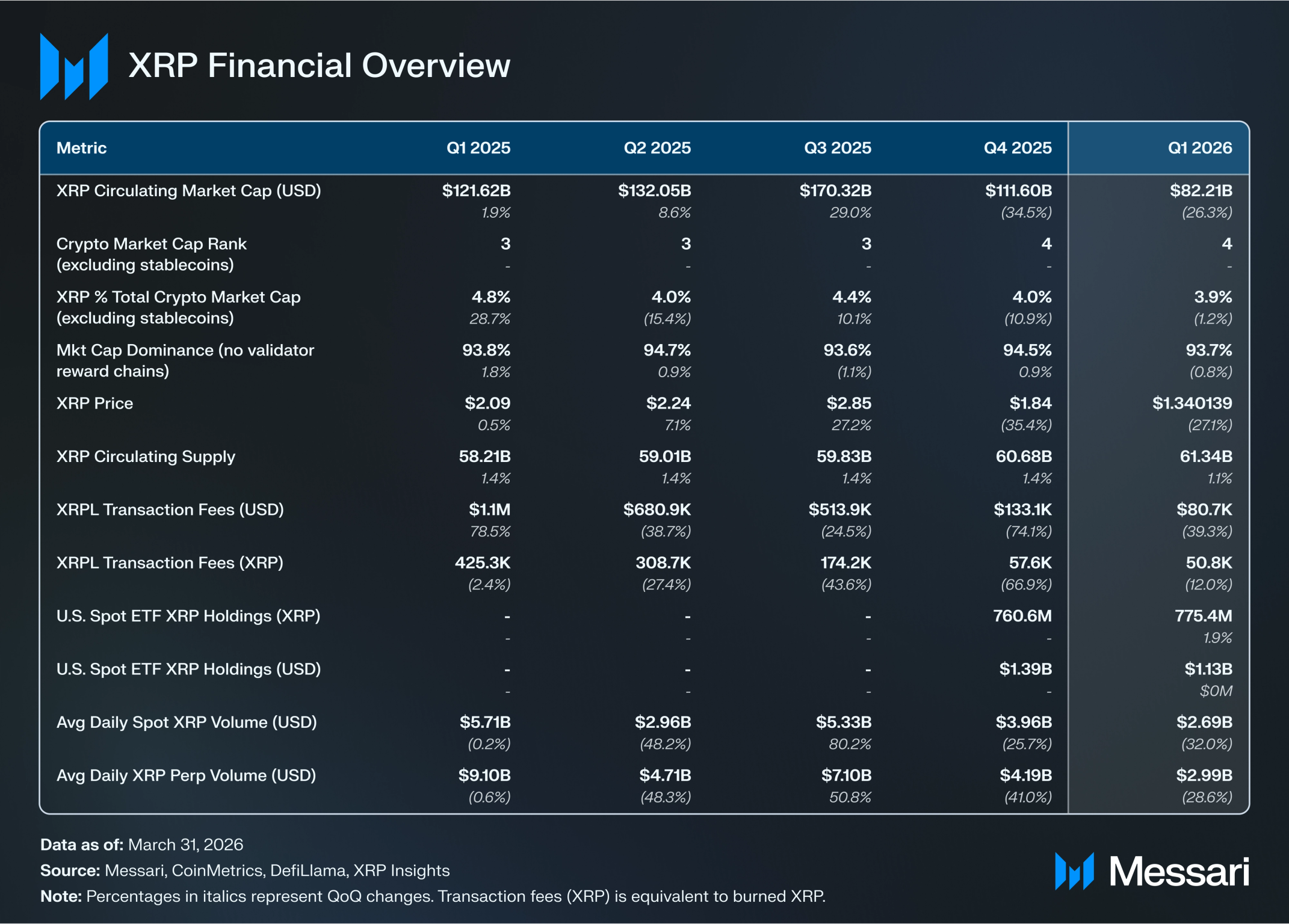
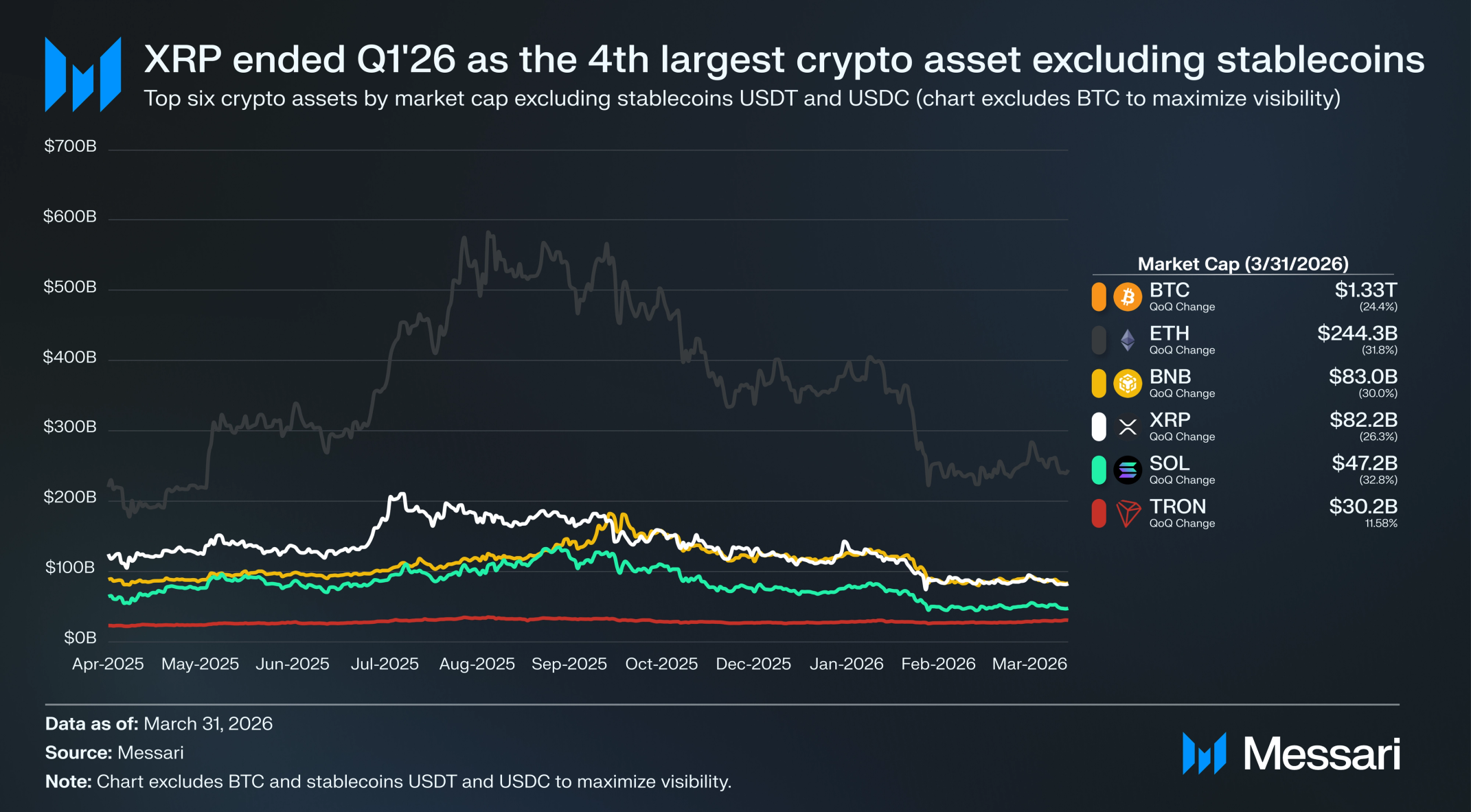
XRP closed Q1 2026 as the fourth largest non-stablecoin crypto asset by market cap behind BTC, ETH, and BNB.
XRP’s utility continues to grow, both directly and indirectly, as XRPL’s feature set expands, particularly for institutional DeFi use cases such as tokenized real-world assets (RWAs), stablecoins, and decentralized liquidity. For example, the XRPL’s native lending protocol will enable lending and borrowing of XRP, bringing an entirely new use for the token on the network.
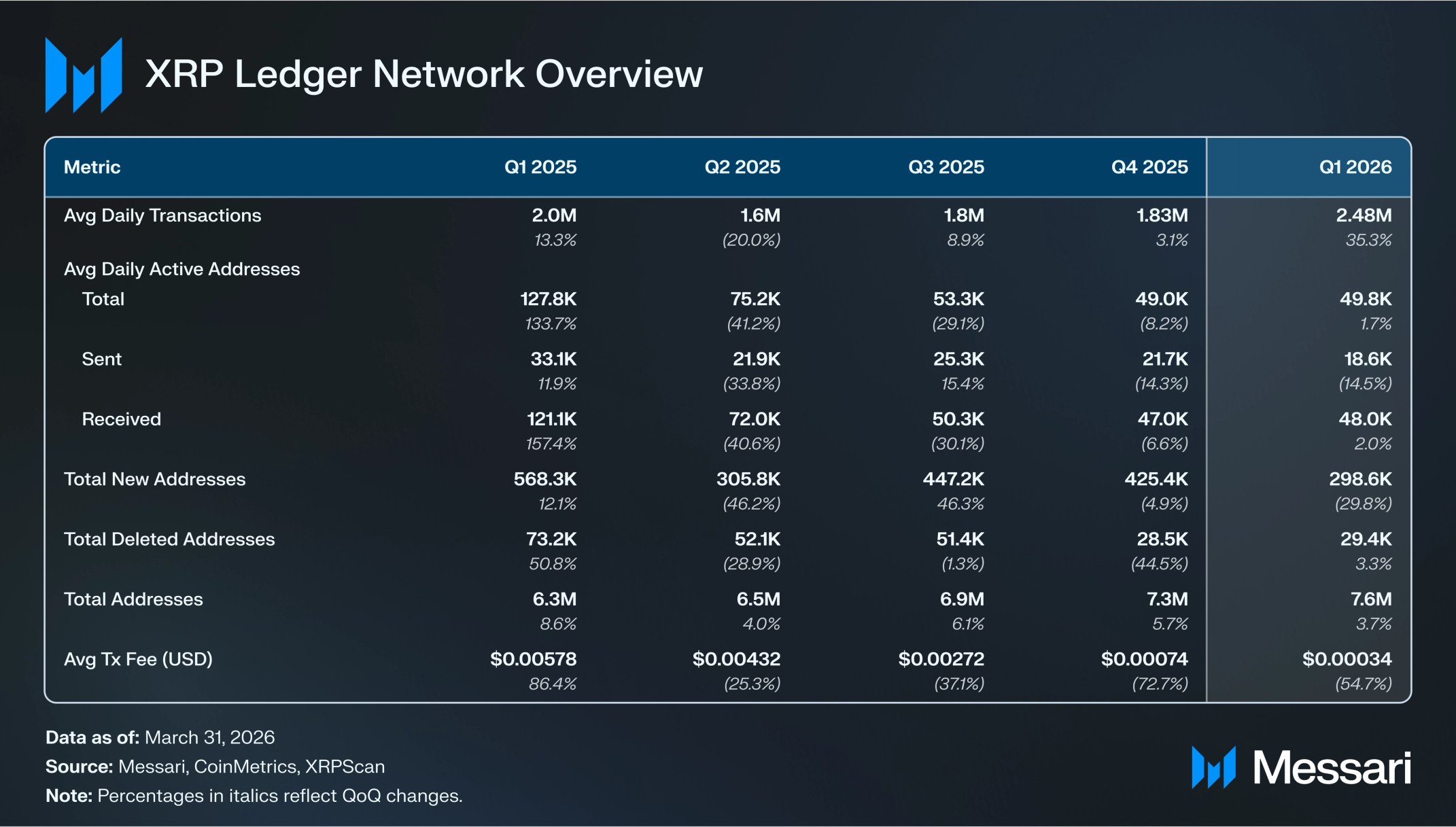
Continued implementation of identity, compliance, and privacy features also drives value to XRP, as increased institutional adoption on the XRPL means more operations using XRP (reserve requirements, transaction fees, asset bridging, etc.). In Q1 2026, average daily transactions increased 35.3% QoQ from 1.83 million to 2.48 million.
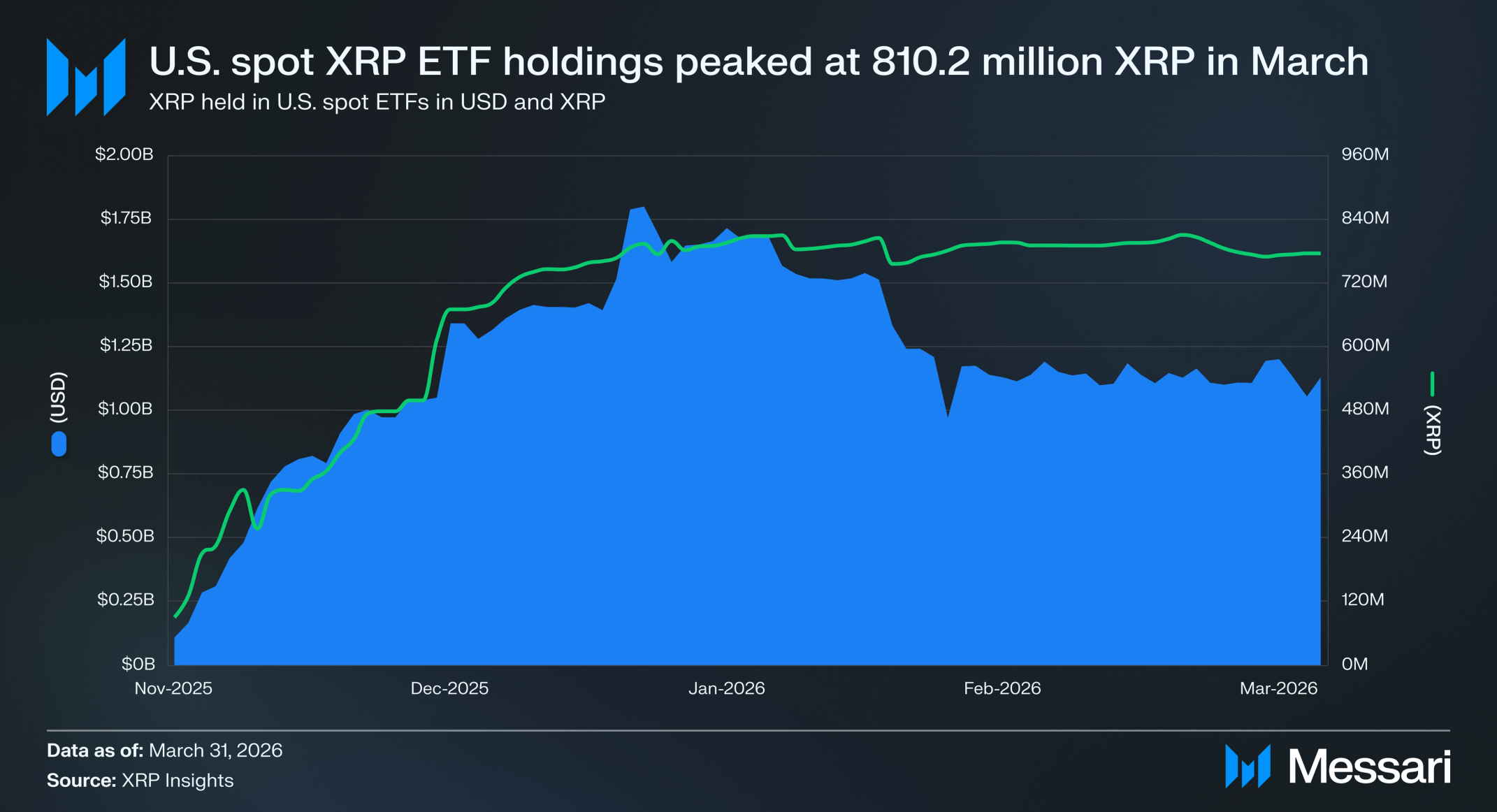
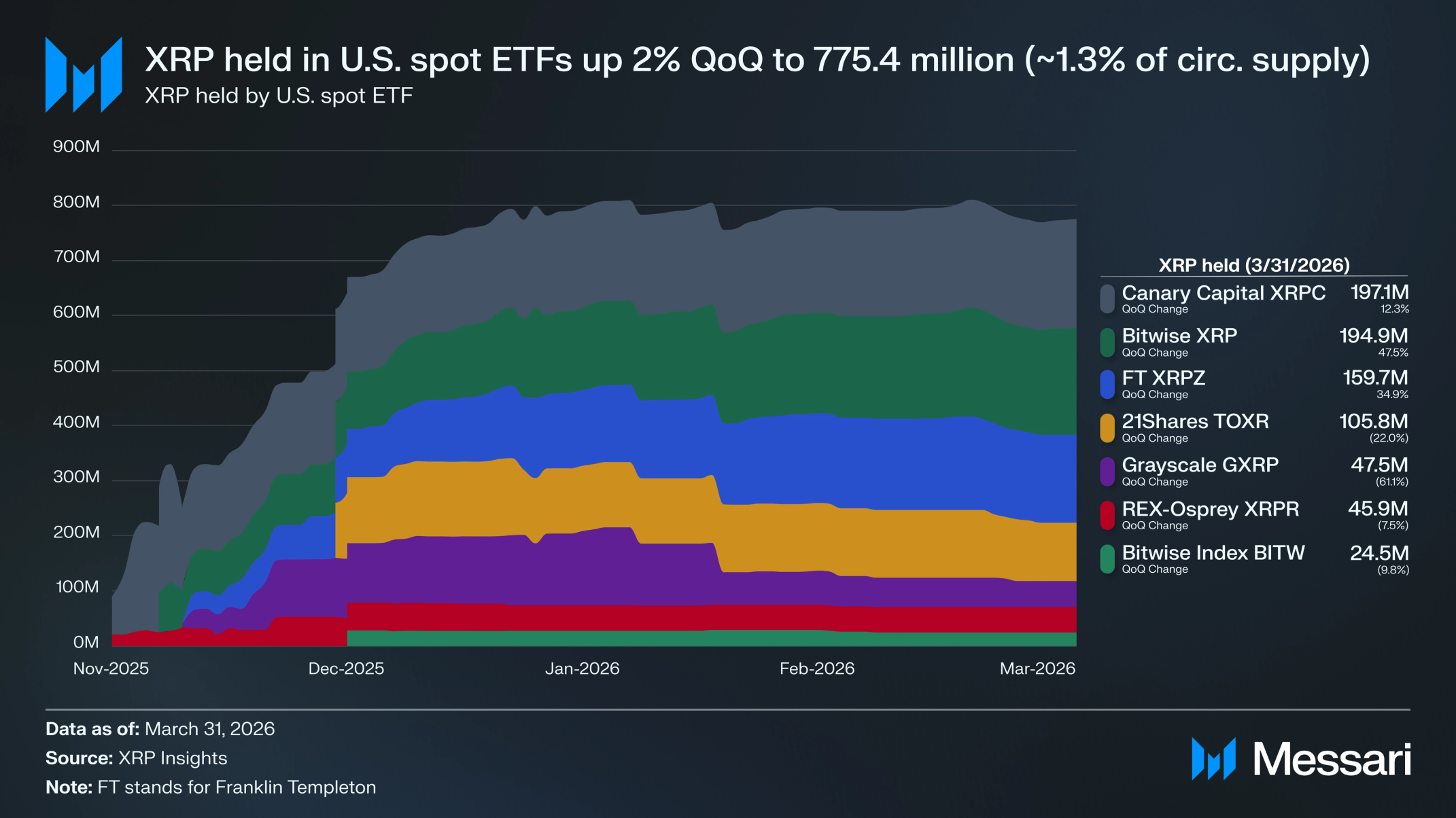
U.S. spot XRP ETFs closed Q1 2026 collectively holding 775.4 million XRP (1.26% of the circulating supply), up 1.9% QoQ, with XRP held peaking at 810.2 million XRP on March 3, 2026. The quarter closed with U.S. spot XRP ETF market share relatively evenly distributed amongst four ETFs, each holding more than 100 million XRP: Canary Capital’s XRPC, Bitwise’s XRP, Franklin Templeton’s XRPZ, and 21Shares’s TOXR.
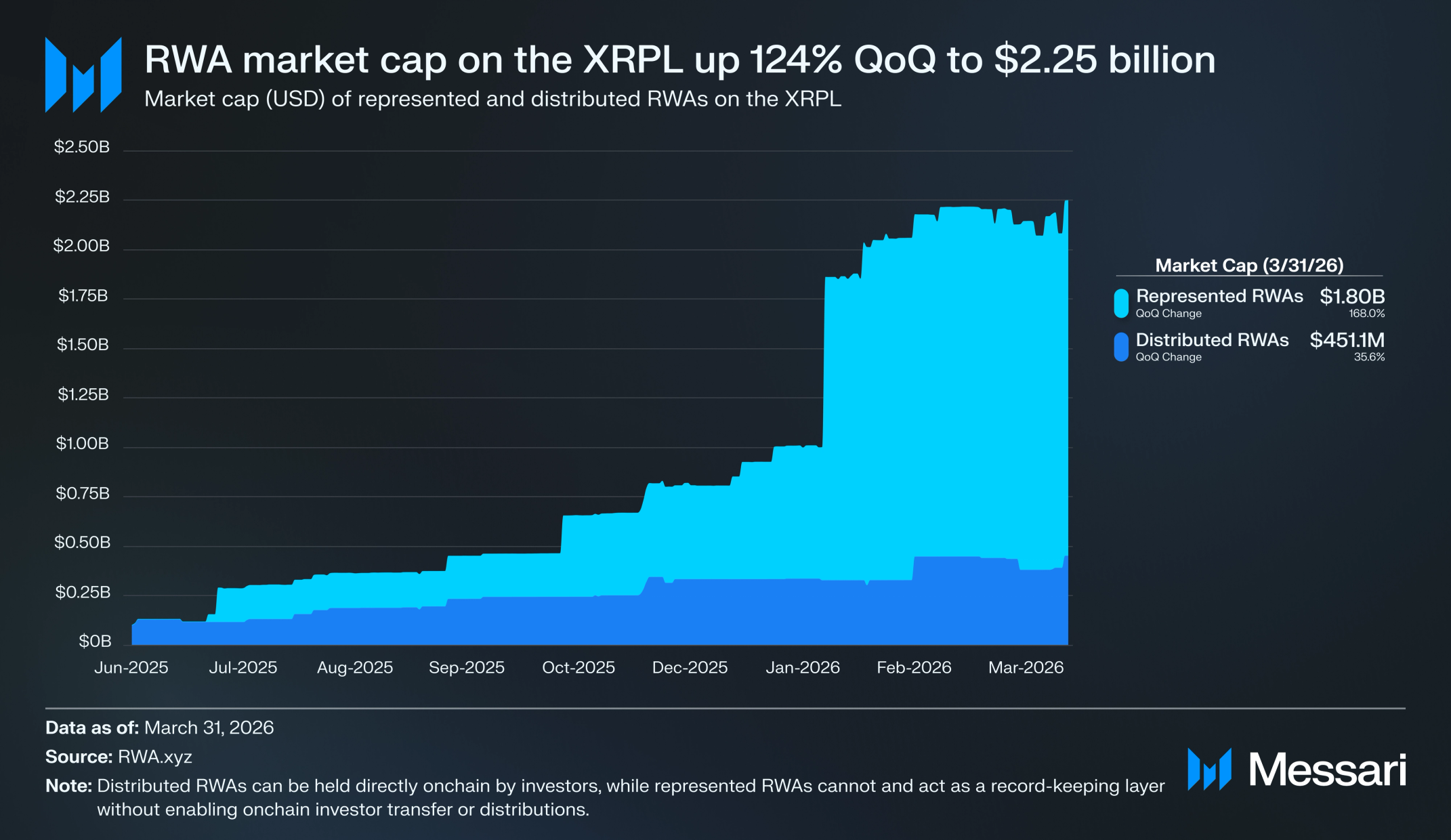
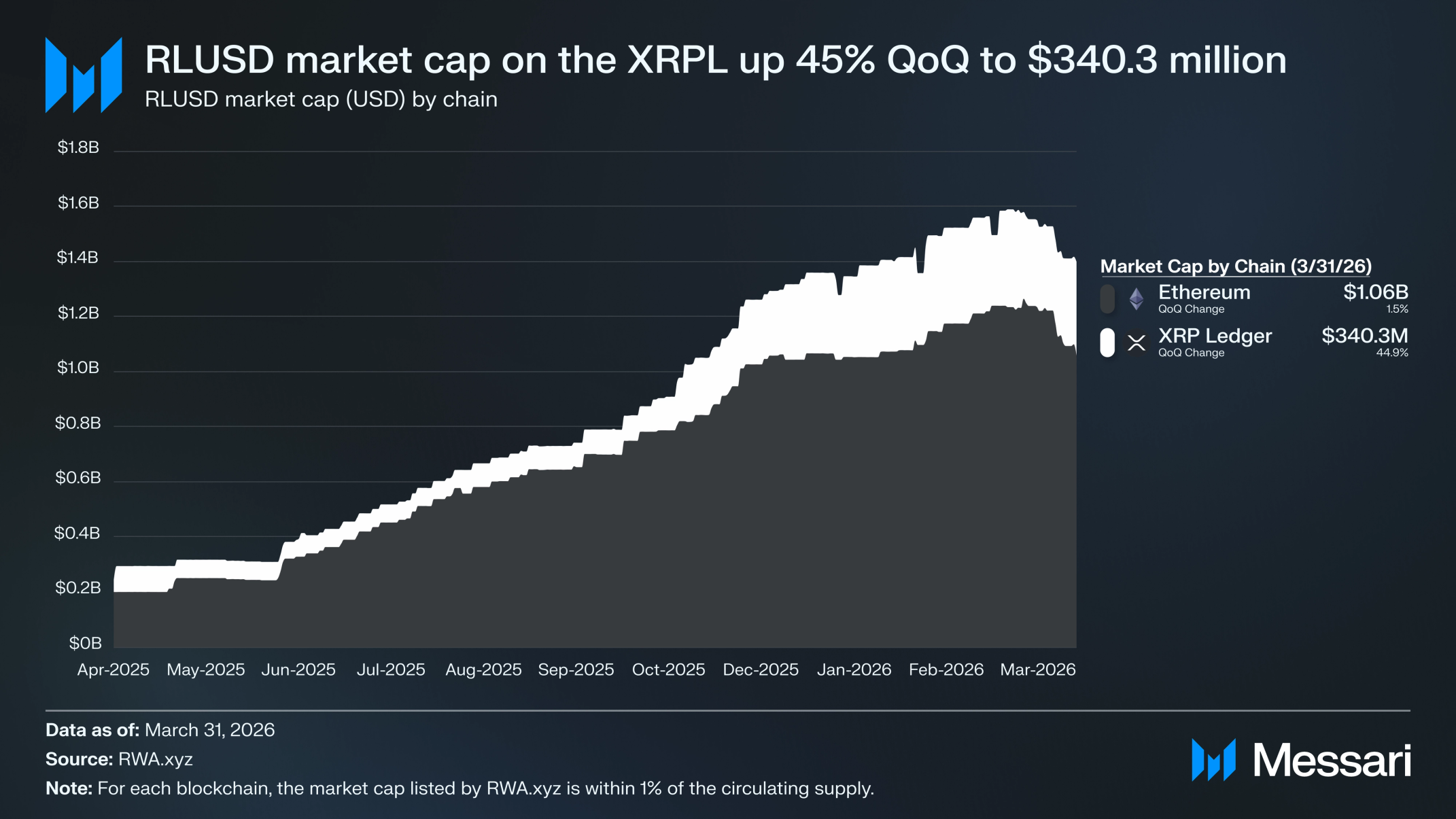
Ripple’s USD-pegged stablecoin, RLUSD, closed Q1 2026 with a market cap of $340.3 million on the XRPL (+45% QoQ), making it the network’s largest stablecoin. Additionally, the XRPL closed the quarter with an all-time high RWA market cap of $2.25 billion (+124% QoQ), making it the seventh largest network by RWA market cap. As of publication, the XRPL now ranks fourth.
Primer
XRP is the native token of the XRP Ledger (XRPL), powering a network that has been running for over a decade, offering a continually expanding set of use cases, including regulated and permissionless DeFi, cross-currency and cross-border payments, and tokenization, particularly of stablecoins and real-world assets. The network’s fast and cheap transactions relative to other public blockchains, reliability, consensus design, and native features (as opposed to smart contracts) — such as embedded compliance, identity, token management, and DEX, make it particularly attractive for institutional use at scale.
XRP’s utility on the network continues to grow, both directly, via upcoming features like the lending protocol, which will enable lending and borrowing of XRP, and indirectly, as institutional DeFi adoption for use cases such as tokenized real-world assets (RWAs), stablecoins, and decentralized liquidity drives more operations using XRP. On the XRPL, XRP is used to make payments (including acting as a bridge between currencies), pay transaction fees, provide liquidity, create an account, and own tokens (owner reserve). XRP was created at the launch of XRPL in 2012, and its supply is permanently capped at 100 billion. No additional XRP can ever be minted, and no single entity (including Ripple) controls or can change the total supply.
XRP closed Q1 2026 as the fourth largest non-stablecoin crypto asset by market cap behind BTC, ETH, and BNB. Moreover, XRP dominates market cap share (~90%) of native assets for chains with no miner or validator rewards. XRPL was the first major blockchain designed this way with a federated consensus mechanism, which operates off agreement between validators that each choose a Unique Node List (UNL) of validators to trust. A key benefit of this design compared to Proof-of-Stake (PoS) networks like Ethereum or Proof-of-Work (PoW) networks like Bitcoin is no miner extractable value (MEV). Because there are no token rewards to validators or miners, they cannot extract profit by reordering, inserting, or censoring transactions within a block to the detriment of users. It is design principles like these that have made the XRPL purpose-built for institutional adoption from the network’s start.
As blockchain financial regulatory clarity and institutional adoption continue to progress, the XRPL’s architecture and ever-progressing native functionality uniquely position it to capture institutional use at scale, all powered by XRP.
For a full primer on XRP Ledger, refer to our Initiation of Coverage report.
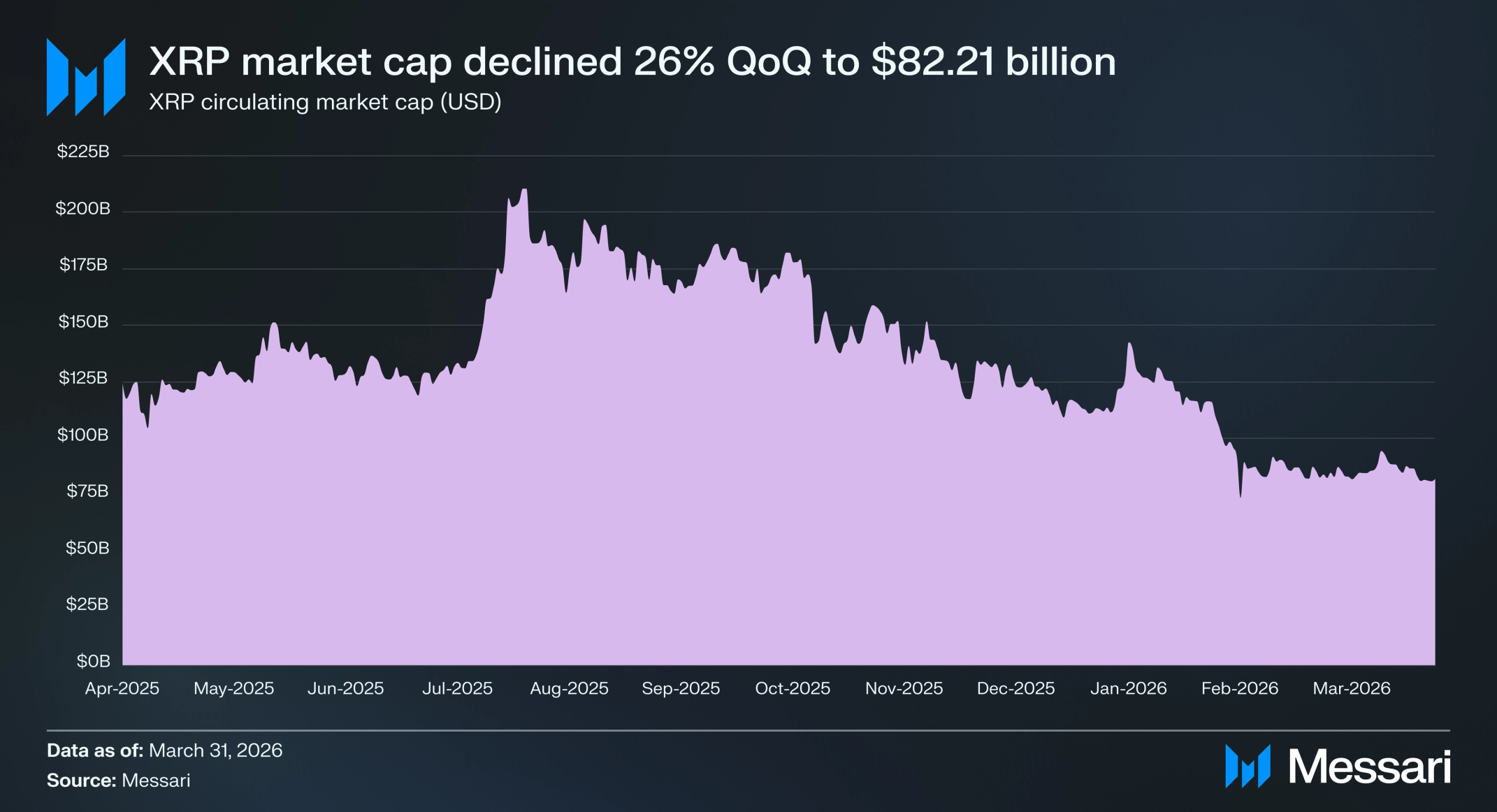
XRP ended Q1’26 as the fourth-largest crypto asset (excluding stablecoins) by market capitalization at $82.21 billion (-26.3% QoQ), slightly underperforming the combined market capitalization of the three non-stablecoin crypto assets with a higher market cap (BTC, ETH, and BNB), which combined decreased by 23.3% QoQ. Notably, BNB closed both Q4 2025 and Q1 2026 with a slightly higher market cap than XRP, though XRP regained its spot as the third largest crypto asset excluding stablecoins again in Q2 2026.
Market Cap Dominance
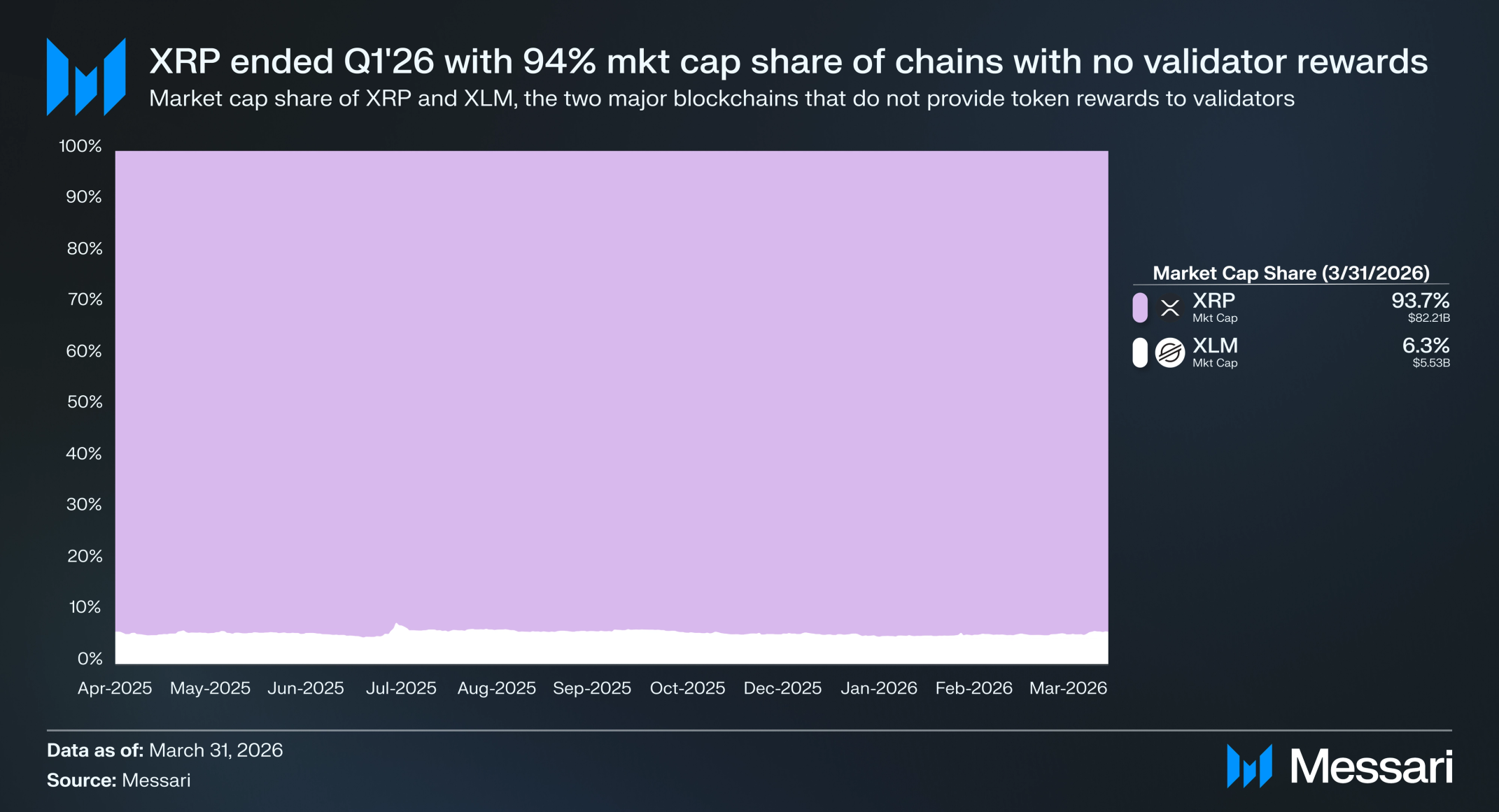
XRP closed Q1 2026 with continued dominance of market cap share (93.7%) of native assets for chains with no miner or validator rewards (federated consensus). XRPL was the first major blockchain designed this way with a federated consensus mechanism, which operates off agreement between validators that each choose a Unique Node List (UNL) of validators to trust. A key benefit of this design compared to Proof-of-Stake (PoS) networks like Ethereum or Proof-of-Work (PoW) networks like Bitcoin is no miner extractable value (MEV). Because there are no token rewards to miners or validators, they cannot extract profit by reordering, inserting, or censoring transactions within a block to the detriment of users.
Zooming out, XRP closed Q1 2026 with 3.9% of the total crypto market cap excluding stablecoins, down from 4% at the close of Q4 2025, and down from 4.8% YoY from the close of Q1 2025. While the entire crypto market cap can grow together with increased adoption, this metric serves as a valuable check on XRP’s relative standing. An increased XRP share of crypto’s total market cap means a higher monetary premium for XRP due to greater social consensus. This can be extrapolated to the increased relative social standing of the XRP Ledger’s design principles, such as trust-based validation, compared to Ethereum’s PoS and Bitcoin’s PoW. It’s important to note that Bitcoin competes much less directly with XRPL than Ethereum, as it prioritizes immutability and censorship resistance (over throughput and programmability) to produce the hardest crypto money. Ethereum, on the other hand, with its programmability, competes directly with the XRP Ledger, albeit with design tradeoffs that make the correlation between market cap dominance and relative social consensus (monetary premium) imperfect. Still, each ultimately competes against one another for monetary premium under the sphere of cryptomoney.
Transaction Fees
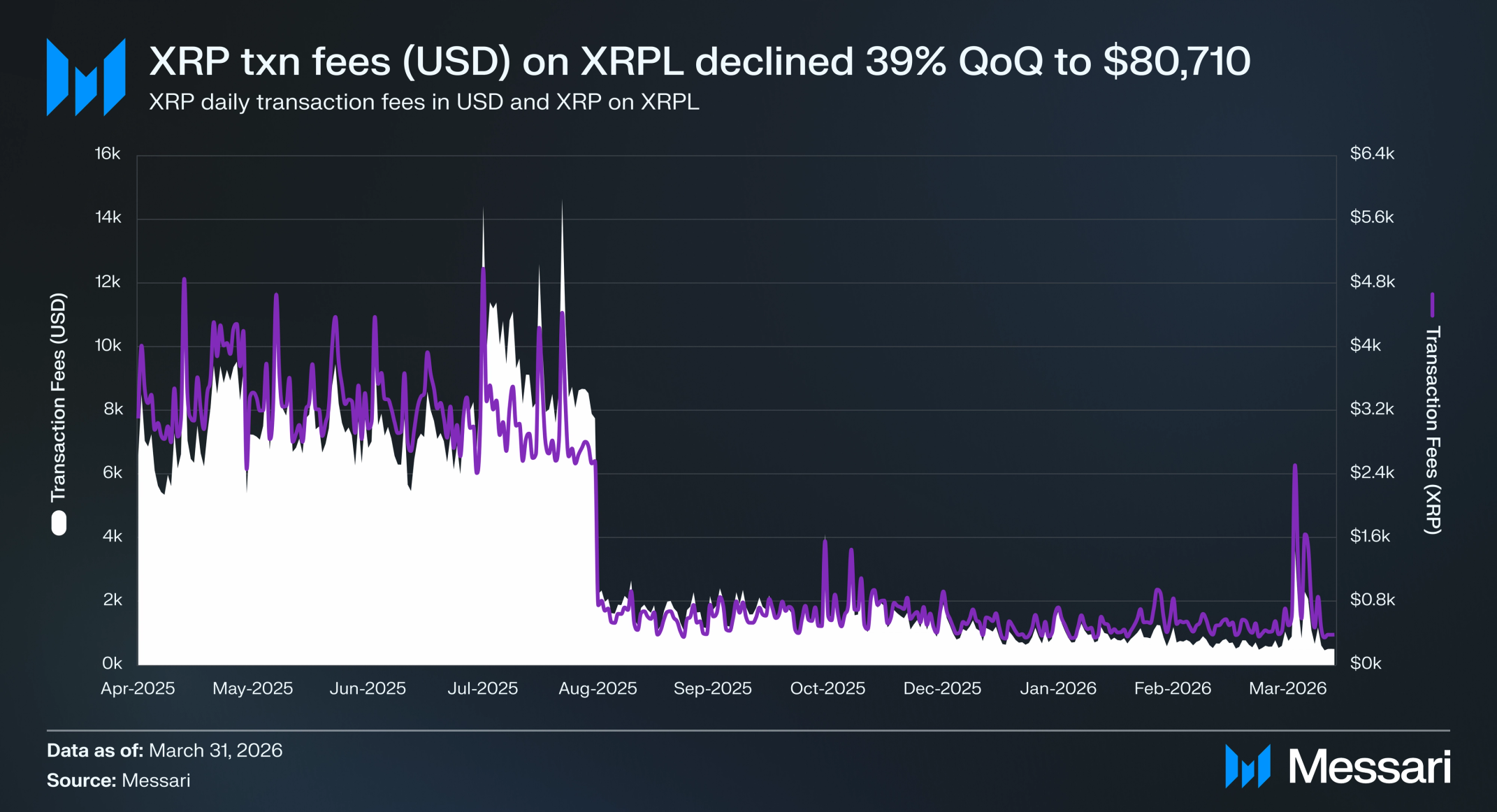
Transaction fees (USD) declined 39.3% QoQ from $133,100 to $80,710, while native transaction fees declined 12% QoQ from 57,600 XRP to 50,750 XRP. On XRPL, transaction fees are systematically burned, applying deflationary pressure to XRP’s permanently capped 100 billion total supply. Since the XRP Ledger’s inception, about 14.3 million XRP ($19.2 million at the close of Q1’26) has been burned. This low burn rate is due to the relatively low transaction fees (<$0.0008 per transaction) on the network.
Circulating Supply
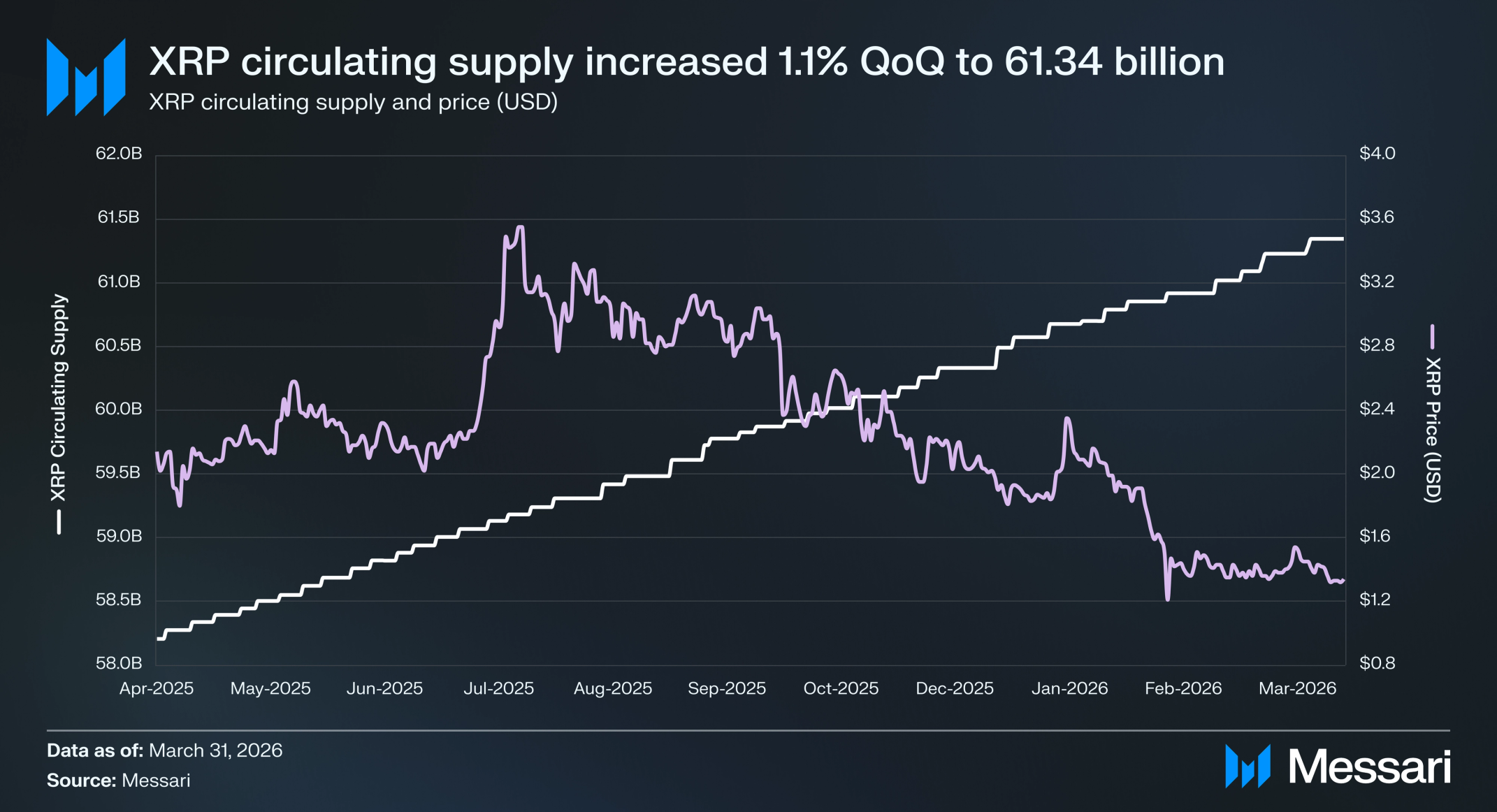
XRP’s price decreased 27.1% QoQ to $1.34, with the discrepancy between market cap and price due to a 1.1% increase in circulating supply to 61.34 billion.
XRP has a permanently capped 100 billion total supply, with one billion XRP ($1.34 billion at the close of Q1’26) released from escrow to Ripple per month. Any XRP not spent or distributed by Ripple in that month is put into new escrow contracts. This system will continue until the remaining ~33.05 billion XRP (as of May 2026) becomes liquid. Typically, approximately 300 million XRP is spent or distributed, with the remainder relocked. At this rate, it will take more than ten years for all XRP in escrow to be released.
U.S. Spot ETFs and Other Financial Products
U.S. spot XRP ETFs closed Q1 2026 holding 775.4 million XRP (1.26% of the circulating supply), up 1.9% QoQ, with XRP held peaking at 810.2 million XRP on March 3, 2026. Major U.S. spot XRP ETFs launched in Q4 2025 following SEC approval,reaching $1 billion in AUM in less than four weeks, the fastest to do so since ETH. The offering significantly expands U.S. access to XRP for retail and institutional investors, who were previously limited by custody and compliance barriers on traditional financial rails.
Spot XRP ETF listing would not have been possible without the resolution of the Ripple vs. SEC case in August 2025, as spot crypto ETFs require the underlying cryptocurrency to be classified as a non-security for secondary market trades to enable direct holdings without triggering full securities registration.
Canary Capital’s XRPC ended Q1 2026 with the most XRP held by a U.S. spot ETF at 197.1 million XRP (+12.3% QoQ), followed by Bitwise’s XRP at 194.9 million (+47.5% QoQ), Franklin Templeton’s XRPZ at 159.7 million (+34.9% QoQ), and 21Shares’ TOXR at 105.8 million. This relatively even distribution of four spot XRP ETFs holding 13% to 26% share of all spot XRP ETFs is in sharp contrast to spot BTC and spot ETH ETFs, where a leader holds more than 50% market share, followed by two or three ETFs holding around 10% share, followed by other ETFs with much smaller holdings. Given that U.S. XRP spot ETFs launched more than a year and a half after U.S. spot BTC ETFs and more than a year after U.S. spot ETH ETFs, it is reasonable to expect a similar distribution of market share for spot XRP ETFs to emerge in the next year. Separately, in October, options on XRP futures launched on the CME, while spot-quoted XRP futures went live in December.
Digital Asset Treasuries (DATs)
Following the Digital Asset Treasury (DAT) plan pioneered by Strategy’s Executive Chairman, Michael Saylor, many companies, including a number publicly traded in the U.S., have announced acquisitions of XRP or plans to acquire the token.
Chief among these is XRP treasury company Evernorth, an XRP treasury that in March filed an S-4 registration with the SEC to merge with Armada Acquisition Corp. II as part of plans to form the largest publicly traded XRP treasury company on Nasdaq, under the ticker XRPN. At S-4 filing on March 18, Evernorth held 388 million XRP tokens purchased at an average price of $2.44, making it the largest institutional XRP holder, with plans to acquire over 473.27 million XRP.
As of May 2026, outside of Evernorth, the remainder of XRP treasury plans remain unexecuted. Notably, on Dec. 12, 2025, Vivopower announced it had entered into a definitive joint venture agreement with South Korean asset manager Lean Ventures to establish a dedicated investment vehicle to acquire and hold an initial target of $300 million of Ripple Labs shares, to realize XRP exposure at “a material discount to the spot price.”
Other XRP acquisition plans announced in the last year in the U.S. include Trident Digital Tech Holdings ($500 million), Webus International ($300 million), Wellgistics ($50 million), Nature’s Miracle Holding Inc. ($20 million), Reliance Group Global ($17 million), Hyperscale Data Inc. ($10 million), Thumzup Media ($5 million), and Worksport Ltd ($5 million), among others. Outside of the U.S., gaming company Gumi announced plans to purchase $17.5 million in XRP, while it is estimated that Japanese financial conglomerate SBI Holdings has billions in XRP holdings. Onchain protocols are also establishing XRP strategic reserves as leading XRPL DEX gateway XPMarketdid so in July 2025.
XRP Yield
There are a few major ways to earn yield on XRP:
Deposit to a Centralized Exchange (CEX) or CeDeFi Platform: XRP can be deposited to CEXs, such as Binance, or CeDeFi platforms, such as Doppler Finance or Soil, to earn yield. Yield from such programs primarily comes from lending XRP to entities implementing delta-neutral strategies such as spot-perp arbitrage. At Q1-close, Doppler Finance had $80.9 million in XRP deposits yielding roughly 3% APY with weekly yield payments, while Soil went live in May with 5% fixed APR for XRP deposits.
Indirect (liquidity provision): XRP can be provided as part of a liquidity pair to liquidity pools on the native DEX to earn trading fees. Because XRP deposited is pooled with another asset, the depositor is subject to impermanent loss due to deviation in the price of pooled assets from the price at deposit. At the end of Q1 2026, a total of 12.85 million XRP was pooled across 27,972 XRPL native AMMs. The largest liquidity pool for XRP on the XRPL is XRP-RLUSD with $5.71 million in liquidity yielding between 1-3% APY on average.
XRP Yield-Bearing Derivatives: XRP can be swapped for yield-bearing derivatives of the token both on the XRPL and on other networks like the XRPL EVM Sidechain. For example, mXRP is a yield-bearing token on the XRPL and XRPL EVM Sidechain issued by Midas under an EU-approved prospectus that earns XRP-yield through active management of XRP deposits by Hyperithm.
Wrapped XRP: XRP can be bridged for wrapped XRP on Flare (FXRP), where it can then be deposited to different opportunities, such as staking, depositing and lending to earn varying yield. Yield on FXRP comes primarily from options strategies, delta-neutral strategies and insurance underwriting. As of May 18, 2026 there is ~154.4 million XRP bridged to Flare as FXRP. XRP can also be bridged for wrapped XRP (eXRP) on the XRPL EVM Sidechain via Axelar and other major networks via Hex Trust, including Ethereum and Solana, with Optimism and the HyperEVM also planned. Coinbase also offers cbXRP, a 1:1 representation of XRP wrapped on Base. XRP holders can deposit native XRP or eXRP to Strobe Finance, a money market on the XRPL EVM Sidechain, with automatic bridging of native XRPL assets deposited to the XRPL EVM. Beyond Strobe Finance and Flare, DeFi use cases, such as depositing to money market protocols to earn yield, and or borrowing against to pursue other yield strategies, are either extremely limited or unavailable.
Notably, in November 2025, Senior Director of Engineering at Ripple, J. Ayo Akinyele, wrote an exploratory article considering what it would look like for native staking of XRP to be supported on the XRPL in some form. To date, the XRPL offers no native XRP token reward mechanism.
Trading Volumes
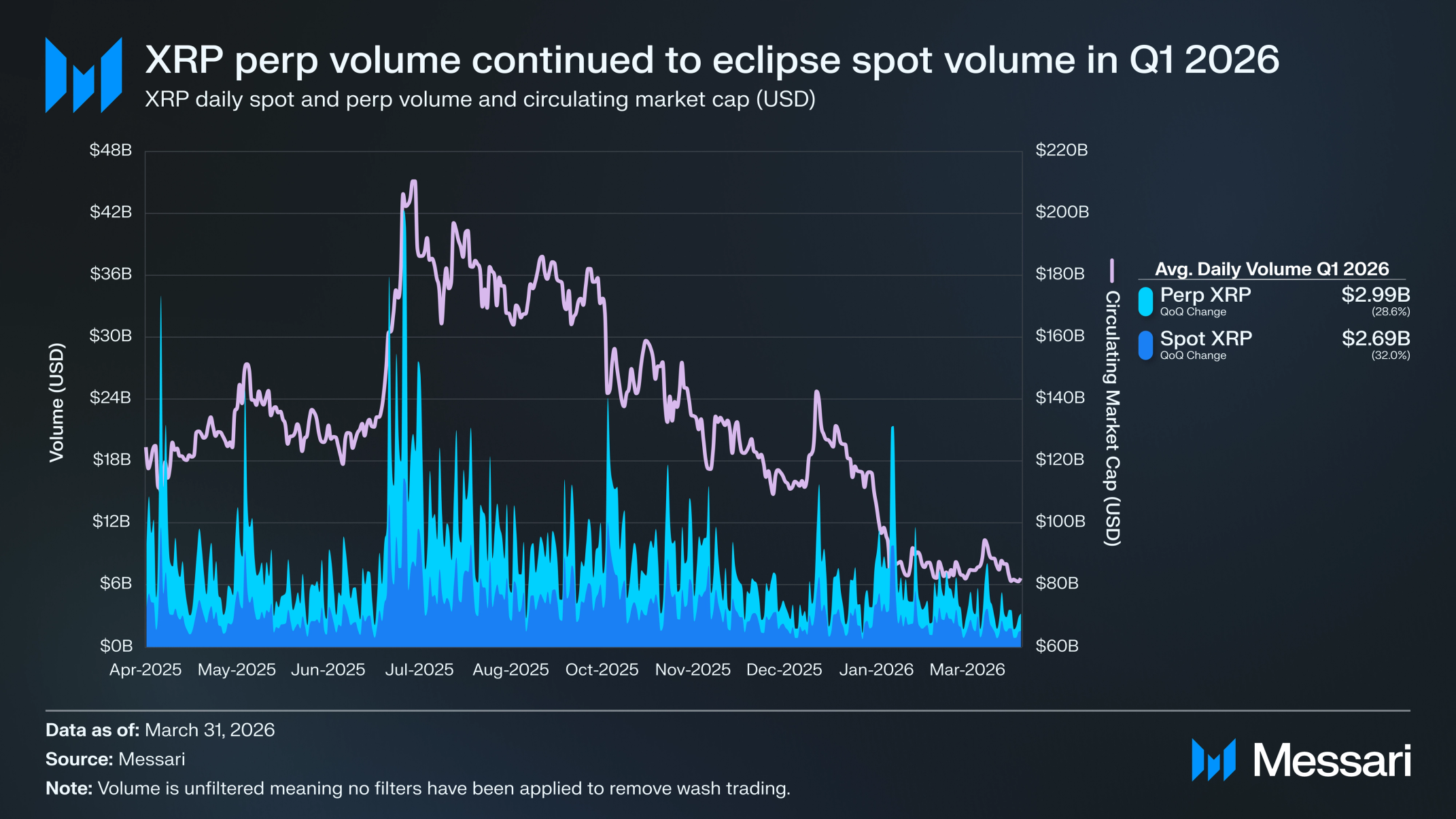
XRP perp volume continued to eclipse XRP spot volume in Q1 2026. Average daily XRP perp volume declined 28.6% QoQ from $4.19 billion to $2.99 billion, while average daily XRP spot volume declined 32% QoQ from $3.96 billion to $2.69 billion, roughly in line with the 26% QoQ decline in XRP’s circulating market cap.
Spot Volume
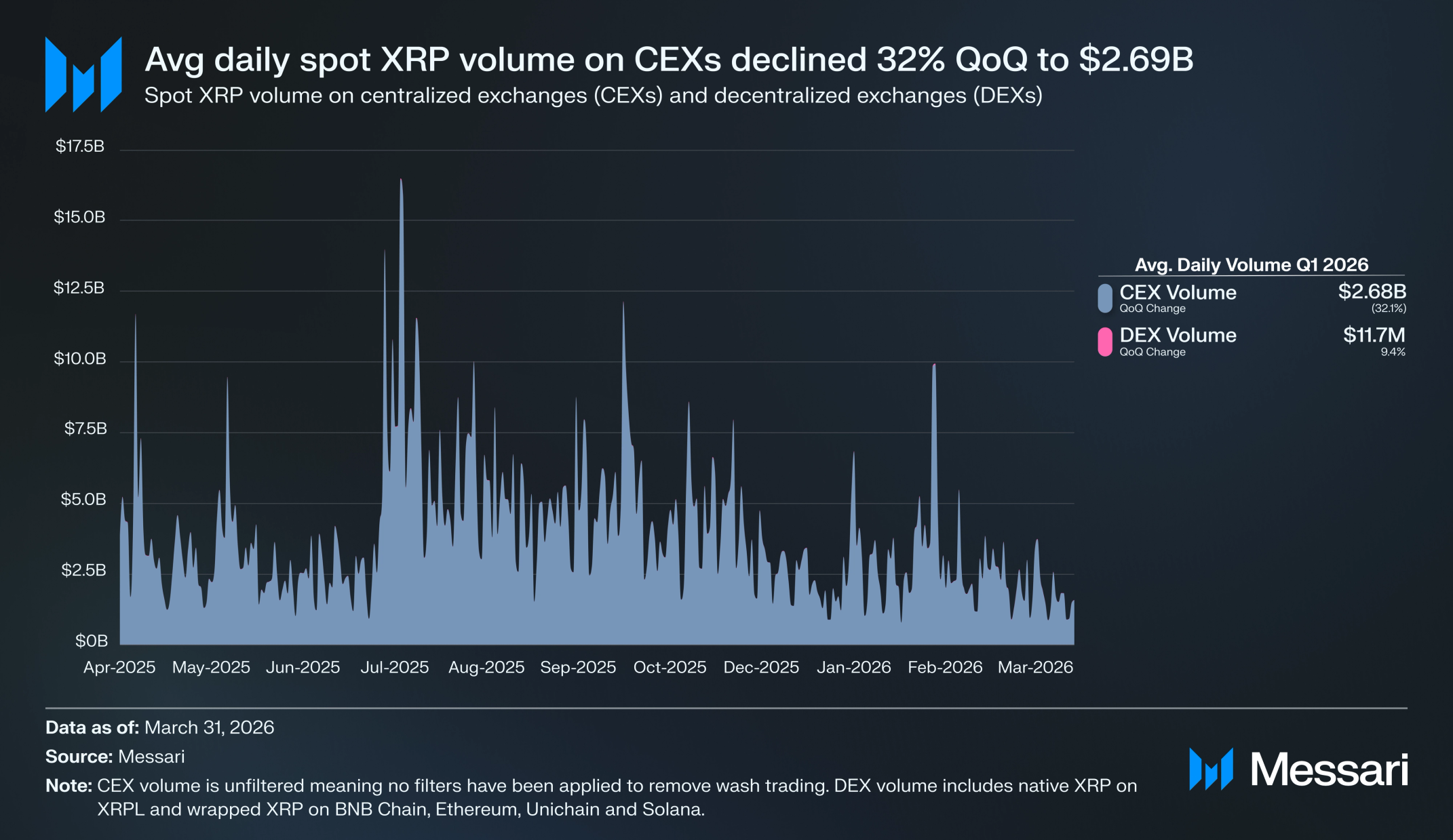
The vast majority of spot XRP volume takes place on centralized exchanges (CEXs). Average daily spot XRP volume from CEXs declined 32.1% QoQ from $3.95 billion to $2.68 billion, while spot XRP volume from DEXs (including native XRP on XRPL and wrapped XRP on BNB Chain, Ethereum, Unichain, and Solana) increased 9.4% QoQ to $11.7 million. Over time, an increasing percentage of XRP spot volume should take place onchain via decentralized exchanges due to
Necessary regulatory and compliance features supported onchain like those native to the XRPL onboarding institutions.
User interface and performance reaching a threshold for permissionless and KYC’d users alike that outweighs any marginal performance benefits of a centralized offering.
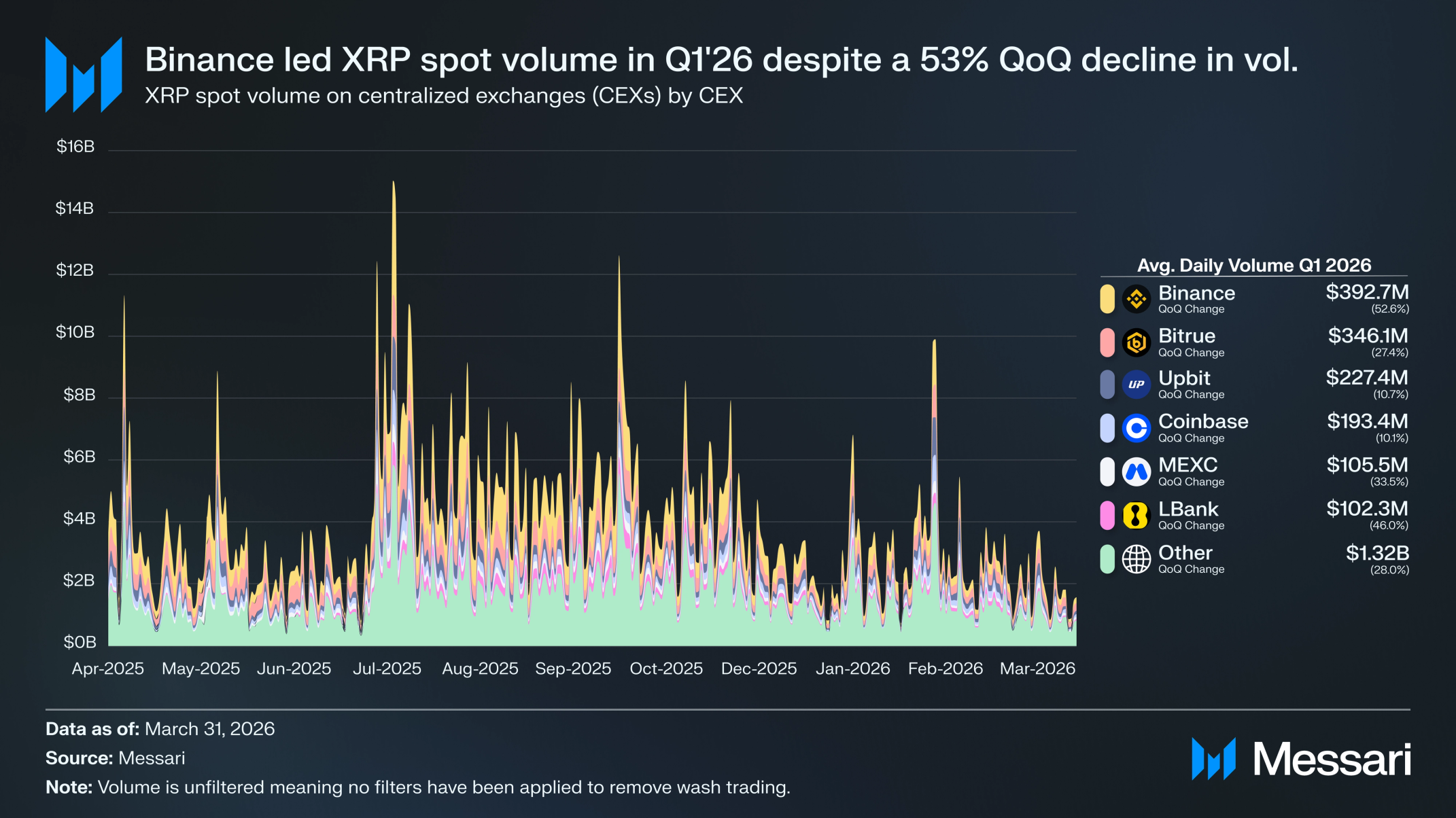
Binance led unfiltered XRP spot volume in Q1 2026, followed by Bitrue, Upbit, Coinbase, MEXC, and LBank.
Perp Volume
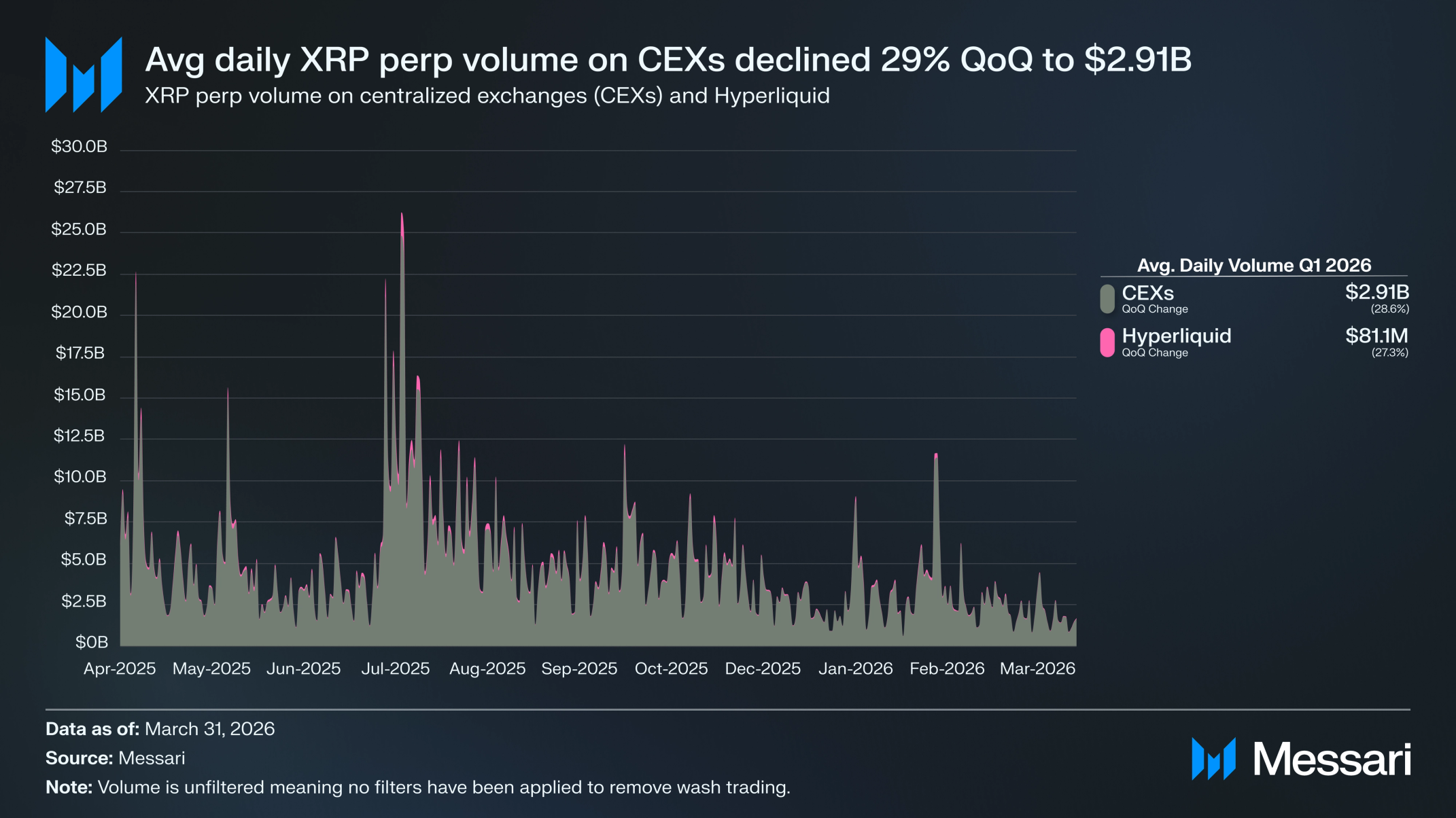
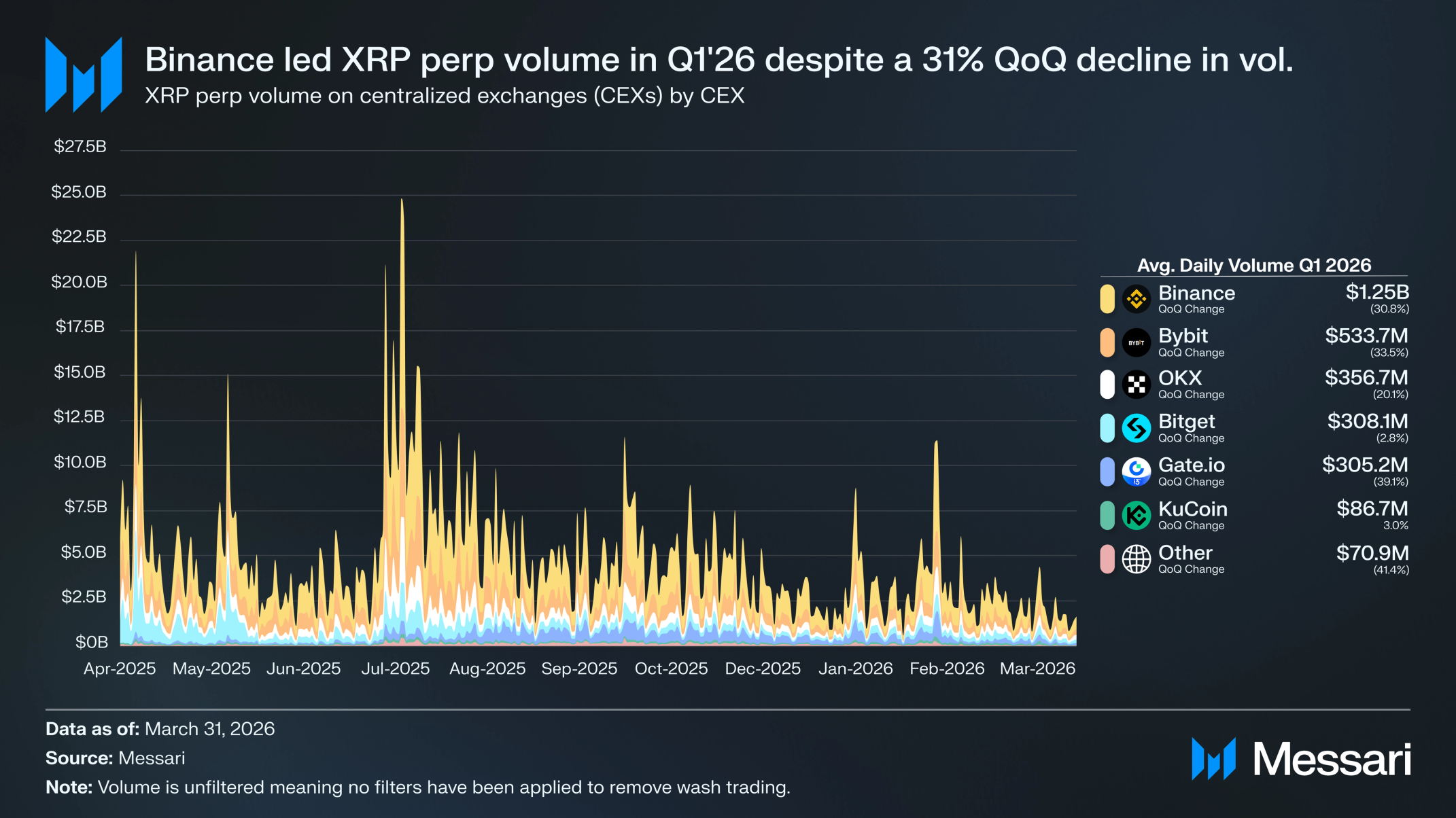
As with XRP spot volume, the vast majority of XRP perp volume takes place on centralized exchanges (CEXs). Average daily XRP perp volume from CEXs declined 28.6% QoQ from $4.08 billion to $2.91 billion, while average daily XRP perp volume from Hyperliquid (used as a proxy for all perp DEXs) fell 27.3% QoQ to $81.1 million. Over time, an increasing percentage of XRP perp volume should take place on perp DEXs for the same reasons outlined for the increased share of XRP spot volume on DEXs.
Binance led unfiltered XRP perp volume in Q1 2026, followed by Bybit, OKX, Bitget, Gate.io, and Kucoin.
Key XRP Updates
Rakuten Integration: Beginning on April 30, Rakuten enabledRakuten Wallet users in Japan to convert Rakuten Points into XRP, spot trade in application, and spend across more than five million merchant locations. With 44 million Rakuten Pay users and $23 billion in loyalty points now redeemable for XRP, this is one of the largest retail deployments of XRP as a payment method to date.
wXRP on Solana: wXRP enabled by HexTrust and LayerZero launched on Solana on April 17, with ~830,640 wXRP on Solana as of May 17, 2026. wXRP provides new crosschain liquidity, expanding the overall XRP market.
Exodus Integration: Exodus, a wallet application, added native XRPL support for XRP.
XRP Deposits on SoFi: Financial platform SoFi enabled XRP deposits.
XRP Utility and XRPL Governance + Roadmap
XRP Utility
XRP is the native token of the XRPL, where it is used to make payments (including acting as a bridge between currencies), pay transaction fees, provide liquidity to the native DEX, create an account, and own tokens (owner reserve). The token’s utility on the network continues to grow, both directly and indirectly, as XRPL’s feature set expands, particularly for institutional DeFi use cases, such as tokenized real-world assets (RWAs), stablecoins, and decentralized liquidity. For example:
Directly: The XRPL’s native lending protocol(in voting at time of publication) will enable lending and borrowing of XRP, bringing an entirely new use for the token on the network.
Indirectly: The introduction of native compliance features drives increased institutional adoption on the network and, in turn, more operations using XRP (reserve requirements, transaction fees, asset bridging, etc.). In Q1 2026, average daily transactions increased 35.3% QoQ from 1.83 million to 2.48 million.
There are three institutional financial use cases where this dynamic is particularly worth highlighting:
Payments and Foreign Exchange (FX)
Permissioned Domains: Allows entities, such as institutions, to require specific credentials to access their offerings on the XRPL. This includes Know Your Customer (KYC) requirements. Notably, user privacy is maintained by verifying credentials without exposing personal information.
Permissioned DEX: Ensures that only accounts with valid credentials can create or fill orders on a permissioned domain, allowing institutions to comply with regulatory requirements, such as Anti-Money Laundering (AML) and KYC, for key use cases, including foreign exchange (FX). Ripple plans to use this capability to route asset conversion within payment and treasury workflows via permissioned order books in which verified liquidity providers participate.
MPT (Multi-Purpose Token): Enables support for metadata to store parameters regarding an issued RWA, such as the maturity date of a tokenized bond, tranches, or transfer restrictions. Capabilities provided by MPT include KYC/AML authorization and allowlists, issuer-defined transfer rules and restrictions, freeze and clawback functions, onchain metadata for reporting and disclosure, and multi-signature delegated key management. Financial technology platform Fortstock is one of the first to make use of MPTs, using them to transform warehouse inventory into institutional-grade financial instruments. Other examples include LiCuido (Money Market Funds) and Centigrade (Carbon Credits).
Token Escrow: Escrow functionality for trustline-based tokens (IOUs) and multi-purpose tokens (MPTs), including stablecoins and RWAs. XRPL also features Checks for deferred settlement and Payment Channels for scalable XRP micropayments, with payment channels IOUs in development.
Batch Transactions: Groups multiple actions into a single atomic transaction of up to eight actions per batch transaction. For example, a user can submit up to eight offers for an asset at different prices, with different amounts of slippage, and where only the first successful offer succeeds.
Credit and Financing
XRPL v3.1.0 (currently under voting) has introduced native onchain credit markets through the Lending Protocol:
Single Asset Vaults (SAVs): Pools capital in token-specific vaults with optional permissioning. The single-asset vault will use credentials and permissioned domains for access control and support a number of compliance features, including account freezing, asset freezing, and clawback
Together, these features comprise the XRPL Lending protocol, which facilitates fixed-term fixed-rate credit on the XRP Ledger. Evernorth, an XRP Digital Asset Treasury (DAT), has announced plans to use the Lending Protocol to unlock yield on its XRP holdings. Additionally, VS1 intends to tokenize bonds using the Single Asset Vault and Lending Protocol, while Soilplans to use SAVs to deliver fixed loans for RLUSD.
All of the above features drive increased transactions on the XRPL, meaning more XRP transaction fees and, in turn, more burned XRP. And some, like MPT, require XRP reserves to hold the token. Additionally, it is worth noting that XRP acts as the auto-bridge asset in FX and remittance transactions, settling trades between stablecoins and other tokens.
XRPL Governance
Implementation of new features and changes to the XRPL is realized through an offchain governance process that allows community members and organizations to propose changes to the network. Users can submit proposals, otherwise known as Amendments, to the “XRPL-Standards” repository on the project’s GitHub.
Validators on the network can then run versions of the XRPL source code that implement the proposed amendments. If 80% or more of the validators support the amended source code for two weeks, then it is implemented as the new source code for the network. Validators that do not support the amended source code are then blocked from contributing to consensus until they update to the newly changed version.
Live and Upcoming Proposals
Together, the aforementioned features, along with additional ones discussed below, make the XRPL fit for institutional adoption by providing necessary identity, financial, compliance, and privacy features.
Went Live Pre-Q1 2026 (Key Amendments)
Full list of proposals enabled and open for voting.
Decentralized Identity (DID): Enables verifiable, self-sovereign digital identities on the XRPL for use cases in compliance, access control, digital signatures, and secure transactions.
Credentials: Builds on DID as a framework for issuing, managing, and verifying user credentials directly on the XRP Ledger. This makes possible permissioned domains, regulated DEXs, and compliant access to tokenized assets and lending markets as they come live on the XRPL.
Deep Freeze: Allows token issuers to prevent addresses from sending or receiving the issuers’ token, enabling compliance with sanctions and other regulatory requirements.
Full list of proposals actively under development.
Confidential Transfers for MPTs (XLS-96): make use of zero-knowledge proofs (ZKPs), which are also in development and scheduled for launch in Q1 2026. These tokens will support privacy-preserving collateral management for token amounts (not the accounts themselves), a requirement for institutional adoption for use cases like onchain collateral repurchase agreements of fixed-income assets like Treasury bonds.
Smart Escrows: Will allow developers to write custom release conditions requiring a notary account, credentials, or other means to unlock an escrow.
Permissioned delegation, confidential transfers for MPTs, sponsored transaction fees and reserves, and dynamic MPT are all scheduled for proposal in late June with the introduction of XRPL v3.3. Additionally, an institutional DeFi portal is in beta testing that will provide a user interface for tokenization, lending, and payments all in one place.
The continued implementation of native features like these on the XRPL makes it a safe, secure, scalable Layer-1 (L1) for institutions adopting blockchain infrastructure for financial use cases, such as institutional liquidity provisioning, tokenized RWA trading, arbitrage and crosschain swaps, and more.
Licensing, Regulatory Compliance, and Ripple
While implementation of native features is crucial for institutional adoption, licensing, regulatory compliance, and business development are also crucial in onboarding institutions to the XRPL.
Ripple is the leading company developing technologies to leverage the XRPL for institutional and government use cases. The company is focused on using XRP, RLUSD, and the XRPL to drive its core businesses:
Ripple Payments: An end-to-end solution for moving money across borders that gives institutions a faster, more transparent way to send, receive, and settle funds in both fiat and stablecoins. Ripple’s comprehensive product suite provides a solution for all aspects of the stablecoin payments landscape.
Ripple Custody: Provides the secure foundation institutions need to safely hold digital assets while enabling payments, trading, and tokenization workflows. In February, Ripple announced new security, compliance, and staking capabilities through new partnerships with Securosys and Figment.
Ripple Prime: Ripple’s prime brokerage that gives institutions access to advanced services across FX, digital assets, derivatives, and fixed income. In early Q1, Ripple Prime expanded access to Hyperliquid, connecting institutional clients to one of crypto’s fastest-growing onchain derivatives venues through a familiar, institutional framework. Ripple Prime also expanded institutional trading capabilities through an integration with Bullish, giving clients seamless access to digital asset options trading. In April, Kroll assigned Ripple Prime an investment-grade issuer rating (BBB). In May 2026, Ripple announced it had closed a $200 million debt facility for Ripple Prime to support its growth amid rising client demand for institutional-grade prime services and margin financing solutions. The same announcement disclosed Ripple Prime has tripled its revenue year over year.
Ripple Treasury: Ripple’s treasury platform that enables management of liquidity, payments, and risk in real time across traditional finance and digital assets through global repo market access and 24/7 cross-border payments. Digital Asset Accounts and Unified Treasury within Ripple Treasury went live in April, the first native digital asset capabilities embedded directly into a treasury management system.
Ripple made four major acquisitions in 2025, with each crucial to one of Ripple’s four core businesses of payments, custody, prime brokerage and treasury management.
Rail Acquisition (Ripple Payments): AcquiredRail, a stablecoin payments platform now integrated into Ripple Payments, which has more than 75 licenses to manage customer payment flows compliantly, using RLUSD and XRP.
Palisade Acquisition (Ripple Custody): Acquired digital asset wallet and custody company Palisade to expand Ripple’s custody capabilities.
Hidden Road Acquisition (Ripple Prime): Ripple closed its acquisition of prime brokerage Hidden Road (now Ripple Prime) in October 2025, making it the first crypto company to own and operate a global, multi-asset prime broker.
GTreasury Acquisition (Ripple Treasury): In December, Ripple closed its $1 billion acquisition of treasury management system GTreasury, now part of Ripple Treasury.
In February, during XRP Community Day, Ripple CEO Brad Garlinghouse said that Ripple is unlikely to pursue more acquisitions in the near term, though additional acquisitions may be considered in the second half of 2026.
Additionally, in November, Ripple announced it had received $500 million in strategic investment led by Fortress and Citadel Securities, valuing the company at $40 billion.
Proper licensing and regulatory compliance for providers like Ripple is necessary for institutional and government adoption. Ripple continues to gain regulatory approvals worldwide, notable of which recently include:
The U.S. Office of the Comptroller of the Currency (OCC) granted Ripple conditional approval in December 2025 for its application to establish Ripple National Trust Bank (RNTB), a U.S. federally supervised trust bank.
The Monetary Authority of Singapore (MAS) approved in December 2025 an expanded scope of payment activities for the Major Payment Institution (MPI) license held by Ripple’s Singapore subsidiary.
In February, Ripple announced it had received full approval of its Electronic Money Institution (EMI) license from Luxembourg's Commission de Surveillance du Secteur Financier (CSSF). This builds on the UK’s Financial Conduct Authority (FCA) granting Ripple its EMI license and Cryptoasset Registration in January 2026 to expand its licenced payments platform, giving UK institutions the ability to send cross-border payments via digital assets through Ripple Payments.
Ripple announced in March that it is acquiring an Australian Financial Services License to expand its payments offering across APAC.
Ripple also announced in March that it plans to apply for a Virtual Asset Service Provider (VASP) license with the Central Bank of Brazil (BCB) to offer compliant services under the country's new virtual asset regulatory framework.
Once licensing and regulatory compliance are established, partnerships with institutions and business development are essential to bootstrap adoption. Recent examples include:
Kyobo Life Insurance Partnership: In April, Ripple announced a partnership with Kyobo Life Insurance to pioneer Korea’s first tokenized government bond settlement on blockchain through Ripple Custody.
Bullish BTC Options: In April, Ripple integrated Bullish options markets for Ripple Prime users.
KBank Partnership: In April, Ripple partnered with Kbank to deploy scalable digital asset wallet infrastructure through Ripple Custody.
Dubai Office: In April, Ripple announced the opening of its new Middle East and Africa (MEA) regional headquarters in the Dubai International Financial Centre (DIFC).
BLOOM x Ripple: In March, Ripple announced its participation in the Monetary Authority of Singapore’s initiative to extend settlement capabilities in tokenized bank liabilities and regulated stablecoins. Ripple is piloting cross-border trade settlements using RLUSD on the XRPL.
Convera Partnership: In March, commercial payments provider Converaannounced a strategic collaboration with Ripple to offer crypto-enabled payment and treasury solutions for businesses.
Hyperliquid Support: In February, Ripple announced that Ripple Prime had added support for Hyperliquid.
Aviva Investors Partnership: In February, Ripple announced a partnership with global asset management business Aviva Investors to tokenize traditional fund structures on the XRPL.
Developments like these lead to meaningful real-world outcomes on the XRPL. In May 2026, the XRPL was home to a landmark settlement transaction, connecting it to interbank settlement rails. This was the first tokenized U.S. treasury settlement across borders and banks in near real time outside traditional banking windows.
XRPL Programmability
The XRPL base layer doesn't currently support arbitrary smart contracts, which was a deliberate design choice to prioritize security and stability through simplicity. However, plans were announced in September 2024 to introduce advanced programmability via native smart contracts. This was driven by developers’ need for instant customizability rather than having to wait for native feature implementation through the XRP Ledger’s amendment process.
The first step in this effort will be the introduction of Extensions, a feature that allows developers to attach code to existing XRPL primitives to enhance their functionality without entirely new smart contracts. This will enable permissionless customization of XRPL’s built-in features, such as escrows, NFTs, authorized trustlines, payment channels, the DEX, and AMM. Smart escrow will be the first extension and is currently under active development, with other smart features such as Smart Vaults under discussion for the future. A full smart contract devnet is intended thereafter,
XRPL EVM Sidechain
The XRPL EVM Sidechain developed by Peersyst serves a complementary role to mainnet programmability, providing solidity developers easy access to XRPL liquidity and identity features. Wrapped XRP (eXRP) bridged via Axelar is the sidechain’s native token. The network connects to the XRPL via the XRPL-EVM bridge by Axelar and the interoperability protocol Wormhole. Crosschain transfers can be completed via Squid.
Servers (Nodes and Validators)
XRPL servers participate in federated consensus as part of the XRPL’s trust-based validation. Nodes and validators, known as servers, all run the same client software: rippled. Anyone can run a node to maintain a local copy of the ledger, relay transactions, and provide access to the ledger. Under this system, each node sets a list of trusted nodes, which it will rely on for consensus. This list of trusted nodes is known as a unique node list (UNL) and determines the validator set that participates in XRPL’s consensus.
Over 47% of nodes have upgraded to V3.1.2 since its release on March 12, 2026. The XRPL is supported by more than 800 nodes and 70 validators.
Ecosystem Analysis
RWAs
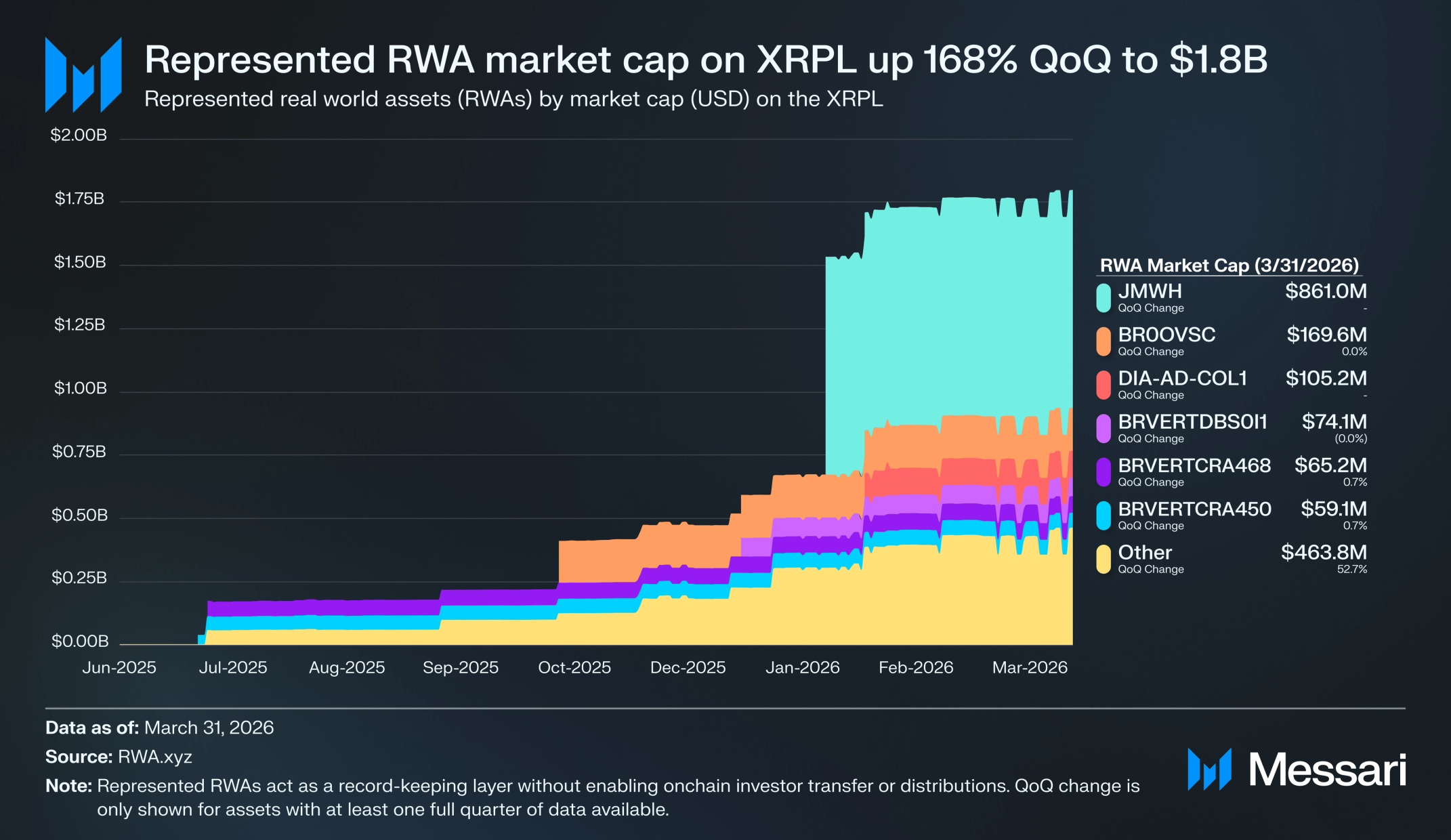
The XRPL closed Q1 2026 with a real-world asset (RWA) market cap of $2.25 billion (+124.1% QoQ), making it the seventh largest network by RWA market cap. As of publication, the XRPL now ranks fourth.
Distributed RWAs: Tokens are by default, transferable and thus composable with DeFi. The underlying blockchain serves as a distribution and access layer.
Represented RWAs: Tokens cannot be moved to wallets outside the issuing platform or transferred between wallets. The underlying blockchain acts as a recordkeeping and reconciliation layer, modernizing legacy infrastructure and reducing operational costs.
To date (excluding stablecoins), 18 distributed RWAs and 312 represented RWAs are tracked by RWA.xyz on the XRPL, though more integrations are planned.
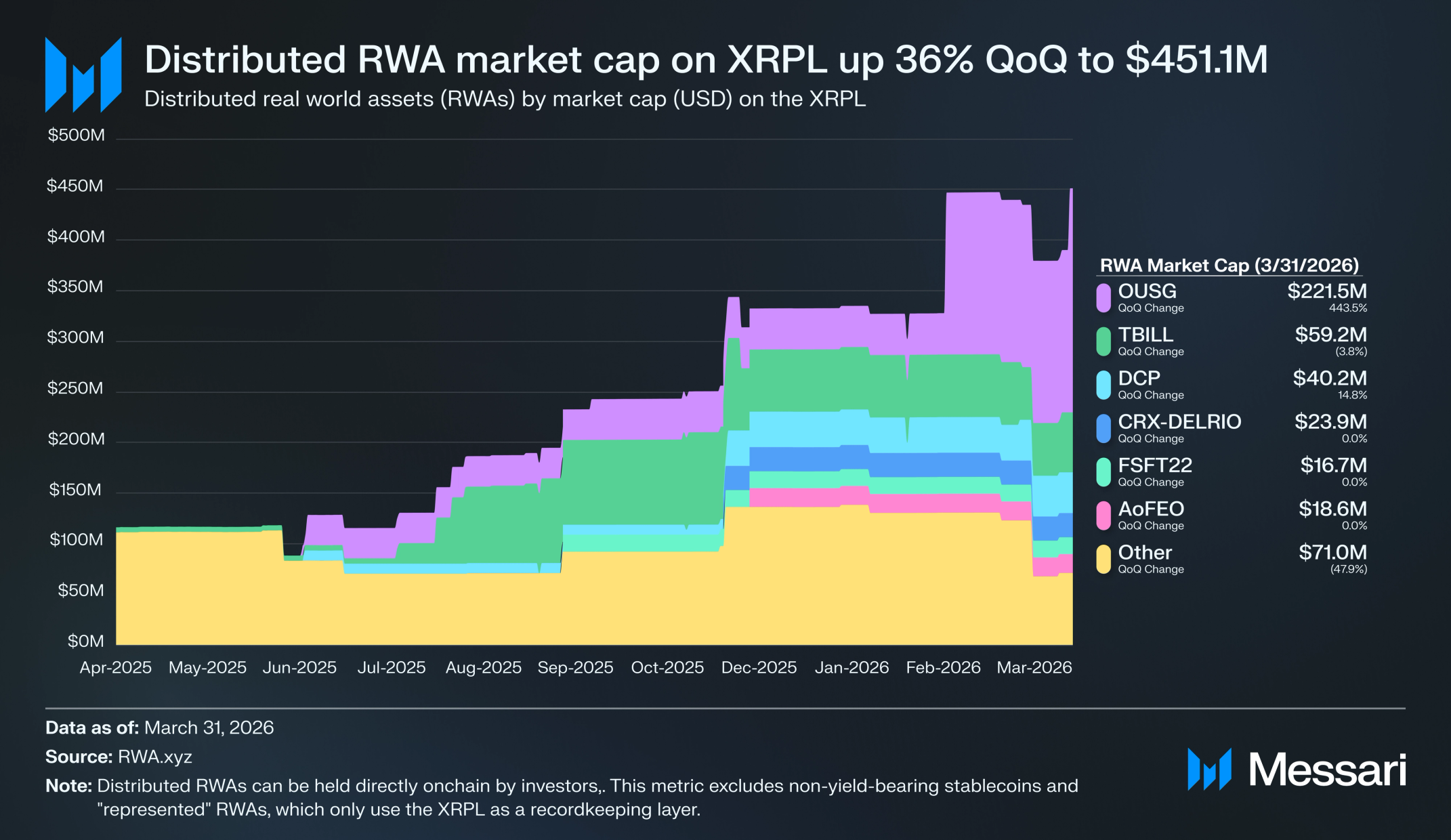
The XRPL closed Q1 2026 with a distributed real-world asset (RWA) market cap of $451.1 million, up 35.6% QoQ from $332.7 million. Distributed RWA market cap excludes represented RWAs and non-yield-bearing stablecoins. Top distributed RWAs by market cap include:
Ondo Short-Term US Government Bond Fund (OUSG): Ondo’s OUSG tokenized treasury fund. Qualified Purchasers and institutions can convert in and out of OUSG using RLUSD.
OpenEden U.S. Treasury Bill Vault (TBILL): TBILL invests deposits in short-dated U.S. Treasury bills and reverse repurchase agreements collateralized by US Treasuries. TBILL tokens can be minted from stablecoins, including RLUSD, and accrue interest earned proportionately.
Digital Commercial Paper (DCP): DCP is a fixed-income asset secured by US Treasuries. It is administered by Guggenheim Treasury Services and issued and managed by Zeconomy.
DelRio – 1st Simple Debenture Issuance (CRX-DELRIO-DB): A tokenized fixed-rate corporate debt instrument originated by CPS Companhia de Produção Sustentável S.A under Brazilian legal and regulatory frameworks. CRX-DELRIO is one of seven Brazilian RWAs issued by CRX Digital Assets on the XRPL.
Aloo Telecom 2nd Corporate Bond Issuance - 2nd tranche (FSFT22): Tokenized corporate credit issued by Aloo Telecom, a Brazilian telecommunications company. FSFT22 is issued by CRX Digital Assets.
Fisherman Capital Fund SPC - Orca SP (AoFEO): AoFEO is a 1:1 asset-backed token collateralized by the Fisherman Capital Fund SPC - Orca SP, which invests in equity, debt, derivative instruments, collective investment schemes, and private equity. AoFEO is issued by Asseto.
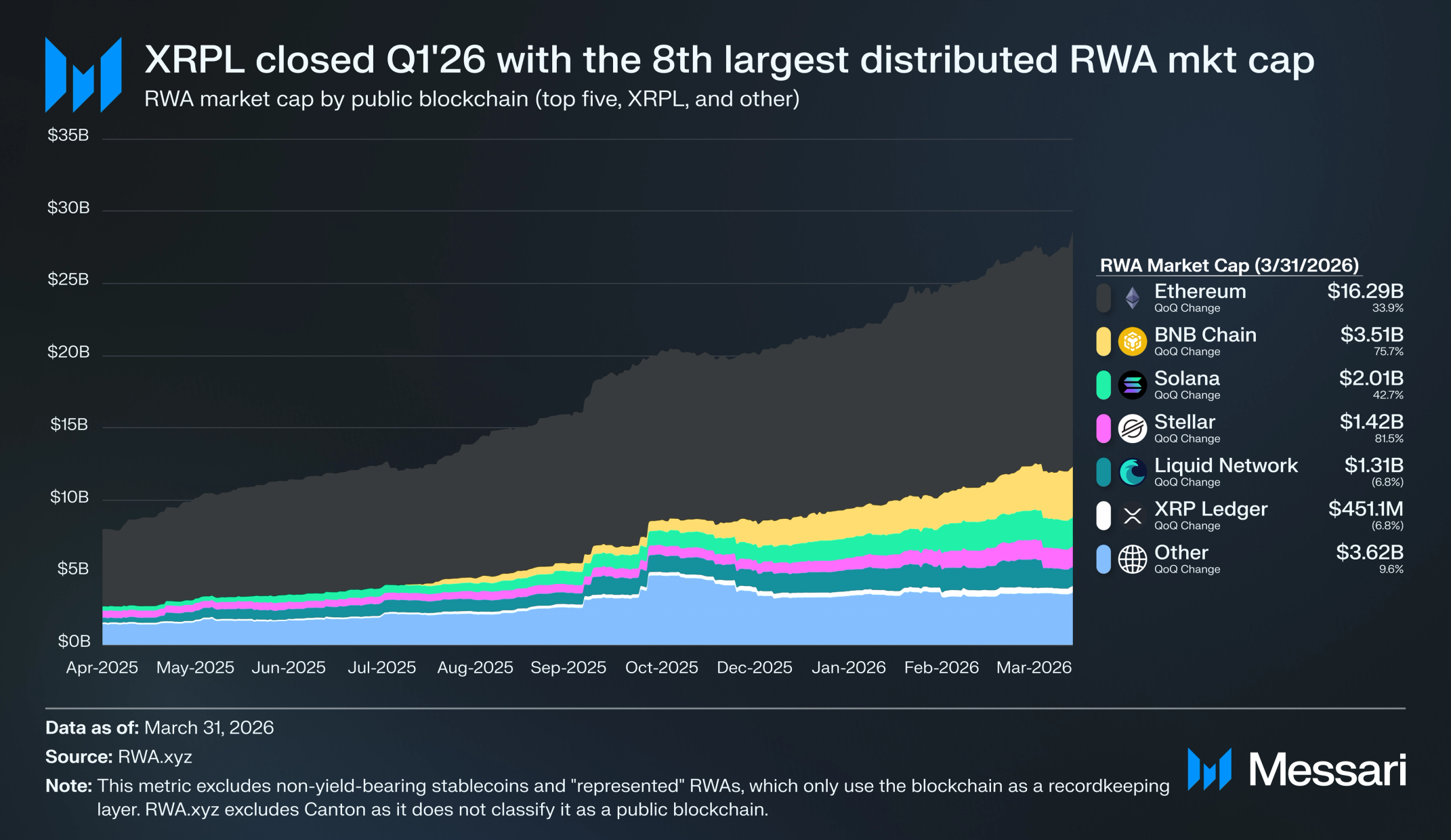
At Q1’26-close, the XRP Ledger had the eighth largest distributed RWA market cap amongst public blockchains at $451.1 million (+35.6% QoQ). This growth rate kept pace with Ethereum (+33.9% QoQ) to $16.29 billion, while trailing BNB Chain (+75.7% QoQ) to $3.51 billion and Solana (+42.7% QoQ) to $2.01 billion.
Represented RWAs
Leading platforms for represented RWAs on the XRPL include:
Justoken: A top RWA tokenization platform and the issuer of JMWH, which represents real megawatt-hour (MWh) of energy backed by energy companies. The token facilitates financial transactions, accountability, and green energy traceability, and represents contractual commitment backed by energy generation.
VERT: A leading securitization and fund management firm in Brazil operates a platform on the XRPL to manage private credit operations via represented RWAs that use the XRPL as a recordkeeping layer. The platform records lifecycle events, documentation, and payments directly onchain, enabling near-real-time auditability while complying fully with Brazilian securities regulations. To date, there are nine represented RWAs that use VERT.
CRX Digital Assets: CRX Digital Assets has issued 17 Asset-backed and corporate credit RWAs on the XRPL. The platform is a B2B infrastructure stack for Brazil’s institutional RWA capital markets that enables regulated institutions to issue, manage, and distribute tokenized credit and other assets.
Mercado Bitcoin: To date, Mercado Bitcoin has issued 244 represented RWAs on the XRPL, representing more than $100 million in value. In July 2025, Mercado Bitcoin announced it would tokenize more than $200 million in permissioned RWAs, including fixed income and equity income instruments.
Stablecoins
Ripple’s USD-pegged stablecoin RLUSD closed Q1 with a combined market cap of $1.31 billion on the XRPL and Ethereum, making it the tenth largest stablecoin by market cap. $340.3 million of that market cap was on the XRPL (+44.9% QoQ), making it the network’s largest stablecoin. Q1 2026 was the first quarter in which RLUSD grew by more on the XRPL (+$105.4 million) than Ethereum (+$15.2 million).
RLUSD's strategic advantage is its integration across Ripple’s financial products, which provide immediate access for regulated institutional enterprise use in payments, treasury management, prime brokerage, and custody. This allows RLUSD supply to grow from real institutional demand rather than just CEX exchange liquidity or unsustainable business development.
The majority of RLUSD holders are on the XRPL, with 46,209 on the network compared to 7,821 on Ethereum at Q1’26-close. However, the majority of transfer volume takes place on Ethereum, with $9.7 billion in transfer volume in March on Ethereum compared to $1.37 billion on XRPL, as large transfers from large RLUSD holders outweighed smaller transfers from a larger holder base on the XRPL. For context, at Q1-end, the leading stablecoins USDT and USDC had market caps of $185.35 billion and $74.04 billion, 146.2 million and 40.2 million holders, and $2.09 trillion and $8.06 trillion in transfer volume, respectively, in March.
Regulated South Korean exchange Coinone added support for RLUSD.
Ripple announced in December that RLUSD will launch on Ethereum Layer 2 networks Optimism, Base, Ink, and Unichain via Wormhole’s NTT token standard.
LMAX Digital listed RLUSD in March, and in January LMAX Group partnered with Ripple to integrate RLUSD as a core collateral asset across its institutional trading infrastructure.
The Giving Block’s 2026 report found that RLUSD was the second-most donated digital asset.
Behind RLUSD, the top stablecoins on the XRPL by market cap at the close of Q1 were as follows:
USDB: $72.9 million market cap (+79.2% QoQ) and 25 holders (+8.7% QoQ). Issued by Braza, USDB is pegged 1:1 to the U.S. dollar, backed by U.S. and Brazilian government bonds.
EUR CoinVertible EURCV: $11.7 million market cap (+2.6% QoQ) and 2 holders (flat QoQ). EURCV is pegged 1:1 to the euro, backed 1:1 by euro cash deposits and equivalents, and issued by SG-FORGE.
USDC: $5.9 million market cap (-11.9% QoQ) and 9,755 holders (+771.2% QoQ). Issued by Circle, USDC is pegged 1:1 to the U.S. dollar and is 100% backed by highly liquid cash and cash‑equivalent assets.
Braza BBRL: $4.5 million market cap (+12.5% QoQ) and 135 holders (+121.3% QoQ). Issued by Braza, BBRL is pegged 1:1 to the Brazilian Real (BRL) and fully backed by reserves at Braza Bank.
Notably, on May 1, Hana Financial TI, XRPL Korea, and Axelar announced the competition of a joint Proof-of-Concept on the issuance, circulation, and settlement of a Korean Won–backed stablecoin.
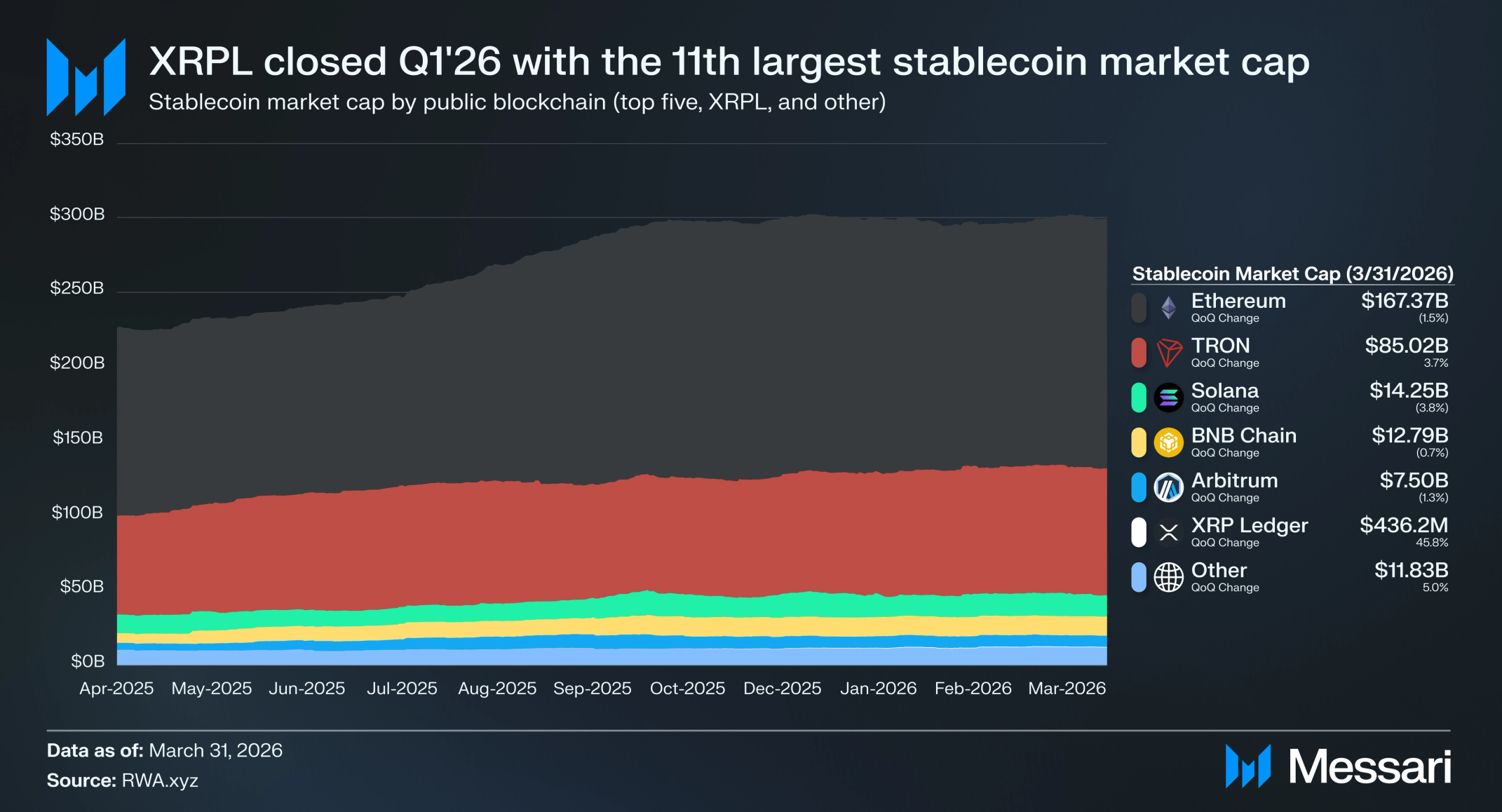
At Q1’26-close, the XRP Ledger had the eleventh largest stablecoin market cap amongst public blockchains at $436.2 million (+45.8% QoaiQ). The 45.8% QoQ increase was driven by the expansion of RLUSD and USDB and outpaced the QoQ change for all public blockchains with a higher stablecoin market cap, which ranged from a 3.8% QoQ decline to a 3.7% QoQ increase.
Issued Currencies
Disclaimer: Market cap data comes from XPMarket, which excludes wallets that hold more than 5% of a token’s total supply from the circulating supply used to calculate a token’s market cap, unless the founding team contacts XPMarket manually to justify the wallet’s holdings.
The total market cap of fungible tokens on XRPL, also known as Issued Currencies, decreased 4% QoQ to $422.2 million, driven by a decline in the market cap of meme tokens even as the RLUSD market cap increased 44.9% QoQ to $340.3 million.
At Q1-close, there were 36,600 listed assets (-2.6% QoQ) on the XRPL, but the top token, RLUSD, accounted for 71.7% of the total market cap at the close of Q1, up from 58.6% of the total market cap at the close of Q4. Combined, the top five tokens accounted for 88.5%, up from 76% at the close of Q4. This trend will continue if RLUSD market cap growth continues while the market cap of meme and utility tokens does not keep pace, stays flat, or declines. Following RLUSD, there were five other tokens on the XRPL with a market cap above $5 million at the end of Q1 2026, according to XPMarket:
Fuzzybear (FUZZY): Market cap of $16.8 million (+163% QoQ) and 6,480 holders (+14.3% QoQ). FUZZY is a memecoin on the XRPL.
Bitstamp BTC (BTC): Market cap of $16 million (-5.2% QoQ) and 4,410 holders (+0.9% QoQ). Bitstamp BTC is a wrapped version of BTC provided by Bitstamp.
GateHub Fifth (ETH) had a market cap of $8 million (-20.3% QoQ) and 25,850 holders (-0.1% QoQ). GateHub Fifth ETH is a wrapped version of ETH provided by GateHub.
PHNIX (PHNIX): Market cap of $7.4 million (+26.3% QoQ) and 27,170 holders (+24.4% QoQ). PHNIX is a memecoin on the XRPL.
Ripple Fox (CNY) had a market cap of $44.8 million (-56.9% QoQ) and 11,780 holders (+0.3% QoQ). CNY is a stablecoin pegged to the Chinese Yuan Renminbi.
Trust Lines
Trust Lines, which are structures in the XRP Ledger for holding fungible tokens, and enforce the XRPL’s rule that someone cannot be forced to hold a token they don’t want, declined 2.5% QoQ from 8.9 million to 8.7 million.
Trust Lines make metrics around token behavior on the XRPL more reliable. While an account’s first two trustlines are free, thereafter the XRPL requires a 0.2 XRP (owner reserve) lockup for each object (such as an issued currency) that the address owns. Notably, wallet provider Xaman provides a workaround to effectively send tokens without trustlines. This works by sending the tokens as a “check,” which automatically sets up a trustline for the prospective receiver that they can opt to accept or decline. Sending as a check requires paying the 0.2 XRP fee to set up the trustline, which is returned to the sender if the receiver accepts the check, the offer is cancelled, or if the receiver declines the check.
A base reserve of 1 XRP is also required to create an address. These requirements make it expensive to enact a Sybil attack on XRPL metrics, such as the number of holders. For this reason, the number of holders is a reliable metric of a token’s adoption on the XRPL. The metric is especially relevant for fungible tokens, which have much higher supplies than NFTs.
DEX (CLOB and AMM)
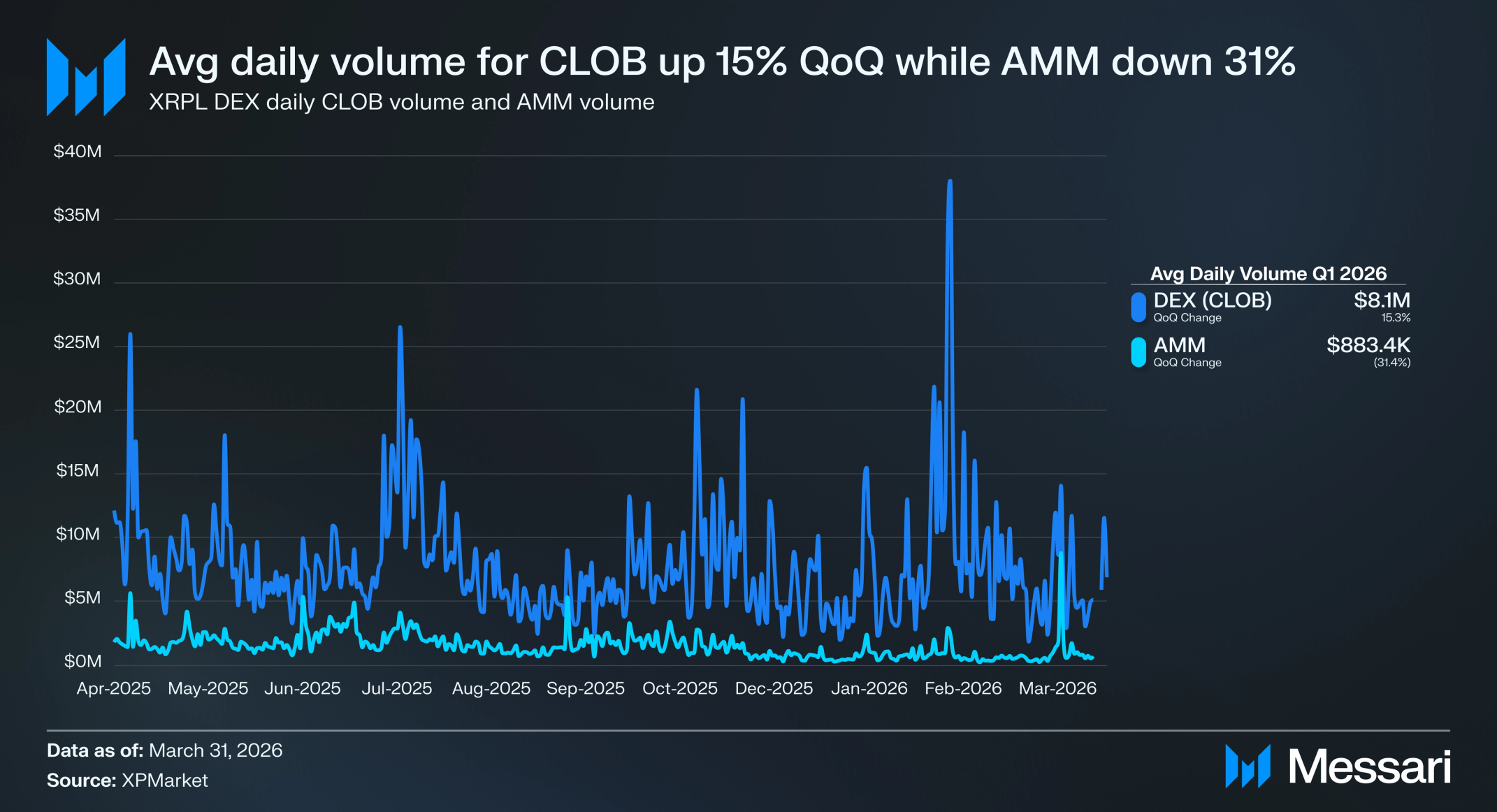
The XRPL features both a native central limit order book (CLOB) and automated market makers (AMMs). Orders can be partially routed through AMMs and the CLOB, as both work together within the DEX. As native features of the XRPL, both the CLOB and AMM have the benefits of fewer trust assumptions and consolidated liquidity, rather than the inherent vulnerabilities of smart contracts.
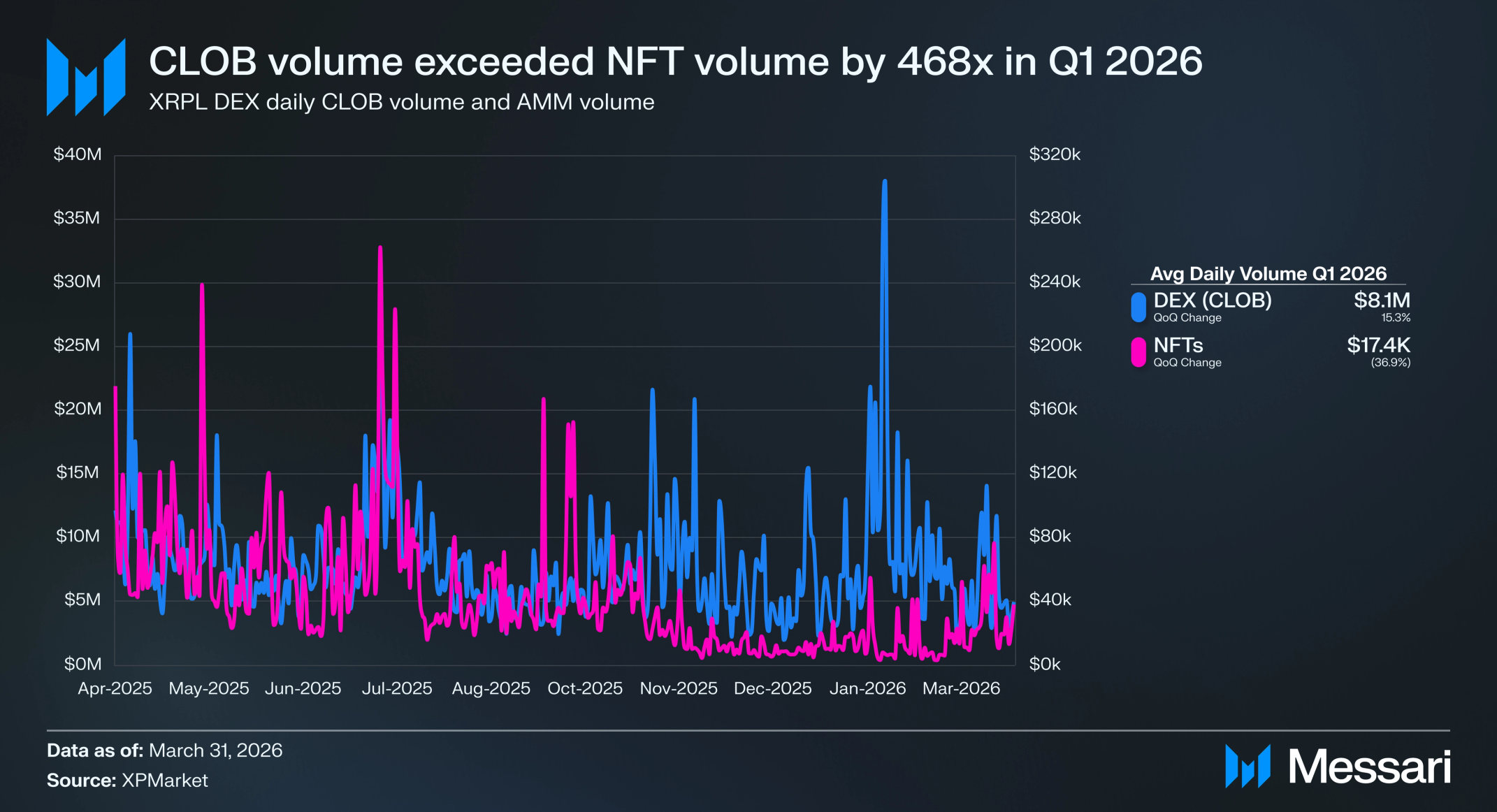
Average daily CLOB volume of fungible Issued Currencies on the XRPL increased 15.3% QoQ from $7.1 million to $8.1 million, while average daily CLOB trades decreased 3.8% QoQ from 764,800 to 735,900. Average daily CLOB traders increased 19.2% QoQ to 8,000. The vast majority of trading volume and trades occur via First Ledger, a Telegram trading bot, which is the leading gateway to the native DEX on the XRPL. Other prominent gateways include XPMarket, Sologenic, Horizon, and Magnetic X. Average daily AMM volume declined 31.4% QoQ from $1.3 million to $883,400, while average daily AMM contributors declined 20.8% QoQ from 229 to 182.
In Q4, average daily CLOB volume exceeded NFT volume by 468x ($8.1 million vs $17,400), the sixth consecutive quarter CLOB volume exceeded NFT volume by at least 90x. This sustained trend on the XRPL matches the wider trend across other major crypto networks, where fungible token trading volumes are exponentially larger than non-fungible (NFT) trading volumes.
Like Issued Currencies, NFTs are built into the core protocol and do not require smart contracts for creation or transfer, while bringing benefits such as royalties and anti-spam features. The DynamicNFT amendment (XLS-46), enabled in June 2025, added functionality for mutable NFTs via a new transaction type called NFTokenModify, which modifies an NFT’s metadata after its creation. This broadened the use cases for NFTs on the XRPL beyond immutable art or collectibles to gaming (in-game assets can gain new abilities), identity (identity tokens can update information), smart ticketing (event tickets can reflect status changes), and more.
Network Analysis
In Q1 2026, key network metrics were mixed. Average daily transactions increased 35.3% QoQ to 2.48 million, and average daily active addresses increased 1.7% QoQ to 49,800, while total new addresses declined 29.8% QoQ to 29,400.
Account creations and deletions are meaningful on the XRPL (unlike EVM networks) as accounts require a 1 XRP deposit to be created, which can be reclaimed after deleting the account. As such, the XRPL’s account metrics are more reliable than other networks where account creations can easily be spammed/Sybiled at zero cost.
Addresses
Addresses on the XRPL can contain destination tags, which enable a single address to receive and track XRP deposits for an arbitrary number of users. As a result, the number of daily active addresses is skewed downward, given that one account (e.g., a centralized exchange) could be responsible for a large number of users. It should be noted that a unique address is required for receiving tokens on most other networks, like ETH on Ethereum or BTC on Bitcoin.
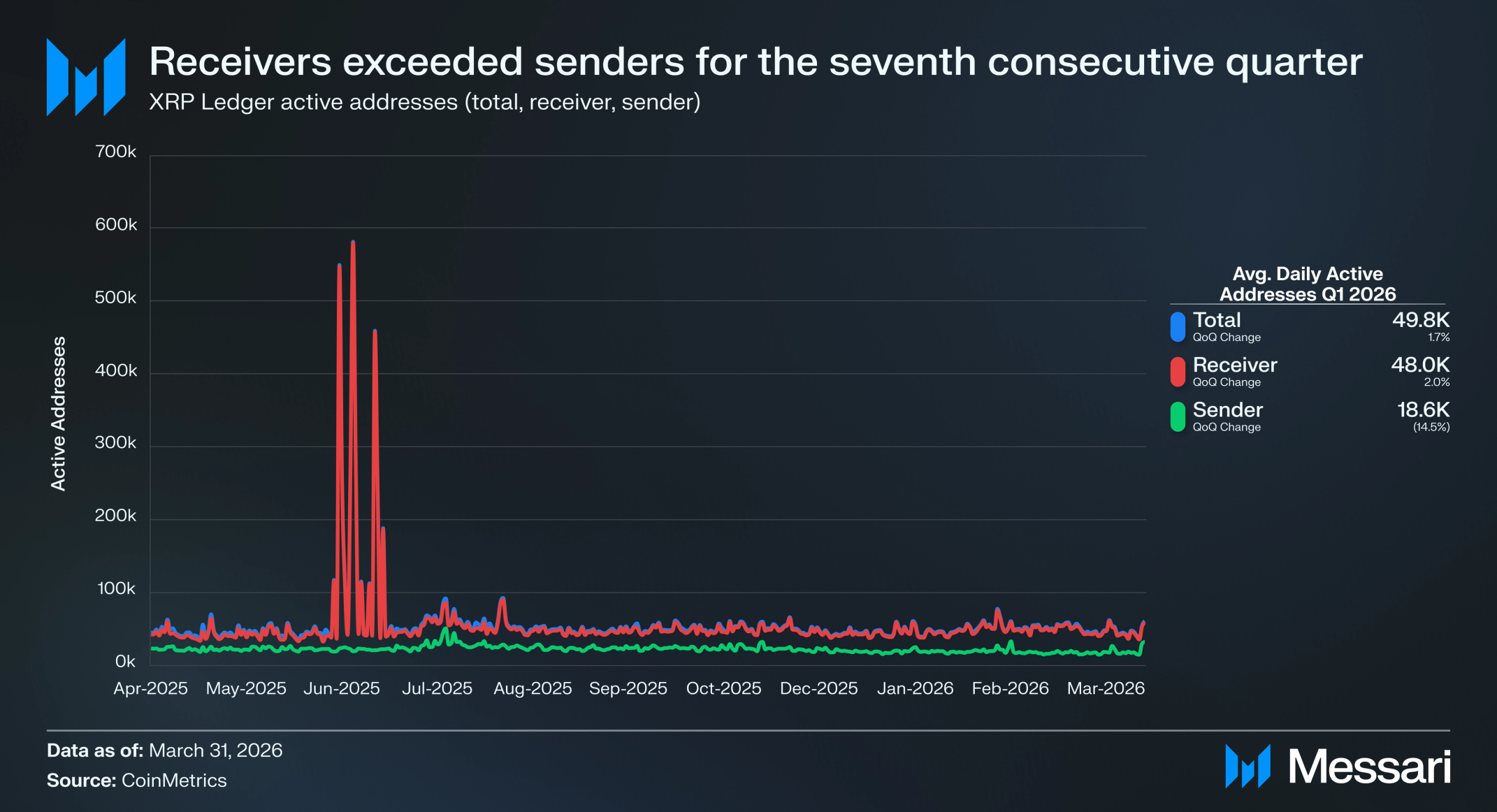
For the seventh consecutive quarter, active receiver addresses exceeded active sender addresses on the XRPL. Average daily receivers increased 2% QoQ from 47,000 to 48,000, while average daily senders decreased 14.5% from 21,700 to 18,600. The active recipient metric is determined by the number of addresses that receive a transfer or other transaction. When recipients outpace senders, it indicates that more previously inactive wallets are receiving tokens distributed by senders than senders are distributing those tokens.
Historically, for smaller activity spikes, the difference between the active recipient and sender addresses has been largely due to centralized exchanges and custodians using destination tags and sending Payment transactions. Centralized exchanges and custodians mostly use the Payment transaction type for deposits and withdrawals. As such, the Payment transaction type has consistently had more receiving addresses than sending addresses. In addition, users typically prefer creating wallets on centralized solutions for easy access to the initial XRP required to create a self-custody wallet. After acquiring their initial XRP, many users withdraw to their self-custody wallets, resulting in fewer active senders and many active receivers.
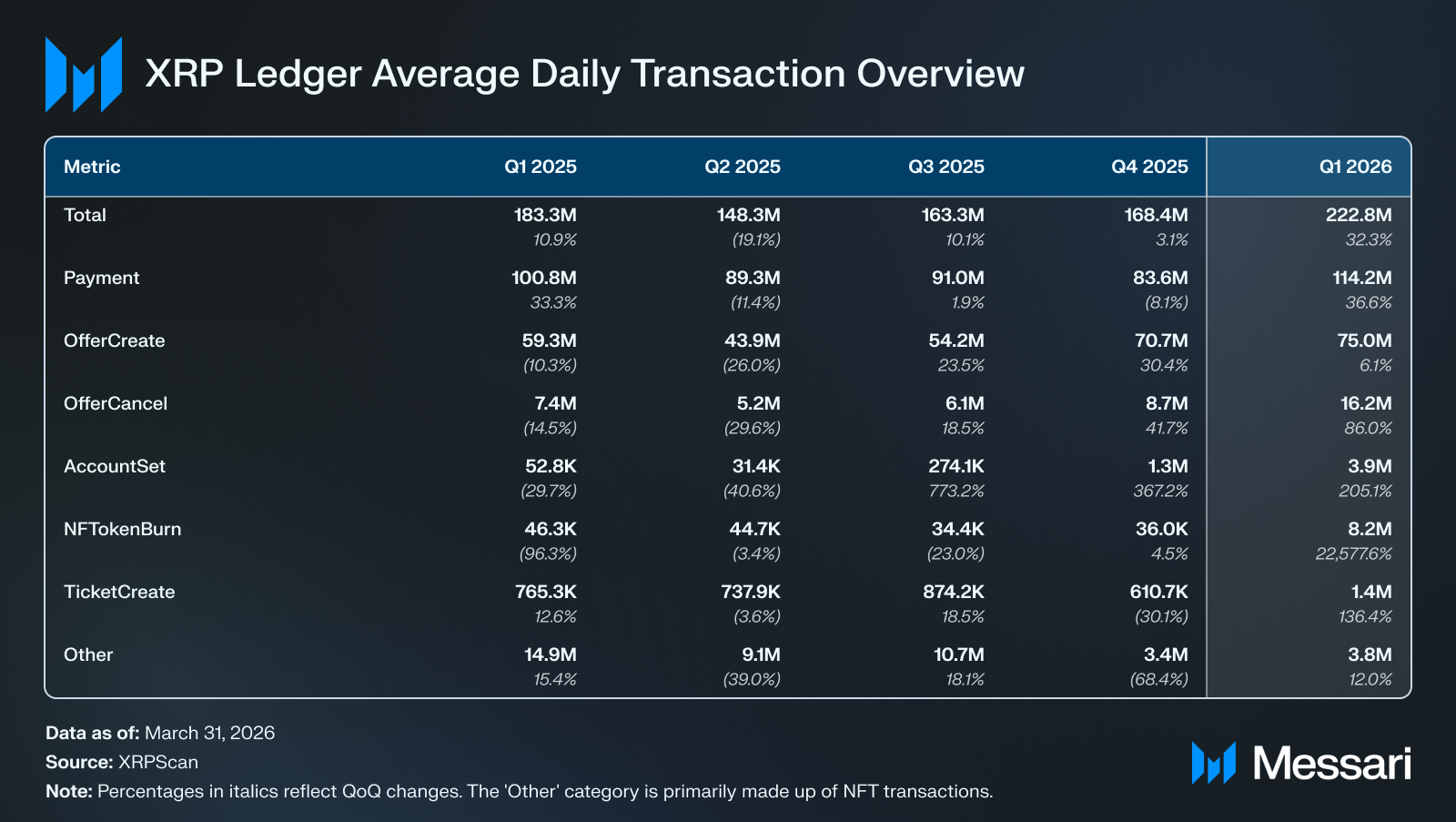
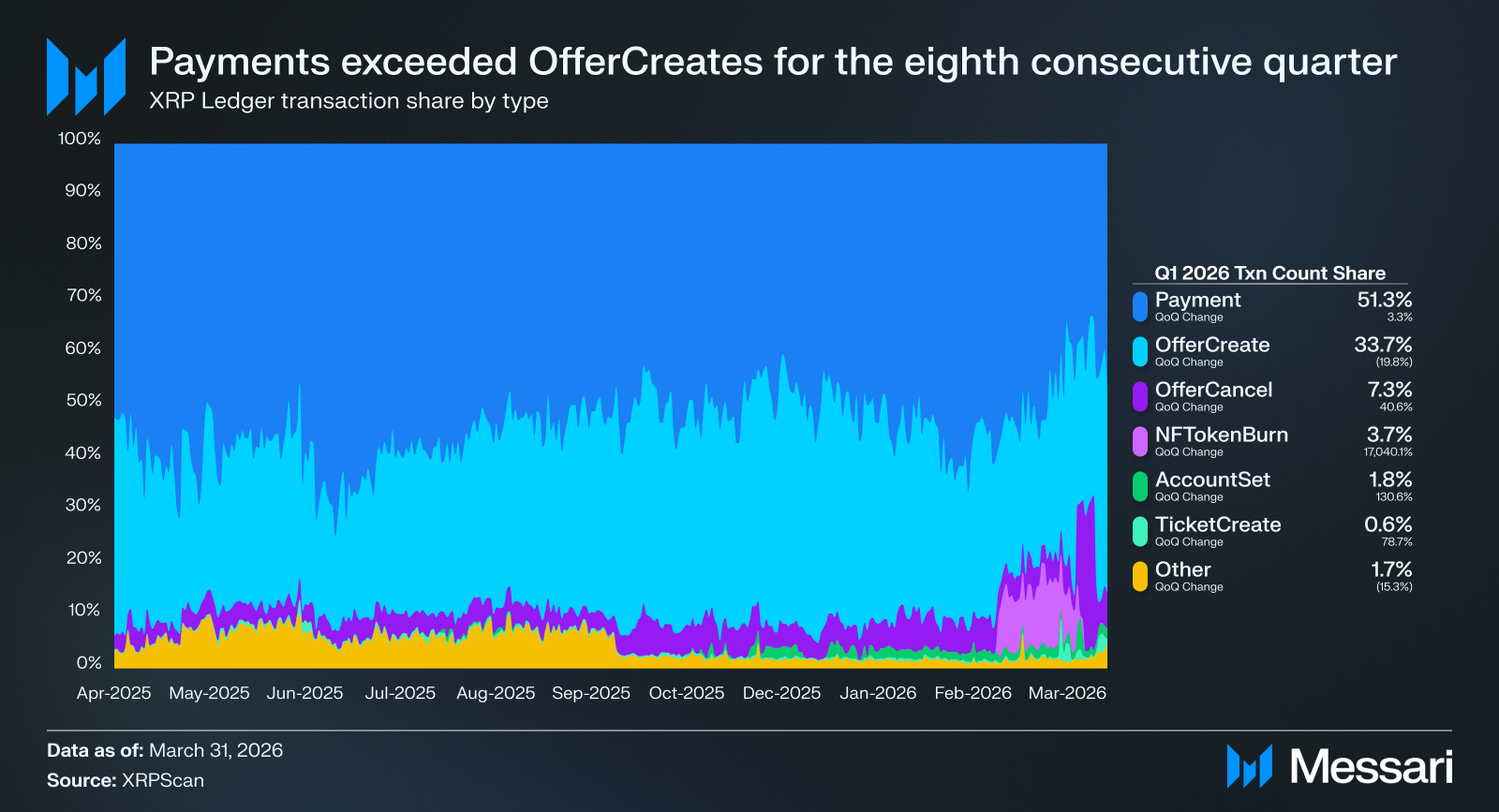
In Q1 2026, average daily transactions increased 35.3% QoQ from 1.83 million to 2.48 million. The total daily transactions metric includes 41 different transaction types, such as payments, escrow creations, NFT burns, and account deletions.
In each of the last five quarters, Payment and OfferCreate have been the vast majority of transactions. Payment represents a transfer of value from one account to another, while OfferCreate submits an order to exchange cryptoassets. Payment transactions exceeded OfferCreate transactions for the eighth consecutive quarter, with Payments' share of the overall transaction count at 51.3% and OfferCreates’ share at 33.7%. Before Q1 2024, OfferCreate was the most common transaction type.
Notably, NFTokenBurn accounted for 3.7% of all transactions in Q1 2026, as there was a surge in NFTokenBurn transactions from the World Expo held in Osaka in March.
Events
Upcoming announced events in 2026 include:
Swell 2026 hosted by Ripple: Oct. 27-29, 2026, in New York City. Swell is Ripple’s premier annual event in New York City. The 2026 event will be the first to combine the Swell (Ripple) and Apex (XRP Ledger) conferences into a unified experience across multiple programming tracks. Applications to speak close on May 29.
Key XRPL Updates
Boundless ZK Verifier x XRPL: In April, Boundless launched the first Zero-knowledge verifier on XRPL Devnet. Once live alongside Smart Escrows, users will be able to require a valid ZK proof before escrow funds move.
t54 x XRPL x402 Facilitator: In February, t54launched its x402 facilitator on the XRPL enabling AI agents to pay for services using XRP and RLUSD.
XRPL Post-Quantum Readiness: In April, Ripple introduced a multi-phase roadmap to prepare the XRPL for a post-quantum future, with a target for full readiness by 2028. Active testing of quantum-resistant cryptography has begun in parallel with a hybrid rollout that runs alongside existing systems before scaling.
Sherlock XRPL Audit Contest: Sherlock hosted an XRPL audit contest from April 13 to April 27 to audit upcoming features to the XRPL, including Batch Transactions, Permission Delegation, MPT DEX, Confidential Transfers for MPT, Sponsored Fees and Reserves.
Immunefi XRPL Attackathon: Immunefi ran a $200,000 Attackathon on the XRPL Lending Protocol and Single Asset Vault features coming to the XRPL.
Open Wallet Standard (OWS) Hackathon: Ripple was a sponsor of the OWS Hackathon, bringing XRPL + RLUSD challenge tracks focused on AI agents in finance in search of builders at the intersection of AI agents and onchain payments.
XRPL Security x AI: In March, Ripple announced its adoption of a more proactive, AI-driven approach to identify and address vulnerabilities on the XRPL before they reach production. These include AI-assisted testing, a dedicated red team, and higher standards for amendments and code changes.
Honeycluster Launch: In March, Honeycluster launched public infrastructure services for developers building on the XRPL.
XRPL Community Support Programs
In March 2022, Ripple committed 1 billion XRP to fund several community support programs. These programs include the XRPL grants program established in May 2021 to support development on the XRPL and the XRPL Accelerator program, an accelerator for new and existing XRPL ecosystem projects. Other community support programs include XRPL Hackathons and the Aquarium Residency for developers offered by XRPL Commons. The RippleX Bug Bounty Program also pays bounties to individuals or groups that identify and report bugs in the rippled, xrpl.js, xrpl-py, and xrpl4j repositories.
The 12-week-long XRPL Accelerator runs annually in Singapore and is offered by Ripple Labs in partnership with Tenity, which, in December 2024, announced its Tenity Inc Fund II to fund early-stage builders on the XRPL in Asia and Europe.
Additionally, on April 15, Tenity announced Ripple had joined SwissHacks, a fintech hackathon, as an Innovation Rockstar Partner, looking for builders tackling real pain points in payments, credit, and AI-powered finance using XRPL’s newest onchain primitives. FENASBAC accelerator batch 8 also closed applications on Feb. 15, and focuses on institutional DeFi development on the XRPL.
Closing Summary
XRP closed Q1 2026 as the fourth largest non-stablecoin crypto asset by market cap behind BTC, ETH, and BNB. XRP’s utility also continued to grow, both directly and indirectly, as XRPL’s feature set expands, particularly for institutional DeFi use cases such as tokenized real-world assets (RWAs), stablecoins, and decentralized liquidity. The increased utility is both direct, via new features like lending and borrowing XRP on the upcoming lending protocol, and indirect, with more operations using XRP from increased institutional adoption. In Q1 2026, average daily transactions increased 35.3% QoQ from 1.83 million to 2.48 million.
RLUSD and RWA market cap growth on the XRPL serve as markers of that increased utility. Ripple’s USD-pegged stablecoin, RLUSD, closed Q1 2026 with a market cap of $340.3 million on the XRPL (+45% QoQ), making it the network’s largest stablecoin. Additionally, closed Q1 2026 with a real-world asset (RWA) market cap of $2.25 billion (+124.1% QoQ), making it the seventh largest network by RWA market cap. As of publication, the XRPL now ranks fourth.
Finally, U.S. spot XRP ETFs closed Q1 2026 collectively holding 775.4 million XRP (1.26% of the circulating supply), up 1.9% QoQ, with XRP held peaking at 810.2 million XRP on March 3, 2026. As the U.S. spot XRP market continues to mature the market share among ETF providers should move towards a similar dynamic found with U.S. spot BTC and ETH ETFs where there is one dominant market leader, followed by two to three smaller competitors, and then a longer tail of ETFs, each with 5% or less market share.
With features for regulatory-compliant institutional DeFi on the XRPL continuing to be enabled, XRP is positioned for increasing use throughout 2026 as institutional adoption scales.
This report was commissioned by Ripple. All content was produced independently by the author(s) and does not necessarily reflect the opinions of Messari, Inc. or the organization that requested the report. The commissioning organization may have input on the content of the report, but Messari maintains editorial control over the final report to retain data accuracy and objectivity. Author(s) may hold cryptocurrencies named in this report. This report is meant for informational purposes only. It is not meant to serve as investment advice. You should conduct your own research and consult an independent financial, tax, or legal advisor before making any investment decisions. Past performance of any asset is not indicative of future results. Please see our Terms of Service for more information.
No part of this report may be (a) copied, photocopied, duplicated in any form by any means or (b) redistributed without the prior written consent of Messari®.
Matt is a Research Manager at Messari for the Protocol Reporting team. A generalist at heart, who's curious about anything and everything, and ultimately, on an adventure to find out what's true. He was an investigative reporter and multifamily/senior housing development associate before joining Messari in 2022.
Matt is a Research Manager at Messari for the Protocol Reporting team. A generalist at heart, who's curious about anything and everything, and ultimately, on an adventure to find out what's true. He was an investigative reporter and multifamily/senior housing development associate before joining Messari in 2022.