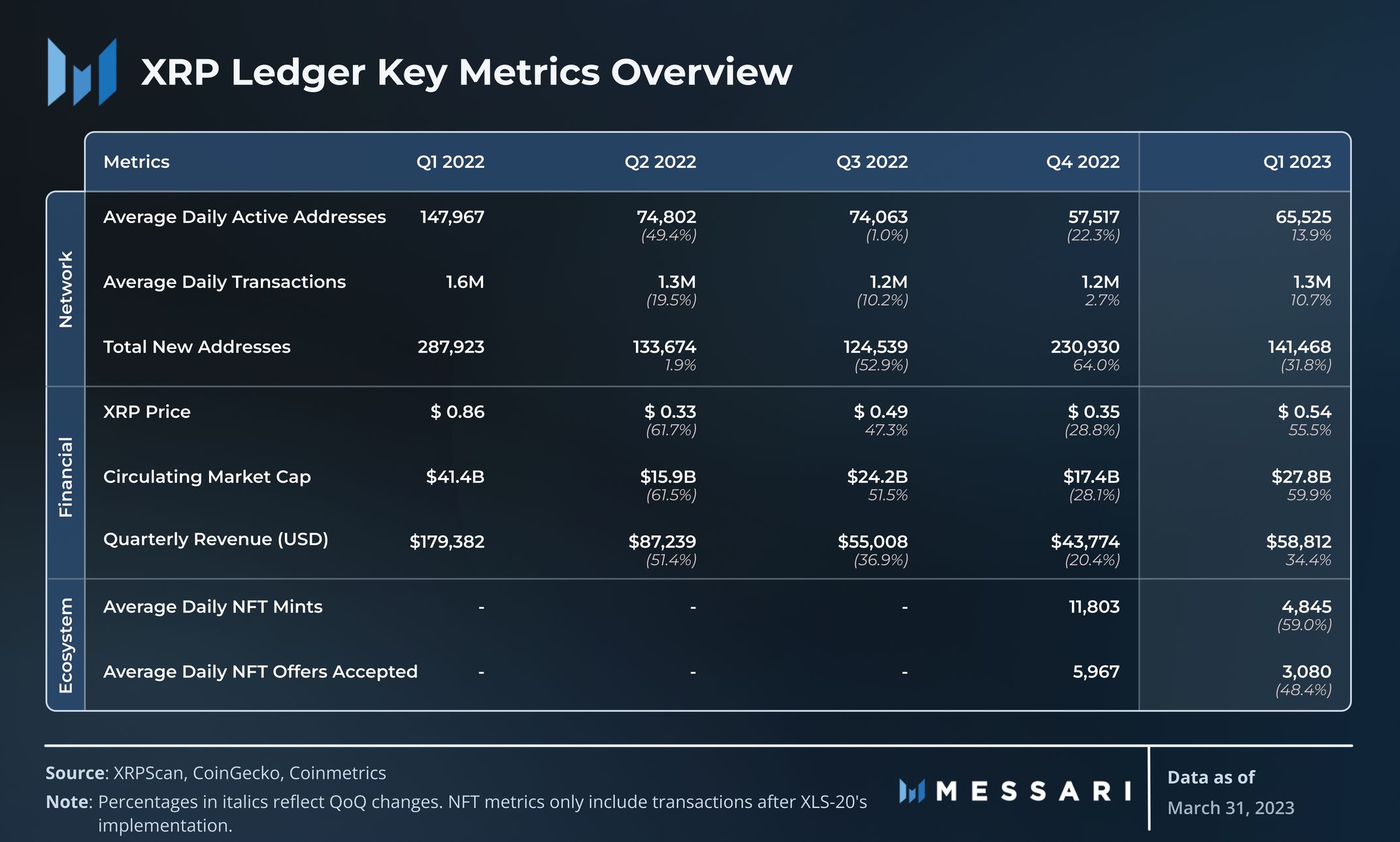
Activity was up on the XRP Ledger in Q1. Daily active addresses and daily transactions increased 13.9% and 10.7% QoQ, respectively.
XRP’s price increased 56% QoQ from $0.35 to $0.54. XRP outpaced the total crypto market cap in Q1 and surged following positive news from the ongoing case between Ripple and the SEC.
The XLS-20 Standard has NFT transactions mapped, with five new transaction types created and five more being proposed. NFT activity was down QoQ in Q1, but there were still 436,000 NFT mints and 277,000 NFT offers accepted.
The Coreum and Flare Network sidechains both reached mainnet. Coreum (CORE) is an enterprise-grade L1 focused on interoperability and scalability. Flare Network (FLR) is an EVM-based sidechain focused on decentralized data.
Developers continue to focus on NFTs, metaverse, and smart contracts. Futureverse’s Root Network, Hooks, and the EVM sidechain are in development, bringing another dimension to the ecosystem.
Primer on XRP Ledger
The XRP Ledger (XRPL) has been running for over a decade, offering fast, energy-efficient, cross-currency, and cross-border payments, among other features. The XRPL offers native Issued Currencies, a decentralized exchange (DEX), escrow functionality, and token management. With these native capabilities, the XRPL can execute many of the same functions that other networks do, even though it does not support smart contracts. Arbitrary smart contracts are not enabled on the base layer as a design choice to ensure maximum security and stability.
XRP, the native token on the XRPL, is the sixth largest cryptocurrency by market capitalization at ~$28 billion, as of Q1 2023. The XRPL averages ~15 transactions per second, although it could theoretically support up to 1,500. Transactions on the XRPL are deterministic in cost, with most transaction types costing 10 drops. A drop is a millionth of an XRP, worth a fraction of a cent at XRP’s current price of $0.54.
The XRPL – supported by Ripple, XRPL Foundation, XRPL Labs, XRPL Commons, and other developers around the world – aims to go beyond other networks’ narrow focus of peer-to-peer transactions. It provides a digital payment infrastructure not just for individuals, but also for existing financial entities such as central banks.
For an in-depth look at the XRPL’s history, technology, tokenomics, and more, see our Initiation of Coverage report.
Key Metrics
Performance Analysis
Network Overview
Overall network activity metrics increased in Q1, with the totals for daily active addresses and daily transactions increasing 13.9% and 10.7%, respectively. Total active addresses increased largely due to receiving addressing growing by 17.1% from 47,000 to 55,000. Sending addresses decreased 7.2% QoQ, further separating the metric from receiving addresses.
Total addresses continued to increase in Q1 despite 141,000 accounts being deleted. Unlike many other networks, the XRPL allows accounts to be deleted to reclaim the deposit of XRP escrowed during account creation. Because of this escrow, there’s actually an incentive to delete accounts and the total address metric has more significance.
Addresses on the XRPL can contain destination tags, which enable a single address to receive and track XRP deposits for an arbitrary number of users. As a result, the number of daily active addresses (DAA) is skewed downward, given that one account (e.g., a centralized exchange) could be responsible for a large number of users. It should be noted that a unique address is required for receiving tokens on most other networks, like native ETH or BTC.
One year ago in Q1 2022, receiving and sending addresses were nearly equal, and they have diverged since. This inequality is largely attributed to centralized exchanges and custodians making use of destination tags. Centralized exchanges and custodians mostly use the Payment transaction type for deposits and withdrawals, which has consistently had more receiving addresses than sending addresses. In addition, users typically prefer creating wallets on centralized solutions for easy access to the initial XRP required to create a self-custody wallet. Following that initial acquisition, many users withdraw to their self-custody wallets, resulting in fewer senders distributing to many receivers.
The DAA (received) is determined by the number of addresses that receive a transfer or other transaction, which has been the primary factor behind major activity spikes. In contrast, the number of addresses that sent transactions remained relatively stable. This indicates that the network's activity surges were generally caused by senders distributing tokens to large groups of previously inactive recipients. The senders were likely exchanges and custody solutions, as they generate many active receiving addresses while only being counted as a single (or few) active sender addresses.
On March 19, 2023, nearly 900,000 addresses received a transaction, which was 20-30x the daily average in Q1. The spike can likely be attributed to users exiting centralized exchanges and custodians in anticipation of news on Ripple’s SEC case.
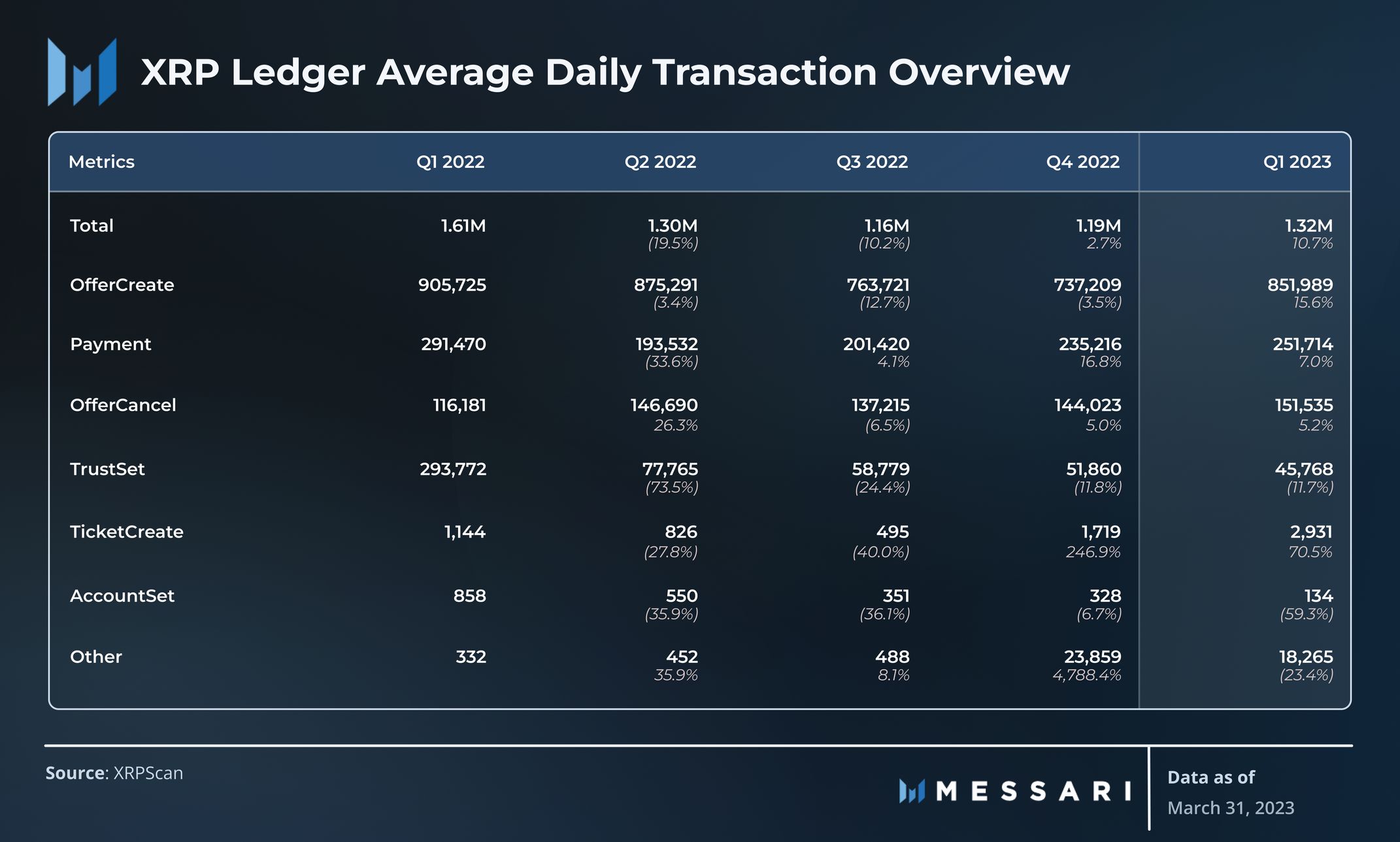
Total daily transactions is a metric made up of 29 different transaction types, such as payments, escrow creations, NFT burns, and account deletion.
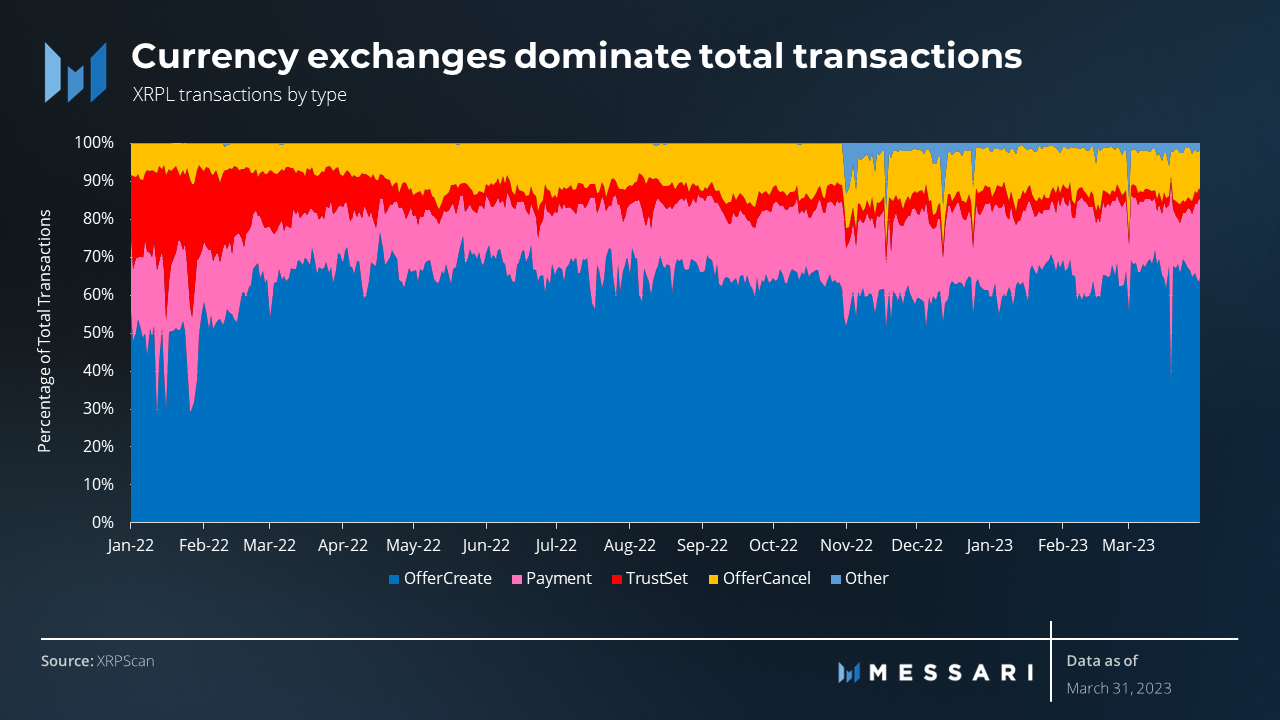
OfferCreate, a transaction type that submits an order to exchange cryptoassets, was the main driver of increased total daily transactions in Q1. OfferCreate was already the most common transaction type in 2022 and grew by another 15.6% in Q1. This transaction type only creates a bid on the order book and does not actually facilitate an exchange. OfferCreate initiates a DEX limit order, and Offer objects represent bids/asks on the order book. Offers are consumed to process transactions such as Payments and OfferCancels (triggered manually or by expirations). If an Offer is only partially consumed by a transaction, new Offers are created with the remainder of the original, similar to a UTXO.
Payment and OfferCancel transactions also increased QoQ, but TrustSet, the next largest transaction type, decreased 11.7%. Trust Lines are structures for holding tokens that protect accounts from being sent unwanted tokens, and the TrustSet transaction is used to open or close those Trust Lines.
The ‘Other’ category of transactions includes functionalities for escrows, multisigs, setting signer keys, and more. The sharp 4,700% increase seen in Q4 2022 in this category is not from increased usage of the aforementioned transaction types but rather from the usage of new transaction types. Increased activity came from NFT transaction types that were standardized and enabled in late October 2022. These transaction types are covered in depth in the Ecosystem Overview section.
OfferCreate had a 65% dominance of transactions. Payment, OfferCancel, and TrustSet had 19%, 11%, and 3% dominance, respectively.
Financial Overview
XRP is the native token on the XRPL and is used for transaction fees, wallet reserves, and other functionalities. XRP’s circulating market cap increased 59.9% QoQ from $17.4 billion to $27.8 billion, outpacing the total crypto market cap’s increase of 46%. Due to the 2.8% QoQ inflation rate, XRP’s price saw a slightly smaller increase of 55.5% QoQ from $0.35 to $0.54.
XRP surged in March twice, following positive news of the legal battle between Ripple and the SEC. The ongoing case began in 2020 when the SEC charged Ripple with conducting an unregistered security offering for the XRP token.
Transaction fees on the XRPL are burned, applying deflationary pressure to the total supply of 100 billion XRP. Only around 10 million XRP have been burned since the XRP Ledger’s inception. Counteracting the burn rate, 1 billion XRP vests to Ripple per month. Any XRP not spent or distributed by Ripple in that month is returned to escrow. This system will continue until the remaining ~48 billion XRP become liquid.
Unlike many other cryptocurrency networks, the XRPL does not distribute rewards or transaction fees to validators. Rather than receiving awards for Proof-of-Association (PoA), validators are mainly incentivized by supporting the decentralization of the network, similar to a full node for Ethereum/Bitcoin rather than a validator/miner. The PoA consensus algorithm relies on trust between nodes, organized through unique node lists (UNLs)
The only revenue component comes in the form of burned fees, which combat inflationary pressure and drive value to the XRP token.
Ecosystem Overview
Although the XRPL’s ecosystem hosts many of the same features as programmable settlement networks such as Ethereum, Cardano, and Solana, the XRPL does not natively support smart contracts. Instead, ecosystem artifacts – such as an exchange and Issued Currencies – are natively built into the protocol.
A built-in central limit order book processes all exchanges on the XRPL, for both fungible tokens and NFTs. This decentralized exchange (DEX) comes with the benefit of fewer trust assumptions and consolidated liquidity, rather than the inherent vulnerabilities of smart contracts.
Although there is only one DEX, there are many marketplaces acting as gateways that facilitate access. Gateways, also known as marketplaces, all share liquidity and provide a viable user interface for the average user.
Issued Currencies
Issued Currencies (i.e., all fungible tokens and NFTs) are treated the same as XRP in terms of swaps and transfers. This is made possible because Issued Currencies are natively supported and not created by heterogeneous smart contracts.
Thanks to Trust Lines, which require a lockup of 2 XRP to hold an Issued Currency, and wallet reserves, which require a lockup of 10 XRP to create a wallet, it is expensive to enact a Sybil attack on metrics such as the number of holders. For this reason, the number of holders is a reliable metric of a token’s adoption on the XRPL. The metric is especially relevant for fungible tokens, which have much higher supplies than NFTs.
The top tokens on the XRPL by market cap (those with over 50% combined market cap dominance) are
Sologenic (SOLO) has $67.8 million in market cap and 230,000 holders. SOLO has utility for the Sologenic gateway.
Coreum (CORE) has $21.0 million in market cap and 57,000 holders. CORE is the native token of the Coreum sidechain.
CasinoCoin (CSC) has $17.6 million in market cap and 27,000 holders. CSC has utility on CasinoCoin’s Lobby platform for regulated gaming.
The top stablecoins and wrapped tokens on the XRPL are
Gatehub ETH: $10.9 million market cap and 25,000 holders
Bitstamp USD: $5.0 million market cap and 9,000 holders
Gatehub USD: $4.3 million market cap and 21,000 holders
The number of Trust Lines open for a given Issued Currency is generally tightly coupled with the number of holders of said token. The average Issued Currencies have around 20-40% more open Trust Lines than holders. Stablecoins and wrapped tokens, on the other hand, typically have 3-10x more Trust Lines than holders. Gatehub’s EUR stablecoin, for example, has the 5th most open Trust Lines, despite only having the 15th largest market cap.
The number of open Trust Lines may be relatively high because users may keep them perpetually open for quick escapes from network-specific volatility. Alternatively, it could be due to the relatively low number of holders for stablecoins and wrapped tokens, which would skew the percentage differences higher than the absolute values would suggest.
NFTs
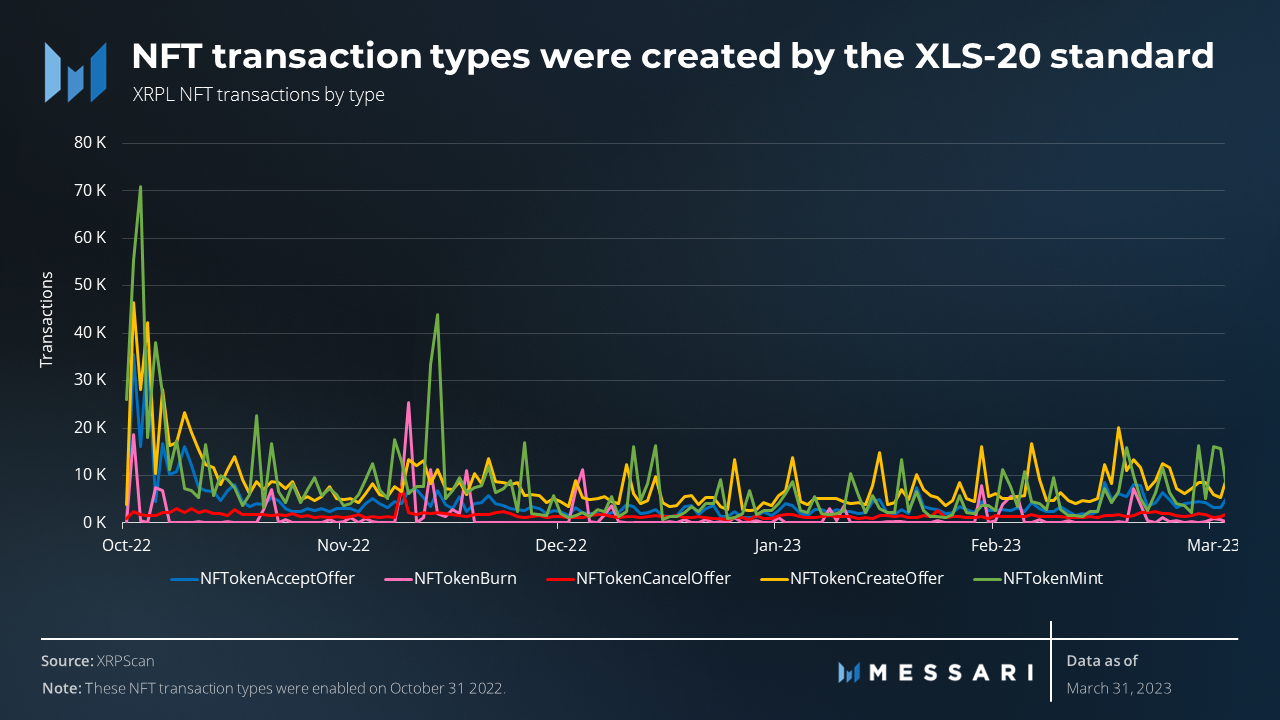
The XLS-20 standard was enabled in October 2022 and standardized NFTs on the network. Five new transaction types for NFTs were created and can be used to accurately track all NFT activity.
NFT mints declined 40.4% QoQ, from 732,000 in Q4 to 436,000 in Q1. NFT offers accepted declined 25.1% QoQ, from 370,000 in Q4 to 277,000 in Q1.
Various spikes in NFTokenMint transactions over the past few months represent mint dates for projects. XPUNKS remains the all-time leader in NFT sales volume, with 15.7 million XRP ($8.5 million as of the end of Q1) in volume. Core Apes Club and RipplePunks rivaled XPUNKS in sales volume in Q1, with each collection doing 400,000-500,000 XRP in quarterly volume. RipplePunks averaged 141,000 XRP ($76,000) in monthly sales volume and 960 monthly sales in Q1.
The Native DEX
Some of the top marketplaces on the XRPL are Sologenic, XPMarket, XRP.cafe, and onXRP. Each of these marketplaces accesses the same shared liquidity on the native DEX. All transactions executed through XRPL marketplaces were included in the transaction analysis of the network overview.
The Sologenic gateway is the service behind the SOLO token. SOLO is primarily used to pay transaction fees on the Sologenic gateway. During Q1, over 1.9 million trades were executed through Sologenic. Roughly 20% of the total trades involved the SOLO and CORE tokens, with 188,000 trades and 207,000 trades, respectively. CORE exists as a token on the XRPL, but it is also the native token of the Coreum sidechain. Starting in Q1, 20% of the total supply of CORE began getting airdropped to SOLO holders.
Sidechains
Coreum (CORE) is an enterprise-grade L1 focused on interoperability and scalability. CORE ended Q1 with a market cap of $138 million and a circulating supply of 503 million. This sidechain is supported by a maximum of 32 active validators. There are five additional validators that were inactive as the threshold was met. Of the 32 active validators, the top six validators controlled over 50% of the voting power.
Flare Network (FLR) is an EVM-based sidechain focused on decentralized data, and Flare Time Series Oracles (FTSOs) provide data to the network. The network is supported by 55 FTSOs, with users delegating FLR tokens to them in a similar fashion to delegated staking for validators. Of those 67 FTSOs, none control more than 4% of the voting power. FLR ended Q1 with a market cap of $447 million and a circulating supply of 14.6 billion.
It’s important to note that the Coreum and Flare Network mainnets only recently launched in Q1 2023, on March 24 and January 10, respectively.
Servers
Nodes and validators, known as servers, all run the same client software: rippled. Roughly 70% of nodes are running the latest version, V1.10.*. The other 30% have not yet updated or are choosing not to update to vote against the implemented amendments. These nodes are still using V1.9.*. As of the end of Q1, the XRPL is supported by 683 nodes and 117 validators.
XRPL servers participate in federated consensus as part of the XRPL’s Proof of Association (PoA) consensus mechanism. Validators do not stake tokens or receive financial rewards. Instead, the system is based on trust between nodes. Each node sets a list of trusted nodes, known as a unique node list (UNL). The UNLModify pseudo-transaction, which is used to add/remove nodes from the ledger's negative UNL, was called an average of 5 times per day in Q1.
Qualitative Analysis
Community
The XRPL is supported by various independent entities. Although these entities are generally aligned, they have their own priorities and goals, resulting in competition and overlap between sidechains, ecosystem tools, and more.
Notable community initiatives in Q1 included:
XRPL Labs initiated the Adopt an XRPL Node program to support setting up and maintaining more XRPL nodes.
Establishment of the XRPL Commons, a new non-profit association focused on educating and empowering the global XRP Ledger (XRPL) community.
Ripple announced Wave3 winners of its $250 million Creator Fund to support NFT projects on the XRPL.
Development
Ecosystem development, ranging from server software to wallet updates, saw several updates and integrations during Q1.
Rippled, the open-source software that all servers (nodes/validators) run on, was upgraded twice. The first update, rippled V1.10.0, enabled six new amendments. These amendments fixed NFT bugs and added minor features. The following update had a small fix related to V1.10.0.
XLS-35d was proposed as an NFT standard alternative with five new transaction types.
XLS-38d was proposed as a cross-chain bridge standard for XPRL sidechains.
XLS-40d was proposed as a W3C Decentralized Identity (DID) standard on XRP Ledger.
Hooks, a system to include smart contract functionality in XRPL transactions, is still in development by XRPL Labs. Hooks is live on XRPL Labs’ public testnet. Hooks is not Turing complete and will not enable arbitrary logic, but it will allow conditions and triggers to be attached to transactions, similar to how scripts work on UTXO chains like Bitcoin and Cardano (pre-Alonzo).
Multichain Approach
Coreum and Flare Network launched in Q1, although they existed in other forms prior to this. Root Network and Peersyst’s EVM-compatible sidechain are still in the ideation and development phases. We have yet to see what roles these networks will take in the greater XRPL ecosystem.
Coreum
Coreum is an independent Layer-1 (L1) network running a WASM VM and secured by a Bonded Proof-of-Stake (BPoS) consensus mechanism. Coreum is focused on interoperability, scalability, and speed. Multichain bridge connects Coreum to the XRPL and other networks. Coreum was developed by the Sologenic team, and the CORE token has existed on the XRPL as an Issued Currency since Q1 2022.
Coreum was built by the Sologenic team to service user needs that could not be efficiently managed on the XRPL. The initial focus of the network is to provide security tokenization, such as tokenized stocks from the NYSE and synthetic assets.
Flare Network
Flare Network is an EVM-based L1 network that has been awaited by the XRP community for several years. In accordance with FIP-01, 15% of the FLR token supply is being distributed to XRP holders from a 2020 snapshot. Flare’s focus on decentralized data and EVM compatibility should bring new functionality to the ecosystem. Flare Network’s testnet, Songbird, was launched as far back as Q3 2021.
EVM Sidechain
Peersyst’s EVM sidechain proposal offers a proof of concept for bringing smart contracts to the XRPL ecosystem. It will grant the XRPL ecosystem access to EVM developers and functionality, just like Flare Network. However, this EVM sidechain will have a general-purpose scope, unlike Flare Network which is more focused on decentralized data and oracles. Additionally, this EVM sidechain does not yet have an official amendment and is only live on Devnet. The sidechain is being built on the Cosmos SDK, specifically Ethermint, and connects to the XRPL through the XRPL-EVM bridge. The Devnet is currently live and is creating blocks every ~5 seconds using Tendermint, a PoS consensus mechanism.
Root Network
The Root Network is a blockchain-based NFT system with a focus on UX and metaverse, run by Futureverse. Futureverse and Ripple announced in 2022 that the Root Network will leverage the XRPL, specifically using XRP as a native currency. The Root Network:
Will use a delegated-Proof-of-Stake (dPoS) consensus mechanism
Will use XRPL DEX to source liquidity
Root Network has announced FuturePass, an account abstraction solution. FuturePass offers users social recovery, management of assets, increased wallet flexibility, and a familiar Web2 experience.
Bridging
Ripple developers proposed a standard, called XLS-38d, in February 2023 for a cross-chain bridge between the XRPL mainnet and a sidechain. Bridges built by this standard will lock tokens on the XRPL to first mint a wrapped version on the sidechain and then later burn the wrapped tokens to unlock the original assets on the XRPL. A new node type called a “witness server'' will communicate between chains. Witness servers together operate the door account connecting the XRPL mainnet. This bridge standard will be implemented with Peersyst’s upcoming EVM sidechain.
Closing Summary
During Q1, XRP experienced a significant surge in value, with an uptick in activity across several critical areas on the XRPL. Two sidechains — Coreum and Flare Network — have been launched on the XRPL, but it will take some time for usage to stabilize on these networks. Nonetheless, the XRPL ecosystem has expanded to multiple layers, after much anticipation.
Although the increased activity was primarily driven by existing functionality, the upcoming deployment of Hooks, sidechains, and new token standards may pave the way for fresh use cases, leading to further acceleration of the activity trend.
On December 22, 2020, the U.S. Securities & Exchange Commission stated that XRP is a "digital asset security." A couple notes: (1) Messari does not provide financial or trading advice - our services are for informational purposes only; and (2) Messari's services are impersonal - do your own due diligence. Please refer to our Terms of Service for more info.
This report was commissioned by Ripple. All content was produced independently by the author(s) and does not necessarily reflect the opinions of Messari, Inc. or the organization that requested the report. The commissioning organization may have input on the content of the report, but Messari maintains editorial control over the final report to retain data accuracy and objectivity. Author(s) may hold cryptocurrencies named in this report. This report is meant for informational purposes only. It is not meant to serve as investment advice. You should conduct your own research and consult an independent financial, tax, or legal advisor before making any investment decisions. Past performance of any asset is not indicative of future results. Please see our Terms of Service for more information.
No part of this report may be (a) copied, photocopied, duplicated in any form by any means or (b) redistributed without the prior written consent of Messari®.
Red is a researcher, educator, and developer in the web3 space. Red's background is in electrical and software engineering. His main interest is privacy technology, through zero-knowledge proofs and general cryptography.
Red is a researcher, educator, and developer in the web3 space. Red's background is in electrical and software engineering. His main interest is privacy technology, through zero-knowledge proofs and general cryptography.