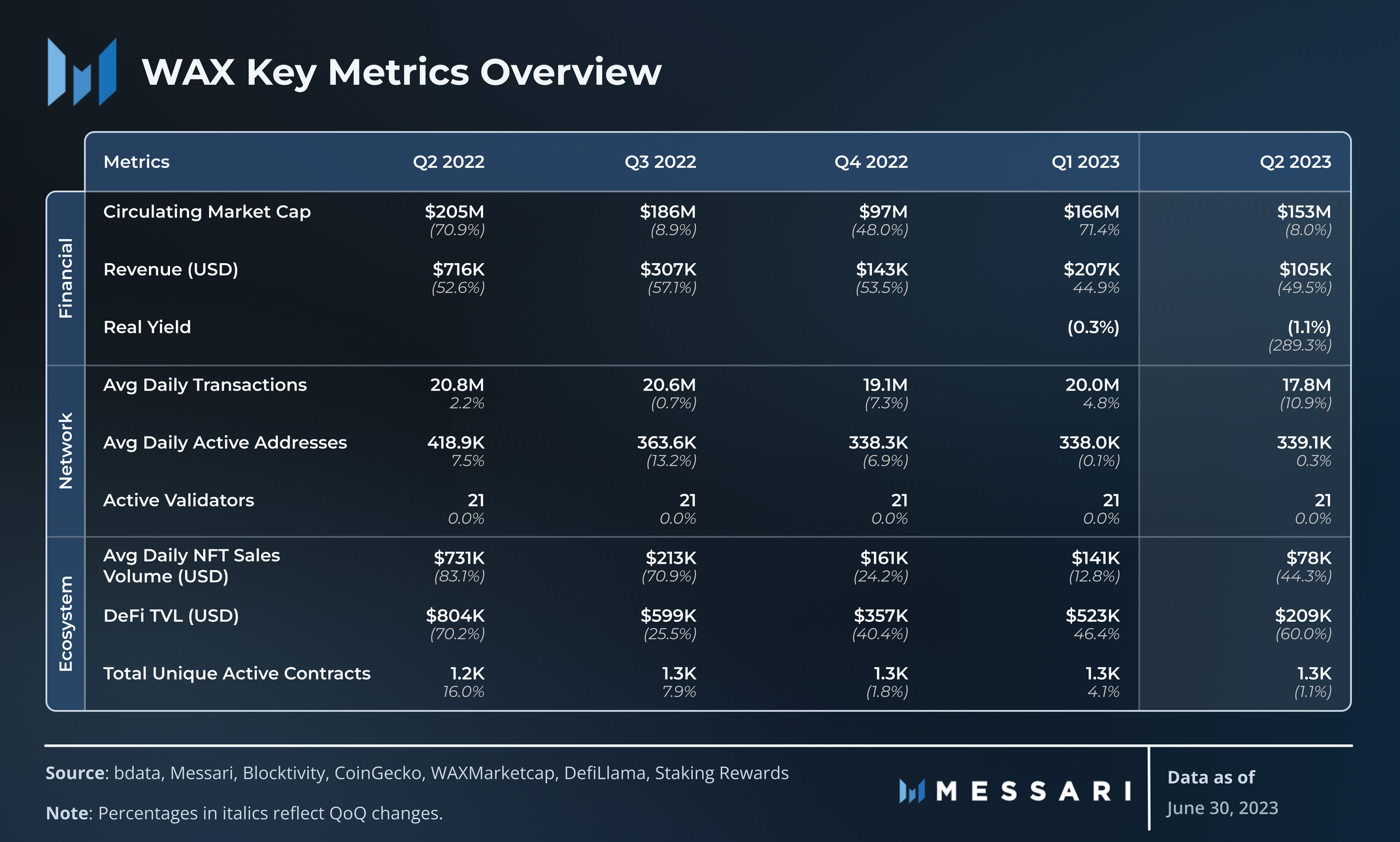
In a rough quarter for alternative Layer-1 (L1) tokens, WAX’s market cap decreased only 8% QoQ to $153 million, mainly due to a reclassification of some tokens as circulating. WAX’s price fell 33% QoQ.
Q2’23 featured fewer but stickier new addresses. Average daily new addresses decreased 68% QoQ to 1,600, but April and May cohorts both had over 61% one month retention rate.
WAX integrated Antelope IBC in May, securely connecting WAX with EOS, UX Network, and Telos. IBC activity has been low so far, but a planned consensus upgrade to add near-instant finality by the end of the year will further unlock use cases of the cross-chain protocol.
P2E game Alien Worlds drove the majority of active address activity. The game averaged 240,000 daily active addresses in Q2’23, of which around 68% were power addresses.
Average daily NFT sales volume decreased 44% to $78,000, but daily unique NFT buyers increased 38%. The most popular collection by volume this quarter was Funko’s licensed collectible drop with the Dark Knight Trilogy.
Primer on WAX
Worldwide Asset eXchange (WAX) is a Layer-1 (L1) network geared toward gaming and NFT use cases. WAX launched in June 2019 following an ICO that raised around $60 million at the end of 2017. The network is built using the open-source Antelope framework (formerly EOSIO) which features Delegated Proof-of-Stake consensus, smart contract programming in C++, a unique resource model with bandwidth and state storage components, and a smart contract accounts model with similar effects to account abstraction. On top of this core Antelope stack, WAX Labs built other services including a cloud-based wallet, an NFT creator and marketplace, an on-chain random number generator, and a block explorer. These services were built to provide a more familiar Web2 experience on top of the core blockchain protocol. For a full primer on WAX, refer to our Initiation of Coverage report.
Q2’23 was an up-and-down quarter for the overall crypto market. In the first half of the quarter, a meme coin craze drove up on-chain activity and prices. After a brief period of relative calm, several U.S. regulatory events, including enforcement actions against Coinbase and Binance, drove the market down. Among other claims, these enforcement actions alleged that several Layer-1 tokens are securities. BTC and ETH were not part of these allegations; thus, alt-L1 tokens generally experienced more negative price action.
Although $WAX was not named in any of the claims, it was not an exception to the market downturn. While $WAX’s price decreased 33% QoQ, its market cap only decreased 8% due to a 37% QoQ increase in circulating supply. However, most of this increase was not driven by any new tokens being minted or vested. Instead, CoinGecko and CoinMarketCap reclassified tokens that had long ago vested from $WAX’s 2017 ICO as now being circulating. Nevertheless, with the increase in market cap, $WAX’s market cap rank jumped from 176th to 160th from quarter start to end.
WAX’s revenue (all fees collected by the protocol) dipped this quarter to yearly lows, both when denominated in USD and WAX. Revenue (USD) decreased 50% QoQ to $105,000 and revenue ($WAX) decreased 42% QoQ to 1.7 million. WAX has a unique resource model where $WAX ($WAX on the WAX network, $WAXP on the Ethereum network) can often be recouped by the user if they no longer require bandwidth or state storage resources. Thus, WAX does not collect revenue through gas fees. Instead, WAX revenue comes from a 2% tax on NFT secondary sales backed by a “gentlemen’s agreement” with NFT marketplaces. Therefore, the decrease in WAX revenue is a result of less NFT sales volume this quarter.
WAX burns 20% of its revenue and bridges the remaining 80% to Ethereum to distribute to liquidity providers (see the DeFi section for more details). The WAX protocol mints $WAX at a 5% annual inflation rate which it distributes to validators (2%), delegators (2%), and its treasury (1%). The burn mechanism has not significantly impacted inflation, which has remained around 4.9%. Since all validator rewards come from inflation and the burn mechanism does not significantly lower inflation, WAX’s real staking yield (nominal staking yield adjusted for inflation) is negative (-1%).
The WAX team is planning an overhaul of $WAX tokenomics and staking mechanisms in 2023. The number of rewards to each network participant (validators, delegators, and treasury) will remain roughly the same. However, if the fees collected by the protocol cover the rewards, no additional $WAX will be minted, and all leftover fees will be burned. If there’s not enough activity to cover the rewards, inflationary $WAX will be minted to cover the difference. In the proposed system, inflation should not exceed 4%.
Network Analysis
Usage
Transactions and daily active address activity have remained relatively constant throughout the past year. Average daily transactions decreased 11% QoQ to 17.8 million, while average daily active addresses increased 0.3% QoQ to 339,000.
In Q2’23, there were a total of 1.1 million total active addresses, a 27% QoQ decrease. Of these 1.1 million addresses, 24% were active for only one day in the quarter. On the other hand, 13% were active every day in the quarter. Over half of the active addresses were active for over seven days in the quarter.
After a 38% QoQ increase in average daily new addresses last quarter, partially spurred by the four-part “BlastOff” NFT marketing campaign, address growth dipped back down this quarter, decreasing 68% to 1,600 new daily addresses on average.
Although fewer addresses joined the network, the ones that did have so far been stickier than previous cohorts. Over 61% of the addresses that joined in April and May 2023 were active again the following month. This one month retention rate is a notable increase (22%) from the average of 50% from June 2022 to March 2023.
Security and Decentralization
At the end of the quarter, there were 68 validators with WAX voting power; however, only the top 21 with the most voting power can participate in consensus in a given round. The amount of $WAX staked increased 22% QoQ to 1.96 billion ($90 million). The increase largely came from the WAX team staking tokens they had accumulated over the years but never staked. Not all of these staked tokens are necessarily delegated to validators, though; they could just be staked in WAX’s resource model and not used for voting for validators.
In WAX’s Delegated Proof-of-Stake (DPoS) model, a tokenholder does not delegate tokens toward one validator; instead, they stake their tokens and then can vote for up to 30 validators. Each validator would then receive that tokenholder’s full amount as voting power. For example, if a tokenholder has 1 million voting power and votes for 30 validators, each validator would have 1 million voting power. Due to this system, it is impossible to precisely measure how much stake is delegated to all validators versus the top 21 (participating validators).
In order to take over the network through a two-thirds attack, a malicious actor would need to control 15 validators. Because of the abovementioned voting power system, a malicious actor would need enough stake to control the seventh highest validator by voting power. At the end of the quarter, this threshold was 992 million $WAX ($46 million).
Geographic diversity is also an important factor to the resiliency of a validator network. Of the participating validators at the end of the quarter, Europe was the most popular hosting region with eight validators.
Upgrades and Roadmap
On May 23, WAX integrated Antelope IBC into the network. The Antelope Coalition (collection of teams from WAX, EOS, UX Network, and Telos) funded UX Network core development team 0rigin to develop an inter-blockchain protocol connecting the Antelope networks. With WAX’s integration, all four networks now support Antelope IBC. Beyond enabling secure interoperability between Antelope chains, it will allow popular dapps to create their own Antelope sidechain that remains connected to the ecosystem. Usage of the new IBC protocol has yet to take off, with an average of 54 daily calls of WAX IBC-related contracts from an average of 11 daily addresses.
0rigin is also developing a new consensus mechanism, expected to release by the end of the year. The mechanism will be a modified variant of HotStuff (Aptos’ consensus mechanism). The upgrade will expand Antelope validator sets beyond 21, improving decentralization. It will also bring near-instant finality (compared to the current three-minute transaction process), improving user experience and developer capabilities. Antelope IBC will greatly benefit from the upgrade to instant finality.
Ecosystem Analysis
Popular Contracts
Play-to-Earn (P2E) game Alien Worlds accounted for a majority share of daily active address activity among all WAX contracts. In Q2’23, Alien Worlds averaged 240,000 daily active addresses and increased its share of active addresses from 12% QoQ to 65%.
The next most popular set of contracts by active addresses is Farmers World, another high-click P2E game. However, over a year ago, the Farmers World team sold the entire treasury (worth around $50 million at the time) and halted all development and communication. Farmers World’s average daily active addresses decreased slightly this quarter to 55,000.
The WAX System contract averaged 13,000 daily active addresses this quarter, down from 24,000 last quarter. It manages functions such as staking, delegation, and resource management. The decrease aligns with the decrease in new addresses since new addresses will likely need to call the contract to receive resources to transact.
Many NFT marketplaces and projects that conduct primary drops use the same set of contracts in their backend. We grouped these into the “NFT Marketplaces” bucket. As a group, these contracts averaged over 10,000 daily active addresses this quarter, down from 14,000 last quarter.
Other popular dapps by active address activity include NFT-based games Dungeon Master and Taco.
This chart includes only contract calls from addresses on the same day that the address is created (“newly created addresses”). It highlights what addresses are doing when they join the network, and the results offer several noticeable differences from the above analysis on contract calls from all addresses.
The most popular contract for newly created addresses is the WAX System. Over the quarter, the WAX System had a 44% share of newly created address interactions compared to a 4% share of all address interactions. As mentioned above, many new addresses will need to call the system contract to receive resources to transact.
Of the addresses that join and participate in the ecosystem on the same day, the majority are either playing Alien Worlds or trading/minting NFTs. On average in the quarter, Alien Worlds had a 20% share of newly created address interactions compared to its 65% share of all address interactions. While Alien Worlds’ activity is driven by existing users, it still has a significant share of newly created addresses. On the other hand, Farmers World did not crack the top six dapps by newly created address interactions despite its 15% share of all address interactions.
Dungeon Master’s average market share of newly created addresses was 12%, a QoQ increase of 273%. Dungeon Master is an NFT staking game on WAX and EOS created by gaming platform Wombat, which also features an in-house wallet.
This chart again only looks at contract calls from a subset of addresses; here, power addresses. Power addresses are defined as addresses that were active for over 81 days in the quarter. Out of the 1.1 million total active addresses in Q2’23, 211,000 were power addresses.
Alien Worlds’ amount of daily power addresses increased significantly QoQ. In Q2’23 Alien Worlds averaged over 163,000 daily power addresses, up from around 41,000 in Q1’23. With the increase, 68% of Alien Worlds’ active addresses are power addresses. Farmer Worlds’ amount of daily power addresses decreased, from around 41,000 in Q1’23 to 34,000 in Q2’23. About 62% of Farmer Worlds’ active addresses are power addresses.
Alien Worlds and Farmer Worlds combined for an 85% share of daily power addresses. High-click Play-to-Earn games like Farmers World and Alien Worlds are prime for bot usage because they incentivize repeatedly clicking buttons. As such, the nature of these games could be accounting for the large amount of power addresses for these dapps. It should be noted that bot activity occurs on many games and is not exclusive to WAX.
The WAX team has been consciously working to reduce bot activity. In June, the WAX team integrated into the WAX Cloud Wallet an AI/ML tool called TRUST made by the NFT marketplace Chain Champs. TRUST analyzes an address’s transaction history and scores how likely it is to be a bot. TRUST scores are publicly available through the Cloud Wallet interface, an API, and on-chain through a smart contract. This will allow WAX dapps to use the scores within their own smart contracts, for use cases such as blocking addresses with a set likelihood of being a bot.
This chart re-examines all addresses (rather than just newly created or power addresses), but just counts an address's first interaction with a contract group. This analysis reveals the number of daily new addresses for each contract group.
The 68% QoQ decrease of new WAX addresses primarily affected the number of new addresses for the WAX system, Alien Worlds, and NFT marketplaces. Each group’s average daily new addresses decreased over 73% QoQ.
NFTs and Gaming
In the past quarter, WAX averaged $78,000 in daily NFT sales volume, a 44% QoQ decrease. Average daily sales similarly decreased 31% to 22,000. The spikes in NFT volume and number of sales were driven by Funko drops. The drop in volume is largely a result of fewer Funko drops in the quarter; only four this quarter compared to six in Q1’23.
According to CryptoSlam!, WAX ranked 12th among blockchains in total NFT volume but 5th in the number of sales in Q2’23. It should be noted that CryptoSlam! only includes secondary sales data, unlike the above data which includes primary sales.
Contrary to the decline in the number of sales and volume, daily unique NFT traders increased notably for the second straight quarter. According to CryptoSlam! (again, only secondary sales) daily unique NFT buyers increased 38% to 4,200 and sellers increased 46% to 6,000. With strong increases in back-to-back quarters, average daily unique NFT buyers bounced back 142% from its yearly low in Q4’22.
Funko collections averaged $49,000 in daily sales volume, 62% of total WAX NFT volume. Funko is a toy company that sells licensed pop culture collectibles. In Q3’21, it partnered with WAX to launch digital collectibles, some of which are redeemable for physical toys. Funko sells these digital collectibles in pack drops, which explains the significant spikes in WAX NFT sales volume. In Q2’23, Funko held four drops featuring licensed collectibles from Flintstones, the Dark Knight Trilogy, Adventure Time, and IT.
Sales volume increased noticeably QoQ for Alien Worlds, Colonize Mars, and NFT Battle Miners. Alien Worlds’ volume grew 79% QoQ to an average of $7,800 daily, making it the second-most popular collection by volume. Colonize Mars, an outer-space NFT-based strategy game, saw its average daily volume grow 310% to $2,200. And NFT Battle Miners, an NFT-based PVP card game, saw its average daily volume grow 457% to $123.
Other NFT and gaming-related launches include:
WAX Ape Rave Club: NFT collection based on Bored Ape Yacht Club that launched in June. The collection has averaged $1,800 in daily sales volume.
vPunks: The WAX team conducted a giveaway for 6,666 vPunks NFTs. The collection has averaged $46 in daily sales volume since release in mid-June.
Sandlot Boys of Summer Series 2: Sandlot cast members released a second series of their NFT collection on WAX to celebrate the movie’s 30th anniversary. The collection has averaged $22 in daily sales volume since release at the end of April.
In the past quarter, DeFi TVL denominated in USD decreased 60% to $209,000. This ranks WAX roughly 155th among all chains. The decrease in TVL resulted from a significant reduction in Alcor Exchange’s TVL on April 30. Alcor Exchange is one of the main DEXs on WAX. On April 29, the protocol launched the V2 of its AMM, introducing concentrated liquidity. However, some users reported issues with the upgrade, including the new UI, which the exchange is considering reverting back to. While concentrated liquidity can bring better capital efficiency, it can make it more difficult to be a profitable liquidity provider, as has been revealed with Uniswap V3. Following the upgrade, Alcor TVL almost halved, and Defibox overtook Alcor as WAX’s top DeFi protocol by TVL.
At the moment, WAX does not have any natively minted stablecoins. The WAX team has brought over several Ethereum native stablecoins, namely USDC, USDT, and DAI, via a two-of-four multisig bridge (consisting of WAX’s president, COO, CTO, and blockchain lead). The combined market caps of the above stablecoins increased 12% QoQ to $28,000.
As mentioned earlier, 80% of WAX revenue is bridged to Ethereum to distribute to liquidity providers in a WAX-ETH Uniswap V2 pool. At the end of the quarter, TVL in the pool stood at $4.8 million. However, the team plans to migrate the system back to WAX around the end of 2023.
Development
While the number of total unique active contracts called remained steady in the past year, new contracts continued to decline. Total active contracts decreased 1.9% QoQ to just under 1,300. New contracts fell 22% QoQ to 122.
The network will continue tapping into its treasury to incentivize new builders on WAX. Its treasury currently stands at $4.1 million, and it is projected to grow at a yearly rate of $1.5 million based on current prices from its allocation of 1% network inflation.
Furthermore, the WAX team launched several tools that open up new use cases for ecosystem builders:
Unity 3D SDK: The WAX team released an SDK in early May that enables game developers to easily access various WAX infrastructures needed to integrate their games with the blockchain.
Cloud Wallet NFT bridge: In early April, the WAX team integrated an NFT bridge into the Cloud Wallet. The bridge allows WAX NFT collection creators to map the collection to an ERC-721 smart contract. Then, individual NFT holders can transfer the NFT to and from WAX, Ethereum, and BNB Chain.
Closing Summary
Driven by negative U.S. regulatory actions, Q2’23 featured downward price action specifically for alt-L1s. $WAX was no exception, with its price dropping 33%. While daily transactions and active addresses remained steady, several other key metrics fell notably QoQ including revenue in $WAX (-42%), new addresses (-68%), NFT volume (-44%), and DeFi TVL (-60%). However, several metrics indicated positive growth during the bear market, including stickiness of new addresses (+22%) and daily unique NFT traders (+38%). Furthermore, the quarter featured several notable upgrades and launches, including integration with Antelope IBC, the Unity 3D SDK, TRUST scores, and the NFT bridge. Additionally, ecosystem initiatives such as the Creators First program and AtomicHub GameFest continued engaging the WAX community. Continued development and growth initiatives will be key to improving the strength and diversity of WAX’s network and ecosystem.
This report was commissioned by Exposition Park Holdings SEZC. All content was produced independently by the author(s) and does not necessarily reflect the opinions of Messari, Inc. or the organization that requested the report. The commissioning organization may have input on the content of the report, but Messari maintains editorial control over the final report to retain data accuracy and objectivity. Author(s) may hold cryptocurrencies named in this report. This report is meant for informational purposes only. It is not meant to serve as investment advice. You should conduct your own research and consult an independent financial, tax, or legal advisor before making any investment decisions. Past performance of any asset is not indicative of future results. Please see our Terms of Service for more information.
No part of this report may be (a) copied, photocopied, duplicated in any form by any means or (b) redistributed without the prior written consent of Messari®.
Looking to dive deeper? Subscribe to Messari Pro. Messari Pro memberships provide access to daily crypto news and insights, exclusive long-form daily research, advanced screener, charting & watchlist features, and access to curated sets of charts and metrics. Learn more at messari.io/pro.
Peter is a Research Analyst in Protocol Services focused on Layer-1s. He recently graduated from Boston College where he studied economics and computer science and led the school's blockchain club.
Peter is a Research Analyst in Protocol Services focused on Layer-1s. He recently graduated from Boston College where he studied economics and computer science and led the school's blockchain club.