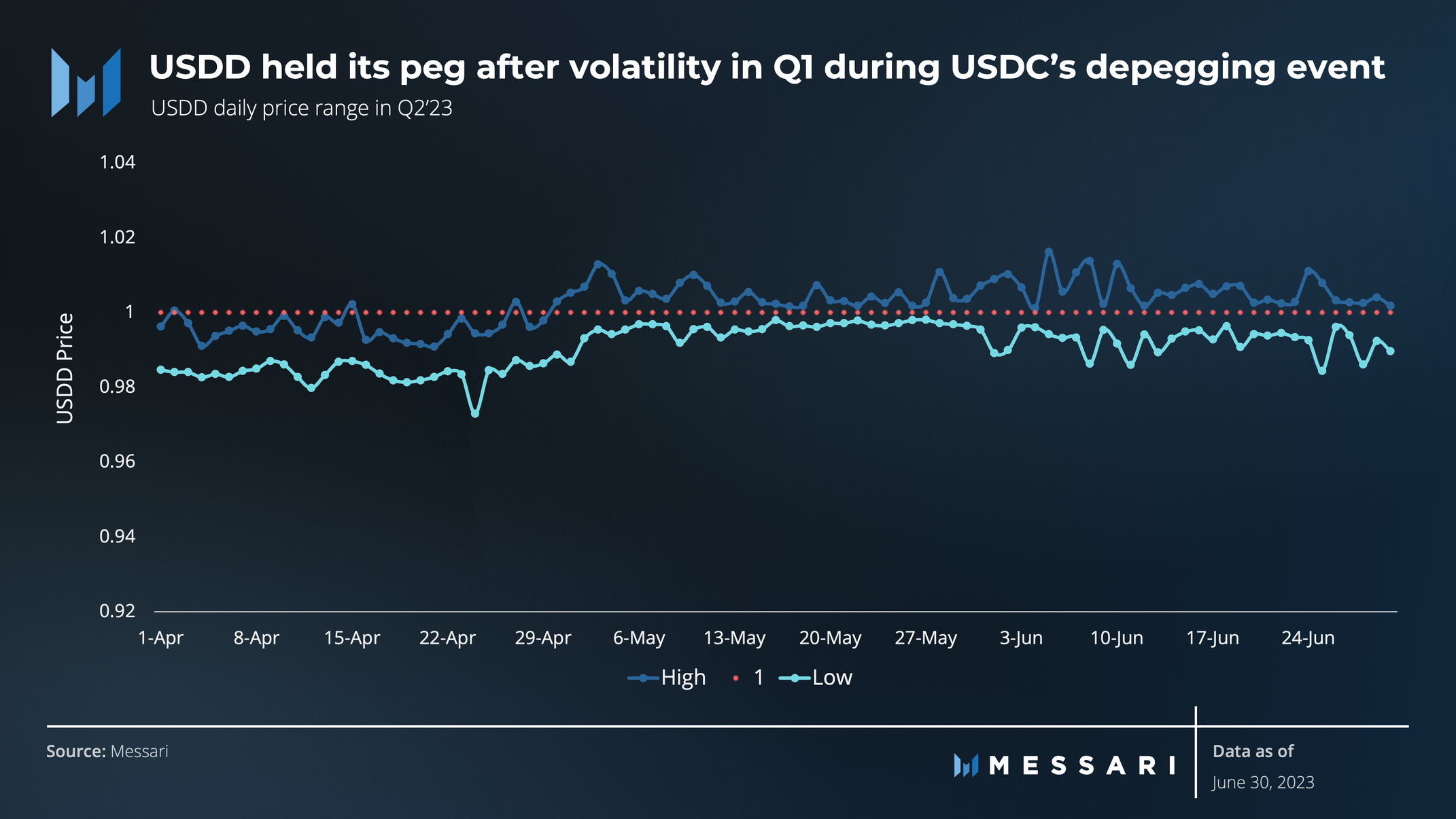
USDD traded tight to its peg in Q2, enabling $13 million of backing to accumulate in the PSM and the Curve pool to return to balance.
Adoption metrics leveled out but did not show a meaningful increase from Q1, with volumes and holders roughly flat quarter over quarter.
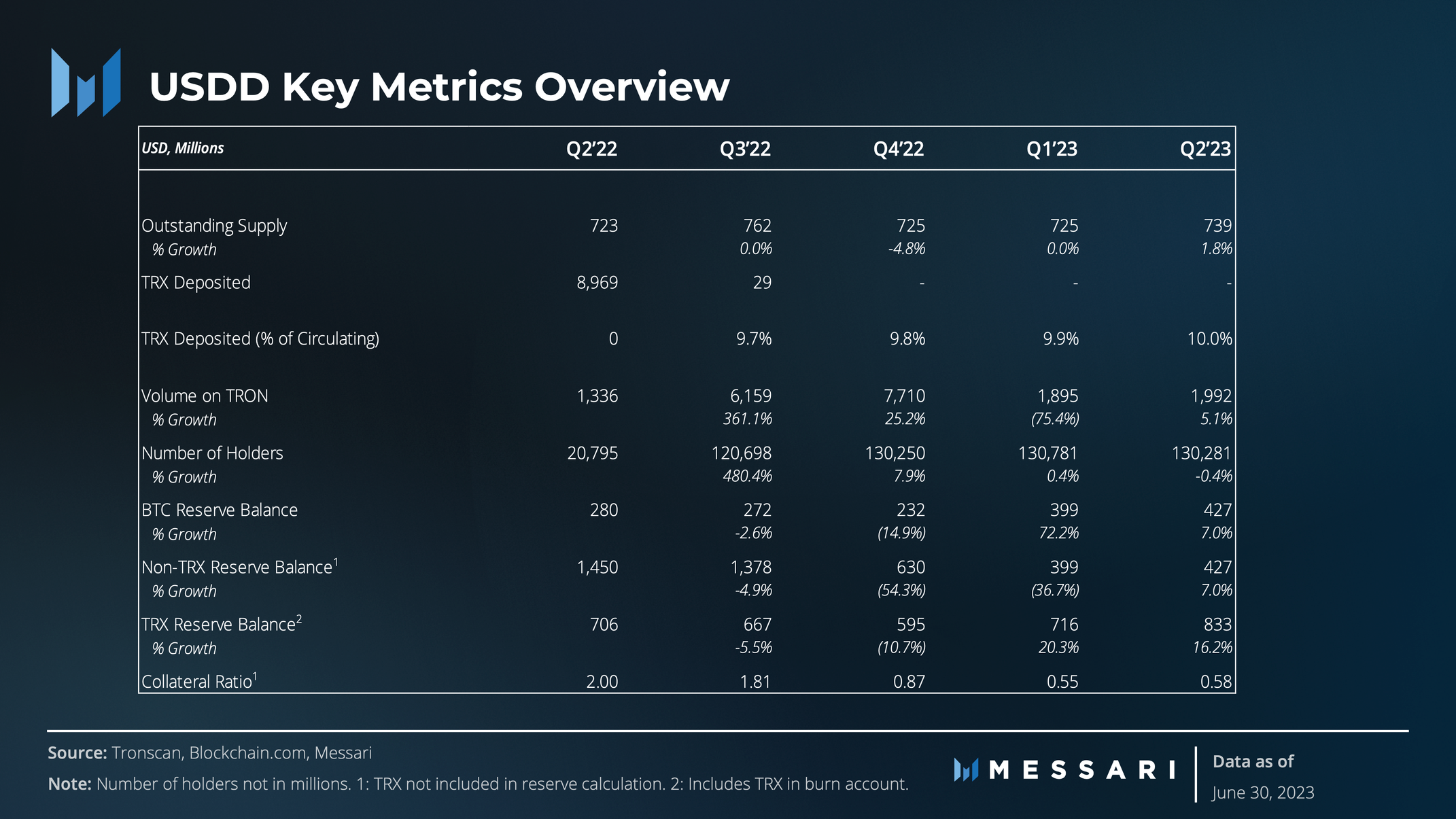
The backing for USDD improved in Q2, thanks to BTC and TRX prices rising 7% and 15%, respectively. The stablecoin remains undercollateralized with non-TRX assets but is 171% collateralized including TRX assets.
Primer on USDD
USDD is an overcollateralized stablecoin issued by the TRON DAO Reserve (TDR), which is also the custodian. The TDR is made up of seven crypto-native institutions. USDD’s value is backed by the overcollateralization of crypto assets under the TDR, including BTC, USDT, USDC, and TRX. The peg is maintained through the Peg Stability Module (PSM), which allows 1:1 transfer of USDD for USDT, USDC, TUSD, and USDJ. The PSM’s USDD funding is controlled by the TRON DAO Reserve. USDD can be minted by the whitelisted institutions of the TDR by depositing TRX.
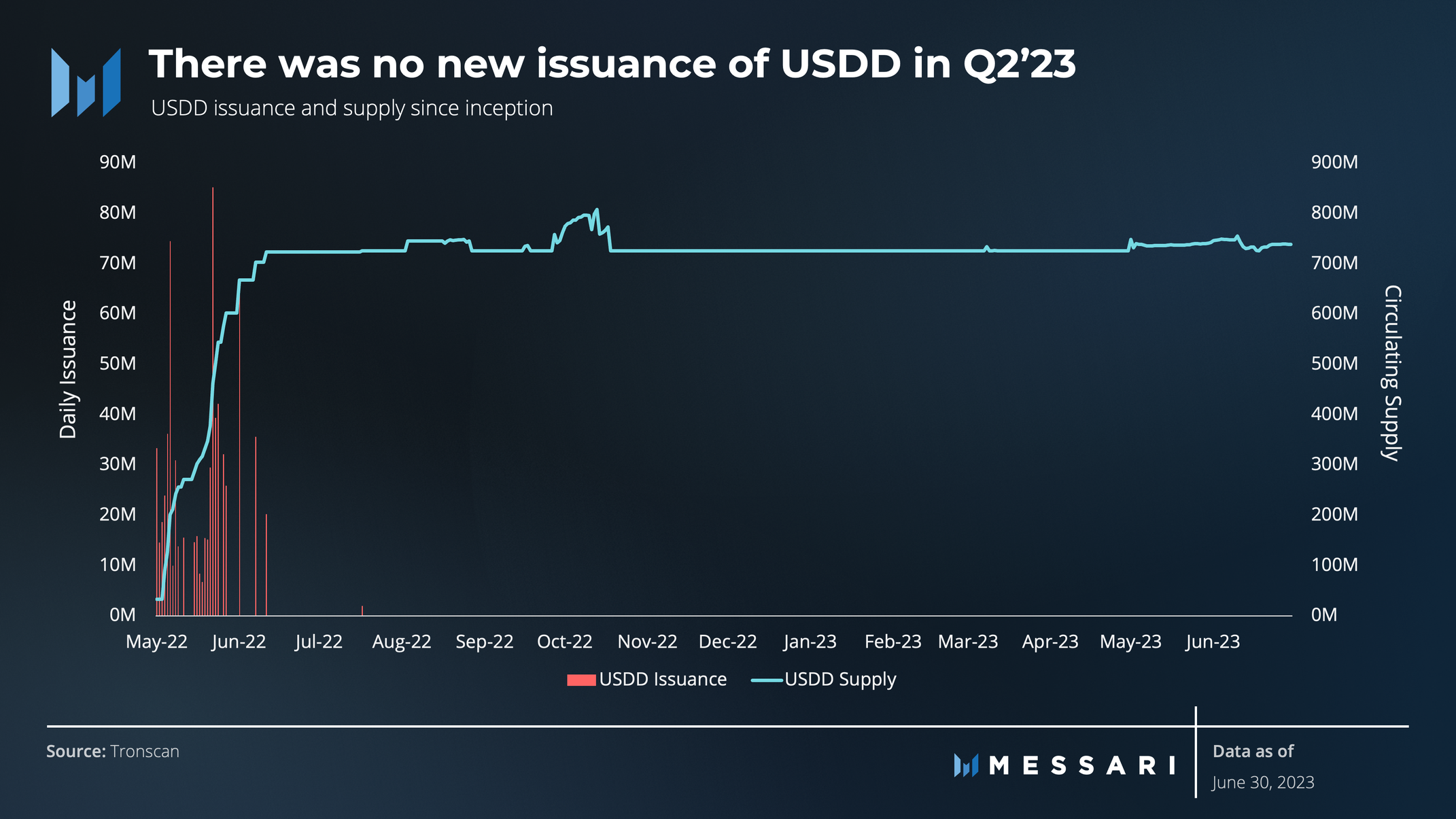
USDD new issuance has not changed since Q3'22, but the PSMs have continued to fluctuate with volatility around the peg. Driven by stablecoin price volatility in Q1 brought on by USDC fears, the USDD supply fell to its base issuance level of 725 million. However, as USDD returned to peg, the PSM again became viable, adding 13 million USDD to the circulating supply.
Reserve Balances
The TRX balance in the deposit account remained unchanged while the TRX balance in the two reserve accounts increased very slightly. Similarly, the bitcoin backing USDD remained unchanged, while its value increased another 7% from price changes in Q1.
Although USDD’s collateral ratio improved in Q2, thanks to price increases in both BTC and TRX, the non-TRX collateral ratio remained meaningfully below 1. Measuring only on-chain reserves, the non-TRX collateral ratio of USDD increased to 0.58 with BTC as the only reserve. Including the TRX deposited by TRON DAO Reserve, the collateral ratio rose to 1.71 at quarter end.
Peg and Support
After its most volatile quarter since inception, USDD returned to tight trading in Q2. The fall in volatility was paired with a return to peg, after months of trading below 1. In Q2, USDD had its tightest trading range around its target peg since Q3’22.
The peg stability can also be seen in USDD’s share of the USDD/3CRV pool on Curve. The TRON DAO Reserve uses this Curve pool to help maintain liquidity for USDD on Ethereum and to keep the stablecoin peg. The pool contains USDD and 3CRV, Curve’s DAI/USDC/USDT stablecoin pool.
The liquidity in the pool was flat for the quarter around $2.8 million, but its allocation returned to near 50/50 balance. The pool started Q2 with only 22% of liquidity in USDD and ended with over 47% in USDD.
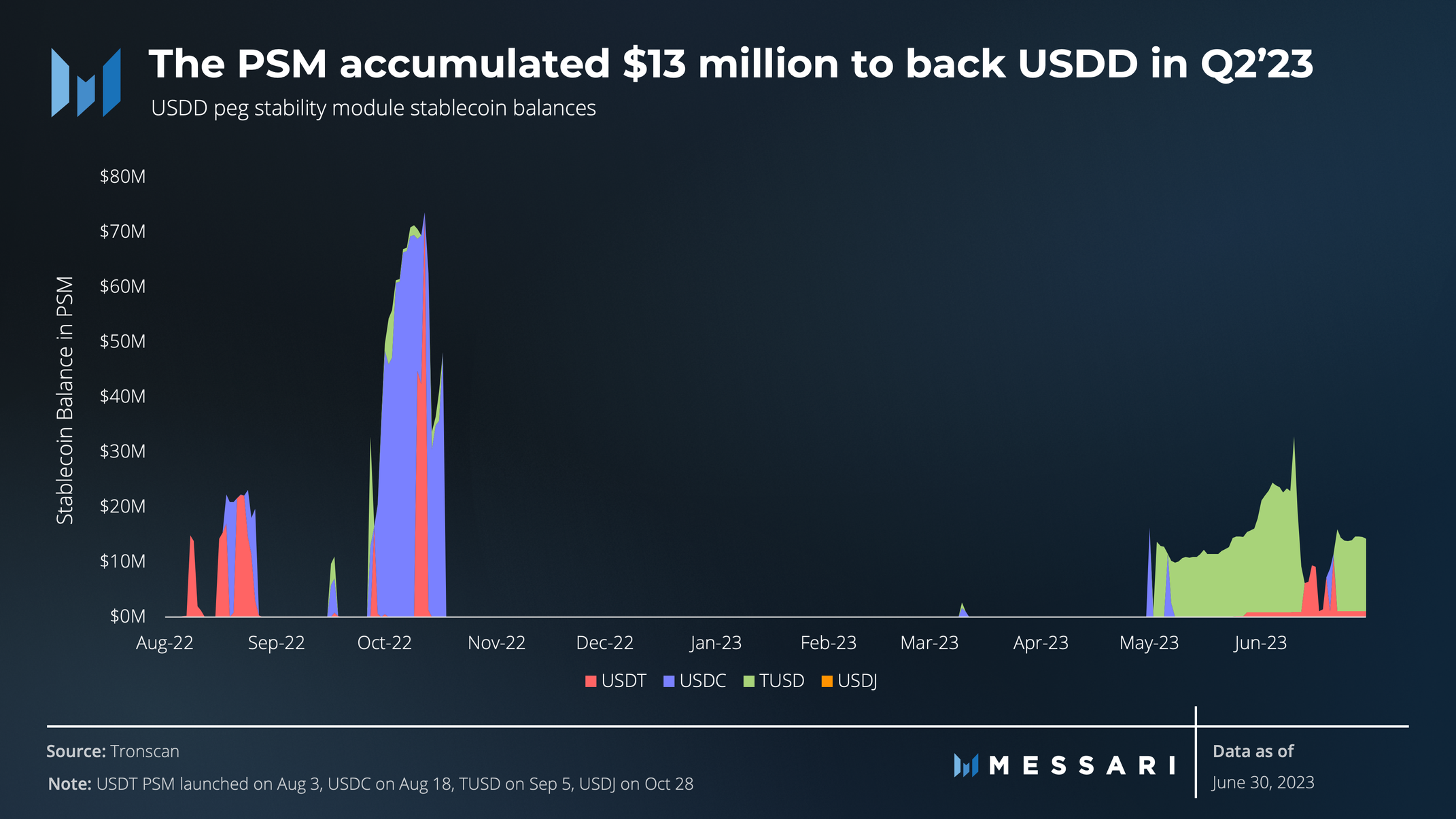
After nearly two quarters of no assets in the PSM, Q2 saw renewed interest as USDD returned to peg. When USDD trades above $1, users can buy USDT, USDC, TUSD, or USDJ and deposit them into the PSM for a 1:1 exchange of USDD. If the stablecoin is trading below its peers, then users can buy it for less than $1 and exchange it 1:1 with any asset in the PSM as long as the PSM is funded.
The strength of USDD enabled the PSM to accumulate over $13 million of TUSD in Q2, aided by the brief depeg of TUSD. That event also drove $250 million of volume in the PSM for TUSD alone. The PSM was used to execute over $640 million of volume in Q2.
Adoption and Usage
The number of holders of USDD on TRON stayed just above 130,000 in Q1, though falling for the first quarter in USDD’s existence. The transaction volume of USDD on TRON seemed to level out just below $2 billion, although the average transaction size was 70% larger in Q2 than Q1. The low transaction volume could be reflective of the relatively low price volatility of USDD in Q1. For comparison, USDD volume spiked in previous quarters around times of uncertainty and depegging.
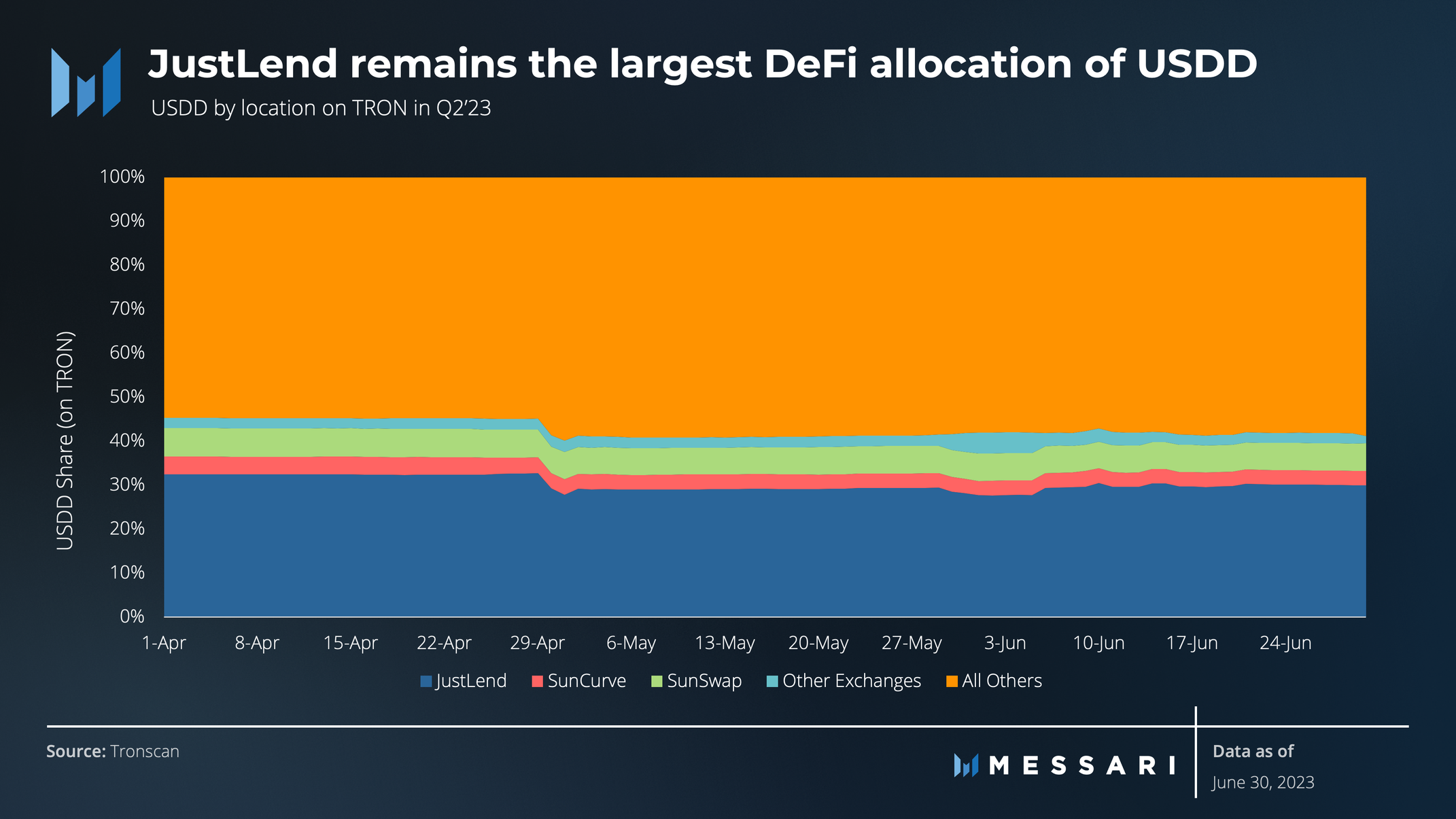
Nearly 40% of the USDD on TRON participates in TRON Network’s largest DeFi protocols. JustLend was the leading lending protocol on TRON, with over 220 million USDD deposited to earn yield. Despite the ample supply, the borrowing demand for USDD was not commensurate in Q2, with only 5 million USDD borrowed at quarter’s end. SunSwap and SunCurve, the leading DEXs on TRON, made up 70 million, or nearly 10%, of the USDD on TRON. The remaining USDD on TRON was primarily in user wallets or other contract accounts.
Qualitative Analysis
Due to the volatility and concerns around USDC, the TDR paused USDC trading in the PSM on March 22. On April 18, USDD reopened its USDC PSMs. The pause was an important action for the team, because it avoided the possibility of unbacked USDD entering the market. With the concerns quelled, the team went on to increase the defensibility of the USDD peg by enabling USDC.
Near the end of April, USDD aligned with 8pay, enabling the processing of payments and salaries in USDD. This integration signified a significant adoption step, positioning USDD as a viable option for real-world financial transactions.
The first day of May marked the one-year anniversary of USDD. Coinciding with this milestone, USDD launched a Footprint Analytics Dashboard, which provides a holistic view of USDD integrations across the wider ecosystem.
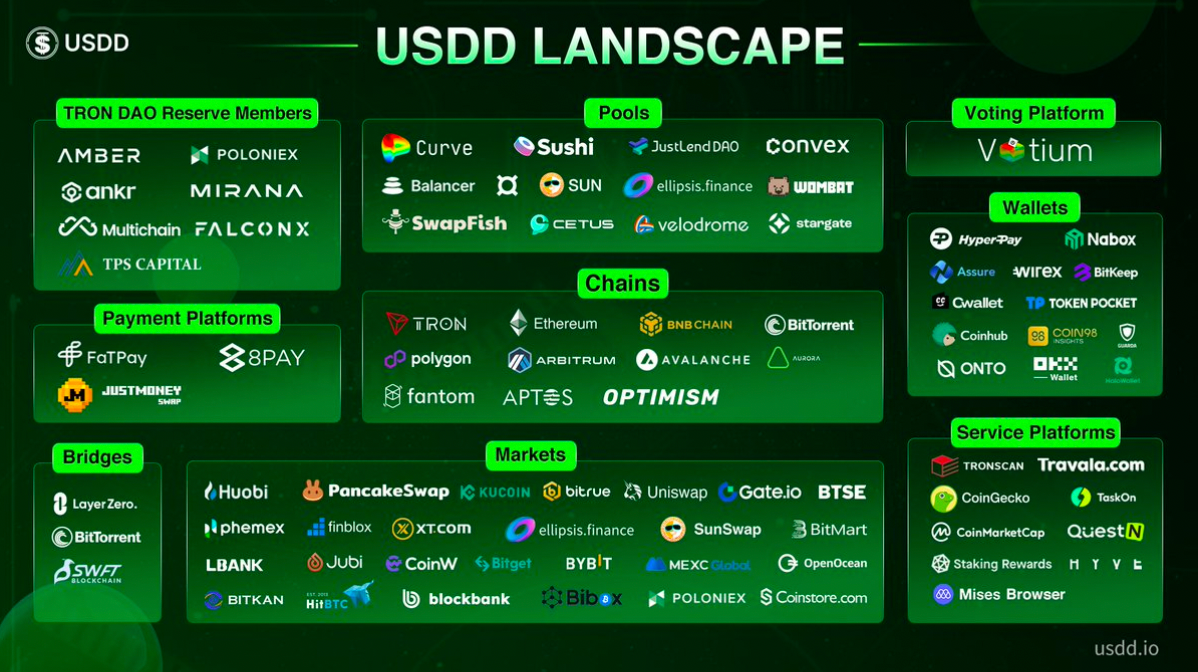
The USDD team made progress in its mission to make USDD ubiquitous and easy-to-use across platforms. Throughout the quarter, USDD had several announcements of integrations and partnerships:
On May 24, the stablecoin expanded its collaboration with digital platforms by getting listed on Uquid, a leading e-commerce site.
June started on a strong note with USDD being added to the OKSE wallet.
On June 8, Stargate extended its support to USDD, which enlarged the scope and reach of the stablecoin.
June 16, brought more liquidity and ease for users as Rangers Protocol, a new Ethereum-Binance bridge, enabled USDD bridging.
It also announced an integration with FoxWallet. Both of these developments brought more platform diversity and practical options for USDD users.
Q2 also brought on the introduction of governance for USDD. On May 10, the TRON DAO Reserve activated the first governance proposal where TRX holders could participate in voting. The vote passed on May 13, but not without some confusion from the community. The proposal enables TRX from the “burn contract” (what we call the deposit contract) and the reserve contract to be staked as sTRX and used in TRON governance.
For many users, it was the first time they learned the burn contract was not a burn address but instead a wallet controlled by the TRON DAO Reserve. The USDD team published an explanation prior to the closing of the vote on May 12 to clarify the mechanics of the system. They explain that "The TRX Burning Contract was deployed just prior to the collapse of Terra UST. In response to community concerns following the Terra Death Spiral, USDD promptly shifted from an algorithmic approach to the over-collateralization model we have now. But the "burn" naming remains unchanged since the smart contract was already live on mainnet."
In sum, Q2 2023 was highly dynamic for USDD, marked by collaborations, integrations, anniversary celebrations, and its first governance vote.
Closing Summary
The second quarter saw the TRON-native stablecoin return to peg and trade with significantly reduced volatility. Paired with volatility in other assets like TUSD, USDD managed to attract over $13 million to the PSM along with an increase in its supply. Holders would also be pleased to see the Curve pool return to balance in the quarter. The volume and the number of transactions did not make any meaningful increases this quarter, and DeFi usage remained steady. At current prices, BTC’s backing alone is insufficient to maintain USDD. That said, the TRON DAO Reserve does have sufficient TRX in the deposit account and reserve accounts, at current prices, to back USDD dollar for dollar.
This report was commissioned by TRON Network Ltd. All content was produced independently by the author(s) and does not necessarily reflect the opinions of Messari, Inc. or the organization that requested the report. The commissioning organization may have input on the content of the report, but Messari maintains editorial control over the final report to retain data accuracy and objectivity. Author(s) may hold cryptocurrencies named in this report. This report is meant for informational purposes only. It is not meant to serve as investment advice. You should conduct your own research and consult an independent financial, tax, or legal advisor before making any investment decisions. Past performance of any asset is not indicative of future results. Please see our Terms of Service for more information.
No part of this report may be (a) copied, photocopied, duplicated in any form by any means or (b) redistributed without the prior written consent of Messari®.
Before joining Messari as a Senior Research Analyst, John worked in Equity Derivatives on the buy-side and sell-side for over five years. He studied macroeconomics and markets for almost a decade. Now, John spends time thinking about token design, DeFi protocols, and governance.
Before joining Messari as a Senior Research Analyst, John worked in Equity Derivatives on the buy-side and sell-side for over five years. He studied macroeconomics and markets for almost a decade. Now, John spends time thinking about token design, DeFi protocols, and governance.