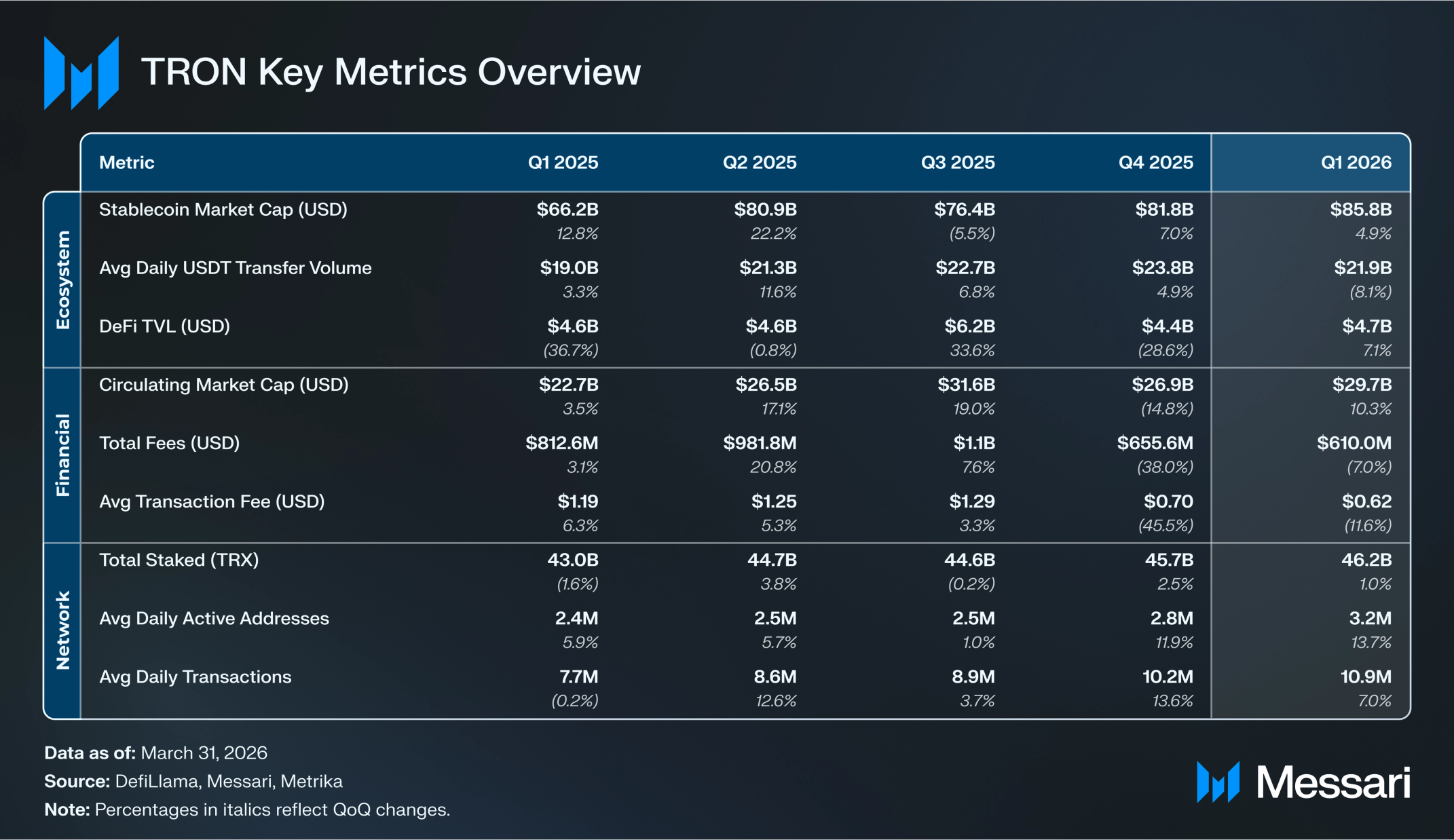
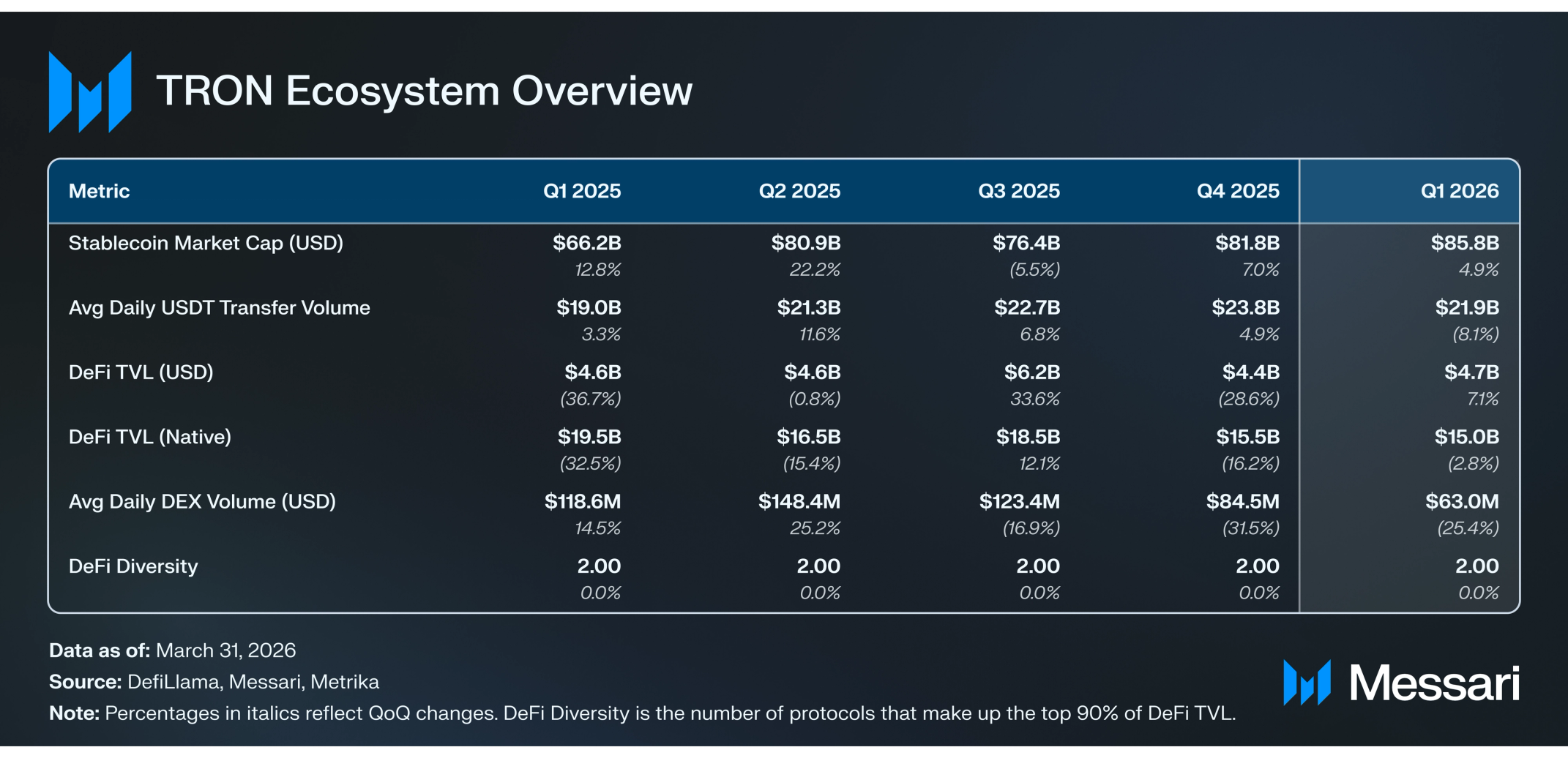
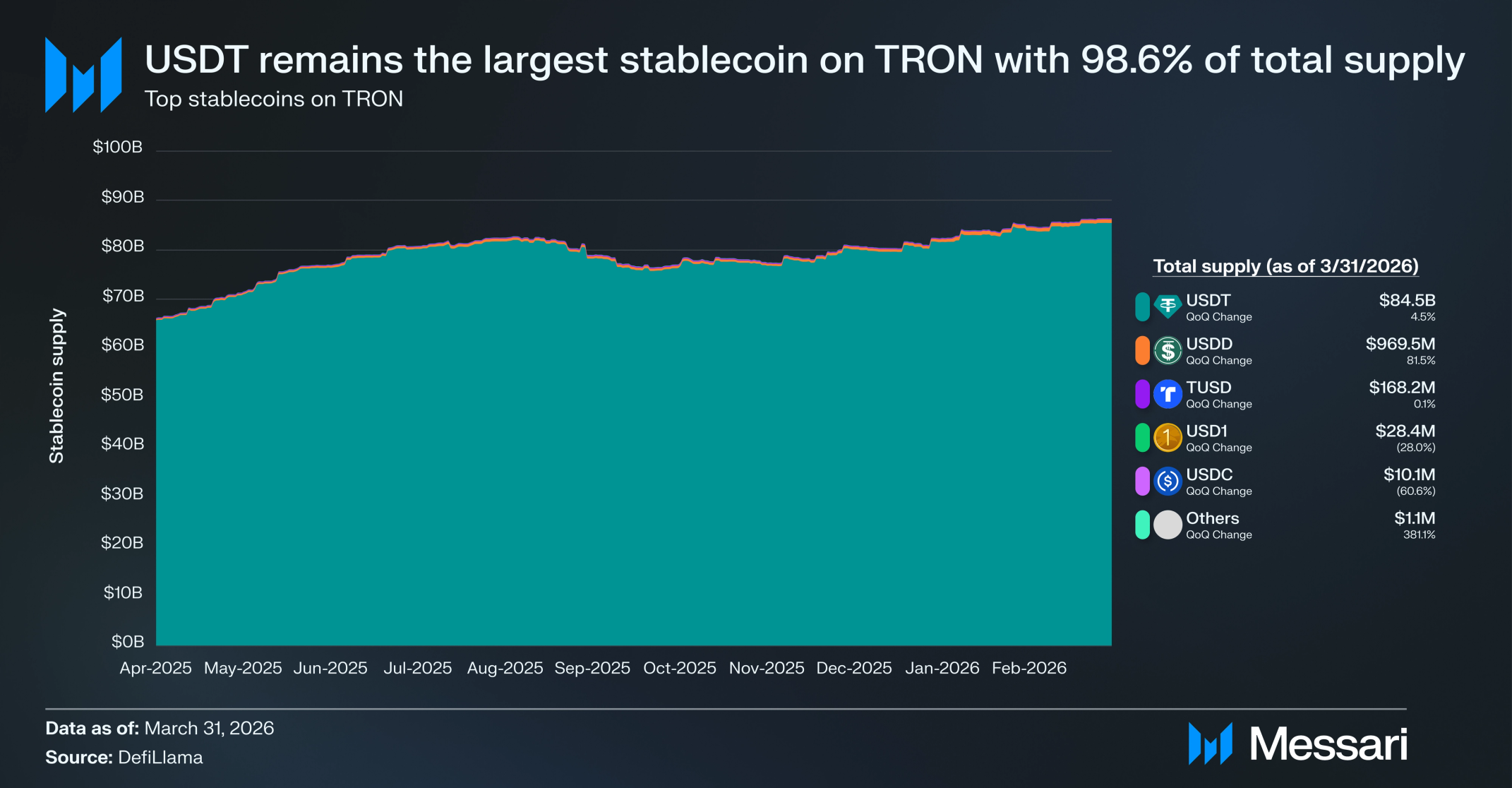
TRON’s stablecoin market cap grew 4.9% QoQ to $85.8 billion at Q1-end, with USDT at 98.6% market share. The network processed $2.0 trillion in cumulative USDT transfers during Q1, reinforcing TRON’s role as the primary settlement rail for the world’s largest stablecoin.
In Q1 2026, TRON DAO positioned the network as infrastructure for the emerging agentic economy. The AI Fund expanded tenfold from $100 million to $1 billion, AINFT launched the Bank of AI for autonomous agent finance, and TRON joined the Agentic AI Foundation’s governing board alongside Circle and JPMorgan.
TRX’s circulating market cap rose 10.3% QoQ to $29.7 billion, amidst a string of institutional catalysts. The SEC dismissed all claims against the TRON Foundation in early March, Anchorage Digital announced custody support for TRX, and TRON joined the Mastercard Crypto Partner Program, linking its settlement layer to point-of-sale infrastructure.
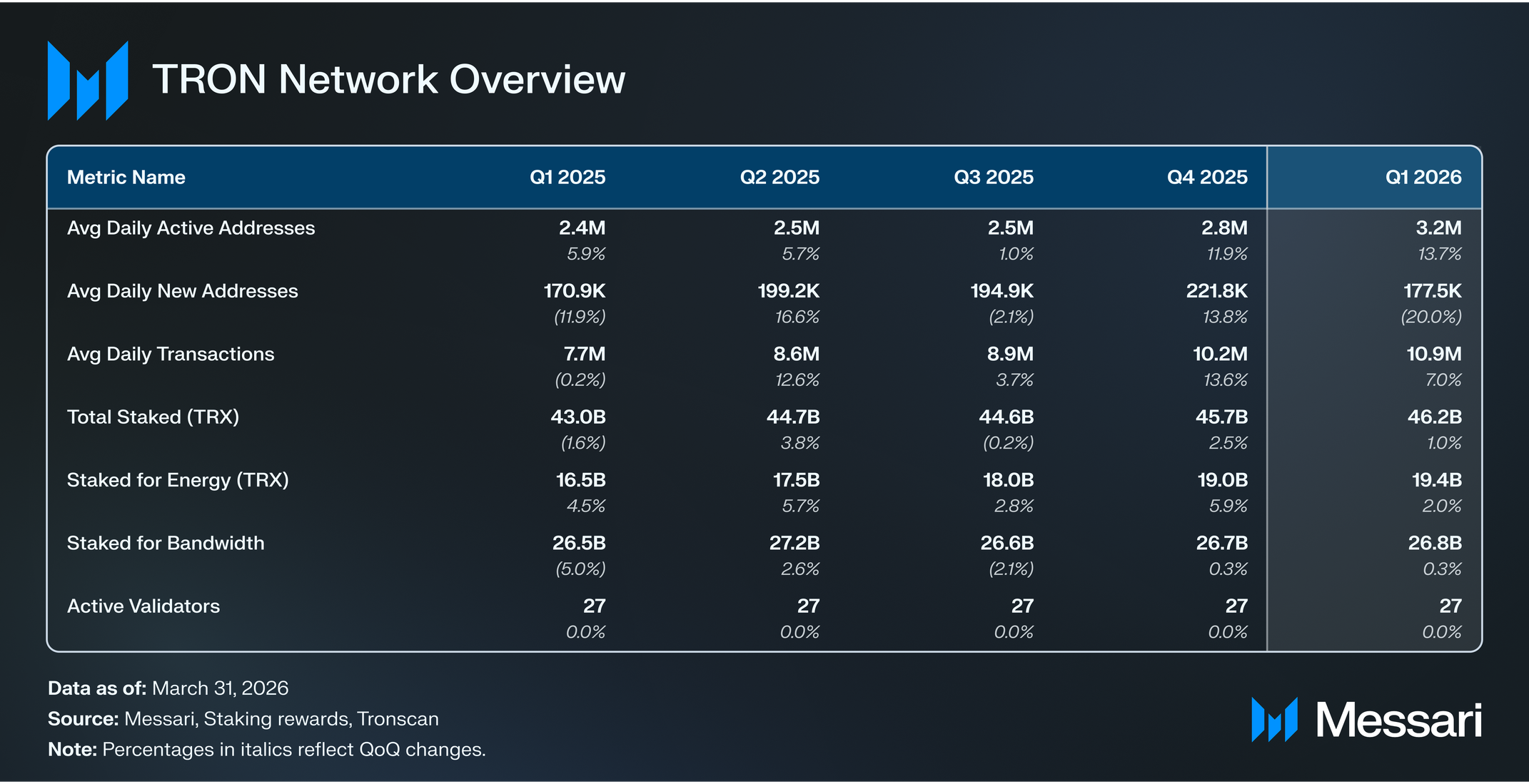
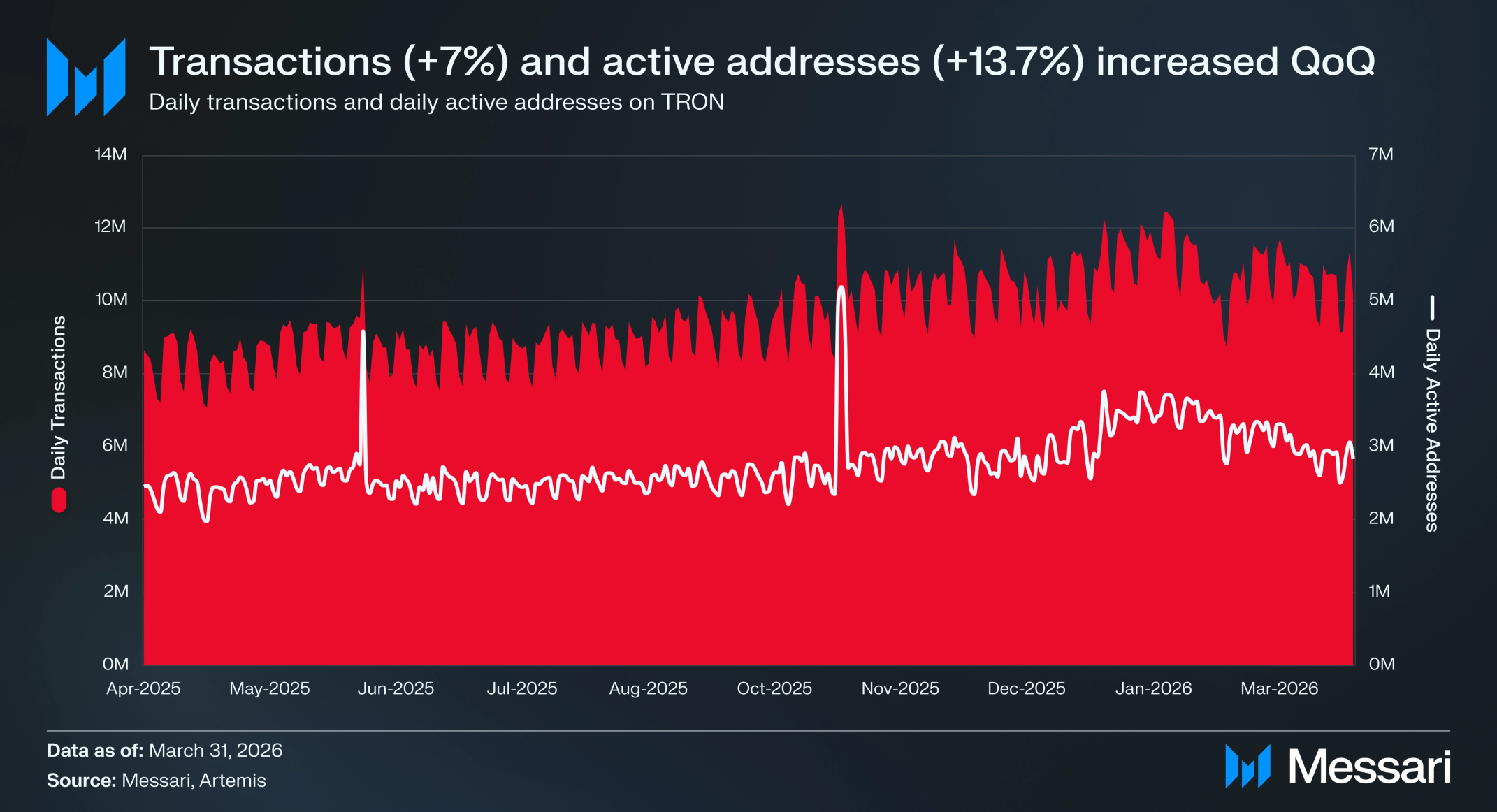
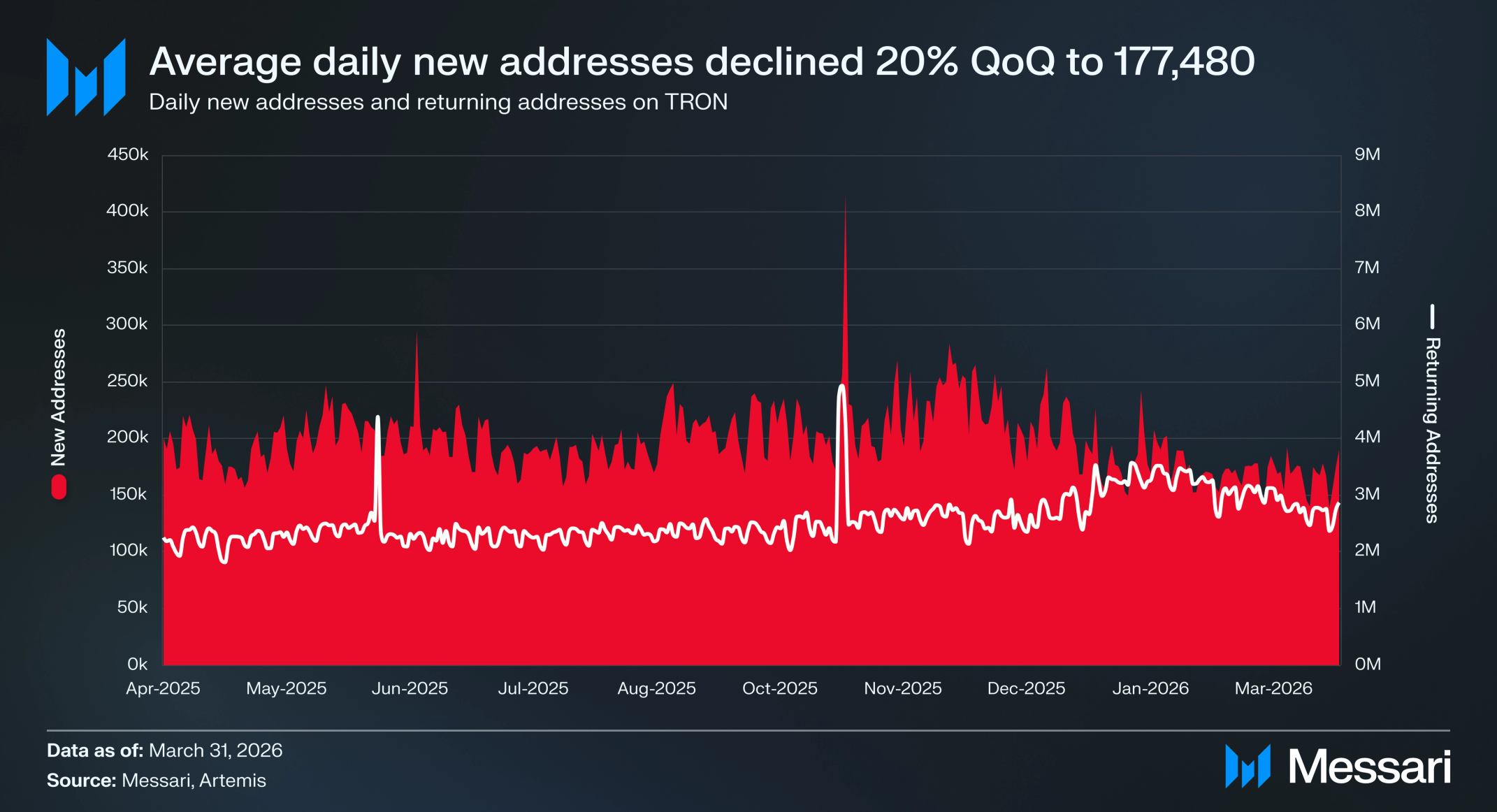
Network activity set new quarterly records despite a decline in new address creation. Average daily transactions rose 7.0% QoQ to 10.9 million, and average daily active addresses climbed 13.7% QoQ to 3.2 million. New addresses fell 20% QoQ, meaning growth was driven by returning users.
Fees continued to adjust from the August 2025 fee reduction, but the rate of decline is decelerating. Total fees fell 7.0% QoQ to $610 million, a significantly shallower drop than Q4 2025’s 38% QoQ decline.
Primer
TRON (TRX) is a public, open-source Layer-1 blockchain that uses a Delegated Proof-of-Stake (DPoS) consensus mechanism. Justin Sun founded the network in 2017, and the TRON Foundation raised $58 million through an ICO that year. The network launched its mainnet in June 2018, migrating from an ERC-20 token to its own chain, and acquired BitTorrent later that year to expand its decentralized infrastructure footprint. The TRON Virtual Machine (TVM) is EVM-compatible and replaces traditional gas with two resources. Bandwidth is consumed by standard transactions, while Energy is consumed by smart contract calls. Users acquire both by staking TRX or by burning TRX to cover execution costs directly. An election process determines which validators participate in consensus: all TRX stakers vote onchain for candidates, and the top 27 most voted-for candidates become Super Representatives in each six-hour epoch.
TRON is the leading network alongside Ethereum for stablecoin transfers and peer-to-peer payments. The network became the dominant chain for USDT circulation in 2022 and held that position through Q1 2026, when onchain USDT supply surpassed $85 billion. Low transaction fees, reduced by 60% following an August 2025 fee adjustment, and fast finality make TRON a preferred rail for USDT transfers, particularly in emerging markets. In 2026, TRON expanded its strategic focus to include AI infrastructure, growing its AI Fund from $100 million to $1 billion and joining the Agentic AI Foundation as a governing board member, alongside Circle and JPMorgan.
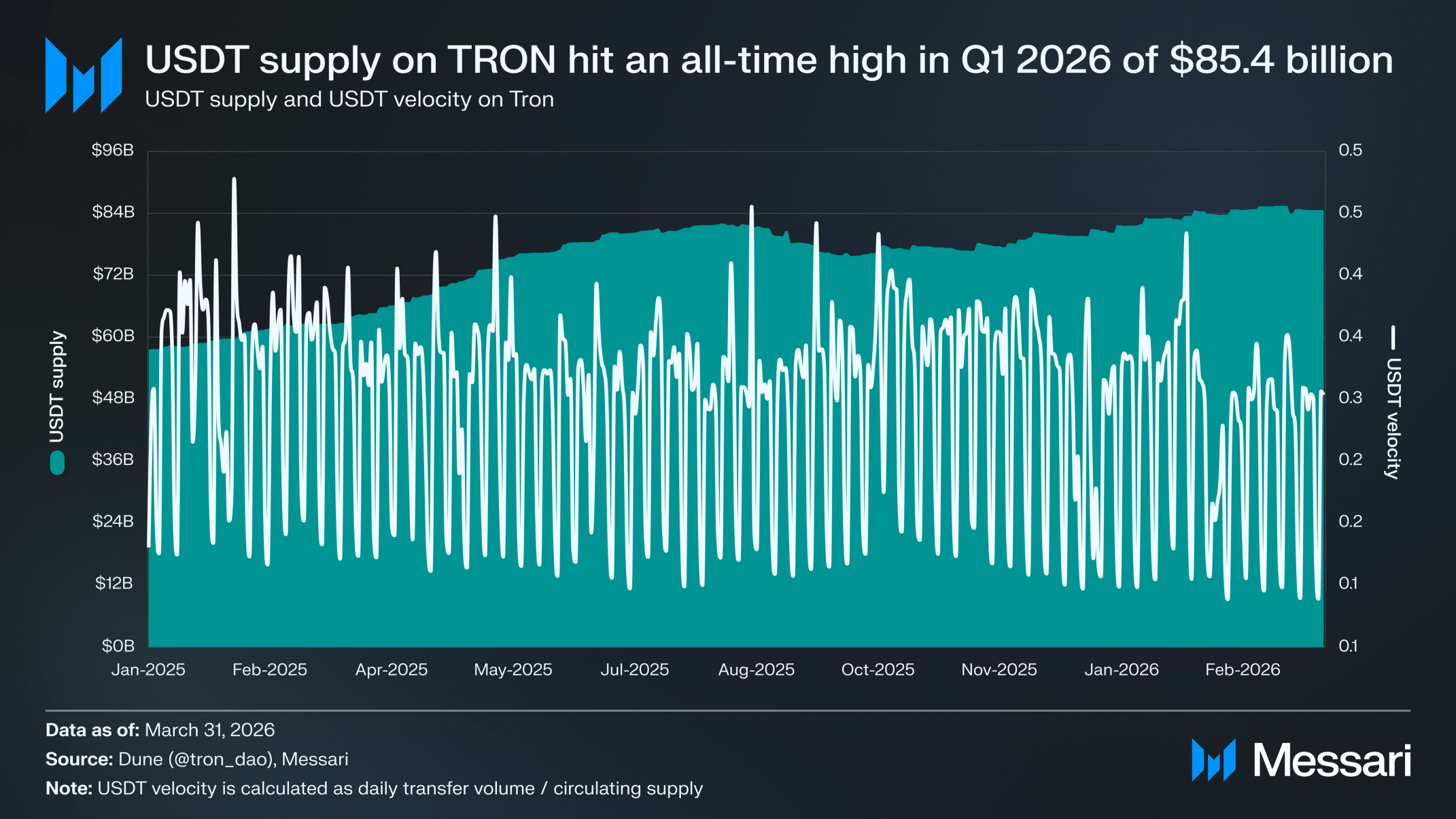
USDT remained the dominant stablecoin on TRON, growing 4.5% QoQ from $80.9 billion to $84.5 billion and holding 98.6% market share. The remaining 1.4% is split among USDD, TUSD, USDC, USD1, and others. USDD outpaced the other stablecoins with 81.5% QoQ growth from $534.2 million to $969.5 million, driven by recurring JustLend supply mining programs offering 6-8% APY to depositors and the sUSDD yield vault, which gave TRON-native holders a productive alternative to idle USDT.
USDT
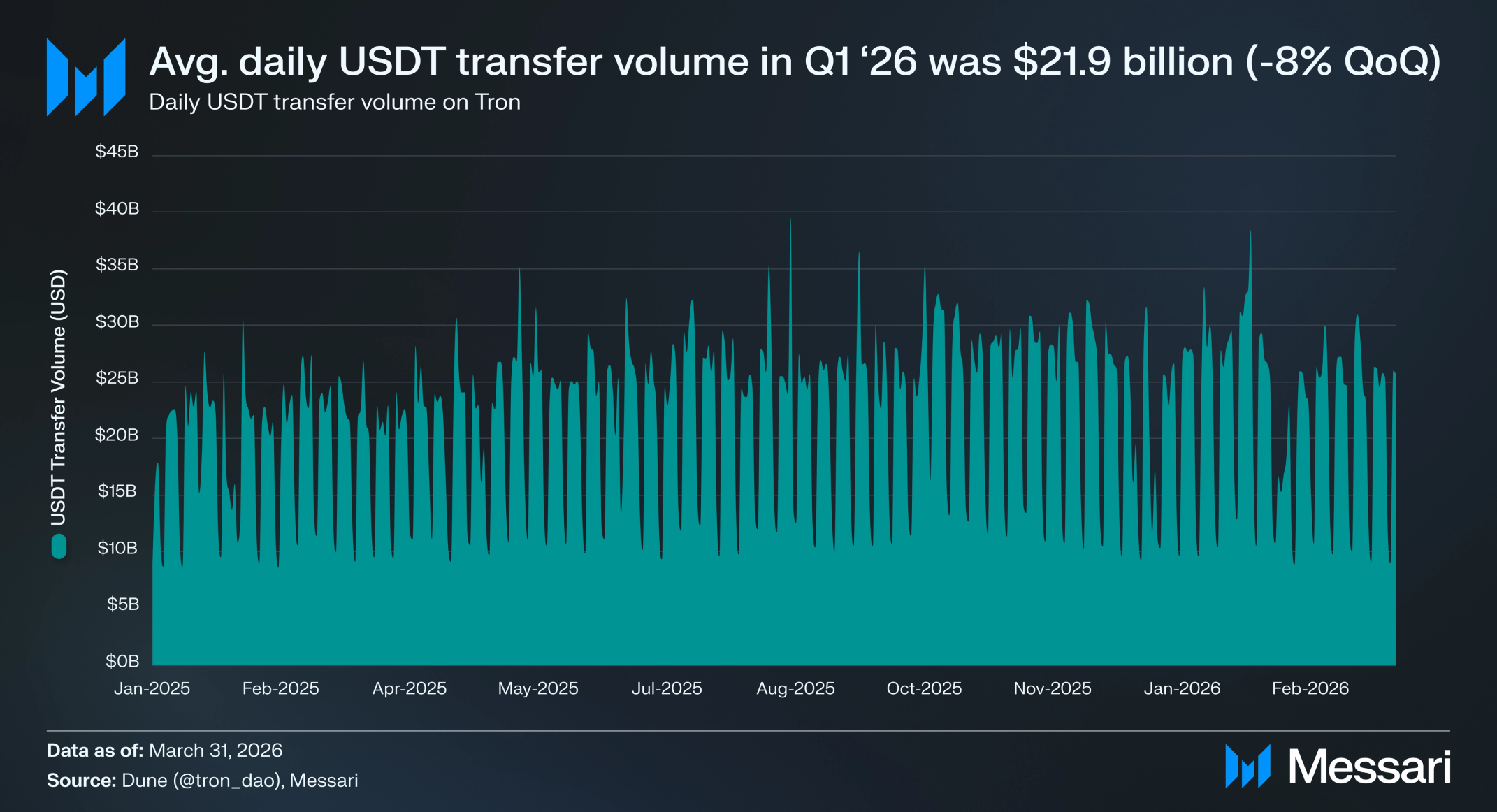
Average daily USDT transfer volume on TRON declined 7.7% QoQ from $23.8 billion to $21.9 billion in Q1 2026. The pullback followed three consecutive quarters of growth and coincided with a broader cooldown in onchain activity across major Layer-1 networks. TRON still processed over $2 trillion in cumulative USDT transfers during the quarter, underscoring the network’s role as the leading settlement rail for USDT alongside Ethereum.
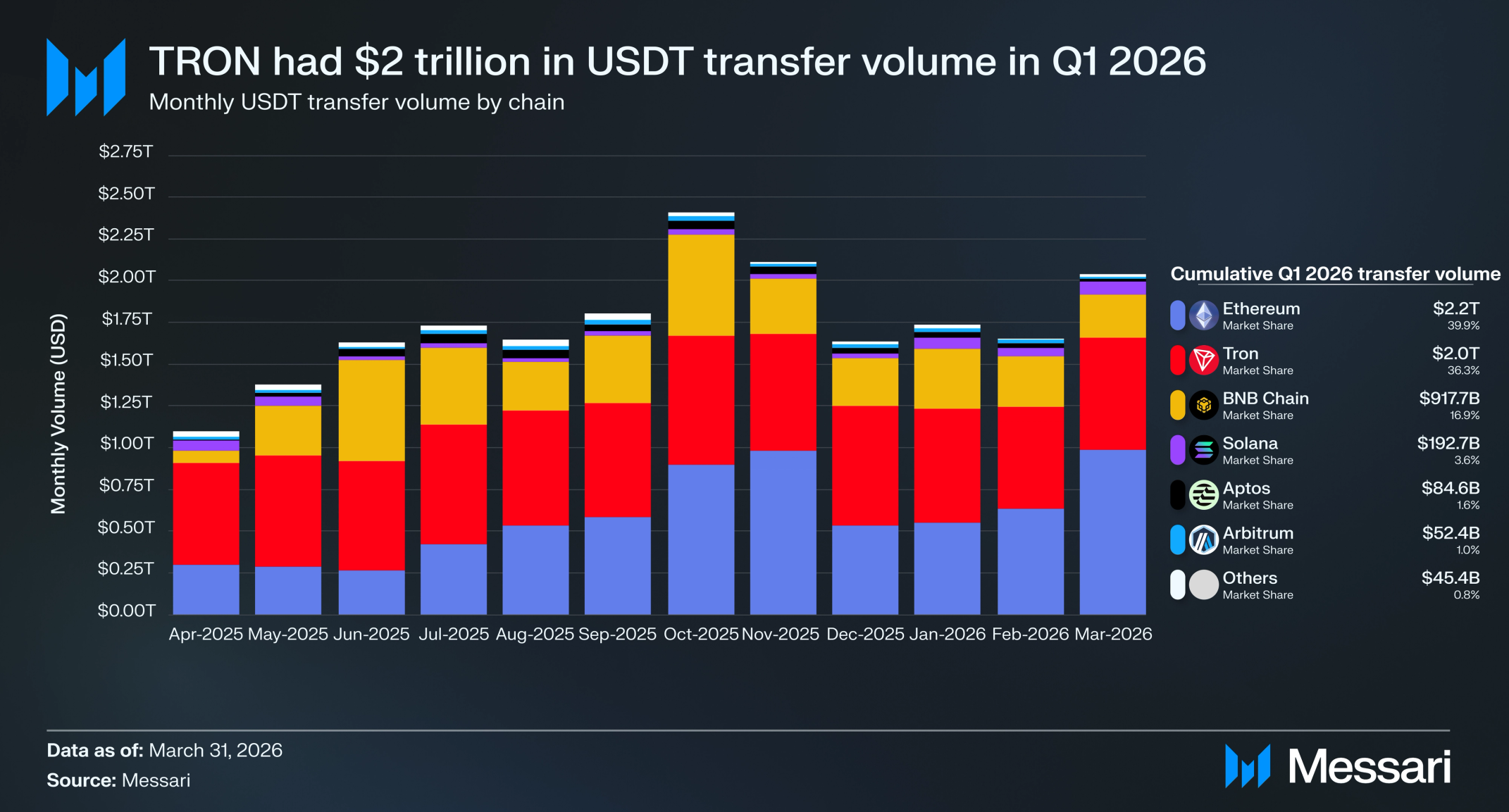
In Q1 2026, TRON processed $2.0 trillion in USDT transfer volume, trailing only Ethereum’s $2.2 trillion and accounting for 36.3% of all USDT transfers across tracked chains. Both networks declined 10.1% QoQ as onchain stablecoin activity cooled from elevated Q4 2025 levels.
Stablecoin velocity on TRON averaged 0.26 in Q1 2026, down from 0.29 in Q4 2025, as USDT supply growth (+4.5% QoQ) outpaced transfer volume. Velocity is calculated as daily transfer volume divided by circulating supply. Despite the QoQ dip, velocity has remained within a narrow band over the trailing four quarters. That consistency indicates TRON-based stablecoins function primarily as a utility for moving value between platforms and jurisdictions, with roughly a quarter of supply turning over daily regardless of broader market conditions.
Artificial Intelligence
TRON’s stablecoin infrastructure, sub-dollar transaction fees, and three-second block time already make it one of the most used networks for peer-to-peer value transfer. In Q1 2026, TRON DAO moved to extend that foundation into the emerging agentic economy, where autonomous AI agents execute financial transactions without human intervention. The quarter’s AI-related activity clustered around three areas: payment infrastructure for agents, governance over cross-industry standards, and capital deployment to seed the ecosystem.
On the infrastructure side, Wirexlaunched TRON-native payment rails on Jan. 6, 2026, designed to support agentic payments. The system processes stablecoin conversions and settlement entirely onchain, with connections to Visa’s merchant network across 130+ countries, allowing AI agents and autonomous applications to transact programmatically while maintaining self-custody. On March 2, 2026, AINFTlaunched the Bank of AI on TRON, a financial layer that enables AI agents to hold, manage, and deploy digital assets across DeFi protocols, including JustLend and SunSwap.
TRON also secured a role in shaping the standards that will govern how AI agents interact with blockchain networks. On March 9, 2026, TRON DAO joined the Agentic AI Foundation (AAIF) as a Gold Member and took a seat on its governing board alongside Circle and JPMorgan. The foundation focuses on building shared, cross-chain infrastructure for AI payment rails. On March 23, 2026, TRON became a founding contributor to Moonpay’s Open Wallet Standard, an open-source specification that gives AI agents a secure way to hold value and sign transactions across major blockchains without exposing private keys. The standard launched with backing from PayPal, OKX, Ripple, the Solana Foundation, and Ethereum Foundation, among others.
To fund the pipeline of projects building on these rails, TRON DAO expanded its AI Fund tenfold from $100 million to $1 billion on March 23, 2026. The fund targets early-stage companies building core infrastructure for the agentic economy, with a focus on onchain compute, data marketplaces, and autonomous agent tooling.
DeFi
TVL
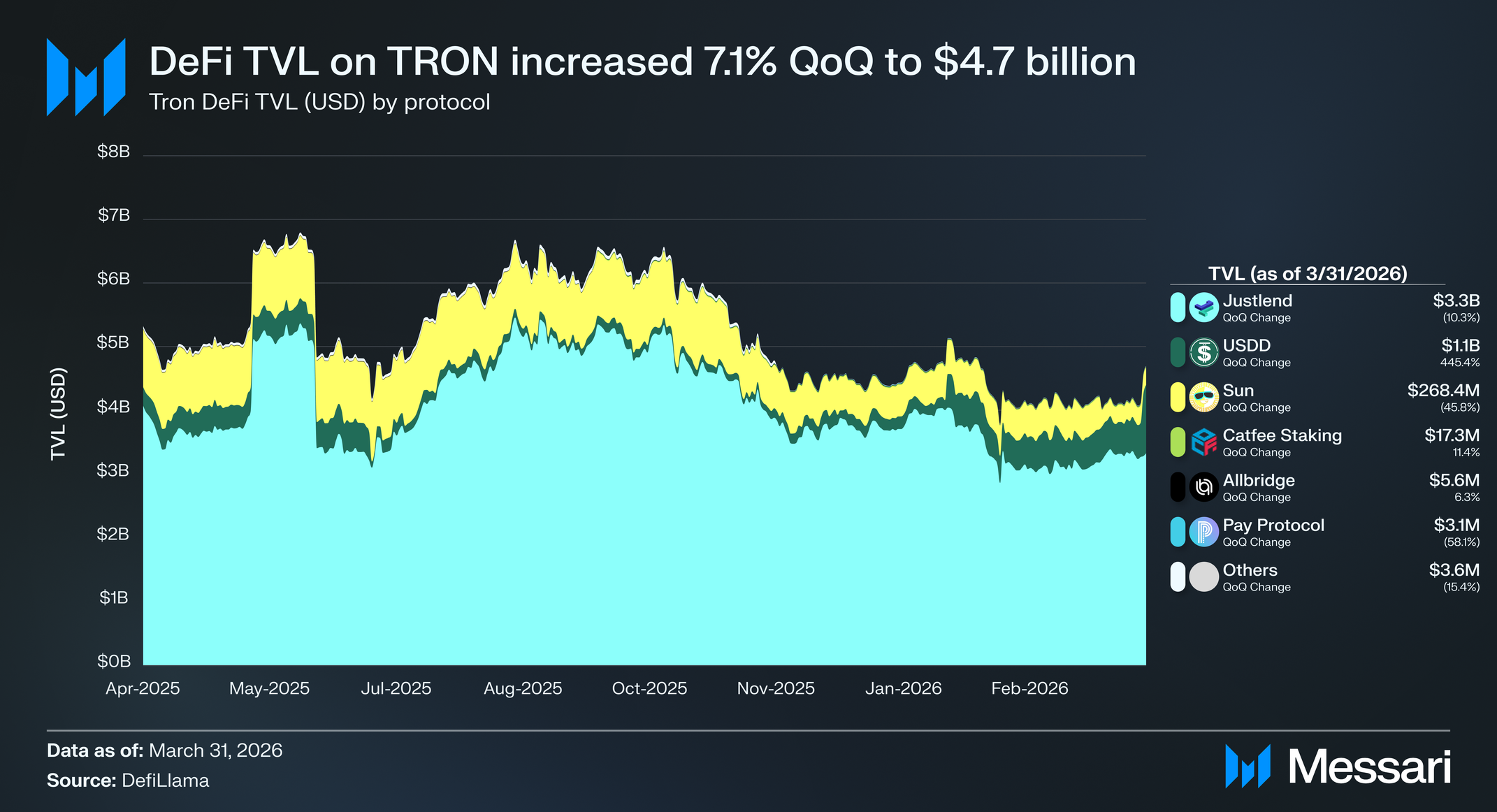
TRON’s DeFi TVL ended Q1 at $4.7 billion, up 7.1% QoQ from $4.4 billion. Growth at the headline level masked divergent trends among the network’s two largest protocols.
JustLend remained the largest DeFi protocol on TRON but declined 10.3% QoQ from $3.7 billion to $3.3 billion, dropping its market share from 83.7% to 70.9%. The contraction likely reflects capital rotating into high-yielding opportunities like USDD, whose collateralized debt protocol increased 445.4% QoQ to $1.1 billion.
DEX Volume
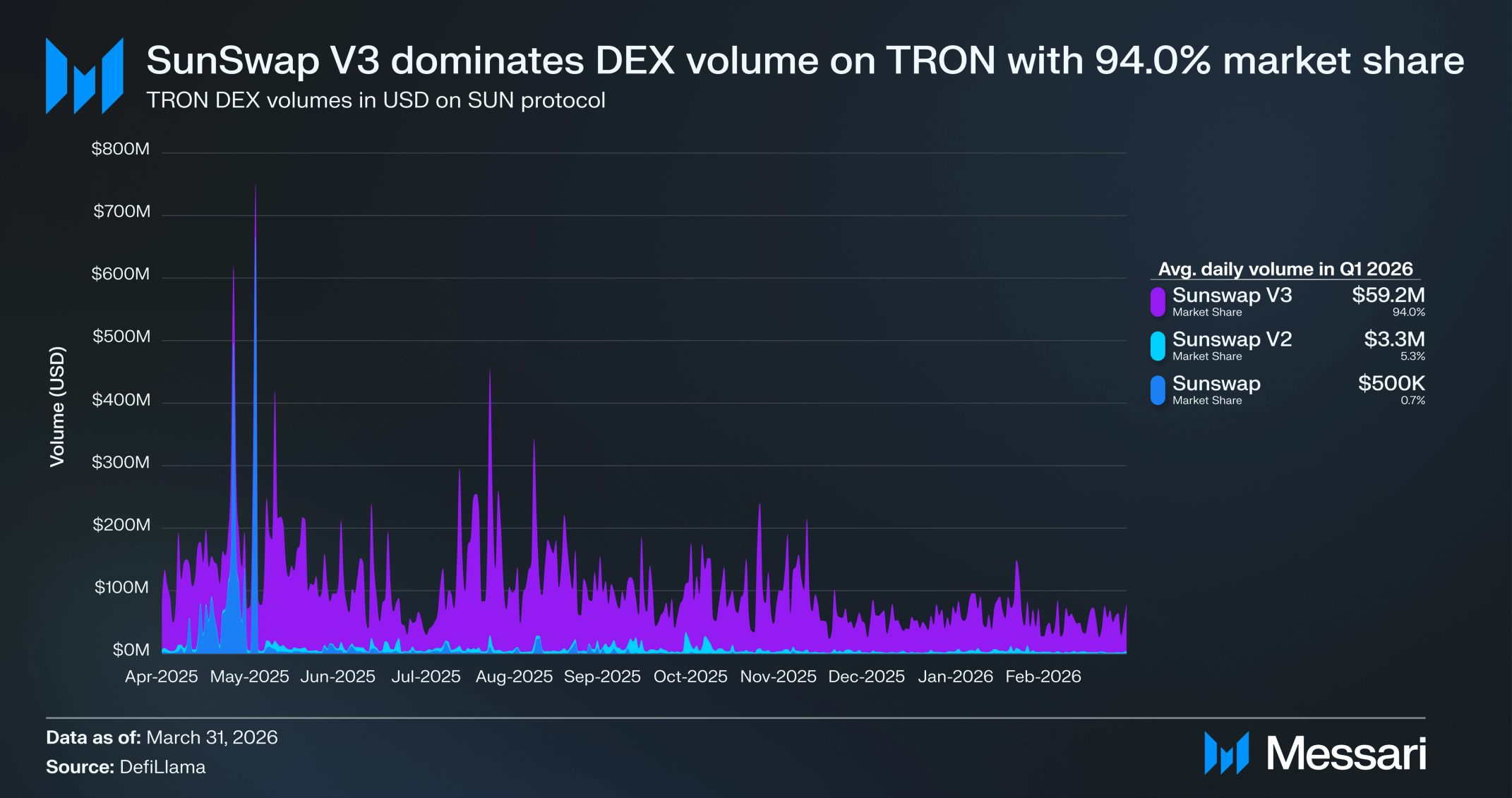
Average daily DEX volume on TRON declined 25.4% QoQ from $84.5 million to $63 million, marking the third consecutive quarter of contraction. The decline aligns with broader market cooldown in spot trading activity rather than any TRON-specific structural trend.
SunSwap V3 remained the dominant venue, accounting for 94% of DEX volume on TRON with an average daily volume of $59.2 million, down 25.1% QoQ from $79 million. SunSwap V2 averaged $3.3 million per day (5.3% share), and legacy SunSwap (V1) remained negligible at $500,000.
Ecosystem Growth
Institutional Adoption and Collaborations
Q1 2026 marked a turning point in TRON’s regulatory and institutional standing. On March 5, 2026, the SEC dismissed all claims against the TRON Foundation, with the case officially closed on March 10, 2026. The resolution removed a longstanding legal overhang and cleared the path for broader institutional engagement with the network.
That engagement materialized quickly. On March 13, 2026, TRON joined the Mastercard Crypto Partner Program, enabling instant conversions of TRX and USDT for everyday purchases across Mastercard’s global merchant network. The integration links TRON’s settlement layer directly to point-of-sale infrastructure, extending the network’s stablecoin utility beyond peer-to-peer transfers and into retail payments.
On March 26, 2026, Anchorage Digital, a federally chartered crypto bank, announced support for the TRON network. The phased integration begins with institutional custody for native TRX on Anchorage’s regulated platform and its Porto wallet, with future phases adding TRC-20 asset support and native TRX staking. Anchorage provides the first U.S.-regulated and based custody option for institutional TRX allocators.
Protocol Upgrades and Developer Activity
Notable protocol upgrades and developer collaborations in Q1 2026 include:
GreatVoyage-v4.8.1 (Democritus) (Feb. 4, 2026): Mandatory upgrade with a deadline of March 9, 2026. Key changes included ARM64 and JDK17 compatibility, modified SELFDESTRUCT behavior to align with Ethereum's EIP-6780, and multiple network performance optimizations. The EIP-6780 alignment restricts SELFDESTRUCT so it only destroys a contract in the same transaction it was created, preventing a class of bugs where contracts could be unexpectedly removed and keeping TRON’s TVM in step with Ethereum’s evolving smart contract standards.
Reown SDK integration (March 17, 2026): The multichain developer toolkit added TRON support, reducing friction for developers building applications that span TRON and EVM-compatible chains
TRON dev meeting #57 (March 23, 2026): A meeting that announced the v4.8.1 upgrade, introduced a vote for TIP-6780 to come soon, the release of TronWeb v6.2.2, and the next java tron version (v4.8.2) is expected in Q2 2026.
GreatVoyage-v4.8.2 (Pyrrho) (March 23, 2026): Planned for Q2 2026, the next major upgrade targets five new TIPs including efficient signature verification and zero-knowledge proof support through BLS12-381 cryptographic precompiles (TIP-2537), historical block hash retrieval from state to let smart contracts access older block hashes beyond the current 256-block window (TIP-2935), tighter gas pricing bounds on ModExp, a computationally expensive cryptographic operation (TIP-7823, TIP-7883), and a Count Leading Zeros (CLZ) opcode that speeds up binary arithmetic used in optimized math libraries (TIP-7939). The release also includes nine API enhancements covering non-blocking rate limiting, parallel event matching, and HTTP/gRPC protocol deprecation, along with infrastructure improvements such as replacing fastjson with the Jackson library and 64-bit integer overflow prevention.
Wallet and Developer Integrations
TRON expanded its presence across major wallet platforms and developer tooling during Q1 2026, with several integrations broadening access for both end users and builders.
Jan. 8, 2026: Zerion, a multichain DeFi wallet, integrated the TRON network to give its 300,000+ monthly active users direct access to TRC-20 transfers.
Jan. 15, 2026: Metamask, the leading self-custody wallet, integrated the TRON network to expose its EVM-native user base to TRON’s low-cost transfer rails.
Jan. 20, 2026: Blockaid, a Web3 security platform, integrated TRON for onchain and offchain threat detection, extending its real-time transaction scanning and malicious activity blocking to TRON users and applications.
Jan. 21, 2026: WalletConnect, an open-source wallet connectivity protocol, added TRON network support, enabling any of its 85,000+ integrated applications to accept connections from TRON-based wallets.
Feb. 3, 2026: Kolo, a crypto Visa card platform, integrated the TRON network to enable near-instant TRC-20 USDT settlement to its payment cards with Bitcoin cashback rewards.
Feb. 4, 2026: CoolWallet, a hardware wallet provider, integrated energy rental services on TRON, allowing users to rent Energy on demand to reduce TRC-20 transfer fees without staking TRX.
March 25, 2026: Utila, an institutional MPC wallet platform, launched native TRON resource management capabilities, giving fintechs and stablecoin issuers a regulated interface for TRX and TRC-20 treasury operations.
March 31, 2026: ZeroHash, a B2B embedded crypto infrastructure provider, integrated TRON to allow its enterprise clients to support TRC-20 stablecoin payments and settlement natively.
Exchange and Market Access
New exchange listings and market integrations during the quarter expanded TRX’s availability across trading platforms and prediction markets.
Jan. 14, 2026: TRX options went live on Deribit, the dominant crypto options exchange, giving traders a venue to hedge TRX exposure through options contracts for the first time on a major derivatives platform.
Feb. 18, 2026: Leading prediction market, Polymarket, added support for TRON deposits, allowing users to fund positions using TRC-20 USDT.
Feb. 19, 2026: TRX listed on Bitstamp, a long-running regulated exchange with a strong European institutional client base.
Feb. 26, 2026: TRX listed on Gemini, a U.S. regulated exchange and custodian.
Feb. 27, 2026: TRX listed on BitMart US, the U.S.-regulated arm of the global BitMart exchange, rounding out three new exchange listings within a ten-day span.
Crosschain Expansion
TRON expanded its crosschain footprint through new trading pairs and protocol integrations on other networks.
March 19, 2026: TRX/USDC trading pair launches on Aerodrome, the leading DEX on Base, marking TRX’s first native liquidity presence on Coinbase’s Layer-2 network.
March 24, 2026: A crosschain DEX and lending protocol on NEAR named Rhea, integrated the TRON network to allow TRON users to access crosschain swaps and lending without manual bridging.
Financial Analysis
Market Cap vs. Fees
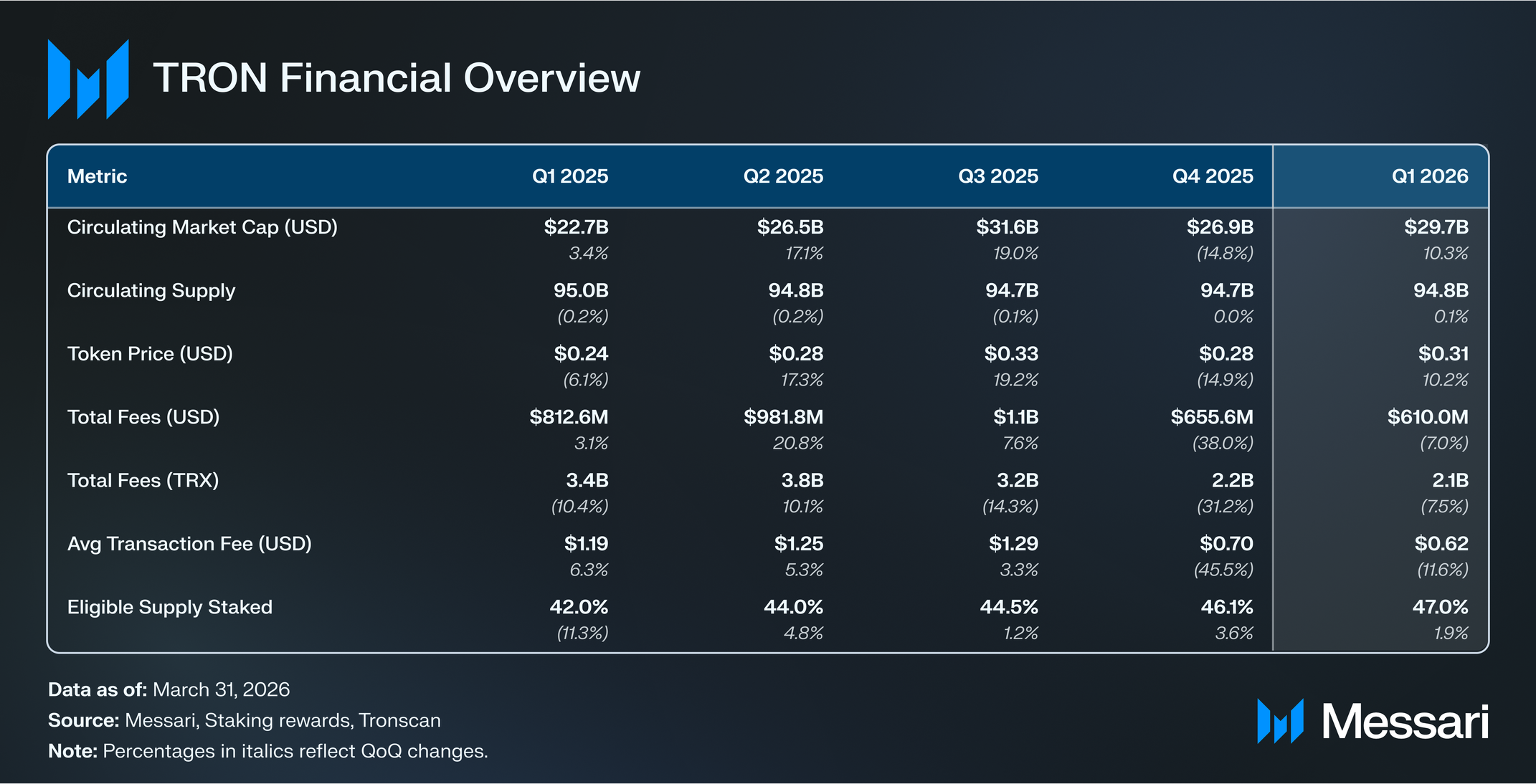
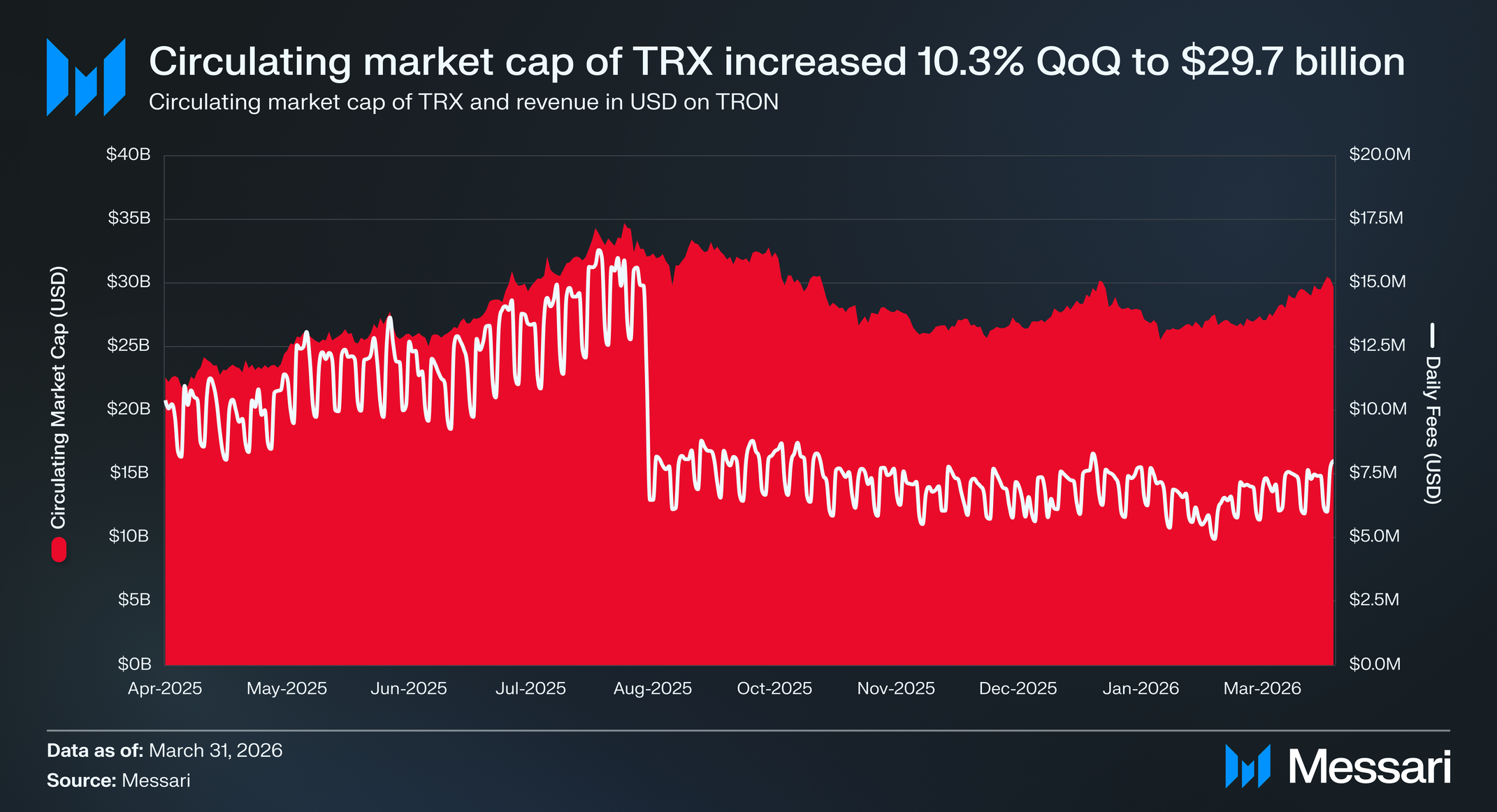
TRX’s circulating market cap rose 10.3% QoQ from $26.9 billion to $29.7 billion, while the token price climbed 10.2% QoQ from $0.28 to $0.31. Institutional catalysts, including the SEC dismissal and Anchorage Digital custody support, reinforced market confidence. Total fees declined 7.0% QoQ from $655.6 million to $610 million, as the 11.6% QoQ decline in the average transaction cost to $0.62 outpaced growth in transaction volume.
The fee decline traces back to a governance proposal in August 2025 that slashed transaction fees by 60%. The impact was immediate, with quarterly fees dropping 38% QoQ from $1.1 billion in Q3 2025 to $655.6 million in Q4 2025. Q1 2026’s 7.0% QoQ decrease to $610 million signals the rate of erosion is decelerating, as a 7.0% QoQ increase in transaction volume to 10.9 million average daily transactions partially offset lower per-transaction fees, but fees have not yet stabilized.
Supply Dynamics
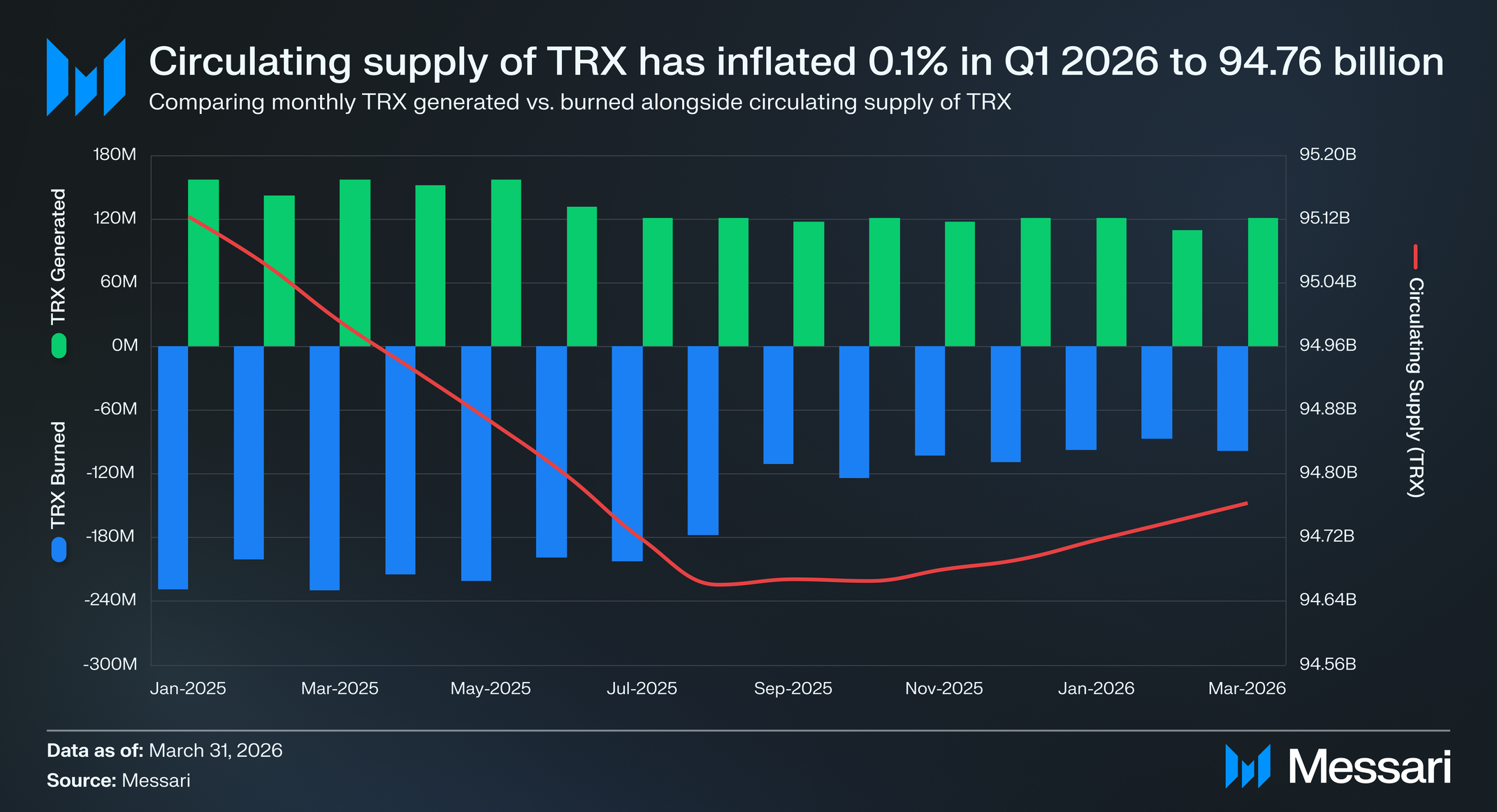
The circulating supply of TRX is primarily affected by two parameters: (i) tokens minted to reward stakers and block producers, and (ii) tokens burned due to network transaction fees. Approximately 3.9 million TRX are minted daily as block and vote rewards distributed to Super Representatives and stakers. As such, the circulating token supply will decrease over time if more than 3.9 million TRX are burned daily, on average.
The circulating supply of TRX increased 0.07% QoQ from 94.69 billion to 94.76 billion, a net addition of 71 million TRX. This marks the second consecutive quarter of net inflation after multiple deflationary quarters. The average daily burn rate fell 14.3% QoQ to 3.12 million TRX, from 3.64 million in Q4 2025, while daily generation held steady at 3.91 million TRX, resulting in a net daily supply increase of 790,000 TRX. The shift is a direct consequence of the August 2025 governance proposal that cut transaction fees by approximately 60%. Lower fees mean less TRX burned per transaction, even as transaction counts rise.
TRON incentivizes participation in its staking mechanism through a combination of the following:
Block Reward: Super Representatives earn 8 TRX for each block produced, subject to change through onchain governance. After producing a block, the Super Representative’s chosen commission ratio is kept, while the remaining TRX is distributed amongst the representative’s associated voters.
Vote Reward: The 28th to 127th most voted-for Super Representative become Super Representative Partners for the next epoch. Although partners are not involved in block production, both they and the TRX stakers who voted for them receive voting rewards. For every block produced, 128 TRX are cumulatively rewarded to Super Representatives and Super Representative Partners in proportion to their respective TRX stakers’ votes.
Network Analysis
Usage
Average daily transactions on TRON rose 7% QoQ from 10.2 million to 10.9 million, totaling 977 million total transactions in Q1 2026 and setting a new quarterly record. Average daily active addresses climbed 13.7% QoQ from 2.8 million to 3.2 million, also a quarterly record. Wallet integrations from MetaMask and Zerion, along with new exchange listings on Bitstamp, Gemini, and BitMart US, broadened access and likely contributed to the acceleration in usage on TRON.
Average daily new addresses on TRON fell 20% QoQ from 221,820 to 177,480. The decline in new address creation coincided with record-high overall activity, meaning Q1’s growth was driven overwhelmingly by returning users. Returning addresses averaged 3 million per day, up 17.4% QoQ from 2.6 million, as existing USDT holders continued transactions at higher rates and lower fees.
Security and Decentralization
TRON uses a delegated Proof-of-Stake (DPoS) consensus mechanism and the Practical Byzantine Fault Tolerance (PBFT) consensus algorithm to secure the network. A DPoS election occurs every six hours, in which 27 Super Representatives (SR) take turns producing blocks. Those wishing to run a TRON node can pay 9,999 TRX to become an SR candidate.
The active SR set remained at 27 in Q1, elected from a pool of 436 governance participants, including 100 SR Partners and 309 SR Candidates. The 44.6 billion total votes cast were distributed unevenly across the set. The top five SRs, led by Poloniex at 4.0 billion votes, controlled 34.6% of all votes, and the top 10 controlled 57.2%. While no single entity exceeded 10%, TRON’s fixed set of 27 SRs creates a narrow validator base. Under the network’s solidified block mechanism, a block becomes irreversible only after it is acknowledged by at least 19 of the 27 SRs (approximately 70%). If ten or more SRs become faulty or compromised, TRON’s DPoS mechanism provides a built-in safeguard where TRX voters can remove underperforming SRs and elect replacements, restoring block finality without requiring a hard fork or external intervention. The SR set has increasingly shifted toward institutional and professional validators, with Google Cloud, Binance Staking, HTX, Kraken, OKX Earn, OKCoin Japan, Kiln, P2P.org, and Nansen collectively holding 22.8% of total votes, improving node reliability but narrowing the operator profile.
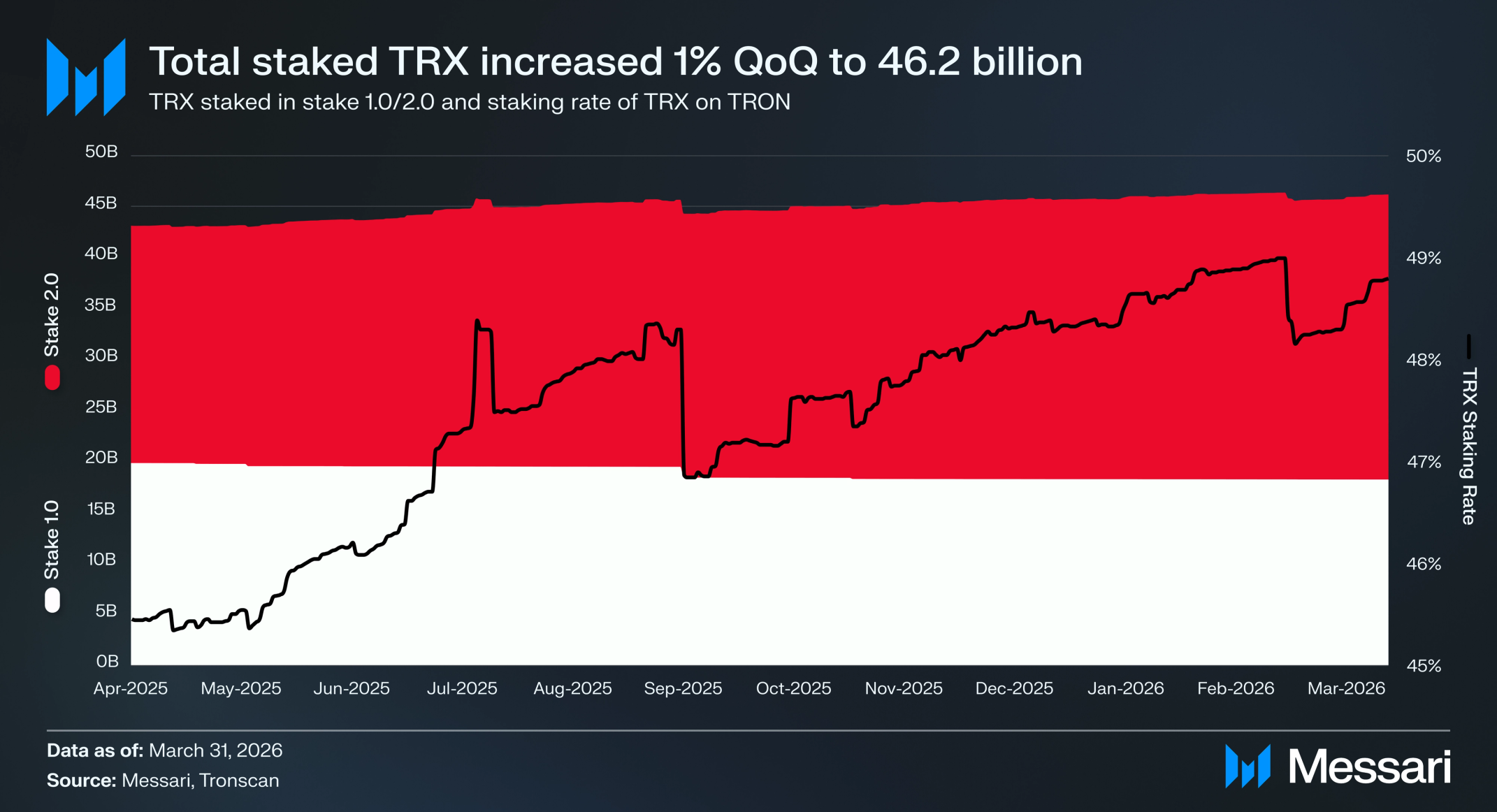
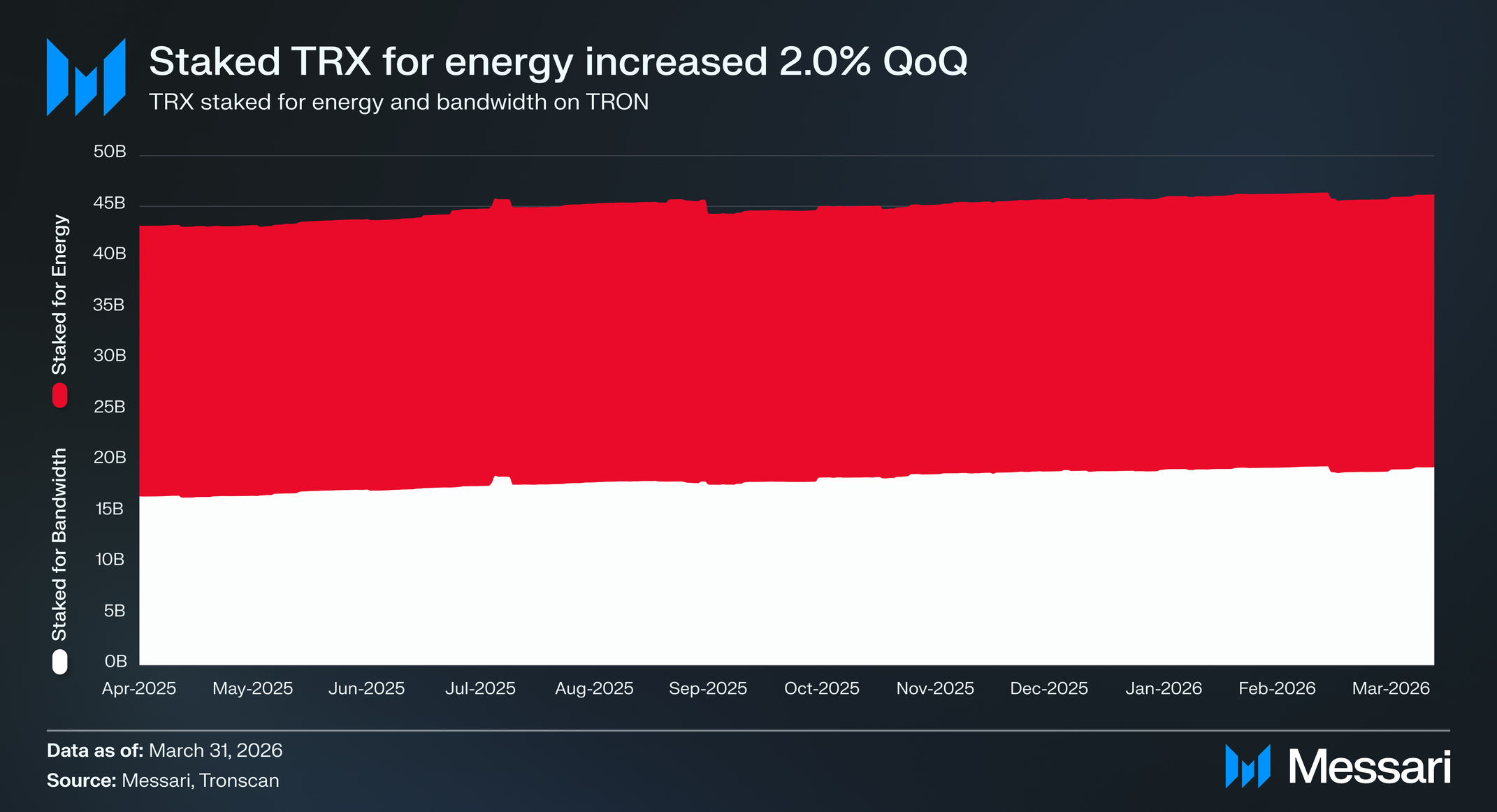
Total TRX staked rose 1% QoQ from 45.7 billion to 46.2 billion, pushing the staking rate to 48.7%, up from 48.3% in Q4 2025. This marks the fifth consecutive quarter of staking rate increases.
The migration from Stake 1.0 to Stake 2.0 continued at a steady pace. Stake 1.0 declined 0.2% QoQ from 18.24 billion to 18.21 billion TRX, while Stake 2.0 grew 1.8% QoQ from 27.5 billion to 28 billion TRX, increasing its share of total staked TRX from 60.1% to 60.6%. Stake 2.0 allows stakers to flexibly allocate their staked TRX between Bandwidth and Energy resources rather than locking into a single resource type, which explains the continued migration from the legacy system.
Energy staking grew 2% QoQ from 19 billion to 19.4 billion TRX, while Bandwidth staking was roughly flat, up 0.3% QoQ from 26.7 billion to 26.8 billion TRX. The faster growth in Energy staking reflects rising smart contract execution demand driven by stablecoin transfers and DeFi activity.
Closing Summary
TRON’s Q1 2026 was defined by stablecoin entrenchment and institutional legitimacy. USDT supply on the network hit an all-time high at $85.4 billion. Daily transactions and active addresses both set quarterly records, and the SEC’s dismissal of all claims against the TRON Foundation removed the network’s longest-standing legal overhang. The institutional pipeline that followed, from Mastercard’s Crypto Partner Program to Anchorage Digital custody to three new U.S. exchange listings in ten days, reflected a network that cleared a regulatory threshold and moved quickly to capitalize on it.
The forward-looking catalysts center on two threads. GreatVoyage-v.4.8.2 (Pyrrho), expected in Q2 2026, brings BLS12-381 precompiles and other EVM-aligned upgrades that lay the groundwork for zero-knowledge proof compatibility on the TVM. The other is AI infrastructure buildout anchored by a $1 billion AI Fund, a governing board seat on the Agentic AI Foundation, and co-authorship of the Open Wallet Standard. This buildout is a bet that autonomous agents will need the same sub-dollar fees and deep stablecoin liquidity that already drive TRON’s human user base. Whether the bet converts into onchain activity depends on how quickly the agentic economy matures, but the infrastructure is now in place.
To stay up-to-date with all things TRON, visit the TRON Portal.
TRON DAO Commentary
Team Commentary Disclaimer
The Project Team Commentary section of this report was written by TRON DAO and reflects the views, opinions, and forward-looking statements of TRON DAO only. This section is included to provide additional context on the project's strategy, priorities, and outlook and does not necessarily reflect the views or opinions of Messari, Inc.
Q1 2026 was another strong quarter for TRON, as the network strengthened its dominance in stablecoin settlement while continuing to expand its broader ecosystem, including infrastructure for agentic AI payments.
TRON's stablecoin market cap grew 4.9% quarter-on-quarter to $85.8 billion at the close of Q1, with USDT commanding a 98.6% share of that supply. The network processed $2.0 trillion in cumulative USDT transfers over the quarter, a number that speaks not just to TRON's scale, but to the trust that individuals and institutions continue to place in its rails for moving value at speed and low cost. That foundation is what makes TRON relevant for what comes next.
In Q1, TRON DAO’s AI Fund was expanded tenfold, growing from $100 million to $1 billion. The expansion builds on the fund’s thesis, first outlined in 2023, that AI and blockchain would converge, creating demand for programmable, permissionless financial infrastructure. With growing validation of its original thesis, what began as an early conviction has now scaled into a strategic commitment: AI agents will become active participants in the global economy, requiring new financial infrastructures that combine identity, payment, and asset ownership fully onchain.
The TRON network’s high throughput, deep liquidity, and low transaction costs provide an ideal operational foundation for emerging machine-to-machine financial interactions at scale. This is further reflected in TRON’s participation in the Agentic AI Foundation (AAIF), an open foundation driving the transparent and collaborative evolution of agentic AI. Under the Linux Foundation, the AAIF is designed to provide neutral stewardship for open, interoperable infrastructure as agentic AI systems move from experimentation into real-world production.
At the same time, institutional engagement around the network continued to build. Anchorage Digital’s custody support for TRX, TRON’s integration with Securitize to expand access to tokenized real-world assets, and its entry into Mastercard’s Crypto Partner Program each point to growing alignment between TRON’s infrastructure and traditional financial systems.
Looking ahead, TRON DAO will continue to support the growth of the TRON network as a leading settlement layer for stablecoins while advancing the infrastructure required for the next generation of autonomous, agent-driven economic activity. Activity in Q1 indicates that this transition is already underway, supported by continued growth in network usage, capital deployment, and ecosystem development.
This report was commissioned by Tron Network Limited. All content was produced independently by the author(s) and does not necessarily reflect the opinions of Messari, Inc. or the organization that requested the report. The commissioning organization may have input on the content of the report, but Messari maintains editorial control over the final report to retain data accuracy and objectivity. Author(s) may hold cryptocurrencies named in this report. This report is meant for informational purposes only. It is not meant to serve as investment advice. You should conduct your own research and consult an independent financial, tax, or legal advisor before making any investment decisions. Past performance of any asset is not indicative of future results. Please see our Terms of Service for more information.
No part of this report may be (a) copied, photocopied, duplicated in any form by any means or (b) redistributed without the prior written consent of Messari®.
Eric is a research analyst at Messari and an ambassador for Maple Finance. He previously was a Product Manager for FINTRX and is passionate about DeFi and AI.
Eric is a research analyst at Messari and an ambassador for Maple Finance. He previously was a Product Manager for FINTRX and is passionate about DeFi and AI.