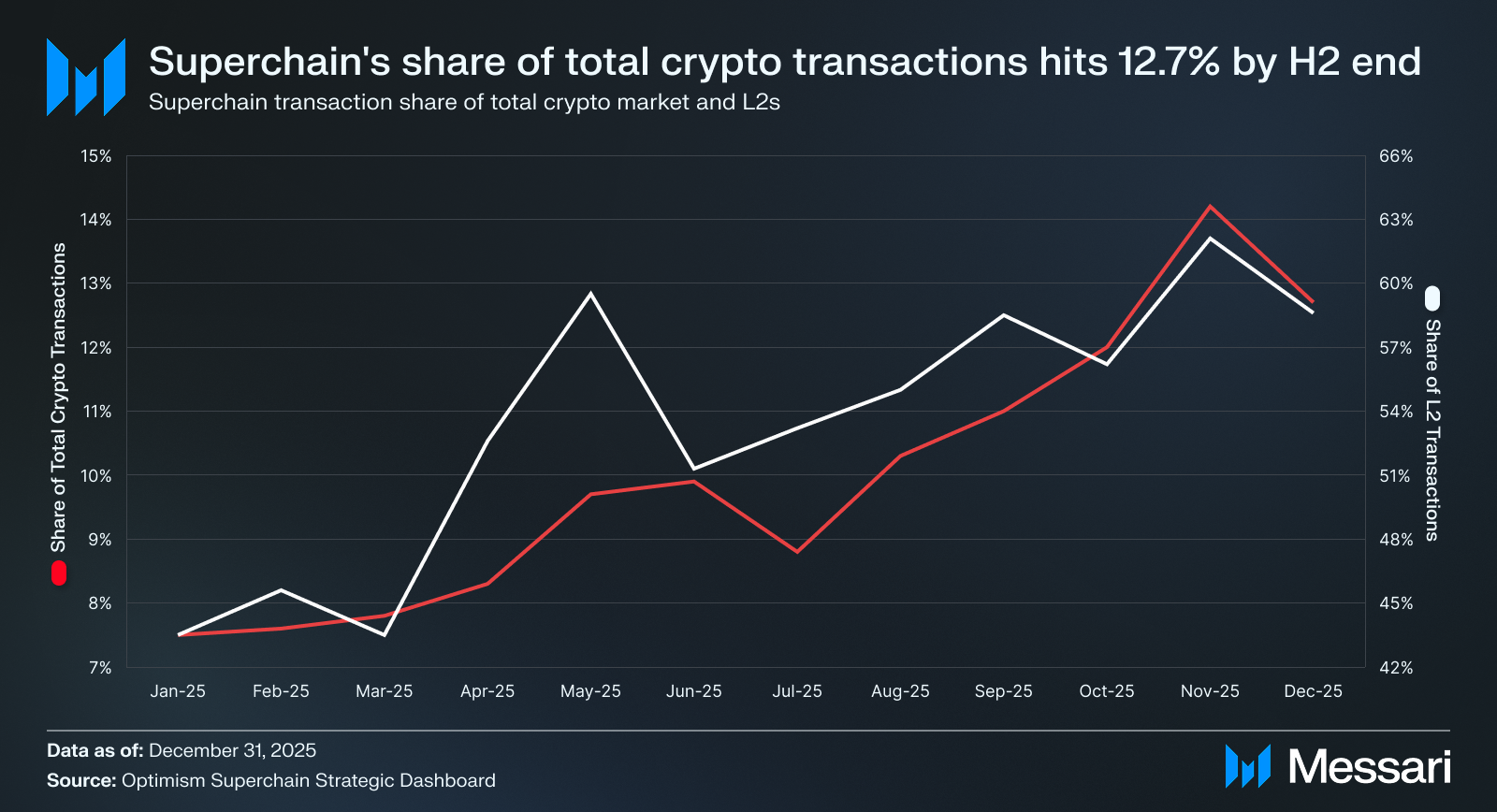
The Superchain captured 12.7% of total crypto transactions by H2 end and has maintained more than half of the total L2 market share by transactions since April 2025.
Aggregate Superchain GDP reached $415.4 million, led by Uniswap ($159.4 million), reflecting an App Revenue Capture Ratio of 10.1x relative to sequencer revenue.
Active loans across the Superchain rose 95.8% YoY to $1.95 billion, driven primarily by Morpho, whose outstanding loans surged to $1.19 billion following Coinbase integration.
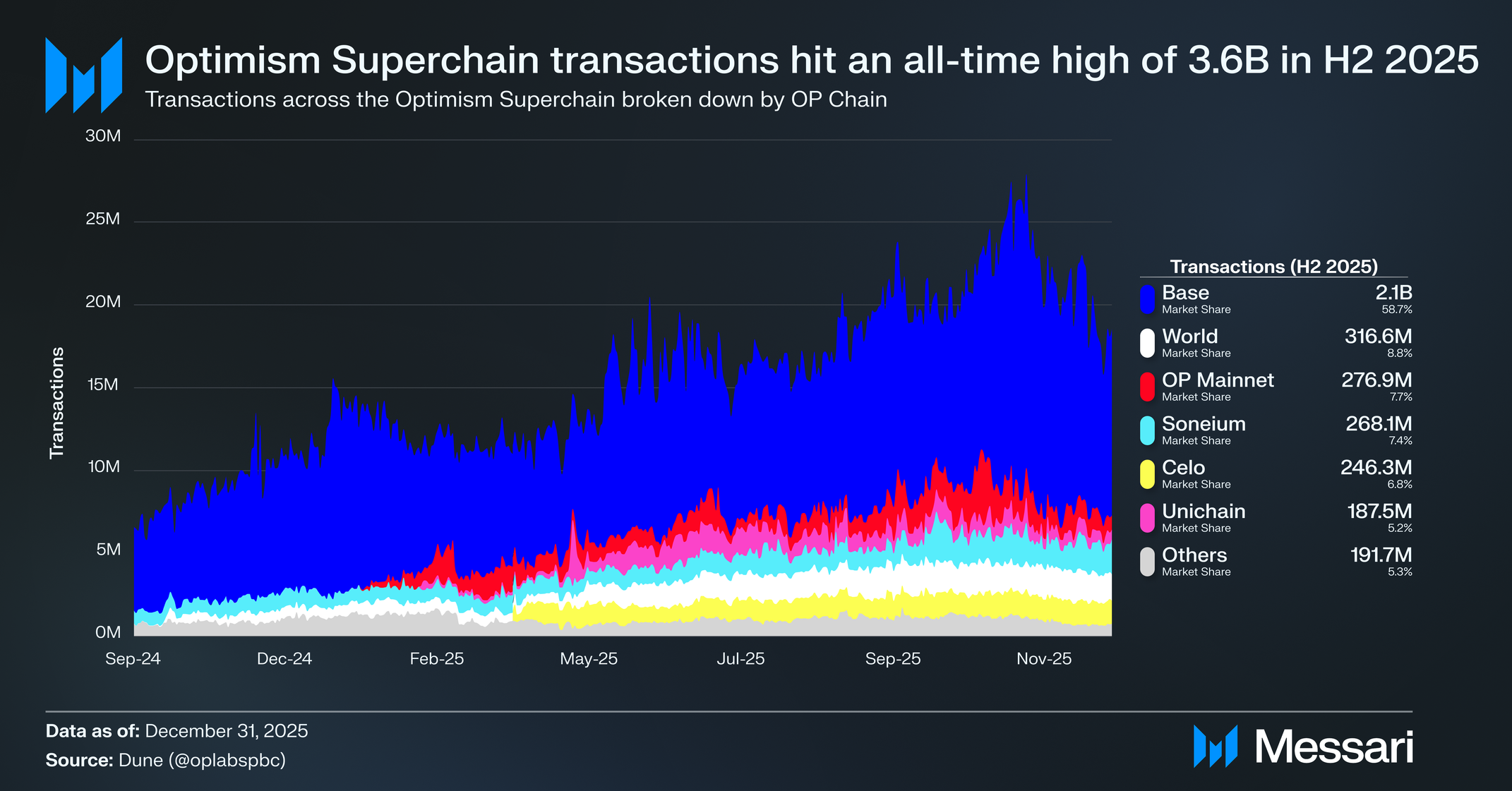
Superchain transactions reached a new all-time high of 3.60 billion in H2 2025, up 44% since the end of June 2025, driven primarily by activity on Base and World.
Institutional adoption of the OP Stack accelerated, with Upbit, OKX, and EY-backed Nightfall deploying exchange-backed L2s and enterprise infrastructure.
Optimism’s long-term strategy is rooted in its vision for a “Superchain.” The OP Stack is a modular, open-source technology stack that enables the creation of L2 and L3 networks (OP Chains). The goal of the Superchain is to bring seamless interoperability between OP Chains that share security, bridging, governance, and network upgrades. Today, the Superchain is a network of 34 OP Chains that make up over half of all L2 activity and over 10% of all crypto activity.
Increasingly, Optimism is positioning the OP Stack as institutional-grade infrastructure, enabling exchanges, enterprises, and application teams to deploy purpose-built chains with greater control over execution, economics, and compliance while remaining interoperable within a shared Superchain environment.
For real-time metrics and additional superchain coverage, refer to the Optimism Portal.
By H2 2025, the Optimism Superchain had progressed from a scaling initiative into a production-grade, multichain execution environment supporting material economic activity and institutional participation. With 34 OP chains live on mainnet, the Superchain increasingly resembles a standardized blockchain runtime layer, where organizations can onboard incrementally, operate within defined performance and security constraints, and expand into more customized deployments as operational requirements mature.
Onchain Economics
Assets and Chain GDP
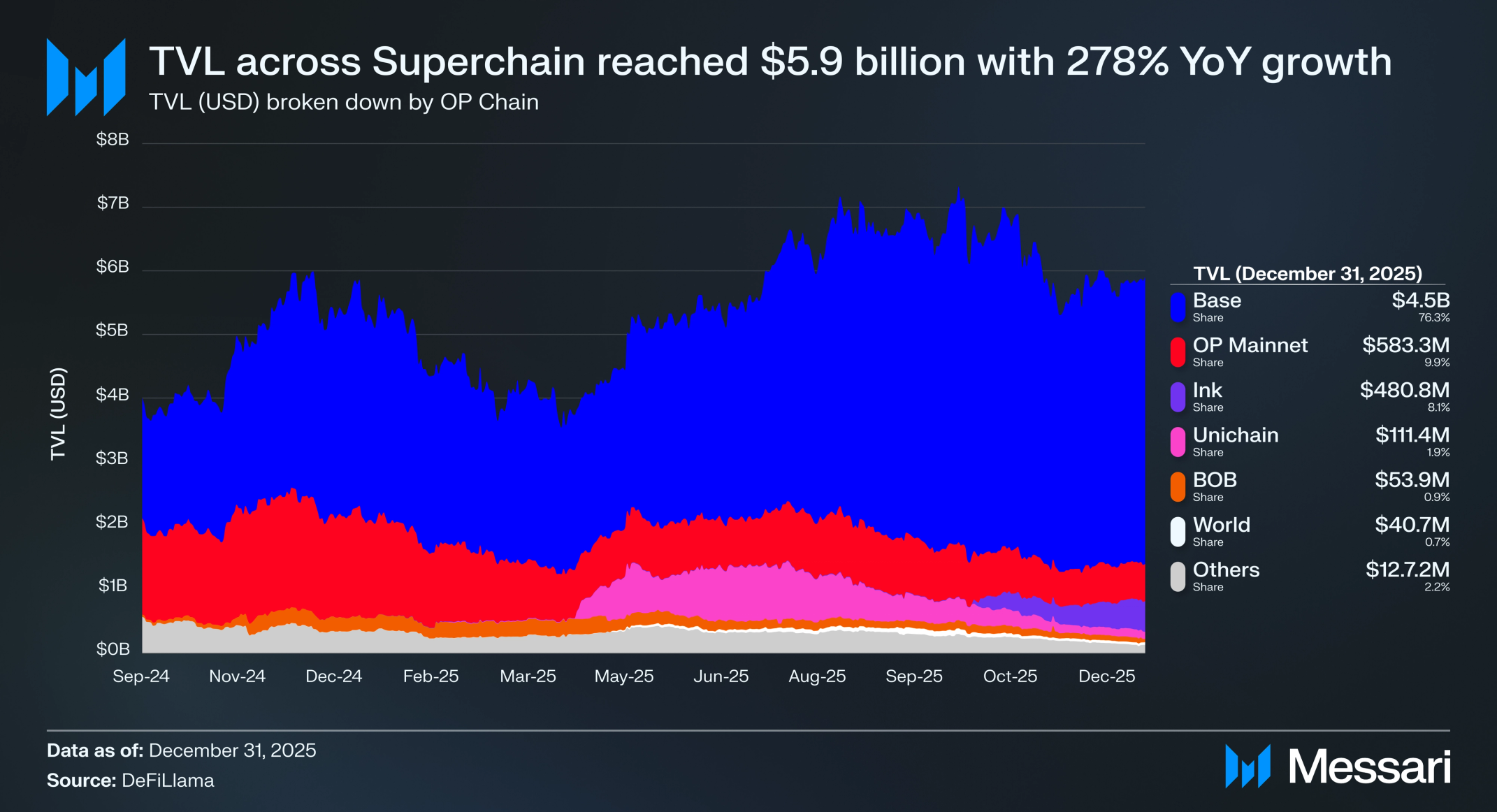
By the end of 2025, TVL across the Superchain ecosystem reached $5.9 billion, representing 278% year-over-year (YoY) growth. Base and OP Mainnet drove the majority of this expansion, growing 1,845.5% to $4.5 billion and 153.7% to $583.3 million, respectively. Ink entered the top three OP Chains by TVL for the first time in H2, reaching $408.8 million by year-end. Ink’s rapid TVL growth was largely driven by the launch of Tydro, a white-label Aave V3 lending protocol introduced in October 2025.
The SuperStacks incentive program, which ended on June 30, 2025, contributed approximately $205 million in TVL during its campaign period. Despite the program’s conclusion, aggregate TVL across the Superchain ecosystem continued to rise, increasing 31.5% from $5.17 billion at the end of Q2 2025 to $6.80 billion by the end of 2025.
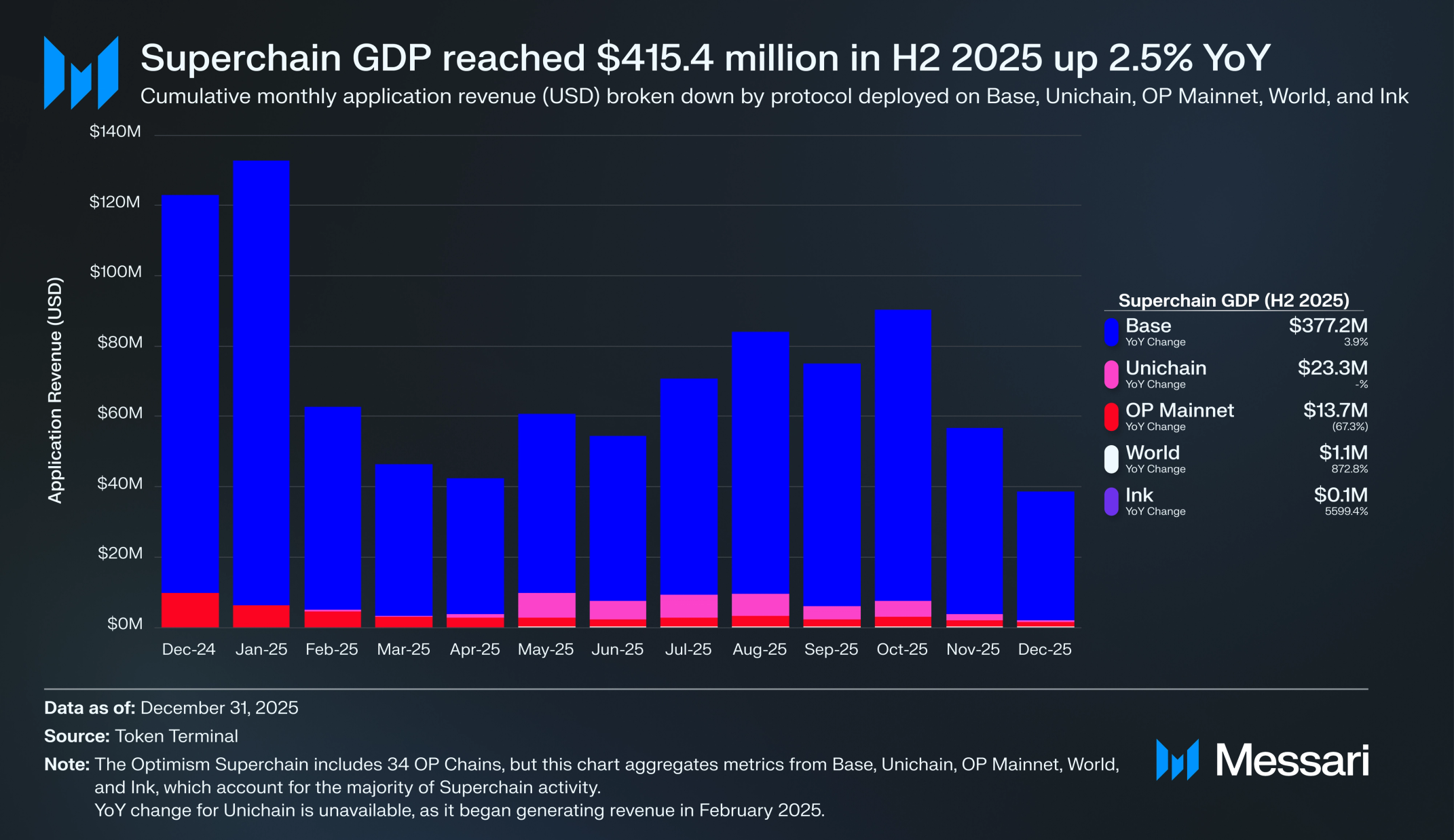
Chain GDP, which refers to the total application revenue (USD) generated on a network, totaled $415.4 million across Base, Unichain, OP Mainnet, World, and Ink in H2 2025, representing 2.5% YoY growth. Base posted steady but modest 3.9% YoY growth, while newer Superchain deployments accounted for the majority of incremental upside. Unichain, launched by Uniswap Labs in February 2025, scaled rapidly to $23.3 million in H2 application revenue, making it the second-largest contributor and demonstrating the monetization advantage of vertically integrated distribution.
Smaller chains drove outsized percentage growth from low bases. World generated $1.1 million in H2 revenue, representing 872.8% YoY growth, with monthly revenue rising from roughly $40,000–$45,000 in early 2025 to peaks above $240,000 in the second half before moderating into year-end. Ink, which began generating revenue only in December 2024, remained small in absolute terms but showed clear late-year acceleration, with monthly revenue inflecting from sub-$4,000 levels through September to $83,506 in December.
Tracking Chain GDP alongside TVL provides a more sophisticated lens into network maturity. While TVL measures the total value of assets being deposited in DeFi protocols, Chain GDP tracks the revenue generated by those assets, distinguishing between idle capital and active economic velocity. This shift indicates that the top Superchains are evolving into functional economies where capital is no longer parked but actively used to drive sustainable application growth.
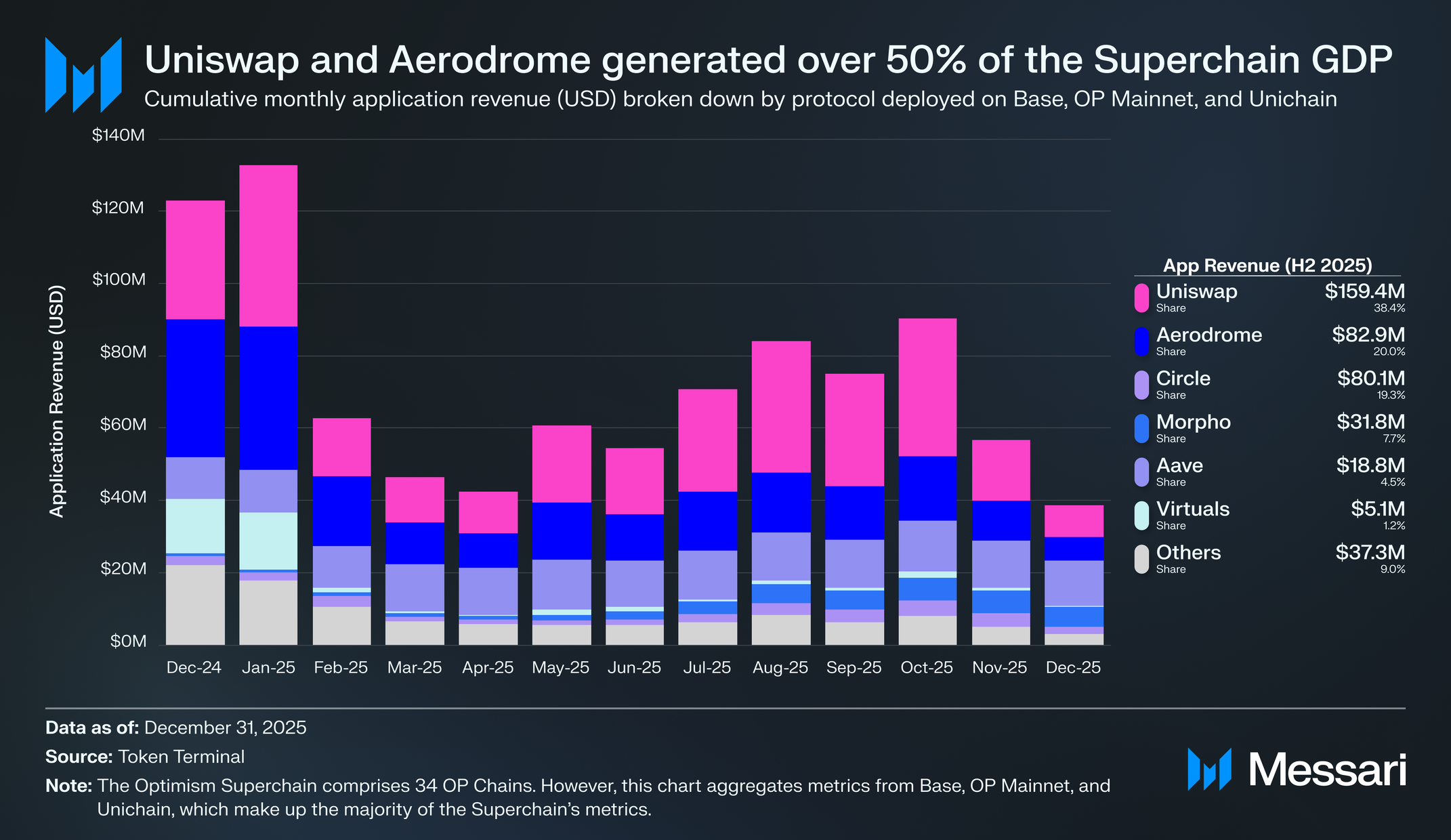
Uniswap, Aerodrome, and Circle continue to account for the majority of the Optimism Superchain’s GDP in H2 2025, collectively making up 87.7%. Uniswap led with $159.4 million (38.4% share), followed by Aerodrome with $82.9 million (20.0% share) and Circle with $80.1 million (19.3% share) in application revenue.
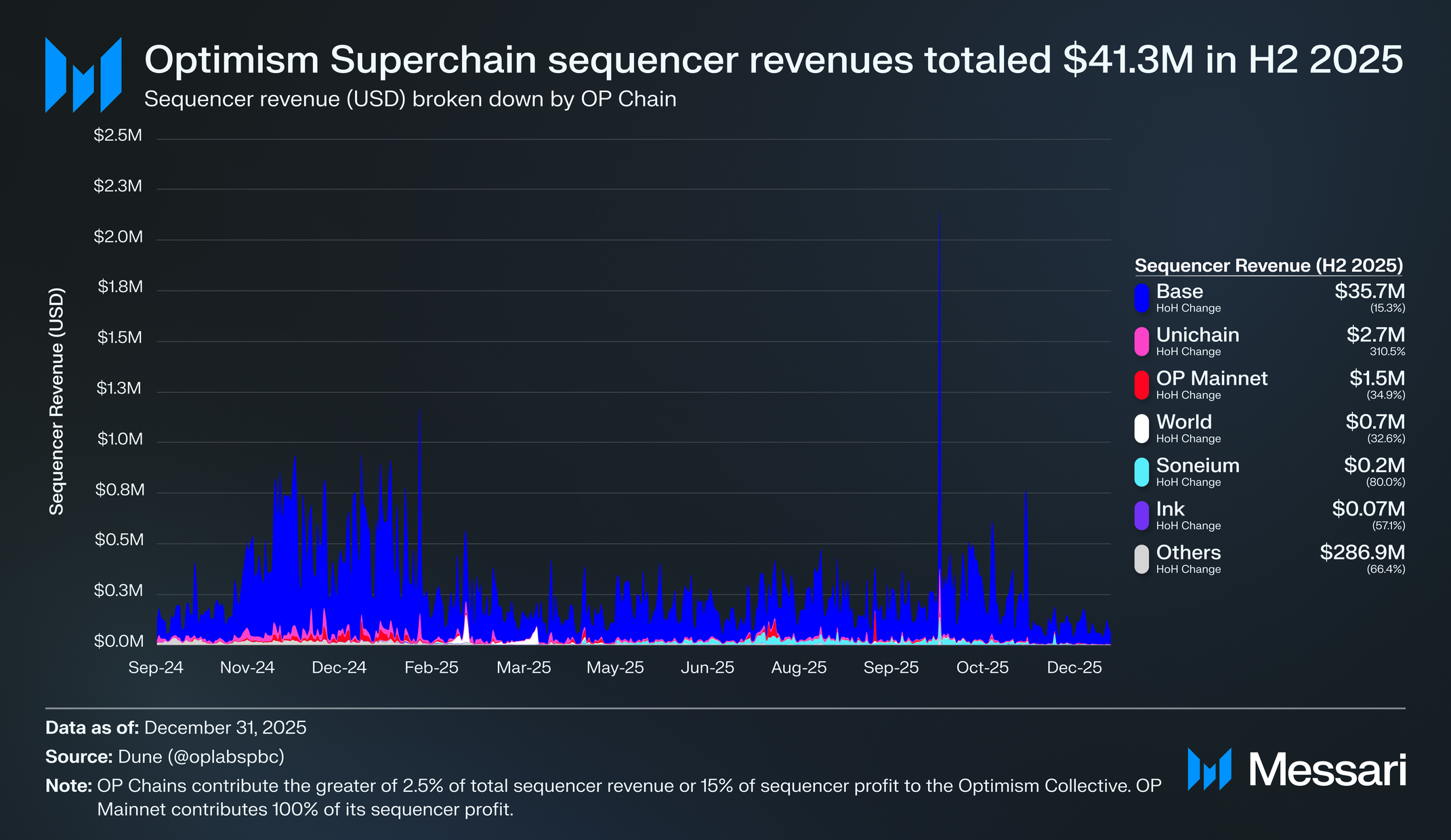
A network’s App Revenue Capture Ratio (App RCR) is the ratio of revenue generated by its apps to its Real Economic Value (REV). In the case of networks on the Optimism Superchain, REV is defined as the sum of base transaction fees and priority fees paid to sequencers, also known as sequencer revenue. The Superchain’s REV (USD) totaled $41.3 million in H2 2025, while application revenue reached $415.4 million, resulting in an App RCR of ~10.1x. This means that for every $100 spent in transaction fees on the Superchain, applications generated $1,010 in revenue.
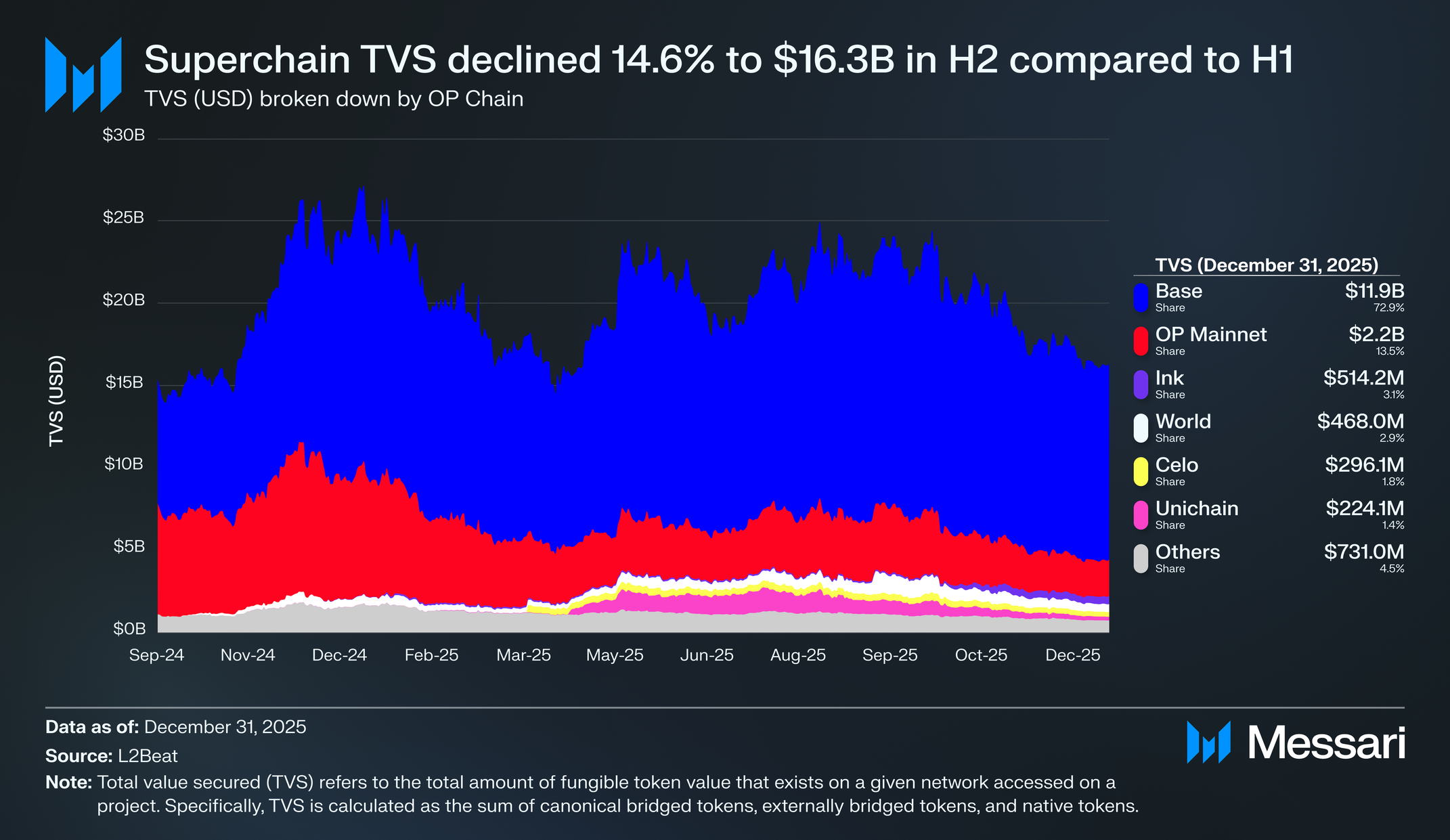
Total value secured (TVS) represents the total value of fungible tokens on a given network, including assets held in DeFi protocols and those held elsewhere. Specifically, TVS is calculated as the sum of canonical bridged tokens, externally bridged tokens, and native tokens.
The TVS across the Superchain ecosystem totaled $16.33 billion by the end of 2025. Base and OP Mainnet remain the two largest chains by TVS, with Base leading at $11.90 billion (72.9% share) and OP Mainnet following with $2.20 billion (13.5% share). Ink ranked third, securing $514.2 million in TVS (3.1% share). World, which ranked fourth, recorded a sharp surge in Q3, with TVS rising to $1.01 billion by the end of the quarter, following the announcement of a $250 million treasury deal by Eightco Holdings to acquire WLD. World’s TVS levels then stabilized through Q4, indicating the increase was largely event-driven.
DeFi
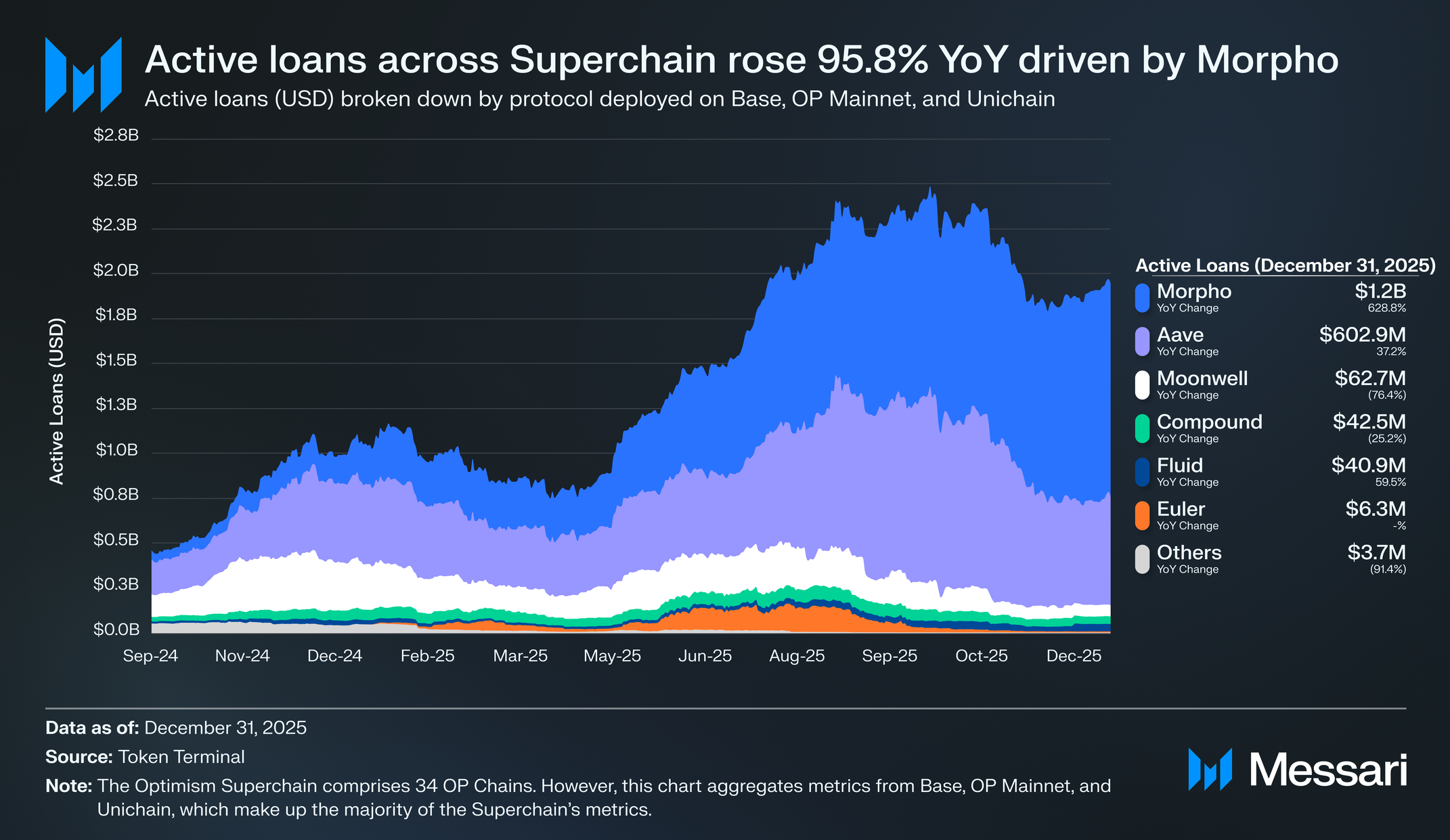
Active loans measure the total value of outstanding borrow positions on a lending protocol and serve as a key indicator of user activity and capital utilization. Total active loans across the Superchain increased 95.8% YoY, rising from $993.7 million to $1.95 billion by the end of 2025. Morpho was the primary driver of this growth, with its active loans surging 628.8%, from $162.2 million to $1.19 billion over the same period.
After Coinbase Wallet integrated Morpho in January 2025 to enable borrowing USDC against Bitcoin deposits, Morpho’s TVL on Base grew rapidly and surpassed Aave, with the cbBTC/USDC pool becoming the largest lending market on Base at over $1.07 billion supplied, nearly double the size of the same pool on Ethereum. Morpho's vault architecture, which allows permissionless market creation with customizable risk parameters, enabled the rapid deployment of optimized lending markets tailored to Superchain’s emerging DeFi ecosystem.
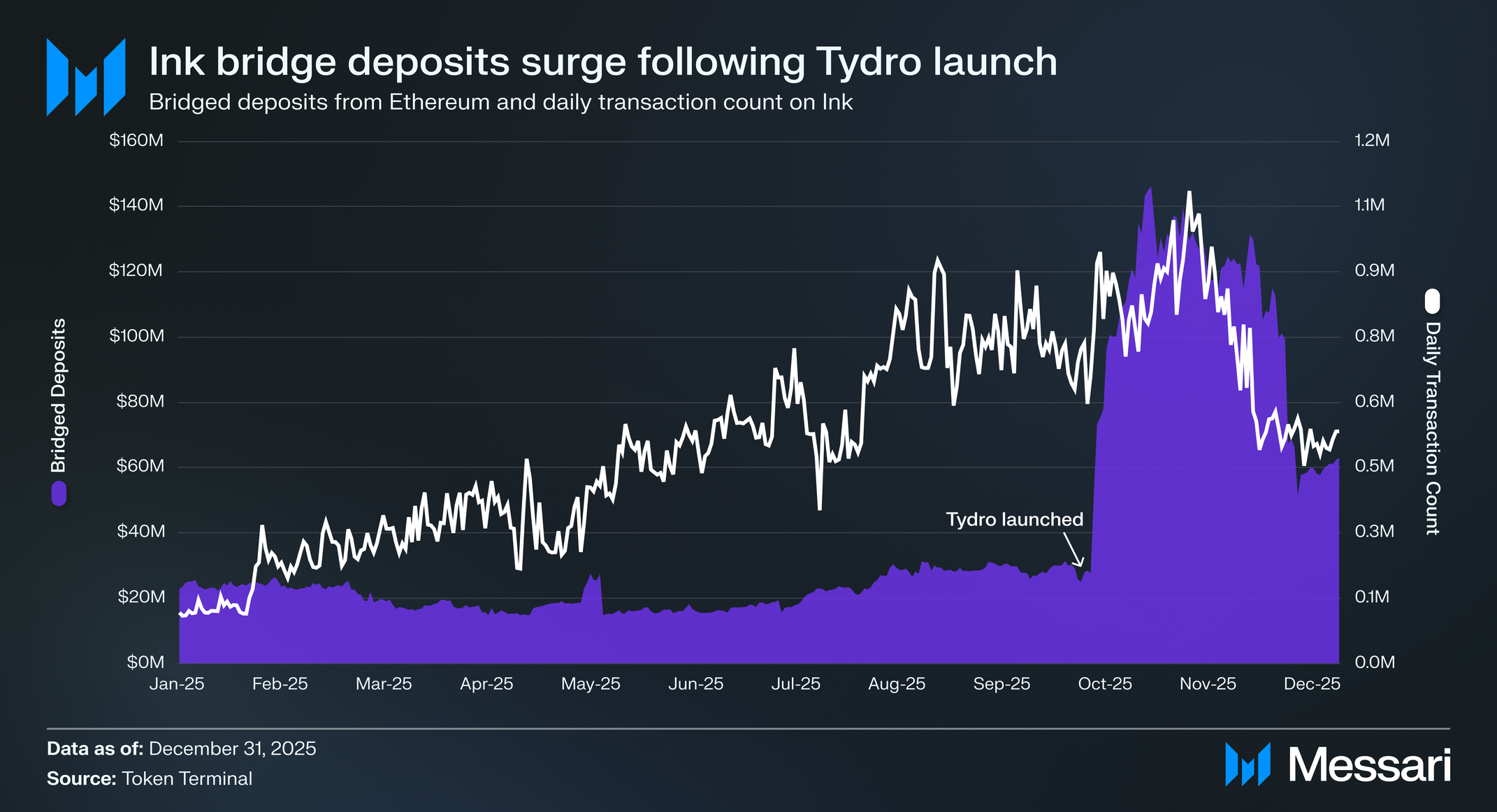
Tydro, Ink's native lending and borrowing protocol, launched on Oct. 15, 2025, driving substantial growth in onchain activity. Bridged deposits from Ethereum surged from approximately $30 million in early October to a peak of $144 million by early November, representing a nearly 5x increase. While activity moderated toward year-end, bridge deposits stabilized around $60 million in late December, still double the pre-Tydro levels. Daily transaction counts showed steady growth throughout 2025, rising from an average of 120,000 in January to over 1 million at their peak in November.
Another newly launched protocol, Nado, is a CLOB DEX in private beta as of February 2026. Despite its early stage, Nado has generated $21 billion in cumulative perpetual volume with 75% month-over-month growth.
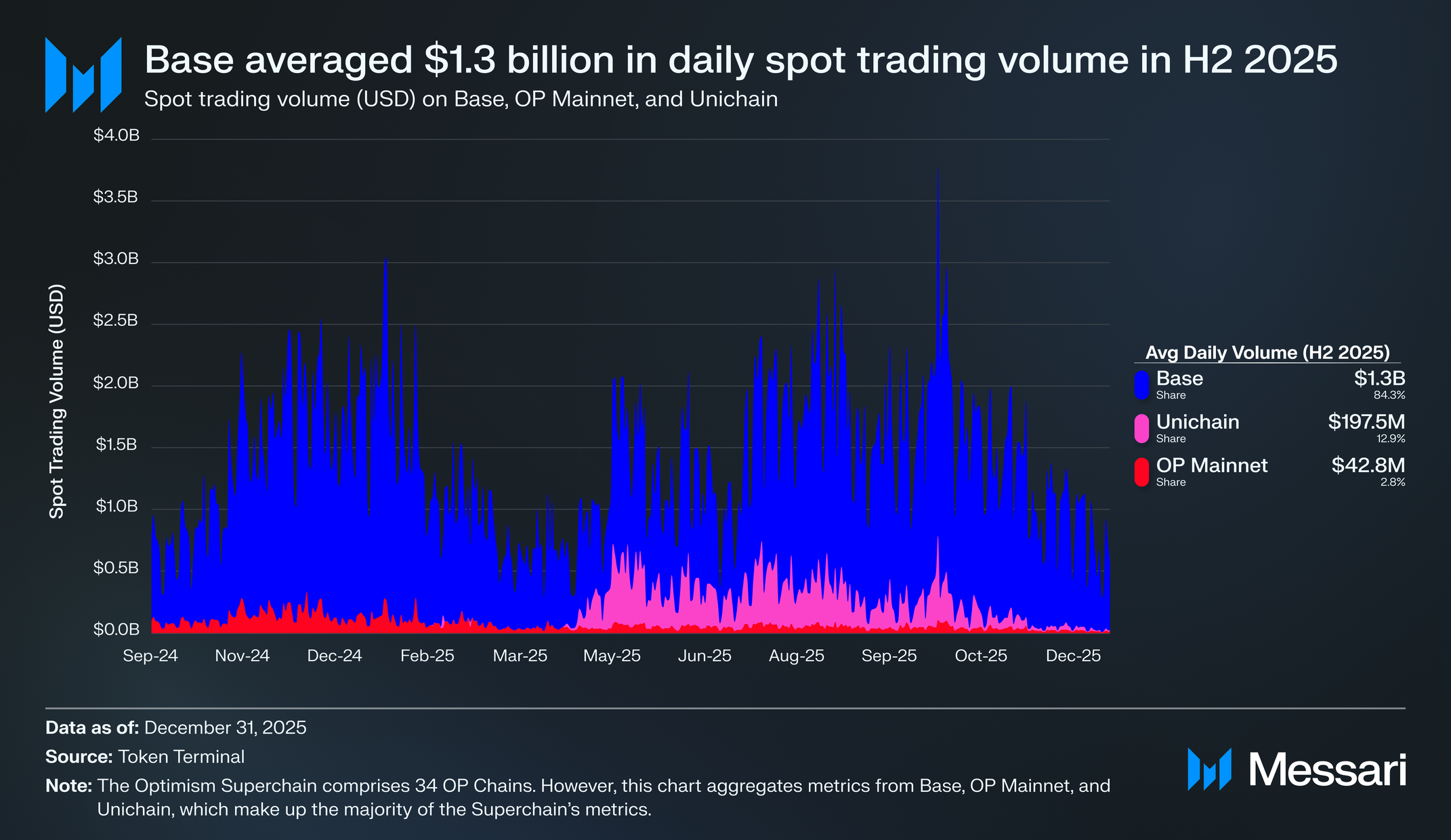
Base remains the leading DEX venue by spot trading volume across the Optimism Superchain. In H2 2025, Base averaged $1.29 billion in daily spot trading volume, accounting for 84.3% of total activity. In terms of growth, Unichain posted the fastest expansion, with average daily volume rising 58.7% in H2 relative to H1, compared to 29.2% growth on Base.
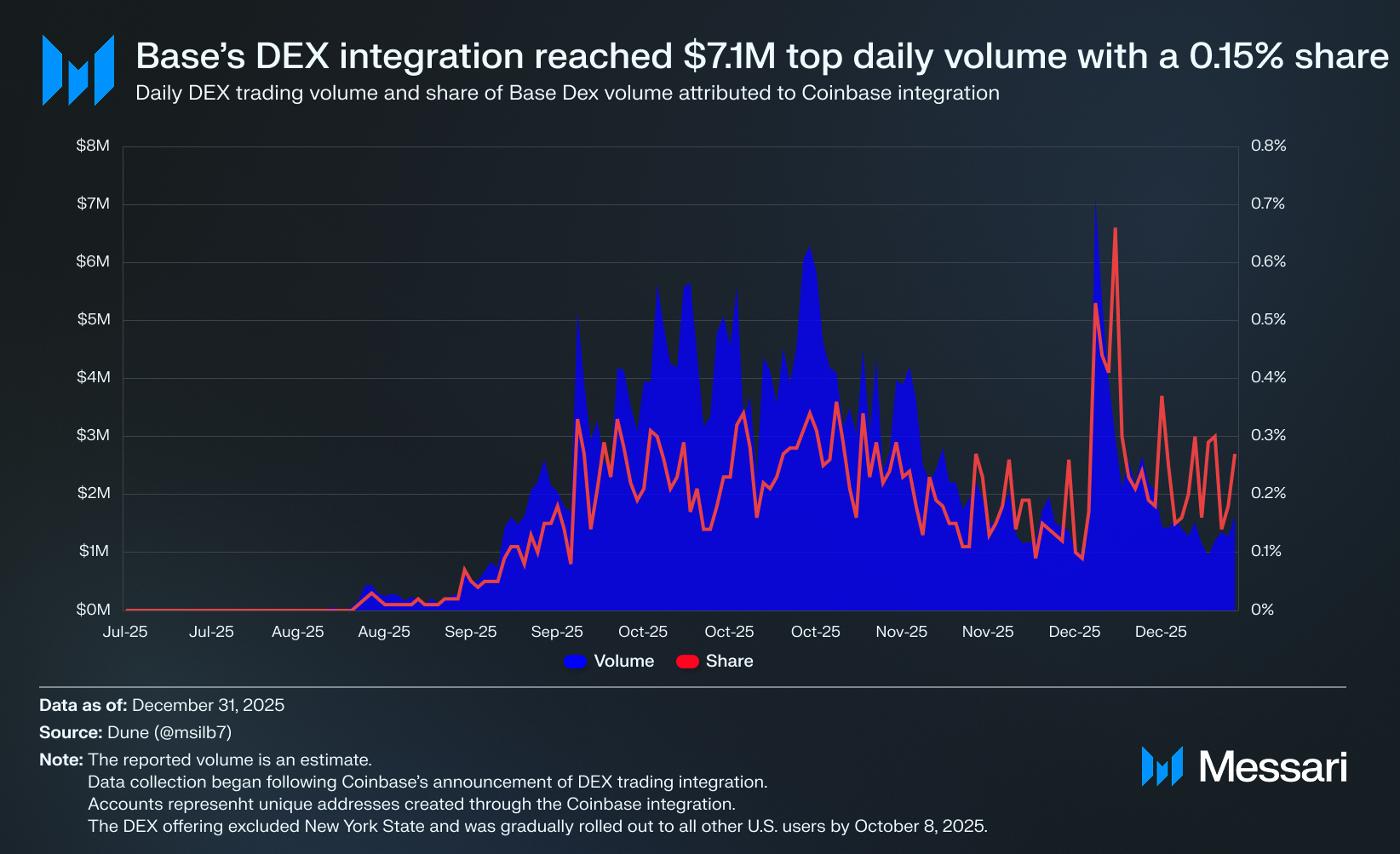
Coinbase introduced DEX trading on Aug. 8, 2025, allowing U.S. users (excluding New York) to trade Base-native tokens directly within the Coinbase app through integrations with DEXs such as Aerodrome and Uniswap. Since launch, the feature has generated millions in trading volume on Base and up to 10,000 new Coinbase-linked addresses per day. Initially rolled out to select users, the DEX integration became available to all eligible U.S. customers by Oct. 8, 2025. Coinbase also plans to extend DEX support to additional networks, including Solana, and expand access to international markets.
OP Chain Activity
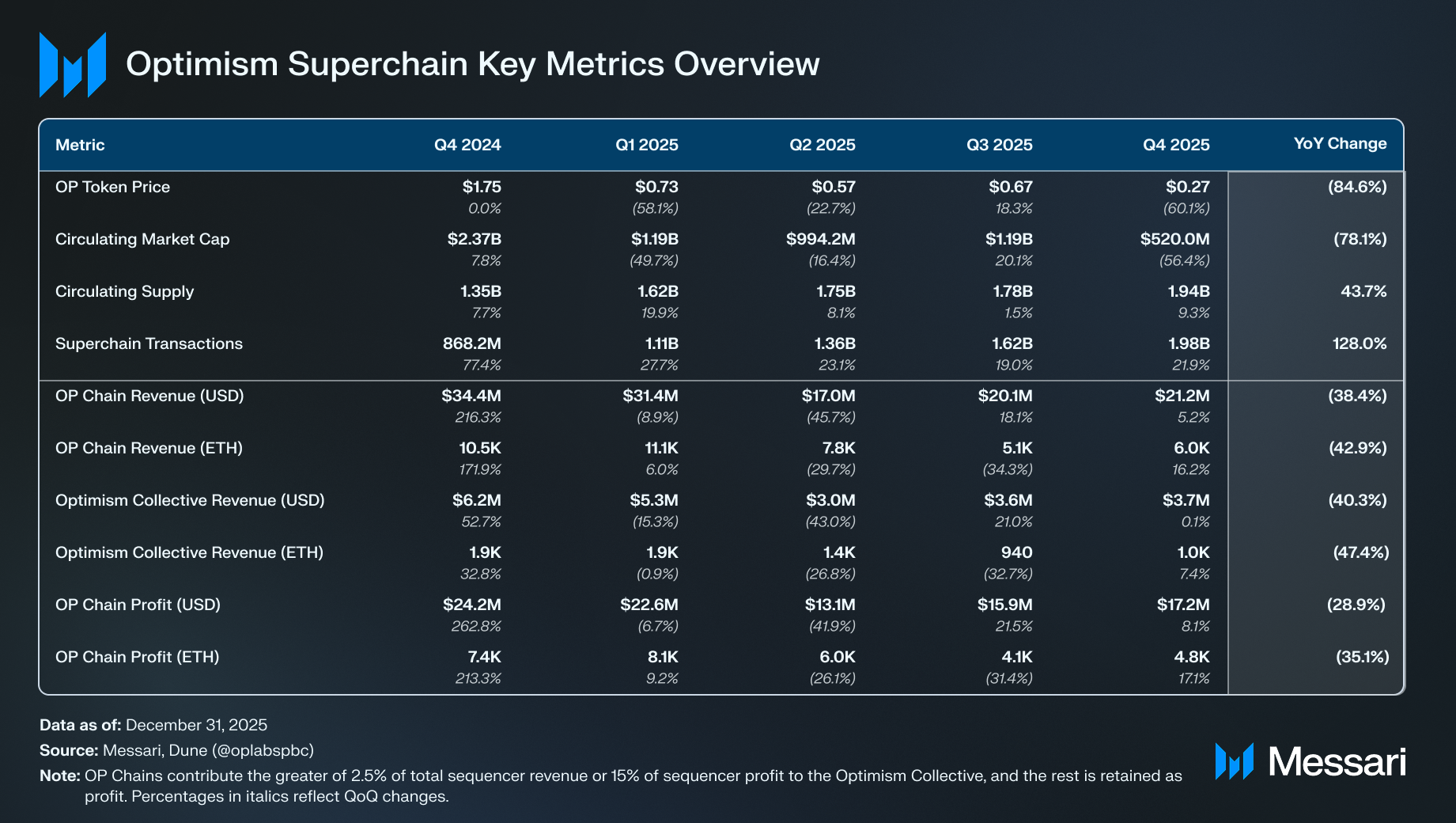
Transactions across the Optimism Superchain reached a new all-time high of 3.60 billion in H2 2025, up 44% from 2.47 billion in H1. Growth was led by Celo, World, and OP Mainnet, which recorded the sharpest increases in transaction volume: 135.4% to 246.3 million, 95.0% to 316.6 million, and 61.9% to 276.9 million, respectively.
By the end of H2 2025, the Optimism Superchain ecosystem accounted for 12.7% of all crypto transactions. Since early April 2025, the ecosystem has consistently captured over half of the total L2 market share by transaction volume. This sustained dominance shows that OP Stack chains are driving consistently high network activity, reinforcing the Superchain’s leading role in the L2 landscape.
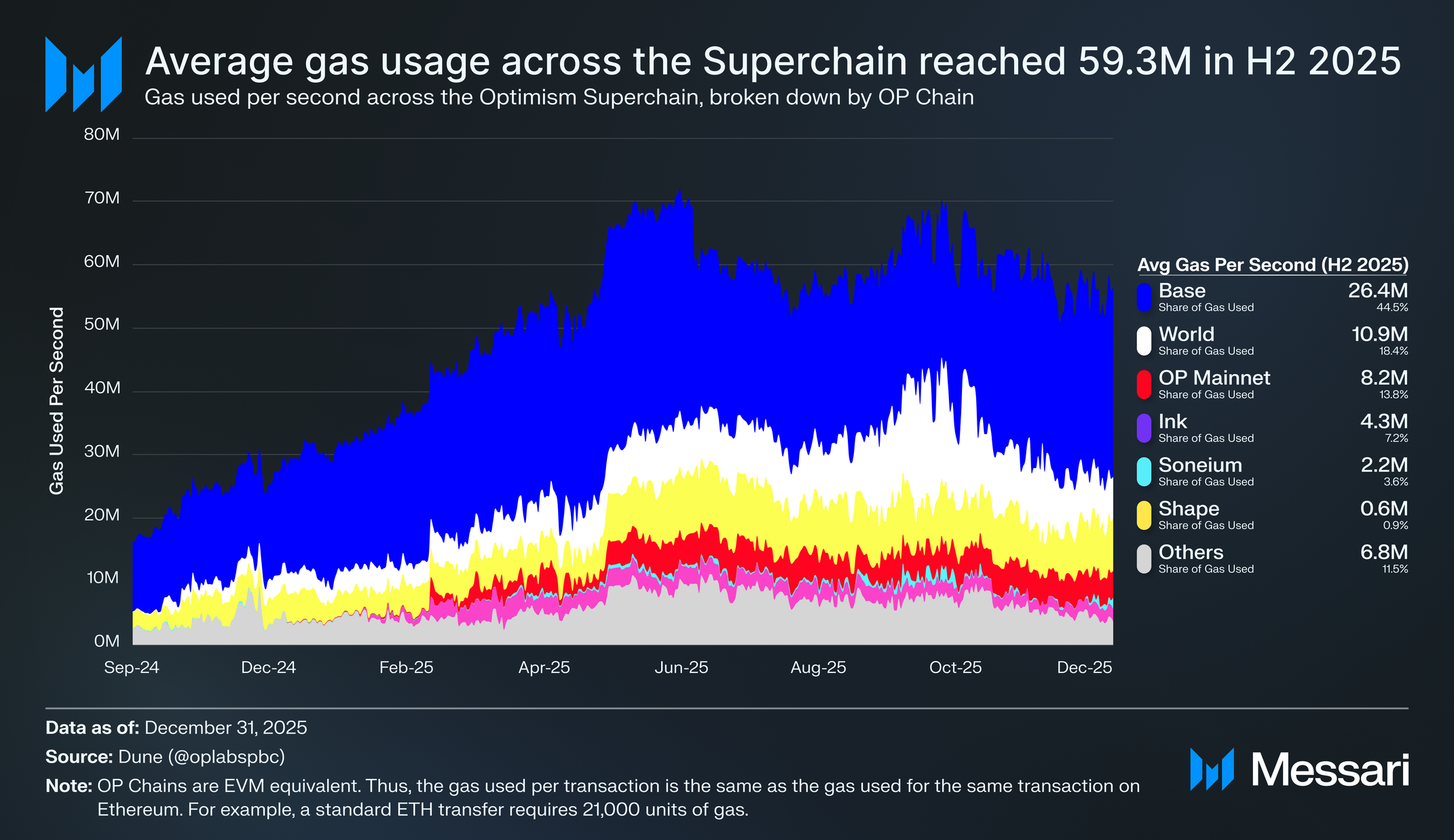
Gas used per second (gas/s) is a metric that matters for the Optimism Superchain. Gas refers to the unit that measures the amount of computational effort required to execute operations on the Ethereum Virtual Machine (EVM). Gas, also referred to as blockspace, is a limited resource provided by blockchains. Gas usage metrics show how much of that resource is actually being consumed.
The total average gas used across the Superchain ecosystem reached 59.3 million in H2 2025, representing a 14.6% increase from the 50.7 million average at the end of H1 2025. This growth was driven in part by sharp increases in gas consumption on individual Superchain networks, most notably World.
World’s average gas usage per second surged to 20.0 million in Q3 2025, up from 5.8 million in the first half of the year, driven by a sharp increase in daily active addresses and the network’s reliance on smart wallet architectures such as Gnosis Safe and ERC-4337, which consume significantly more gas than standard externally owned accounts (EOAs). The introduction of Priority Blockspace for Humans (PBH) in June further contributed to the rise, as it reserved blockspace for verified users at fixed rates while requiring bots and non-verified users to compete for the remaining capacity at higher prices, leading to elevated gas fees.
Superchain Enterprise Developments
The ecosystem updates below reflect Optimism’s shift toward institutional and enterprise adoption through the OP Stack. Rather than centering growth solely on a single public L2, Optimism is prioritizing purpose-built chains that give organizations greater control over execution, governance, and economic design, while remaining interoperable within the broader Superchain.
OP Mainnet anchors this approach as the Superchain’s enterprise launch pad, providing a credibly neutral, high-performance L2 where enterprises can validate use cases, access liquidity, and build initial traction before migrating to a dedicated OP Stack chain. Designed to combine low fees, high throughput, and production reliability, OP Mainnet serves as both a proving ground and reference implementation for enterprises transitioning from first onchain deployments to fully customized networks.
Upbit Unveils Giwa Layer 2 on OP Stack
On Sep.9, 2025, South Korea’s largest cryptocurrency exchange, Upbit, announced the launch of Giwa, a new L2 built using the OP Stack. Giwa is designed to integrate Upbit’s massive retail user base directly into the Optimism ecosystem. This move marks a significant expansion of Optimism into the Asian market, providing millions of users with a high-performance, exchange-backed gateway to decentralized applications and onchain liquidity.
OKX Migrates XLayer to the OP Stack
On Dec. 9, 2025, OKXannounced the migration of its XLayer network to the OP Stack, bringing the exchange-backed L2 into the Optimism ecosystem. The move aligns X Layer with Optimism’s shared infrastructure and interoperability roadmap, enabling lower fees, improved scalability, and deeper integration with other OP Stack chains.
Nightfall Deploys on Celo
On Sep.30, the Celo FoundationlaunchedNightfall, an open-source zk privacy layer developed by EY, as a Layer 3 (L3) on the Celo network. The deployment enables confidential yet auditable B2B payments, extending Celo’s mobile-first payments infrastructure into enterprise use cases.
Vertex Protocol Team to Join Ink Foundation
On Jul. 1, 2025, the Ink Foundation announced an agreement to bring the Vertex Protocol team and its core infrastructure into the Ink ecosystem. As part of this transition, Vertex will sunset its current deployments to launch a purpose-built DEX exclusively on Ink, integrating its high-performance synchronous orderbook and perpetuals stack.
Messari Launches Optimism Portal
Messari launched a dedicated Optimism Portal that consolidates ecosystem-wide data, analytics, and research into a single, no-login interface. The portal provides real-time network metrics, ecosystem maps, and AI-powered research summaries across the Superchain, with coverage set to expand in 2026 as Optimism’s network of OP Stack chains continues to grow.
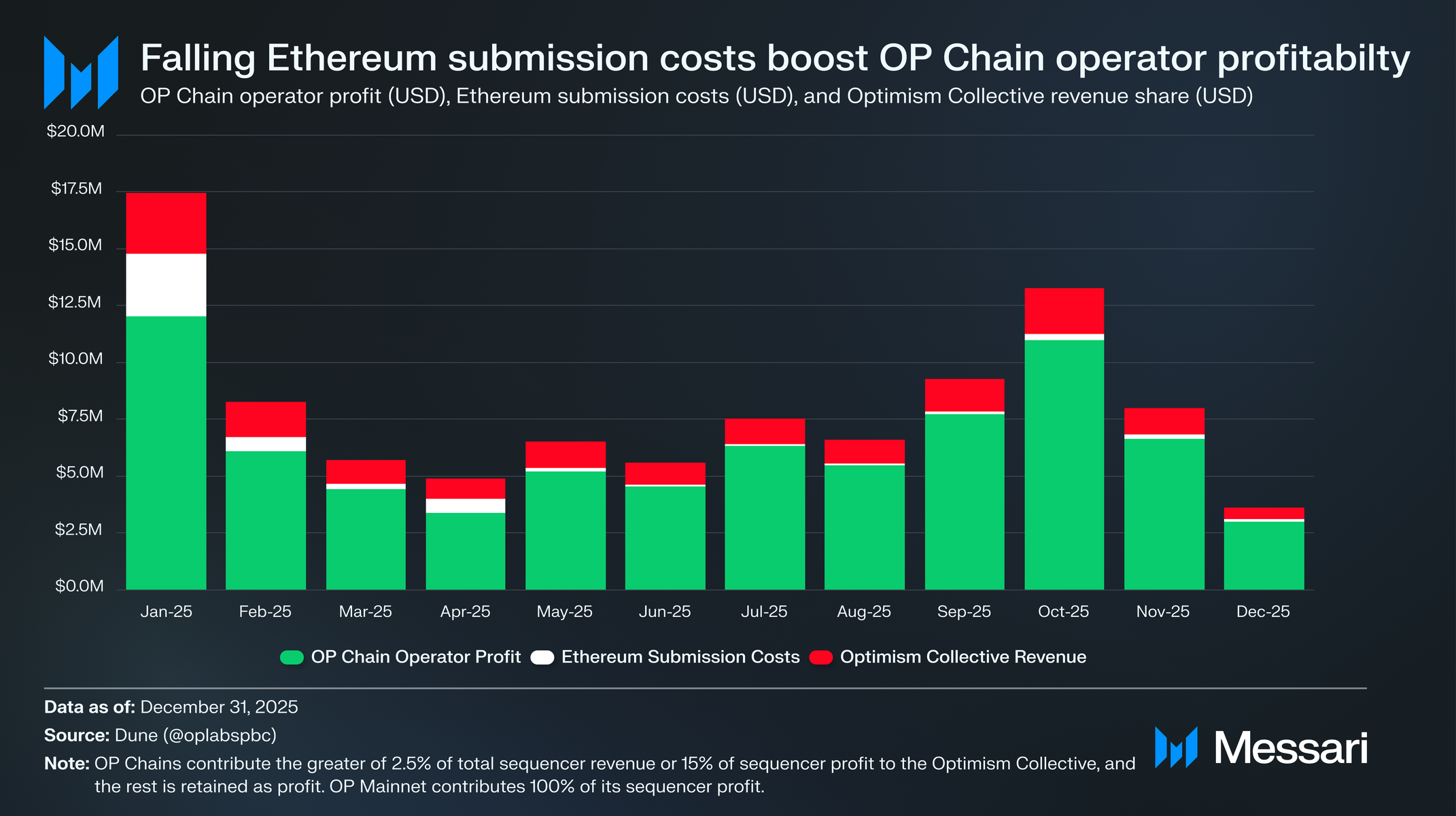
While the Optimism Collective does not have a publicly viewable, singular treasury, it generates consistent revenue through a revenue-sharing model. According to the Standard Rollup Charter, all OP Chains within the Optimism Superchain must contribute the greater of either 2.5% of sequencer revenue or 15% of sequencer profit (sequencer revenue minus Ethereum submission costs). The lone exception is OP Mainnet, which contributes 100% of its sequencer profit.
Monthly submission costs on Ethereum have declined significantly since the Dencun upgrade in March 2024. Before the introduction of blobs, monthly data posting costs peaked at $2.8 million in January 2025. By the end of H2 2025, these costs had dropped to an average of $156,186 per month. The Dencun upgrade greatly improved the profitability of OP Chain operators by reducing data submission expenses.
In H2 2025, operators generated $44.5 million in profit, up 24.9% from $35.7 million at the end of H1. Of this amount, about $7.2 million in sequencer revenue was allocated to the Optimism Collective, representing a 13.0% decline from the $8.3 million distributed in H1.
Base remained the largest OP Chain by sequencer revenue in H2 2025, generating $35.7 million, followed by Unichain at $2.7 million and OP Mainnet at $1.5 million. Total sequencer revenue fell 14.7% HoH from $48.4 million in H1. Among the top chains, Unichain was the only one to grow, surging 310.5% HoH from $659,994, while Base declined 15.3% from $42.2 million and OP Mainnet fell 34.9% from $2.3 million. Despite lower absolute sequencer revenue in H2 2025, the Superchain gained a meaningful share of total crypto transaction fees. Its share rose from 2.0% at the end of Q1 to 4.2% by Q4, indicating continued growth in usage and throughput even as per-chain monetization eased. While sequencer revenue declined, OP chains maintained 7 of the 10 lowest transaction costs across major networks.
Governance
Overview
The Optimism Collective operates a public decision-making process that allows key stakeholders (tokenholders, end-users, apps, and chains) to participate in important decisions about the protocol and treasury.
So far, the Optimism Collective has completed seven governance seasons, each advancing decentralization and ecosystem coordination through distinct themes such as interoperability, blockspace charters, and collective governance.
Season 8 was launched on July 31, 2025, running through December 24, 2025, under the theme “Purpose-built Governance.” This season represents a major evolution of the governance framework, shifting from a general-purpose model to a system specifically designed to reduce platform risk for participants across the Superchain.
Season 8 introduces several major updates that operationalize this vision:
The Stakeholder Voting Model formally integrates new categories of governance participants, granting voting representation to chains, applications, and end users alongside token holders.
The Optimistic Approval process has been adopted for most proposal types, allowing measures to pass automatically unless vetoed, creating faster and more predictable decision-making.
The Protocol Upgrade Process was overhauled, introducing a Developer Advisory Board (DAB) to review and approve technical upgrades, while delegates and Citizens now exercise veto power during a one-week review period.
Technical Developments
Optimism underwent several significant technical developments and network upgrades in H2 2025:
OptimismFlashbots Integration: Optimism partnered with Flashbots to deploy verifiable sequencing across OP Stack chains, with Flashblocks live on Base, Unichain, and OP Mainnet, enabling roughly 200 millisecond transaction preconfirmations.
Superchain Upgrade 16: OP Labs launched Upgrade 16, preparing the network for Superchain interoperability by removing a permissioned role, updating Cannon to Go 1.23, and increasing the gas limit to 500 million per block.
Upgrade 16a Proposal: In September 2025, Optimism proposed Upgrade 16a to refine interop features, add configurable toggles, and improve upgrade flexibility while maintaining network stability.
Jovian Hard Fork: As part of the U17 upgrade, the Jovian hard fork was activated in December 2025, introducing protocol-level improvements to onchain fee markets, including configurable minimum base fees and data availability footprint block limits to enable continued scaling with stable fees and spam mitigation. The upgrade also enhanced the fault proof system with the latest version of golang and patched two disclosed vulnerabilities that were not exploited.
Reth-Based Sequencing: The first OP Stack chains transitioned to a Reth-based architecture, delivering significant improvements in block building and execution performance. This advancement enables future increases in gas limits and throughput while simplifying the development process for adding new features to the stack.
Fusaka Hardfork Went Live: Ethereum activated the Fusaka hard fork on mainnet, delivering a major expansion of data availability for rollups and the Superchain. The upgrade introduces PeerDAS and the Blob Parameter Only (BPO) mechanism, enabling Ethereum to safely increase blob capacity and reduce L2 fees without waiting for a full hard fork, thereby immediately improving throughput and scalability for OP Stack chains.
Closing Summary
The Optimism Superchain closed H2 2025 firmly established as the most active and economically productive Ethereum L2 ecosystem, marked by record high transaction throughput, sustained dominance in L2 market share, and continued evolution toward a revenue-generating onchain economy. Base remained the clear anchor of the Superchain, while the rapid growth of networks such as World, Unichain, Ink, and Celo reflected an increasingly diversified and resilient ecosystem.
Economic indicators reinforced this maturation. Aggregate TVL and TVS continued to climb even after major incentive programs concluded; Chain GDP expanded despite mixed performance across individual chains; and application revenue consistently outpaced sequencer revenue by an order of magnitude, highlighting strong app-layer value capture. Meanwhile, declining Ethereum data costs materially improved operator profitability, enabling sustained revenue sharing with the Optimism Collective.
In parallel, Optimism strengthened the Superchain’s institutional readiness through technical upgrades, governance evolution, and partner onboarding. Sub-second execution via Flashblocks, increased adoption of smart account architectures, and progress toward full Superchain interoperability improved performance and operational predictability at scale. The onboarding of exchange- and enterprise-backed deployments such as Upbit, OKX, and Nightfall, alongside rapid growth on smaller chains, reinforces the OP Stack’s emergence as a standardized framework for institutional rollups and production-grade onchain deployment.
This report was commissioned by Optimism Foundation. All content was produced independently by the author(s) and does not necessarily reflect the opinions of Messari, Inc. or the organization that requested the report. The commissioning organization may have input on the content of the report, but Messari maintains editorial control over the final report to retain data accuracy and objectivity. Author(s) may hold cryptocurrencies named in this report. This report is meant for informational purposes only. It is not meant to serve as investment advice. You should conduct your own research and consult an independent financial, tax, or legal advisor before making any investment decisions. Past performance of any asset is not indicative of future results. Please see our Terms of Service for more information.
No part of this report may be (a) copied, photocopied, duplicated in any form by any means or (b) redistributed without the prior written consent of Messari®.
Alice is a Research Analyst on the Protocol Services team. She previously worked as a Research Analyst at The Block and was an Investment Intern at Variant Fund. Alice graduated from Northwestern University, where she studied Economics.
Alice is a Research Analyst on the Protocol Services team. She previously worked as a Research Analyst at The Block and was an Investment Intern at Variant Fund. Alice graduated from Northwestern University, where she studied Economics.