On Jan. 29, OP Labs launched OP Enterprise, a managed blockchain infrastructure product structured across three tiers (Fully Managed, Self Managed, and OP Mainnet) with Unichain and Celo as the first two customers. Institutional demand for dedicated OP Stack chains grew in 2025, but the operational overhead of launching and maintaining a chain deterred many prospective operators. OP Enterprise allows institutions to own and operate dedicated chains without building blockchain operations in-house.
On March 26, Bitpanda announced Vision Chain, the first chain deployed under the Fully Managed OP Enterprise tier, built to support tokenized asset issuance, Euro stablecoin deployment, and regulated DeFi applications for European financial institutions.
On April 15, ether.fi migrated its Cash product to OP Mainnet with zero downtime, adding $220 million in TVL and positioning OP Mainnet as a home for payments-oriented DeFi.
In Q1 2026, Chain GDP totaled $144.8 million across the top five OP Chains, down 29.9% QoQ from $206.5 million in Q4 2025, as a broader crypto market downturn reduced trading and lending activity across the OP Stack. Ink’s GDP grew 776.9% QoQ from $254,200 in Q4 2025 to $2.2 million in Q1 2026, driven by growing activity on Tydro.
On April 7, Sunnyside Labs launched Privacy Boost, the first privacy infrastructure built natively for the OP Stack to enable confidential onchain transactions with sub-500ms proof generation and 1,800 tps throughput. The product targets regulated institutions that have kept treasury, payroll, and counterparty positions off public blockchains due to ledger transparency, and on April 28, Soneium became the first OP Chain to announce a planned integration.
Optimism's long-term strategy centers on the OP Stack, a modular, open-source technology stack for building blockchain networks. Its core components include an execution layer for processing transactions and managing state, a consensus layer for block production and validation, a data availability layer for publishing transaction data, and a settlement layer for finalizing transactions on Ethereum. OP Chains are built on the OP Stack and include both L2s that settle on Ethereum and L3s that settle on an L2. Together, OP Chains form a connected ecosystem with a shared security model, standardized bridging, and coordinated governance. As of March 31, 34 OP Chainsaccounted for over 40% of all L2 activity and over 7% of all crypto activity.
Optimism markets the OP Stack to exchanges, fintechs, and application teams as infrastructure for deploying purpose-built chains with control over execution, economics, and compliance. For real-time metrics and additional OP Stack coverage, refer to the Optimism Portal.
Optimism's growth strategy shifted from scaling a single public L2 to positioning the OP Stack as institutional blockchain infrastructure. The approach prioritizes purpose-built chains that give organizations control over execution, economics, and compliance. OP Mainnet anchors this strategy as the entry point where institutions can access existing liquidity, validate use cases, and build traction before migrating to a dedicated chain.
OP Enterprise Launch
In Q1 2026, Optimism continued its shift toward institutional adoption. On Jan. 29, OP Labs launched OP Enterprise, a production-grade managed blockchain infrastructure product designed for institutions that need blockchain infrastructure but lack the ability to operate blockchain networks in-house. The customer targets include centralized exchanges launching tokenized products, payments companies building cross-border rails, and financial institutions exploring tokenization and digital assets, among others.
OP Enterprise's second structural advantage is partner and vendor management. A key bottleneck in blockchain launches is not the infrastructure itself but the ecosystem onboarding that surrounds it. Individual negotiations with RPC providers, indexers, oracles, wallets, bridges, and compliance tooling can each take months and cost hundreds of thousands of dollars before technical work even begins. Optimism intends for OP Enterprise to reduce this friction. Tier-one partners are already integrated, contracted, and ready to deploy on a new chain from day one. Optimism estimates this will reduce customer procurement processing time to production from 6-to-12-months to 8-to-12-weeks.
OP Enterprise has three tiers (with exact figures negotiable on a case-by-case basis):
Fully Managed: OP Labs runs the chain end-to-end, covering sequencer management, 24/7 monitoring, incident response, capacity planning, security operations, and upgrade orchestration. If Mission-Critical support is included, the customer’s chain is backed by a 99.99% uptime SLA and 15-minute P1 incident response. Once live, the institution will retain full chain ownership. Enterprises receive mainnet and testnet environments, managed L1 bridge contracts with Stage 1 certification, Public RPC endpoints supporting up to 5 billion requests per month, and engineering support.
Self Managed: The institution operates its own infrastructure with direct support from the OP Labs engineering team. OP Labs provides a dedicated account manager, priority access to zero-day security patches, 40 hours per year of direct engineering support, security and performance assessments, and migration support from existing infrastructure. OP Labs designed this tier for institutions with existing infrastructure teams that want expert backing without delegating operations.
OP Mainnet: This tier serves as a lower-commitment entry point. Organizations deploy on Optimism's public flagship network, access existing liquidity and users from day one, and validate their model in a live environment before committing to a dedicated chain. When ready, migration uses the same codebase and tooling throughout to reduce the operational burden during a transition.
All tiers can be upgraded to include Mission-Critical Support: 15-minute P1 incident response with war-room access, priority security patches, bespoke integrations, elevated SLAs, and a direct escalation path to senior engineering leadership. OP Enterprise launched with Unichain and Celo as the first two customers under Mission-Critical Support.
Ether.fi Announcement
On April 15, ether.fi announced it was live on OP Mainnet, adding $220 million in TVL, 70,000 active cards, and 300,000 accounts to the chain. Optimism and the ether.fi team completed the migration in three days, encompassing bridge engineering, oracle support, and asset metadata transfer. As of April 16, ether.fi ranked as the 8th-largest DeFi protocol by TVL with $5.7 billion across three revenue lines: Stake, Liquid, and Cash, offering staking, yield vaults, and crypto card payments. Cash accounts for roughly 50% of protocol revenue.
The deployment arrives amid a broader tailwind for crypto card payments, which expanded at a 106% compound annual growth rate from January 2023 to August 2025 as banks grew more comfortable working with crypto platforms following post-Gensler regulatory shifts. Cash's growing revenue share amid a bearish crypto environment reflects a decoupling of ether.fi's business model from Ethereum staking yields. The product introduces a recurring revenue stream not tied to ETH price or staking activity.
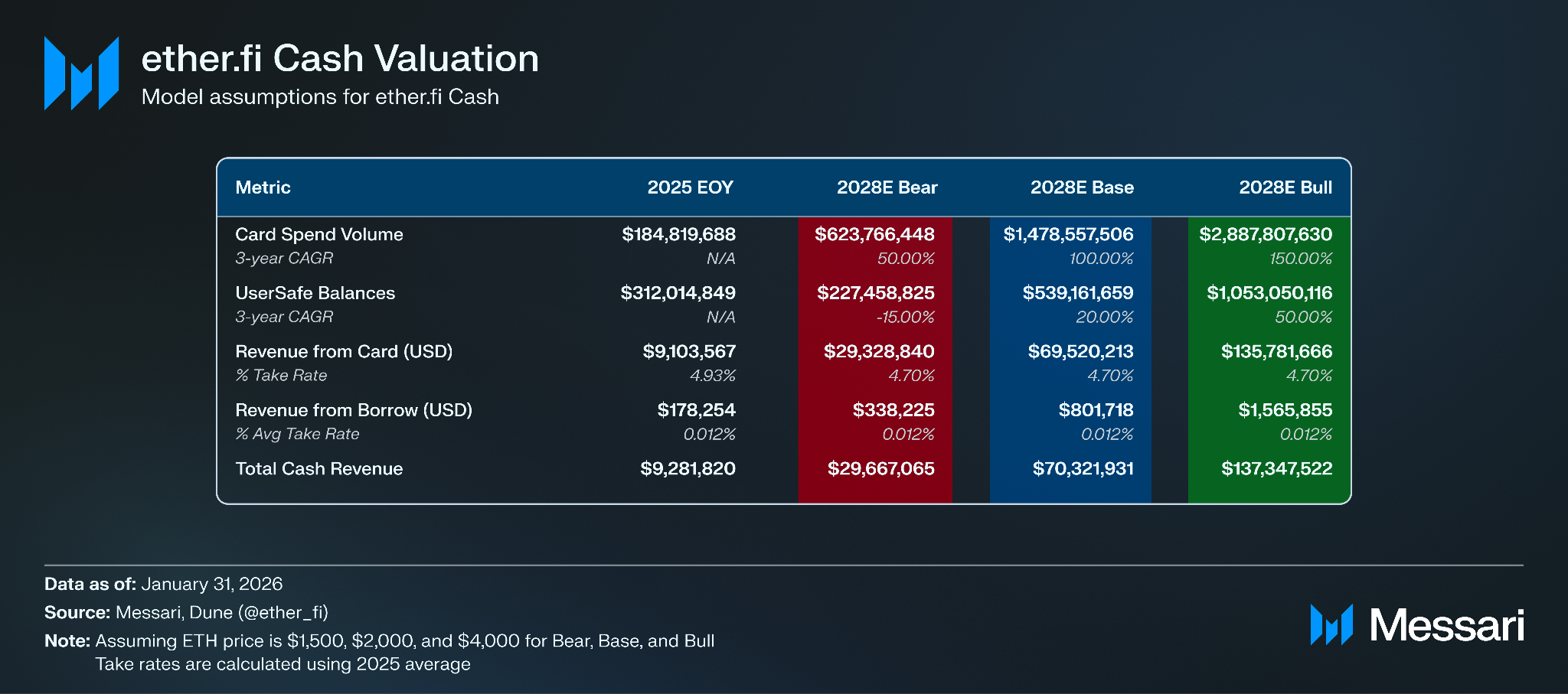
Messari's recent ether.fi valuation projects UserSafe balance, the cumulative USD value of crypto assets locked in ether.fi Cash safes available to spend, borrow against, or withdraw, to reach $539.2 million in the base case and $1.05 billion in the bull case by 2028. If those projections hold, the partnership could meaningfully increase OP Mainnet TVL over the coming years.
Bitpanda Launches Vision Chain
On March 26, Bitpanda, a European crypto brokerage platform, announced Vision Chain, the first chain to deploy under the Fully Managed OP Enterprise tier. Bitpanda built Vision Chain to support tokenized asset issuance, Euro stablecoin deployment, and regulated DeFi applications across European institutional finance. Key technical specifications include 200ms block times, planned integration of OP Succinct ZK-proofs for same-day withdrawals, and support for MiCA-compliant Euro stablecoins for gas payments. Bitpanda is targeting a mainnet launch later in 2026, with an initial focus on institutional asset issuance before expanding into Euro-denominated lending and retail distribution through Bitpanda's brokerage app.
Privacy Boost Launch
On April 7, Sunnyside Labs, an Optimism Collective Core Dev team, launched Privacy Boost, the first privacy infrastructure built natively for the OP Stack. The product pairs ZK-proofs with trusted execution environments to enable confidential onchain transactions. Proof generation runs under 500ms, throughput exceeds 1,800 tps, and the product includes SDKs for TypeScript, React, iOS, Android, and Rust. OpenZeppelin completed a security audit of the Privacy Boost smart contracts.
The architecture targets use cases where onchain visibility creates competitive or regulatory exposure, such as treasury management, payroll, counterparty position management, and similar transactions that institutions have historically kept off public blockchains. Developers can integrate Privacy Boost via SDK without protocol-level changes to the underlying chain.
On April 28, Soneium, an L2 on the OP Stack, became the first chain to announce a planned integration with Privacy Boost. Mastercard, Bitpanda, and Ink are listed as early adopters. Sunnyside Labs builds and operates Privacy Boost independently of OP Labs, and the product is one of multiple privacy solutions Optimism plans to support on the OP Stack in 2026.
Mitsui Launch
On April 17, Mitsui & Co. Digital Commodities (MDC) launched Zipangcoin on OP Mainnet. The product comprises three regulated precious-metals-backed tokens: ZPG (gold), ZPGAG (silver), and ZPGPT (platinum). All three Zipangcoins are listed on GMO Coin, a Japan Financial Services Agency-regulated cryptocurrency exchange. MDC described the launch as the first issuance of a regulated commodity-backed cryptoasset by a traditional Japanese financial institution on a public blockchain. MDC is a wholly owned subsidiary of Mitsui & Co., a Fortune Global 500 general trading company with $94 billion in market capitalization and operations across more than 60 countries.
MDC operates the token contracts directly on OP Mainnet, and OP Labs will provide partnership and marketing support rather than running infrastructure. This positions OP Mainnet as a viable public blockchain venue for regulated asset issuers seeking access without the operational commitment of a dedicated chain. The structure mirrors the ether.fi Cash deployment and signals a developing template for institutional onchain product launches in regulated markets.
UpBit Launches GIWA Chain
On May 4, Dunamu, the operator of Upbit, a South Korean centralized exchange, announced that it will launch its GIWA Chain on the OP Stack. GIWA Chain would be the first deployment on the Self-Managed tier of OP Enterprise, where Dunamu controls the primary sequencer and core network decisions, while Optimism provides system monitoring and backup-sequencer support.
As of May 3, GIWA Chain has processed 100 million transactions on testnet. A mainnet launch date has not been confirmed. Early-stage discussions have referenced potential use cases including tokenized payments and Korean won-backed stablecoins, though no commitments have been announced.
Base Transition
On Feb. 18, Base announced a transition from the OP Stack to a Base-operated software stack. Base will consolidate its sequencer, proofs, and core infrastructure into a single codebase, replacing a setup that previously drew from Optimism, Flashbots, and Paradigm. In the announcement, Base credited the OP Stack's technology and three years of collaboration with Optimism as foundational to its development.
Base will continue working with Optimism as an OP Enterprise Mission-Critical Support client during and after the transition.
OP Stack Quantitative Analysis
By Q1 2026, the OP Stack had progressed from a scaling initiative into a production-grade, multichain execution environment supporting material economic activity and institutional participation. As of March 31, 34 OP chains were live on mainnet. The OP Stack increasingly resembles a standardized blockchain runtime layer, where organizations can onboard incrementally, operate within defined performance and security constraints, and expand into more customized deployments as operational requirements mature.
Onchain Economics
Assets and Chain GDP
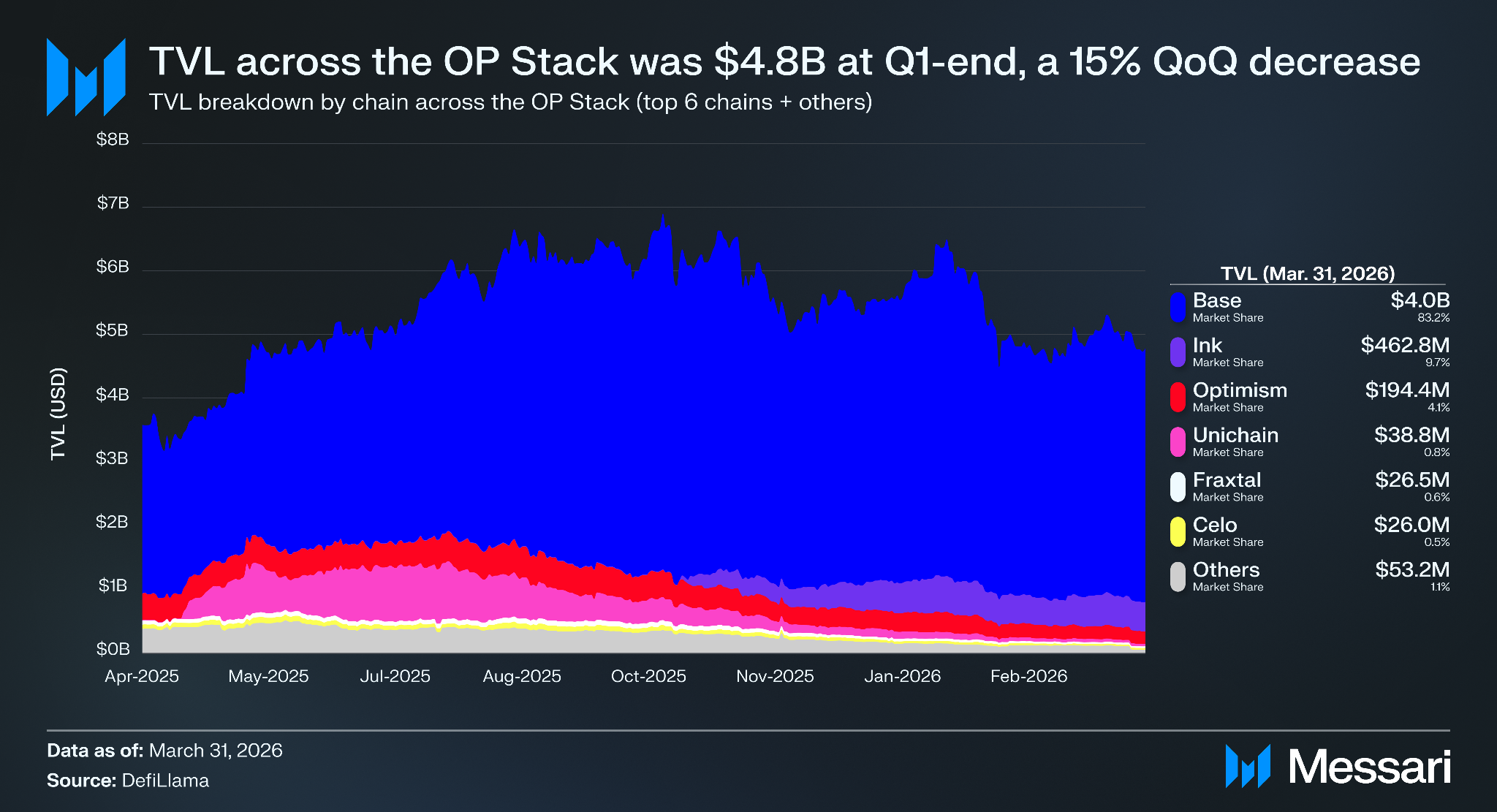
In Q1 2026, OP Stack TVL declined 14.8% QoQ, from $5.6 billion on Dec. 31 to $4.8 billion on March 31, as the total crypto market cap fell 20.4% QoQ, from $3.0 trillion to $2.4 trillion, which compressed asset values and reduced deposits across the ecosystem.
Ink maintained its position from Q4 2025 as the second-largest OP Chain by TVL with $462.8 million on March 31, down 3.7% QoQ from $480.1 million on Dec. 31. The stability reflects the maturation of Ink's DeFi infrastructure, particularly Tydro, the Aave V3-based lending protocol that launched on Oct. 15, 2025. Tydro's lending markets retained capital through the quarter, and Ink avoided the sharper drawdowns that other OP Chains posted.
Base was the largest OP chain by TVL at $4.0 billion on March 31, down 11.7% QoQ from $4.5 billion on Dec. 31. Over the same time frame, OP Mainnet fell 33.4% QoQ from $291.6 million to $194.4 million. On April 15, ether.fi migrated its Cash product, a non-custodial crypto debit card and digital cash account, from Scroll to OP Mainnet, adding about $220 million in TVL. The migration positions OP Mainnet for a rebound in Q2 TVL. In Q1, Unichain TVL decreased 65.2% QoQ, from $111.4 million on Dec. 31 to $38.8 million on March 31, the largest decrease among the top six OP chains. Fraxtal fell 33.1% QoQ to $26.5 million at Q1-end, and Celo declined 27.7% QoQ to $26.0 million.
Chain GDP is the total application revenue generated on a network over a given time period. While TVL measures the total value of assets deposited in DeFi protocols, Chain GDP measures the economic output generated by those assets, distinguishing between idle capital and real velocity.
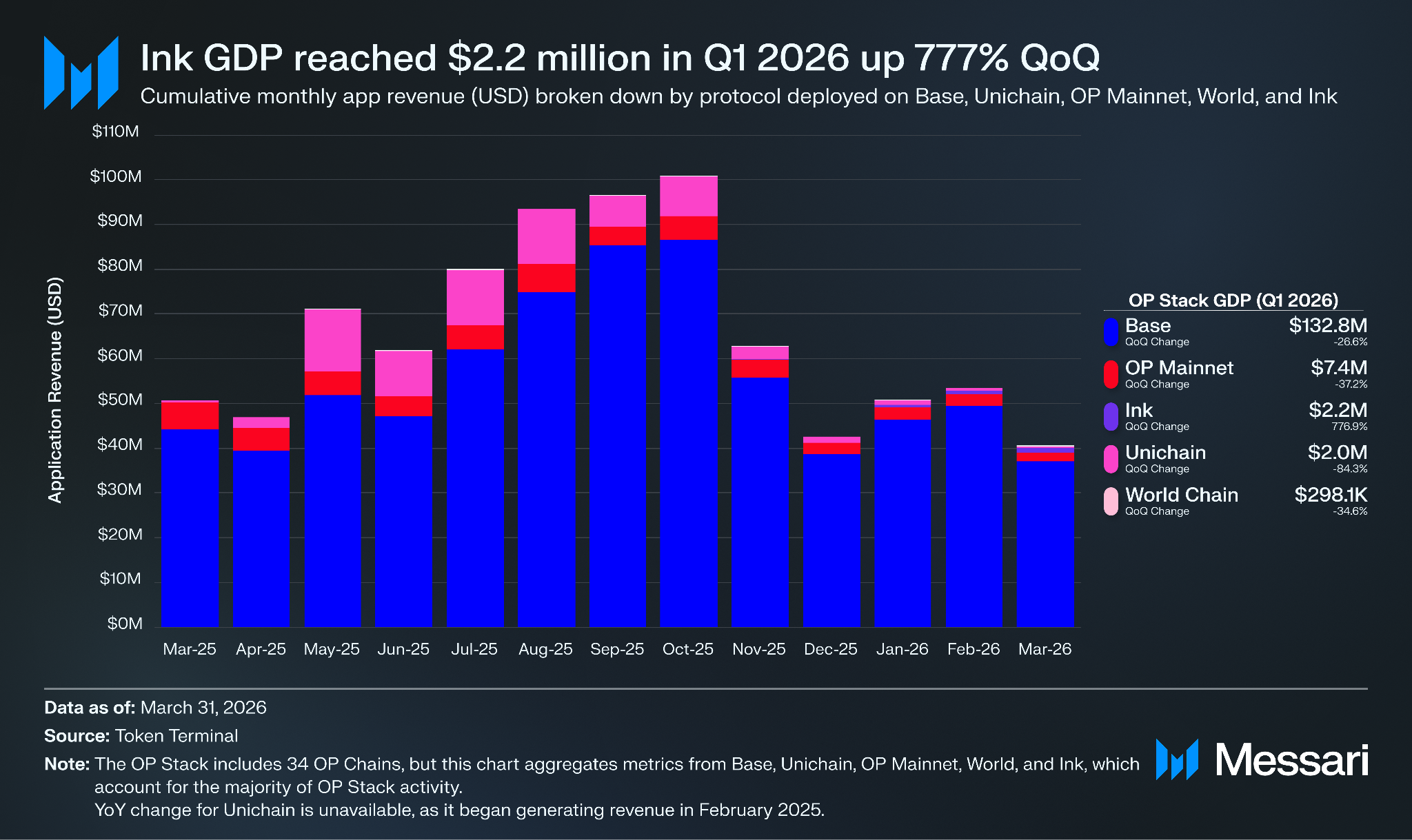
In Q1 2026, Chain GDP totaled $144.8 million across the top five OP Chains, down 29.9% QoQ from $206.5 million in Q4 2025, as a broader crypto market downturn reduced trading and lending activity across the OP Stack. Ink was a positive outlier, as the chain's GDP surged 776.9% QoQ from $254,200 in Q4 2025 to $2.2 million in Q1 2026, driven largely by growing activity on Tydro. The acceleration positioned Ink as the fastest-growing OP Chain by application revenue.
Base was the largest contributor to Chain GDP at $132.8 million in Q1, down 26.6% QoQ from $180.9 million in Q4 2025. Unichain's Chain GDP fell 84.3% QoQ from $13.1 million to $2.0 million, the steepest decline among the top five OP Chains. OP Mainnet fell 37.2% QoQ from $11.9 million to $7.4 million, and World Chain declined 34.6% QoQ from $455,900 to $298,100.
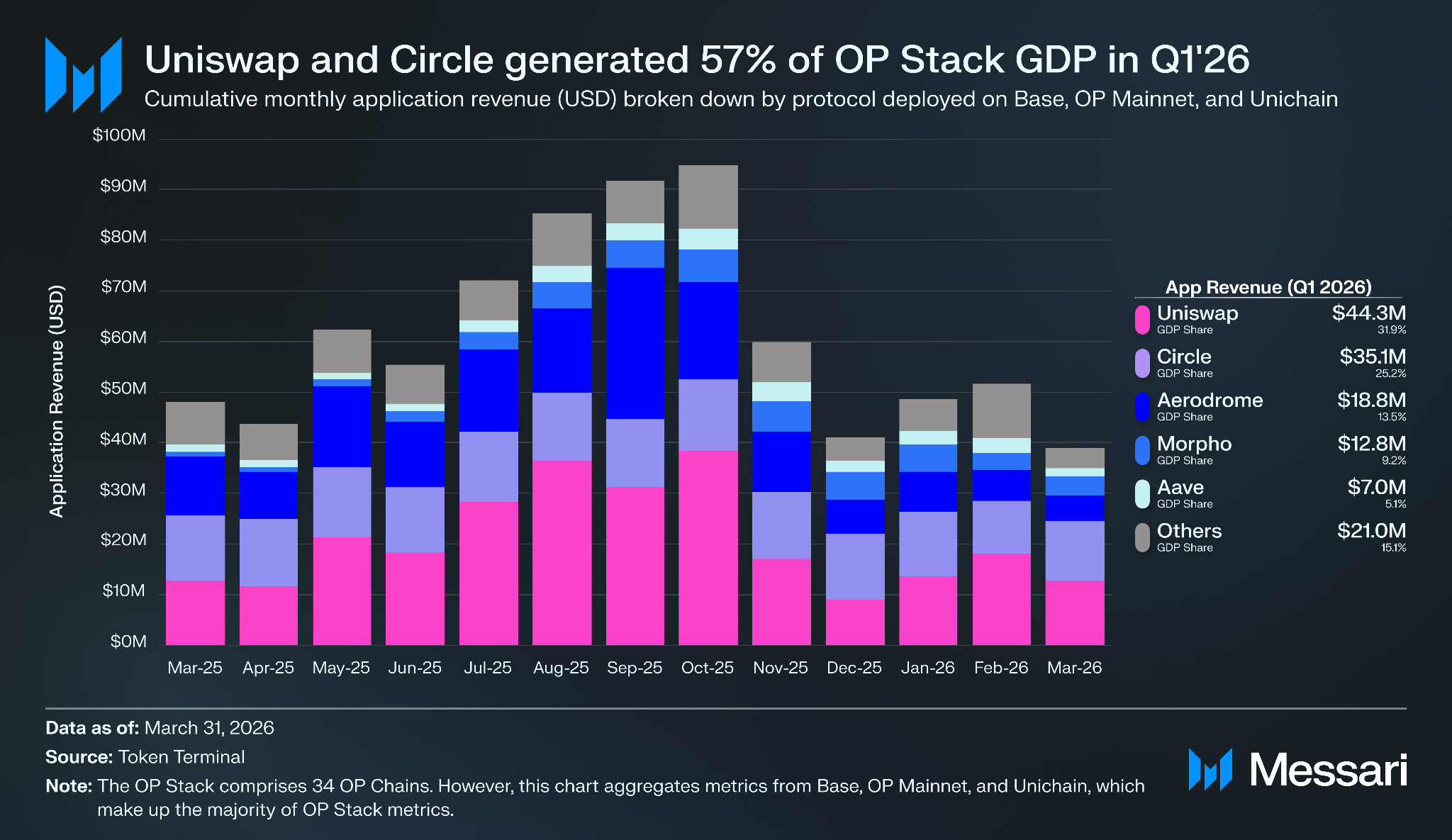
Total application revenue across the top protocols deployed on Base, OP Mainnet, and Unichain declined 29.0% QoQ from $195.8 million in Q4 2025 to $139.1 million in Q1 2026. Monthly DEX-to-CEX spot volume market share fell from 17.9% in December 2025 to 14.5% in March 2026, reflecting reduced onchain trading activity that compressed fee revenue across OP Stack DEXs.
Circle's revenue share rose from 20.7% to 25.2% over the same period. Speculative activity cooled in Q1, as trading and lending protocols contracted, while Circle's interest-based income from stablecoin reserves held steadier. This shows that capital on the OP Stack shifted from active trading to passive yield. In Q1, Uniswap and Circle accounted for 57.1% of OP Stack GDP.
Uniswap, a DEX, GDP fell 31.2% QoQ from $64.5 million to $44.3 million, but remained the largest single contributor to OP Stack GDP, with a 31.9% share. Stablecoin issuer Circle, which generates application revenue primarily through interest income from stablecoin reserves and USDC redemption fees, decreased 13.3% QoQ, from $40.4 million to $31.5 million, the smallest decrease among the top five protocols. From Q4 2025 to Q1 2026, Circle's revenue share increased from 20.7% to 25.2%. Aerodrome, a DEX native to Base, fell 50.0% QoQ from $37.7 million to $18.8 million, the largest decline among top protocols. Morpho, a permissionless lending protocol, fell 29.3% QoQ from $18.1 million to $12.8 million, and Aave, a multichain lending protocol, declined 29.5% QoQ from $10.0 million to $7.0 million.
Total value secured (TVS) represents the total value of fungible tokens on a given network, including assets held in DeFi protocols and those held elsewhere. TVS is the sum of canonical bridged tokens, externally bridged tokens, and native tokens.
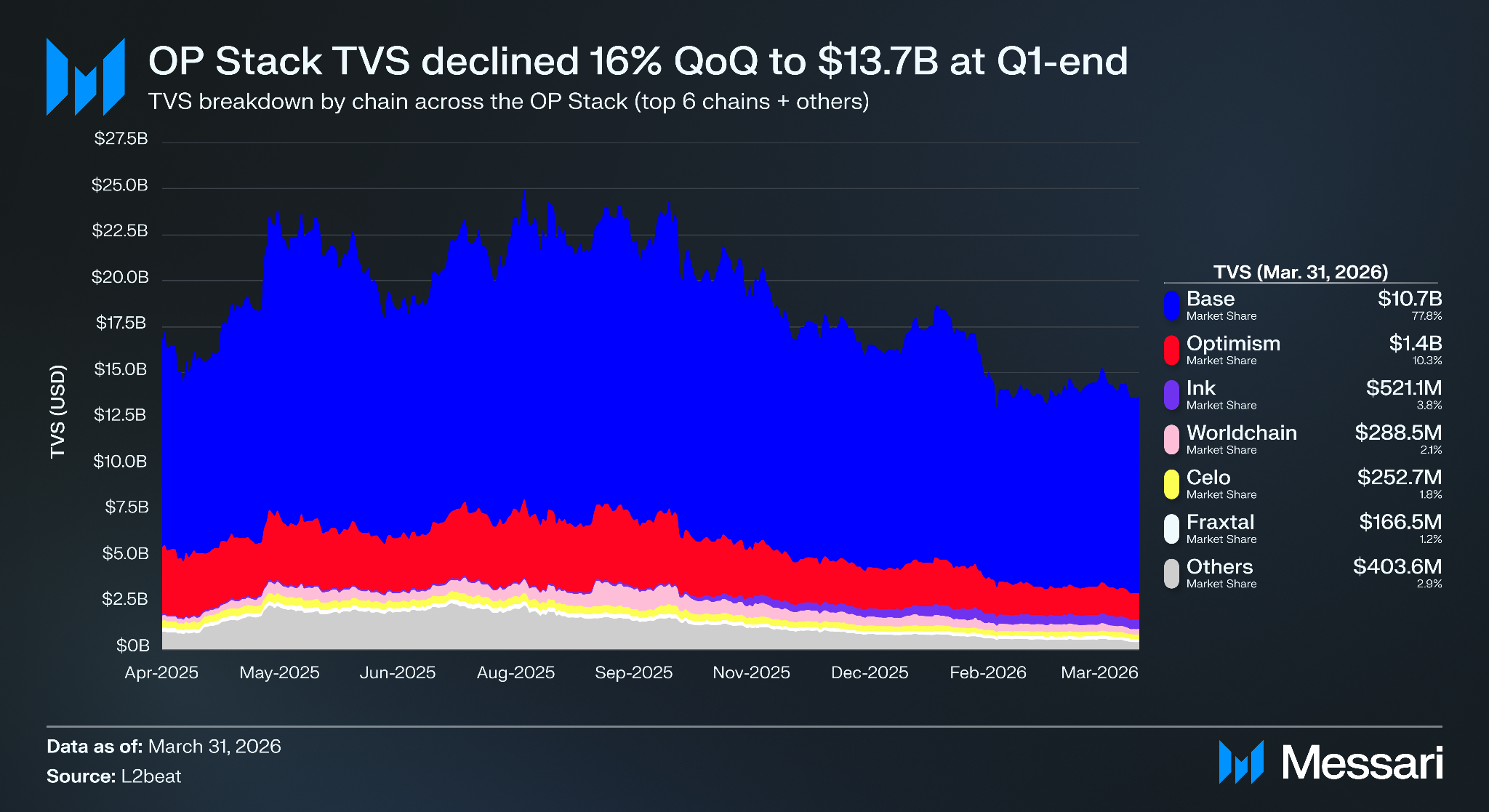
OP Stack TVS declined 15.9% QoQ from $16.3 billion on Dec. 31 to $13.7 billion on March 31. TVS decline outpaced TVL's 14.8% decline over the same period. TVS captures all fungible tokens on a network, including volatile assets sitting in wallets, native tokens, and speculative holdings not deployed in protocols. TVL only counts assets deposited in DeFi protocols, which skew more heavily toward stablecoins in lending pools, DEX liquidity pairs, and yield vaults. In a risk-off quarter when the crypto market cap fell 20.4% QoQ, TVS absorbed more of that price impact because a larger share of its composition is volatile tokens. TVL was partially insulated because stablecoin deposits do not lose value when markets decline and remain sticky as depositors continue earning yield.
Base held the largest share at 77.8% ($10.7 billion). OP Mainnet followed at 10.3% share ($1.4 billion). Ink was the only OP Chain to grow in TVS, rising 1.3% QoQ from $514.2 million on Dec. 31 to $521.1 million on March 31, and increased its share from 3.1% to 3.8%. World Chain held 2.1% share ($288.5 million), Celo held 1.8% share ($252.7 million), and Fraxtal held 1.2% share ($166.5 million).
DeFi
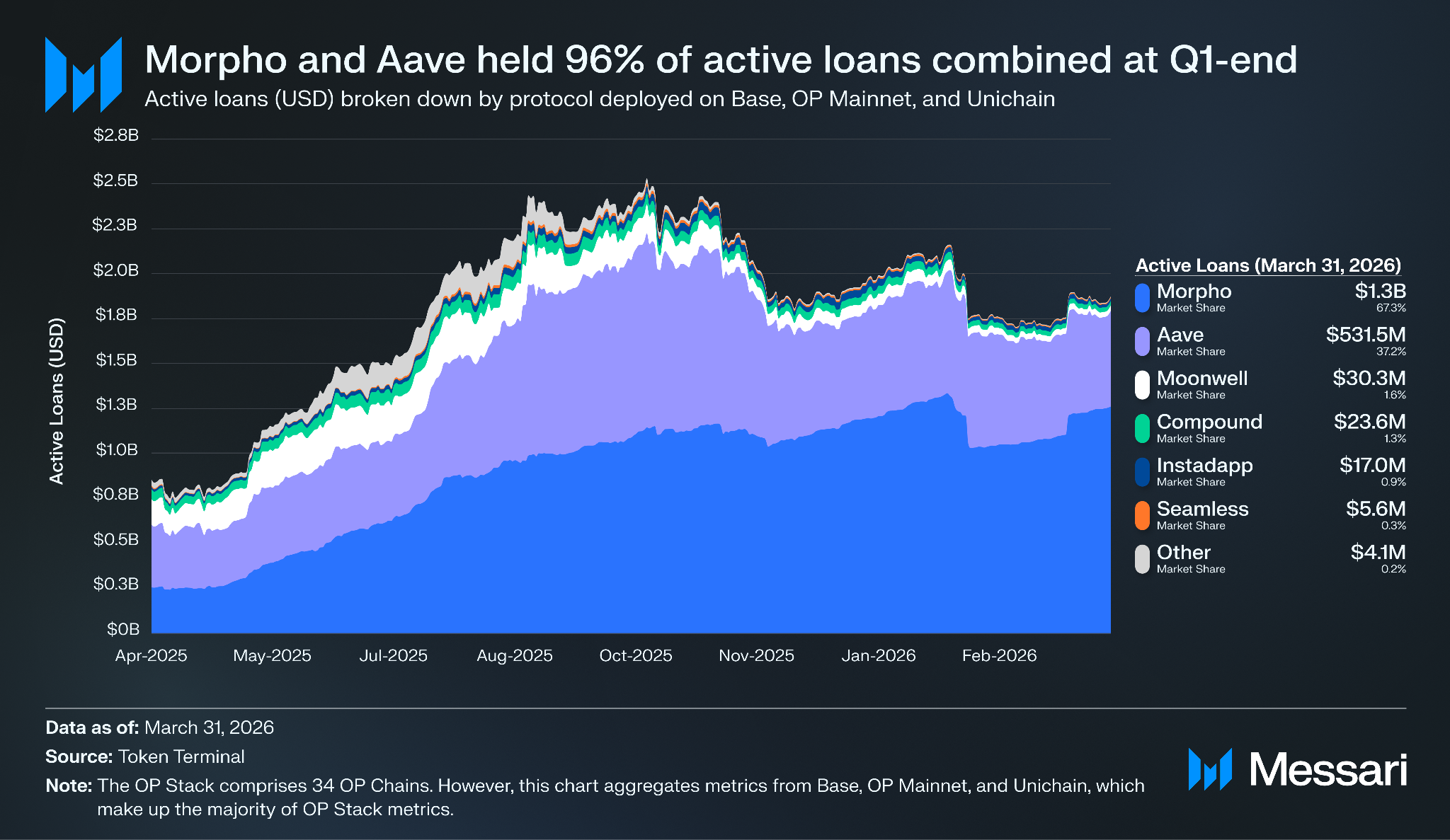
Active loans measure the total value of outstanding borrow positions on a lending protocol. Total active loans across Base, OP Mainnet, and Unichain declined just 4.6% QoQ from $2.0 billion on Dec. 31 to $1.9 billion on March 31. Active loans were the best-performing OP Stack core economic indicator in Q1. Morpho and Aave accounted for 95.7% of active loans combined at Q1-end.
Morpho was the only major lending protocol to grow in Q1, rising 5.3% QoQ from $1.2 billion on Dec. 31 to $1.3 billion on March 31. Morpho increased its share during the quarter from 61.0% at Q4-end to 67.3% at Q1-end. Q1 marked Morpho's fourth consecutive quarter of growth on the OP Stack, up 395.6% YoY from $253.9 million on March 31, 2025. On Feb. 18, Coinbase expanded its onchain loan product on Morpho to accept XRP, DOGE, ADA, and LTC as collateral, which was a catalyst for the increase in active loans. On Jan. 26, Bitwise Asset Management joined Morpho as a vault curator, and on Feb. 17, regulated custodian Taurus integrated Morpho, offering institutional clients direct access to curated vaults.
Aave active loans fell 11.8% QoQ from $602.9 million to $531.5 million (28.4% share) at Q1-end. Moonwell declined 51.7% QoQ to $30.3 million (1.6% share), Compound fell 44.4% QoQ to $23.6 million (1.3% share), and Instadapp declined 58.6% QoQ to $17.0 million (0.9% share).
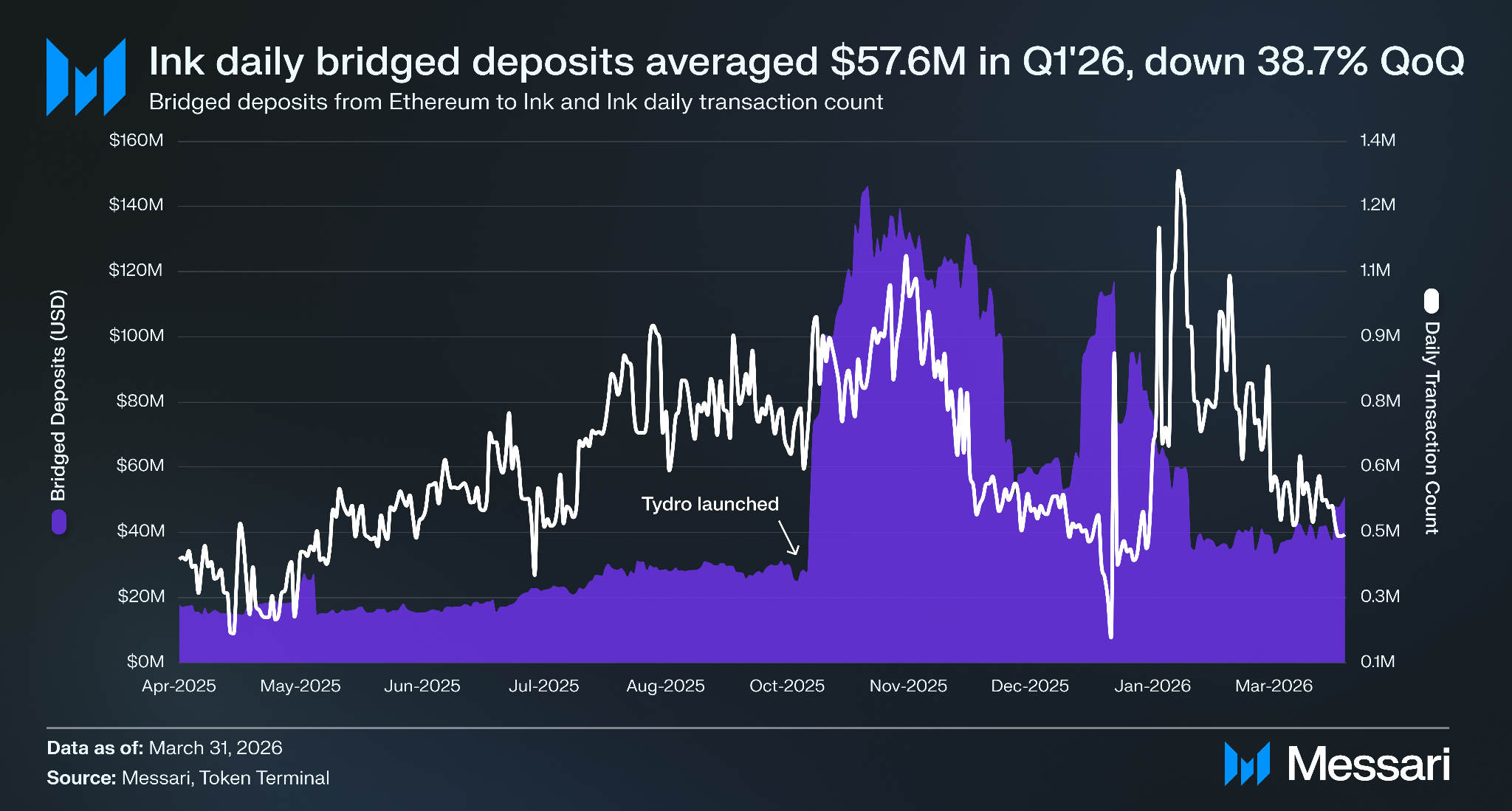
In Q1 2026, Ink bridged deposits from Ethereum averaged $57.6 million, a 38.7% QoQ decrease from $94.0 million in Q4 2025. The Q1 average was more than double the $25.4 million recorded in Q3 2025 before the Oct. 15 launch of Tydro, Ink's native lending and borrowing protocol. In Q1, total transactions on Ink reached 56.0 million, down 16.4% QoQ from 67.0 million in Q4 but roughly in line with Q3's 61.8 million, indicating that bridged capital is actively circulating rather than sitting idle.
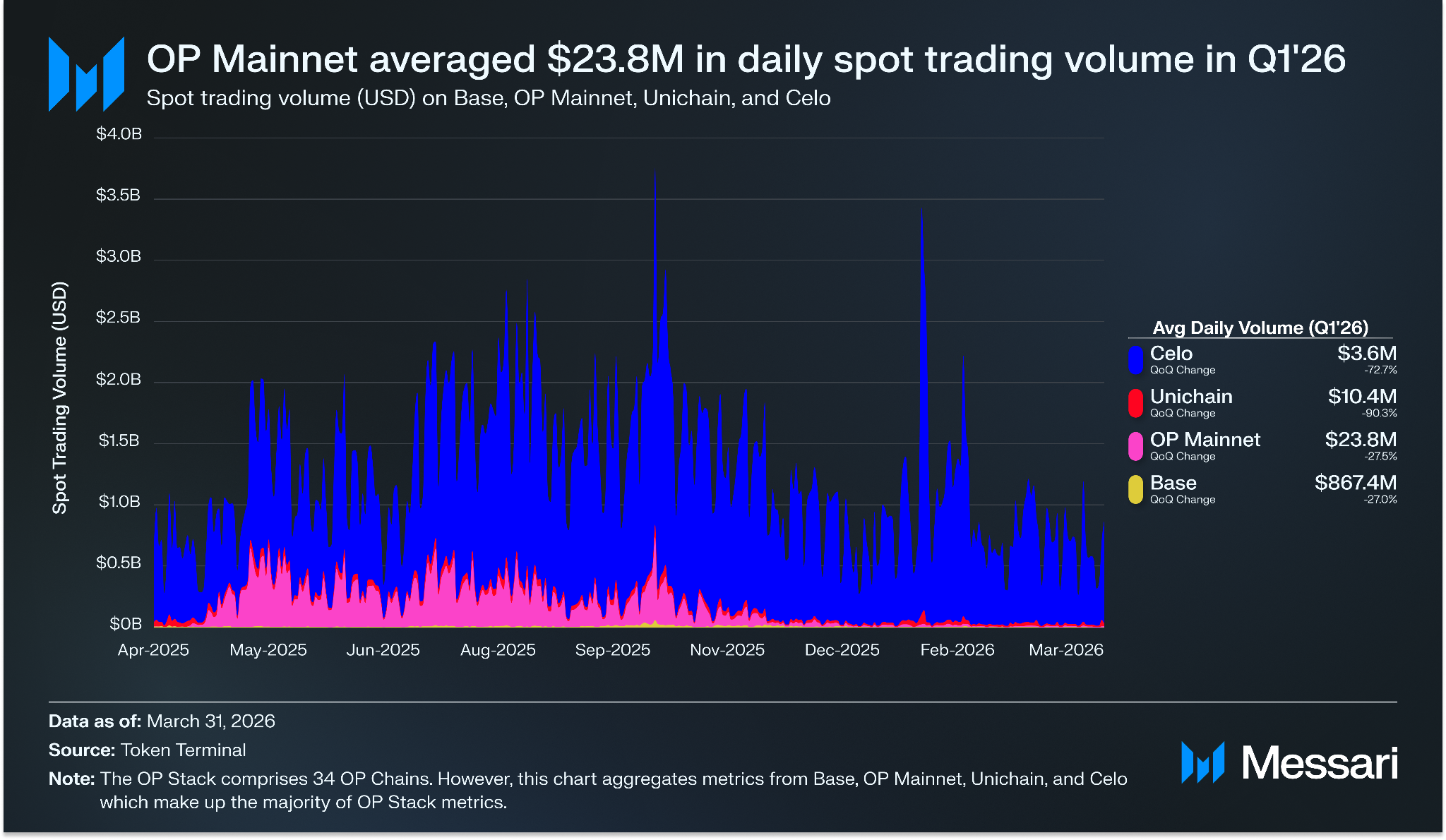
In Q1, average daily spot trading volume declined 32.5% QoQ to $905.2 million from $1.3 billion in Q4 2025. Base and OP Mainnet declined at roughly the same rate, suggesting their volume tracked the broader market contraction, while Unichain and Celo fell far more sharply as post-launch trading activity faded. Base held the largest share of DEX spot trading volume across all OP Chains at $867.4 million (95.8% share), down 27.0% QoQ from $1.19 billion in Q4 2025. OP Mainnet followed at $23.8 million (2.6% share), down 27.5% QoQ from $32.9 million in Q4. Unichain posted the largest decline at 90.3% QoQ from $106.8 million in Q4 to $10.4 million (1.1% share), and Celo fell 72.7% QoQ from $13.1 million in Q4 to $3.6 million (0.4% share).
OP Chain Activity
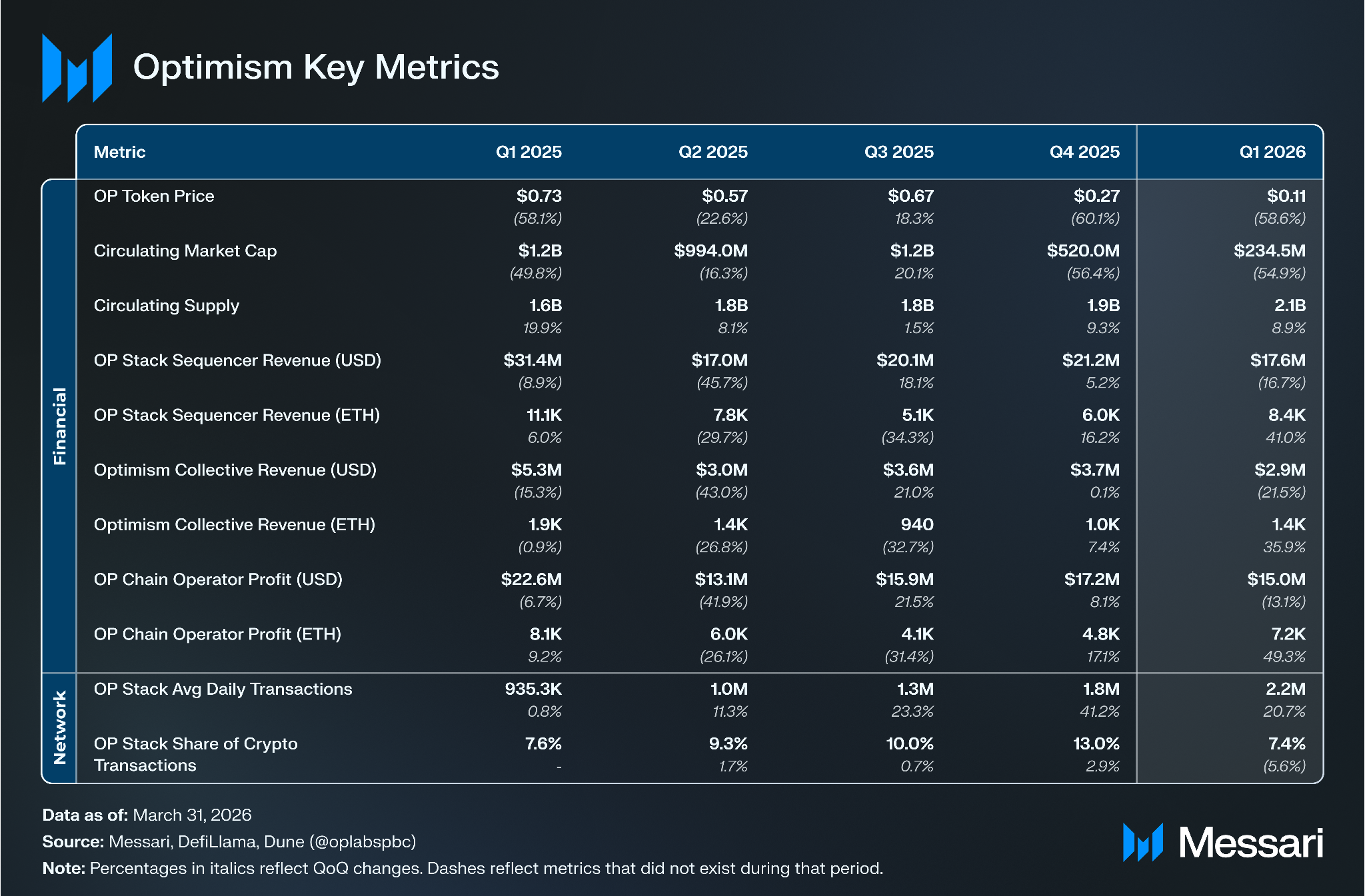
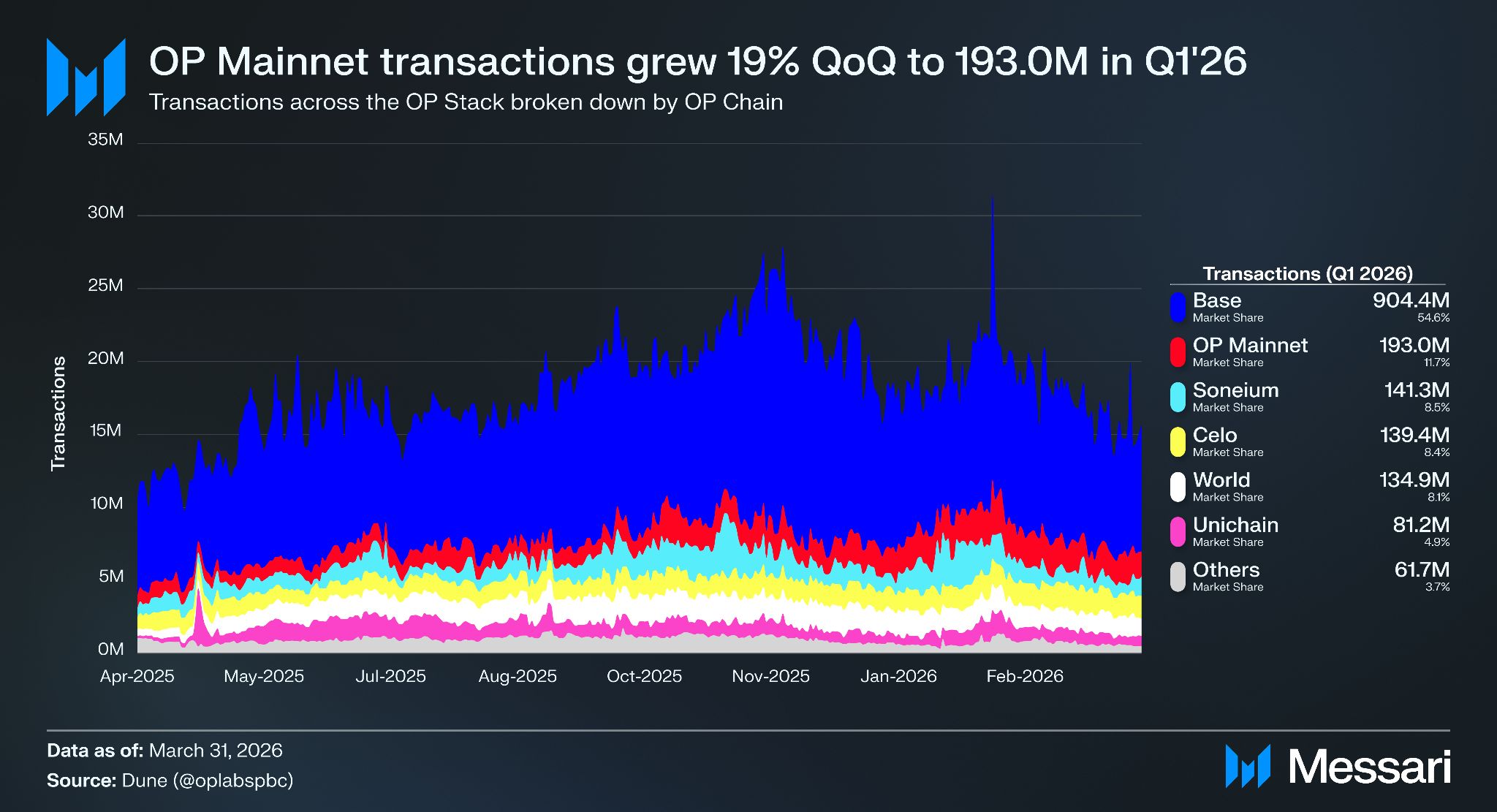
Total transactions across the OP Stack declined 16.3% QoQ from 2.0 billion in Q4 2025 to 1.7 billion in Q1 2026. OP Mainnet and Celo were the only OP Chains to grow in transaction volume.
OP Mainnet transactions grew 18.6% QoQ from 162.8 million in Q4 to 193.0 million in Q1, increasing its share from 8.2% to 11.7%. Ether.fi's Cash migration to OP Mainnet is expected to bring an estimated 28,000 daily spend transactions and 2,000 daily internal swaps to the chain, which will accelerate OP Mainnet transaction growth in Q2.
Celo grew 6.6% QoQ from 130.8 million to 139.4 million transactions, increasing its share from 6.6% to 8.4%. The growth was driven primarily by MiniPay, a self-custodial stablecoin wallet that facilitates high-frequency micro-transactions across Africa, Southeast Asia, and Latin America. As of Sept. 16, 2025, MiniPay recorded 270 million cumulative transactions, and as of March 31, it surpassed 430 million cumulative transactions, adding 160 million transactions during that period.
Base led transaction share with 54.6% (904.4 million), and Soneium was third with 8.5% share (141.3 million). World accounted for 8.1% share (134.9 million), and Unichain processed a 4.9% share (81.2 million).
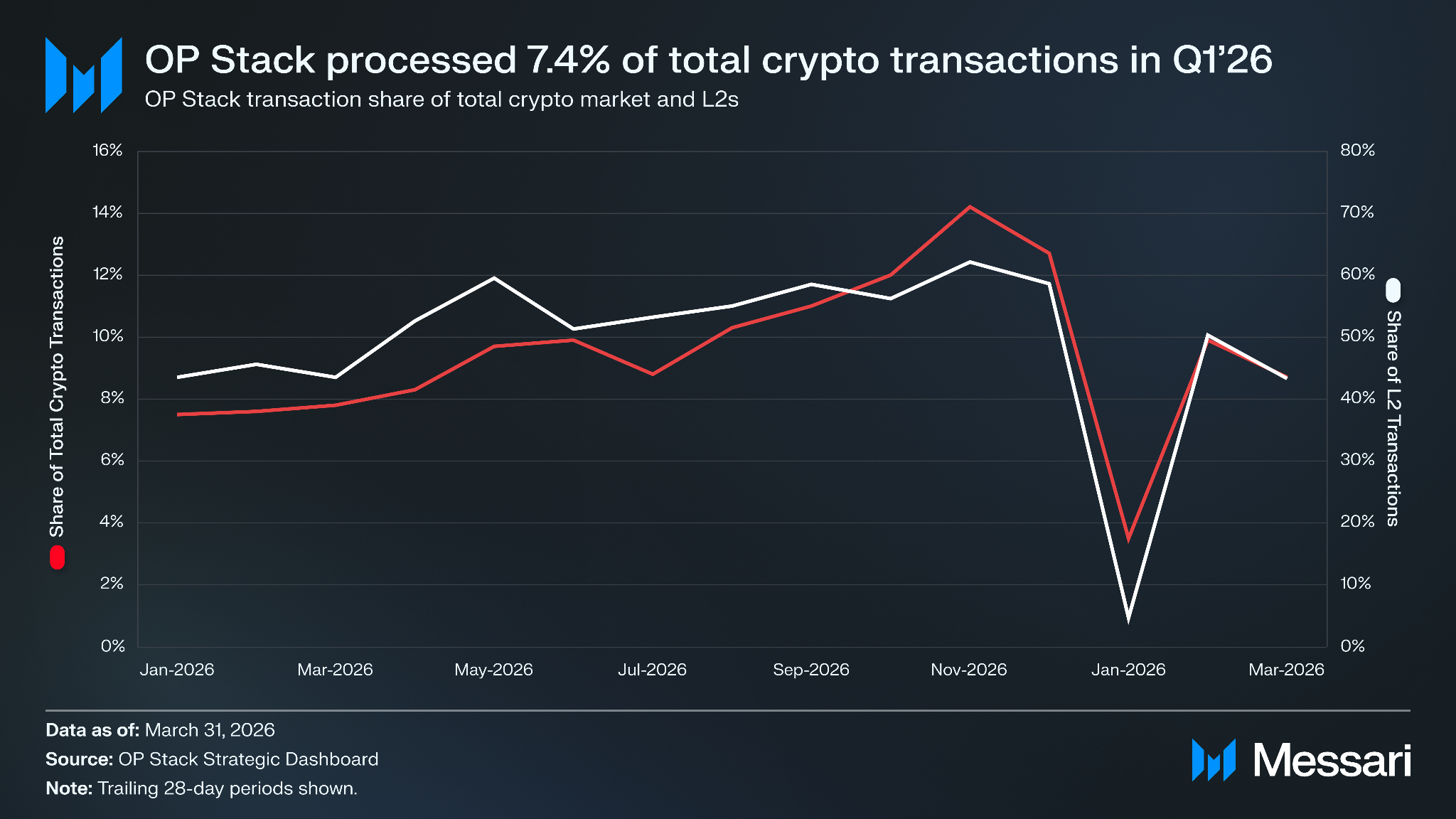
In Q1, the OP Stack processed 7.4% of total crypto transactions, down from 13.0% in Q4 2025. Its share of L2 transactions fell from 59.0% to 32.8% over the same period.
Both metrics had climbed steadily through 2025, with total crypto share rising from 7.6% in Q1 2025 to 13.0% in Q4 2025, and L2 share expanding from 44.2% to 59.0% over the same period. The Q1 2026 reversal, however, was largely due to a transaction surge from MegaETH, an Ethereum L2, in January 2026 rather than an OP Stack contraction. On Jan. 22, MegaETH launched a week-long mainnet stress test thatprocessed 10.7 billion transactions. In January 2026, the OP Stack processed 579.4 million transactions and recorded a 4.7% share of L2 transactions. In February, after MegaETH’s stress test concluded, the OP Stack processed 567.8 million transactions, down only 2.0% MoM, yet recorded a 50.3% share of L2 transactions.
These figures reflect trailing 28-day snapshots rather than full-quarter averages and are particularly sensitive to short-term surges, such as the MegaETH stress test. Excluding that anomaly, the OP Stack's underlying transaction activity remained stable through Q1 2026.
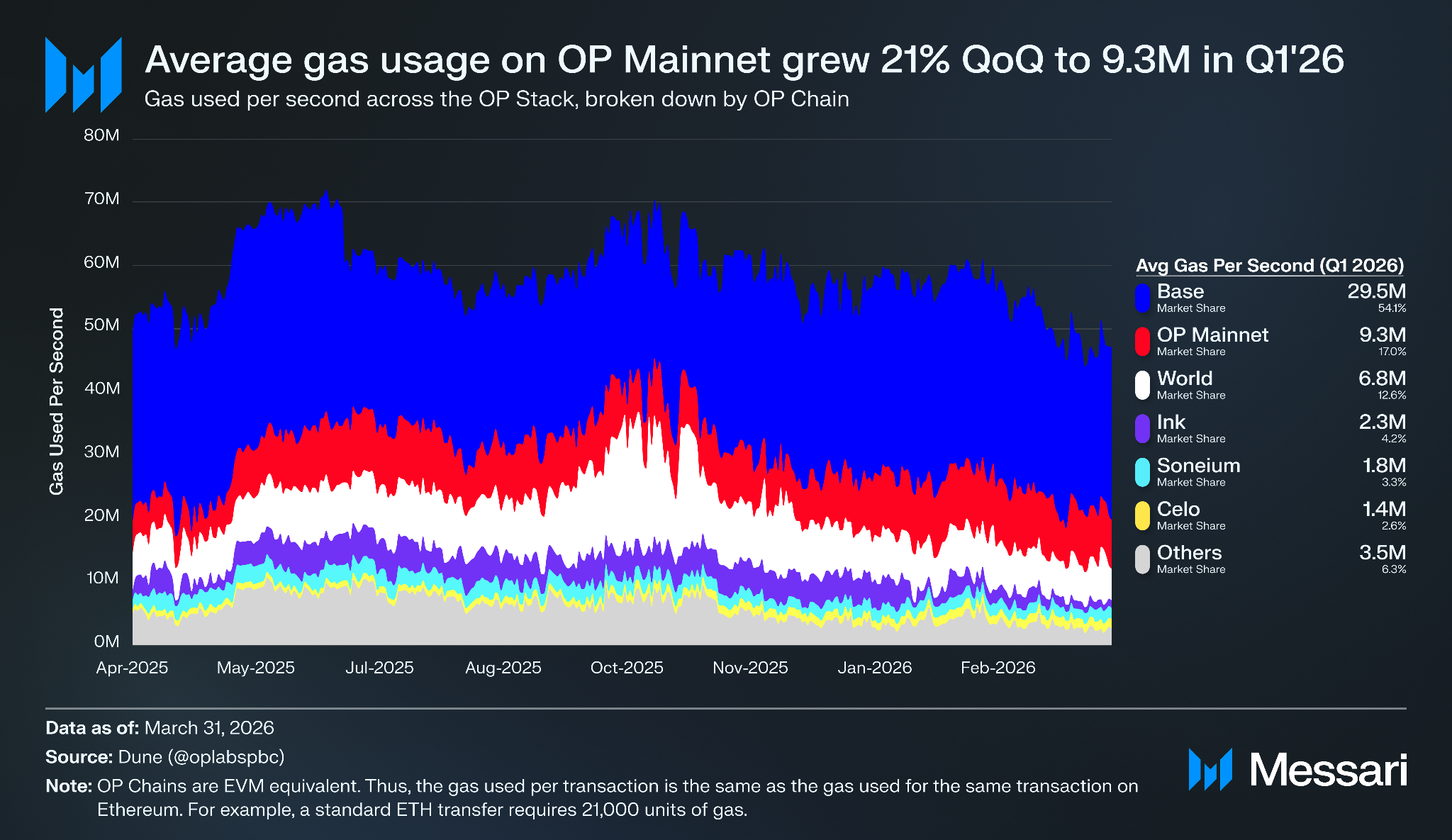
Total average gas used per second across the OP Stack fell 9.3% QoQ to 54.5 million in Q1 2026 from 60.1 million in Q4 2025. The decline was concentrated in World Chain and Ink, where gas consumption dropped 40.7% and 48.1% QoQ, respectively. World Chain's average gas/s fell from 11.6 million to 6.8 million (12.6% share), a reversal from its surge in Q3 2025 when smart wallet architectures like Gnosis Safe and ERC-4337 accounts drove gas consumption to 20.0 million.
Base users remained the largest consumers of gas by a wide margin at 29.5 million gas/s (54.1% share), up 6.2% QoQ from 27.8 million in Q4 2025. OP Mainnet gas consumption grew 20.8% QoQ from 7.7 million to 9.3 million gas/s (17.0% share), its highest level over the trailing year. Celo also posted a modest 5.8% QoQ increase from 1.3 million to 1.4 million gas/s (2.6% share). Soneium held relatively steady at 1.8 million gas/s (3.3% share), down from 1.9 million in Q4 2025.
Optimism Collective
OP Stack Revenue Sharing
The Optimism Collective is a bicameralgovernance body comprising the Token House and Citizens’ House, with the Optimism Foundation as the executive arm that implements Collective decisions and manages day-to-day operations. The Collective brings together companies, communities, and individual citizens to coordinate the OP Stack's growth and reward contributions to public goods.
While the Optimism Collective does not have a publicly viewable, singular treasury, it generates consistent revenue through a revenue-sharing model. According to the Standard Rollup Charter, all OP Chains within the OP Stack must contribute the greater of either 2.5% of sequencer revenue or 15% of sequencer profit (sequencer revenue minus Ethereum submission costs). The lone exception is OP Mainnet, which contributes 100% of its sequencer profit.
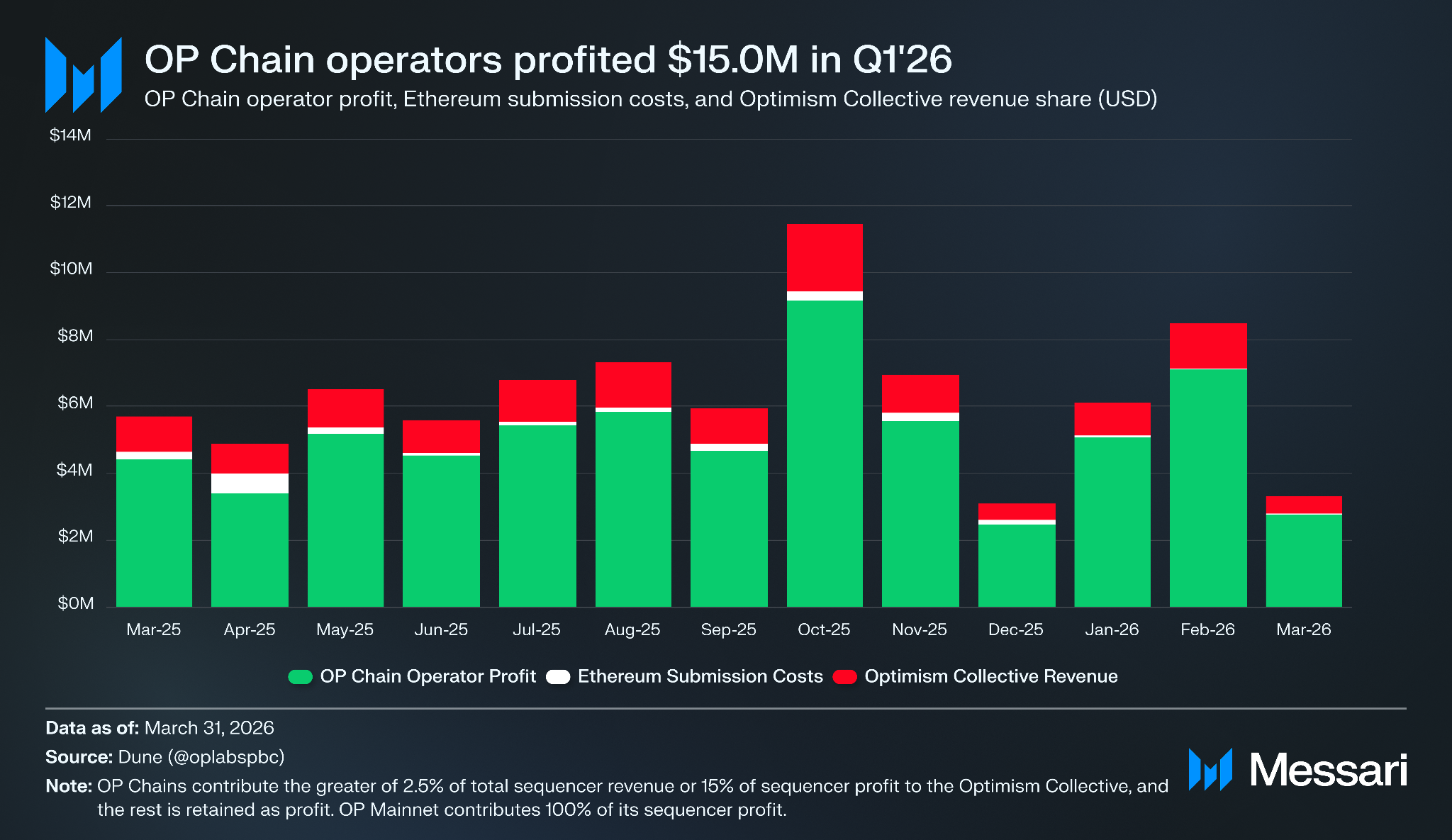
In Q1 2026, Ethereum submission costs continued their structural decline since Ethereum's Dencun upgrade in March 2024, which introduced blobs and reduced L2 data posting costs. This past quarter, OP Chains paid $108,900 to post data to Ethereum, averaging roughly $36,000 per month and down 82.5% QoQ from $622,800 in Q4 2025. OP Chain operators retained $15.0 million in profit during Q1, down 13.1% QoQ from $17.2 million in Q4. OP chains contributed $2.9 million of their sequencer revenue to the Optimism Collective in Q1, down 21.5% QoQ from $3.7 million.
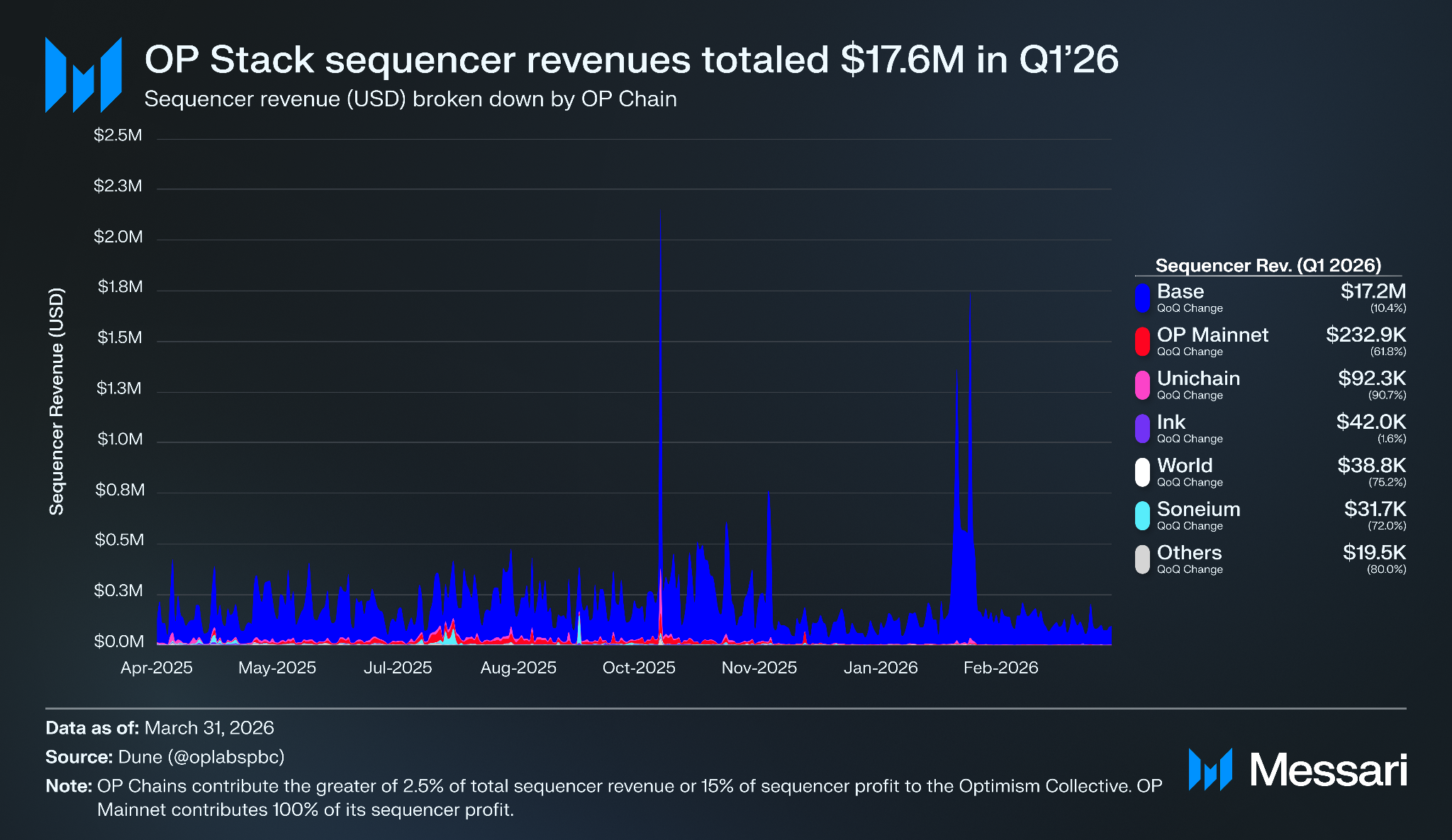
In Q1 2026, OP Stack sequencer revenue totaled $17.6 million, down 16.7% QoQ from $21.2 million in Q4 2025. Base remained the dominant contributor at $17.2 million, representing a 97% share of total OP Stack sequencer revenue and down 10.4% QoQ from $19.1 million. OP Mainnet posted the second-highest sequencer revenue in Q1 at $232,900. In Q1, Ink held roughly flat at $42,000, down just 1.6% QoQ from $43,000 in Q4, the smallest decline among OP Chains.
Governance
Q1 2026 governance activity centered on two themes: aligning the OP token with OP Stack economic growth through token buybacks and restructuring the Collective's organizational model.
Season 9
A season is a recurring governance period within the Collective during which it recalculates citizenship eligibility, approves grants, and assigns governance roles on a per-season basis.
On Jan. 8, the Optimism Foundation announced Season 9, which introduced an updated process for governing the Optimism treasury, called Capital Allocation 2.0, to be rolled out over six months. Capital Allocation 2.0 will consist of multiple proposals from the Foundation, subject to governance approval, to restructure how treasury funds are allocated to prioritize OP Stack development.
OP Token Buyback Program
On Jan. 8, the Optimism Foundation launched its first proposal: a 12-month pilot program to direct 50% of incoming OP Stack sequencer revenue toward monthly OP token purchases. The buyback mechanism ties OP demand directly to network activity, a dynamic that did not exist before this proposal.
As of Jan. 8, trailing 12-month OP Stack revenue totaled approximately 5,868 ETH ($13.8 million as of April 15). The Foundation will continue to manage the remaining 50% of revenue for yield generation and ecosystem investment, subject to governance oversight. On Jan. 22, the proposal moved to an onchain vote and passed on Jan. 28 with 84.4% support. On March 5, the Optimism Collective announced the first monthly buyback, funded by Jan. 2026 revenue, which purchased 1,574,817 OP using 95.8 ETH. Proceeds were settled to a designated Collective wallet.
At January 2026 revenue levels, the program would direct 1,056 ETH toward OP purchases over the remaining 11 months of the pilot. Governance will evaluate the pilot's results before deciding whether to extend or modify the program in 2027.
Retro Funding Pause
As part of the Season 9 restructuring, the Foundation announced that Retroactive Public Goods Funding (Retro Funding) will be paused through at least the end of 2026. Retro Funding was previously OP tokens distributed to OP Stack open-source builders, researchers, educators, and contributors. The Foundation noted that it may put forward a proposal to reallocate all or a portion of the 775 million OP reserved for Retro Funding in the coming months.
Legal Structure Proposal
The Foundation outlined other future proposals for structural changes expected in 2026. These include a legal restructuring proposal to convert to a Decentralized Unincorporated Nonprofit Association (DUNA) to enable more voting power to come online and to transfer specific assets and governance powers to an onchain structure.
Technical Developments
Optimism underwent several technical developments and network upgrades in Q1 2026:
Upgrade 19: On Feb. 20, automated OP Stack revenue distribution replaced a previous manual distribution, under which a protocol's share remains the greater of 2.5% of revenue or 15% of profit (excluding L1 fees).
Succinct partnership: On Feb. 12, Optimism selected Succinct as its first preferred ZK proving provider. The integration will replace the seven-day optimistic challenge window with ZK validity proofs to reduce settlement time for L2-to-L1 withdrawals. ZK proofs will deploy first on OP Mainnet, with other OP Stack chains able to upgrade thereafter.
Post-quantum roadmap: On Jan. 14, OP Labs announced a 10-year timeline to deprecate externally owned accounts (EOAs), which currently rely on ECDSA cryptography vulnerable to quantum computing, across the OP Stack. The migration path will rely on EIP-7702, an account abstraction standard that allows EOAs to delegate signing authority to post-quantum smart contract accounts. The L2 sequencer and batch submitter will also transition to post-quantum signatures.
OP Stack benchmarking framework: On March 11, OP Labs introduced an end-to-end benchmarking framework that will measure sustained performance across full devnets under realistic workload conditions, rather than isolated execution-layer metrics. The framework will produce bottleneck diagnoses alongside headline results and will inform the OP Stack's scalability roadmap.
Celo Jovian hardfork: On March 31, Celo upgraded to the latest OP Stack update, which refined gas accounting, introduced execution layer changes, and transitioned Celo to the Minimum Base Fee model.
Closing Summary
Q1 2026 was defined by the institutional products and partnerships that will shape Optimism's trajectory. On Jan. 29, OP Labs launched OP Enterprise, a managed infrastructure product that allows institutions to own and operate dedicated chains without building blockchain operations in-house. Bitpanda became the first Fully Managed tier customer with Vision Chain, and on April 15, ether.fi went live on OP Mainnet, adding $220 million in TVL and positioning the chain as a home for payments-oriented DeFi.
These developments were supported by governance changes that tied OP Stack revenue to OP token buybacks. On Jan. 28, onchain voters approved a 12-month buyback program directing 50% of sequencer revenue toward monthly OP purchases, with the first buyback executed on March 5. Season 9 restructured the Collective's organizational model. OP Mainnet transactions grew 18.6% QoQ to 193.0 million, increasing its share of OP Stack activity from 8.2% to 11.7%.
Ether.fi's Cash product, which generates roughly 50% of the protocol's revenue, brings a payments-oriented revenue stream to OP Mainnet at a time when crypto card payments have expanded at a 106% CAGR since January 2023. Messari projects ether.fi's UserSafe balance to reach $539.2 million in the base case and $1.05 billion in the bull case by 2028, capital that would flow through OP Mainnet. Bitpanda targets a Vision Chain mainnet later in 2026, bringing MiCA-compliant Euro stablecoins and institutional asset issuance to the OP Stack. If these pipelines convert, Optimism will enter Q2 2026 with institutional revenue streams that do not depend on speculative trading activity, a structural shift in how the network generates and sustains economic value.
This report was commissioned by Optimism Foundation. All content was produced independently by the author(s) and does not necessarily reflect the opinions of Messari, Inc. or the organization that requested the report. The commissioning organization may have input on the content of the report, but Messari maintains editorial control over the final report to retain data accuracy and objectivity. Author(s) may hold cryptocurrencies named in this report. This report is meant for informational purposes only. It is not meant to serve as investment advice. You should conduct your own research and consult an independent financial, tax, or legal advisor before making any investment decisions. Past performance of any asset is not indicative of future results. Please see our Terms of Service for more information.
No part of this report may be (a) copied, photocopied, duplicated in any form by any means or (b) redistributed without the prior written consent of Messari®.
Austin is a Sr. Research Analyst for Messari’s Protocol Services team. He focuses on Prediction Markets, DeFi, & Interop. protocols. He previously worked on PwC's Digital Assets team.
Austin is a Sr. Research Analyst for Messari’s Protocol Services team. He focuses on Prediction Markets, DeFi, & Interop. protocols. He previously worked on PwC's Digital Assets team.