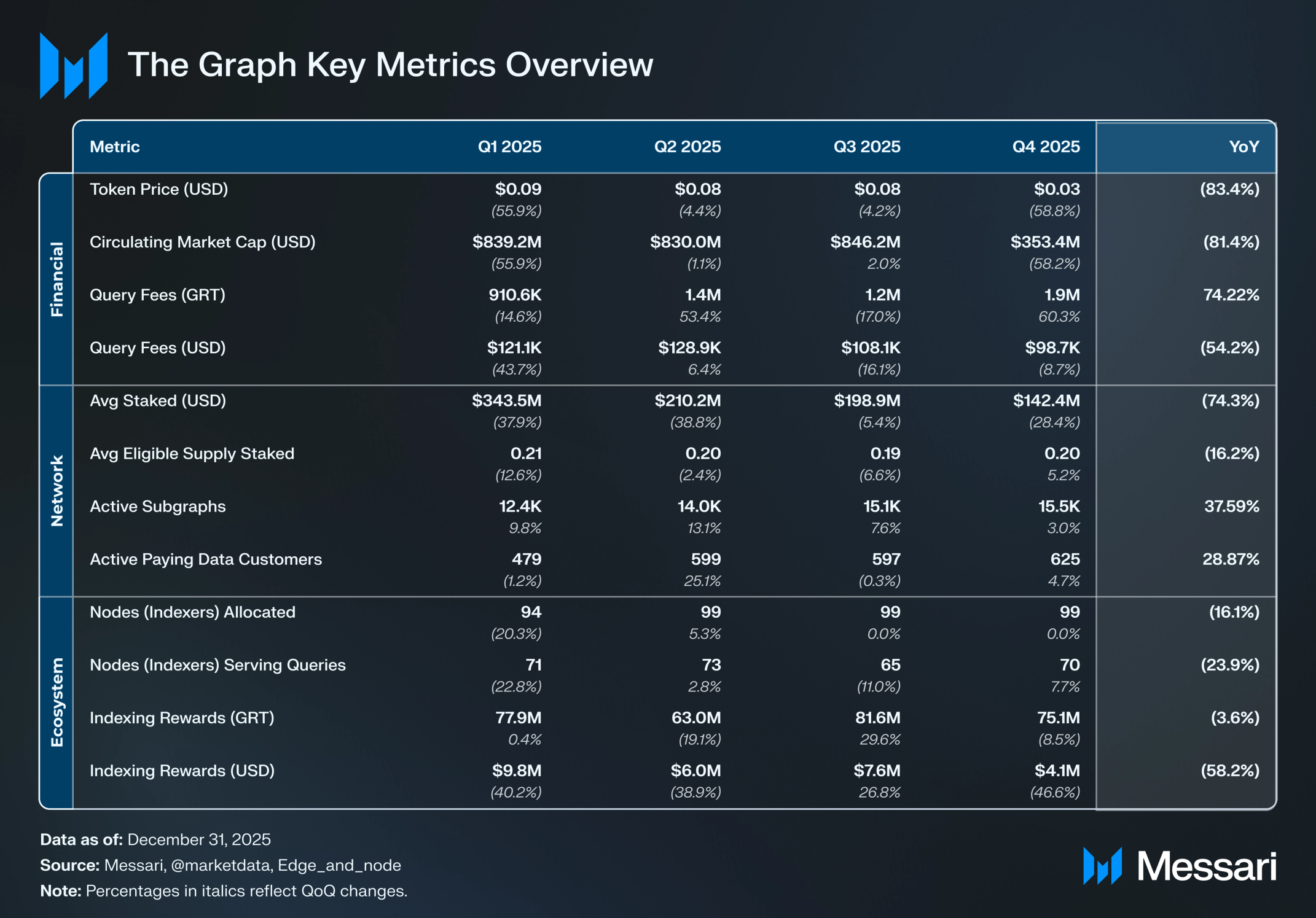
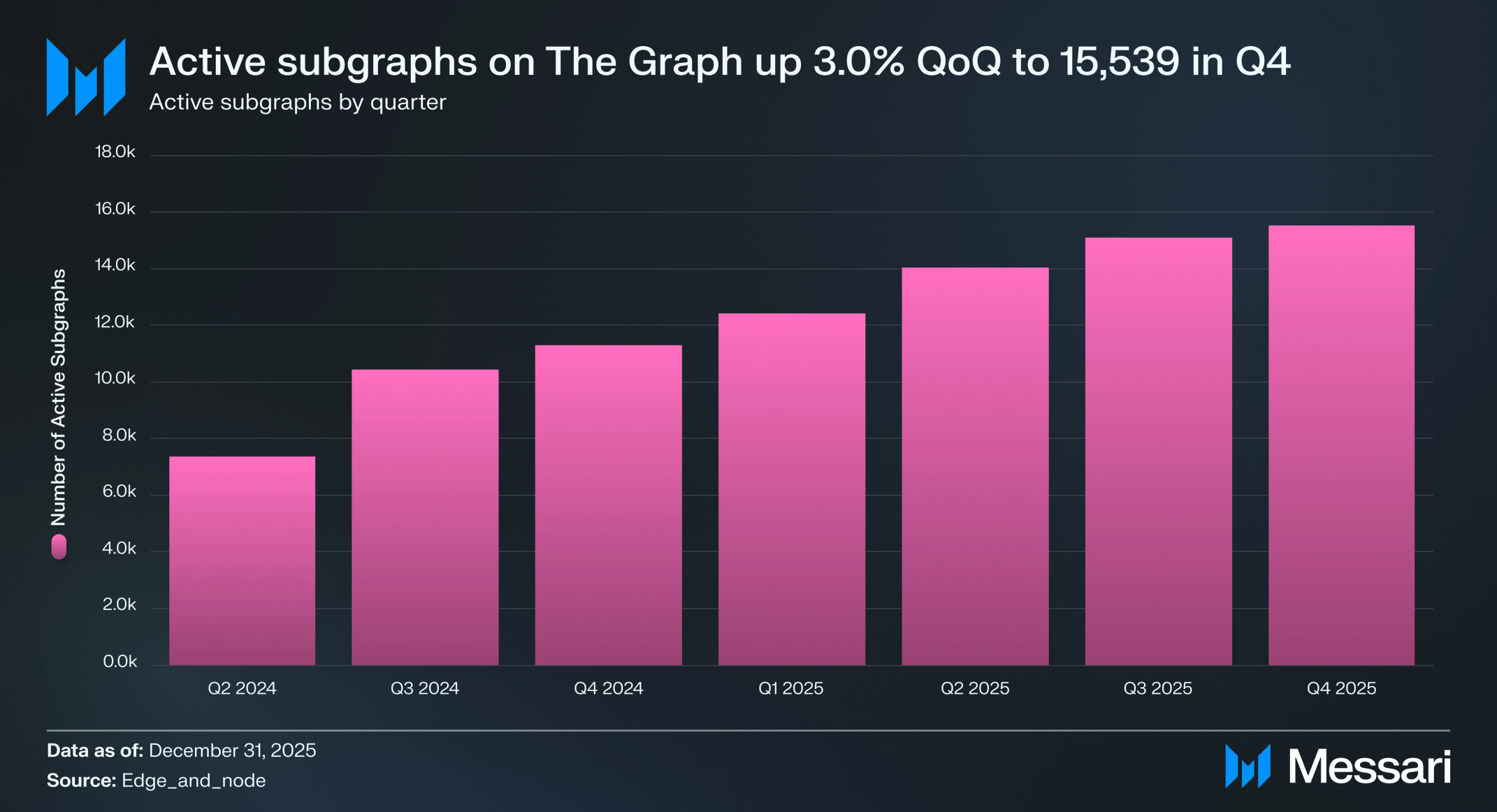
Active Subgraphs reached a new all-time high of 15.5K, up 3.0% QoQ, indicating continued developer engagement despite a sharp slowdown in new Subgraph creation.
Layer 2 networks continued to drive usage, with Base leading all chains at 1.23 billion queries, up 11.0% QoQ, and Arbitrum posting the strongest growth among major networks, increasing 31.0% QoQ.
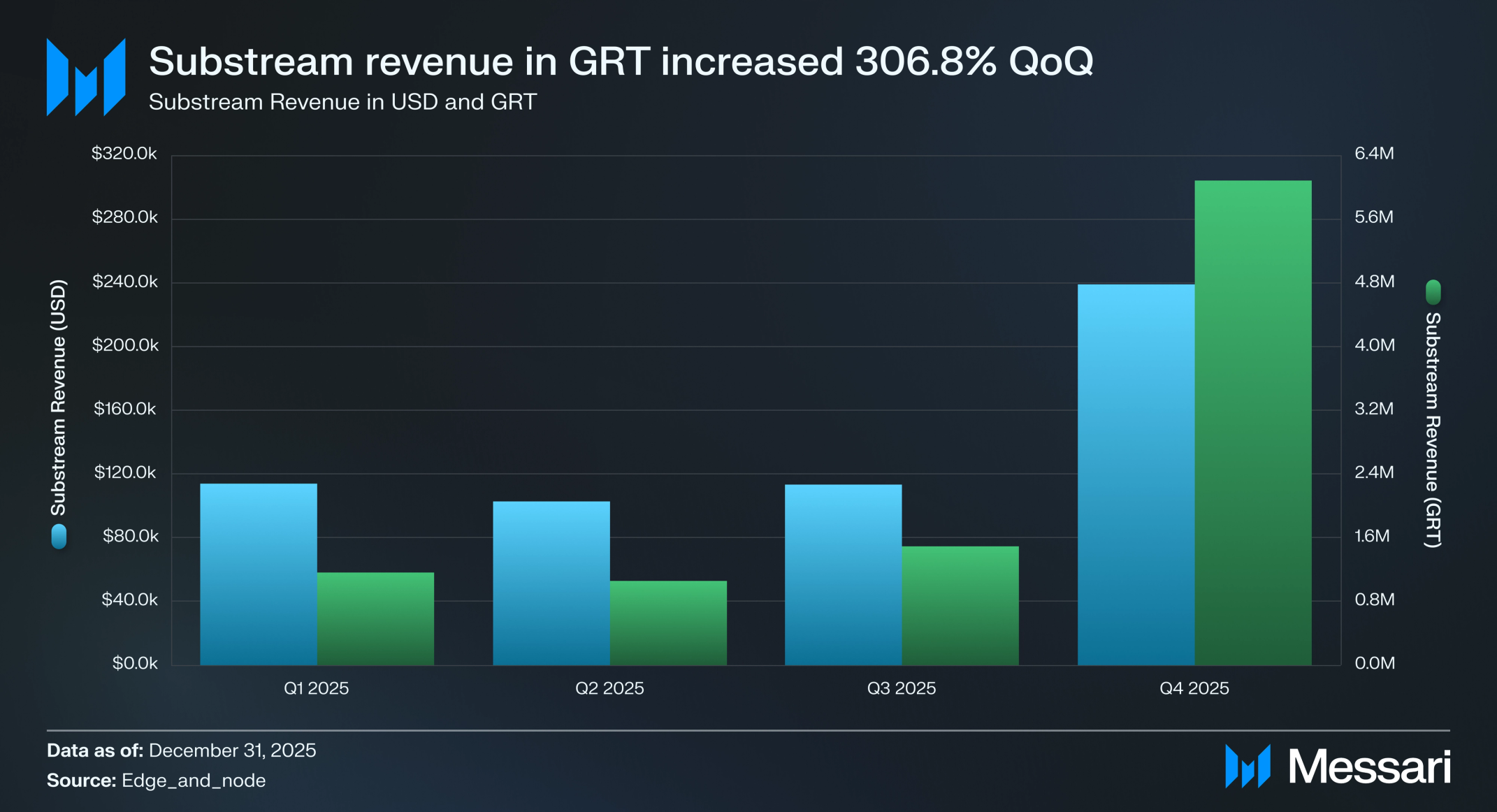
Substreams revenue hit a record high, rising more than 4x QoQ to 6.08 million GRT, marking a breakout quarter and signaling growing adoption of streaming-first, high-performance data pipelines.
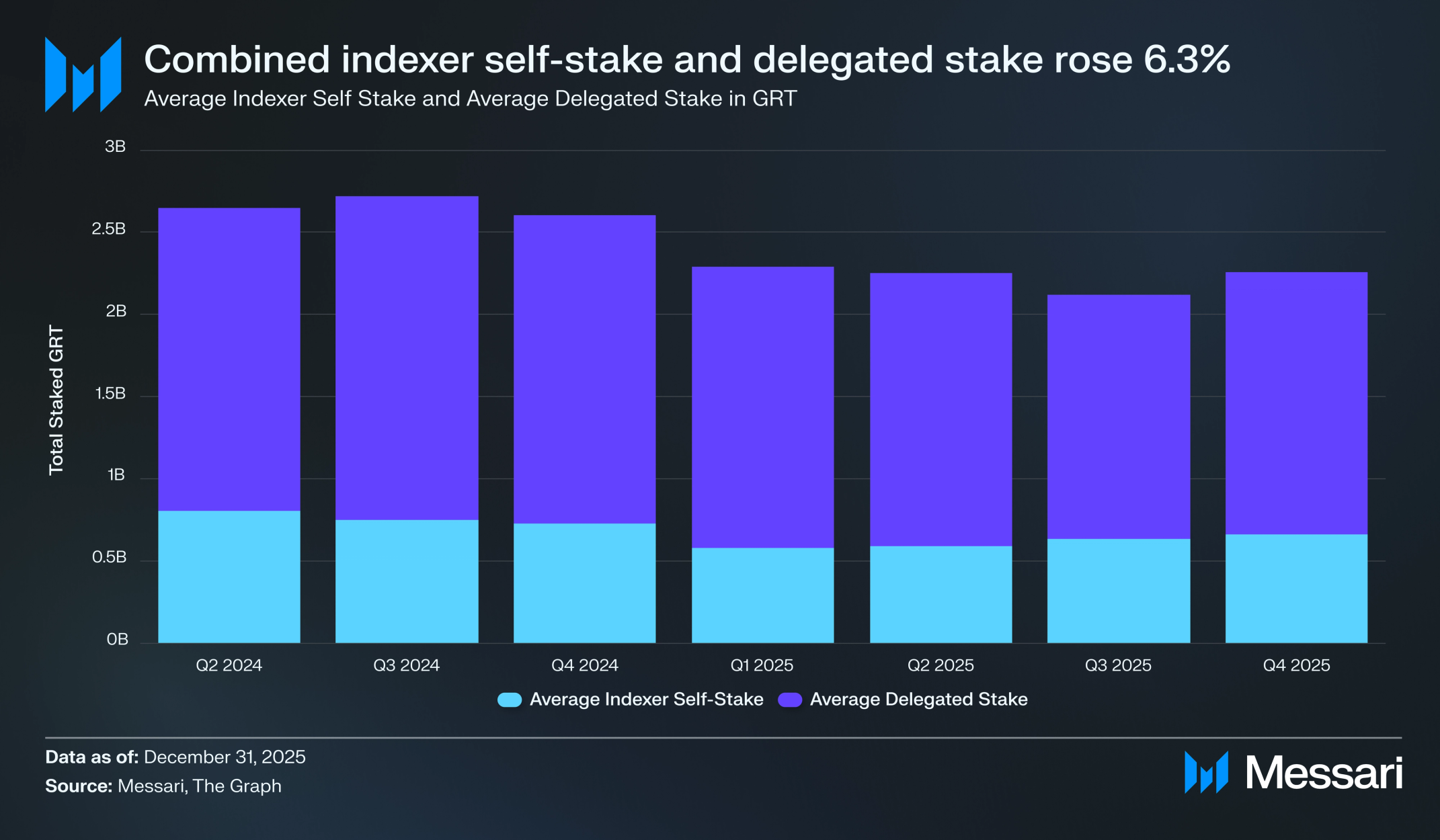
Staked GRT increased for the first time in three quarters, as both Indexer self-stake and delegated stake recovered, suggesting renewed confidence among core network participants.
The rollout of Graph Horizon repositioned The Graph as a modular, multi-service data protocol, laying the foundation for broader data services and more diversified fee generation beyond Subgraph queries.
Primer
The Graph (GRT) is an indexing protocol that provides onchain data, such as DeFi transactions and liquidity pool data, from various sources. The Graph eliminates the need for data consumers (e.g., app developers) to build complex infrastructure to access onchain data. Instead, data consumers pay to query custom APIs, called “Subgraphs”, of onchain data via the GraphQL API. Subgraphs define a data schema to be indexed, making that data queryable. Subgraphs can be developed and queried by anyone.
The Graph Network uses its native utility token, GRT, to incentivize data indexing and consumption:
Indexers process and store onchain data from Subgraphs. They usually have advanced technical knowledge of node operation. Indexers receive query fees in GRT from data consumers and indexing rewards from new GRT issuance.
Curators are incentivized to analyze and signal which Subgraphs are valuable to index. Curators earn a 10% portion of the GRT query fees generated by Subgraphs.
Delegators do not employ resources to index onchain data; instead, they delegate The Graph's native utility token, GRT, to Indexers. The amount of GRT query fees and indexing rewards a delegator receives is proportional to the amount of GRT delegated, less an Indexing Reward Cut (commission).
In June 2024, The Graph completed its Sunrise of Decentralized Data initiative, upgrading all Subgraphs to its distributed network of independent Indexers. The Graph has also implemented Substreams, high-performance, modular data pipelines built using Rust.
The Project Team Commentary section of this report was written by The Graph team and reflects the views, opinions, and forward-looking statements of The Graph only. This section is included to provide additional context on the project’s strategy, priorities, and outlook and does not necessarily reflect the views or opinions of Messari, Inc.
Looking back, 2025 was defined by monumental progress and strategic repositioning for The Graph, culminating in the launch of Horizon. The Foundation deeply appreciates and recognizes all the ecosystem contributors who worked on Horizon - an effort that took place over the course of many years! This protocol upgrade transforms The Graph from a single-service indexing protocol into an extensible, multi-service data platform. Horizon represents the most significant architectural evolution in the network's history and sets the stage for future growth.
We want to use this short note to acknowledge contributions that rarely make it into quarterly reports, including the operational and ecosystem efforts that happen behind the scenes.
Network Momentum
Several metrics help validate the strategic direction of The Graph. As examples, active Subgraphs grew nearly 40% year-over-year, while Substreams generated over $500k in revenue. GraphTally, a new payment aggregation solution, is now saving approximately $90,000 in gas costs per million queries - a structural enhancement to network economics. Additionally, ecosystem contributors delivered a multi-chain GRT deployment via Chainlink CCIP to simplify cross-chain liquidity management, thereby removing friction that previously complicated participation. We’re also happy to highlight the overhauled Chain Integration Process (CIP), which reduced new chain onboarding timelines from months to weeks - a quiet improvement that dramatically accelerates the ability to meet builders where they are.
A few longer-term explorations continue as well. Edge & Node's Amp SQL Platform offers a verifiable, blockchain-native database that transforms smart contract activity into queryable datasets - built for enterprise scale, AI workloads, and audit-ready compliance. Meanwhile, Hypergraph - a local-first framework for user-owned applications - represents a vision of the future where users control their data without sacrificing the benefits of connected applications.
The Graph is also establishing itself as critical infrastructure for institutional finance. At SmartCon 2025, The Graph joined DTCC to discuss an ongoing collaboration - a signal of the network's readiness to meet enterprise requirements for scale, reliability, and compliance.
Ecosystem Contributors
There were several notable contributions from the developer teams supporting The Graph worth highlighting:
Edge & Nodelaunched Amp into beta - a new verifiable blockchain native database suitable for different workloads. Here’s the official launch video from SmartCon!
StreamingFast generated 9.9 million GRT (approximately $569k) in cumulative annual revenue through Substreams and Firehose. Q4 2025 represented a breakout period, with revenue increasing more than 4x quarter-over-quarter.
Semiotic Labs shipped GraphTally, a payment aggregation solution that acts as a structural upgrade to network economics.
GraphOps is building an open-source price solver for Tycho Indexer that promises to unlock wide adoption and advance the Tycho standard.
The Foundation’s Commitment
Beyond visible milestones, significant effort has gone into structural refinement, process optimization, and organizational clarity. There have been a lot of internal changes - more careful untangling of legacy approaches, operational optimizations, and more deliberate alignment of resources with priorities - than most external observers would recognize. The Foundation has also adopted a more pragmatic, product-focused approach, orienting around the needs of builders and the emerging demands of enterprises and institutions. This isn't glamorous work. It doesn't generate announcements or social media engagement. But it's the core of what enables a growing ecosystem to execute with consistency and adapt to new challenges.
The Graph exists to make blockchain data universally accessible. In 2025, the Foundation delivered on its mandate by supporting the network’s most ambitious protocol upgrade, scaling to institutional demand, expanding the multi-chain footprint, and laying important operational groundwork.
In 2026, the Foundation is building the strategy for The Graph's next chapter - not just in code, but in how the ecosystem organizes, prioritizes, and executes. We look forward to sharing more soon.
Thank you to the Indexers, Delegators, and all the developers building on The Graph. Your ongoing participation and feedback make this network what it is.
-The Graph Foundation
Financial Overview
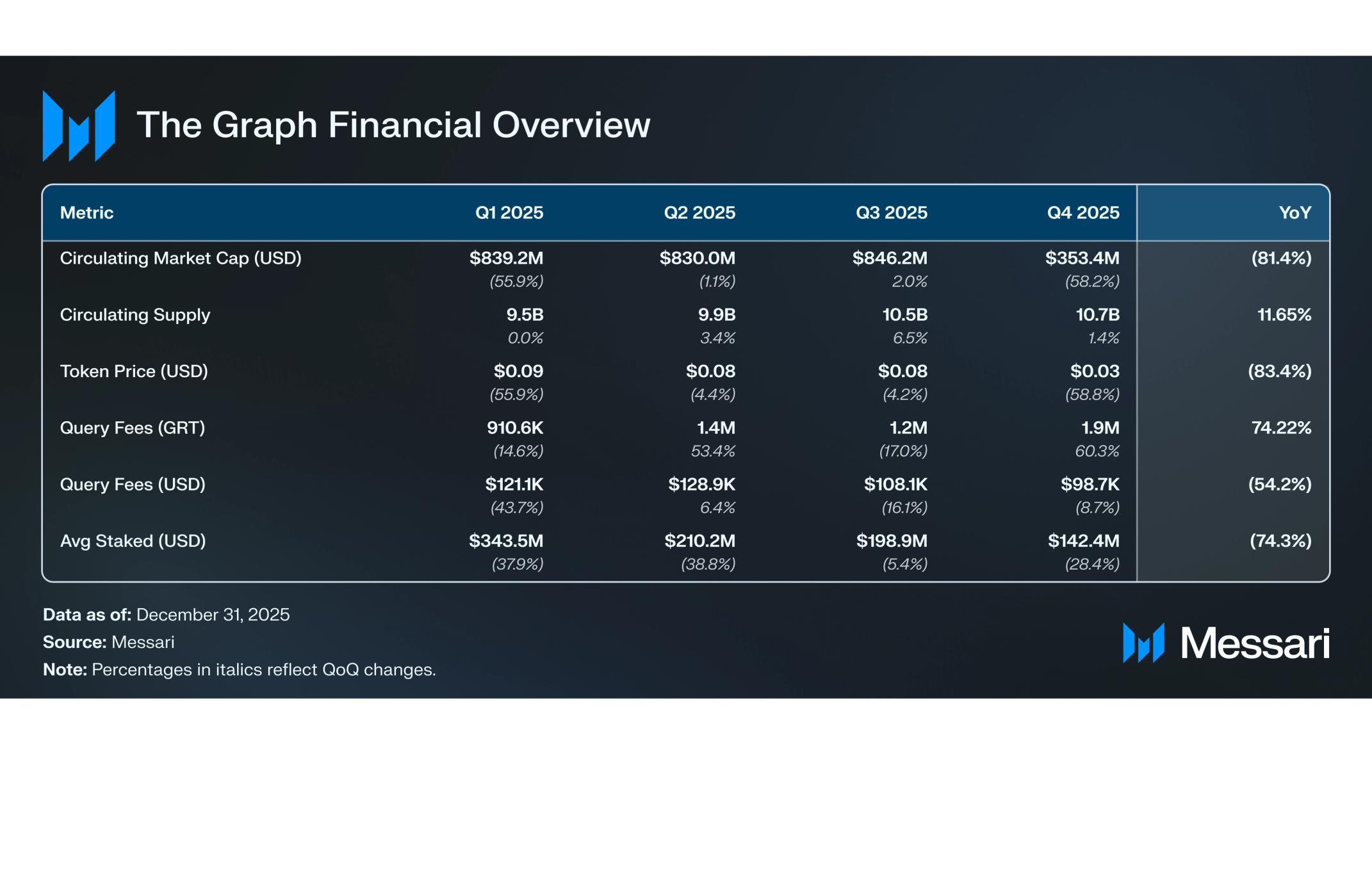
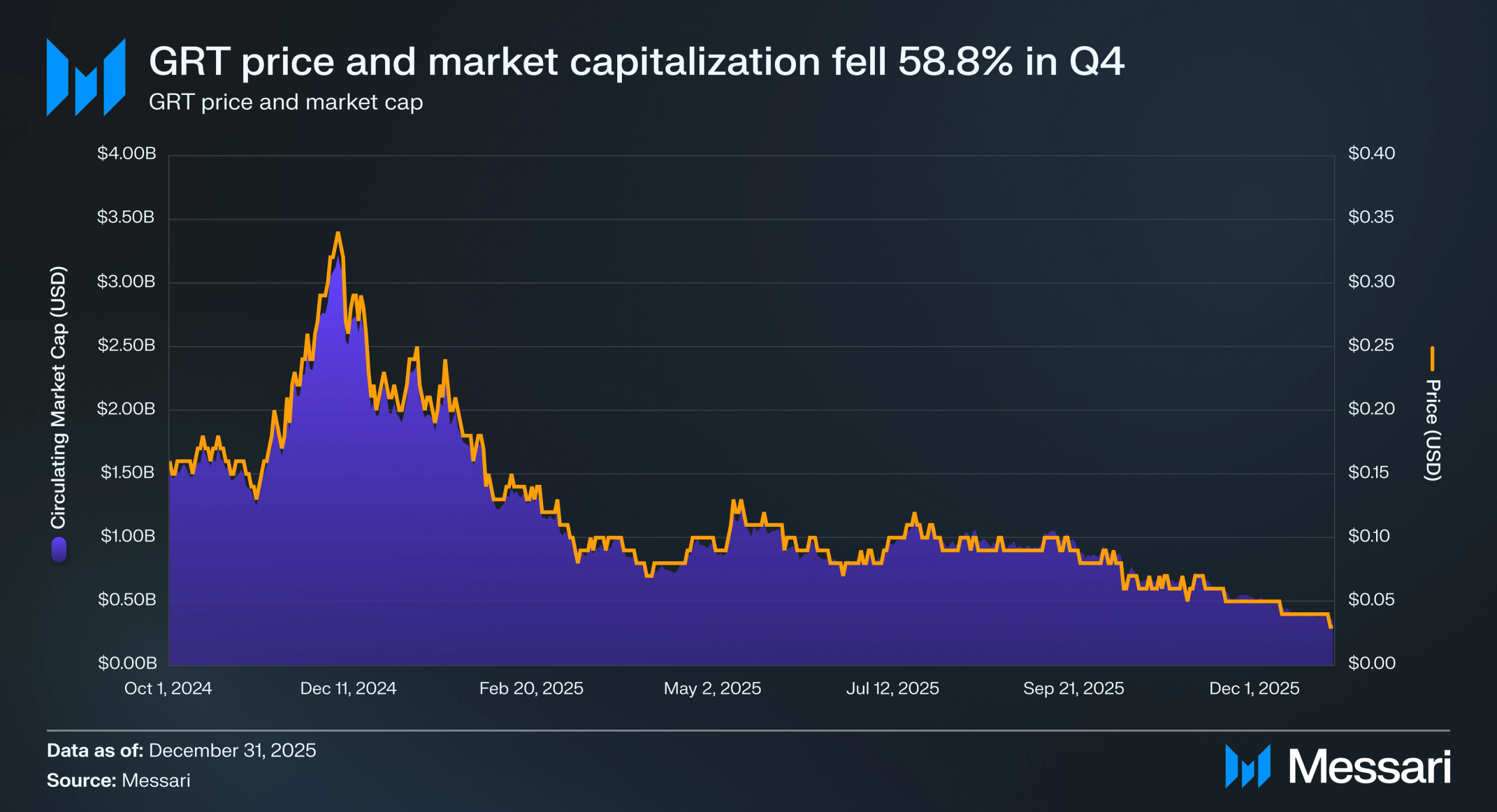
GRT ended the quarter at approximately $0.03, down 58.8% QoQ, underperforming the broader crypto market, which fell 30.8%. The decline in price pushed circulating market capitalization down 58.2% QoQ, from $846.2 million in Q3 to $353.4 million at quarter's end.
GRT’s circulating supply increased modestly during the quarter, rising 1.4% QoQ from 10.5 billion to 10.7 billion tokens due to ongoing protocol issuance and reward distributions.
Query Fees
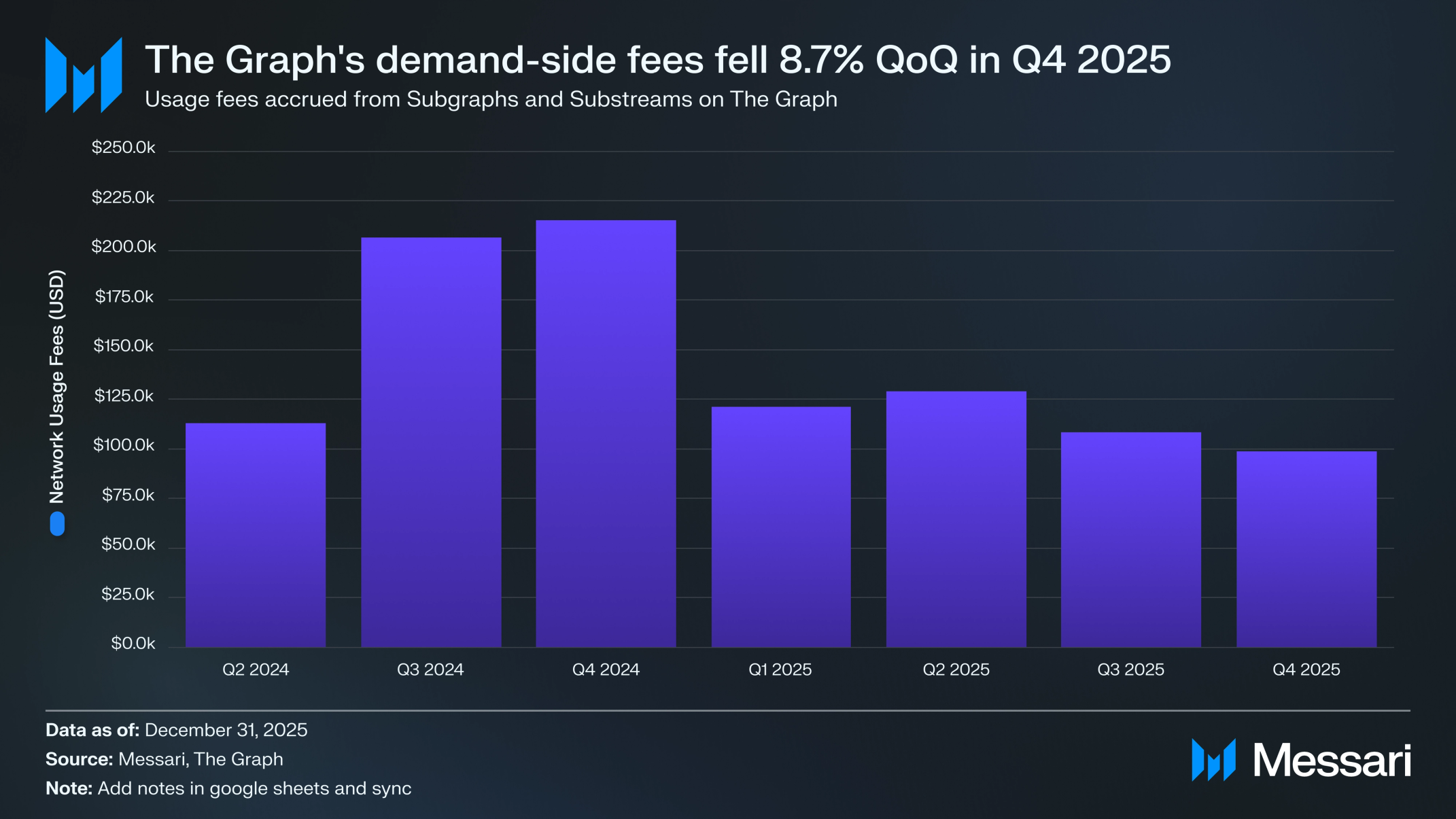
Despite weaker token performance, protocol-level usage showed mixed signals. Query fees measured in GRT increased 60.3% QoQ to 1.9 million GRT, indicating higher onchain demand for indexing services. However, when denominated in USD, query fees declined 8.7% QoQ to $98.7K, reflecting the impact of lower token prices on real revenue capture.
Network Overview
The Graph Network is used by developers and data consumers who pay GRT to query data. The network's performance can be measured by the growth in the volume of queries serviced, the number of active Subgraphs serving queries, and the accumulation of query fees.
Query Volume
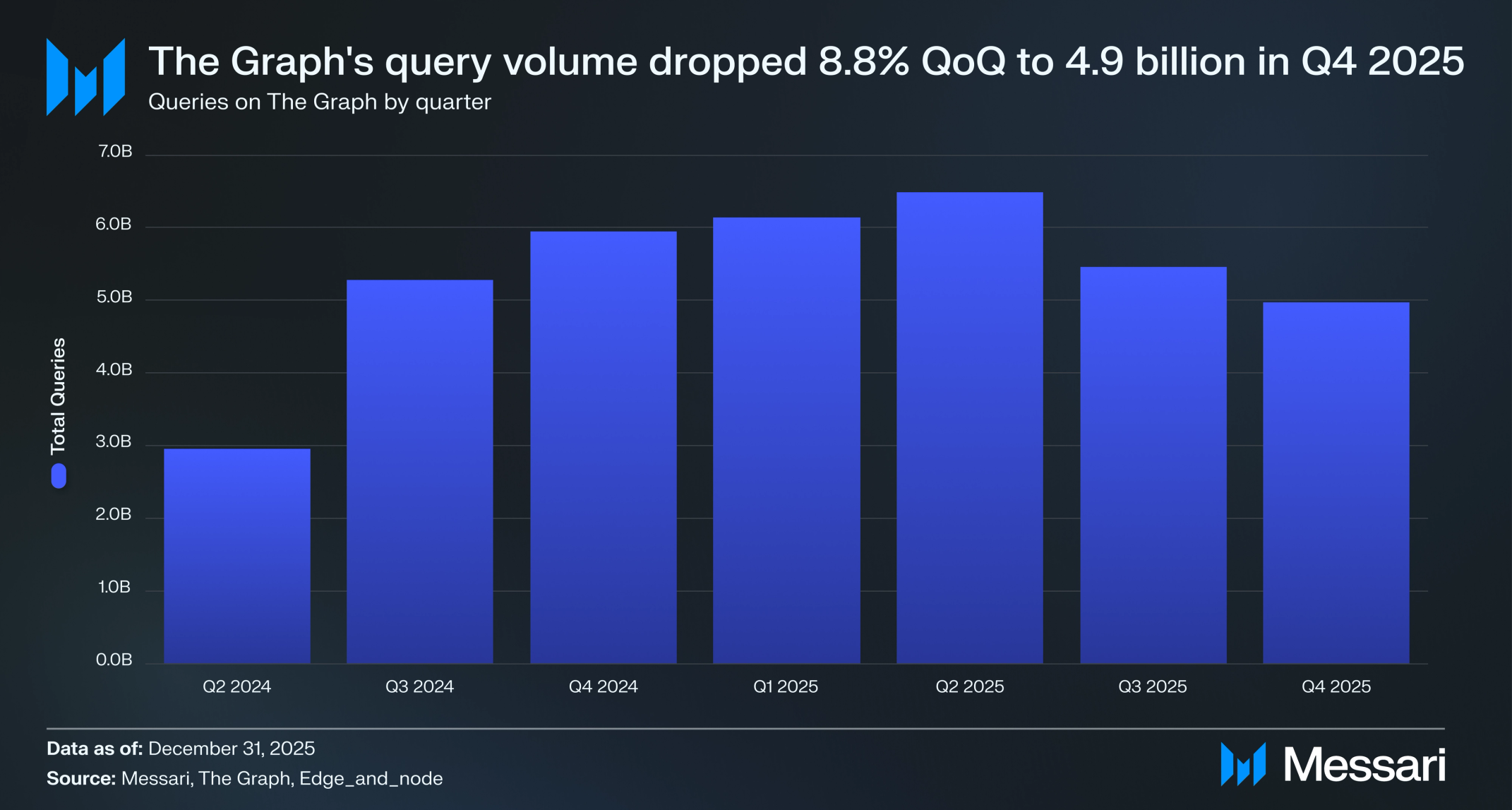
The Graph’s query volume declined again in Q4 2025, extending the pullback that began in Q3. Total quarterly queries fell to 4.97 billion, down 8.9% QoQ from 5.46 billion in Q3. This marks the second consecutive quarter of declining query volume following the all-time high of 6.49 billion queries recorded in Q2.
While volumes have moderated from peak levels, query activity remains elevated relative to historical norms. Q4 query volume remained materially higher than early 2024, showing that baseline demand for decentralized indexing and data availability remains intact despite softer market conditions and reduced onchain activity across DeFi.
Query volume concentration across networks remained mostly unchanged in Q4 2025, with Base retaining its position as the largest source of queries on The Graph. Base generated approximately 1.23 billion queries during the quarter, up 11.0% QoQ from 1.11 billion in Q3, reinforcing its role as the dominant network for indexing demand as application activity continues to migrate toward L2 environments.
Ethereum Mainnet remained the second-largest network by query volume, recording 910.3 million queries in Q4. This represented a 13.1% QoQ decline from 1.05 billion queries in Q3, extending the trend of reduced mainnet activity as usage increasingly shifts to lower-cost execution layers. Despite the decline, Ethereum continues to account for a substantial share of total query demand due to its mature application ecosystem.
Among other major networks, Arbitrum One had the largest relative increase in activity, with query volume rising 31.0% QoQ from 637.9 million to 835.7 million queries. In contrast, BNB Smart Chain (BSC) experienced a notable pullback, with queries falling 26.7% QoQ to 487.7 million. Polygon (PoS) also declined materially, down 36.5% QoQ to 412.0 million queries.
Overall, Q4 chain-level data highlights continued dispersion in indexing demand. Growth remained concentrated among select L2 networks, particularly Base and Arbitrum, while several previously high-volume chains had meaningful normalization. These shifts reflect evolving application deployment patterns rather than a broad-based contraction in demand for decentralized data services.
Subgraphs
To bootstrap The Graph, a hosted service was initially created. This service hosted Subgraphs as the protocol gradually transitioned to its decentralized network. The hosted service was free (subsidized by The Graph ecosystem) and offered indexing infrastructure run by Edge & Node, the initial team behind The Graph.
The first Subgraph launched on the decentralized network in Q1 2021. In October 2023, the project introduced its Sunrise of Decentralized Data (completed in June 2024) to upgrade all Subgraphs to its distributed network of independent Indexers in three phases: Sunray, Sunbeam, and Sunrise.
The first phase of the upgrade, Sunray, was completed in March 2024. Sunray introduced additional chains, enhanced billing, and a complimentary query plan of 100,000 queries per month. This helped developers get started on the network and scale their development.
The second phase, Sunbeam, concluded in June 2024. Sunbeam focused on upgrading hosted service Subgraphs to The Graph Network. The third phase of the upgrade, Sunrise, retired hosted service endpoints and was completed in June 2024.
Growth in active Subgraphs on The Graph’s decentralized network continued in Q4 2025, marking the seventh consecutive quarter of expansion. The number of active Subgraphs increased to 15,539, up 3.0% QoQ from 15,087 in Q3, setting a new all-time high. While the pace of growth slowed compared to earlier quarters, the continued increase suggests steady developer engagement despite softer market conditions.
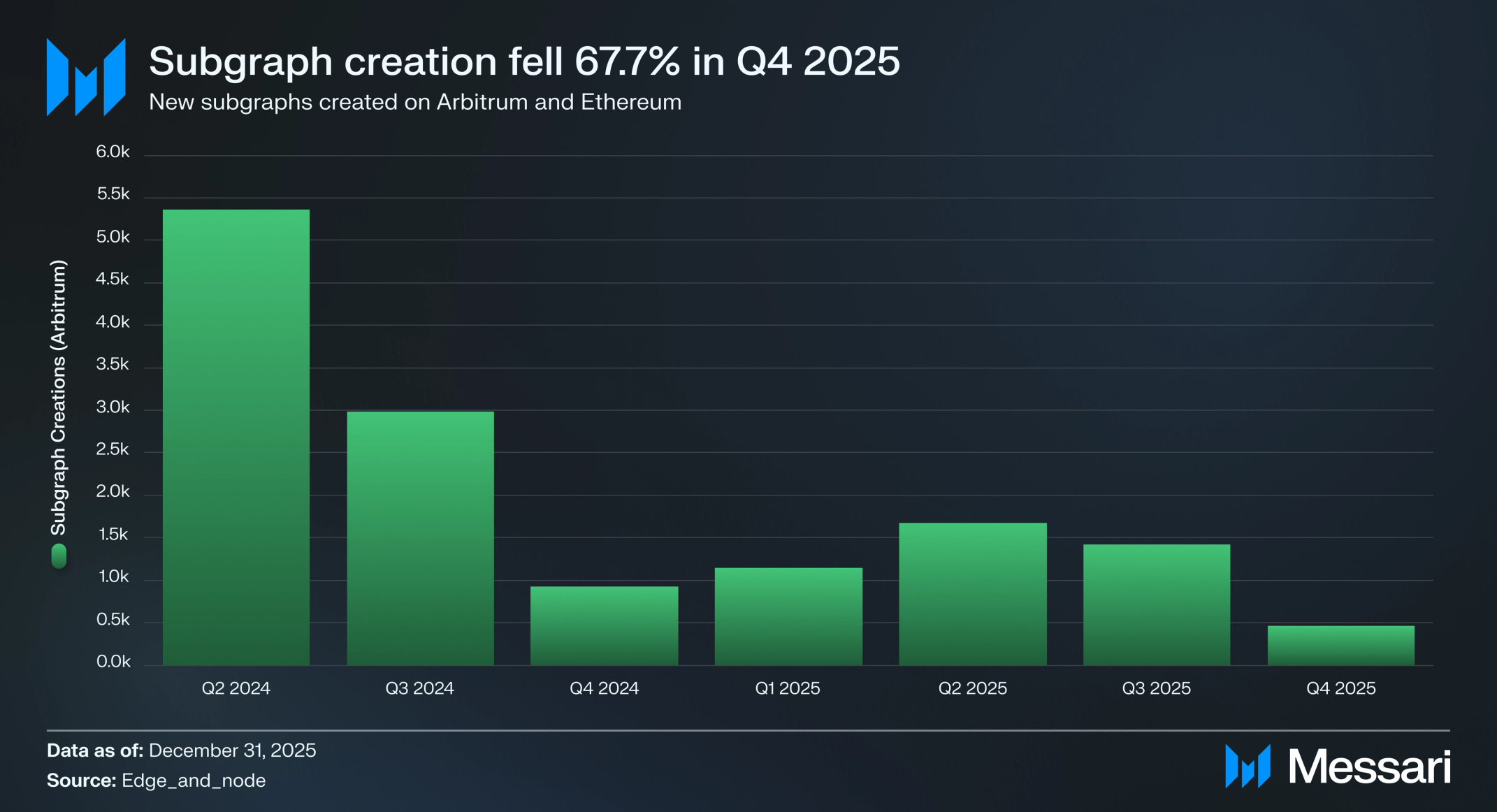
Subgraph creation slowed sharply in Q4 2025, with developers launched 458 new Subgraphs during the quarter, down 67.7% QoQ from 1,419 in Q3. This represents the lowest quarterly level of Subgraph creation since Q4 2024 and a notable reversal from the steady rebound observed earlier in 2025.
All new Subgraphs continue to be deployed on Arbitrum One, where indexing rewards are distributed, and transaction costs remain lower than on Ethereum mainnet. As a result, the decline in creation appears to be driven by demand-side factors rather than by structural limitations of the network.
Indexers and Ecosystem Participation
The Graph’s economic design coordinates participation from both technical and non-technical participants to meet supply and demand for data indexing and consumption:
Indexers operate Graph Nodes to process and store onchain data. Data consumers can then query this data via GraphQL, an open-source language for The Graph’s APIs. Indexers receive query fees in GRT from data consumers and indexing rewards from the issuance of new GRT.
Curators signal to Indexers which Subgraphs are worth indexing. Curators also often act as Subgraph developers. Curators earn a 10% portion of the GRT query fees generated by Subgraphs.
Delegators delegate their GRT tokens to Indexers in exchange for a portion of an Indexer’s GRT query fees and indexing rewards. The amount of GRT query fees and indexing rewards a delegator receives is proportional to the amount of GRT delegated, less an Indexing Reward Cut and Query Fee Cut (commissions).
Staked GRT is required for indexing Subgraphs and processing queries. As an Indexer stakes and is delegated more GRT, its capacity to process queries increases.
The minimum stake for an Indexer is currently set at 100,000 GRT (approximately $3,000 as of Dec. 31, 2025). In addition to this minimum, Indexers can also receive delegated stake from other ecosystem participants. Collectively, a maximum of 16x an Indexer’s personal stake can be delegated to a given Indexer.
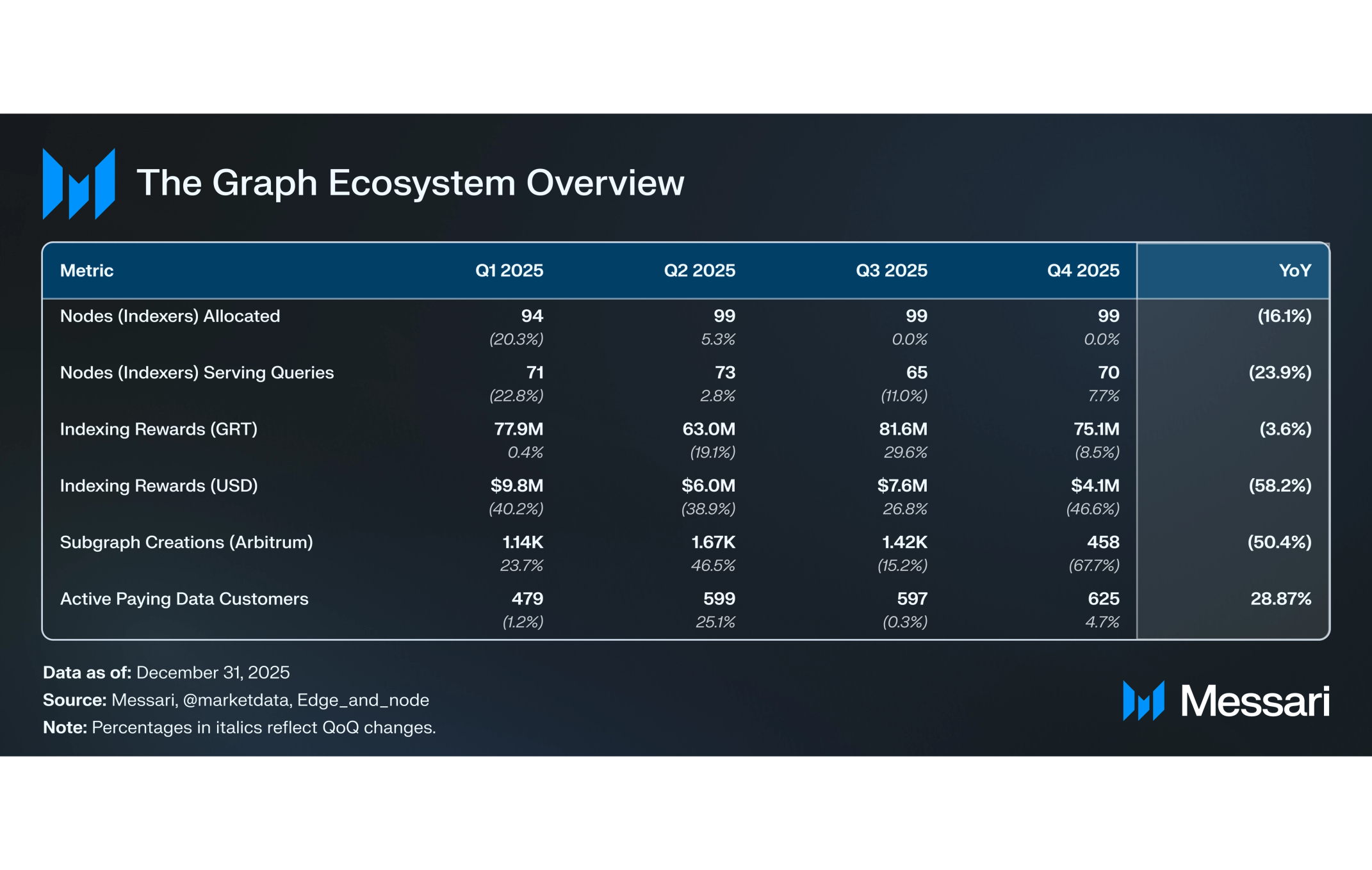
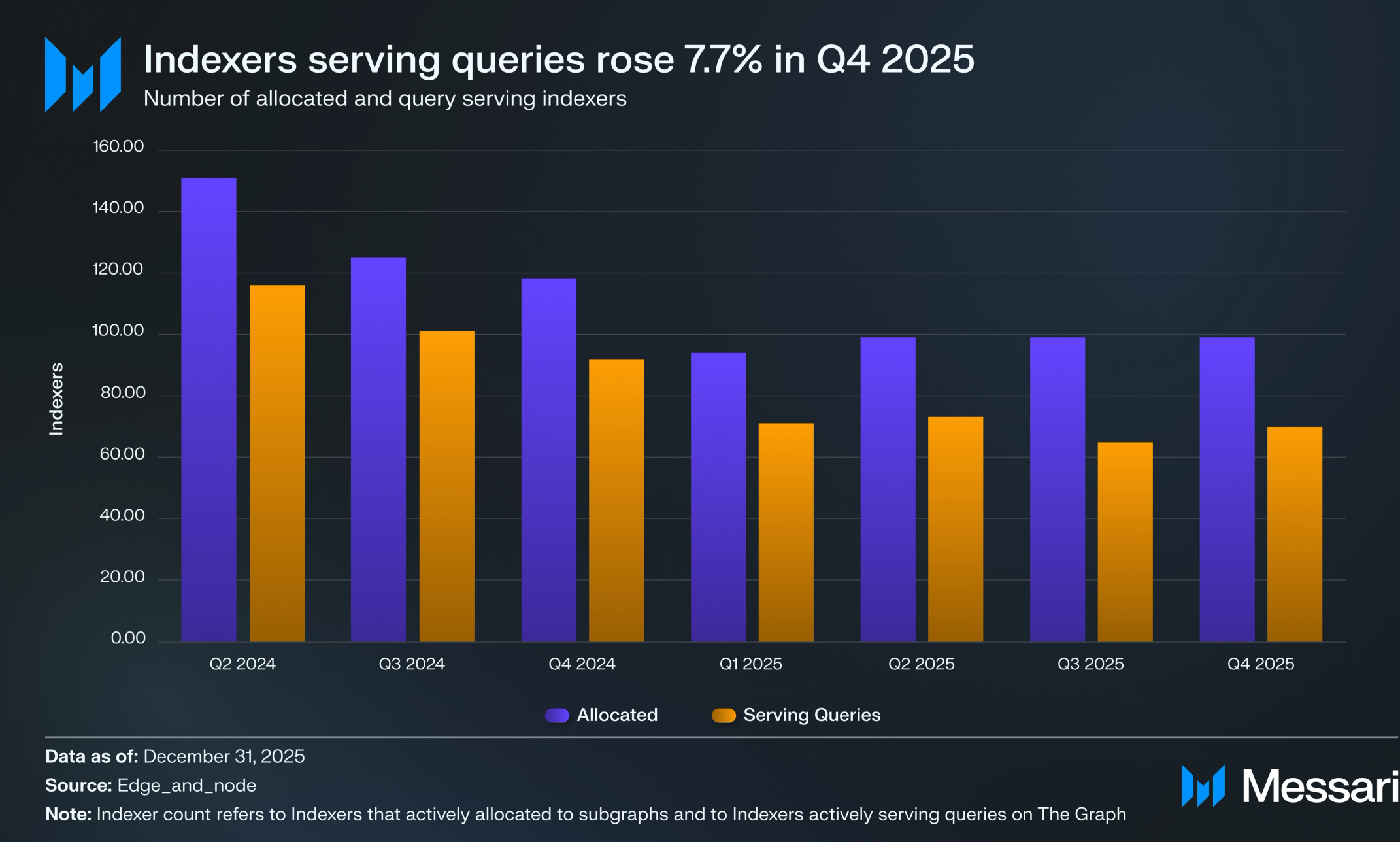
Indexer participation on The Graph remained stable in Q4 2025. The number of Indexers with allocated stake was unchanged at 99 for the second consecutive quarter, indicating steady operator commitment despite continued market volatility and lower token prices.
In contrast to Q3, activity among Indexers serving queries improved modestly. The number of active Indexers increased from 65 to 70, representing a 7.7% QoQ rise. This recovery partially reversed the decline observed in the prior quarter and suggests improved alignment between stake allocation and query-serving activity as network usage stabilized.
Indexing Rewards
Annualized inflation from new GRT issuance remained relatively stable at 2.77% in Q4 2025. GRT inflation is governed by protocol parameters and funds indexing rewards for staked participants.
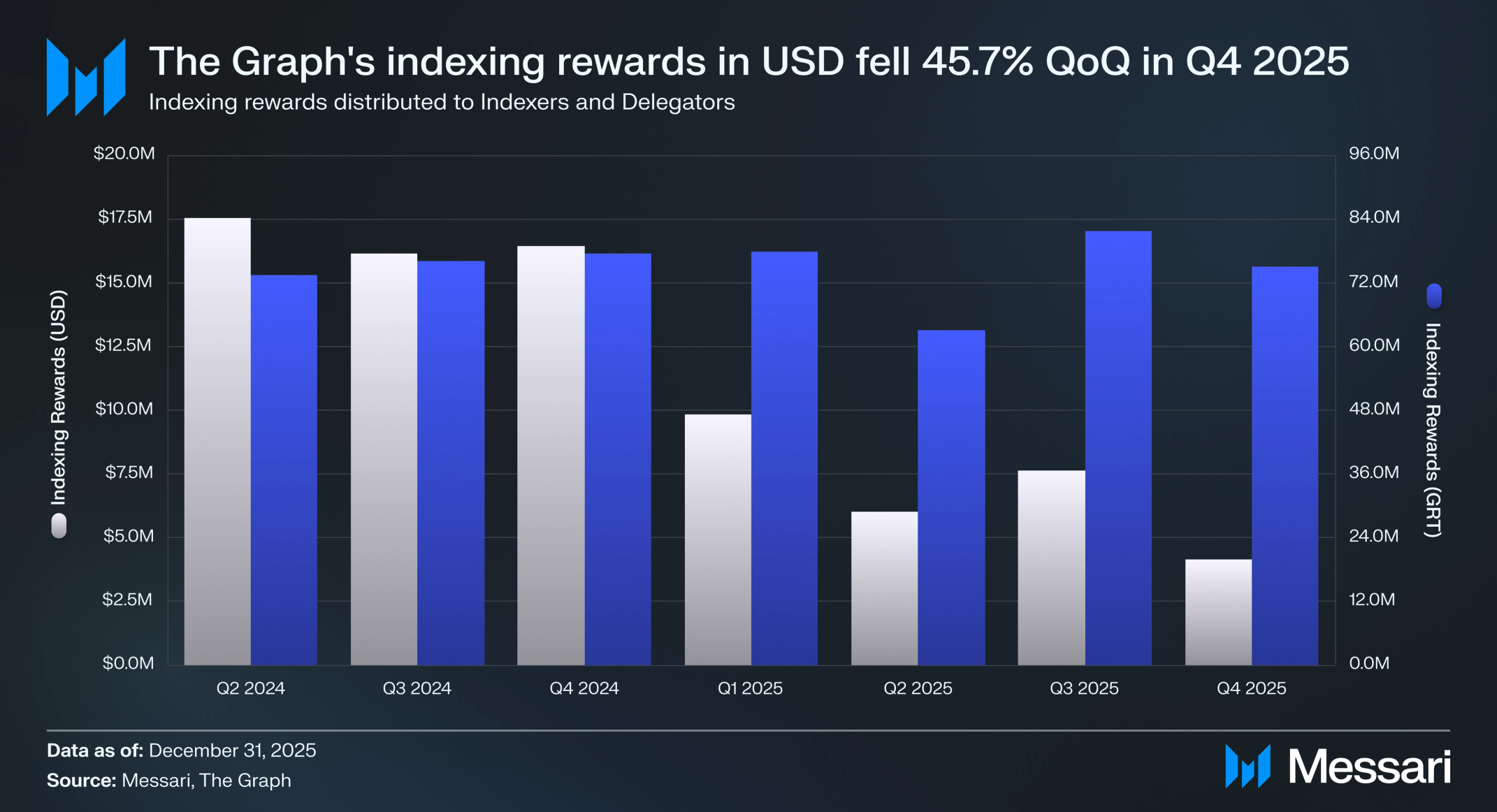
Indexer rewards declined modestly in Q4 2025, reversing the rebound observed in the prior quarter. While protocol-level issuance parameters remained broadly unchanged, indexing rewards fell slightly as network usage and effective fee capture softened during the quarter.
In GRT terms, indexing rewards dropped 8.1% QoQ, falling from 81.6 million GRT in Q3 to 75.1 million GRT in Q4. While lower than the prior quarter’s peak, rewards remained elevated relative to most of 2024 and early 2025, indicating that indexing activity and network utilization remained comparatively strong.
When measured in USD, the contraction was more pronounced. Indexer rewards fell 45.7% QoQ from $7.6 million to $4.1 million, driven by both lower GRT-denominated rewards and continued weakness in the GRT token price. As a result, aggregate indexer revenue declined to its lowest level of 2025.
Despite the reduction in total rewards, the number of active indexers serving queries increased modestly in Q4, suggesting that operators largely remained committed despite lower near-term profitability. However, the magnitude of the revenue decline likely compressed margins for individual indexers, reinforcing the sensitivity of indexer economics to both token price and query demand.
Substreams Revenue
Substreams are a way to build high-performance, modular data pipelines on The Graph. They’re built using Rust, stream raw blockchain data at scale, and output structured data that can then be used by subgraphs or other applications.
Substreams revenue accelerated sharply in Q4 2025, reflecting a step change in the adoption of high-performance, streaming-first data pipelines on The Graph. In GRT terms, Substreams revenue increased more than fourfold QoQ to 6.08 million GRT, up from 1.49 million GRT in Q3. This represents the highest quarterly Substreams revenue recorded to date and signals rapidly growing demand for large-scale, modular data processing.
The growth was also evident in USD terms. Substreams generated $239.2K in Q4, more than doubling from $113.6K in Q3. Unlike prior quarters, higher usage more than offset lower average GRT prices, resulting in a meaningful increase in realized revenue.
Overall, Q4 marked a breakout quarter for Substreams. The sharp rise in both GRT and USD-denominated revenue suggests accelerating developer adoption and expanding production use cases. Substreams are increasingly emerging as a material contributor to The Graph’s network usage fees, strengthening the protocol’s revenue mix beyond traditional Subgraph queries.
Network Usage Fees
Query fee revenue for The Graph protocol encompasses two primary sources: Subgraph query fees and Substreams fees. Subgraph query fees are determined by the volume of queries multiplied by the query indexing fee, while Substreams fees accrue from the execution and transformation of streaming‑first data pipelines.
Subgraph query fees on The Graph declined again in Q4 2025, reflecting softer query demand and continued price compression. Revenue from query fees fell 8.7% QoQ to $98,667, down from $108,066 in Q3. This marked the second consecutive quarterly decline following the Q2 peak, though revenue levels remained broadly in line with early-2025 averages.
As in prior quarters, fee generation remained concentrated on Ethereum Mainnet and major Layer 2 networks. Base continued to lead among individual chains, generating $24,430 in query fees during Q4, up 11.1% QoQ, and further extending its lead over Ethereum Mainnet. Ethereum finished the quarter with $18,081 in fees, down 12.0% QoQ, consistent with declining mainnet activity as usage continues to migrate toward lower-cost execution environments.
Other networks with meaningful fee contributions included Arbitrum One ($16,352), BNB Smart Chain ($9,794), and Polygon ($8,486). Smaller but steady contributions from Optimism and Gnosis (xDai) further reflected The Graph’s broad multichain footprint.
Staking
Staking is a core component of The Graph’s security and incentive model. Indexers stake GRT to signal reliability and earn indexing rewards, while Delegators allocate GRT to Indexers to participate in rewards without operating their own infrastructure. The combined staking base aligns economic incentives between data providers and network users, while also serving as a signal of long-term commitment to the protocol.
Staking dynamics on The Graph stabilized in Q4 2025, with modest increases in both Indexer self-stake and delegated stake following declines earlier in the year. Average Indexer self-stake rose 3.9% QoQ to 658.3 million GRT, up from 633.5 million GRT in Q3. This increase suggests renewed confidence among operators, even as token prices remained under pressure.
Delegated stake also recovered during the quarter. Average delegated GRT increased 7.4% QoQ to 1.60 billion GRT, reversing the steady decline observed over the prior three quarters. The rebound indicates improved sentiment among Delegators and a willingness to reallocate capital toward staking yields despite lower USD-denominated returns.
Taken together, total staked GRT increased in Q4, via a gradual reaccumulation of stake after a prolonged period of contraction. While staking levels remain below 2024 highs, the Q4 recovery suggests that core network participants remain engaged and that staking participation may be stabilizing as broader market conditions normalize.
Ecosystem Developments
Graph Horizon Upgrade
In Q4 2025, The Graph advanced its long-term protocol roadmap with the rollout of Graph Horizon, a major architectural upgrade that repositions the network as a modular data services protocol rather than a system optimized solely for Subgraphs. While The Graph’s core mission of organizing and serving public blockchain data remains unchanged, Horizon introduces a more flexible design intended to support a wider range of data services over time.
At a high level, Horizon decouples the protocol’s tightly integrated components into reusable primitives. The original Graph protocol bundled staking, payments, and the Subgraph use case into a single system, which proved effective but limited extensibility. Horizon separates these into a core staking protocol, a core payments protocol, and permissionless data service implementations, which can be composed via a new Data Service Framework. This allows developers to build and deploy new types of data services without modifying the underlying protocol or introducing governance bottlenecks.
The new framework is designed to support additional services such as real-time data streams, custom APIs, analytics tools, and other specialized data delivery mechanisms. Products like Substreams, Token APIs, and analytics-focused services are expected to benefit from this modular structure as adoption grows.
Horizon also introduces an integrated payments system that brings fee collection and distribution directly into the core protocol. New contracts, including GraphPayments and PaymentsEscrow, manage fee escrow, protocol taxes, and distribution to Indexers, Delegators, and data service providers. This design generalizes the existing TAP-based payment model, improves transparency, and allows future payment mechanisms to be integrated without protocol rewrites.
From a participant's perspective, Horizon expands flexibility while increasing economic accountability. Indexers can opt into multiple data services with distinct requirements and stake configurations, backed by slashable economic guarantees. Delegators take on a more direct role in network security through slashable delegation, though risk is mitigated by prioritizing Indexer self-stake. Developers and data service builders gain a permissionless path to deploy new services on shared infrastructure, lowering development costs and reducing fragmentation.
Overall, Graph Horizon represents a structural shift rather than a short-term performance driver. While the immediate impact on usage and revenue is still emerging, the upgrade lays the foundation for The Graph to support a broader set of data-intensive use cases and diversify fee generation beyond Subgraph queries as blockchain data demand continues to evolve.
Closing Summary
Q4 2025 underscored a divergence for The Graph between token performance and protocol fundamentals. GRT declined sharply, weighing on USD-denominated metrics, but core network activity remained relatively resilient. Query volumes stayed elevated compared to historical levels, active Subgraphs reached new highs, and Indexer participation stabilized despite a more challenging market environment.
Usage continued to shift toward L2 networks, particularly Base and Arbitrum, reflecting broader changes in application deployment. While Subgraph creation slowed, ongoing growth in active Subgraphs points to sustained developer engagement. Revenue trends were mixed: traditional query fees softened, but Substreams delivered a breakout quarter, signaling early diversification in The Graph’s revenue base.
Structurally, the rollout of Graph Horizon marked an important milestone. Although its near-term impact is still emerging, Horizon positions The Graph as a modular, multi-service data protocol capable of supporting a wider range of data use cases over time. Overall, Q4 reinforced The Graph’s role as durable infrastructure, with long-term positioning strengthened despite near-term market pressure.
This report was commissioned by The Graph. All content was produced independently by the author(s) and does not necessarily reflect the opinions of Messari, Inc. or the organization that requested the report. The commissioning organization may have input on the content of the report, but Messari maintains editorial control over the final report to retain data accuracy and objectivity. Author(s) may hold cryptocurrencies named in this report. This report is meant for informational purposes only. It is not meant to serve as investment advice. You should conduct your own research and consult an independent financial, tax, or legal advisor before making any investment decisions. Past performance of any asset is not indicative of future results. Please see our Terms of Service for more information.
No part of this report may be (a) copied, photocopied, duplicated in any form by any means or (b) redistributed without the prior written consent of Messari®.
Drexel is a Research Manager at Messari for the Protocol Reporting team with a focus on base layers and DeFi. He is a strong follower of the crypto mullet thesis of diligence in the front and degen in the back.
Drexel is a Research Manager at Messari for the Protocol Reporting team with a focus on base layers and DeFi. He is a strong follower of the crypto mullet thesis of diligence in the front and degen in the back.