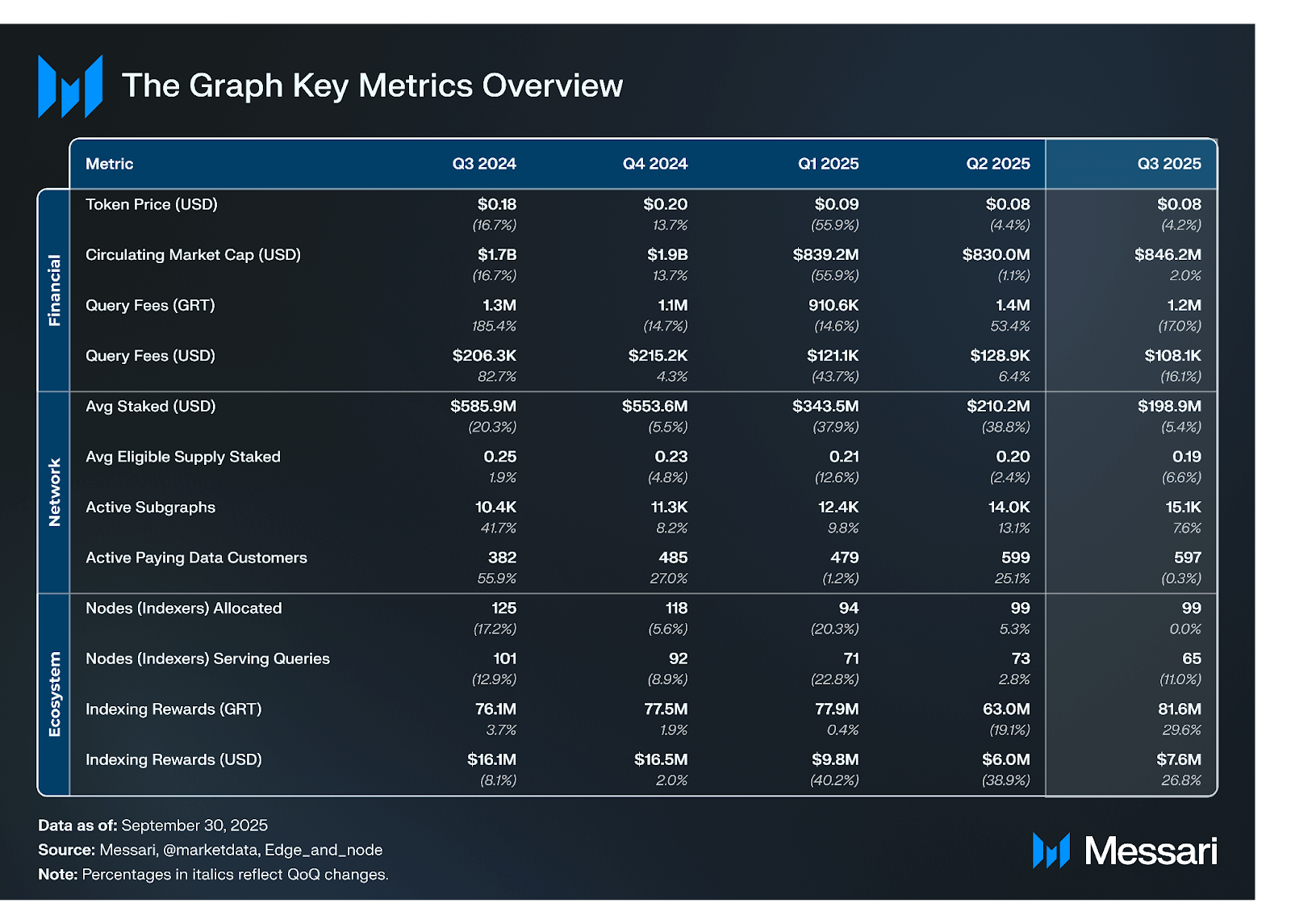
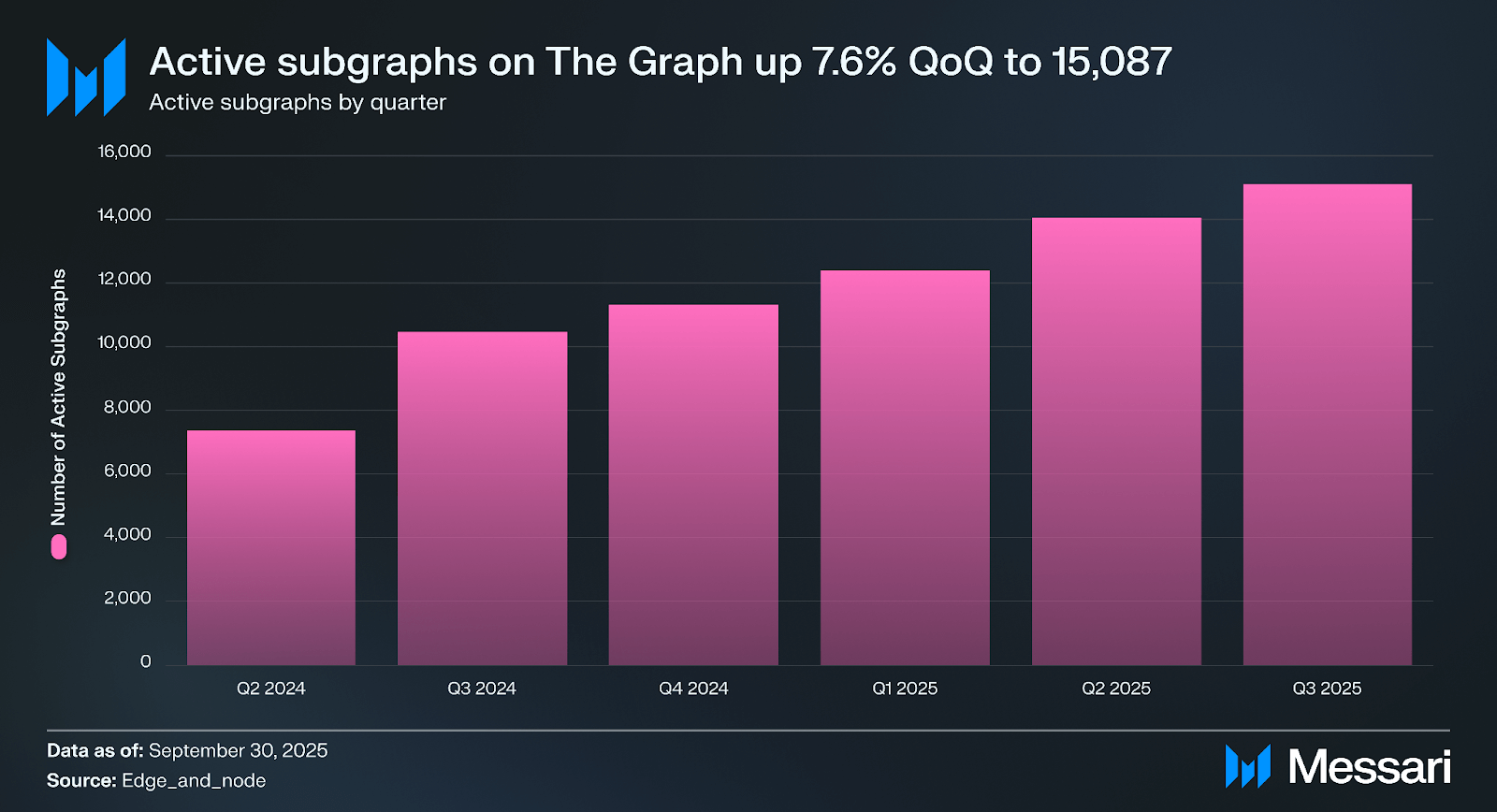
Active Subgraphs hit 15,087, up 7.6% QoQ, showing strong developer engagement even as new deployments slowed.
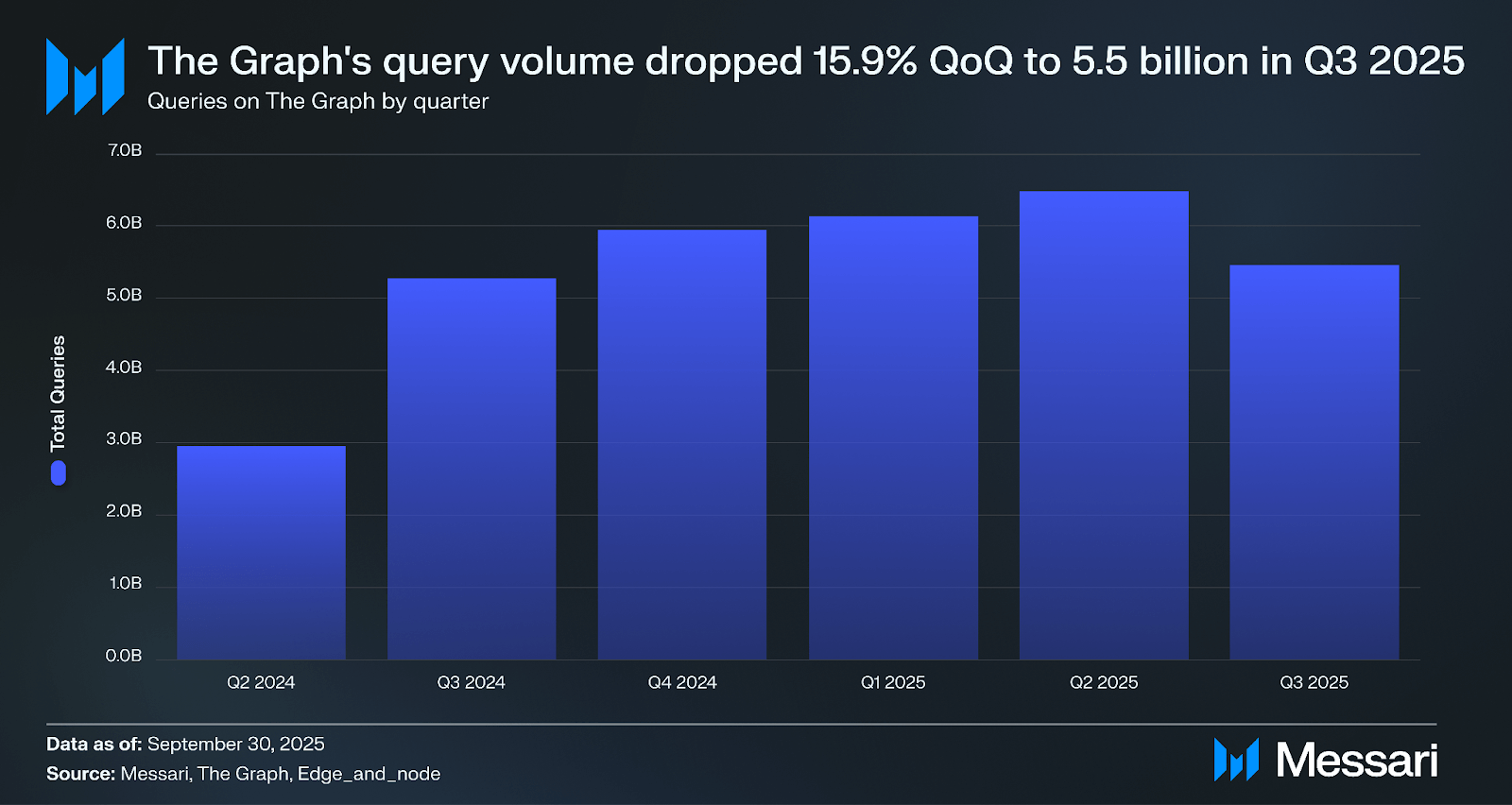
Overall queries declined 15.9% QoQ, as Base surpassed Ethereum Mainnet in volume for the first time, underscoring the network’s deepening multichain adoption.
The Graph overhauled its Chain Integration Process (CIP) to only reward chains with real usage and active subgraphs, aligning incentives with sustainable, demand-driven growth.
Hypergraph introduced a local-first framework that merges privacy, composability, and usability, allowing developers to build real consumer applications where users control their own data.
Substreams’ parallel and modular design cuts full-chain sync times from days to hours, powering products like Token API and making high-speed, cross-chain data access a practical reality.
Primer
The Graph (GRT) is an indexing protocol that provides onchain data, such as DeFi transactions and liquidity pool data, from various sources. The Graph removes the need for data consumers (e.g., app developers) to build complicated infrastructure to get onchain data. Instead, data consumers pay to query custom APIs, called “Subgraphs”, of onchain data via the GraphQL API. Subgraphs define a data schema to be indexed, making that data queryable. Subgraphs can be developed and queried by anyone.
The Graph Network uses its native utility token, GRT, to incentivize data indexing and consumption:
Indexers process and store onchain data from Subgraphs. They usually have advanced technical knowledge of node operation. Indexers receive query fees in GRT from data consumers and indexing rewards from new GRT issuance.
Curators are incentivized to analyze and signal which Subgraphs are valuable to index. Curators earn a 10% portion of the GRT query fees generated by Subgraphs.
Delegators do not employ resources to index onchain data; instead, they delegate The Graph's native utility token, GRT, to Indexers. The amount of GRT query fees and indexing rewards a delegator receives is proportional to the amount of GRT delegated, less an Indexing Reward Cut (commission). There is also a 0.5% delegation tax each time a wallet delegates GRT.
In June 2024, The Graph completed its Sunrise of Decentralized Data initiative, upgrading all Subgraphs to its distributed network of independent Indexers. The Graph has also implemented Substreams, high-performance, modular data pipelines built using Rust.
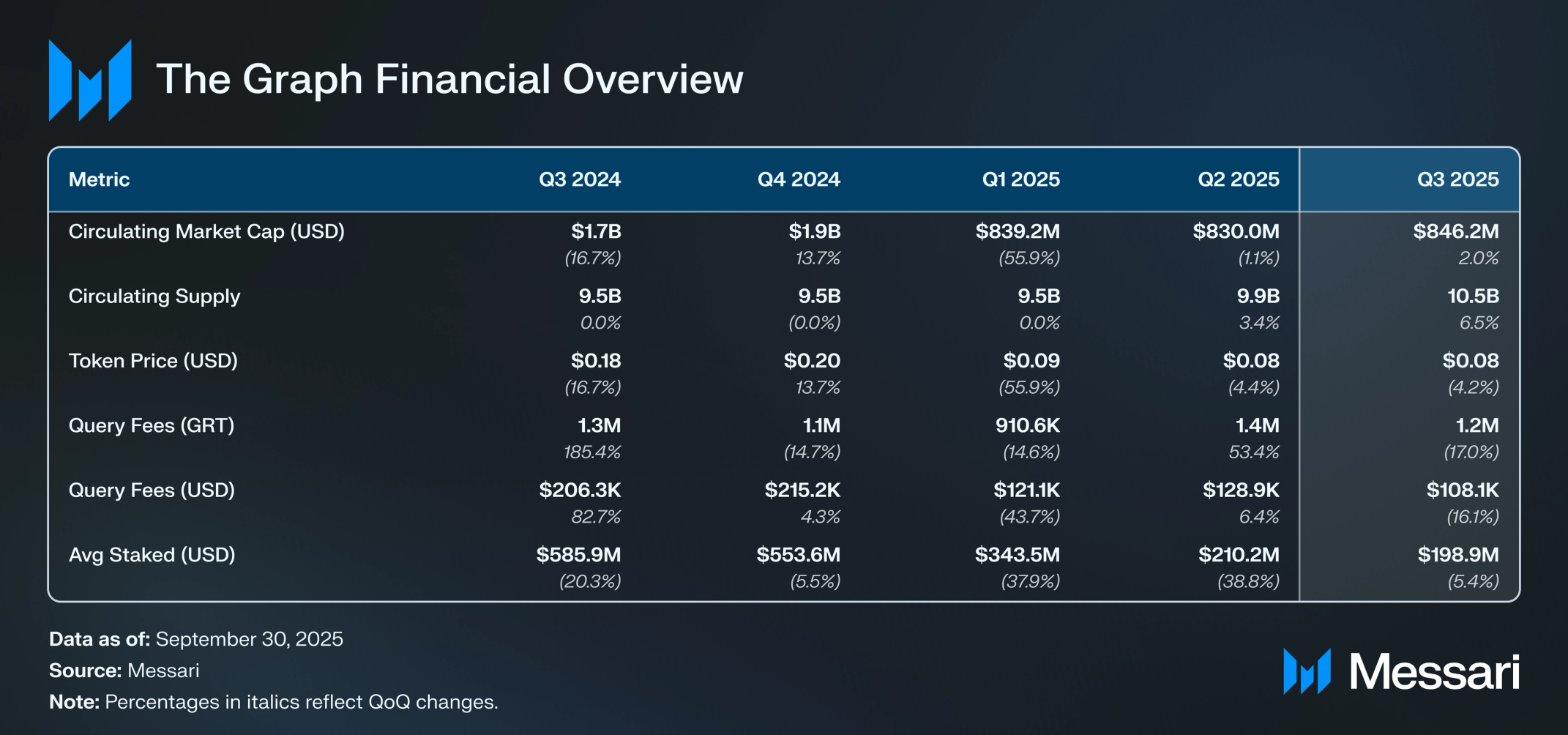
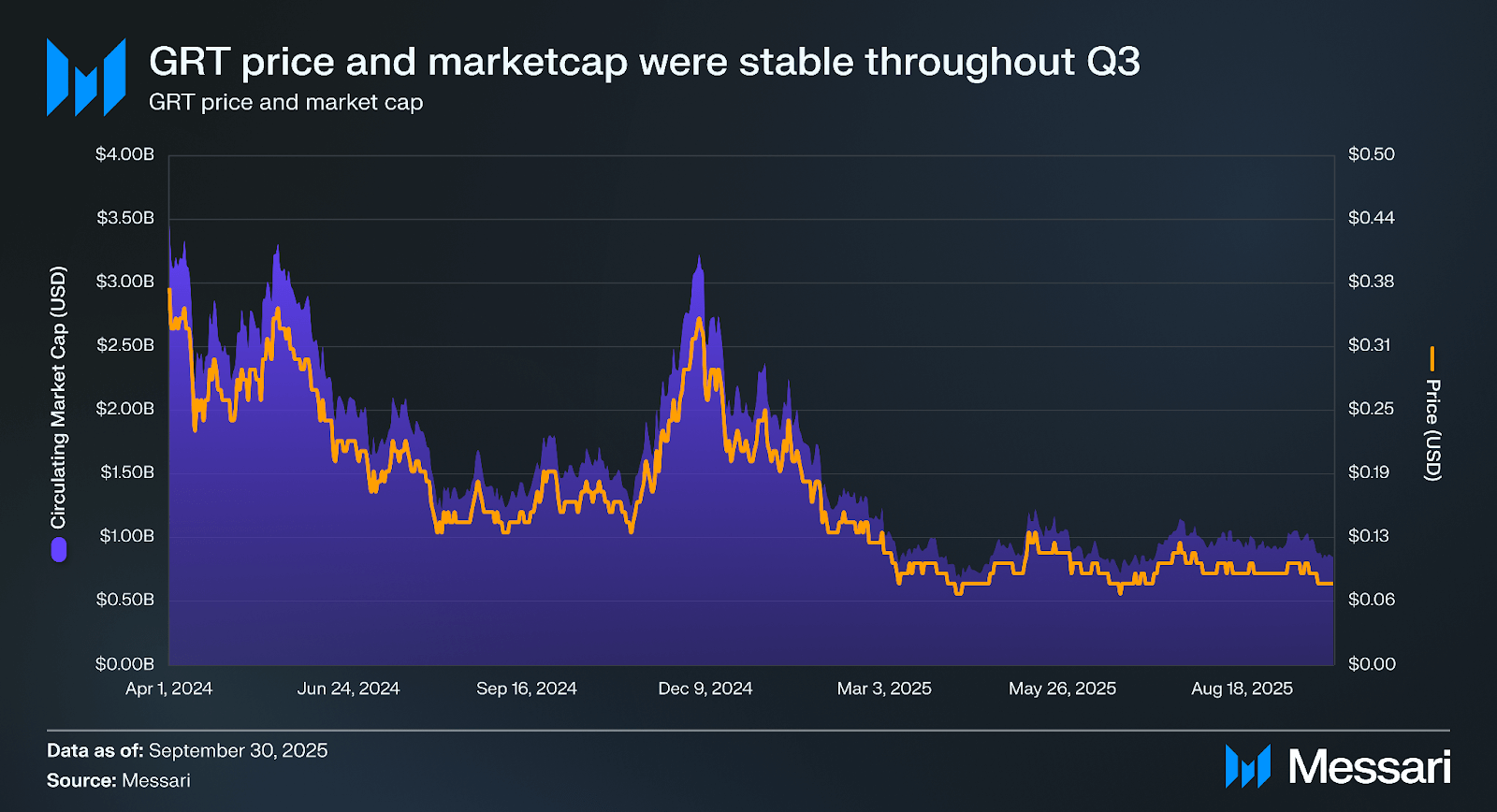
The Graph’s financial profile continued to show relative stability in Q3 2025. The circulating market cap grew by 2.0% QoQ, from $830.3 million to $846.2 million, due to the GRT circulating supply increasing 6.5% from 9.9 billion to 10.5 billion QoQ from protocol issuance and reward distributions.
The GRT token price slipped 4.2% QoQ, to $0.080 in Q3, down from $0.084 at Q2-end. Although GRT started and finished the quarter at a similar price, GRT hit a quarterly high of $0.116 on July 7. Despite continued ecosystem development and usage, token performance underperformed the broader market throughout the quarter, as evidenced by the total crypto market cap excluding the top 10 (OTHERS), which rose 29.1% in Q3.
Network Overview
The Graph Network is used by developers and data consumers who pay GRT to query data. The network's performance can be measured by the growth in the volume of queries serviced, the number of active Subgraphs serving queries, and the accumulation of query fees.
Query Volume
The Graph's quarterly query volume decreased for the first quarter since Q2 2024, falling from an all-time high of 6.49 billion queries in Q2 to 5.46 billion, down 15.9% QoQ. Despite the dip, demand for queries remains strong, reflecting ongoing interest in decentralized data access across chains and applications.
Across the top 10 networks by quarterly query volume, Base led, surpassing Ethereum Mainnet for the first time with 1.11 billion queries, a 42.7% increase from 777.2 million in Q2. Query volume fell 25.1% QoQ on the second network by volume, Ethereum Mainnet, from 1.40 billion to 1.05 billion. BNB Smart Chain (BSC) claimed the third-place slot with 665.5 million queries across Q3, up 13.7% from Q2.
Arbitrum One had the biggest QoQ decrease in query volume of any network, falling 53.4% from 1.37 billion to 637.9 million queries in Q3.
These shifts reflect both organic growth and decline as networks fluctuate in usage, while levels of application and Subgraph deployment activity vary across networks. Notably, Base’s rapid rise signals deepening adoption of L2 infrastructure for data indexing and querying.
Subgraphs
To bootstrap The Graph, a hosted service was initially created. This service hosted Subgraphs as the protocol gradually transitioned to its decentralized network. The hosted service was free (subsidized by The Graph ecosystem) and offered indexing infrastructure run by Edge & Node, the initial team behind The Graph.
The first Subgraph launched on the decentralized network in Q1 2021. In October 2023, the project introduced its Sunrise of Decentralized Data (completed in June 2024) to upgrade all Subgraphs to its distributed network of independent Indexers in three phases: Sunray, Sunbeam, and Sunrise.
The first phase of the upgrade, Sunray, was completed in March 2024. Sunray introduced additional chains, enhanced billing, and a complimentary query plan of 100,000 queries per month. This helped developers get started on the network and scale their development.
The second phase, Sunbeam, concluded in June 2024. Sunbeam focused on upgrading hosted service Subgraphs to The Graph Network. The third phase of the upgrade, Sunrise, retired hosted service endpoints and was completed in June 2024.
For the sixth consecutive quarter, the number of active Subgraphs on The Graph’s decentralized network continued to grow. In Q3 2025, the number of active Subgraphs reached a new high of 15,087, up 7.6% from 14,023 in Q2. The continued expansion highlights the rising adoption of developers and an increasing diversity of applications indexing data across The Graph’s supported networks.
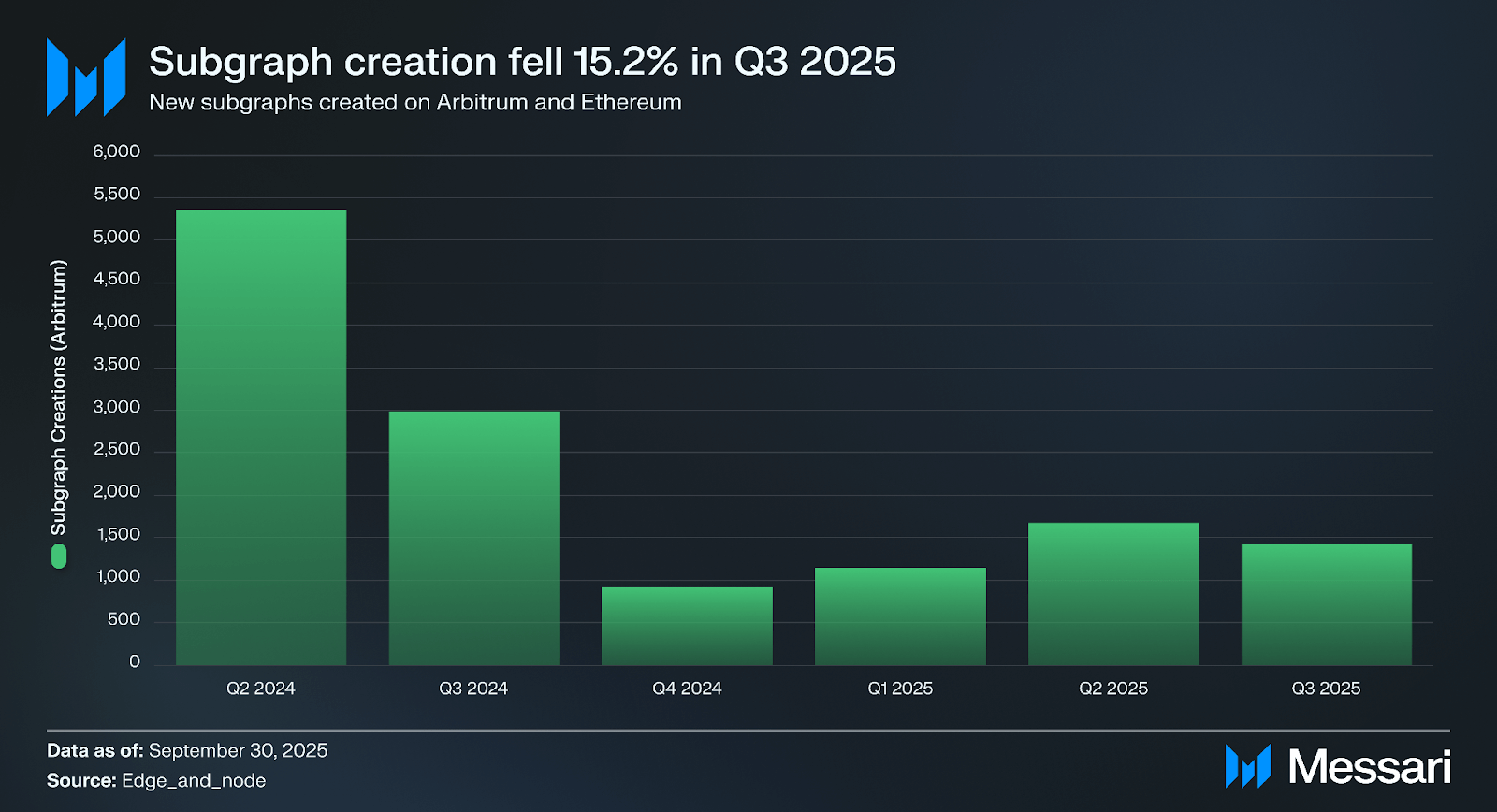
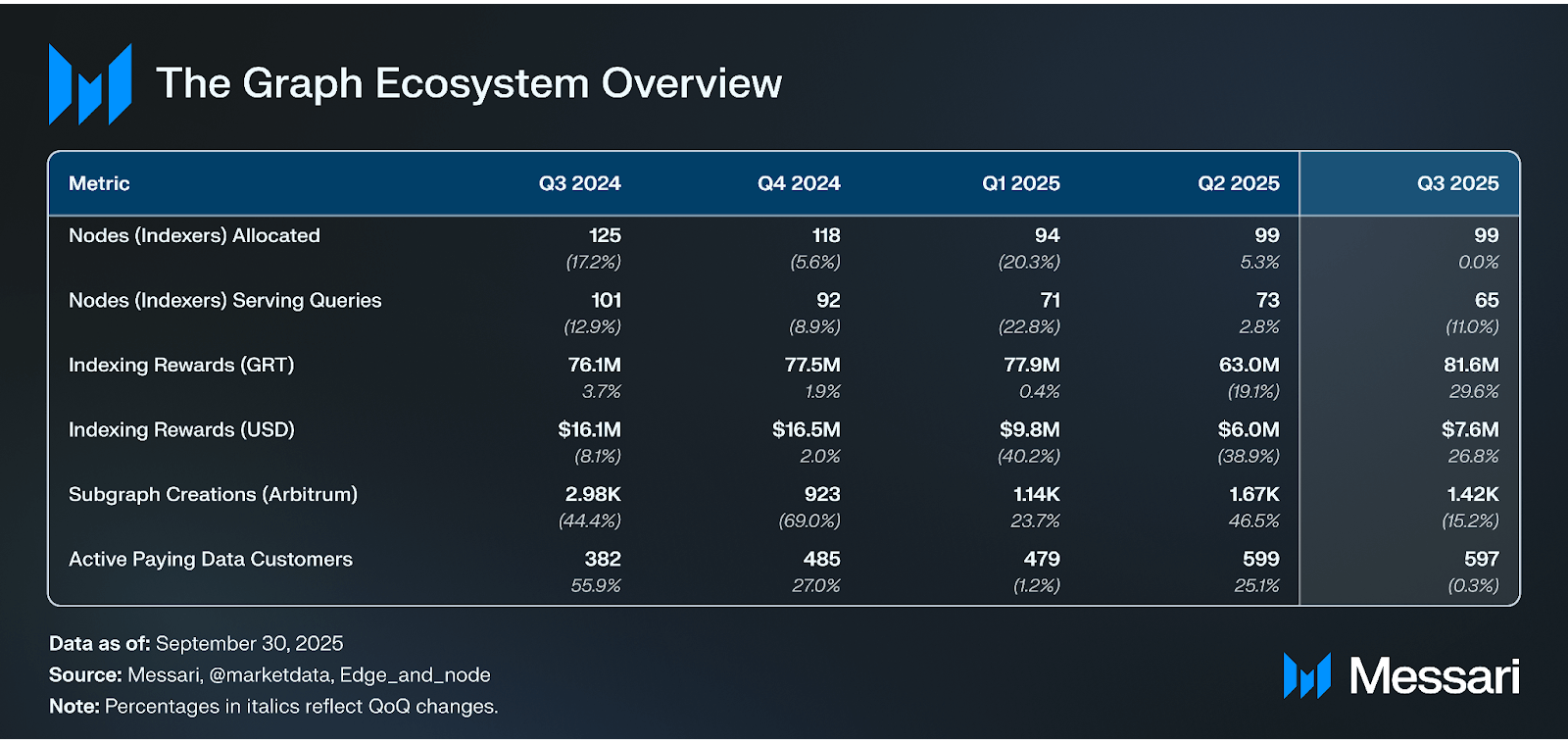
In Q3 2025, developers launched 1,419 new Subgraphs, a 15.2% decrease QoQ from the 1,673 deployed in Q2. Although there was a reduction in new Subgraphs in Q3, the trend of growth is still present, with Q3 2025 outpacing Q1 2025 and Q4 2024. The steady rebound signals growing demand for onchain indexing and continued developer engagement following The Graph’s full transition to Arbitrum. Since Q3 2024, all new Subgraphs have been created on Arbitrum One, benefiting from lower costs and faster settlement as indexing rewards remain exclusively distributed on the L2 network.
Indexers and Ecosystem Participation
The Graph’s economic design coordinates participation from both technical and non-technical participants to meet supply and demand for data indexing and consumption:
Indexers operate Graph Nodes to process and store onchain data. Data consumers can then query this data via GraphQL, an open-source language for The Graph’s APIs. Indexers receive query fees in GRT from data consumers and indexing rewards from the issuance of new GRT.
Curators signal to Indexers which Subgraphs are worth indexing. Curators also often act as Subgraph developers. Curators earn a 10% portion of the GRT query fees generated by Subgraphs.
Delegators delegate their GRT tokens to Indexers in exchange for a portion of an Indexer’s GRT query fees and indexing rewards. The amount of GRT query fees and indexing rewards a delegator receives is proportional to the amount of GRT delegated, less an Indexing Reward Cut and Query Fee Cut (commissions). There is also a 0.5% delegation tax each time a wallet delegates GRT.
Staked GRT is required for indexing Subgraphs and processing queries. As an Indexer stakes and is delegated more GRT, its capacity to process queries increases.
The minimum stake for an Indexer is currently set at 100,000 GRT (approximately $8,000 as of September 30, 2025). In addition to this minimum, Indexers can also receive delegated stake from other ecosystem participants. Collectively, a maximum of 16x an Indexer’s personal stake can be delegated to a given Indexer.
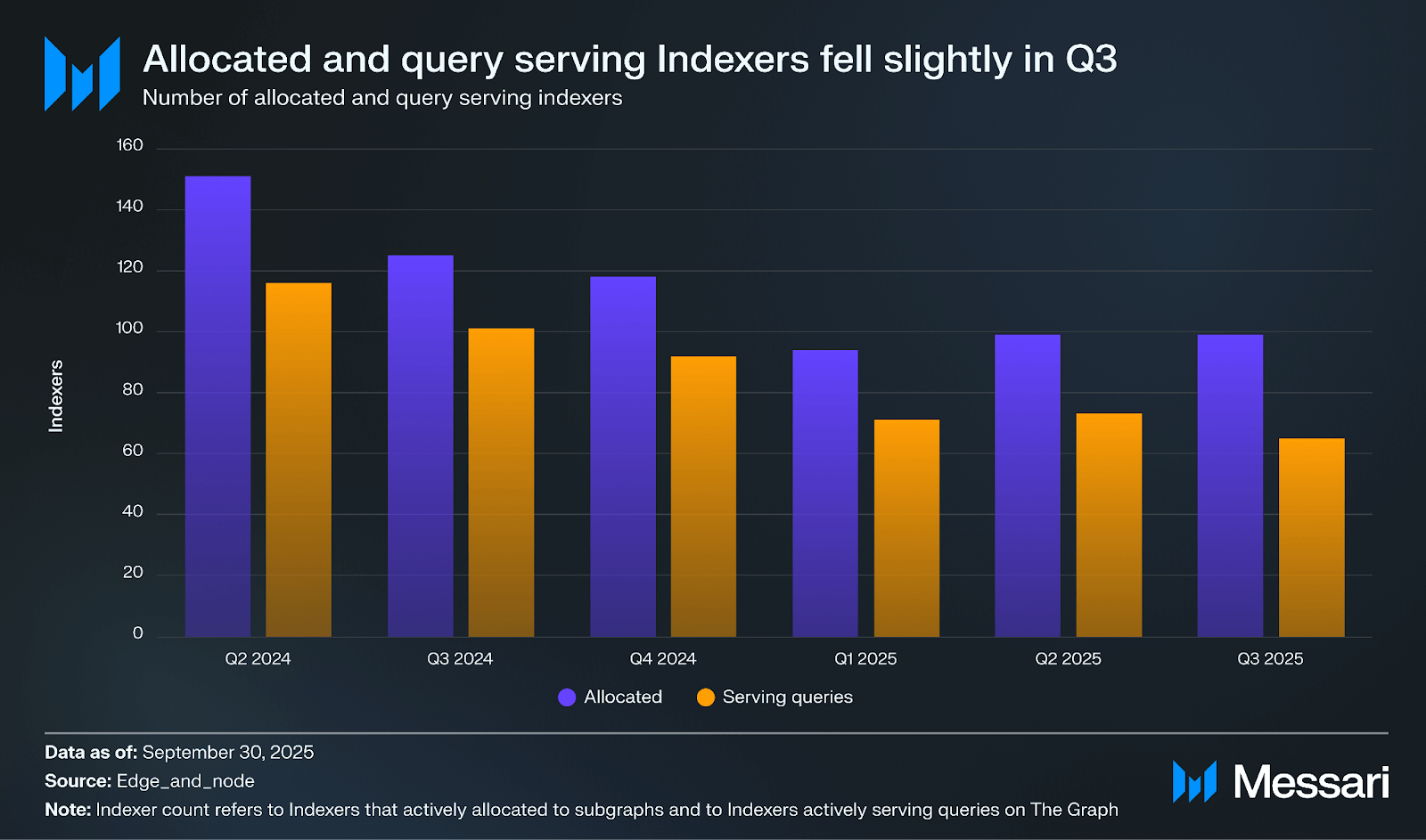
The number of Indexers with allocated stake on The Graph was unchanged in Q3, at 99. However, active Indexers serving queries modestly declined from 73 to 65, a 10.9% drop QoQ. Despite the minor decline, operator participation remains steady overall, and the set of indexers continues to keep pace with the expanding demand for Subgraphs.
Indexing Rewards
Annualized inflation from new GRT issuance remained relatively stable at 2.79% in Q3 2025. GRT inflation is governed by protocol parameters and funds indexing rewards for staked participants.
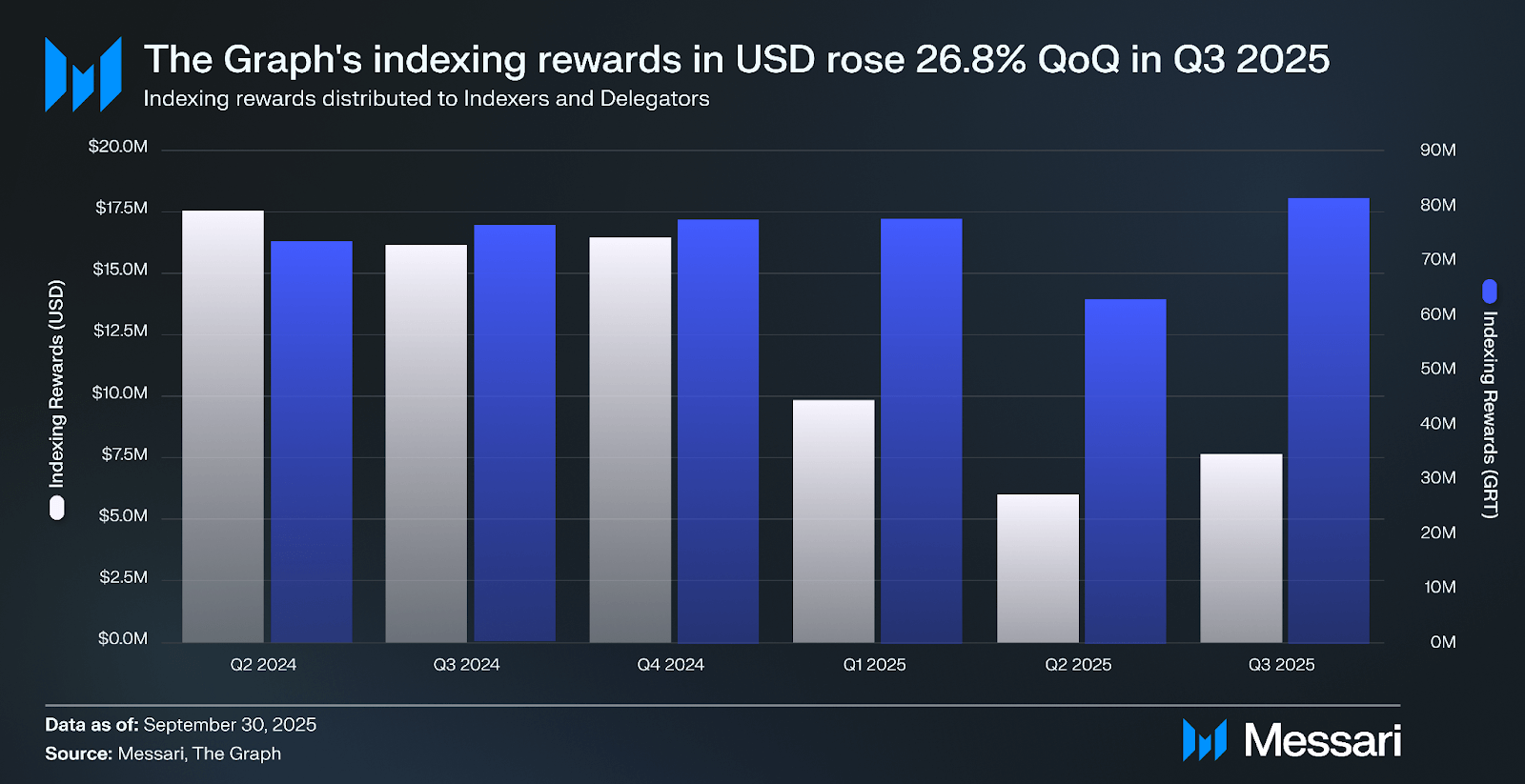
Indexing rewards increased meaningfully in Q3 2025. In GRT terms, rewards grew 29.6% QoQ from 63.0 million GRT to 81.6 million GRT, an all-time high in indexing rewards for a single quarter. This bounce in indexing rewards is especially positive following a 19.1% QoQ decrease in Q2.
In USD terms, rewards rose 26.8% QoQ from $6.0 million to $7.6 million. Despite still being below 2024 averages, the increase in indexing rewards in Q3, combined with a slight reduction in active indexers, resulted in increased profitability for individual indexers across the quarter.
Substream Revenue
Substreams are a new way to build high-performance, modular data pipelines on The Graph. They’re built using Rust, stream raw blockchain data at scale, and output structured data that can then be used by subgraphs or other applications.
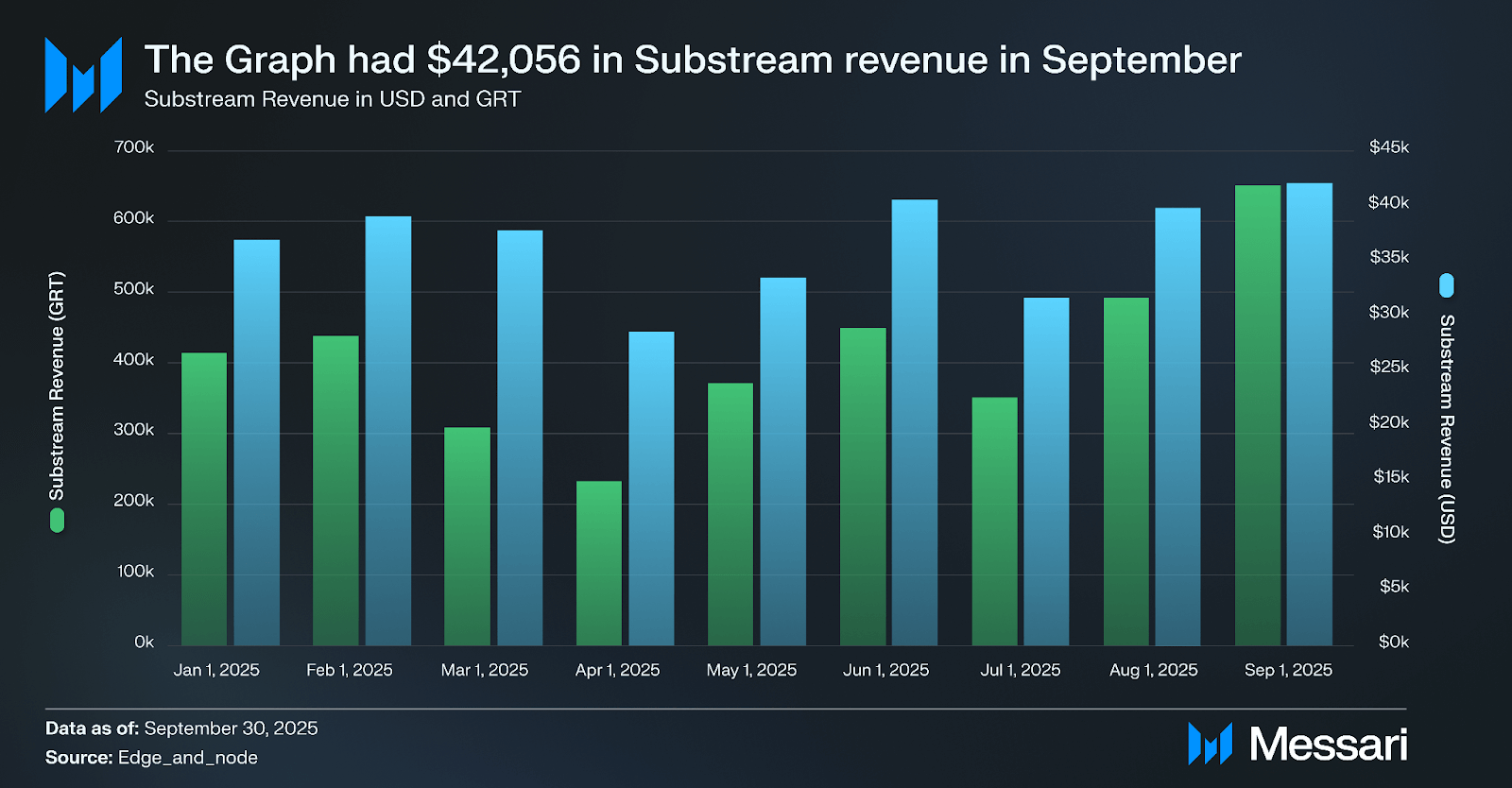
In GRT terms, Substream revenue increased 41.8% QoQ from 1.1 million to 1.5 million GRT in Q3. Due to the slight decrease in GRT price, when measured in USD, Substream revenue only increased 10.7% QoQ. However, when broken down by month, there was a record high revenue in September when denominated in both GRT (651,021) and USD ($42,056), which bodes well for momentum to continue into Q4.
Network Usage Fees
Query fee revenue for The Graph protocol encompasses two primary sources: Subgraph query fees and Substreams fees. Subgraph query fees are determined by the volume of queries multiplied by the query indexing fee, while Substreams fees accrue from the execution and transformation of streaming‑first data pipelines.
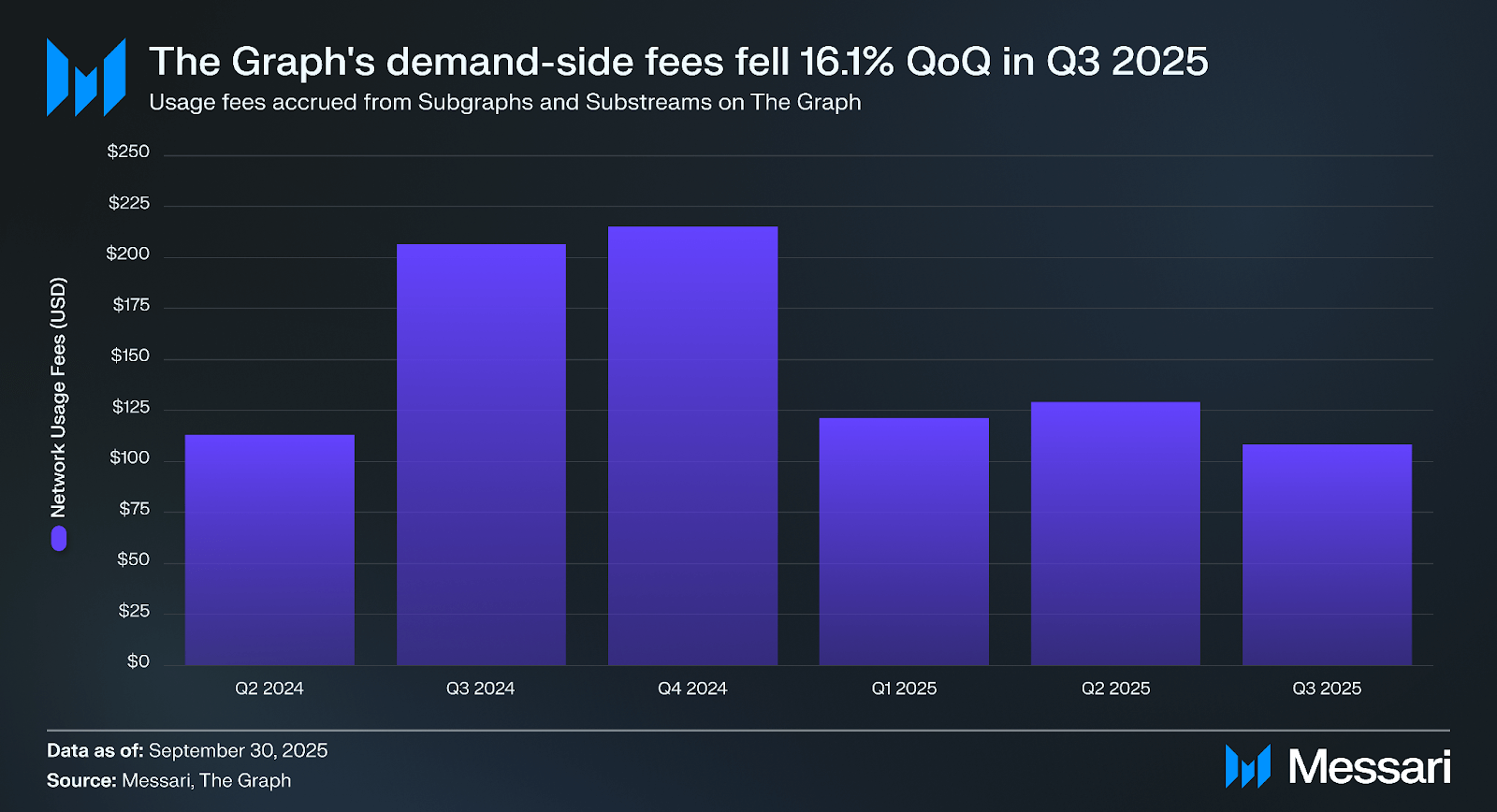
In Q3 2025, The Graph generated $108,066 in total revenue from Subgraphs, a 16.1% QoQ decrease from $128,862 in Q2.
Most demand remained concentrated on Ethereum and major L2s. For the first time, Base surpassed Ethereum Mainnet in query fees, with $21,982 in fees in Q3, up 39.7% QoQ. Ethereum Mainnet still had significant demand, finishing the quarter with $20,544 in fees, a 25% decrease QoQ. Other networks with significant demand were BNB Smart Chain ($13,388), Polygon ($13,023), and Arbitrum One ($12,511).
Despite the slight decrease, the data reflects broad and growing multichain utilization of The Graph, particularly on L2s. The continued adoption of batch settlement tools like GraphTally has further optimized fee flows, making query services more cost-effective and accessible while preserving revenue under a reduced pricing model.
Ecosystem Developments
Hypergraph Ushers in the Era of User-Owned Applications
At ETHCC, The Graph unveiled Hypergraph, a new local-first framework that’s already reshaping how developers think about Web3 applications. Within a week, builders began launching real, consumer-ready tools, from AI-assisted mind maps to private health data vaults, proving that user-owned data is no longer a theory but a working reality.
Before Hypergraph, developers faced a tradeoff between centralized convenience and decentralized ideals. User data was either locked in Web2 silos or trapped in rigid onchain systems. Hypergraph unifies public and private data under a single, open-source framework. Data is encrypted, stored locally, and shared peer-to-peer, enabling composability without compromise.
By introducing local-first storage, GRC-20 knowledge graphs, and a simple TypeScript SDK, Hypergraph makes it as easy to build decentralized apps as traditional web ones. The results came fast. Hypermaps demonstrated private AI-powered collaboration; Livus unified biometric data from Whoop and Oura into a user-owned vault; and ClearsignKit decentralized smart contract intelligence by publishing readable metadata directly to The Graph’s Public Knowledge Graph.
The Graph’s team is already refining the framework based on developer feedback, improving IPFS reliability, and backend documentation. However, the real momentum is community-driven, with teams now publishing reusable schemas and data types that make each new application easier to build than the previous one.
Chain Support in The Graph Enters a New Phase
The Graph is restructuring how it supports new chain integrations, shifting from growth-at-all-costs to a focus on sustainable, adoption-driven incentives. Since launching the Chain Integration Process (CIP) in 2023, the protocol has used indexing rewards and GRT token subsidies to bootstrap new ecosystems and rapidly expand its reach. That strategy paid off, enabling The Graph to scale to billions of monthly queries and become core infrastructure for thousands of dapps.
However, with the network now entering a more mature phase, the bar is rising. Going forward, indexing rewards will no longer be awarded solely for technical integration. Instead, chains must show real usage signals, sustained query volume, active subgraphs, and ecosystem traction to qualify for protocol-funded support.
These changes tighten the CIP criteria. Chains already in Subgraph Studio or using Substreams can still participate, but will undergo a usage-based evaluation before advancing. Indexing rewards will be reserved for chains that demonstrate developer adoption and meaningful user activity. Chains that don’t meet the new thresholds won’t be removed from the network; they can still be indexed and serve data, but they’ll no longer receive subsidized infrastructure.
This move marks a deliberate shift toward demand-based network expansion. The goal is to reduce unnecessary protocol costs, improve the quality of indexed data, and help Indexers focus on high-impact queries. It also gives core contributors and partners a more predictable planning framework, aligning long-term protocol growth with real-world usage.
Substreams Supercharges Multi-Chain Indexing with Token API
The Graph’s new Token API is a case study in what’s now possible thanks to Substreams, a parallel processing engine that has turned slow, sequential blockchain indexing into something fast, scalable, and developer-ready. Traditional RPC-based methods cannot keep up with the demands of multi-chain data: they are slow, miss complex DeFi movements, and require duplicative infrastructure for each chain. Substreams rewrites those limitations.
Built on Substreams, the Token API delivers real-time token, balance, price, and NFT data across Ethereum, Arbitrum, Polygon, Solana, and other major networks. By slicing block histories into parallelized jobs, The Graph slashed full-chain sync times from days to hours. Arbitrum's history now indexes in 15 hours instead of 15 days. Ethereum? Down to 10 hours from 3 days.
The speed boost comes from more than just parallelism. Substreams’ modular architecture caches outputs, avoids redundant processing, and allows developers to reuse core logic across chains. It also tracks even the most complex balance changes — including flash loans and DeFi position shifts — with high accuracy thanks to a blend of stateful indexing and redundant RPC lookups.
A Model Context Protocol (MCP) server introduces AI-query capabilities, enabling users to retrieve wallet balances, NFT histories, and token prices across chains using natural language and real-time data streams.
Closing Summary
Q3 2025 marked a period of recalibration and forward acceleration for The Graph. While overall query volume dipped from record highs, the protocol continued to deepen its multichain presence, grow its Subgraph ecosystem, and roll out new infrastructure that expands what’s possible for developers and data consumers alike.
At the core of this evolution is Substreams, now powering both high-performance indexing and the Token API, which cuts sync times by over 20x and unlocks new, AI-powered data access patterns. These technical gains are not just performance wins; they expand the scope of what developers can build, and how quickly.
The launch of Hypergraph added another dimension, offering a local-first framework for private, user-owned data. In just weeks, developers proved its viability with applications that blend privacy, interoperability, and usability, a long-missing combination in Web3. Meanwhile, the protocol’s decision to tighten incentives through a revised Chain Integration Process underscores a shift toward long-term sustainability and support driven by adoption.
Despite short-term market pressures and fluctuating network usage, the foundations being laid point toward a more composable, performant, and user-respecting data layer, one built not for speculation, but for real, scalable application development. As The Graph continues to mature, it’s doing so with a sharper focus: delivering fast, secure, and decentralized access to the data that powers Web3.
This report was commissioned by The Graph. All content was produced independently by the author(s) and does not necessarily reflect the opinions of Messari, Inc. or the organization that requested the report. The commissioning organization may have input on the content of the report, but Messari maintains editorial control over the final report to retain data accuracy and objectivity. Author(s) may hold cryptocurrencies named in this report. This report is meant for informational purposes only. It is not meant to serve as investment advice. You should conduct your own research and consult an independent financial, tax, or legal advisor before making any investment decisions. Past performance of any asset is not indicative of future results. Please see our Terms of Service for more information.
No part of this report may be (a) copied, photocopied, duplicated in any form by any means or (b) redistributed without the prior written consent of Messari®.
Drexel is a Research Manager at Messari for the Protocol Reporting team with a focus on base layers and DeFi. He is a strong follower of the crypto mullet thesis of diligence in the front and degen in the back.
Drexel is a Research Manager at Messari for the Protocol Reporting team with a focus on base layers and DeFi. He is a strong follower of the crypto mullet thesis of diligence in the front and degen in the back.