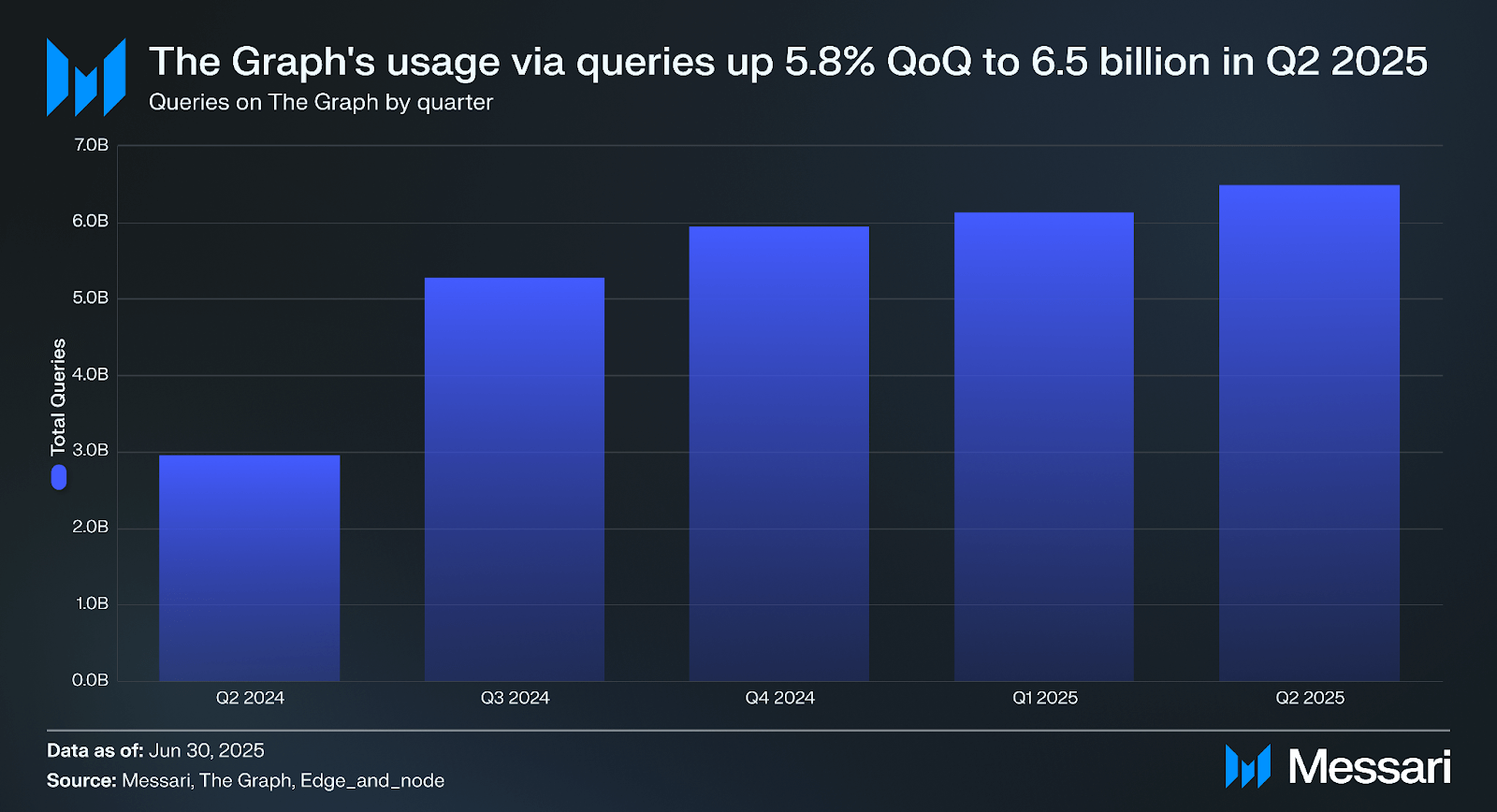
Query volume hit an all-time high of 6.49 billion in Q2, marking four straight quarters of growth and signaling strong, sustained demand for decentralized data.
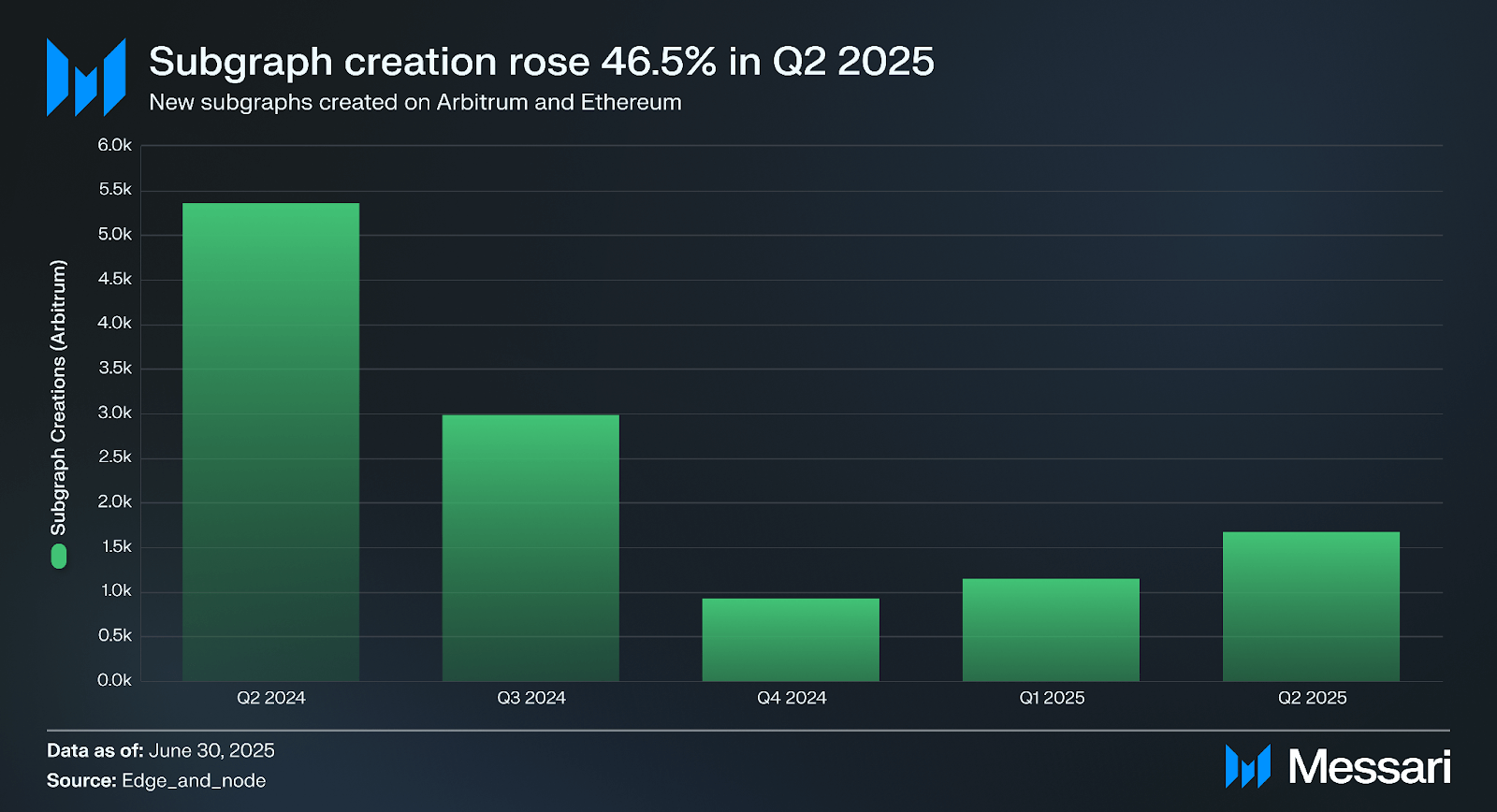
Developers launched 1,673 new Subgraphs in Q2, up 46.3% QoQ. This is the highest growth rate since the full migration to Arbitrum, showing renewed momentum in network adoption.
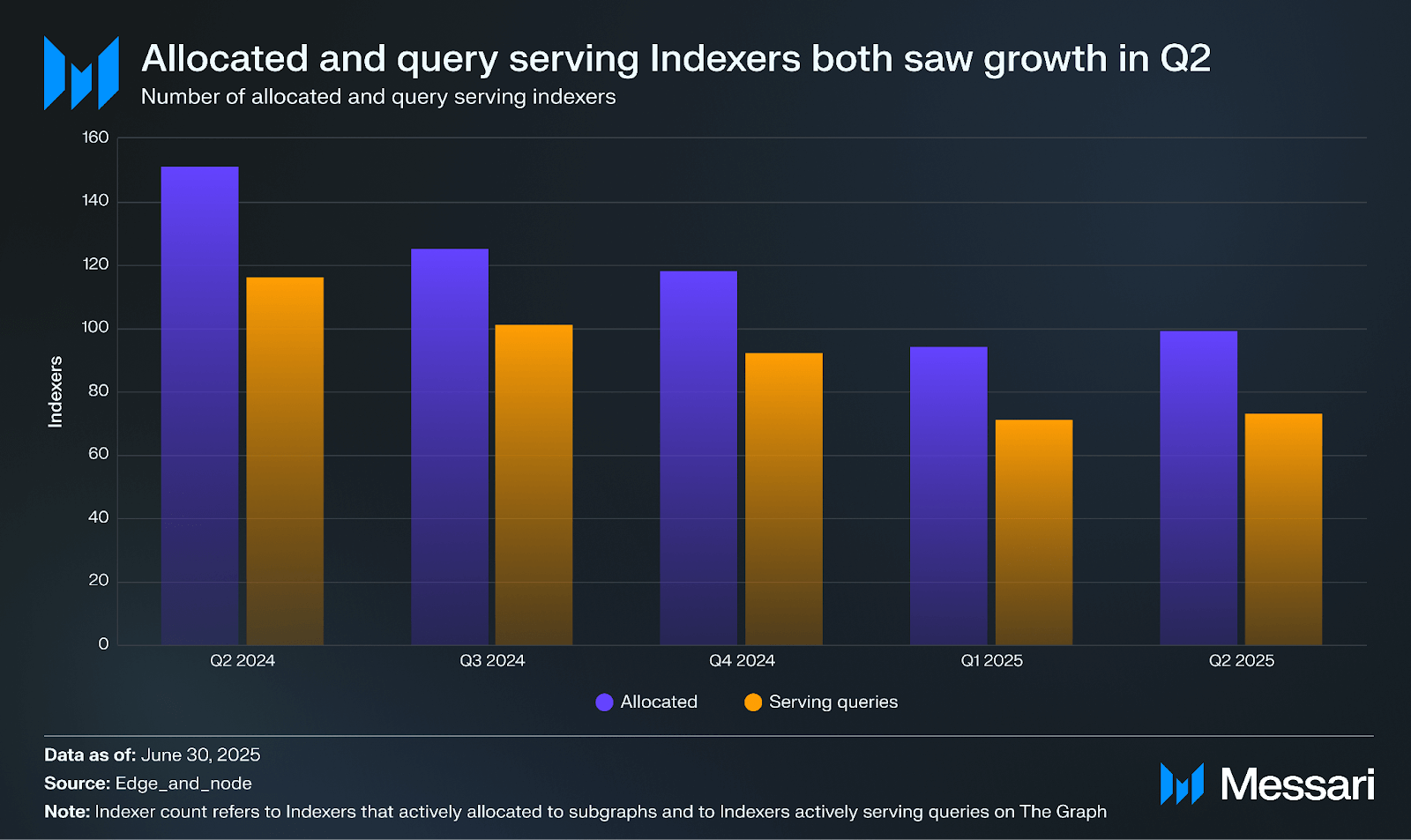
After nine quarters of decline, Indexer participation reversed course, with a 5.3% increase in allocated stake and a 2.8% rise in active Indexers, suggesting early signs of operational recovery.
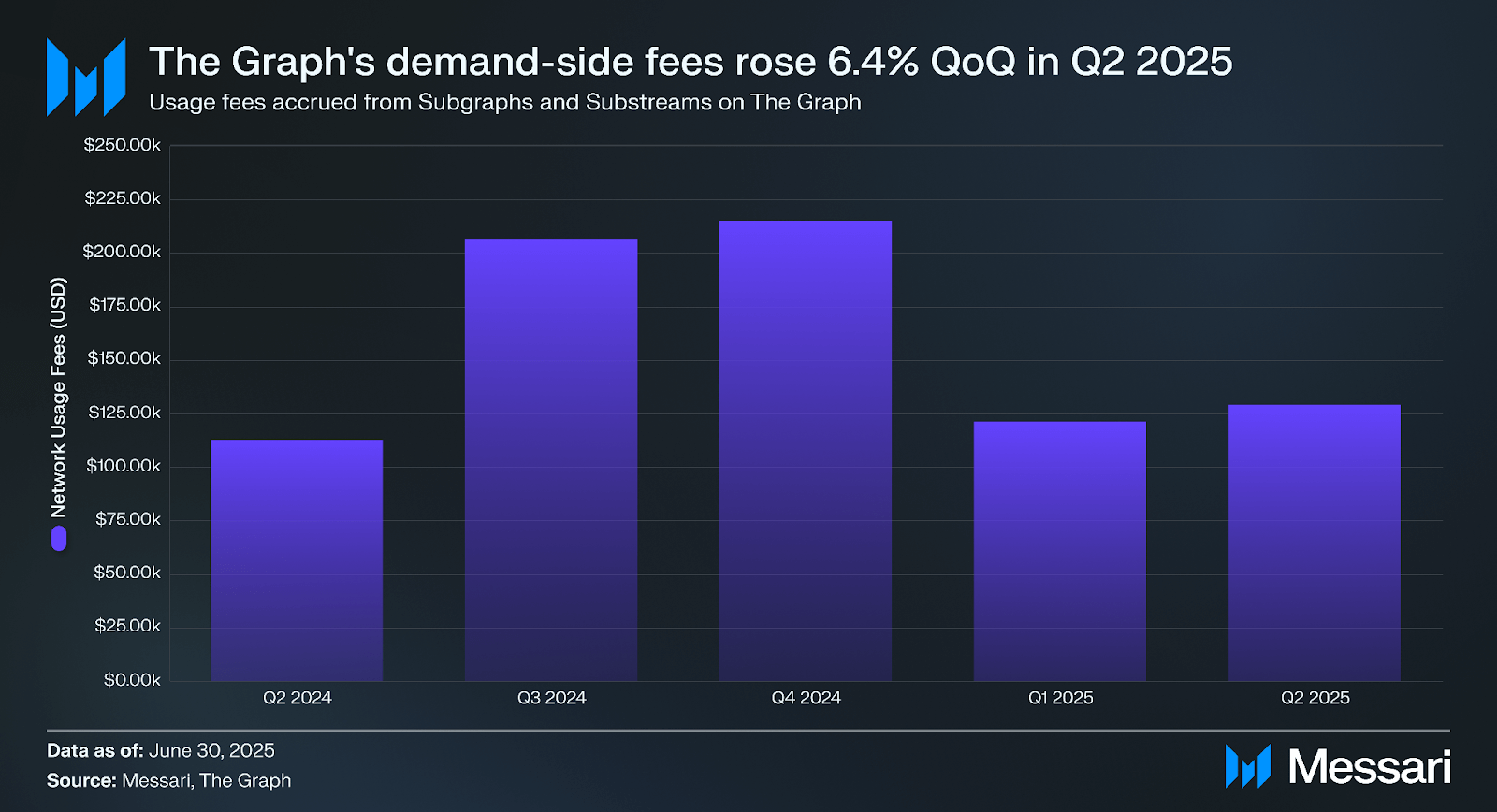
Total usage-based revenue rose 6.4% QoQ to $128,862, supported by broader multichain activity and improved payment efficiency from tools like GraphTally.
The Graph is integrating Chainlink CCIP to enable GRT transfers across Arbitrum, Base, and Solana, setting the stage for cross-chain staking, fee payments, and broader ecosystem reach.
Primer
The Graph (GRT) is an indexing protocol that provides onchain data, such as DeFi transactions and liquidity pool data, from various sources. The Graph removes the need for data consumers (e.g., app developers) to build complicated infrastructure to get onchain data. Instead, data consumers pay to query custom APIs, called “Subgraphs”, of onchain data via the GraphQL API. Subgraphs define a data schema to be indexed, making that data queryable. Subgraphs can be developed and queried by anyone.
The Graph Network uses its native utility token, GRT, to incentivize data indexing and consumption:
Indexers process and store onchain data from Subgraphs. They usually have advanced technical knowledge of node operation. Indexers receive query fees in GRT from data consumers and indexing rewards from new GRT issuance.
Curators are incentivized to analyze and signal which Subgraphs are valuable to index. Curators earn a 10% portion of the GRT query fees generated by Subgraphs.
Delegators do not employ resources to index onchain data; instead, they delegate The Graph's native utility token, GRT, to Indexers. The amount of GRT query fees and indexing rewards a delegator receives is proportional to the amount of GRT delegated, less an Indexing Reward Cut (commission). There is also a 0.5% delegation tax each time a wallet delegates GRT.
In June 2024, The Graph completed its Sunrise of Decentralized Data initiative to upgrade all Subgraphs to its distributed network of independent Indexers.
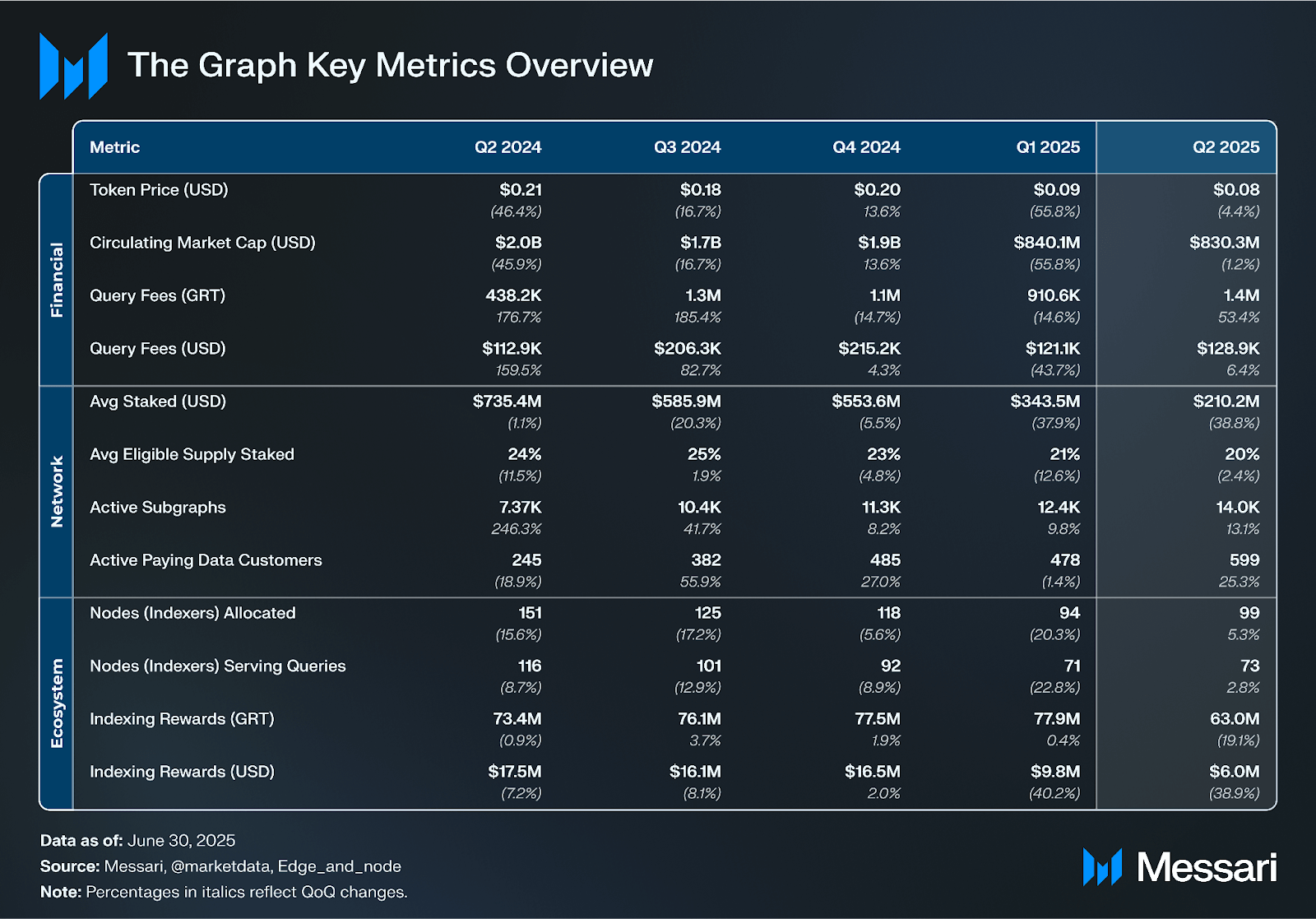
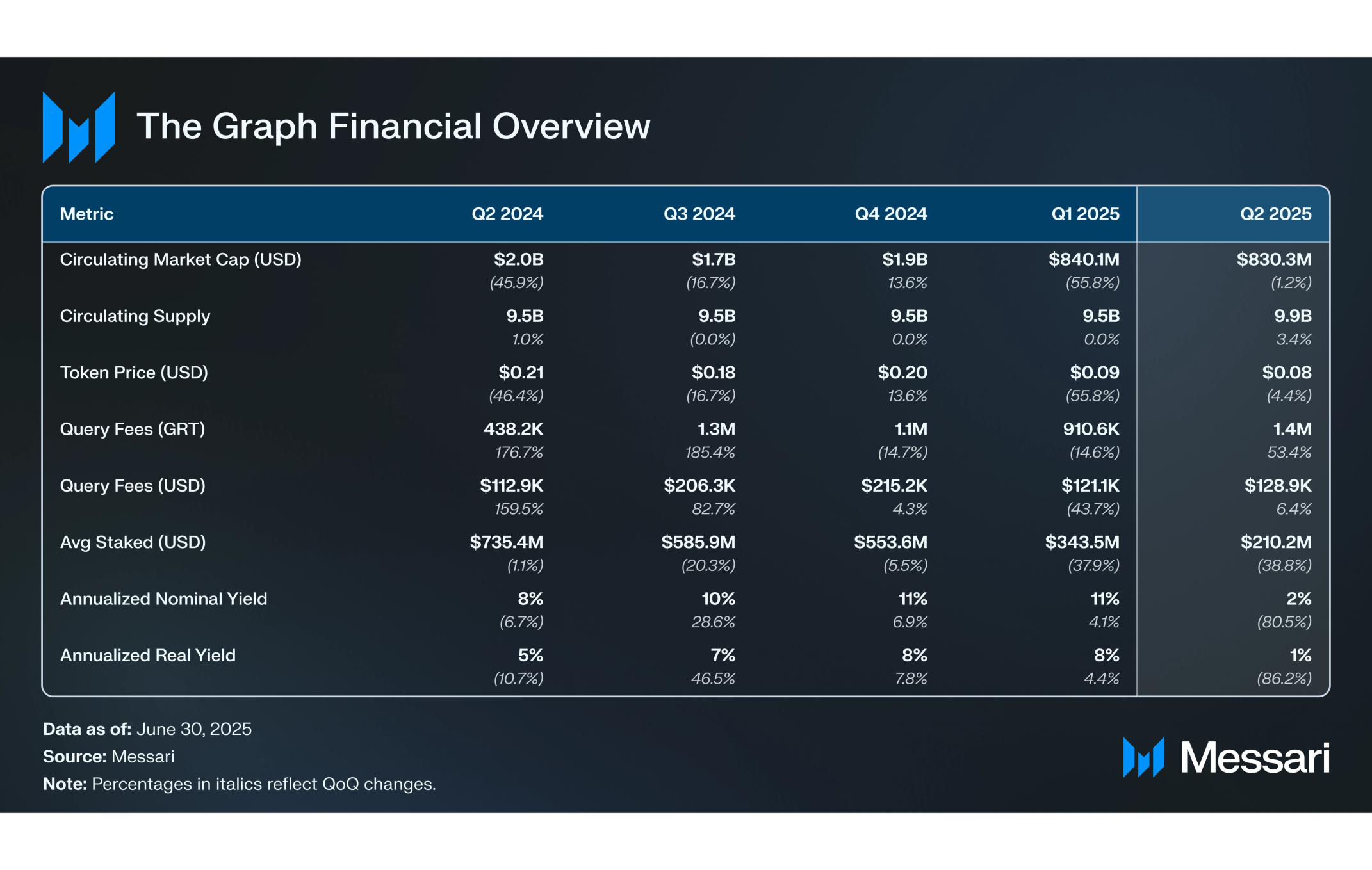
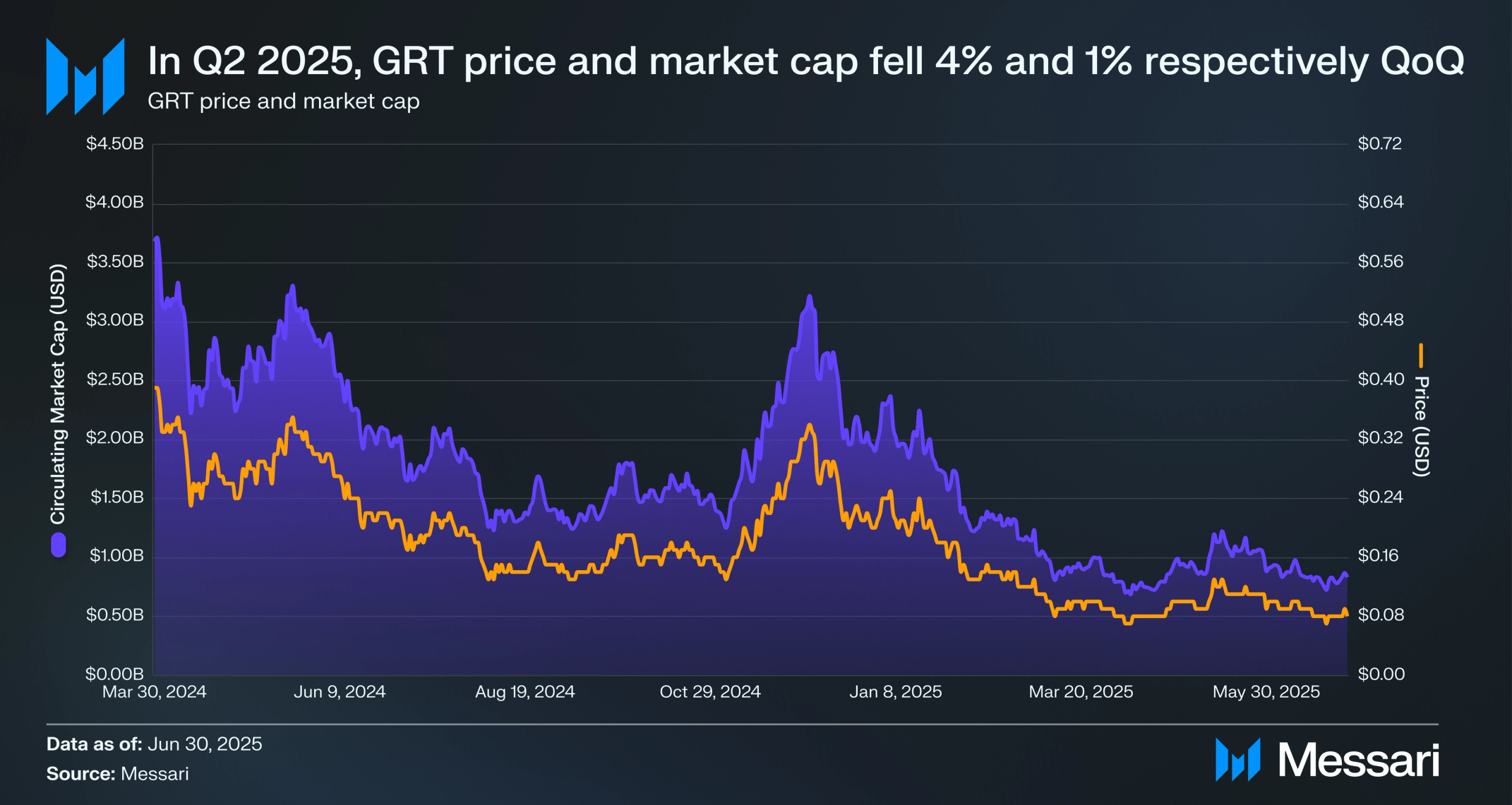
The Graph’s financial profile remained relatively stable in Q2 2025 despite broader market uncertainty. The circulating market cap declined slightly by 1.2% QoQ, from $840.1 million to $830.3 million, reflecting a minor decline in token price and modest growth in circulating supply.
The GRT token price slipped 11.1% QoQ, to $0.08 in Q2, down from $0.09 in Q1. Despite continued ecosystem development and usage growth, token performance remained soft amid broader risk-off sentiment across crypto markets.
Meanwhile, the circulating supply of GRT rose 3.4% QoQ, reaching 9.9 billion tokens by quarter-end. This increase aligns with protocol issuance and reward distributions, which were 1.05% annualized in Q2.
Network Overview
The Graph Network is used by developers and data consumers who pay GRT to query data. The network's performance can be measured by the growth of the volume of queries serviced, the active Subgraphs serving queries, and the accrual of query fees.
Query Volume
The Graph's query volume continued rising steadily in Q2 2025, reaching a new all-time high of 6.49 billion queries, up 5.8% QoQ from 6.14 billion in Q1. This marks the fourth consecutive quarter of growth, reflecting ongoing demand for decentralized data access across chains and applications.
Across the top 10 networks by query volume, Ethereum Mainnet remained the top destination for queries on The Graph, handling 1.40 billion queries, up 2.8% QoQ. Arbitrum One followed closely with 1.37 billion queries, marking a significant 46.2% QoQ increase, the largest gain among major chains.
In contrast, queries on Base declined 14.6% QoQ from 910 million to 777 million, marking a cooldown after its Q1 surge. Polygon remained stable with a minor 0.8% dip, while BNB Smart Chain grew 5.2%, reaching 585 million queries.
These shifts reflect both organic growth and varying levels of application and Subgraph deployment activity across networks. Notably, Arbitrum’s rapid rise signals deepening adoption of L2 infrastructure for data indexing and querying.
Subgraphs
To bootstrap The Graph, a hosted service was initially created. This service hosted Subgraphs as the protocol gradually transitioned to its decentralized network. The hosted service was free (subsidized by The Graph ecosystem) and offered indexing infrastructure run by Edge & Node, the initial team behind The Graph.
The first Subgraph launched on the decentralized network in Q1 2021. In October 2023, the project introduced its Sunrise of Decentralized Data (completed in June 2024) to upgrade all Subgraphs to its distributed network of independent Indexers in three phases: Sunray, Sunbeam, and Sunrise.
The first phase of the upgrade, Sunray, was completed in March 2024. Sunray brought more chains, improved billing, and a free query plan of 100,000 queries per month. This helped developers get started on the network and scale their development.
The second phase, Sunbeam, concluded in June 2024. Sunbeam focused on upgrading hosted service Subgraphs to The Graph Network. The third phase of the upgrade, Sunrise, retired hosted service endpoints and was completed in June 2024.
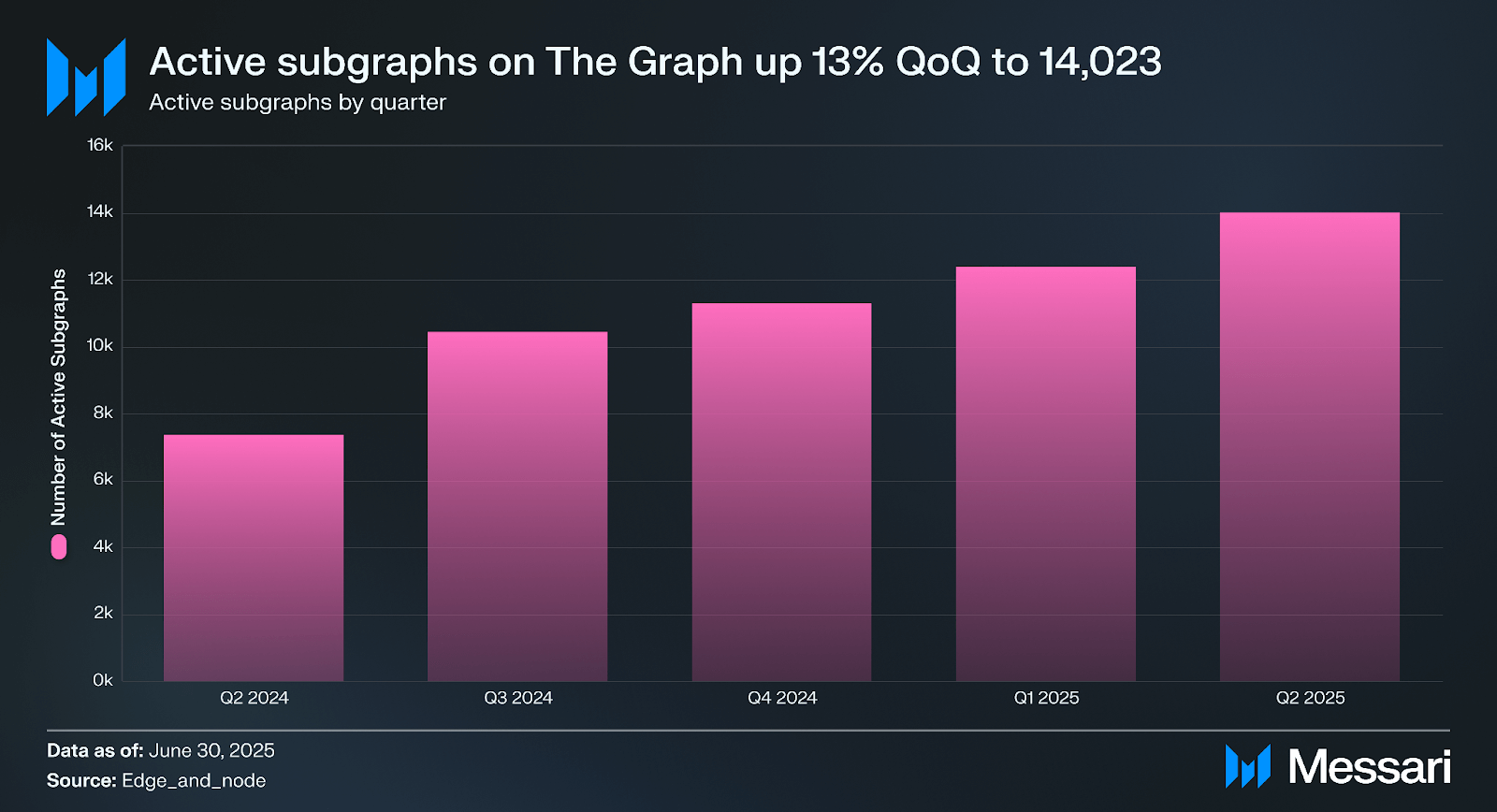
The number of active Subgraphs on The Graph’s decentralized network continued to grow in Q2 2025, reaching 14,023(+13.1% QoQ). This marks the fifth consecutive quarter of growth and the highest number of active Subgraphs to date. The continued expansion highlights rising developer adoption and an increasing diversity of applications indexing data across The Graph’s supported networks.
In Q2 2025, developers launched 1,673 new Subgraphs, a 46.3% increase QoQ from the 1,143 deployed in Q1. This marks the second consecutive quarter of growth following the post-migration dip seen in late 2024. The steady rebound signals growing demand for onchain indexing and continued developer engagement following The Graph’s full transition to Arbitrum. Since Q3 2024, all new Subgraphs have been created on Arbitrum One, benefiting from lower costs and faster settlement as indexing rewards remain exclusively distributed on the L2 network.
Indexers and Ecosystem Participation
The Graph’s economic design coordinates participation from both technical and non-technical participants to meet supply and demand for data indexing and consumption:
Indexers operate Graph Nodes to process and store onchain data. Data consumers can then query this data via GraphQL, an open-source language for The Graph’s APIs. Indexers receive query fees in GRT from data consumers and indexing rewards from new GRT issuance.
Curators signal to Indexers which Subgraphs are worth indexing. Curators also often act as Subgraph developers. Curators earn a 10% portion of the GRT query fees generated by Subgraphs.
Delegators delegate their GRT tokens to Indexers in exchange for a portion of an Indexer’s GRT query fees and indexing rewards. The amount of GRT query fees and indexing rewards a delegator receives is proportional to the amount of GRT delegated, less an Indexing Reward Cut and Query Fee Cut (commissions). There is also a 0.5% delegation tax each time a wallet delegates GRT.
Staked GRT is required for indexing Subgraphs and processing queries. As an Indexer stakes and is delegated more GRT, its capacity to process queries increases.
The minimum stake for an Indexer is currently set at 100,000 GRT (approximately $8,000 as of June 30, 2025). In addition to this minimum, Indexers can also receive delegated stake from other ecosystem participants. Collectively, a maximum of 16x an Indexer’s personal stake can be delegated to a given Indexer.
The number of Indexers with allocated stake on The Graph rose slightly in Q2 2025 to 99, up 5.3% QoQ from 94 in Q1. Similarly, active Indexers serving queries increased modestly from 71 to 73, a 2.8% QoQ uptick. This marks the first quarterly increase in Indexer participation since Q1 2023, following nine straight quarters of decline after the Migration Infrastructure Providers incentive was sunset.
Though growth was modest, it suggests early signs of stabilization in operator participation. Network performance remained strong, with the smaller set of Indexers continuing to scale effectively alongside expanding Subgraph demand.
Staking Overview
The GRT token follows the Stake-for-Access model, also known as a utility token model. Participants in The Graph's ecosystem earn revenue in GRT by performing indexing and querying services on the decentralized network. Both services require GRT to be staked. An Indexer’s stake comprises their own GRT tokens (i.e., self-stake) and GRT delegated toward them (i.e., delegated stake).
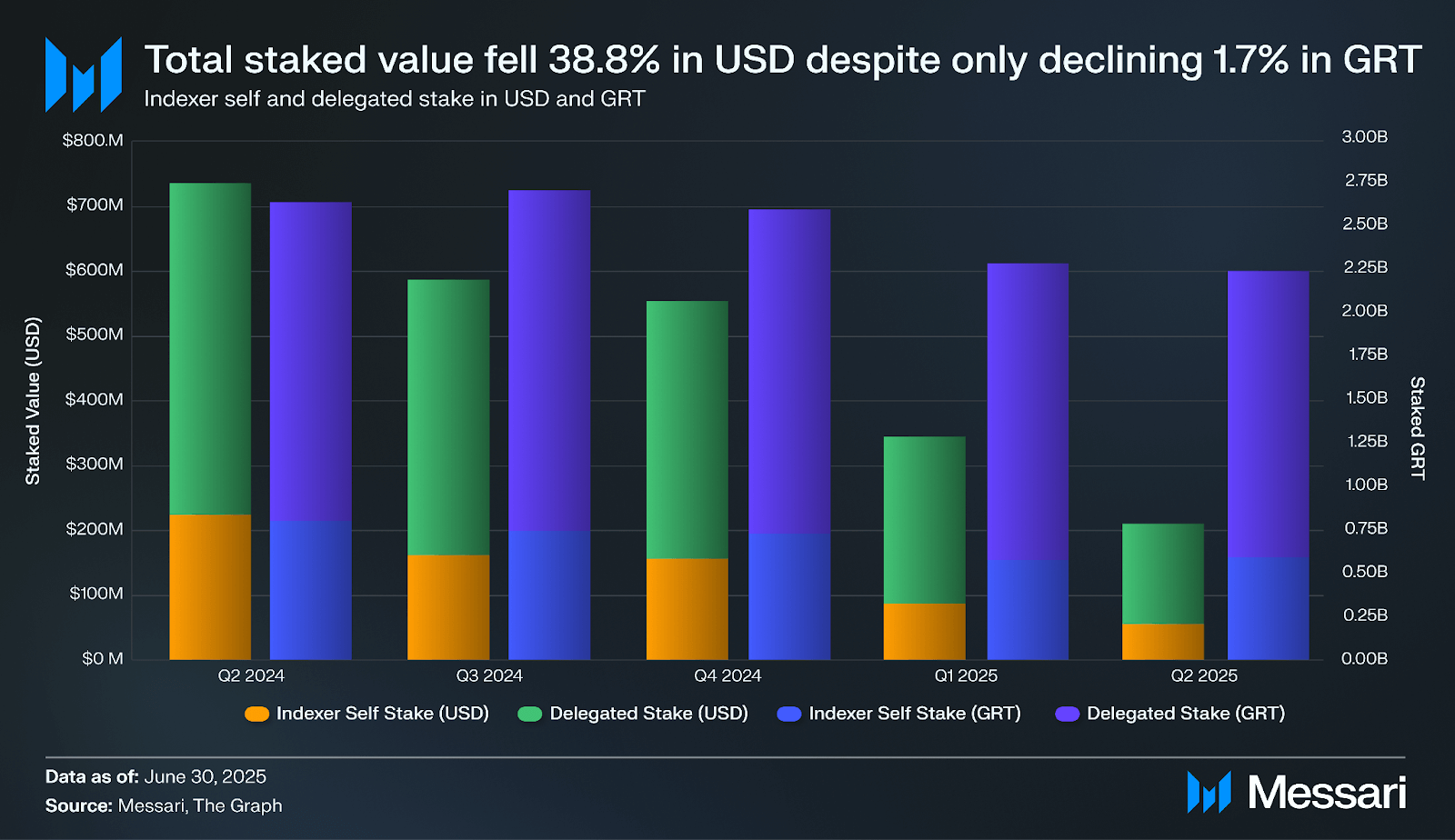
GRT staking activity on The Graph Network declined sharply in Q2 2025, both in dollar terms and as a percentage of circulating supply. The total value staked, including both indexer self-stake and delegated stake, averaged $210.2 million, down 38.8% QoQ from $343.5 million in Q1 2025. This drop reflects both reduced GRT prices and lower staking participation.
Indexer self-stake in Q2 averaged $55.2 million, a 36.5% decrease from $86.8 million in the prior quarter. Delegated stake followed a similar trend, falling 39.6% QoQ to $155.1 million, down from $256.7 million in Q1.
In GRT terms, however, the changes were more muted. Average indexer self-stake rose slightly to 590.3 million GRT, up from 578.6 million in Q1, while delegated GRT fell marginally from 1.71 to 1.66 billion GRT.
The average staking rate dipped to 20.01% of the circulating supply, down from 20.5% in Q1. This marked the second consecutive quarterly decline in staking participation as a percentage of supply, reinforcing a trend of reduced token lock-in.
Indexing Rewards
Annualized inflation from new GRT issuance dropped a significant 179bps QoQ from 2.84% to 1.05%, the sharpest reduction in issuance since The Graph’s network launched.
GRT inflation is governed by protocol parameters and funds indexing rewards for staked participants. The decline reflects tightening token economics, which aims to improve long-term sustainability and reduce dilution across the network.
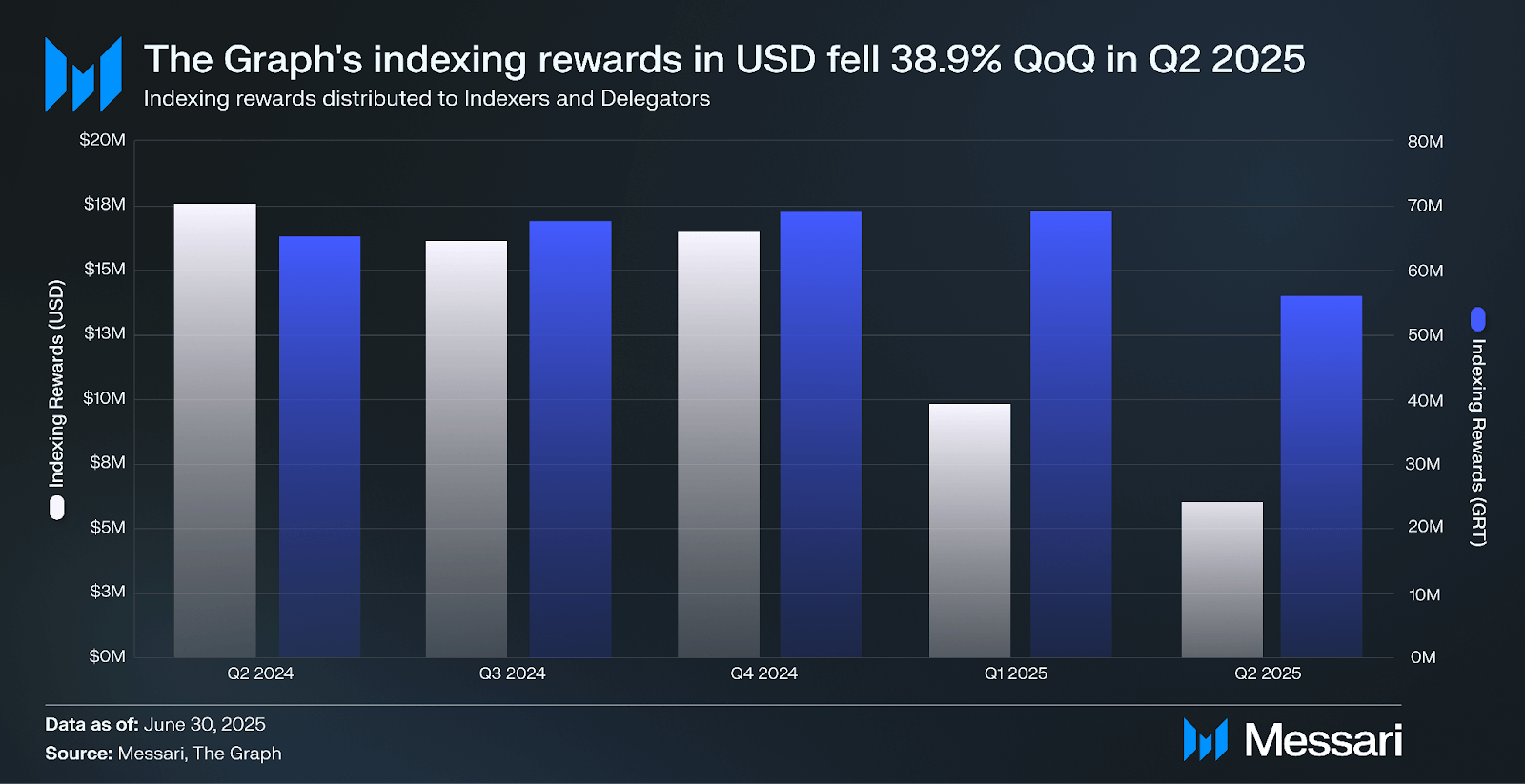
Indexing rewards declined sharply in Q2 2025. In GRT terms, rewards dropped 19.1% QoQ from 77.9 million GRT to 63.0 million. This is the first significant decrease after several quarters of stable growth.
In USD terms, rewards fell an even steeper 38.9% QoQ from $9.8 million to $6.0 million. The decline reflects both reduced issuance and continued weakness in the GRT token price, which further compressed operator earnings. Combined with only modest growth in Indexer participation, these figures reflect a tightening revenue environment for the network’s core infrastructure providers.
Network Usage Fees
Query fee revenue for The Graph protocol encompasses two primary sources: Subgraph query fees and Substreams fees. Subgraph query fees are determined by the volume of queries multiplied by the query indexing fee, while Substreams fees accrue from the execution and transformation of streaming‑first data pipelines.
In Q2 2025, The Graph generated $128,862 in total revenue from Subgraphs, a 6.4% QoQ increase from $121,069 in Q1. This modest rebound comes after a sharp pricing reduction in Q1 and reflects early stabilization in usage-based monetization. The overall uptick in revenue suggests that new deployments and increased query efficiency helped offset previous pricing headwinds. The continued rollout of batch settlement tools like GraphTally has made payments more cost-effective, preserving demand even at lower price points.
Most demand remained concentrated on Ethereum and major L2s. Ethereum Mainnet led all networks with $27,523 in query fees, closely followed by Arbitrum One at $26,885. Base and Polygon followed with $15,736 and $12,758, respectively, while BNB Smart Chain had $12,067. Chains with smaller but growing query fees included Gnosis ($4,313), Celo ($2,970), and Fantom ($2,702).
These figures reflect broad and growing multichain utilization of The Graph, particularly on L2s. The continued adoption of batch settlement tools like GraphTally has further optimized fee flows, making query services more cost-effective and accessible while preserving revenue under a reduced pricing model.
Ecosystem Developments
GRC-20 and the Rise of Decentralized Knowledge
In Q2 2025, The Graph took its first real step toward organizing not just blockchain data but decentralized public knowledge with the launch of GRC-20, a new composable standard for building decentralized knowledge graphs, and the debut of Geo Genesis, a community-curated onchain knowledge hub.
To kickstart this vision, The Graph hosted the inaugural GRC-20 Hackathon, a five-week virtual event focused on building public, queryable knowledge in domains like education, jobs, and civic infrastructure. Backed by a 150,000 GRT prize pool, the hackathon produced dozens of open-source contributions that populated the first Spaces in Geo Genesis, seeding a foundation for decentralized apps, search engines, and AI agents.
The winning project, Mapping Law & Courts by Preston Mantel, exemplified what’s possible with GRC-20. By encoding the U.S. legal system into structured data, judges, jurisdictions, and case law, the project showed how crypto infrastructure can support transparency and automation in traditionally opaque systems, which earned him a job offer from the Geo team.
GRC-20 and Geo Genesis combine flexible governance with verifiable data, allowing communities to curate knowledge with the same autonomy that DAOs use to manage assets. By defining entities, relationships, and ontologies directly onchain, builders can create live, evolving data ecosystems without relying on centralized platforms.
As AI systems increasingly rely on structured data and as crypto continues to mature, the need for open, interoperable knowledge graphs will only grow. GRC-20 offers a native crypto approach that is open-source, transparent, and composable by design. With builders now proving its utility in the wild and momentum building across hackathons and community initiatives, The Graph is laying the groundwork for the next generation of intelligent, decentralized applications.
GRT Goes Cross-Chain with Chainlink CCIP
To further improve interoperability, The Graph announced its plan to adopt Chainlink’s Cross-Chain Interoperability Protocol (CCIP) to enable secure GRT transfers across Arbitrum, Base, and Solana. This move positions GRT as a cross-chain utility token and signals The Graph’s growing alignment with the needs of developers building in a multichain world.
The initial phase of the integration will focus on deploying the core bridging infrastructure, allowing users to move GRT seamlessly between supported networks. By standardizing this transfer mechanism with Chainlink CCIP, The Graph is ensuring not just compatibility, but security and reliability, leveraging Chainlink’s battle-tested infrastructure for message and token transport.
While this rollout begins with basic bridging, it lays the groundwork for more powerful cross-chain capabilities down the line, including staking, delegation, and query fee payments in GRT across L2s. These upgrades would allow users to interact with The Graph’s decentralized data services wherever they operate, without being confined to a single chain.
Perhaps most notably, this marks The Graph’s first formal step toward Solana integration, opening the door to new developer communities and use cases outside the EVM world.
Chain Integrations
Q2 2025 saw continued adoption of The Graph by numerous protocols. In April, The Graph announced that the Stellar network is available to be indexed via Substreams and Subgraphs, allowing devs to power dApps with reliable onchain data.
Importantly, The Graph also announced a strategic integration with TRON, introducing real-time indexing through Substreams. This integration gives TRON developers instant access to live blockchain metrics, such as wallet activity, TVL, and token swaps, enabling faster, infrastructure-free development. The rollout includes developer support through multilingual resources, webinars, and hackathon bounties. Substreams also features AI-ready endpoints, allowing seamless integration of AI agents and enhancing cross-chain data visibility. The partnership expands The Graph’s indexing capabilities while accelerating innovation within TRON’s developer ecosystem.
Rootstock, a Bitcoin L2, also completed the chain integration process, which unlocked indexing rewards and opened data from The Graph’s Indexer network to users of the network.
The Graph also announced full support for Lens Chain at launch, allowing future social apps to access onchain data and the Graph’s full network of Indexers.
Q2 saw a broad spectrum of networks added to The Graph’s Subgraph Studio. Announcements included Viction, Manta, Metis, Autonomys, Apechain, Hashkey Chain, peaq, Swell, and Ronin.
Closing Summary
Q2 2025 marked a quarter of quiet strength for The Graph, with sustained growth in core usage metrics despite broader market softness. Query volume hit a record 6.49 billion, and active Subgraphs climbed to an all-time high of 14,023, reflecting rising developer demand for decentralized data infrastructure. Subgraph creation surged 46.3% QoQ, reinforcing The Graph’s position as the leading indexing layer for onchain data.
For the first time in over two years, Indexer participation grew, hinting at renewed ecosystem confidence. While GRT price weakness impacted staking and rewards, the network continued to function efficiently, processing more data with fewer resources. Indexing rewards fell in both GRT and USD terms, driven by a sharp drop in protocol inflation and ongoing GRT price pressure. Still, the network’s revenue from Subgraph and Substreams services increased 6.4% QoQ, showing early signs of monetization recovery.
Beyond the data, The Graph advanced key initiatives to position itself for long-term relevance. The launch of GRC-20 and Geo Genesis introduced a new frontier: decentralized knowledge graphs. The upcoming integration of Chainlink CCIP will unlock GRT transfers across Arbitrum, Base, and Solana, setting the stage for cross-chain staking and broader utility.
Overall, Q2 was a foundational quarter. While financial headwinds persisted, The Graph’s infrastructure, developer activity, and multichain integration efforts quietly gained momentum, laying the groundwork for future upside as demand for decentralized, AI-ready data accelerates.
This report was commissioned by The Graph. All content was produced independently by the author(s) and does not necessarily reflect the opinions of Messari, Inc. or the organization that requested the report. The commissioning organization may have input on the content of the report, but Messari maintains editorial control over the final report to retain data accuracy and objectivity. Author(s) may hold cryptocurrencies named in this report. This report is meant for informational purposes only. It is not meant to serve as investment advice. You should conduct your own research and consult an independent financial, tax, or legal advisor before making any investment decisions. Past performance of any asset is not indicative of future results. Please see our Terms of Service for more information.
No part of this report may be (a) copied, photocopied, duplicated in any form by any means or (b) redistributed without the prior written consent of Messari®.
Drexel is a Research Manager at Messari for the Protocol Reporting team with a focus on base layers and DeFi. He is a strong follower of the crypto mullet thesis of diligence in the front and degen in the back.
Drexel is a Research Manager at Messari for the Protocol Reporting team with a focus on base layers and DeFi. He is a strong follower of the crypto mullet thesis of diligence in the front and degen in the back.