As of Q1'23, 776 subgraphs have been published from The Graph’s hosted service to the decentralized network (mainnet), up 26% QoQ.
The Graph's ecosystem of active Indexers (+58%), Delegators (+2%), and Curators (+1%) continued its growth QoQ.
In Q1'23, The Graph saw a 41% QoQ increase in USD revenue from query fees.
Revenue from indexing rewards increased 48% QoQ in USD terms.
The ongoing migration of The Graph’s protocol smart contracts to Arbitrum aims to bring a seamless and gas-efficient decentralized data experience to The Graph’s users.
Primer on The Graph
The Graph is an indexing protocol that provides on-chain data to consumers from a wide spectrum of sources. It removes the need for data consumers (e.g., app developers) to build out complicated infrastructure to get on-chain data. Instead, data consumers pay to query APIs of on-chain data — called “subgraphs” — via the GraphQL API.
To ensure the protocol runs correctly and efficiently, The Graph network incentivizes several key roles within its ecosystem of both technical and non-technical participants:
Indexers process and store on-chain data from subgraphs. They usually have advanced technical knowledge to operate nodes. In return, Indexers receive query fees from data consumers and indexing rewards from new token issuance.
Curators are economically incentivized to analyze and signal which subgraphs are valuable to index. Curators earn a portion 10% of the query fees generated by a particular subgraph.
Delegators do not employ resources to index on-chain data; instead, they delegate The Graph's native utility token GRT to Indexers. In return, Delegators earn a portion of query fees and indexing rewards without running nodes themselves.
As of Q1’23, five networks are fully supported by The Graph's decentralized protocol and hosted service: Ethereum, Gnosis Chain, Celo, Avalanche, and Arbitrum One.
The migration of The Graph’s protocol smart contracts to Arbitrum is ongoing. The present report aggregates figures from Ethereum Mainnet. The Q2’23 report will aggregate post-migration figures from both Ethereum Mainnet and Arbitrum.
Key Metrics
Performance Analysis
The Graph Network is based on the relationship between subgraph developers and data consumers (e.g., app developers) that pay to query subgraph data. The performance of the network can be measured by the growth of active subgraphs, the network's revenue in query fees, and the activity of Indexers, Delegators, and Curators.
Usage (Subgraphs)
To bootstrap The Graph, a hosted service was initially created. This service hosts subgraphs as the protocol gradually transitions to its decentralized network (mainnet). The hosted service is free (subsidized by The Graph ecosystem) and consists of indexing infrastructure run by Edge & Node, the initial team behind The Graph.
As of Q1'23, The Graph is a hybrid of its hosted service and mainnet. The first subgraph launched on the mainnet in Q1'21.
Over the past five quarters, the number of subgraphs launched on mainnet has grown steadily. As of March 2023, there are 776 active subgraphs on mainnet, which is a 26% increase QoQ. Unlike the hosted service, The Graph Network requires data consumers to pay a fee per query to Indexers. These query fees are further distributed by Indexers to Delegators and Curators.
Curators are incentivized to signal subgraphs that are of a high quality. The Graph then indexes these subgraphs to earn a share of the query fees that subgraphs generate. The amount of GRT signaled toward a subgraph represents the market’s prediction for future query volume on a subgraph. Curators currently signal the highest amount of GRT toward the Premia, Livepeer, and RAI subgraphs.
Over the next several quarters, the number of deployed subgraphs on The Graph Mainnet is expected to increase. The Graph community aims to migrate all subgraphs from the hosted service to its mainnet, as more chains integrate with the decentralized network. As more mainnet subgraphs are added, other key metrics on The Graph should also improve, ranging from ecosystem participation to the demand-side revenue generated from query fees.
Ecosystem Participation
Subgraphs provide an arena for both technical and non-technical ecosystem participants to interact symbiotically:
Indexers operate Graph Nodes to process and store on-chain data. Data consumers can then query this data via GraphQL, an open-source language for The Graph’s APIs.
Curators signal to Indexers which subgraphs are worth indexing. Curators may also often act as subgraph developers.
Delegators are ecosystem participants who may lack the technical know-how or resources to index; they may choose to delegate GRT to Indexers.
Staked GRT is required for indexing subgraphs. As Indexers receive more GRT via delegation, they increase their capacity to collect a larger portion of the indexing rewards.
The number of Indexers (+58%), Delegators (+2%), and Curators (+1%) continues to increase QoQ as more mainnet subgraphs are deployed. In particular, the growth of Indexers is critical to scaling The Graph’s network.
Indexers monetize their indexing and query processing services on The Graph's query market by staking GRT. The minimum stake for an Indexer is currently set to 100,000 GRT (roughly $14,600 as of March 31, 2023). On top of this minimum, Indexers can also receive delegated stake from other ecosystem participants. Delegators can increase their total stake up to 16x an Indexer's personal stake.
All 622 Indexers have either allocated or are currently allocating their own stake towards their subgraphs to earn staking rewards. However, only 460 are actively staking GRT (i.e., are active) as of the end of Q1’23, up 58% QoQ. This growth in active indexers may be explained by Indexers anticipating the migration of more subgraphs to the mainnet. This migration would bring more indexing opportunities and thus fee revenue.
Revenue
The GRT token follows the Stake-for-Access model, also known as a utility token model. Participants in The Graph's ecosystem earn revenue in GRT by performing work in the form of indexing and querying services on the mainnet. Both services require GRT to be staked. Indexers' stake comprises their own GRT tokens (i.e., self-stake) and GRT delegated toward them (i.e., delegated stake).
The two main sources of revenue for The Graph are indexingrewards and queryfees paid by data consumers. Revenue from both indexing rewards and query fees is funneled through Indexers who then distribute it to Delegators and Curators.
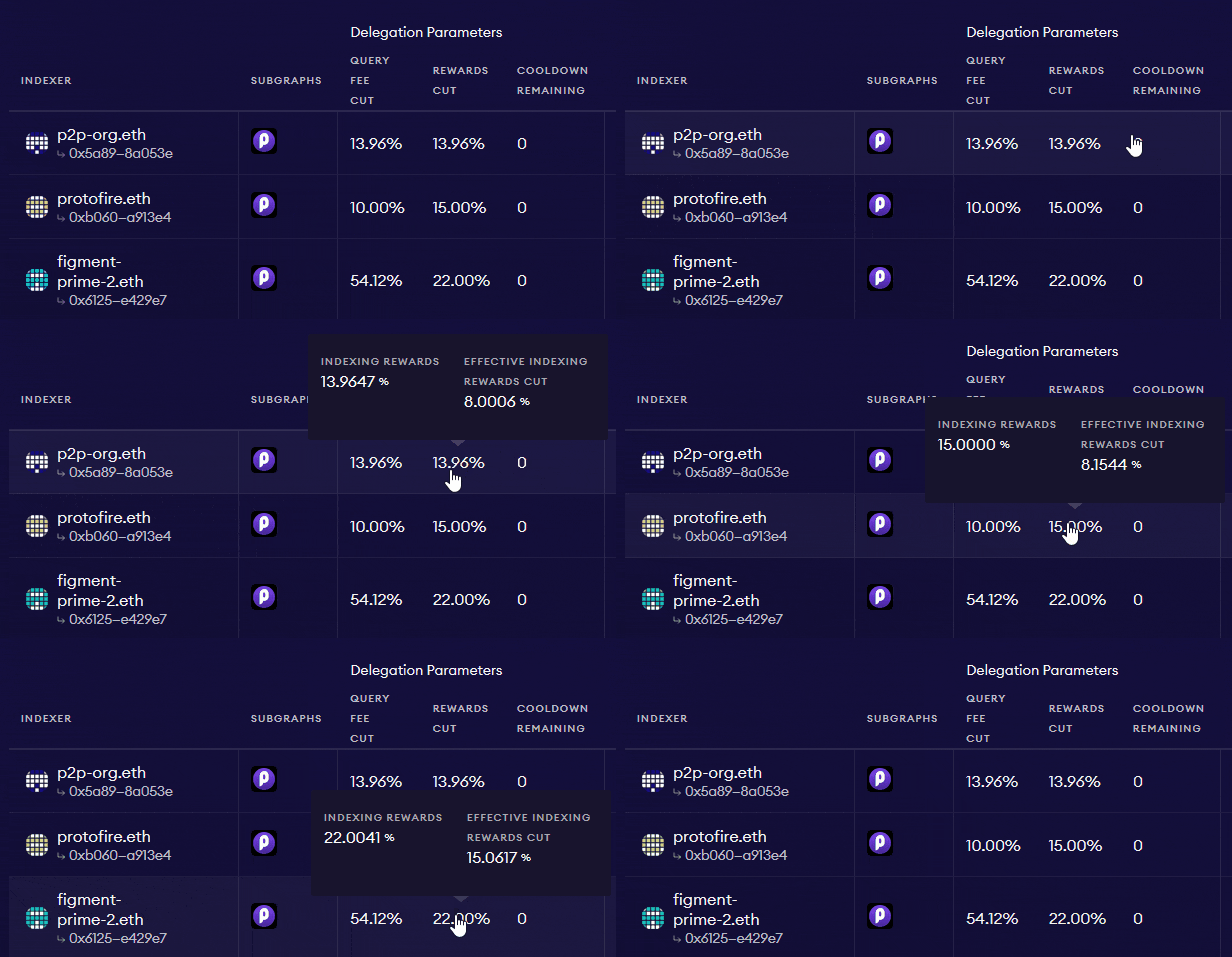
Every Indexer is free to define their own individual cut of query fees and indexing rewards, based on the supply-and-demand dynamics of the open marketplace. According to this individual cut, each Indexer then distributes the revenue as follows: query fees are shared with Curators, whereas both indexing rewards and query fees are shared with Delegators.
As per the above example, if an Indexer set the query fee cut to 13.96%, their Delegators would receive the remaining 86.04% of the fee revenue. While Delegators' stake cannot be slashed, Delegators should still consider several factors when staking GRT with Indexers. These factors relate to:
Indexer choice, i.e., choosing effective Indexers with the most optimal balance between reward payouts and “skin-in-the-game” from allocation of self-stake.
Unbonding period, i.e., no GRT transfers or rewards are possible within a 28-day window after undelegation.
Delegation tax of 0.5%, i.e., calculating how long it takes to earn back the 0.5% tax on delegation.
Indexing Rewards
Indexing rewards come from a 3% annual inflation in the GRT supply, derived from the GRT issuance rate. Rewards are distributed to staked Indexers in return for providing indexing and querying services on The Graph’s open marketplace.
Indexing rewards grew 41% QoQ to approximately $8.8 million in Q1’23. In GRT terms, indexing rewards decreased 12% QoQ from 80 million GRT in Q4’21 to 71 million GRT in Q1’23. The drop is a consequence of the governance decision to set protocol issuance rate back to The Graph’s original 3% prior to The Merge in September 2022. For context, following The Merge, the number of blocks created on Ethereum increased, leading to the GRT rewards issued per block to increase to 3.2% for approximately one month in Q4’22.
Over the past five quarters, Delegators received more GRT indexing rewards than Indexers themselves. In Q1'23 alone, Delegators were rewarded over 44 million GRT (roughly $5.7 million). This amounted to approximately 62% of the total indexing rewards distributed, up from 57% in Q4’22. Delegators may have received more rewards because Indexers focused on attracting more delegated stake by offering a more generous cut of indexing rewards to Delegators, especially due to rising GRT-USD prices in Q1’23.
Query Fees (Network Usage Fees)
While the bulk of Indexer earnings come from rewards, the second source of network revenue comes from query fees. Data consumers (e.g., app developers) payquery fees for Indexers to fetch and organize data. Query fees are determined by market demand and distributed to Curators, Indexers, and Delegators.
Total revenue from query fees increased 41% QoQ in USD terms, reaching an all-time high in Q1’23. The higher fees may have been driven by The Graph’s Multi-Chain Incentivized Program (MIPs) over Q4'22 and Q1'23.
For The Graph, the Q1’23 total revenue from query fees (approx. $89,000) made up 1% of the total revenue from indexing rewards (approx. $8.8 million). This indicates that The Graph’s network participants still highly rely on indexing rewards for sustaining their day-to-day operations.
Qualitative Analysis
Key Events
Arbitrum Migration
The migration of The Graph to Arbitrum, a Layer-2 scaling solution on Ethereum, aims to bring a seamless and gas-efficient decentralized data experience to users. The migration entails three phases:
Phase 1 enables Arbitrum One on mainnet.
Phase 2 enables indexing rewards on Arbitrum One.
Phase 3 enables express migration to Arbirum One.
As of the end of Q1’23, the migration is in the beginning of Stage 2. indexing rewards have gradually increased from the current level of 5% to 100%.
Additionally, migration assistance is offered to all participants attempting to migrate.
New Integrations
The Graph offers support for subgraphs on the Base testnet, a Layer-2 by Coinbase built with the OP Stack and which will be a part of the Optimism Superchain. With these new tools, any developer will be able to build a subgraph indexing Base testnet data and deploying it using Subgraph Studio.
Additions to The Graph Network
Gnosis Chain, Arbitrum, Celo, and Avalanche are available on The Graph's network as of Q1’23 as part of the Migration Infrastructure Providers (MIPs) Program. In the future, The Graph will be adding support for the Fantom network. The exact date has yet to be announced.
Launch of Graphcast Developer Tools
To enhance efficiency and cost-effectiveness within The Graph’s ecosystem, the GraphOps team, a core developer of The Graph, launched three tools for Indexers and developers:
Graphcast Network allows Indexers to exchange information in real-time at low costs.
Proof-of-Indexing (POI) Radio helps Indexers cross-check subgraph data integrity and avoid any liability of a dispute or being slashed by the protocol.
Graphcast SDK enables building dapps to serve Indexers to achieve greater efficiency without worrying about the underlying infrastructure.
A full list of The Graph events can be accessed via Messari Intel.
Key Governance Decisions
Update Parameters Post-Merge
The successful proposal GGP-0019 aims to update The Graph’s protocol parameters in response to reduced block times post-Merge. The updates are intended for parameters that calculate time by blocks and are currently short as a result of the merge. The two parameter updates are increases of the length of an epoch, and the time tokens are locked.
L2 Migration Helpers
On February 13, a forum discussion started on a proposal to introduce L2 migration helpers to allow Indexers, Delegators, Subgraph Owners, and Curators to move their tokens and state to the Arbitrum One network. The migration helpers require upgrades to the Staking and GNS contracts on L1 and L2. They will also enable migrating with minimal friction and low cost.
Update API Feature Support Matrix
This successful proposal aims to update the subgraph API Feature Support Matrix to include new Data Sources, Data Source Features, and the minimum required Graph Node version (V0.30.0).
Activate Indexing Rewards on Arbitrum
This successful proposal aims to update the protocol contracts to support indexing rewards on Arbitrum as described inGIP 0037. The rewards distribution for Indexers on Arbitrum will represent 5% to 10% of the global issuance.
DataEdge Contract Deployment on Arbitrum One
This successful proposal led to the decision to deploy a DataEdge contract on Arbitrum One so that the Graph can integrate the Epoch Block Oracle unlocking indexing rewards and network growth.
Enforce Minimum Indexer Stake
This ongoing proposal aims to enforce a minimum stake whenever an Indexer accesses the staked amounts. It will also change any Indexer's status to inactive when under the minimum stake amount. The goal is to maintain the protocol's overall security by ensuring the correctness and consistency of the way the protocol manages the Indexer stake.
A full list of The Graph governance proposals can be accessed via Messari Governor.
Closing Summary
The Graph is primarily focused on migrating from a hosted service to a decentralized network (mainnet). As of Q1'23, 776 mainnet subgraphs were successfully migrated. Notably, The Graph's ecosystem of staked Indexers (+58%), Delegators (+2%), and Curators (+1%) continued to grow QoQ.
Simultaneously, The Graph experienced a 41% QoQ increase in USD revenue from query fees in Q1'23. The migration of The Graph to Arbitrum, a Layer-2 scaling solution on Ethereum, aims to bring a seamless and gas-efficient decentralized data experience to The Graph’s users. As more subgraphs are migrated to mainnet in the coming quarters, The Graph will continue to remove technical barriers for developers, ultimately leading to faster innovation across Web3.
Messari is a Core Subgraph Developer for The Graph and the recipient of a grant from The Graph Foundation. Author(s) may hold cryptocurrencies named in this report, and each author is subject to Messari’s Code of Conduct and Insider Trading Policy. Additionally, employees are required to disclose their holdings, which are updated monthly and published here. This report is meant for informational purposes only and should not be relied upon. This report is neither financial nor investment advice. You should conduct your own research and consult an independent financial, tax, or legal advisor before making any investment decisions. Nothing contained in this report is a recommendation or suggestion, directly or indirectly, to buy, sell, make, or hold any investment, loan, commodity, or security, or to undertake any investment or trading strategy with respect to any investment, loan, commodity, security, or any issuer. This report should not be construed as an offer to sell or the solicitation of an offer to buy any security or commodity. Messari does not guarantee the sequence, accuracy, completeness, or timeliness of any information provided in this report. Please see our Terms of Service for more information.
No part of this report may be (a) copied, photocopied, duplicated in any form by any means or (b) redistributed without the prior written consent of Messari®.
Mihai is Director of Research at Messari. Mihai leads Protocol Research, covering base layers, mid-layer infrastructure, DeFi, and consumer apps. Prior to joining Messari, Mihai was a tech entrepreneur and worked in AI at UBS and Swiss Re in Zurich. His background is in computer science and math. Mihai holds a PhD in information systems from ETH Zurich, Switzerland
Mihai is Director of Research at Messari. Mihai leads Protocol Research, covering base layers, mid-layer infrastructure, DeFi, and consumer apps. Prior to joining Messari, Mihai was a tech entrepreneur and worked in AI at UBS and Swiss Re in Zurich. His background is in computer science and math. Mihai holds a PhD in information systems from ETH Zurich, Switzerland