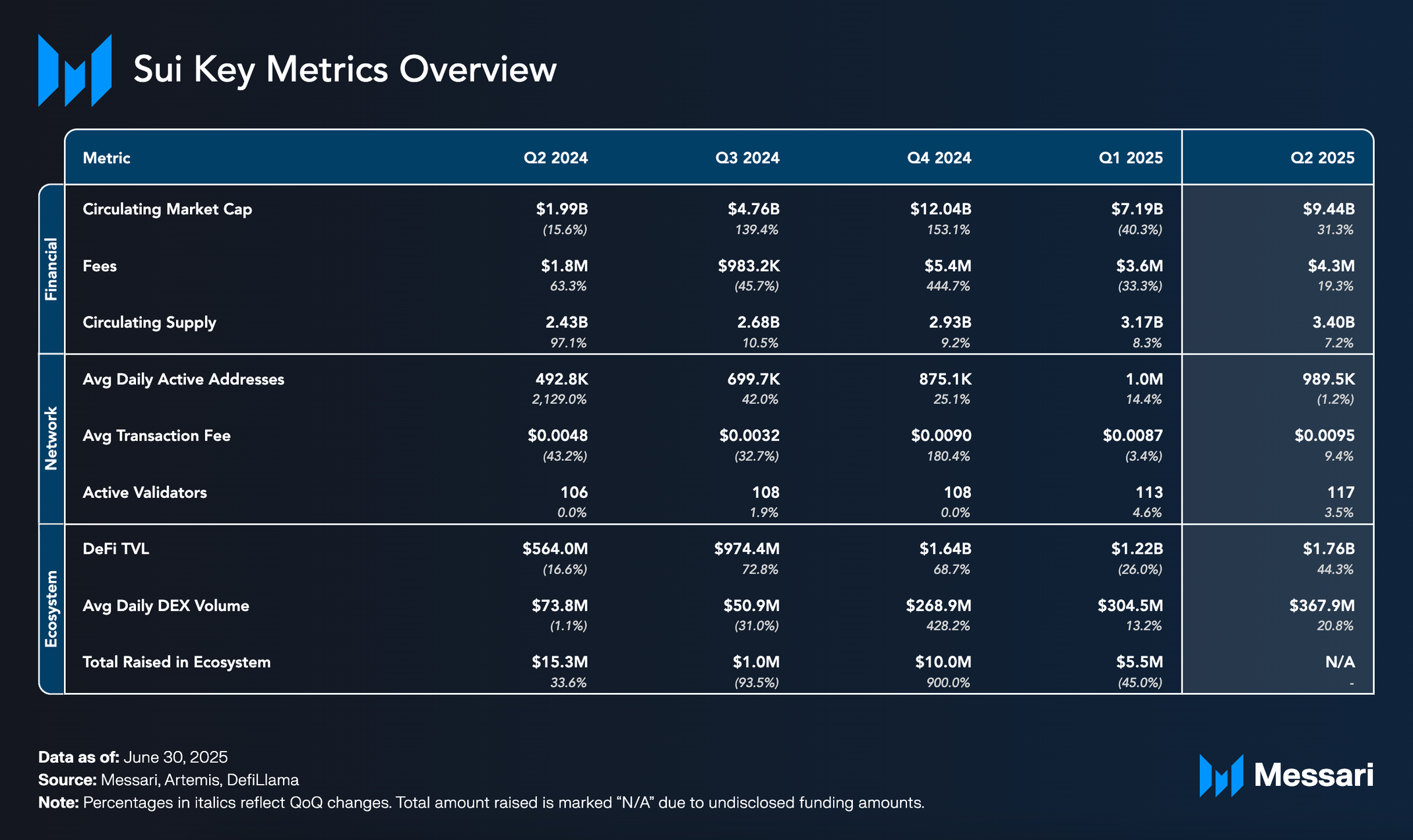
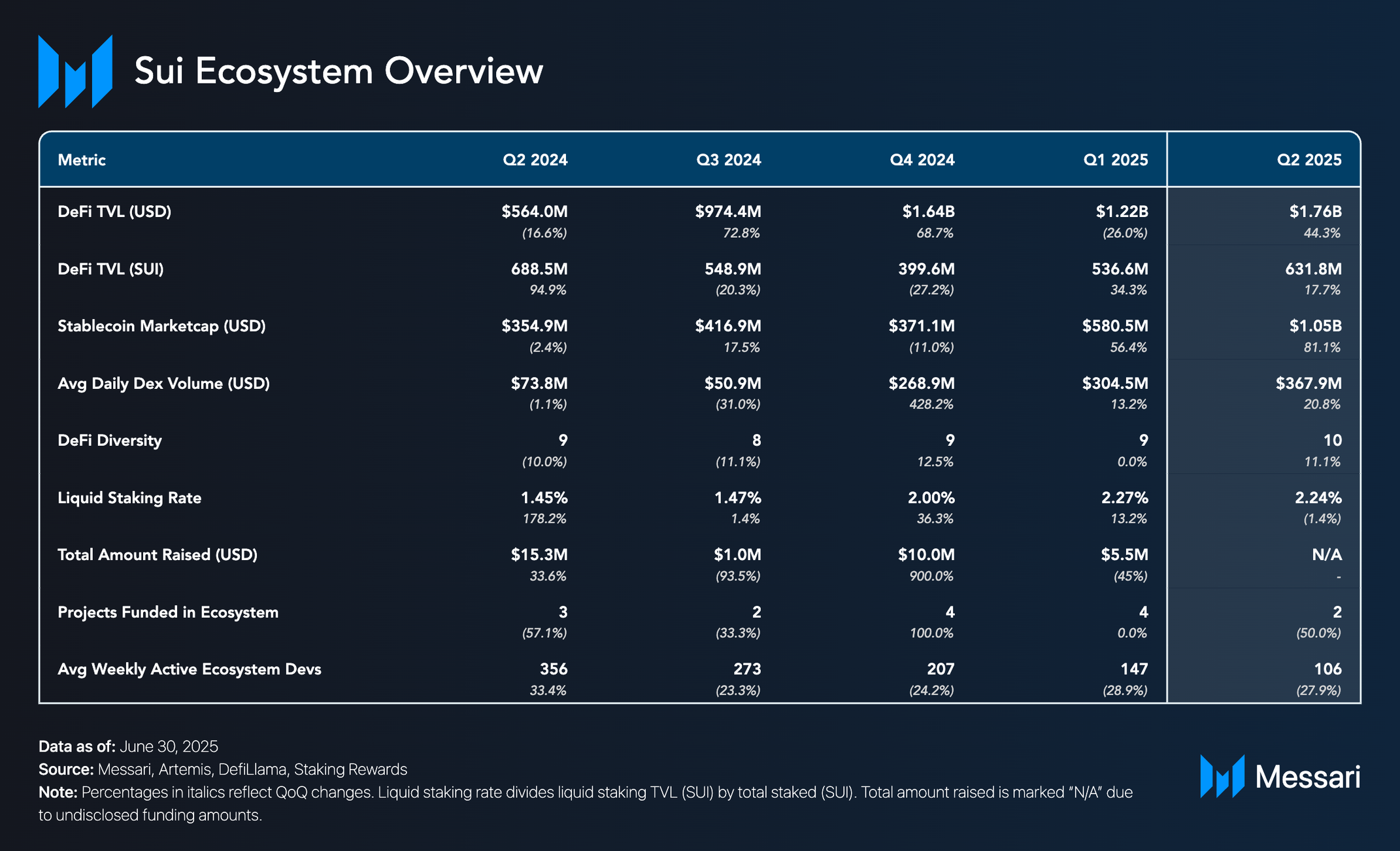
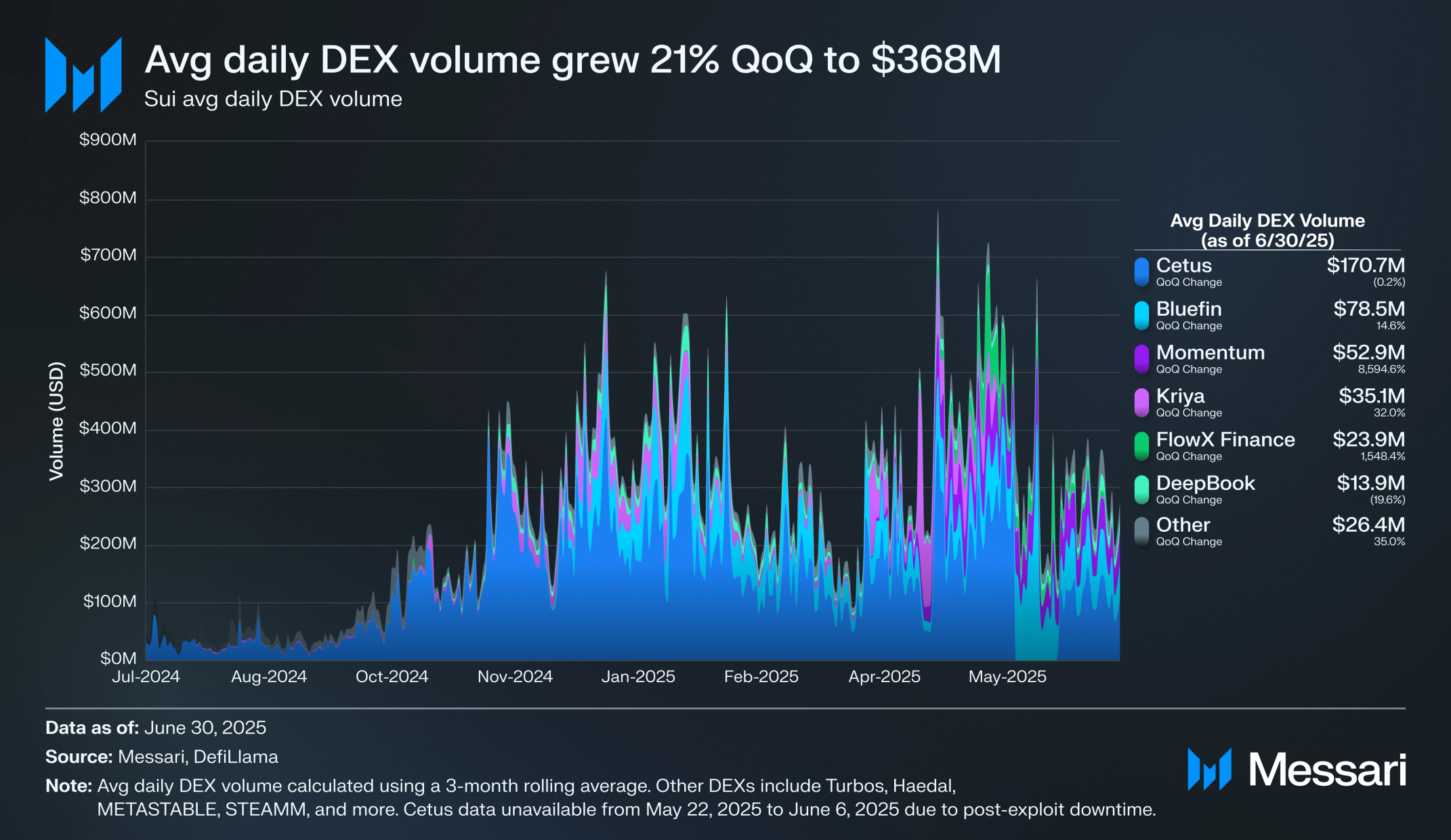
Sui’s average daily DEX volume hit another all-time high of $367.9 million in Q2 2025,a 20.8% quarter-over-quarter (QoQ) increase. Cetus and Bluefin led with $170.7 million and $78.5 million in average daily DEX volume, respectively.
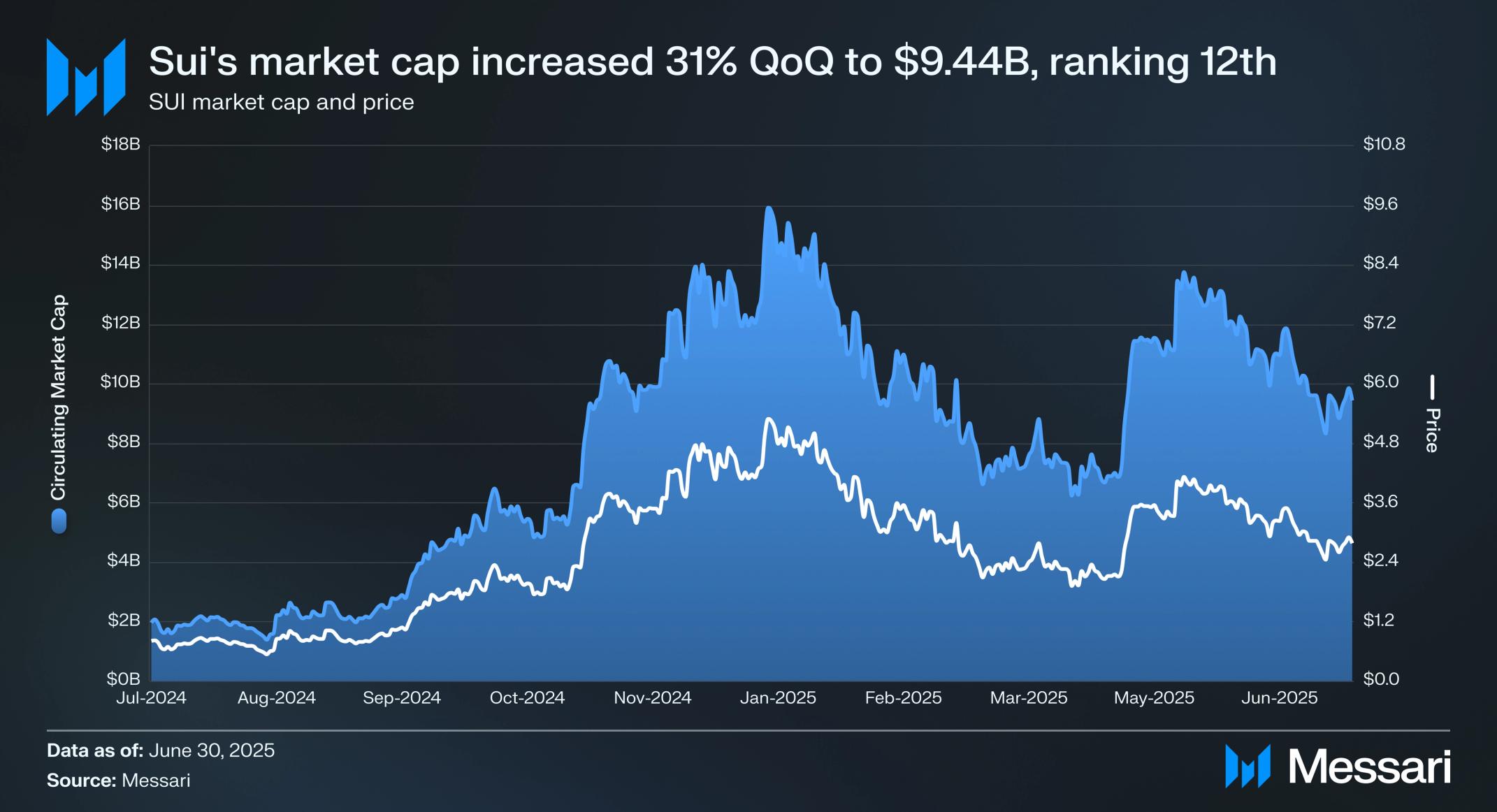
SUI’s circulating market cap increased 31.3% QoQ to $9.44 billion, outperforming the broader crypto market, which rose by 23.5% over the same period.
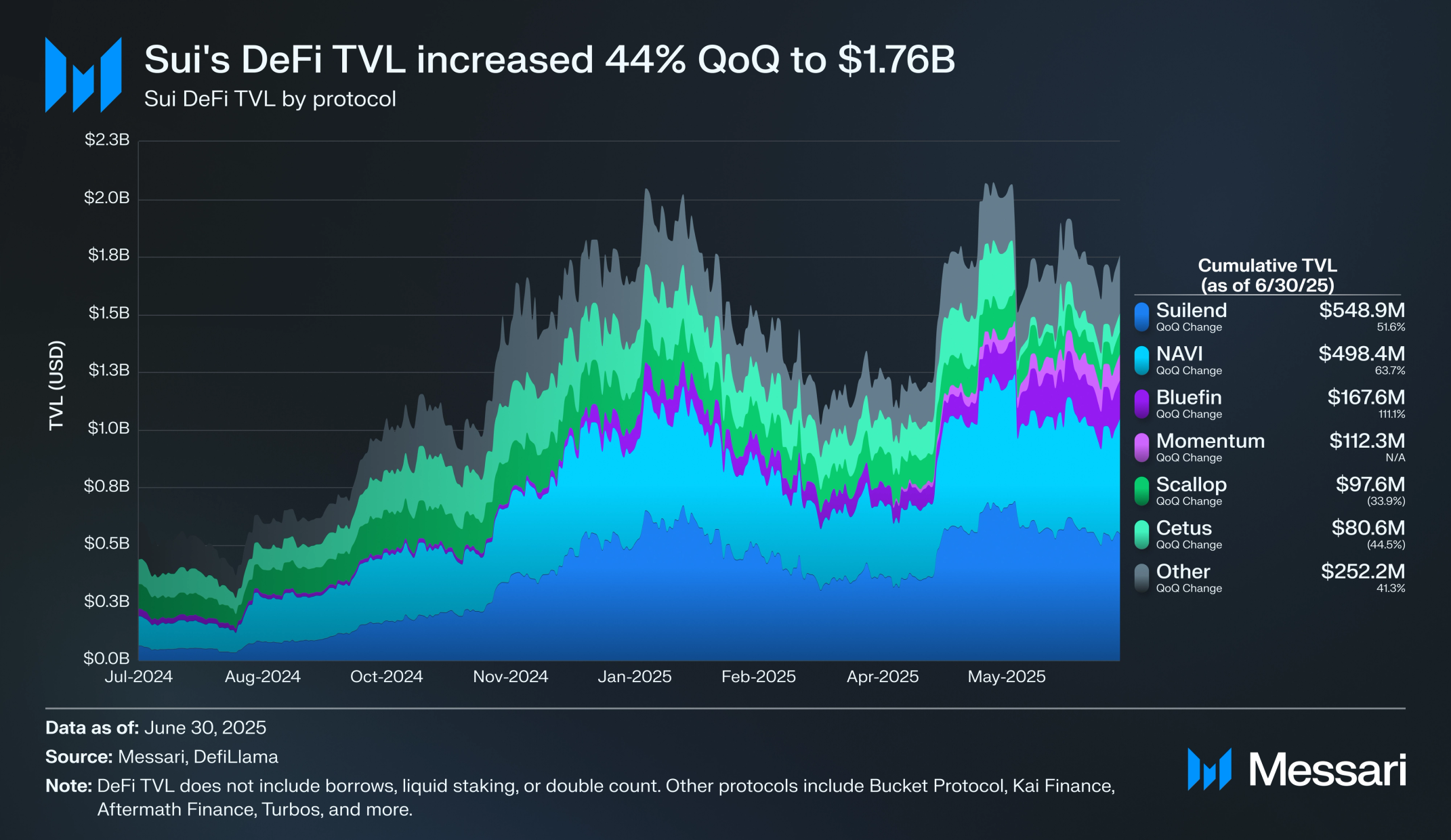
Sui’s DeFi Total Value Locked (TVL) increased 44.3% QoQ to $1.76 billion. When measured in SUI, TVL rose 17.7% over the same period, from 536.6 million to 631.8 million SUI.
Institutional interest in Sui accelerated in Q2, highlighted by the launch of the Grayscale SUI Trust, 21Shares’ strategic partnership and spot SUI ETF filing, and Fireblocks’ integration.
Infrastructure around Sui continued toexpand in Q2, with Mysten Labs launching Seal on Sui Testnet, Kraken and MEXC enabling support for native USDC, and new integrations from Ledger, Axelar, Backpack, Privy, Trust Wallet, Microsoft Fabric, and others.
Sui’s architecture features many novel aspects, including its object-centric data model, Mysticeti consensus mechanism, and Move on Sui programming language. Move on Sui builds on the original Move language, which was created by Mysten Labs co-founder Sam Blackshear. It offers enhanced flexibility and safety compared to other Web3 programming languages. Unlike Solidity's reliance on sequential transaction processing, which can lead to inefficiencies and higher gas fees, Sui Move's object-centric data model uses parallel transaction processing to enhance efficiency. Additionally, Move negates five of the OWASP Top 10 vulnerabilities, and partially mitigates three others.
Several protocols and products have been released on Sui, providing foundational infrastructure and enabling a broad range of onchain functionality. These include:
Growth of the Sui ecosystem is led by the Sui Foundation, with Mysten Labs being the initial contributor to the development of the Sui blockchain protocol. For a complete primer on Sui, refer to our Initiation of Coverage report.
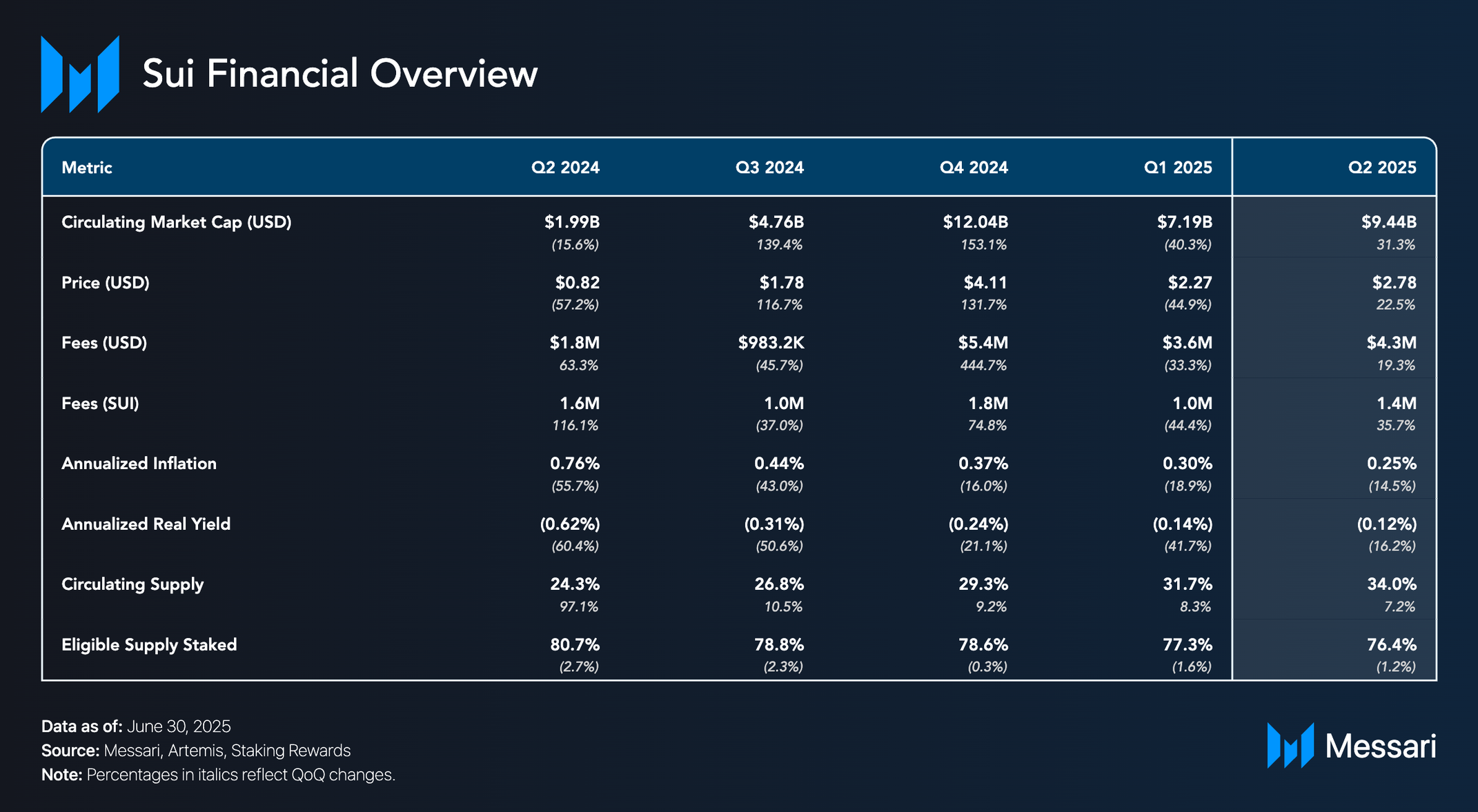
In Q2 2025, SUI’s circulating market cap increased 31.3% QoQ to $9.44 billion, outperforming the broader crypto market, which rose by 23.5% over the same period. By the end of Q2, Sui climbed one spot from Q1 2025 to rank as the 12th largest cryptocurrency by market cap.
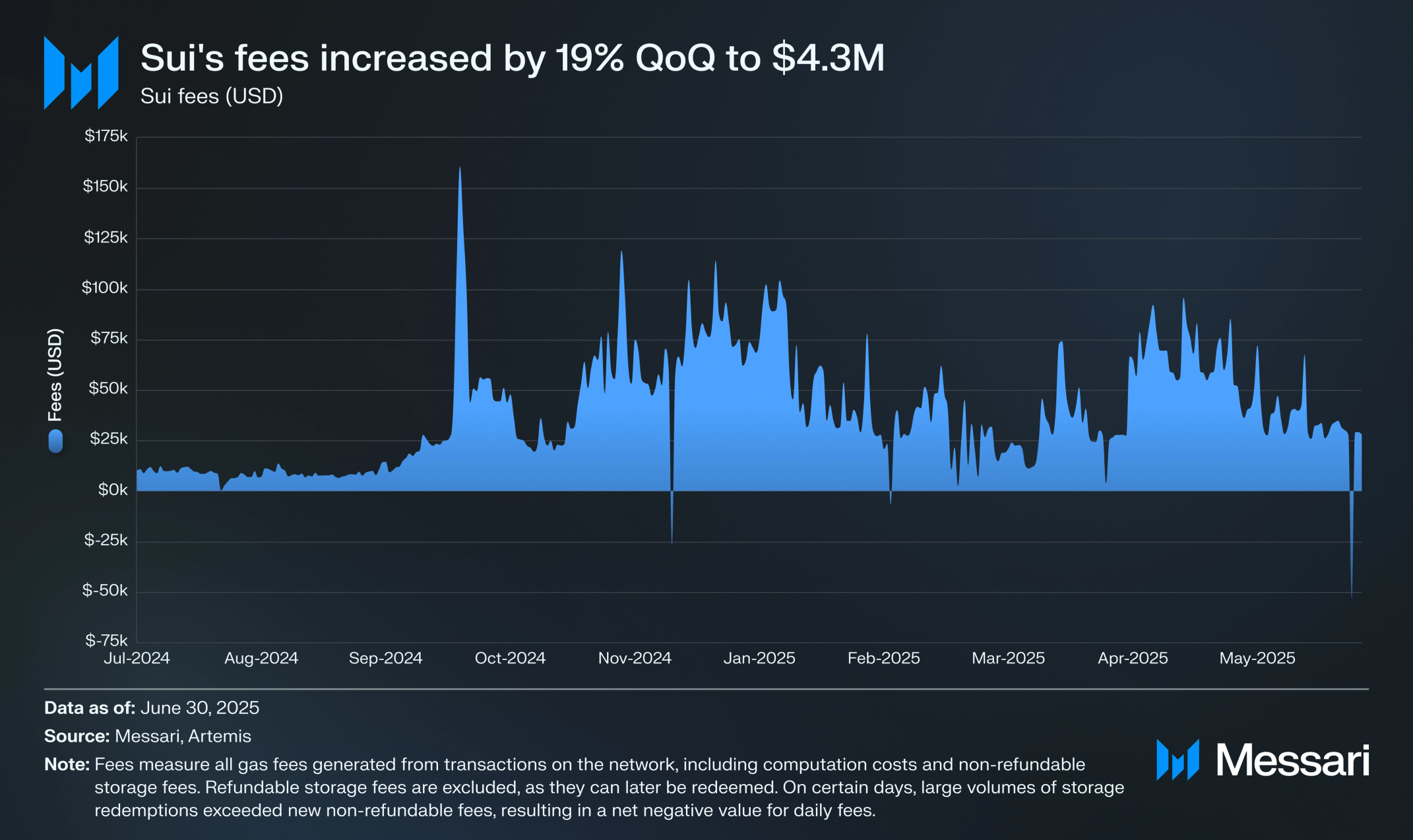
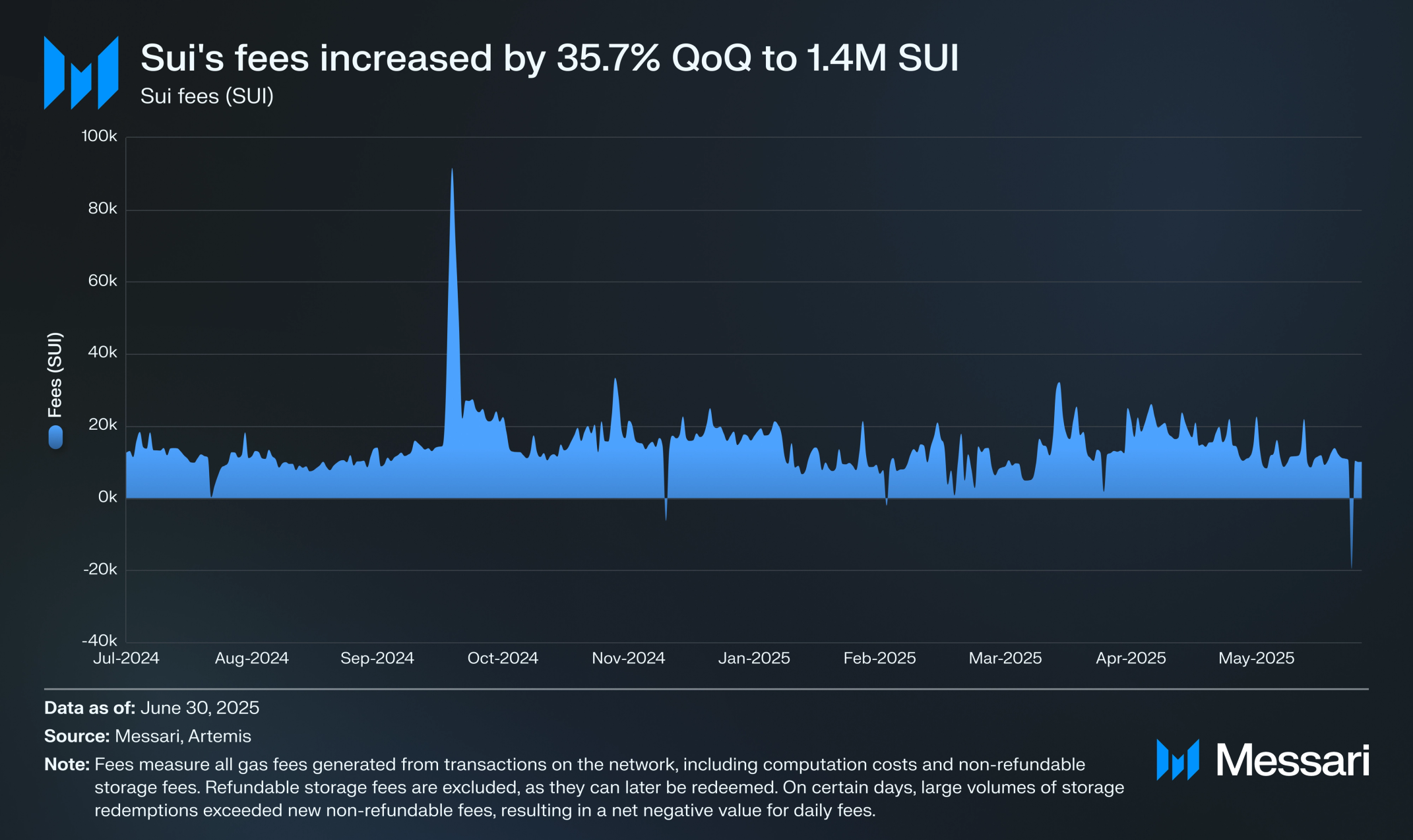
Sui's fees include all gas fees generated from transactions on the network, which consist of computation costs and non-refundable storage fees. These fees are subsequently distributed to network validators. In Q2 2025, total fees increased by 19.0% QoQ to $4.3 million.
While the price of SUI grew by 22.5% QoQ, contributing to the increase in fees when measured in USD, fees denominated in SUI grew by 35.7% QoQ to 1.4 million SUI. This suggests that while price appreciation played a role, other factors drove the increase in network activity and fee generation.
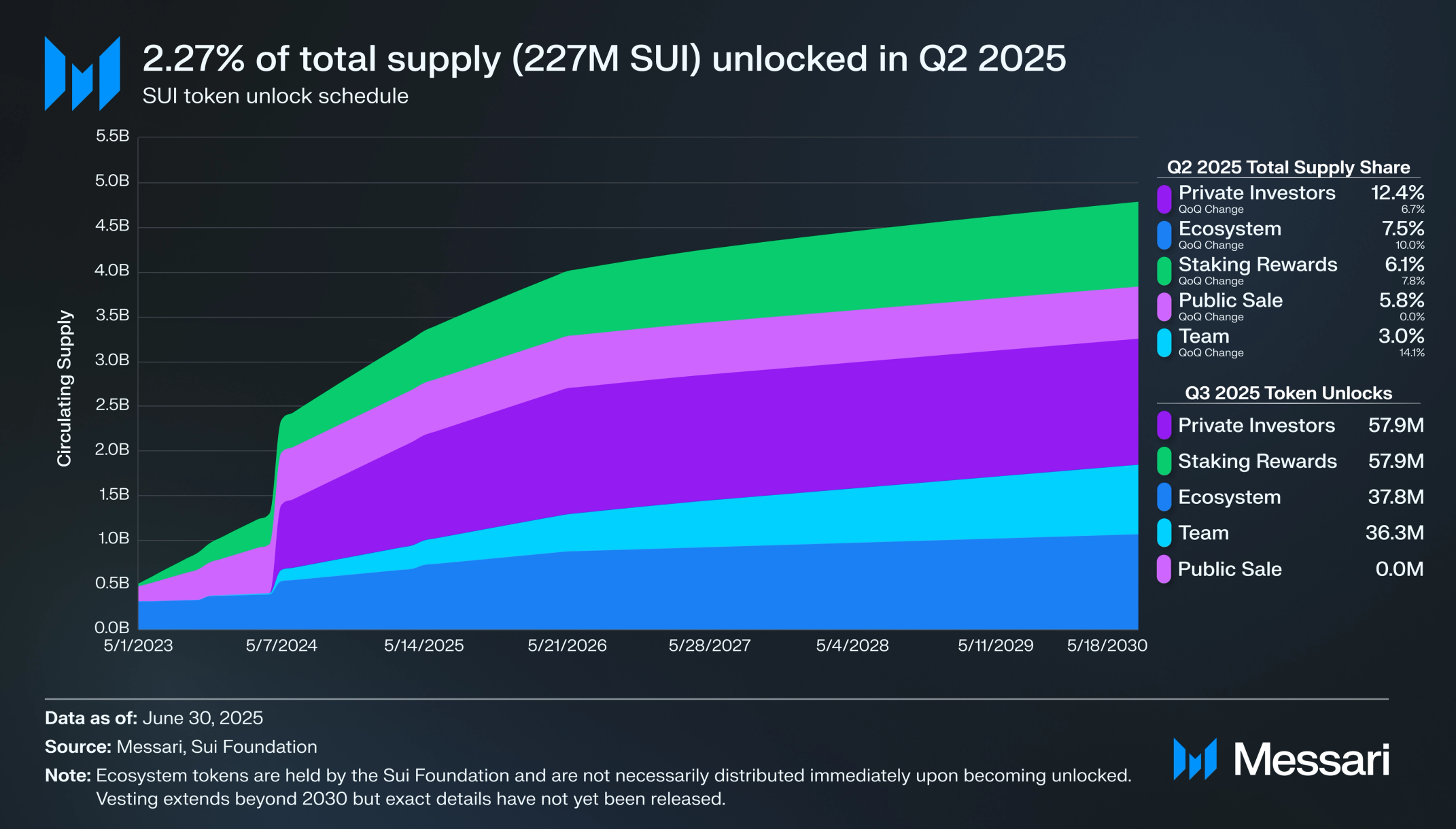
SUI has a fixed total supply of 10 billion, with 1 billion tokens set aside for staking rewards. Relative to the remaining 9 billion tokens, SUI’s annualized inflation rate from staking reward issuance was 0.25% at the end of Q2 2025. This rate decreases by 10% every three months until all 1 billion tokens are distributed.
Other inflationary pressures came from token supply unlocks. By the end of Q2 2025, 34.8% of SUI’s total supply was distributed, a 7.0% QoQ increase from Q1 2025. This increase in supply came from unlocks that occurred on the following dates. All USD values are based on SUI’s price on June 30, 2025.
April 1, 2025:
Ecosystem: 12.6 million SUI ($35.0 million) unlocked for the Community Reserve.
Team: 12.5 million SUI ($34.7 million) unlocked for the Early Contributors and Mysten Labs Treasury.
Private Investors: 39.2 million SUI ($108.9 million) unlocked for the Series A and Series B investors
Staking Rewards: 16.0 million SUI ($44.5 million) unlocked for the Staking Subsidies.
Total: 80.2 million SUI ($222.9 million) unlocked - 0.89% of total tokens vesting and 0.80% of total token supply.
May 1, 2025:
Ecosystem: 42.4 million SUI ($117.8 million) unlocked for the Community Reserve.
Team: 12.1 million SUI ($33.6 million) unlocked for the Early Contributors and Mysten Labs Treasury.
Private Investors: 19.3 million SUI ($53.6 million) unlocked for the Series A and Series B investors.
Staking Rewards: 14.3 million SUI ($39.7 million) unlocked for the Staking Subsidies.
Total: 88.2 million SUI ($245.1 million) unlocked - 0.98% of total tokens vesting and 0.88% of total token supply.
June 1, 2025:
Ecosystem: 12.6 million SUI ($35.0 million) unlocked for the Community Reserve.
Team: 12.1 million SUI ($33.6 million) unlocked for the Early Contributors and Mysten Labs Treasury.
Private Investors: 19.3 million SUI ($53.6 million) unlocked for the Series A and Series B investors.
Staking Rewards: 14.3 million SUI ($39.7 million) unlocked for the Staking Subsidies
Total: 58.4 million SUI ($162.3 million) unlocked - 0.65% of total tokens vesting and 0.58% of total token supply.
In total, 226.7 million SUI tokens ($629.9 million) were unlocked in Q2 2025, which is 2.27% of the total supply. At the end of Q2 2025, 76.4% of the eligible supply was staked, a 1.2% QoQ decrease. Locked tokens can still be staked and earn liquid staking rewards, so the supply eligible to be staked is SUI’s total supply rather than its circulating supply. With such a high stake rate, SUI’s annualized real yield is slightly below zero, at -0.12%.
Network Analysis
Usage
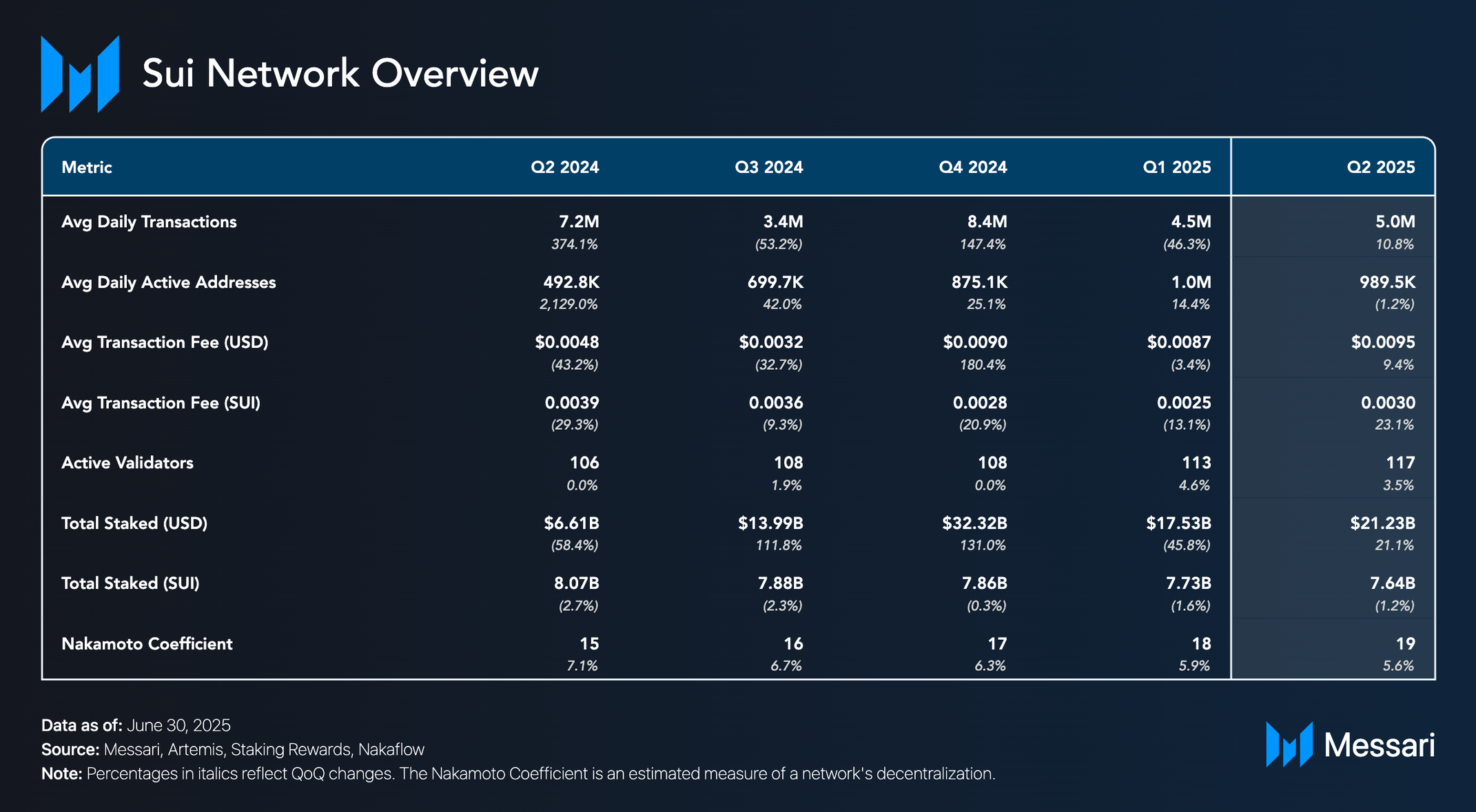
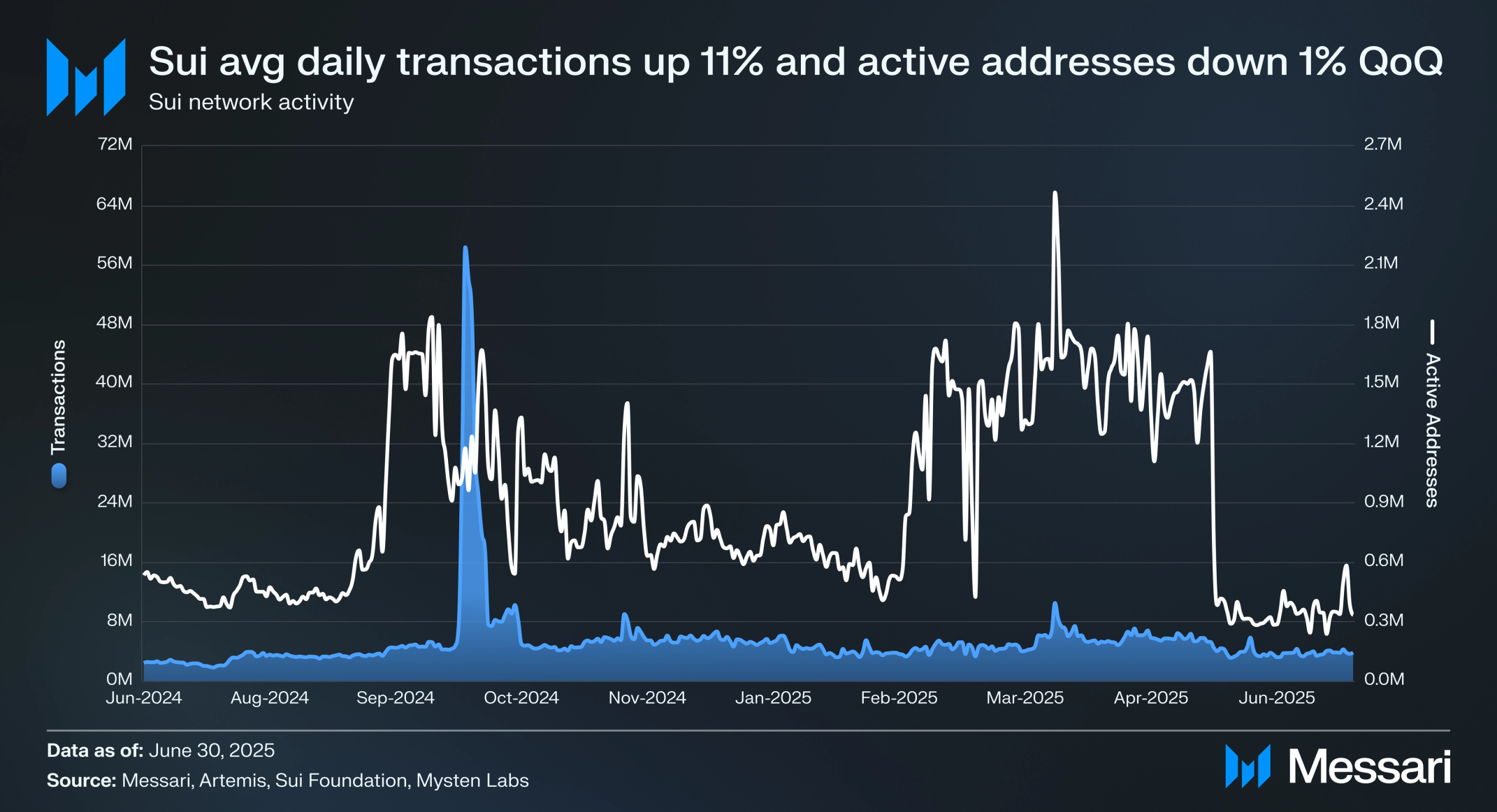
In Q2, Sui’s average transaction fee increased 23.1% QoQ to 0.0030 SUI ($0.0095). Although gas fees cost a fraction of a penny, Sui offers sponsored transactions that allow applications and other entities to cover gas fees for end users. An average of 29.7% of all transactions on Sui were sponsored during Q2.
Security and Decentralization
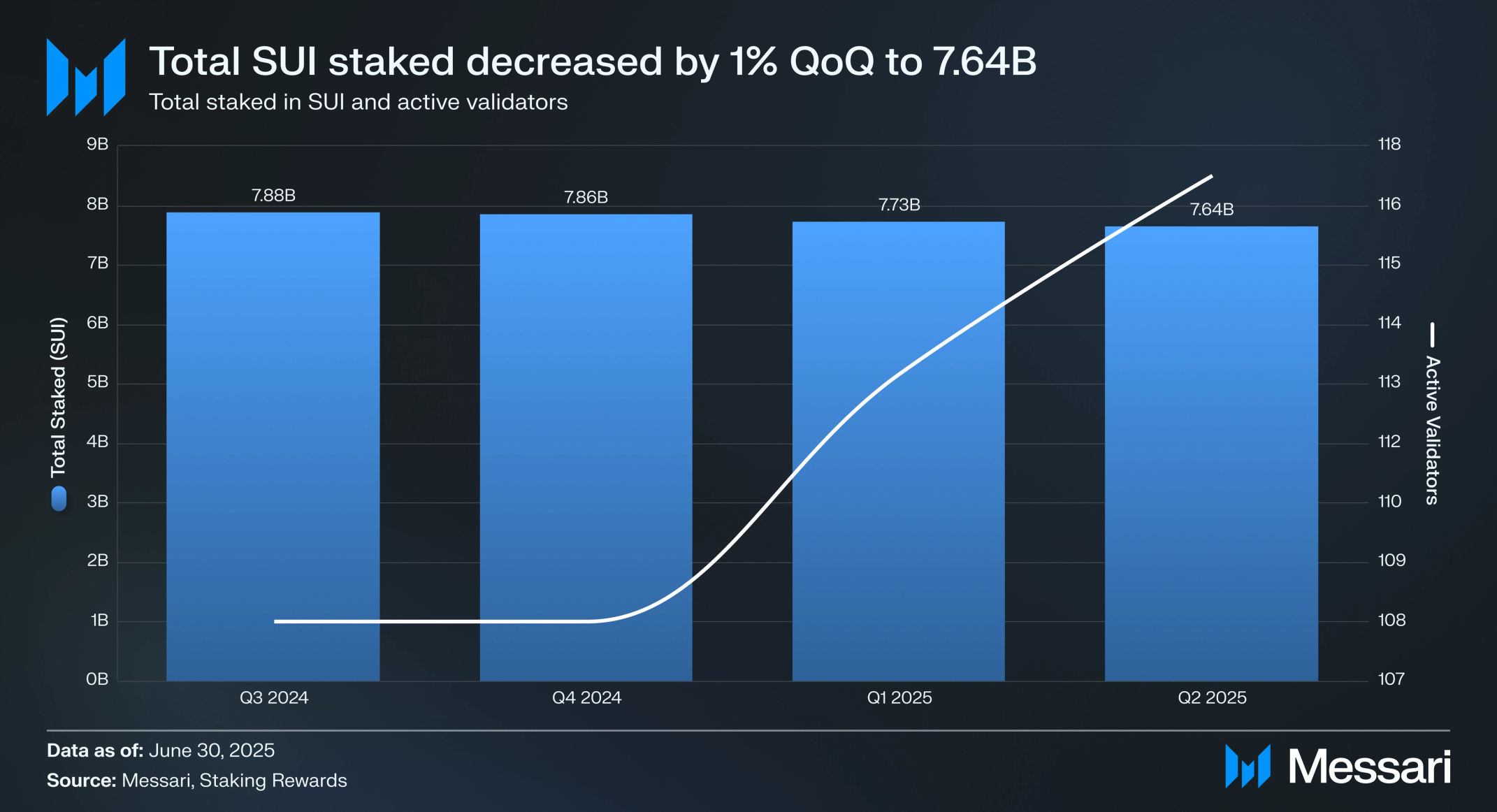
The total amount of staked SUI declined slightly in Q2, falling 1.2% QoQ to 7.64 billion (76.4% of the eligible supply). However, due to SUI’s price appreciation over the quarter, the USD value of staked SUI rose 21.1% QoQ to $21.23 billion.
Active validators on Sui have steadily grown since launch, increasing from 104 to 117. The Sui Foundation holds a significant portion of the total SUI supply on behalf of the Ecosystem allocation and helps distribute stakes equally among validators. As a result, Sui ended Q2 2025 with a Nakamoto coefficient of 19, which is above the median for a curated selection of Proof-of-Stake networks.
Upgrades
Sui frequently upgrades its protocol. It entered Q2 2025 on Sui Protocol Version 78 and concluded Q2 2025 on Version 85. Notable new features include:
Consensus Stability Enhancements: Adopted median-based commit timestamps and raised faulty-leader thresholds to improve block ordering and resilience under load.
TLS Across Network Stack: Defaulted to TLS for validator gRPC connections and CLI tools, strengthening data integrity and node-to-client communication security.
Governance-Led Fund Recovery: Enabled community-approved fund recovery at the protocol level, providing a governance-based path for exceptional asset restitution.
On April 15, 2025, the Sui Foundation launchedNautilus on Testnet, enabling verifiable offchain computation via developer-managed Trusted Execution Environments (TEEs) like AWS Nitro Enclaves. It allows sensitive or compute-heavy tasks to run offchain while producing cryptographic attestations verified onchain by Move smart contracts. This supports high-performance, privacy-preserving applications, such as tamper-proof oracles, AI inference, and private identity verification, without compromising decentralization. Nautilus launched on Mainnet on June 5, 2025.
On April 24, 2025, Mysten Labs launched the Move Registry (MVR), an onchain package management system for Sui. Built on SuiNS, MVR introduces versioning, dependency resolution, and human-readable naming, simplifying Move package integration across Testnet and Mainnet. It surfaces onchain usage data and metadata to improve transparency, trust, and coordination across the ecosystem.
Also on April 24, 2025, Sui Wallet and Stashed merged to launch Slush, a unified wallet for all Sui activity. Slush supports self-custody, zkLogin, link-based token transfers, and asset management across web, mobile, and extensions. It streamlines access to DeFi, gaming, and NFTs with built-in risk alerts and seamless syncing. Existing users were automatically upgraded with no migration required.
On May 30, 2025, the Sui Foundation announced the Sui Prover, an open-source formal verification tool developed and released by Asymptotic. It allows developers to mathematically prove that Move smart contracts satisfy critical properties, such as balance preservation or invariant share prices, across all inputs. By enabling rigorous checks during development, not just audits, the Prover introduces a higher standard of reliability across the Sui ecosystem.
Ecosystem Overview
DeFi
Lending protocol Suilend concluded Q2 as Sui’s top protocol by TVL, with $548.9 million in TVL, a 51.6% QoQ increase. Suilend captured a 31.2% market share despite launching just over a year prior. During the quarter, Suilend achieved $600.0 million in total swap volume and reduced its borrow fees to 0.0%. STEAMM, Suilend’s “superfluid” Automated Market Maker (AMM), reached $15.0 million in TVL within three months of launch. SpringSui, Suilend’s liquid staking protocol, became permissionless, allowing users to create Sui liquid staking tokens (LST). Over 200 LSTs were created by the end of the quarter.
Lending protocol NAVI concluded Q2 with $498.4 million in TVL, a 63.7% QoQ increase and 28.3% market share. During the quarter, NAVI surpassed $200 million in total value borrowed and redesigned its lending UI/UX. NAVI also secured a Binance Alpha listing for its NAVX token. Astros, NAVI’s aggregator, launched the beta version of its perpetuals exchange.
Lending protocol Scallop concluded Q2 with $97.6 million in TVL, a 33.9% QoQ decrease and 5.5% market share. The protocol launched three new features: sCoins for direct entry into lending positions, Scallop Tools for building PTBs, and veSCA Merge and Split for managing veSCA allocations. Its native token, SCA, was also listed on Binance Alpha and Biconomy.com.
Sui’s average daily DEX volume hit another all-time high of $367.9 million in Q2, a 20.8% QoQ increase. Cetus and Bluefin led with $170.7 million and $78.5 million in average daily DEX volume, respectively. Other top DEXs by volume included Momentum ($52.9 million), Kriya ($35.1 million), FlowX Finance ($23.9 million), and DeepBook ($13.9 million).
Cetus, the leading DEX on Sui, concluded Q2 with $80.6 million in TVL, a 44.5% QoQ decrease, and representing a 4.6% market share. The protocol launched new features such as Cetus Pro, Cetus Tide, and Cetus Portfolio, while total trading volume rose 26.0% QoQ to $64.0 billion and total accounts increased 28.0% to 16.0 million. On May 22, Cetus suffered a smart contract exploit targeting its Concentrated Liquidity Market Maker (CLMM) pools, resulting in approximately $223.0 million in stolen funds. The protocol successfully froze $162.0 million and offered a $5.0 million bounty for information leading to the identification and arrest of the hacker. Following a community vote, validators representing 90.9% of the stake approved a proposal to recover the frozen assets. To support the resolution, the Sui Foundation issued a $30.0 million secured loan to fully compensate affected users and committed an additional $10.0 million to support builders and fund security audits. Cetus Protocol relaunched on June 7 and implemented multiple security upgrades.
Bluefin, the leading perpetuals protocol on Sui, ended Q2 with $167.6 million in TVL, a 111.1% QoQ increase and 9.5% market share. In April, Bluefin launchedBluefinX, Sui’s first Request for Quote (RFQ) system, enabling multiple Execution Agents to bid on quotes and optimizing order execution. In June, the protocol introduced Bluefin7K, a Sui-native aggregator that integrates its RFQ engine with a network of DEXs to provide best-execution pricing and deep liquidity. The aggregator was made possible through the acquisition of 7K’s backend infrastructure. Bluefin also launched its governance platform powered by Common and announced plans to upgrade Bluefin Perps Beta to Bluefin Pro, which will integrate Nautilus TEE and additional enhancements. During the quarter, BLUE, Bluefin’s native token, was listed on Binance Alpha, LBank, Bithumb, and Backpack. Bluefin also surpassed $60.0 billion in cumulative trading volume.
Momentum, a DEX built on the Move ecosystem, concluded Q2 with $112.3 million in TVL, a 6.4% market share. The protocol emerged from stealth on March 31, 2025, and surpassed $1.00 billion in total swap volume just within its first month. Momentum partnered with Wormhole and OKX to become the first DEX to support Wormhole’s Native Token Transfer framework on Sui, enabling seamless native asset transfers from EVM and Solana chains. The team raised a strategic round at a $100.0 million valuation led by OKX Ventures, with participation from Coinbase Ventures, Gate Ventures, MEXC Ventures, KuCoin Ventures, and more. In June, Momentum launched its liquid staking token xSUI on Suilend’sSpringSui platform and closed the quarter with nearly $5.00 billion in cumulative swap volume.
Kriya, a multi-product DeFi protocol on Sui offering an AMM, limit orders, strategy vaults, and leveraged perpetuals, recorded $35.1 million in average daily volume in Q2, up 32.0% QoQ. On Jan. 19, 2025, Kriya launched its native token, KDX, distributing 50% of the total supply via an airdrop. Following the token launch, Kriya initiated its governance process by launching a DAO forum and passing its first proposal, KIP-1, which set withdrawal and performance fees to 0% across all strategy vaults. On April 16, Kriya executed a buyback of 1.7 million KDX using vault-generated fees, burned 1.0 million to support the token’s price, and distributed the remaining 676,000 to stakers.
FlowX Finance, a DeFi platform offering a DEX aggregator, liquidity hub with AMM and CLMM support, and a launchpad, recorded $23.9 million in average daily DEX volume in Q2, a 1,548.4% QoQ increase. The protocol partnered with Liquid Agents, NoodlesFi, Suilend, and Weiss Finance during the quarter and closed Q2 with $2.71 billion in total trading volume.
DeepBook, Sui’s native liquidity layer, is integrated across protocols including Cetus, Kriya, FlowX, and Hop Aggregator. DeepBook V3 launched on Oct. 14, 2024, introducing dynamic trading fees, improved gas efficiency, flash loans, shared liquidity, and the DEEP token. On April 16, 2025, DeepBook V3.1 went live, adding permissionless pools, revamped fee mechanics, multi-token fee support, and an enhanced balance manager. By the end of Q2, DeepBook V3 held $20.5 million in TVL (down 6.4% QoQ) and reached $3.93 billion in cumulative volume (up 50.0% QoQ).
Other notable DeFi protocols on Sui include Turbos, a hyper-efficient decentralized crypto marketplace; Haedal, a one-click liquid staking platform; METASTABLE, a stablecoin protocol; Aftermath Finance, a DEX aggregator, liquid staking, and yield farming protocol; and AlphaFi, a yield aggregator.
BinancelistedHAEDAL, the native token of Haedal Protocol, and distributed it through a HODLer airdrop. AlphaFiintroducedAlphaLend, a next-generation lending protocol integrated with Bluefin’s spot and perps platforms, offering 0.0% borrow fees, leveraged yield strategies, and curated vaults. Magma FinanceunveiledALMM, an Adaptive Liquidity Market Maker designed for capital efficiency and zero-slippage trades using dynamic price bins. Lotus Financelaunched its mainnet, enabling users to earn yield from strategy-powered vaults integrated with DeepBook.
Sui announced support for sBTC and Stacks, unlocking institutional-grade Bitcoin DeFi use cases and reinforcing the network’s growing position as a BTCfi hub. OKXlaunchedxBTC on Sui, marking the exchange’s first BTC-backed asset deployment on the network. Bitlayerannounced plans to launch Peg-BTC (YBTC), a trust-minimized BTC asset powered by BitVM, giving Bitcoin holders additional options to access staking, lending, and trading opportunities on Sui.
Consumer
In Q2 2025, Sui continued its expansion beyond DeFi with significant progress in consumer apps such as gaming, NFTs, and RWAs.
Gaming
Preorders for Sui’s upcoming handheld gaming device, SuiPlay0X1, sold out ahead of its expected summer 2025 shipping date. Priced at $599.0, the device is built to support both traditional and blockchain-native games and will host titles such as Samurai Shodown R and Panzerdogs.
Mysten Labs introduced G Dollar, a USD-backed stablecoin built by Playtron and M0 that will facilitate payments, subscriptions, and reward mechanisms within the Playtron GameOS ecosystem, including on the SuiPlay0X1.
ONE Championship, the world’s largest martial arts organization, launched its Web3-enabled mobile game on April 29. ONE Fight Arena, developed with Animoca’s Notre Game, lets players compete in fast-paced, real-time, player-versus-player (PvP) battles featuring over 20 iconic MMA athletes.
Nimblebites’ Super-B, a multiplayer game set in a brick-world environment, launched its playtest on May 28. Players can fight, build, and socialize through customizable avatars. The game incorporates digital asset ownership and user-generated content using Sui’s infrastructure, including zkLogin, sponsored transactions, and onchain storage via Walrus.
OVERTAKElaunched its closed beta on June 2 and open beta on June 20 for its peer-to-peer marketplace for in-game items and accounts. Built on Sui by the team behind ItemBay and ItemMania, the platform uses multi-signature smart contracts to enable secure escrow-based trades without intermediaries. It aims to reduce transaction fees by over 90.0% compared to traditional Web2 marketplaces and recorded over 30,000 USDC in volume during its first 10 days of its closed beta. A full launch will support both crypto and fiat payments, with plans to onboard game studios and bring more assets onchain.
Lineup Games, a mobile-first gaming studio, integrated Sui to power its growing mobile gaming ecosystem. Live titles Gold Striker and Striker League now run on Sui, enabling seamless, gasless transactions across mobile and messaging platforms like Android, iOS, Telegram, and LINE. Players can earn rewards and airdrop allocations by completing in-game tasks. Sui will serve as the default network for all future Lineup games, supporting a frictionless, cross-game experience designed for mass adoption.
Samurai Shodown R, developed by LumiWave in partnership with SNK, launched its open beta on June 24. A new chapter in the franchise that began in 1993, the game brings PvP sword-fighting to Android, iOS, and the upcoming SuiPlay0X1 device. Built on Sui, Samurai Shodown Rfeaturesdynamic NFTs that evolve with in-game progress, along with closed-loop tokens and zkLogin for seamless onboarding.
NFTs
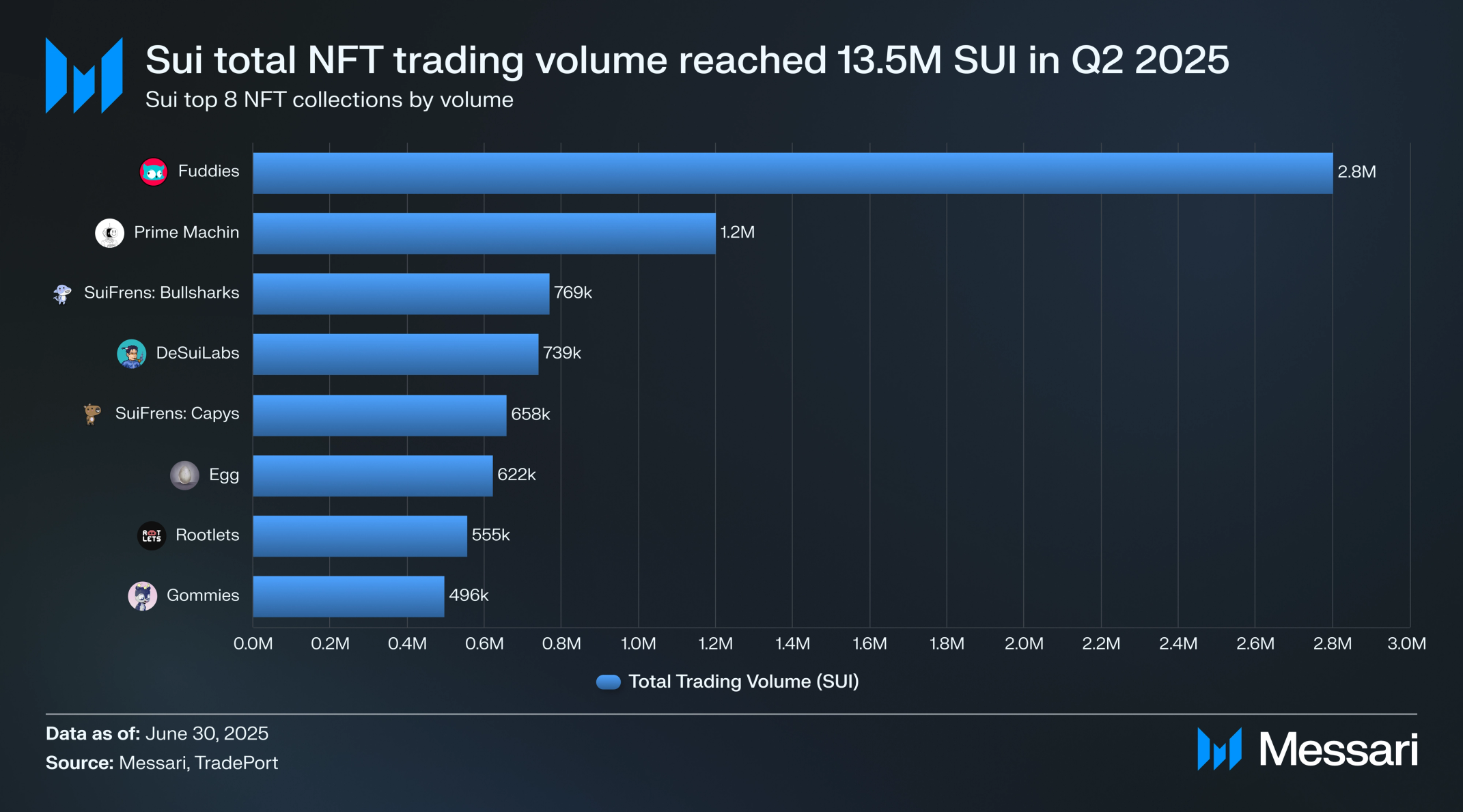
From the launch of Sui Mainnet to the end of Q2 2025, there has been 13.5 million SUI in total NFT trading volume. Leading marketplaces by volume include Clutchy (6.1 million SUI), BlueMove (2.5 million SUI), and TradePort (1.8 million SUI). Top NFT collections by volume include Fuddies (2.8 million SUI), Prime Machin (1.2 million SUI), SuiFrens: Bullsharks (769,000 SUI), DeSuiLabs (739,000 SUI), SuiFrens: Capys (658,000 SUI), Egg (622,000 SUI), Rootlets (555,000 SUI), and Gommies (496,000 SUI).
XOCIETY, an RPG pop shooter built on Unreal Engine 5, partnered with Adidas to launch a limited edition NFT skin collection featuring 2,600 ADIDAS x XOCIETY mystery boxes. Each box includes in-game avatar skins across four rarity tiers, bundled with an NFT certificate and XOCIETY’s ecosystem token, XO. Built on Sui, the collection leverages dynamic NFTs to enable real asset ownership and in-game interoperability. Minting was hosted on TradePort from May 14 to May 23, with prices ranging from $90.0 to $130.0 across different pack tiers.
Claynosaurzlaunched its Popkins NFT collection on Sui, featuring 25,000 mystery packs sold in a public mint from May 29 to June 3. Each pack included a chance to receive one of 2,000 Popkin NFTs, with non-winners refunded in USDC and eligible for additional rewards. The campaign minted nearly 100,000 NFTs, processed $17.6 million in ticket sales, and refunded $13.9 million, all with under 800 SUI in gas costs. Built using Sui primitives like Kiosk, sponsored transactions, and native randomness, the launch demonstrated the scalability of complex, user-friendly onchain mechanics.
TradePortreleased its Minting SDK to enable fully customizable NFT minting experiences on Sui. The SDK allows creators to build mint flows directly on their own sites while maintaining visibility through the TradePort launchpad. It supports edition and drop creation, custom mint phases, allowlists, and pricing controls. The tool is designed to reduce backend complexity for teams focused on art, storytelling, and community.
Other Use Cases
Open Market Group (OMG), an RWA investment platform, announced its integration with Sui. The launch will allow users to mint Soulbound Tokens that serve as credentials for accessing offchain yield opportunities. By leveraging Sui’s scalable infrastructure, OMG aims to expand access to assets like commodities and real estate while minimizing volatility.
Real Vision, a financial media and membership platform, partnered with Sui to bring onchain functionality to its community experience. The integration enables secure attribution of member contributions and introduces crypto-native rewards, coordination tools, and governance over time. The update aims to enhance participation while keeping blockchain complexity invisible to users. Early features will begin rolling out in summer 2025, marking the start of a broader platform transformation.
Smithii, a no-code token launch toolkit used by over 7,000 Solana-based projects, launched on Sui. The platform enables users to create tokens, add liquidity, and run airdrops without writing code. With over 120,000 transactions and $65.0 million in volume, Smithii aims to simplify asset creation and distribution for Sui’s user base.
Zark Labpartnered with Sui to launch a blockchain-native foundation model tailored for the network. The generative AI platform offers real-time insights, transaction risk analysis, onchain package scanning, and native app development tooling.
Mogul, a fantasy league for film powered by MoviePass, launched its beta on Sui. Players draft actors and directors, manage onchain rosters, and earn points based on real-time box office performance. The platform utilizes Sui for dynamic pricing and verifiable trades, bringing gamified entertainment investing onchain.
Sui partnered with xMoney and xPortal to launch a virtual Mastercard for real-world payments across Europe. Users can spend SUI at over 20,000 merchants and add the card to Apple Pay or Google Pay via a custom wallet experience in xPortal. xMoney provides the regulatory infrastructure, with a physical card and global expansion planned for later this year.
Institutional Interest
Institutional interest in Sui continued to grow throughout Q2 2025, marked by new investment products, custody integrations, and strategic partnerships that expanded access to Sui-based assets and infrastructure.
Following its initial SEC registration in March, Canary Capital advanced its proposed spot SUI ETF by filing with the Cboe BZX Exchange. The submission includes fraud and manipulation safeguards similar to those used in approved Bitcoin and Ethereum ETFs. If approved, it would be the first U.S.-based ETF to track SUI and may incorporate staking through trusted providers.
On April 16, Athens Exchange Group (ATHEX) and Mysten Labs finalized the technical design for upgrading ATHEX’s Electronic Book Building platform to operate on Sui. Development began on a proof of concept that integrates zero-knowledge proofs into the bidding process, enabling confidential submissions while preserving regulatory transparency. The initiative aims to create the first fully onchain order book for a stock exchange, leveraging Sui’s architecture to support privacy, scalability, and compliance.
On April 23, Grayscale launched the Grayscale SUI Trust, providing accredited investors with regulated exposure to the SUI token. The vehicle is structured to track the market price of SUI, net of fees and expenses, without requiring direct token custody. The trust offers an alternative pathway for institutional investors to gain access to SUI through traditional investment channels.
In May, 21Sharesannounced a strategic partnership with Sui and filed an S-1 registration statement with the SEC for a proposed U.S.-listed spot SUI ETF. The collaboration includes joint research and product development aimed at expanding institutional access to the Sui ecosystem. On June 9, Nasdaq filed the corresponding 19b-4 form, marking the start of the ETF’s formal SEC review process.
Sui announced an integration with Fireblocks to enhance institutional access to the network. The partnership will provide native SUI custody, direct exchange connectivity, and secure access to DeFi protocols via WalletConnect. Fireblocks will enable qualified custodians and TradFi institutions to interact with Sui securely and at scale.
Interactive Brokersadded SUI to its cryptocurrency trading platform, allowing clients in over 160 countries to trade the token alongside traditional assets such as stocks, options, and futures. The integration, enabled through Zero Hash, offers 24/7 trading, wallet withdrawals, and low-cost execution. SUI joins a lineup of digital assets on the platform, expanding institutional access to the token through a regulated, multi-asset brokerage interface.
Utila, a digital asset management platform, integrated support for Sui, enabling institutions to manage SUI and Sui-based assets with MPC-secured transactions and native staking. The platform offers object-level policy controls tailored to Sui’s architecture, direct access to DeFi protocols, and CEX integrations for custody and treasury operations. Institutions can also scale operations programmatically using Utila’s API and co-signer infrastructure.
Infrastructure
On April 3, 2025, Krakenenabled support for native USDC on Sui, allowing users to deposit, withdraw, and trade the stablecoin directly on the network. This integration enhanced direct access to Sui-native liquidity on one of the most widely used exchanges in the U.S. On May 9, MEXC also announced support for USDC on Sui, with deposits enabled immediately and withdrawals followed shortly after.
On April 4, 2025, Mysten LabslaunchedSeal on Sui Testnet, a decentralized secrets management service that enables secure, onchain data access for Web3 applications. Seal combines programmable access control written in Move, threshold encryption with no single point of failure, and client-side encryption to protect sensitive user data. It supports use cases such as gated content, private messaging, and time-locked asset transfers, while integrating with decentralized storage like Walrus. As a generalized security primitive, Seal gives developers a flexible, scalable alternative to centralized key management systems, bringing robust privacy infrastructure natively to Sui.
Ledgerintegrated support for SUI and Sui-based tokens within Ledger Live, enabling millions of users to securely buy, send, and receive assets on Sui. The update includes Clear Signing for human-readable transactions, with swap and staking support expected in future releases. As a leading self-custody solution securing over 20.0% of the total crypto market cap, Ledger’s integration strengthens secure user access to Sui’s DeFi ecosystem. The rollout began with mobile support on April 17 and will expand over the following months.
Wallet infrastructure provider Dynamicadded support for Sui, enabling developers to integrate Sui wallet connections and embedded wallets across applications. With Dynamic’s integration, developers across EVM, Solana, Bitcoin, Cosmos, and Algorand can add Sui wallet support to their applications. Early adopters like Crossmint and xLabs are using the integration to support Sui payments and cross-chain transfers.
On May 8, Axelarintegrated with Sui on Mainnet, enabling seamless cross-chain interoperability for developers and asset issuers. With support from Squid Router and smart wallets like Backpack Wallet and Slush, users can deploy assets on Sui and access unified global liquidity across ecosystems.
Phantomofficially integrated support for SUI on Jan. 29, 2025, making Sui the first Move-based blockchain and third Layer-1 supported by the wallet. With over 15 million monthly active users, Phantom offers its user base the ability to manage SUI, swap tokens, and access Sui-based applications within a familiar multichain interface. On May 12, Sui became fully live on Phantom, enabling cross-chain swaps between Sui, Ethereum, Base, and Solana, as well as direct SUI purchases inside the wallet.
Backpack Exchangeintegrated support for Sui on May 13, enabling users to buy, trade, lend, and earn using SUI and Sui-based assets. In parallel, Backpack Wallet added full Sui functionality, including token swaps, bridging, and access to leading protocols like Suilend and NAVI. On May 29, Backpack launched six new Sui-native spot markets, WAL, DEEP, SEND, BLUE, HAEDAL, and NS, expanding its lineup to offer the most Sui-native tokens of any centralized exchange globally.
Privyadded support for Sui, enabling developers to integrate seamless wallet onboarding and authentication flows into Sui-based applications. Designed for scalability and user experience, Privy’s tools simplify access to Sui apps with embedded wallets and secure sign-in options.
On May 20, Space and Timeannounced that Sui, alongside Bitcoin and Ethereum, will be one of the first blockchains integrated into Microsoft Fabric. This integration brings Sui’s fully indexed onchain data into Microsoft’s analytics platform, giving developers seamless access to blockchain insights within their existing data workflows.
Trust Walletadded support for both same-chain and cross-chain swaps into Sui directly through its mobile and browser extension apps. Users can swap tokens from networks like Ethereum, Solana, Bitcoin, and Base into SUI using the Trust Wallet interface, simplifying multichain access to the Sui ecosystem.
On June 3, Liquifylaunched support for Sui RPC endpoints, offering developers 50,000 daily requests for free through its infrastructure platform. The integration provides immediate, no-setup access to reliable, production-ready infrastructure used across over 90 networks. Builders on Sui can use Liquify to deploy and scale applications with streamlined access to core network data and functionality.
Sui Name Service (SuiNS) and Solana Name Service (SNS) launched the SuiNS x SNS Portal, enabling cross-chain identity expansion between Solana and Sui. Users holding a .sol name on SNS can claim a free matching subname on Sui, such as name@sol or name.sol.sui. The portal supports gasless claims and includes ecosystem rewards for early participants.
On June 25, Chainspectadded support for Sui, enabling real-time tracking of key network performance metrics such as transactions per second (TPS), transaction volume, and finality. The integration provides developers, analysts, and users with deeper visibility into Sui’s scalability and onchain activity.
Walrus, Mysten Labs’ decentralized blob storage network for blockchain applications and autonomous agents, launched its mainnet on March 27, 2025. Designed for cost-efficiency and high resilience, Walrus reached a milestone on June 4, surpassing 1 petabyte of total storage. In Q2 2025, adoption expanded with integrations from projects including Webacy, Crossmint, Unchained, io.net, OpenGradient, and Pudgy Penguins.
Development and Growth
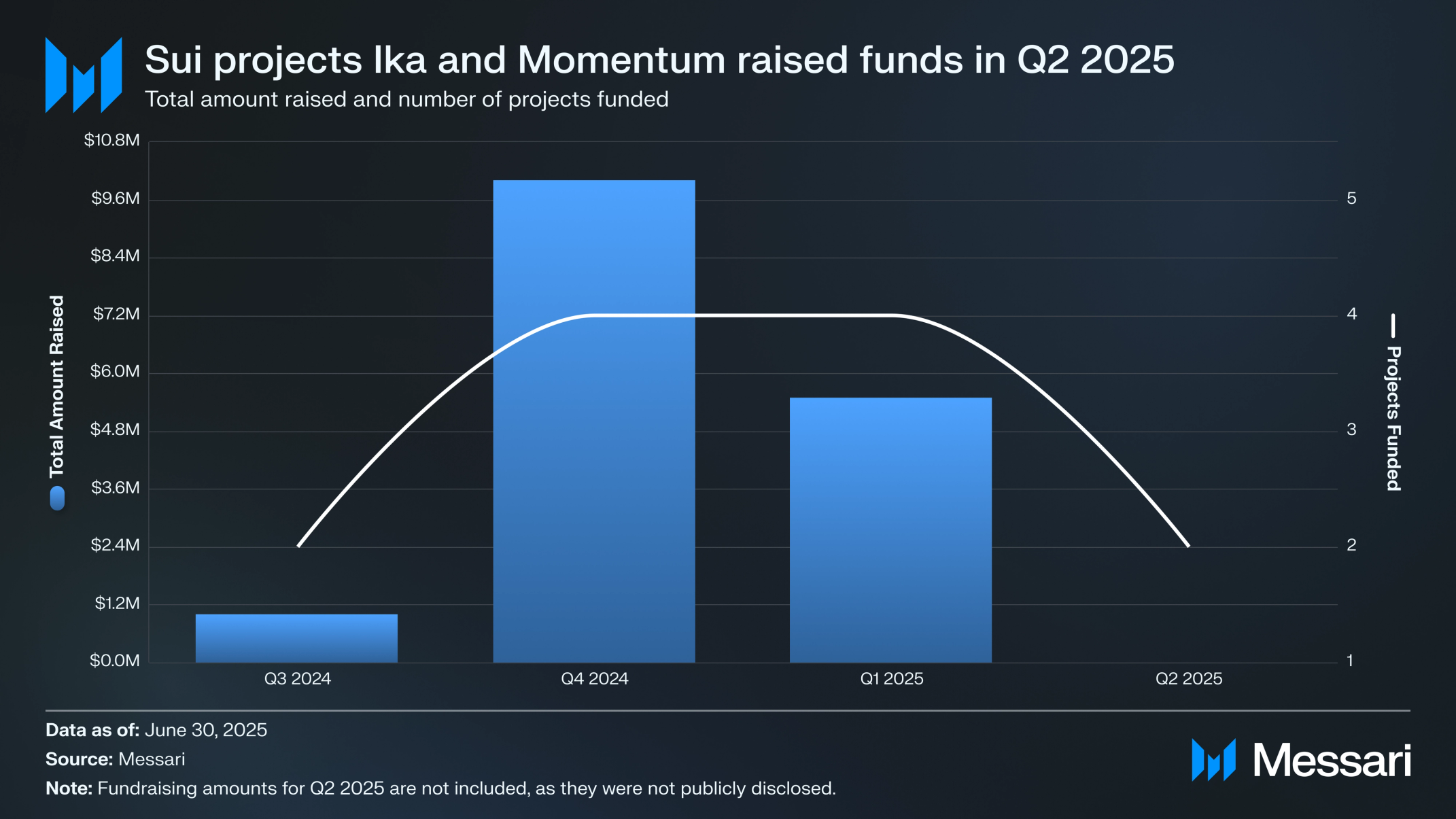
In Q2 2025, two projects building on Sui announced funding rounds with undisclosed amounts, compared to $5.0 million raised in Q1 2025. The two projects that raised money in Q2 include Ika and Momentum, with the Sui Foundation participating in and leading Ika’s round.
Sui Hydropower Fellowship: The Sui Foundation’s Hydropower Fellowship continued into its second cohort in Q2 2025, supporting another 12 early-stage teams through a 12-week program focused on product development, go-to-market, and strategic growth. The cohort featured projects across DeFi, AI agents, social primitives, and developer tooling, with several already live on Sui Mainnet or actively fundraising. Participants benefited from technical mentorship, expert-led workshops, and ecosystem integration to accelerate their progress.
SuiHub Accelerator Launch: In April 2025, the Sui Foundation, in partnership with Brinc and CoinList, launched the inaugural cohort of the SuiHub Accelerator, following over 630 applications. Five teams were selected for the program: Bluwhale, an AI intelligence layer for onchain agents; Swarm Network, creators of decentralized agent swarms for real-time fact-checking; Patara, an all-in-one DeFi asset manager; Aspis, a DeFi automation platform using agentic and DAO infrastructure; and Native, which enables seamless Bitcoin integration into DeFi apps. Participants receive mentorship, engineering support, and ecosystem access to scale their projects on Sui.
Sui Overflow 2025 Hackathon: The Sui Foundation concluded its largest annual hackathon to date with 46 winning teams selected from 599 submissions across nine official tracks and a university category. Participants from 85 countries competed between April and May, exploring categories such as AI, cryptography, DeFi, programmable storage, entertainment, and more. Winning projects leveraged Sui’s performance and composability to develop solutions ranging from encrypted data marketplaces and DeFi protocols to federated learning systems and fully onchain games. Community voting attracted over 195,000 votes, and winners received prizes totaling around $600,000.
Events
Sui Basecamp 2025: The second annual Sui Basecamp took place in Dubai on May 1 and May 2, 2025, gathering over 2,000 attendees, 100 speakers, and 1,000 companies across 90 countries. The event showcased the emergence of the full Sui stack, featuring infrastructure components like DeepBook, Walrus, Seal, and SCION, as the foundation for decentralized compute, storage, privacy, identity, and liquidity. Sessions spanned technical deep dives, DeFi and BTCfi panels, institutional adoption, and onchain gaming, with notable keynotes from Mysten Labs, 21Shares, Phantom, Fireblocks, and Raoul Pal.
Basecamp coincided with Sui’s second mainnet anniversary and featured the first public demo of the SuiPlay0X1 device. The event introduced the first-ever Sui Pitch Day, where 12 finalist teams pitched live onstage to a panel of investors. The winners includedOpenGraph (first place), Blueprint (second), SongBits (third), and Nemo (community favorite).
During the rest of Q2, the Sui Foundation expanded global engagement through new hubs and strategic collaborations. SuiHub Athensopened as a permanent base to support European builders, while SuiHub MENAsigned a partnership with Dubai’s Virtual Assets Regulatory Authority (VARA) to assist startups and co-develop regulatory education and research. The Foundation also hosted its first Sui Connect in Paris, deepening ties with the French developer community.
Activity remained strong across Asia and emerging markets, with the CommandOSS Hacker House in Ho Chi Minh City providing mentorship and hiring pathways for local developers. Regular meetups continued in Vietnam, Indonesia, Thailand, and Nigeria, reinforcing community growth and ecosystem participation across key global regions.
Closing Summary
In Q2 2025, Sui sustained momentum across financial performance, infrastructure, and ecosystem expansion. Average daily DEX volume reached a new high of $367.9 million, while DeFi TVL rose 44.3% QoQ to $1.76 billion. SUI’s circulating market cap increased 31.3% QoQ to $9.44 billion, outperforming the broader crypto market, and total network fees grew 19.0% QoQ to $4.3 million. Institutional interest deepened with the launch of the Grayscale SUI Trust, Fireblocks integration, and multiple spot ETF filings. Infrastructure continued to mature with key product launches, including Seal on Testnet, Nautilus and the Sui Prover on Mainnet, and broad wallet, exchange, and cross-chain support.
Consumer growth accelerated with the sold-out SuiPlay0X1 preorders and new gaming integrations from ONE Championship, Lineup Games, and LumiWave. NFT activity demonstrated new onchain primitives, highlighted by Claynosaurz’s large-scale mint using native randomness, sponsored transactions, and Kiosk. Sui Basecamp returned with a full-stack showcase and the first Sui Pitch Day, while the Overflow hackathon attracted nearly 600 teams from 85 countries. Looking ahead, the network remains focused on scaling decentralized infrastructure, advancing BTCfi, expanding real-world integrations, and enabling developers to build the next generation of user-facing applications.
This report was commissioned by the Sui Foundation. All content was produced independently by the author(s) and does not necessarily reflect the opinions of Messari, Inc. or the organization that requested the report. The commissioning organization may have input on the content of the report, but Messari maintains editorial control over the final report to retain data accuracy and objectivity. Author(s) may hold cryptocurrencies named in this report. This report is meant for informational purposes only. It is not meant to serve as investment advice. You should conduct your own research and consult an independent financial, tax, or legal advisor before making any investment decisions. Past performance of any asset is not indicative of future results. Please see our Terms of Service for more information.
No part of this report may be (a) copied, photocopied, duplicated in any form by any means or (b) redistributed without the prior written consent of Messari®.
Jake is a Research Analyst on the Protocol Research team. He previously worked as an Investment Analyst at an AI-driven crypto research platform and as a Venture Analyst at a digital assets venture fund. He advised multiple RWA tokenization projects on tokenomics. Jake graduated from the University of Southern California, where he studied Philosophy and Finance.
Jake is a Research Analyst on the Protocol Research team. He previously worked as an Investment Analyst at an AI-driven crypto research platform and as a Venture Analyst at a digital assets venture fund. He advised multiple RWA tokenization projects on tokenomics. Jake graduated from the University of Southern California, where he studied Philosophy and Finance.