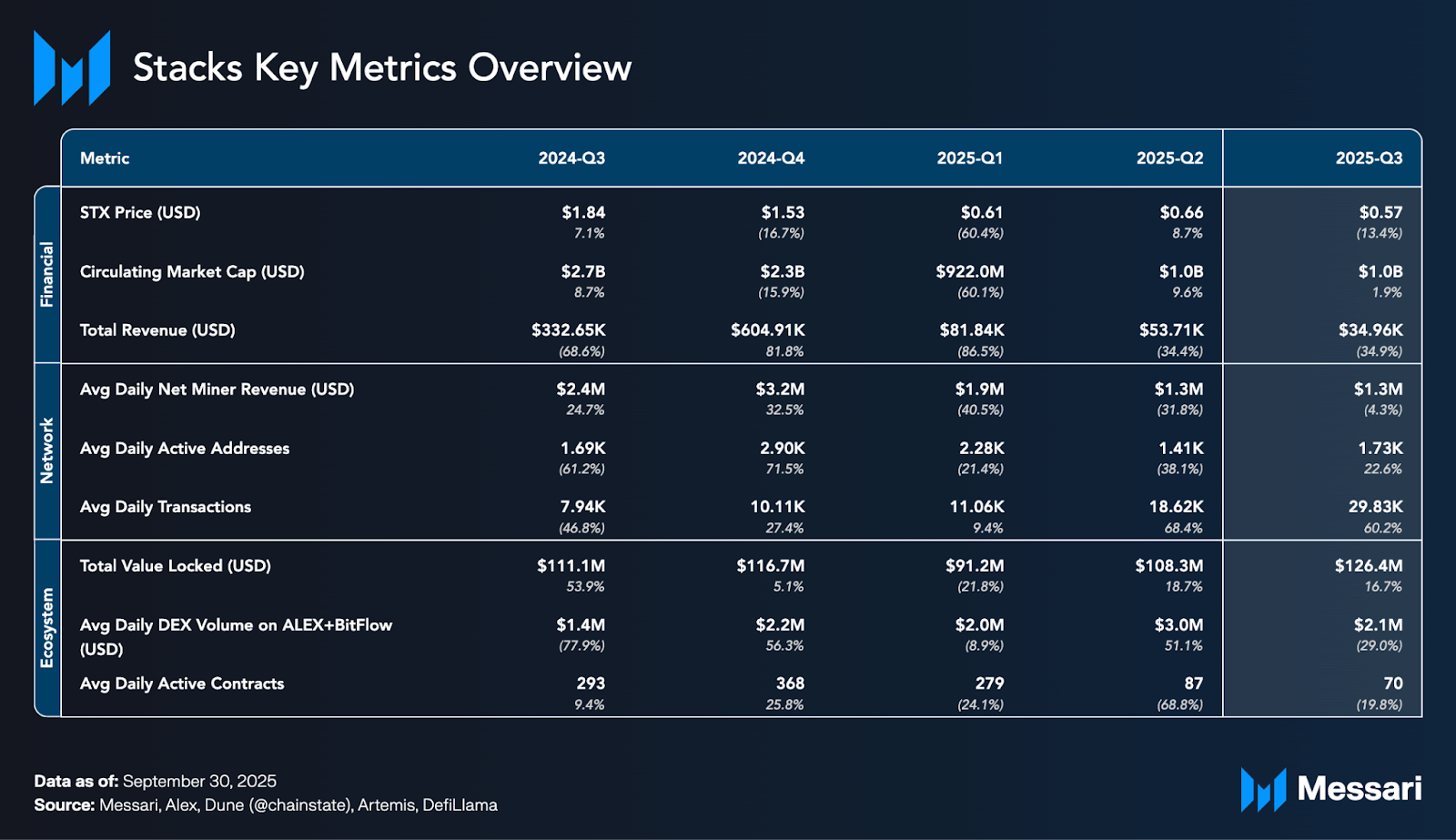
Stacks saw overall growth across several metrics in Q3, including DeFi TVL in USD (+16.7%), DeFi TVL in STX (+47.1%), average total STX stacked (+1.7%), average daily miners (+4.4%), circulating market cap (+1.9%), total transactions (+61.9%), average daily transactions (+60.2%), and average daily active addresses (+22.6%).
In contrast, several incentive and participation metrics declined QoQ, including STX‑denominated revenue (–29.0%), USD‑denominated revenue (–34.9%), average daily net stack volume in BTC (–17.8%), average daily Stackers (–9.5%), and BTC‑denominated miner revenue (–18.7%).
Stacks advanced decentralization and funding infrastructure with the activation of SIP-031 a Treasury Committee was formed to govern a 500 million STX Endowment.
Institutional participation expanded further through progress with Hex Trust, while developer support grew through DeGrants, LearnWeb3, and the global onboarding of Expedition 31.
Removal of the 5,000 BTC cap for sBTC and lowering of minting minimums to 0.001 BTC, significantly improved capital efficiency and retail accessibility.
Primer
Stacks (STX) is a Bitcoin Layer-2 (L2) that allows smart contracts and decentralized applications to use Bitcoin as a secure base layer. Transactions are executed on Stacks and settled on Bitcoin, leveraging Bitcoin's security and capital while offering arbitrary programmability that is not possible on its scriptable settlement layer.
Stacks has knowledge of the full Bitcoin state, thanks to its Proof-of-Transfer (PoX) consensus mechanism and Clarity programming language, allowing it to read from Bitcoin at any time. With PoX, miners commit BTC to eligible Stacks addresses that participate in consensus. This process, in which STX tokenholders participate in consensus and earn BTC from miners, is known as Stacking. PoX operates in parallel to Bitcoin’s Proof-of-Work (PoW) consensus, hashing and settling Stacks transactions on the Bitcoin blockchain. Metadata from newly mined Stacks blocks is anchored to every Bitcoin block, allowing users to verify the canonical Stacks blockchain via Bitcoin blocks.
The previous Nakamoto upgrade strengthened Stacks’ integration with Bitcoin by (i) introducing sBTC, a decentralized tokenized BTC, (ii) enabling faster block production, (iii) improving Bitcoin finality, and (iv) reducing the chances of Maximal Extractable Value (MEV) exploitation.
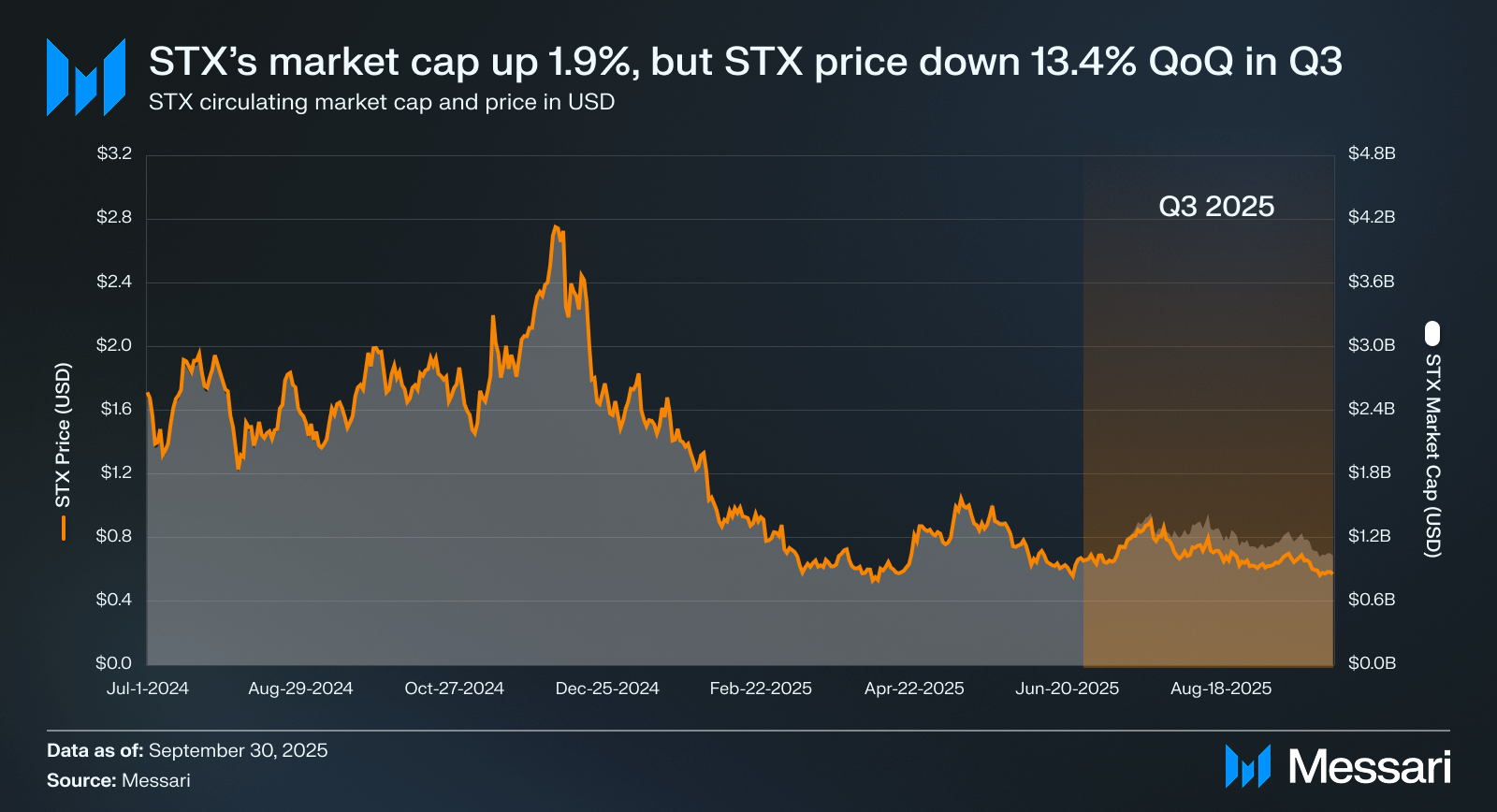
Relative to BTC and ETH market caps, which rose 6.6% and 66.7% QoQ, respectively, Stacks' market cap showed an increase of 1.9% QoQ, reaching $1.03 billion in Q3 2025, up from $1.01 billion in Q2. Despite this nominal gain in absolute terms, the price of STX declined 13.4% QoQ from $0.66 to $0.57.
Revenue
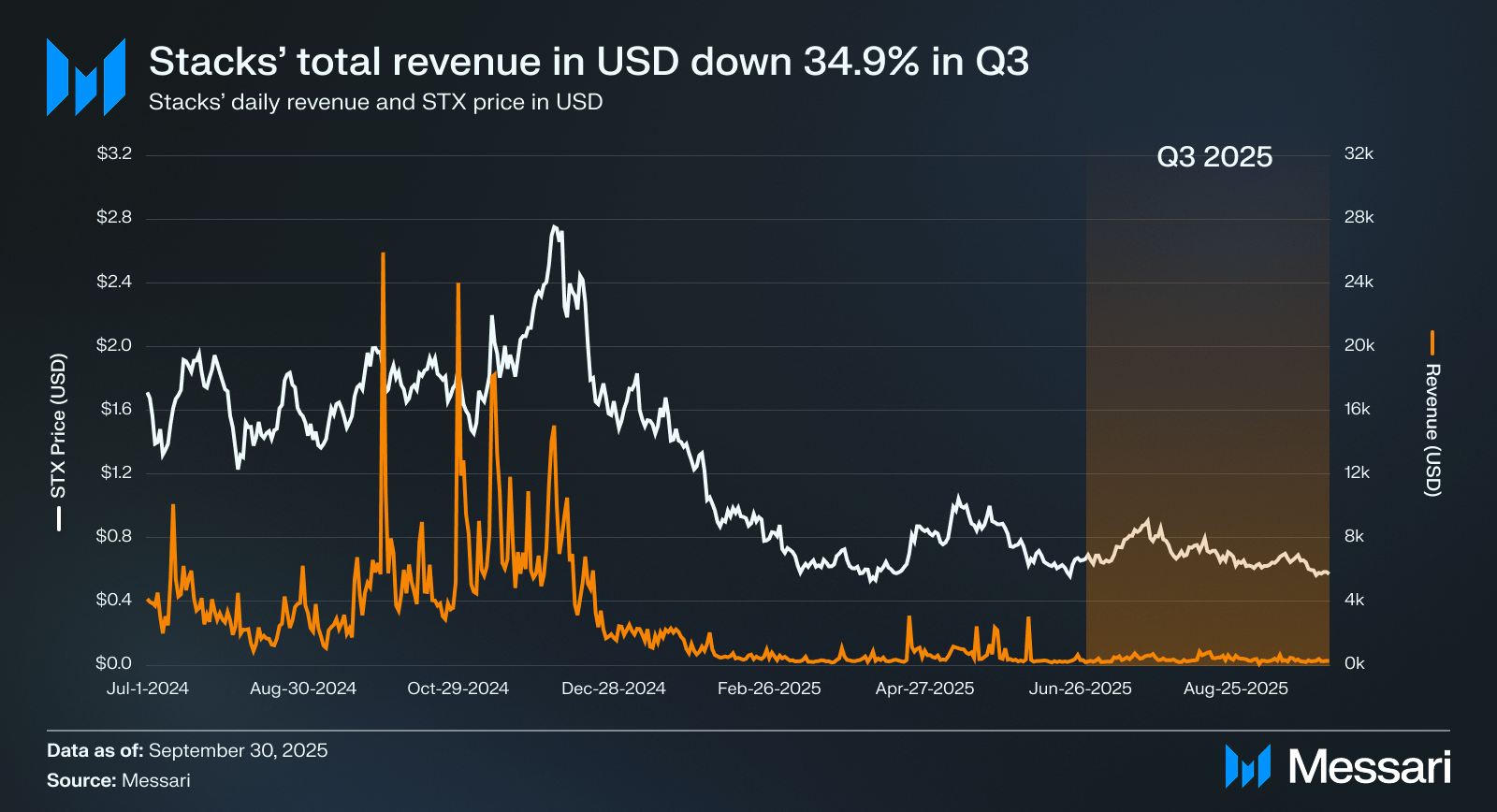
Stacks’ revenue is measured as total transaction fees and is distributed to Miners through Stacks’ PoX mechanism (along with the coinbase reward, i.e., issuance).
Revenue remained under pressure throughout Q3 2025, extending the downtrend that began in late 2024. Total revenue declined 29.0% QoQ in native STX terms, falling from 70,122 STX in Q2 to 49,765 STX in Q3, and 34.9% in USD terms, from $53,714 to $34,956. This continued contraction follows a period of relative stability earlier in the year, as network activity and transaction fees moderated after the post-Nakamoto upgrade surge. While revenue levels have yet to recover to late-2024 highs, the deceleration in decline suggests a stabilization phase, likely reflecting consistent onchain usage despite broader market softness and slower transactional growth.
Usage
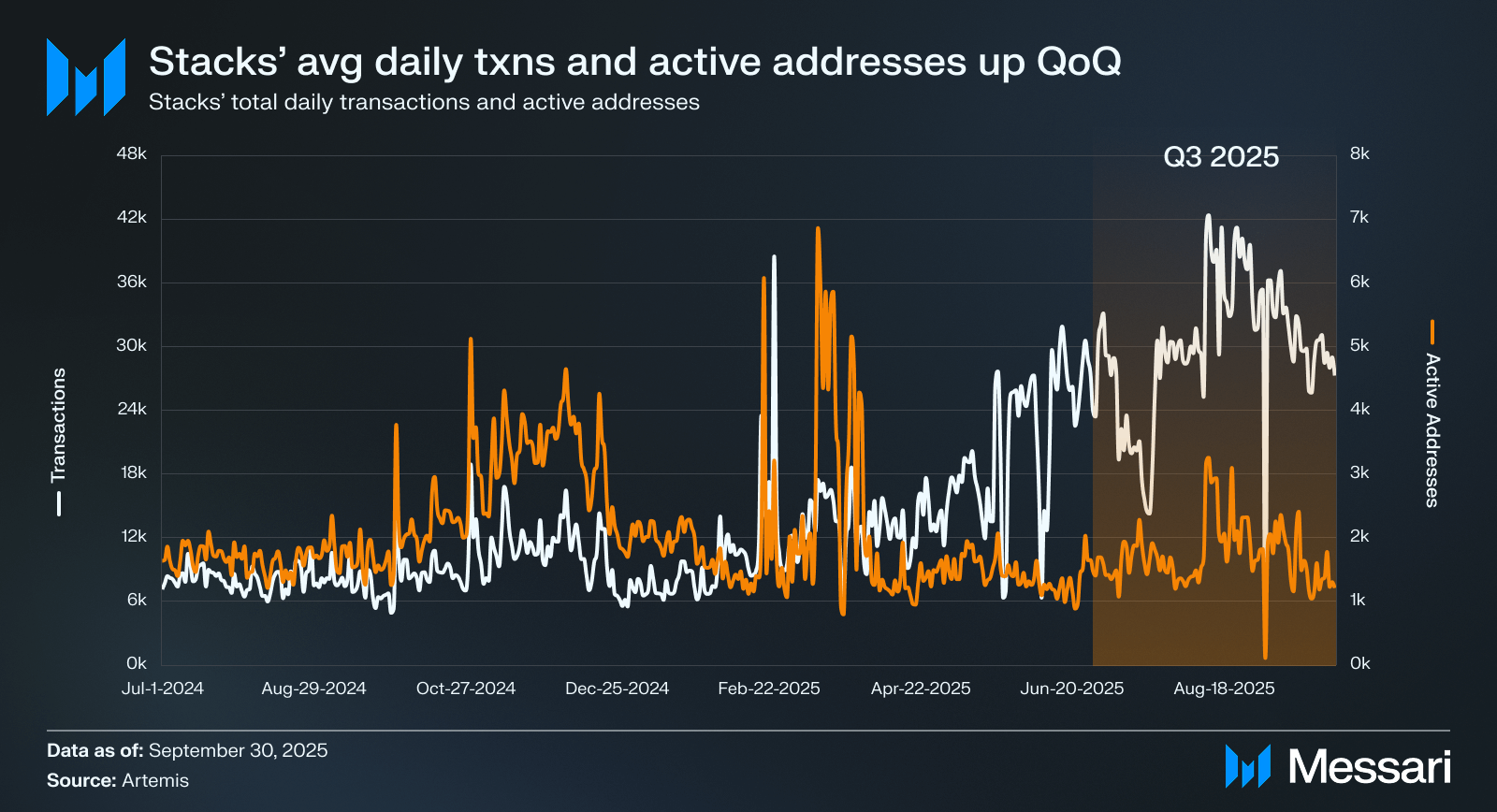
Network activity strengthened considerably in Q3 2025, reversing the declines seen in the prior quarter. Average daily transactions rose 60.2% QoQ, increasing from 18,622 to 29,828, while average daily active addresses grew 22.6% QoQ, from 1,412 to 1,731. Total transactions increased to 2.7 million in Q3, up 61.9% from 1.7 million in Q2.
Total Value Locked (TVL)
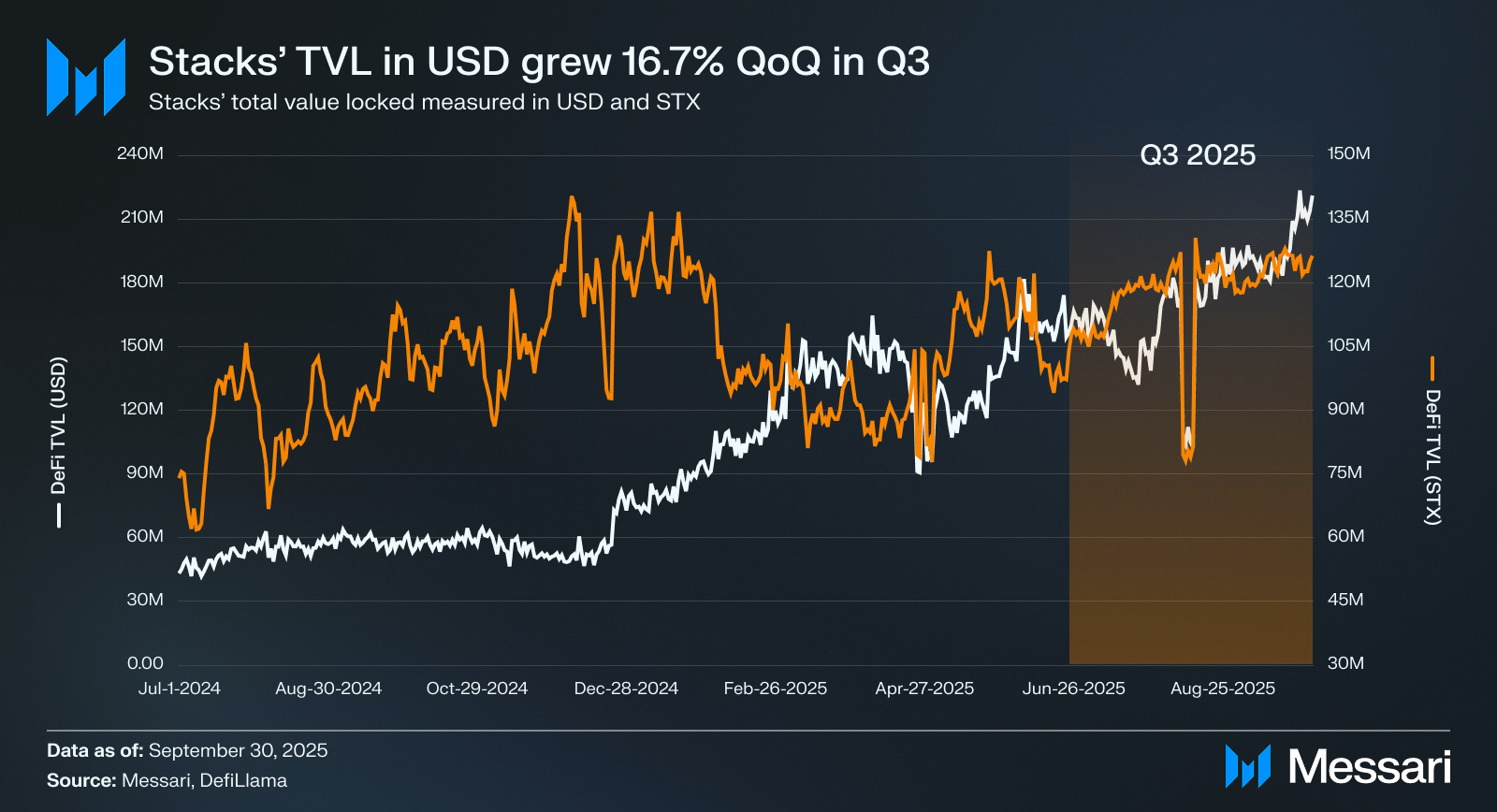
Stacks’ total value locked (TVL) grew meaningfully in Q3 2025, rising 16.7% QoQ in USD terms from $108.3 million to $126.4 million, reflecting renewed momentum in the ecosystem. In native STX terms, TVL rose 47.1% QoQ, increasing from 150.3 million STX to 221.1 million STX. This substantial uptick across both metrics indicates a strengthening of capital participation in Bitcoin DeFi on Stacks, following the mid-year recovery and further product adoption.
Stacking
Stacking, similar to mining on Bitcoin, is largely dominated by pools. In the post-Nakamoto era, nearly everyone must delegate to a pool. Thus, it is impossible to know how many participants are in the custodial pools as the data is not directly onchain.
The system operates as a feedback loop driven by the interaction between miners and Stackers through the Proof-of-Transfer (PoX) mechanism. Miners transfer BTC to produce blocks, while Stackers lock STX to support consensus, network security, and receive BTC rewards. Specifically, the more miners participating in the network, the fewer BTC rewards can be distributed among Stackers. Additionally, assuming the number of miners stays constant, an increase in Stacker participation reduces rewards for Stackers overall.
Stackers, Miners, and Stacking
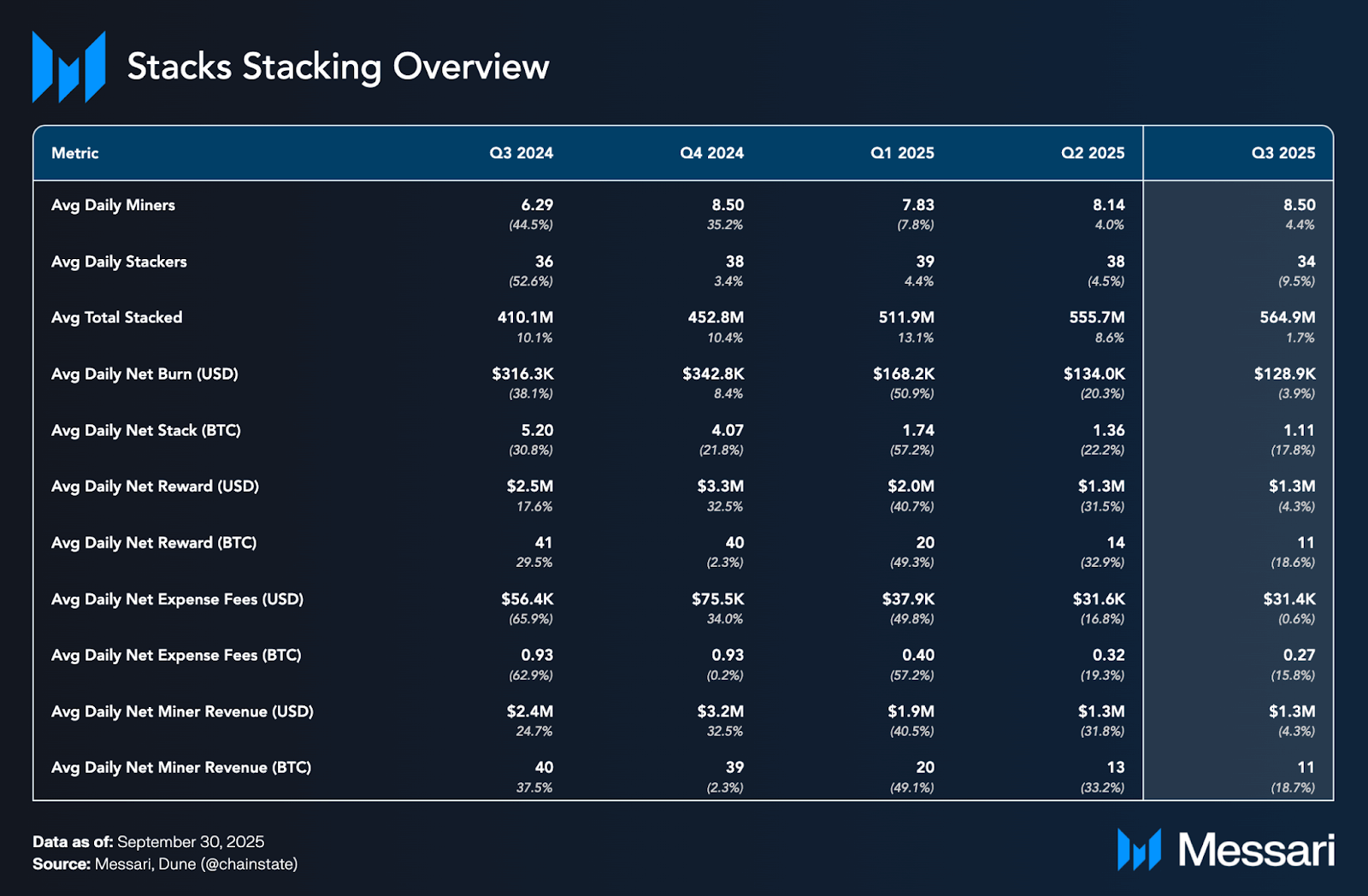
Pool participation continues to dominate Stacking in H1 2025, making it difficult to assess unique participation. What is more visible is the steady growth in the average total STX locked. Average total STX locked in stacking continued its steady growth into Q3 2025, albeit at a slower pace. After rising 13.1% QoQ in Q1 and 8.6% QoQ in Q2, this metric increased 1.7% QoQ in Q3 to 564.9 million STX. Despite this continued capital commitment, the average number of daily Stackers dropped 9.5% QoQ in Q3 to 34 - the lowest figure since the Nakamoto upgrade. This decline suggests increasing concentration among larger participants, especially as stacking has become more pool-dominated and capital-intensive. In contrast, average daily miners rose 4.4% QoQ in Q3 from 8.1 to 8.5, returning to the high set in Q4 2024. The miner count appears to have stabilized around this level after previous volatility.
Net Burn and Net Stack
Stacking incentives continued to deteriorate in Q3, reflecting ongoing headwinds from macro conditions and token dynamics. Average daily net burn in USD decreased 3.9% QoQ in Q3 to 128,858, continuing the downtrend that began after Q4 2024. Similarly, average daily net stack declined 17.8% QoQ in Q3 to 1.1 BTC - the fifth consecutive quarterly contraction. Since peaking at 5.2 BTC/day in Q3 2024, net stack volumes have dropped nearly 79%. These declines highlight persistent misalignment between BTC and STX prices, where BTC outperformance reduces the relative attractiveness of participating in Stacks’ Proof-of-Transfer (PoX) cycle.
Net Rewards and Expense Fees
Rewards also continued to shrink, albeit at a slower rate. Average daily net rewards in USD fell 4.3% QoQ in Q3 to $1.3 million, while BTC-denominated rewards dropped 18.6% QoQ to 11.1 BTC/day. This represents a decline of 72% in BTC rewards since Q3 2024. The drawdown in USD terms appears more muted due to minor STX price volatility during the quarter. Average daily net expense fees showed similar patterns in Q3: down 0.6% QoQ to $31,361/day, but down 15.8% to 0.3 BTC/day in BTC terms. Together, these metrics reinforce the trend of reward compression and further concentration among large-scale participants.
Miner Revenue
Average daily miner revenue showed marginal declines in USD terms, dropping 4.3% QoQ to $1.3 million/day, as well as in BTC terms, falling 18.7% to 10.9 BTC/day. Since Q3 2024, miner rewards in BTC have decreased by 73%, mirroring the broader trend among PoX participants. This reflects both decreased network activity and persistent incentive misalignment, where the opportunity cost of stacking or mining grows as BTC appreciates and STX underperforms.
Overall, despite a modest increase in average total STX stacked, the sharp drop in average daily Stackers, down to the lowest post-Nakamoto levels, signals rising capital concentration and reduced retail participation. Meanwhile, the miner cohort remained stable, and average daily net burn hovered just below Q2 2025 levels, reflecting consistent demand for BTC-denominated rewards. Rewards and expense fees continued to trend downward, particularly in BTC terms, reinforcing consolidation among larger actors. Overall, Stacks’ incentive environment remains heavily influenced by the BTC/STX price relationship, with elevated BTC rewards sustaining miner activity even as stacking participation continues to decline.
Qualitative Analysis
Stacks Improvement Proposals (SIP)
From July to September 2025, one SIP was introduced to strengthen ecosystem funding and decentralize capital allocation.
SIP-031: Five-Year Stacks Growth Emissions
Passed in July 2025 with over 310 million STX in voting power and 97.5% approval, SIP-031 established a 500 million STX Endowment to fund long-term growth across the ecosystem. The proposal’s enactment included a protocol-level hard fork (activated on July 29, 2025, at Bitcoin block 907740), the legal formation of a treasury entity, and the initiation of key appointments. The Endowment will allocate capital across various verticals, including developer grants, DeFi incentives, marketing, integrations, and ecosystem R&D. SIP-031 also introduced a decentralized governance structure, comprising a nine-member Treasury Committee (TC) finalized in September 2025, which is responsible for reviewing and approving budget allocations.
Nakamoto and sBTC Developments
The Nakamoto upgrade was successfully activated in Q4 2024, following Stacks’ proposed rollout plan. This upgrade laid the foundation for sBTC, the first decentralized Bitcoin (BTC) peg that allows smart contracts to write back to the Bitcoin blockchain. Unlike other synthetic BTC variants, sBTC does not rely on federations or centralized custodians. Instead, sBTC utilizes an open network in which anyone can contribute to maintaining the peg. The exact details can be read in the original whitepaper. However, it’s important to note that while sBTC was originally designed to operate with fully decentralized, open-membership signers, the current live implementation uses a federation of 14 elected signers as its base security model. The long-term roadmap still plans to rotate and expand this signer set toward a permissionless, dynamically rotating system aligned with the original whitepaper design.
Bootstrapping Phase: sBTC initially launched with a limited group of Signers selected through community voting. These Signers are responsible for maintaining the sBTC peg wallet, ensuring a 1:1 backing of BTC to sBTC.
Signer Rotation Phase (scheduled for Q2–Q3 2025): Will transition the signer set from the initial cohort to a fully decentralized and dynamically rotating group, marking a key milestone in trust minimization and network decentralization.
Uncapping sBTC and Lowering Entry Barriers
On Sept. 16, 2025, Stacks lifted the 5,000 BTC cap on sBTC issuance and reduced the minimum deposit threshold from 0.01 BTC to 0.001 BTC. These changes unlocked unrestricted sBTC minting and significantly expanded access for smaller depositors. As a result, the ecosystem now supports greater capital scalability, improved DEX and lending liquidity, and enhanced sBTC listing viability on centralized exchanges.
General Developments
Several ecosystem-wide initiatives and protocol updates occurred between July and September 2025, reflecting continued momentum in Bitcoin DeFi, infrastructure, governance, and community development.
July
Stacks partnered with Wormhole to deploy $1.5 billion worth of sBTC and STX across chains using the Native Token Transfers (NTT) standard.
Nansenadded full support for Stacks, unlocking real-time analytics on wallets, smart contract activity, whale flows, and DeFi engagement.
Hex Trustenabled staking for STX and sBTC within its regulated custody platform, with BTC rewards automatically deposited into client vaults.
Zealylaunched the STX DeFi SZN campaign, offering 50,000 STX in rewards for completing onchain quests and interacting with DeFi apps built on Stacks.
Stacks and DeOrganized Mediaran a daily giveaway campaign highlighting diverse applications of STX, including identity verification via BNS, AI with SatoshAI, community tipping via Boost X, NFTs, onchain games like STX City, and DeFi tools.
August
sBTC integrated with Moso, a crypto rewards platform with 2,000+ retail partners.
LearnWeb3 released Course 3 in its Stacks Developer Degree series, teaching how to build Bitcoin DeFi apps using Clarity.
The Stacks Foundation opened applications for its third DeGrants cohort, offering up to $100,000 for early-stage builders.
September
The Stacks ecosystem launched Expedition 31, a global developer onboarding initiative featuring hackathons, webinars, workshops, and a Hacker House.
Gate.io listed sBTC for spot trading, expanding centralized exchange access for Bitcoin-pegged assets on Stacks.
The Stacks Foundation launched the $25,000 Vibecoding hackathon, focusing on AI-powered Bitcoin applications.
Closing Summary
In Q3 2025, the broader crypto market posted modest gains, with BTC and ETH market caps rising 6.6% and 66.7% QoQ, respectively. Stacks (STX), by comparison, remained relatively flat in USD terms, with a 1.9% QoQ increase in circulating market cap to $1.03 billion, while STX price declined 13.4% to $0.57. In contrast to prior quarters, core usage metrics rebounded: average daily transactions increased 60.2% QoQ to 29,828, total transactions jumped 61.9% to 2.7 million, and average daily active addresses rose 22.6% to 1,731. These increases reflect renewed onchain activity following stablecoin integrations and broader DeFi growth.
Stacking dynamics continued to show an increased concentration, as the average daily Stackers fell to 34, while miner participation stabilized near the Q4 2024 highs. Average daily net burn and net stack volumes both declined again, suggesting weaker economic incentives amid STX underperformance relative to BTC. Meanwhile, average daily rewards and expense fees compressed further in BTC terms, pointing to continued consolidation among larger participants.
On the qualitative side, the network made foundational progress. The passage of SIP-031 in July initiated a 500 million STX ecosystem endowment, complete with decentralized governance and capital deployment structures. Stacks also removed the sBTC supply cap and lowered minting minimums, paving the way for expanded sBTC adoption and integration into centralized exchanges. Ecosystem momentum was supported by cross-chain infrastructure developments (e.g., Wormhole NTT integration), institutional adoption (e.g., Hex Trust custody and staking), and community campaigns (e.g., STX DeFi SZN and the Use STX Giveaway). As the signer rotation phase of sBTC looms and developer activity continues, Q4 2025 will be pivotal for catalyzing renewed participation.
This report was commissioned by the Stacks Foundation. All content was produced independently by the author(s) and does not necessarily reflect the opinions of Messari, Inc. or the organization that requested the report. The commissioning organization may have input on the content of the report, but Messari maintains editorial control over the final report to retain data accuracy and objectivity. Author(s) may hold cryptocurrencies named in this report. This report is meant for informational purposes only. It is not meant to serve as investment advice. You should conduct your own research and consult an independent financial, tax, or legal advisor before making any investment decisions. Past performance of any asset is not indicative of future results. Please see our Terms of Service for more information.
No part of this report may be (a) copied, photocopied, duplicated in any form by any means or (b) redistributed without the prior written consent of Messari®.