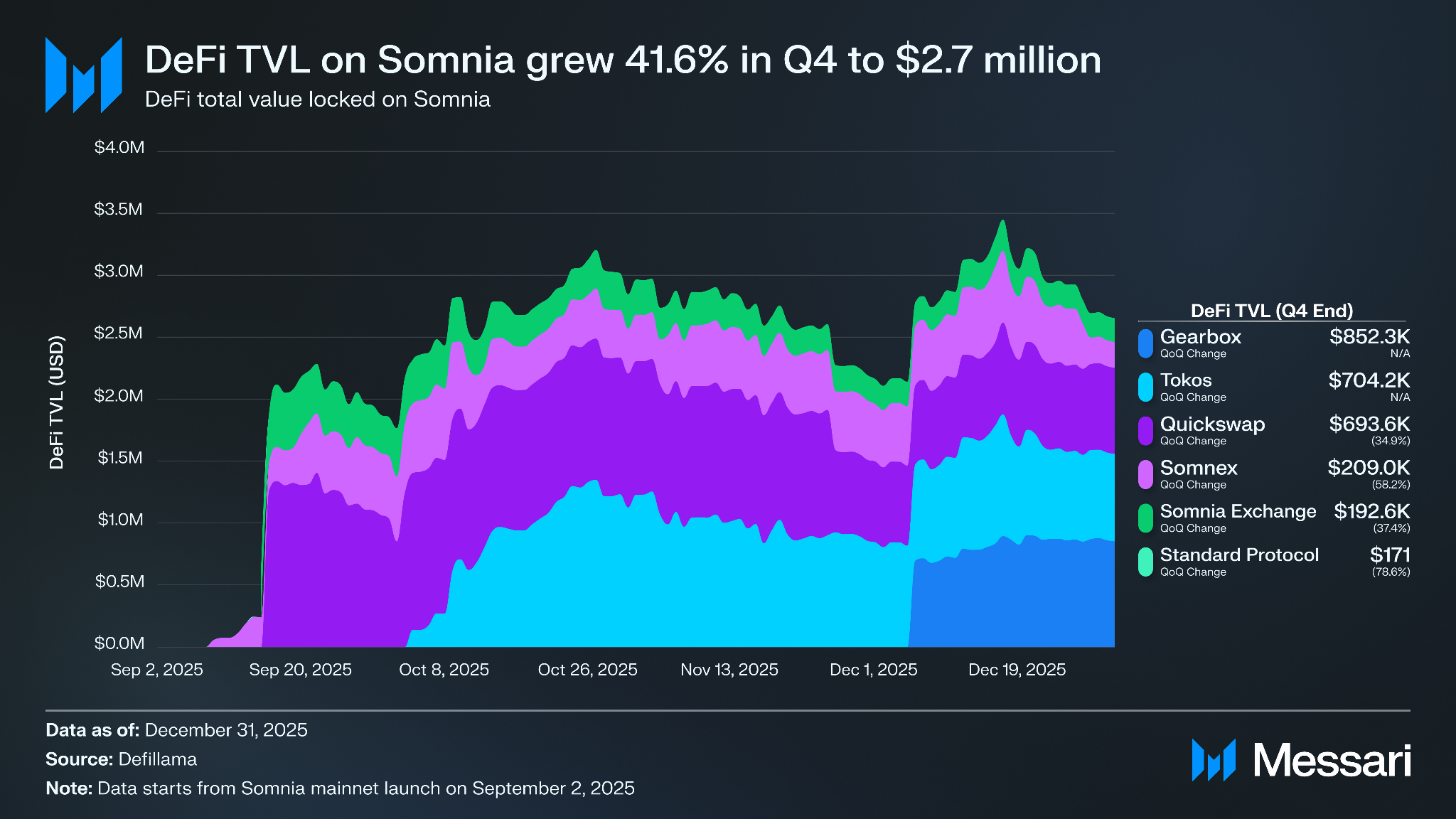
DeFi TVL grew 41.6% QoQ to $2.65 million, driven by the introduction of lending primitives. Gearbox and Tokos together accounted for nearly 59% of total TVL, signaling a structural shift toward credit-based use cases.
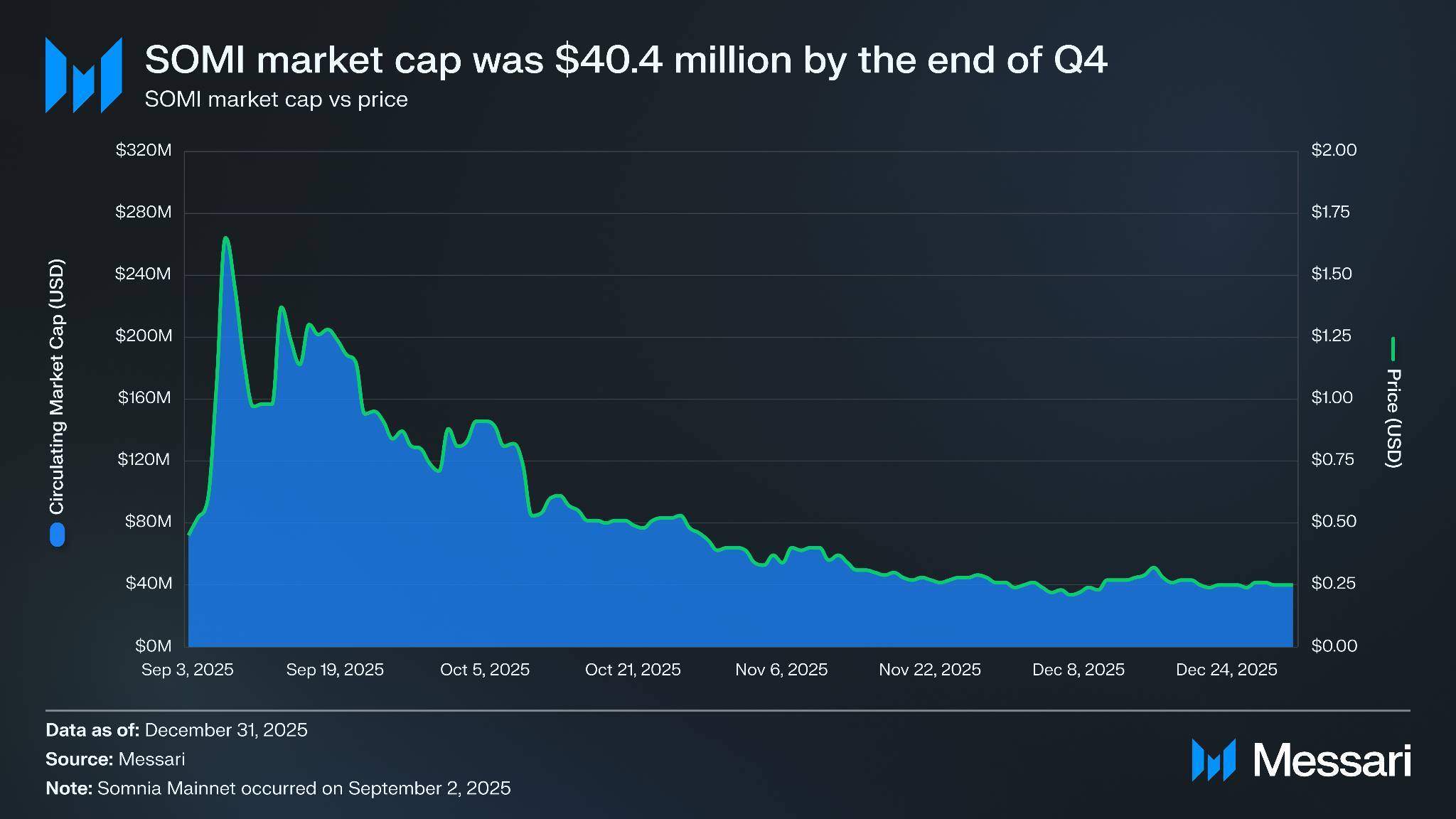
SOMI entered a post-airdrop price discovery phase in Q4, with market cap declining to $40.4 million, down 64.7% QoQ.
Somnia completed the final phase of its initial token distribution in Q4, closing the Somnia Odyssey airdrop after distributing SOMI to over 95,000 contributors.
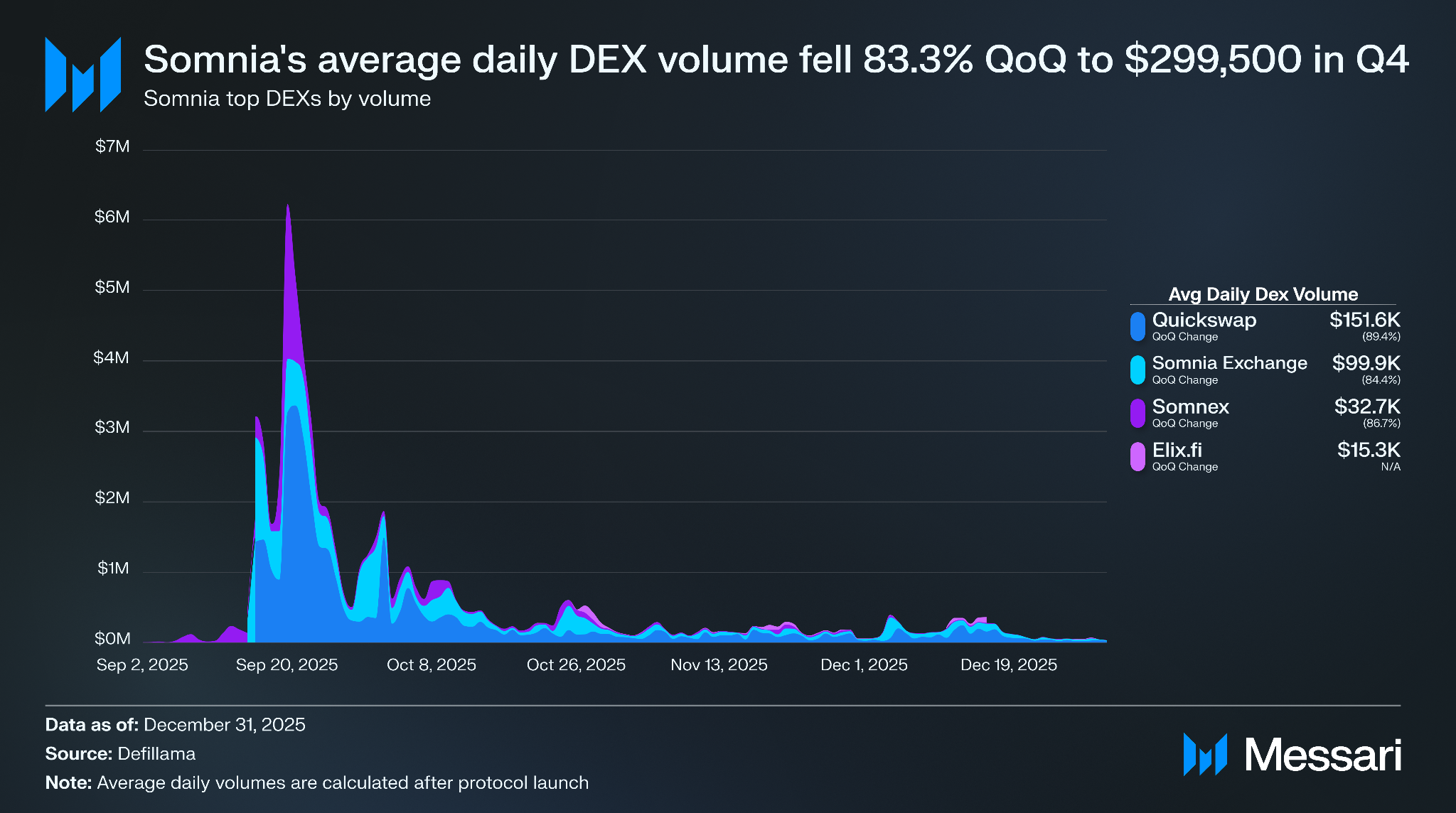
DEX activity normalized following post-mainnet highs, with average daily volume declining 87.1% QoQ to $299,500. While absolute volumes fell, market share stabilized among leading venues and new entrants such as Elix expanded Somnia’s market structure.
Strategic partnerships in Q4 expanded Somnia’s functional surface area, spanning lending, prediction markets, cross-chain liquidity, identity, creator and gaming distribution, and community tooling.
Primer
Somnia (SOMI) is a high-performance Layer-1 blockchain designed to support real-time, large-scale applications such as gaming, social platforms, and interactive digital worlds. Founded by Improbable, the network aims to deliver internet-scale performance while maintaining Ethereum Virtual Machine (EVM) compatibility, enabling developers to migrate or build seamlessly using existing Web3 tooling.
Somnia’s architecture is optimized for mass participation and low-latency interaction. The network claims throughput exceeding one million transactions per second (TPS) with sub-second finality and near-zero transaction fees. This design enables onchain experiences previously limited by scalability constraints, including high-frequency multiplayer games and AI-driven environments.
The SOMI token serves as the network’s native asset, used for transaction fees, staking, and governance. Validators stake SOMI to secure the network, while users can delegate their tokens to earn rewards and participate in governance once it becomes fully activated. Half of all gas fees are permanently burned, introducing a deflationary mechanism that ties network usage directly to token scarcity.
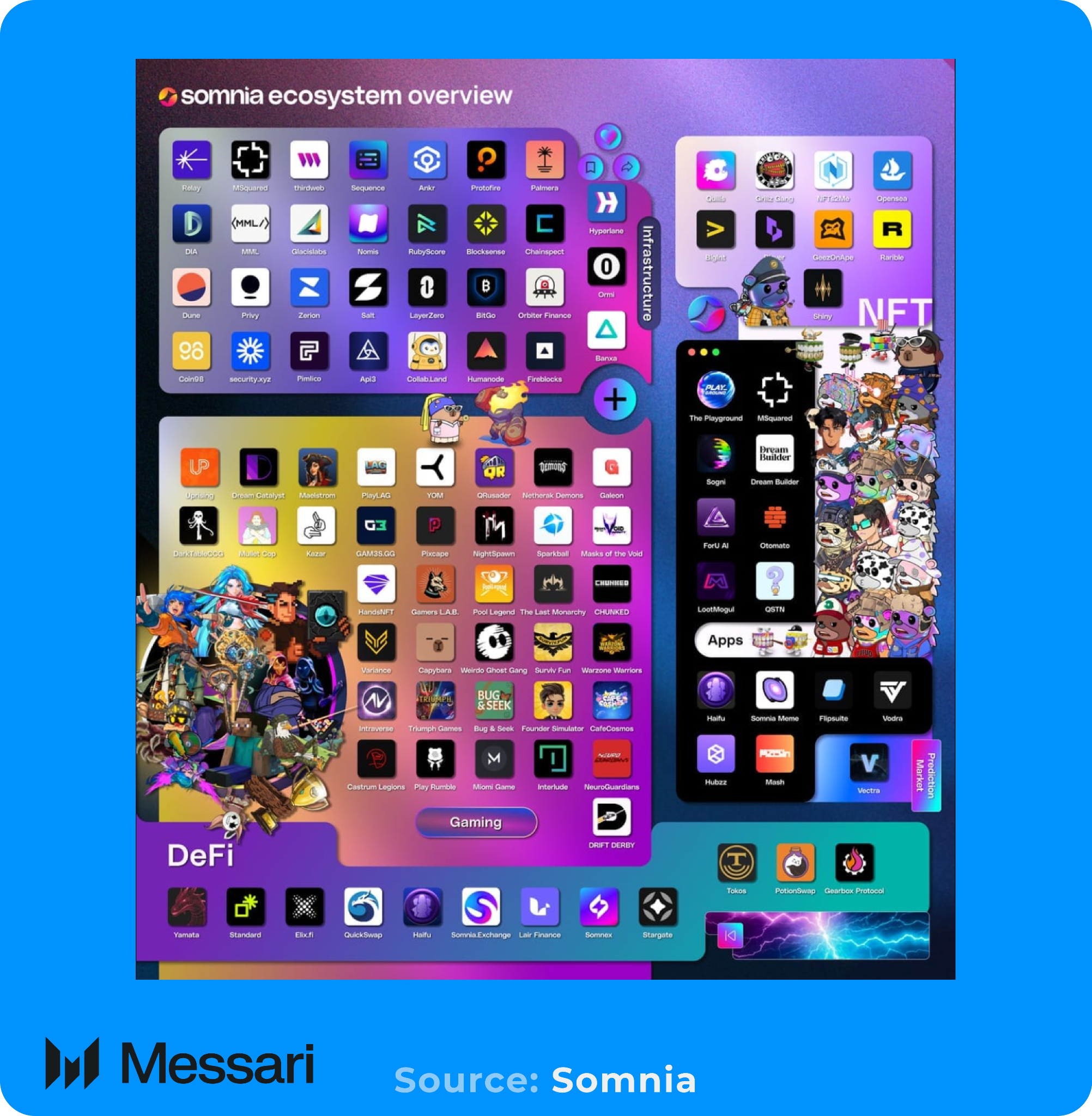
Somnia’s ecosystem is built around interoperability and accessibility. The network integrates with infrastructure partners such as Google Cloud, BitGo, Fireblocks, and Banxa, and connects to external blockchains via LayerZero. Its partnership with Dune Analytics enhances data visibility, while integrations with OpenSea and Rarible support NFT liquidity and creator onboarding.
By the end of Q4 2025, SOMI’s market cap fell to $40.4 million, down 64.7% QoQ from $114.3 million at the end of Q3. The token’s price declined in parallel to $0.25, also down 64.7% QoQ from $0.71. The decline was caused by post airdrop sell-offs and early participant profit-taking, which amplified selling pressure as speculative interest cooled.
Transaction Fees
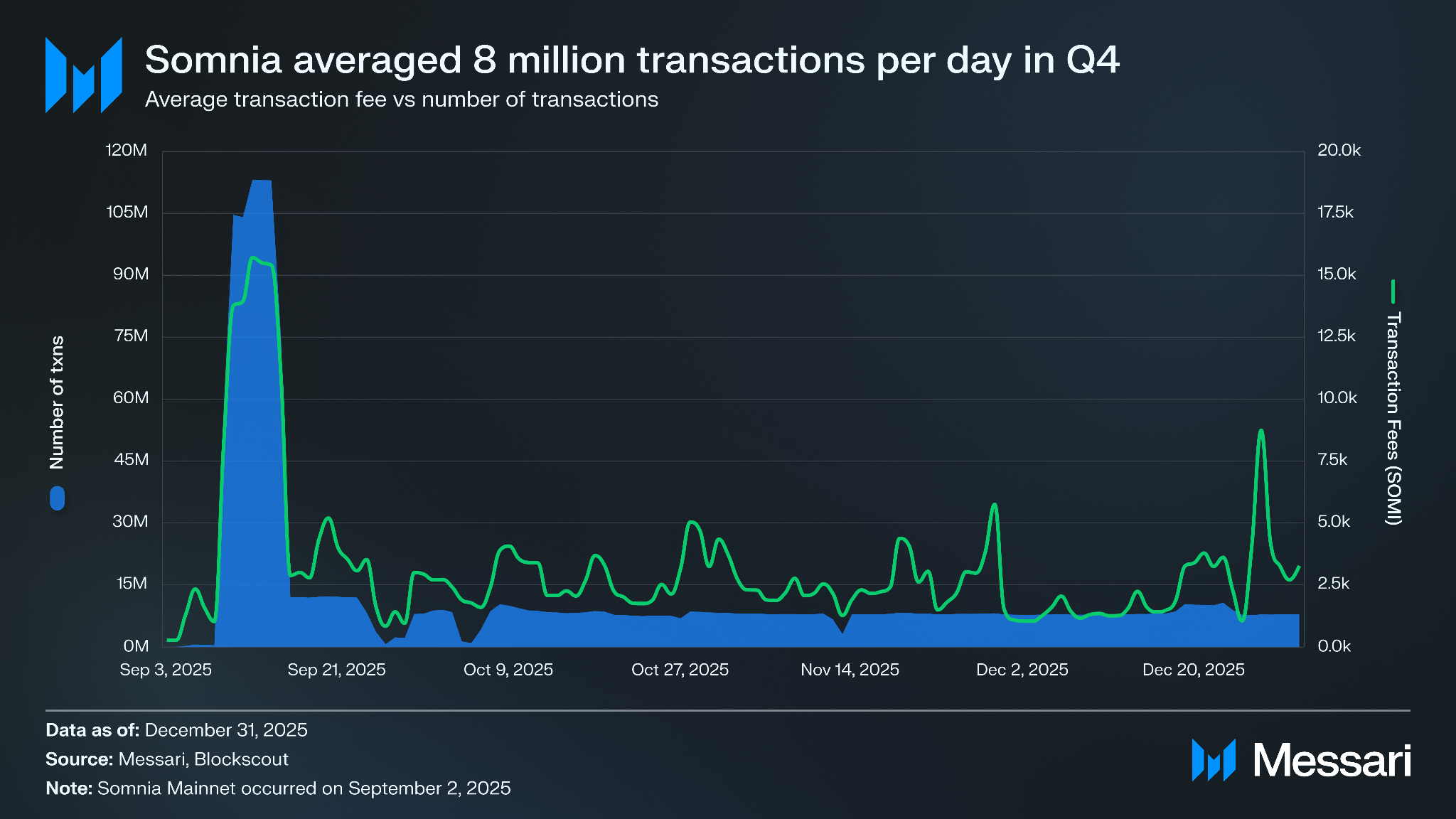
The network averaged 8 million transactions per day during Q4, down 70.5% QoQ from 27.4 million daily transactions in Q3, which captured the immediate post-mainnet period. Average daily transaction fees followed a similar trajectory. Somnia generated 2,580 SOMI per day in fees during Q4, down 48.2% QoQ from 4,976 SOMI per day in Q3. The contraction in both metrics reflects a normalization phase following mainnet launch, as early experimentation, airdrop-related activity, and incentive-driven transactions tapered off.
Network Overview
SOMI Tokenomics and Airdrop
SOMI is the native token of the Somnia network, introduced alongside mainnet on September 2, 2025. The token underpins network activity as the gas asset for transactions and smart contract execution, while also playing a role in validator staking, delegated security, and future onchain governance. Validators are required to stake a minimum of 5 million SOMI, and tokenholders can delegate to validators or pooled staking programs to earn rewards and support network security.
Key parameters for SOMI’s tokenomics include:
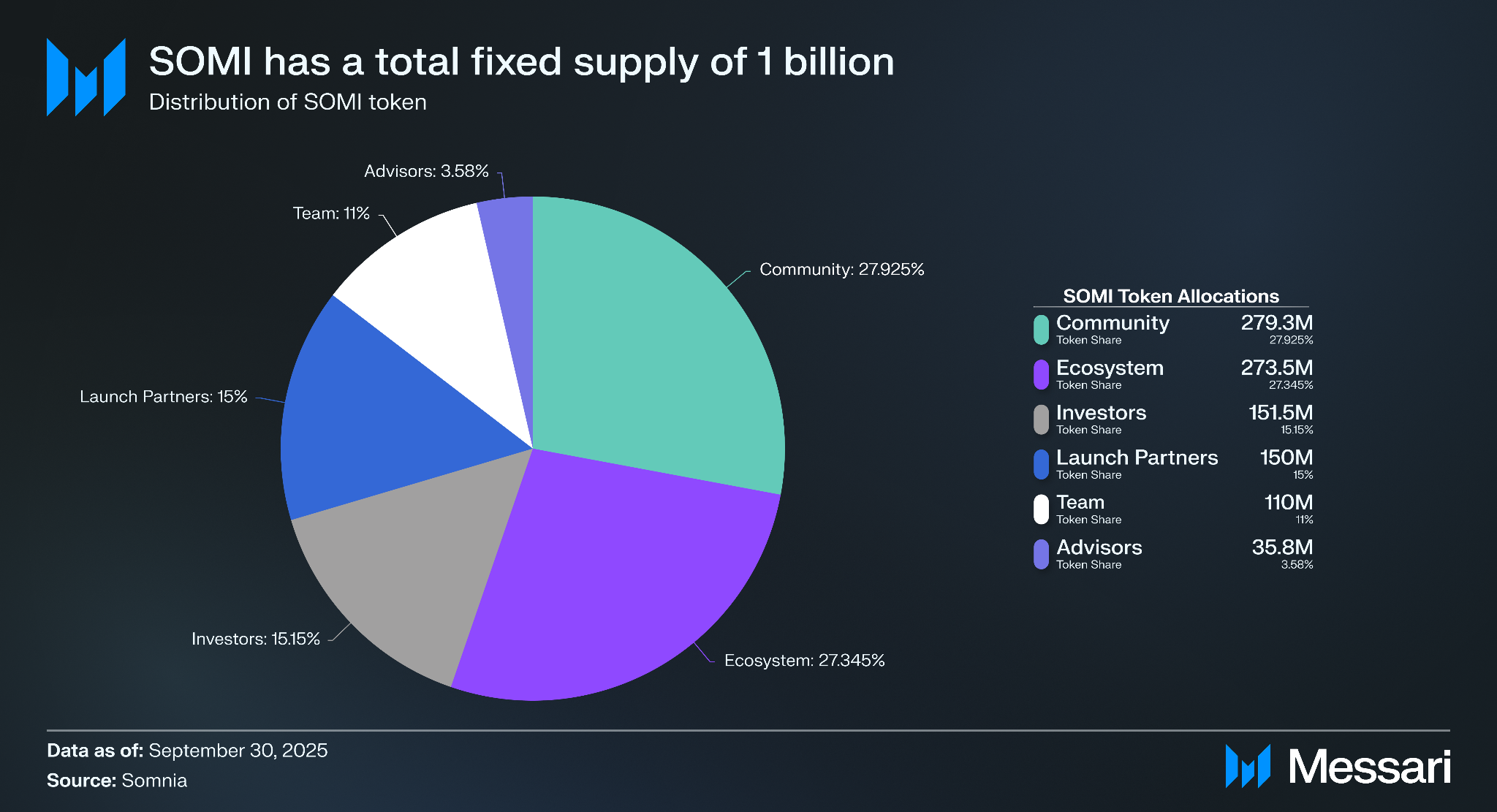
Fixed supply: The total supply is capped at 1 billion SOMI.
Deflationary mechanism: 50% of all gas fees are burned permanently, reducing the circulating supply as network usage increases.
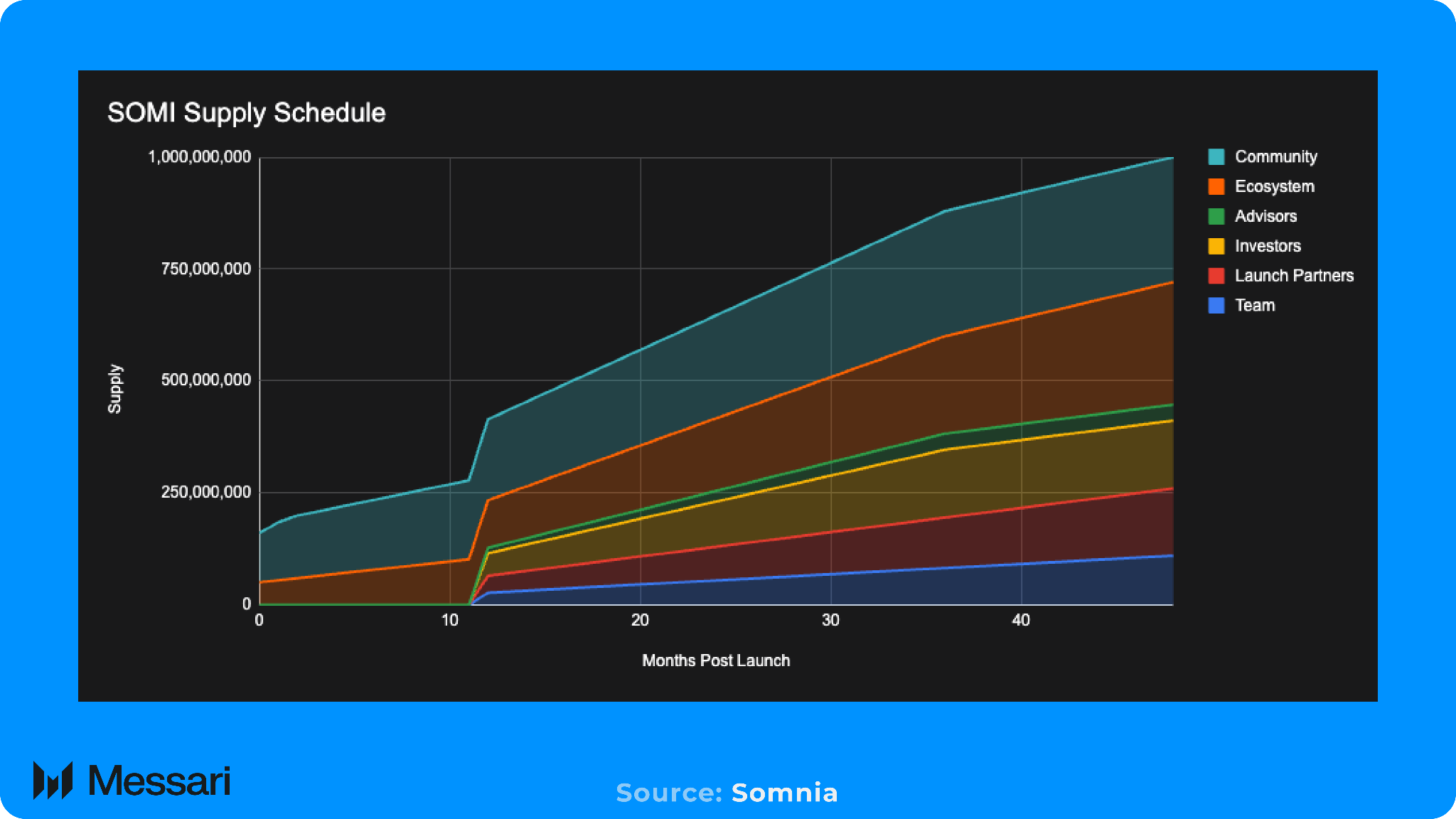
Allocation and Vesting: Token distribution is divided among multiple stakeholder categories with vesting and cliff schedules aimed at controlling supply release. For example:
Team: 11 % (110 million tokens), 12-month cliff, then 48-month linear vesting.
Investors: 15.15 % (151.5 million tokens), 12-month cliff, 36-month vesting.
Advisors: 3.58 % (35.8 million tokens), 12-month cliff, 36-month vesting.
Ecosystem fund: 27.345 % (273.45 million tokens), with a 5.075 % TGE unlock and 48-month vesting.
Community incentives: 27.925 % (279.25 million tokens), with 10.945 % unlocked at TGE and vesting over 36 months
Somnia’s initial airdrop was launched at TGE to reward early contributors and bootstrap post-mainnet activity. Approximately 50 million SOMI (5% of total supply) were allocated to users who participated in the testnet, ecosystem quests, staking programs, or held eligible Somnia NFTs. Eligibility and allocation were determined through a points-based system tracking verified onchain activity. To moderate immediate supply pressure, only 20% of airdropped tokens unlocked at TGE, with the remaining 80% vesting linearly over 60 days through weekly claim windows and onchain tasks under the Somnia Odyssey program.
During Q4 2025, Somnia completed the final phase of the airdrop rollout, covering Odyssey Weeks 5 through 8. These final weeks introduced a set of structured onchain actions, including NFT minting, trading volume thresholds, and liquidity provision, designed to sustain engagement beyond initial claims. The eighth and final unlock went live on October 29. December 1 marked the last day for users to complete required missions and claim their remaining allocations. Unclaimed tokens were redirected to the Ecosystem Fund, reinforcing long-term development resources rather than re-entering circulation.
By the close of the quarter, the Somnia Foundation confirmed the conclusion of the airdrop, distributing SOMI to over 95,000 contributors who supported the network’s testing, growth, and early development.
Data Streams
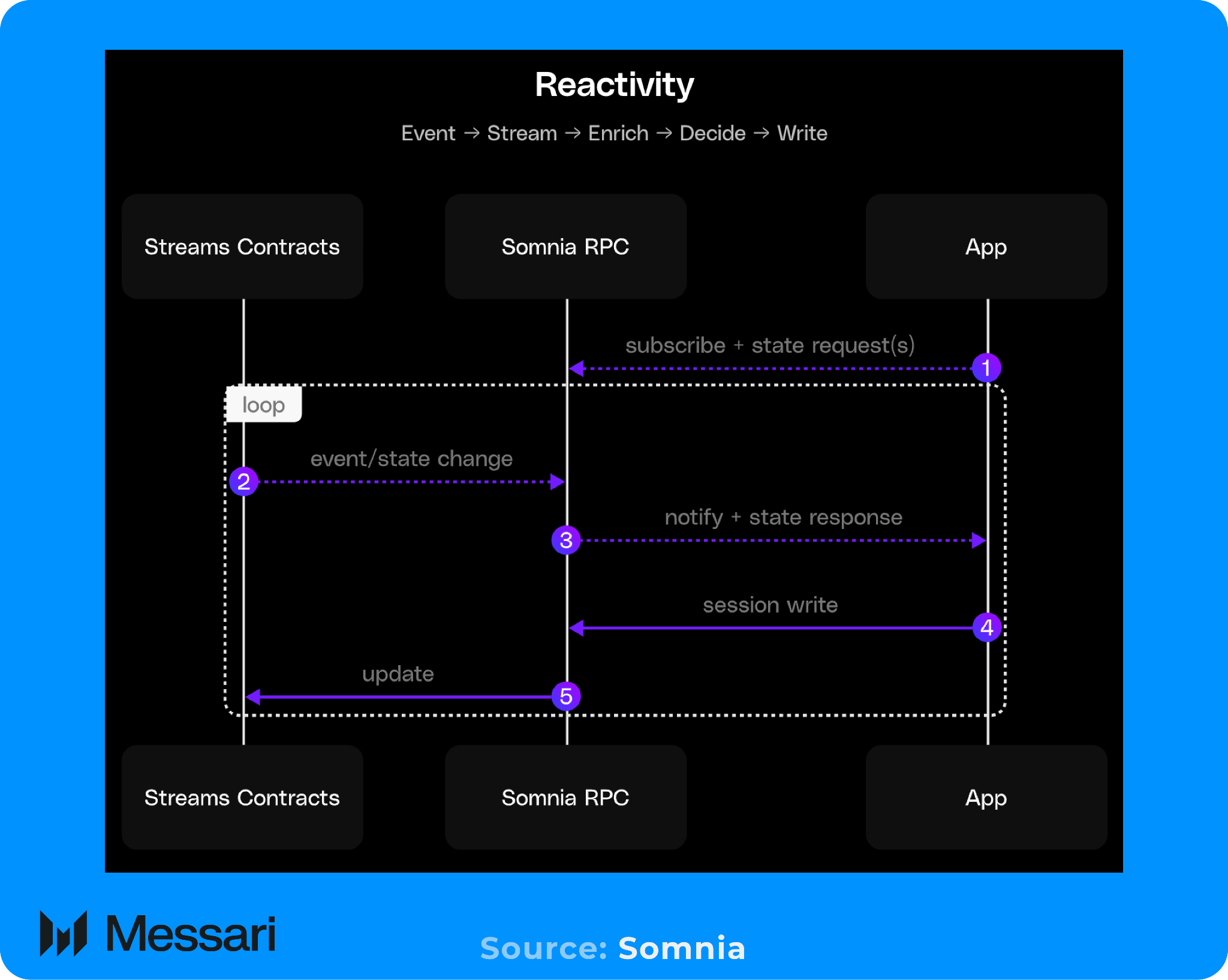
During Q4 2025, Somnia made a series of announcements detailing the upcoming release of Somnia Data Streams, a core infrastructure feature aimed at enabling real-time, reactive blockchain applications. While Data Streams had not yet launched on mainnet by quarter-end, the disclosures provided a clearer view into how Somnia intends to support applications that require continuous state awareness rather than periodic updates.
At a high level, Data Streams will allow applications to subscribe to onchain state changes and receive verified updates as they occur, replacing the polling-based model commonly used in blockchain applications. Instead of repeatedly querying the chain or relying on external indexers, applications receive push-based updates when relevant state transitions happen. This design reduces latency, removes unnecessary confirmations, and aligns blockchain data flows more closely with how modern web applications handle real-time information.
Somnia positioned Data Streams as particularly relevant for prediction markets, trading, gaming, and risk management, where delays of even a few seconds can materially affect user experience or outcomes. For prediction markets, Data Streams enables structured event feeds that support continuous odds updates and near-instant settlement once outcomes are verified onchain. More broadly, the infrastructure is intended to support granular, event-driven markets, real-time leaderboards, responsive auctions, automated liquidation protection, and security monitoring systems that react immediately to changing conditions.
To encourage early experimentation, Somnia hosted a Data Streams mini hackathon from November 4 to November 15. Developers were challenged to build testnet applications using the Data Streams SDK, resulting in early prototypes across gaming, DeFi monitoring, governance tooling, security analytics, and marketplaces. Projects demonstrated use cases such as real-time leaderboards, instant portfolio tracking, exploit detection through live transaction analysis, and responsive bidding systems that synchronize state across users without refresh delays. While exploratory in nature, the hackathon highlighted how Data Streams could shift application design away from delayed reads and toward continuous, event-driven interaction.
Ecosystem Overview
DeFi TVL
By the end of Q4 2025, Somnia’s DeFi TVL increased to $2.7 million, up 41.6% QoQ from $1.9 million at the end of Q3. The largest protocol by TVL was Gearbox, which held $852,300 by quarter-end, accounting for 32.1% of total DeFi TVL. Gearbox’s growth followed Somnia’s partnership announcement on December 2, which introduced lending pools for SOMI and USDC.e. By integrating Gearbox’s modular credit infrastructure, Somnia enabled native applications to support leveraged strategies without bespoke lending development. The launch catalyzed fresh capital inflows and positioned lending as a new pillar of Somnia’s DeFi stack.
Tokos, a native lending protocol launched on September 25, finished Q4 with $704,200 in TVL, representing 26.6% of the market. Together, Gearbox and Tokos accounted for nearly 59% of Somnia’s DeFi TVL, signaling a clear shift toward credit-based use cases as the network’s primary source of capital formation.
By contrast, DEX and trading-focused protocols saw absolute and relative declines. Quickswap remained the largest DEX on Somnia but ended the quarter with $693,600 in TVL, down 34.9% QoQ, and its market share fell from 56.9% to 26.2%. Somnex, a native perps and memecoin platform, declined to $209,000 in TVL (7.9% share), while Somnia Exchange ended Q4 with $192,600 (7.3% share). Although these protocols participated in trading competitions and incentive programs, they were unable to offset broader declines in speculative trading activity and the rotation of capital toward lending.
At the tail end, Standard Spot remained negligible, with $171 in TVL by quarter-end. Overall, Q4 marked a structural rebalancing of Somnia’s DeFi ecosystem, with lending protocols driving net TVL growth while earlier exchange-led liquidity pools ceded dominance.
DEX Volume
By the end of Q4 2025, Somnia’s DEXs averaged $299,500 in daily trading volume, down 87.1% QoQ from $2.32 million in Q3. Quickswap remained the largest DEX on Somnia, averaging $151,600 per day in Q4 (down 89.4% QoQ) and accounting for 50.6% of total DEX volume. Somnia Exchange ranked second, with $99,900 in average daily volume (down 84.4% QoQ). Somnex averaged $32,700 per day in Q4, down 86.7% QoQ, and captured 10.9% of DEX volume.
Rounding out the landscape was Elix, a CLOB-based DEX that went live on Somnia on October 21. Elix averaged $15,300 in daily volume during the quarter, accounting for 5.1% of total DEX activity.
While absolute activity declined sharply, market share stabilized among leading exchanges, and new entrants continued to expand the protocol surface area despite subdued conditions.
Staking
Somnia’s staking ecosystem continued to mature in Q4 2025, with progress across both core staking infrastructure and liquid staking. Developments during the quarter focused on improving transparency for delegators while expanding capital efficiency through DeFi-integrated staking.
A key milestone was the launch of Lair Finance, on October 31, which introduced Somnia’s first liquid staking token, stSOMI. Lair enables users to stake SOMI and receive stSOMI in return, allowing staked capital to remain usable across the DeFi ecosystem. At launch, users could stake a minimum of 20 SOMI to mint stSOMI and provide liquidity to the stSOMI–SOMI pool on Somnex, establishing early liquidity for the asset. To bootstrap adoption, Lair participated in Somnia’s onchain quest system, incentivizing early staking and liquidity provision through SOMI rewards. On November 5, stSOMI was also incorporated into Somnia’s Liquidity Point Program, further encouraging participation by rewarding users for contributing liquidity.
Alongside liquid staking, Somnia saw improvements in staking transparency and validator tooling through the release of Somnia.info, developed by validator operator High Tower. The platform aggregates real-time data on validator performance, including uptime, commission rates, delegation volumes, historical rewards, and network-level metrics such as total stake and validator distribution. By centralizing this information, Somnia.info lowers the information barrier for token holders selecting validators and monitoring staking performance. The platform also provides reward calculators and comparative analytics, supporting more informed delegation decisions and reinforcing decentralization through greater visibility into validator operations.
Strategic Partnerships
During Q4 2025, Somnia Foundation and the Somnia network formed a series of high-profile partnerships that reflect a deliberate shift toward infrastructure completeness and ecosystem acceleration. Below are selected highlights.
Elix.fi: On October 2, 2025, Elix launched its CLOB-based DEX on Somnia, adding an orderbook-driven trading venue alongside existing AMM-based exchanges. The integration diversified Somnia’s market structure options and positioned the network to support more sophisticated trading workflows, even as overall DEX volumes normalized post-mainnet.
Hubzz: On October 9, 2025, Somnia partnered with Hubzz, a social entertainment platform, to support community-driven onchain experiences. The integration focused on creator tooling and engagement mechanics, aligning with Somnia’s emphasis on consumer-facing applications and ecosystem discoverability.
Rarible: On October 14, 2025, Somnia NFTs became available on Rarible, enabling creators and projects to mint, trade, and distribute digital collectibles. The integration strengthened Somnia’s cultural and creator-facing surface area, particularly for gaming and media use cases.
Security.xyz: On October 15, 2025, Somnia partnered with Security.xyz to launch an open security marketplace. The partnership allocated $100,000 in security grants to help projects access trusted audits, improve transparency, and strengthen onchain safety.
Collab Land: On October 28, 2025, Somnia integrated Collab Land to support token-gated communities and access control across Discord and other social platforms. The partnership enhanced community management capabilities for projects building on Somnia and supported ecosystem coordination during early-stage growth.
Vectra: On October 30, 2025, Vectra launched on Somnia as a native prediction market powered by Anomaly Games’ AI-driven engine. The platform introduces a swipe-based interface that allows users to create and participate in markets spanning crypto trends, online culture, and real-time events. The integration marked Somnia’s first live prediction market and served as an early test case for real-time, consumer-facing information markets on the network.
Humannode: On November 5, 2025, Somnia partnered with Humannode to introduce biometric-based identity primitives, expanding the network’s experimentation with proof-of-personhood and identity-aware applications. This integration complemented Somnia’s interest in social, gaming, and consumer applications that benefit from sybil resistance.
Orbiter Finance: On December 2, 2025, Somnia partnered with Orbiter Finance to improve cross-chain bridging and liquidity access. The integration strengthened Somnia’s interoperability stack, reducing friction for users moving assets between Somnia and external ecosystems.
Gearbox: On December 2, 2025, Somnia announced an integration with Gearbox Finance, introducing modular lending pools for SOMI and USDC.e. The partnership brought battle-tested credit infrastructure to Somnia, enabling builders to incorporate leveraged strategies, credit accounts, and capital routing without developing native lending systems. Gearbox’s launch reshaped Somnia’s DeFi stack, catalyzing lending-led TVL growth and establishing credit as a core primitive on the network.
YOM: On December 29, 2025, Somnia announced a partnership with YOM,a decentralized compute and game streaming infrastructure provider. The partnership focuses on enabling high-performance, consumer-grade Web3 gaming by streaming gameplay from a global GPU edge network rather than relying on centralized game servers or local hardware.
Gaming
Dark Table: On November 25, 2025, Dark Table launched on Somnia. Built as a four-player competitive card game, Dark Table leverages onchain assets and gameplay mechanics to enable multiplayer duels centered around collectible champions and in-game strategy. The launch, powered by Somnia and Thirdweb, expanded Somnia’s consumer application footprint and reinforced the network’s focus on fully onchain, interactive gaming experiences.
Vodra: On December 4, 2025, Somnia announced a partnership with Vodra, a Web3-native gaming and livestream distribution platform. The collaboration focuses on integrating streaming, creator payouts, and game distribution into Somnia’s gaming ecosystem. Somnia powers USDC-based creator payouts on Vodra, enabling instant, fee-free payments, while Vodra serves as a distribution layer that brings Somnia-built games directly to creators across platforms like Twitch, Kick, and YouTube.
Flipsuite: On November 19, 2025, Flipsuite launched on Somnia, bringing an all-in-one Web3 integration layer for Discord communities to the ecosystem. The platform enables projects to embed onchain functionality directly into Discord servers, including token gating, NFT interactions, and community engagement tools.
Miomi Game: On December 12, 2025, Miomi joined the Somnia ecosystem, launching a Web3-native esports arena that supports tournaments, ranked competitive play, and multi-game formats. The platform integrates social features designed to bring players and communities together onchain, positioning Miomi as a hub for competitive gaming rather than a single-title experience.
2026 Roadmap
By the end of 2025, Somnia had largely completed its initial infrastructure rollout and shifted its focus toward ecosystem discovery and developer engagement. Following the mainnet launch, the team spent the latter part of the year participating in industry events and holding direct conversations with builders across gaming, markets, and data-intensive applications. While gaming remained a visible early use case, these discussions surfaced a broader and recurring constraint: most existing blockchains struggle to support applications that must react to real-world events in real time. Latency, slow finality, and inflexible state updates were consistently cited as blockers for more dynamic, consumer-facing use cases.
Against this backdrop, Somnia published its 2026 roadmap in early Q1 2026, outlining a more opinionated shift from core infrastructure buildout toward application enablement. The roadmap focuses on use cases that depend on real-time data, low-latency execution, and continuous state updates, with three primary areas of emphasis: reactive infrastructure, prediction markets, and AI-adjacent tooling.
Prediction markets are a central area of development. The recent growth of platforms like Polymarket has shown demand for speculation tied to political, economic, and cultural events; however, most applications are limited by latency and slow finality. Somnia’s roadmap emphasizes support for higher-frequency and event-driven markets, including those tied to live sports, esports, and streaming activity, where outcomes may need to be resolved quickly and repeatedly.
These use cases depend on Somnia’s reactive features, which allow applications to respond to onchain and external data updates with minimal delay. In 2026, the network plans to continue refining this functionality based on developer feedback, with the goal of improving reliability and reducing integration complexity. Beyond prediction markets, the same infrastructure is expected to support applications in areas such as trading, insurance, and interactive games.
The roadmap also introduces the concept of a “market of markets,” where prediction markets are created permissionlessly by users rather than curated centrally. By lowering the operational and maintenance costs of launching markets, Somnia aims to make smaller, niche markets economically viable, including those tailored to specific communities, creators, or events. Vectra, currently the primary prediction market live on Somnia, serves as an early proof point for this design direction.
Overall, the early publication of the 2026 roadmap marks a clear inflection point. Where late 2025 was defined by listening and validation, the 2026 plan reflects a deliberate move toward enabling real-time, consumer-facing applications, with Somnia positioning itself as a base layer optimized for reactive, event-driven onchain markets.
Closing Summary
Somnia closed Q4 2025 in a consolidation phase following its September mainnet launch, with execution centered on defining the networks major use cases. While market activity cooled as the airdrop distribution concluded, Somnia continued to process meaningful throughput at scale, averaging 8 million transactions per day and generating ongoing fees.
On the ecosystem side, Somnia’s DeFi footprint expanded despite weaker trading conditions, with TVL rising to $2.7 million and rotating decisively toward credit primitives. The Gearbox integration and Tokos’ growth repositioned lending as the primary driver of capital formation, while new market structure and liquidity venues, including Elix and liquid staking via Lair’s stSOMI, broadened the set of onchain financial building blocks. In parallel, Somnia continued to invest in consumer-oriented distribution and onboarding through partnerships across gaming, streaming, and community infrastructure, including Vodra, YOM, and Discord-native tooling.
Heading into 2026, Somnia’s roadmap and Data Streams announcements frame the network’s next phase as an application enablement push built around reactive behavior and real-time data. With Vectra live as an early prediction market and developers already prototyping Data Streams use cases, Somnia’s near-term challenge is converting its infrastructure thesis into repeatable product adoption. Q4’s progress suggests the network is assembling the primitives and partnerships needed to pursue its broader goal: supporting interactive applications that require low-latency state updates, continuous settlement, and user experiences that more closely resemble conventional real-time software.
This report was commissioned by Somnia Network. All content was produced independently by the author(s) and does not necessarily reflect the opinions of Messari, Inc. or the organization that requested the report. The commissioning organization may have input on the content of the report, but Messari maintains editorial control over the final report to retain data accuracy and objectivity. Author(s) may hold cryptocurrencies named in this report. This report is meant for informational purposes only. It is not meant to serve as investment advice. You should conduct your own research and consult an independent financial, tax, or legal advisor before making any investment decisions. Past performance of any asset is not indicative of future results. Please see our Terms of Service for more information.
No part of this report may be (a) copied, photocopied, duplicated in any form by any means or (b) redistributed without the prior written consent of Messari®.
Alexander is a protocol researcher specializing in Layer-1 and Layer-2 infrastructure, as well as RWA's and Stablecoins. Before Messari, he worked at Jump Trading and Bull-Moose Consulting. He graduated from Northeastern University with a degree in Economics and Data Science, and helped run Northeastern's blockchain club.
Alexander is a protocol researcher specializing in Layer-1 and Layer-2 infrastructure, as well as RWA's and Stablecoins. Before Messari, he worked at Jump Trading and Bull-Moose Consulting. He graduated from Northeastern University with a degree in Economics and Data Science, and helped run Northeastern's blockchain club.