Somnia launched its mainnet and SOMI token on September 2, 2025, following a six-month testnet that processed over 10 billion transactions. SOMI ended Q3 with a $112 million market cap at $0.70 and a circulating supply of 160 million tokens.
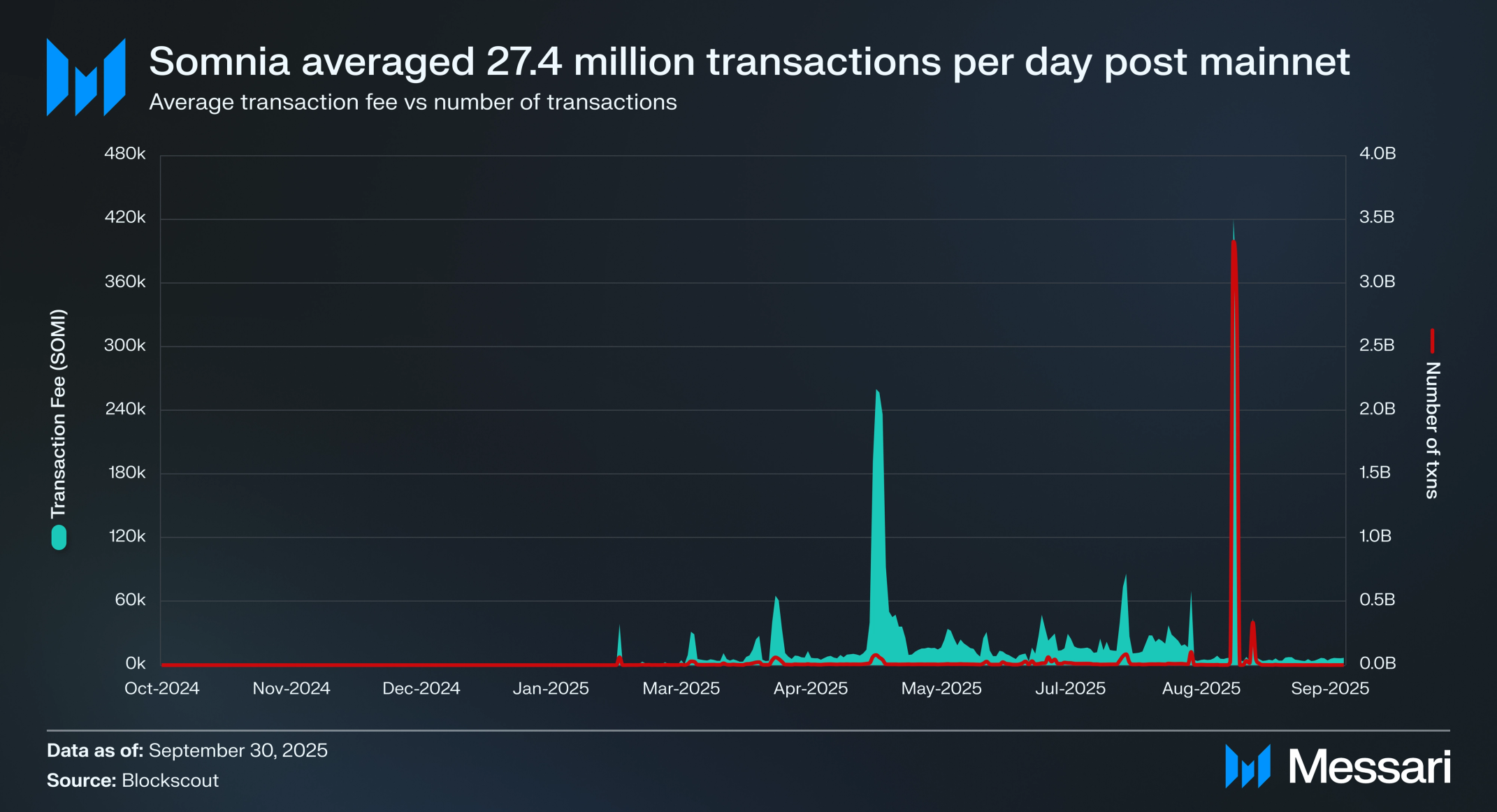
Somnia handled 14.3 million daily transactions and generated 199,400 SOMI in feesduring September, down from testnet levels but indicating sustained organic activity beyond airdrop farming.
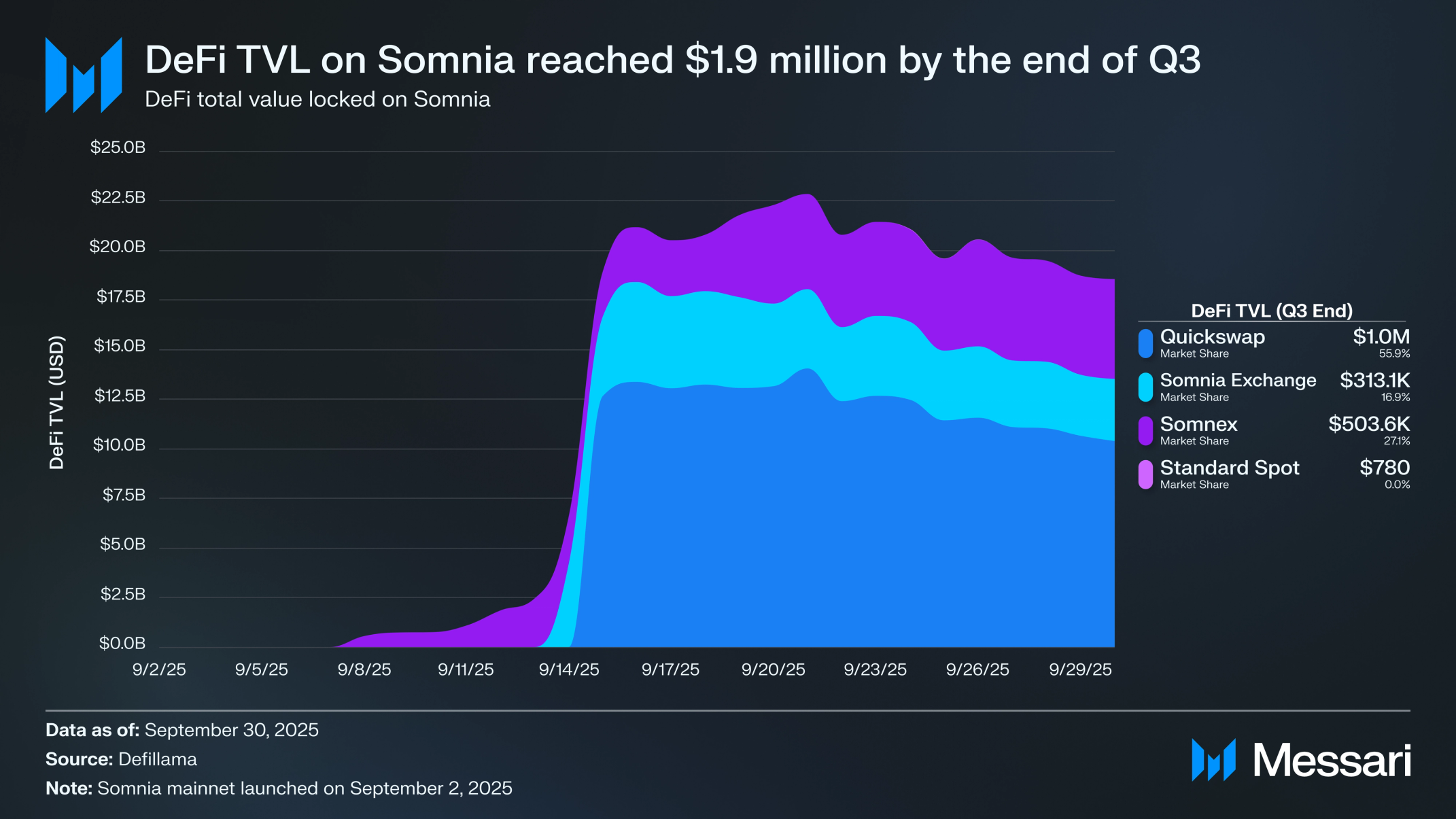
DeFi TVL concentrated in four protocols totaling $1.9 million, led by Quickswap with $1 million and 55.9% market share. Average daily DEX volume reached $1.3 million, with Quickswap dominating at $1.3 million daily.
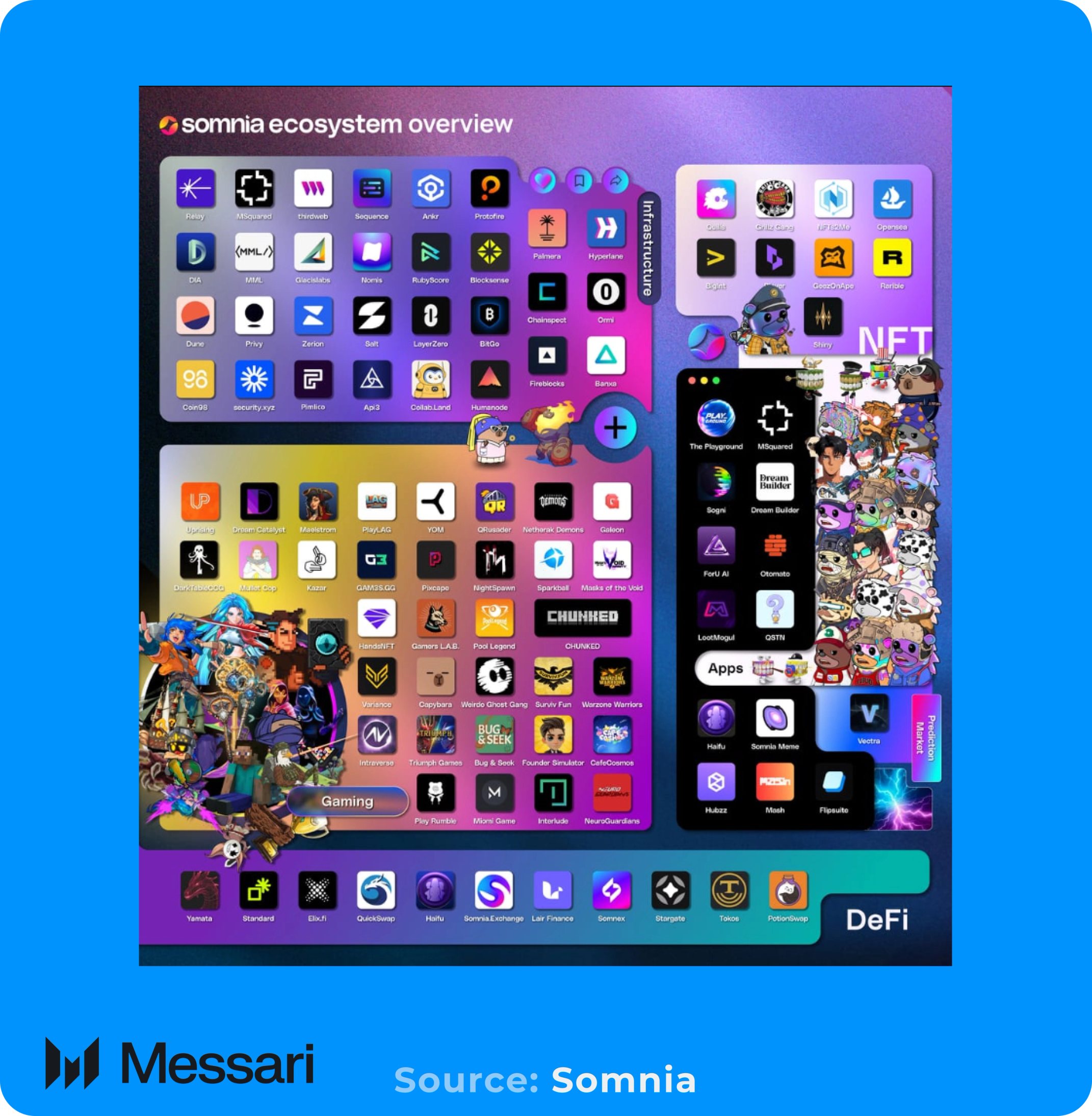
Strategic partnerships with Google Cloud, BitGo, Fireblocks, Dune, LayerZero, and Banxa strengthened validator infrastructure, custody solutions, interoperability, analytics, and fiat onboarding capabilities across the ecosystem.
Developer engagement expanded through Somnia Builder's launch, the Dreamathon quest offering $200,000 in rewards, and a Mini Games Hackathon attracting over 140 participants.
Primer
Somnia (SOMI) is a high-performance Layer-1 blockchain designed to support real-time, large-scale applications such as gaming, social platforms, and interactive digital worlds. Founded by Improbable, the network aims to deliver internet-scale performance while maintaining Ethereum Virtual Machine (EVM) compatibility, enabling developers to migrate or build seamlessly using existing Web3 tooling.
Somnia’s architecture is optimized for mass participation and low-latency interaction. The network claims throughput exceeding one million transactions per second (TPS) with sub-second finality and near-zero transaction fees. This design enables onchain experiences previously limited by scalability constraints, including high-frequency multiplayer games and AI-driven environments.
The SOMI token serves as the network’s native asset, used for transaction fees, staking, and governance. Validators stake SOMI to secure the network, while users can delegate their tokens to earn rewards and participate in governance once it becomes fully activated. Half of all gas fees are permanently burned, introducing a deflationary mechanism that ties network usage directly to token scarcity.
Somnia’s ecosystem is built around interoperability and accessibility. The network integrates with infrastructure partners such as Google Cloud, BitGo, Fireblocks, and Banxa, and connects to external blockchains via LayerZero. Its partnership with Dune Analytics enhances data visibility, while integrations with OpenSea and Rarible support NFT liquidity and creator onboarding.
By the end of Q3 2025, SOMI had a total market cap of $112 million. The token experienced some volatility after its launch, resulting in the price climbing to a peak of $1.77 before falling to $0.70 by the end of the quarter. The volatility can likely be attributed to its airdrop and subsequent investor interest, which drove up the price and led to a sell-off among holders.
Transaction Fees
During its testnet phase, Somnia generated 4.7 millionSOMI Testnet Tokens (STTs) in fees, averaging 24,000 per day. Following its mainnet launch, fee generation decreased, with the network generating just 199,400 SOMI tokens in fees during September, averaging 6,877 per day. Total transactions per day also decreased after mainnet, averaging just 14.3 million per day, down 66.5% from the testnet average of 42.7 million per day. This shift reflects a natural reduction in usage as users now incur real token costs to transact, unlike the frictionless environment on testnet. Despite the decline, the retained transaction count and fee generation are still positive for the network as it shows that there is significant retention of onchain activity without airdrop incentives.
During the pre-launch testnet stage, Somnia achieved several technical milestones, including processing over 10 billion transactions, enlisting more than 118 million unique wallets, and onboarding over 70 ecosystem partners. Per its specification, the network supports EVM-compatibility, claims transaction throughput exceeding one million transactions per second (TPS), sub-second finality, and ultra-low (sub-cent) transaction fees.
SOMI Token
The SOMI token serves as the network’s gas token, used to pay for transactions and smart contract execution across all onchain activity. Validators are required to stake a minimum of 5 million SOMI to participate in consensus, while tokenholders can delegate their tokens to validators or pooled staking programs to secure the network and earn staking rewards.
Beyond securing the network, SOMI is designed to enable community-driven governance. Tokenholders will be able to propose and vote on protocol upgrades, parameter changes, and funding initiatives once the governance framework is fully activated.
Tokenomics
Key parameters for SOMI’s tokenomics include:
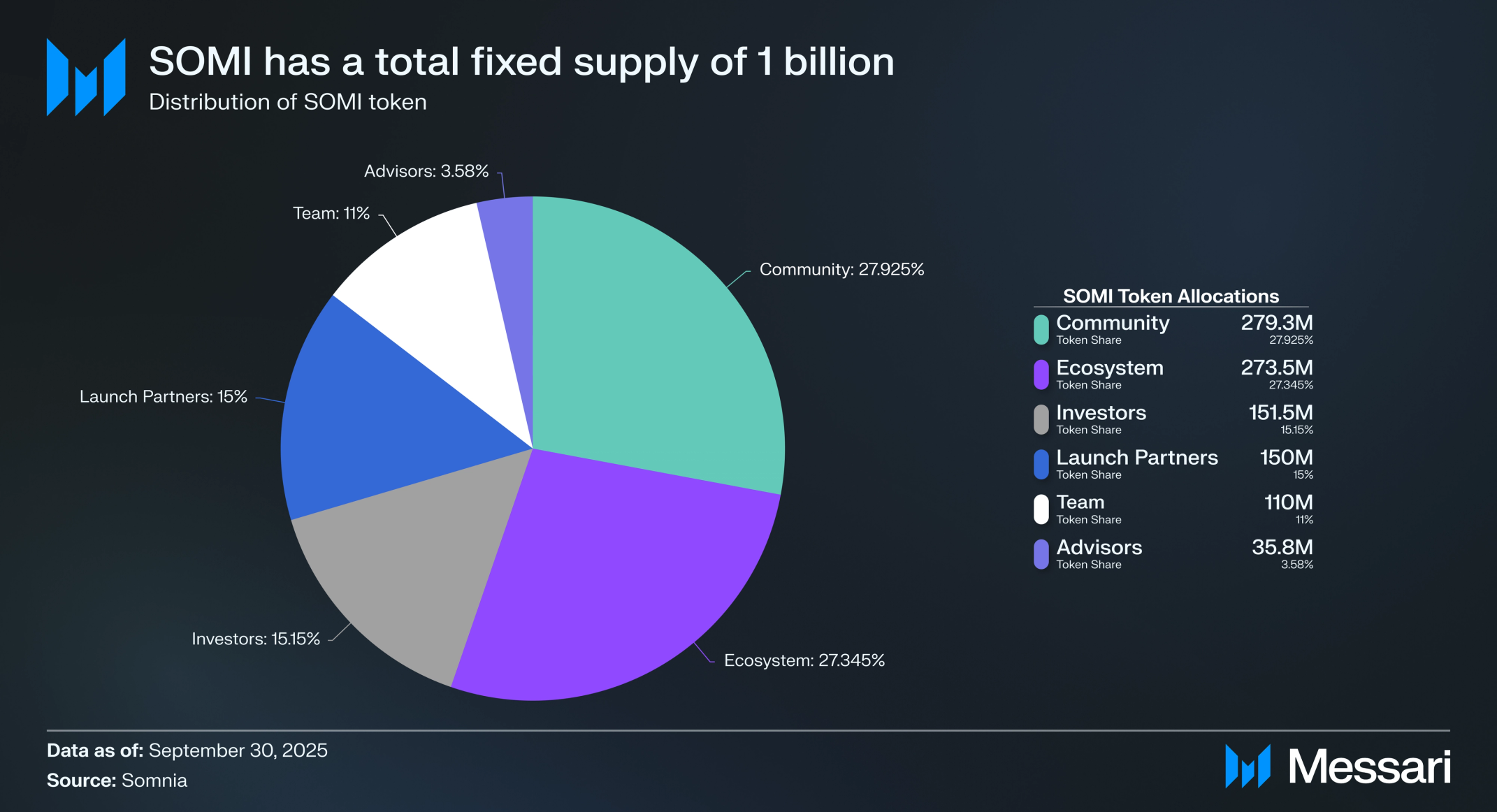
Fixed supply: The total supply is capped at 1 billion SOMI.
Deflationary mechanism: 50% of all gas fees are burned permanently, reducing the circulating supply as network usage increases.
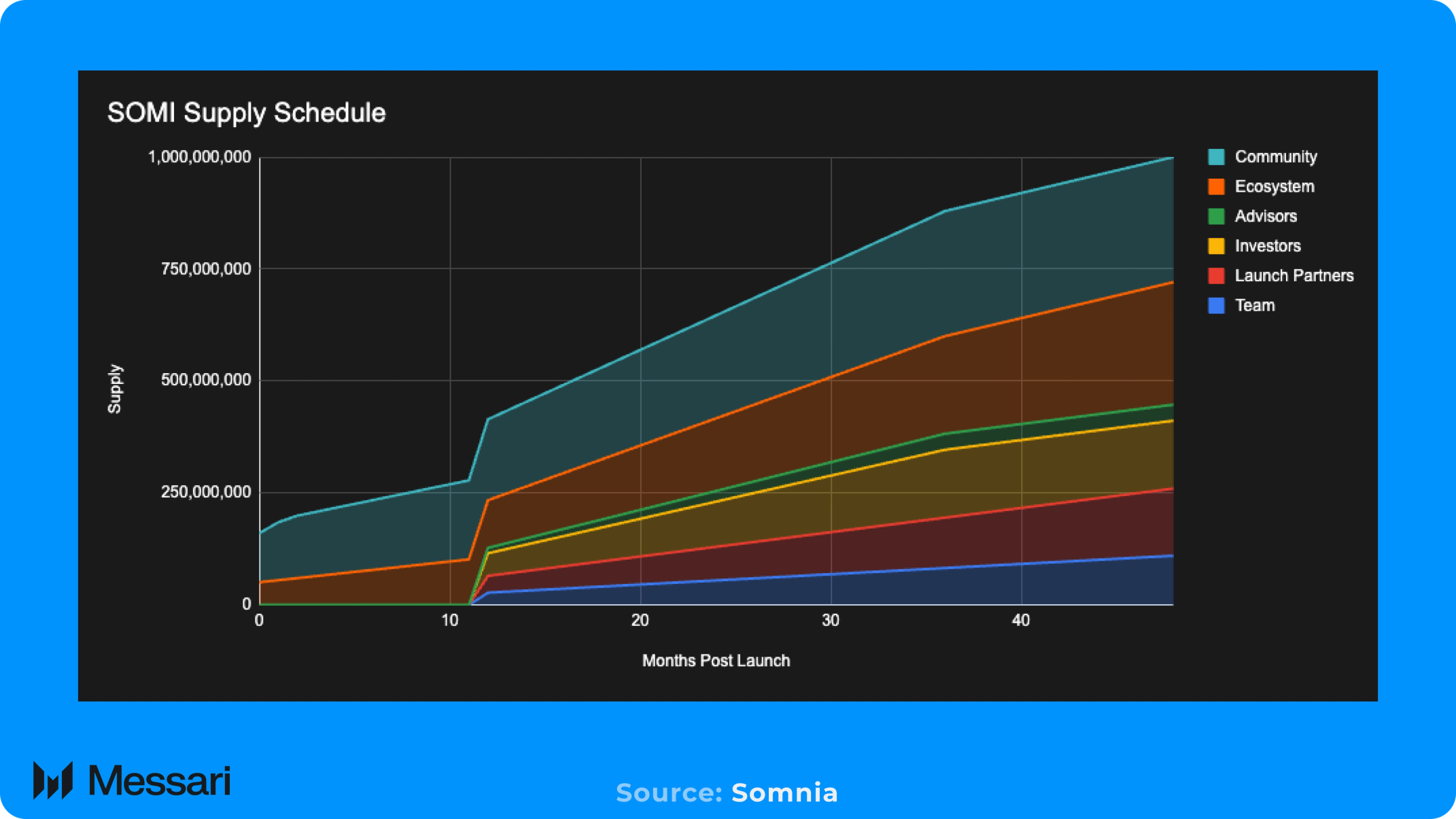
Allocation and Vesting: Token distribution is divided among multiple stakeholder categories with vesting and cliff schedules aimed at controlling supply release. For example:
Team: 11 % (110 million tokens), 12-month cliff, then 48-month linear vesting.
Investors: 15.15 % (151.5 million tokens), 12-month cliff, 36-month vesting.
Advisors: 3.58 % (35.8 million tokens), 12-month cliff, 36-month vesting.
Ecosystem fund: 27.345 % (273.45 million tokens), with a 5.075 % TGE unlock and 48-month vesting.
Community incentives: 27.925 % (279.25 million tokens), with 10.945 % unlocked at TGE and vesting over 36 months.
Airdrop
On September 2, Somnia launched a targeted airdrop to reward early contributors and bootstrap network participation. Roughly 5% of the total supply, or about 50 million SOMI, was distributed to users who engaged during the testnet, participated in staking programs, or held eligible Somnia NFTs. Recipients were selected through a points-based system that tracked verified network activity such as testing applications, completing ecosystem quests, and supporting node operations.
Twenty percent of rewards were unlocked immediately at the token generation event (TGE), while the remaining 80% vested linearly over 60 days through onchain missions and weekly claim periods, known as Somnia Odyssey. Certain strategic contributors and NFT holders received accelerated unlock schedules. This gradual release design helped align early participation with long-term ecosystem commitment, mitigating short-term selling pressure following the TGE.
Ecosystem Overview
DeFi TVL
After mainnet, Somnia’s DeFi total value locked (TVL) was concentrated in four protocols. The largest protocol by TVL was Quickswap, a decentralized exchange on Polygon, Base, Somnia, and other networks, which held $1 million by the end of the quarter (55.9% of the market). In second place was Somnia Exchange, Somnia’s native decentralized exchange, which held $313,100 in TVL by the end of Q3 (16.9% of the market). Rounding out the top three was Somnex, a native perps exchange and memecoin platform, which ended Q3 with $503,600 in TVL (27.1% of the market). The smallest protocol by TVL on Somnia was Standard Spot, which had $780 in TVL by the end of Q3.
DEX Volume
After mainnet, Somnia’s DEXs averaged a combined $1.3 million per day in volume. The largest DEX was Quickswap, which averaged $1.3 million per day since its data started being reported on September 15. The second largest DEX on Somnia was Somnia Exchange, which averaged $668,200 per day. Coming in third was Somnex, which handled an average daily volume of $242,400.
Strategic Partnerships
During Q3 2025, Somnia Foundation and the Somnia network formed a series of high-profile partnerships that span infrastructure, tooling, interoperability, and user onboarding. Below are selected highlights.
Google Cloud: On June 30, 2025, Somnia announced that Google Cloud would join the network as a validator and strategic partner. The collaboration brings enterprise-grade infrastructure and cybersecurity support (via Mandiant) to Somnia, while also integrating Google’s AI-agent tooling and BigQuery/Cloud-Pub Sub data pipelines to support real-time games and apps.
LayerZero: On August 26, 2025, Somnia extended interoperability with the omnichain messaging protocol LayerZero, enabling asset and message flows between Somnia and external chains.
Dune Analytics: On August 29, 2025, Somnia announced its integration with Dune to provide developers, creators, and analysts with transparent, real-time onchain data dashboards of Somnia activity. This partnership enhances ecosystem visibility and supports data-driven decision-making for projects building on the chain.
Custody & Infrastructure Providers (BitGo & Fireblocks): Somnia announced integrations with both BitGo (August 27) and Fireblocks (August 28) to support institutional-grade custody, staking, and node infrastructure. The partnerships underpin a focus on secure, compliant infrastructure for larger-scale actors entering the ecosystem.
OpenSea: On September 5, Somnia established strategic relationships with OpenSea, facilitating native asset launches and marketplaces in the Somnia ecosystem. These integrations support consumer-facing onchain experiences (gaming, collectibles, metaverse).
Fiat On-Ramp (Banxa): To enhance user accessibility, Somnia announced a partnership with Banxa on September 30 to enable fiat-to-crypto conversions for SOMI tokens and onchain assets. This supports user onboarding from traditional finance into the Somnia ecosystem.
Ecosystem Growth
QuestME MiniApp Launch: QuestME’s mini-application launched on July 2, enabling gamified onchain experiences and community quest participation (e.g., leaderboard tasks, wallet milestones) tied directly to network activity and token-earning incentives.
Chunked V2 Goes Live: On July 3, Chunked V2, a sandbox MMO, went live on Somnia, featuring enhanced functionality such as quicker crafting, expanded block colour palettes, and new world features. The project foregrounds Somnia’s high-throughput, fully onchain game ambitions and acts as a technical demonstration of mass-interaction viability.
Jitter Game Launch: On July 29, Jitter, a new streaming-adjacent game, launched on Somnia. It integrates social/audio-visual components with blockchain activity.
NFTs and Launchpad Activity: On July 24, Blever, an NFT launchpad and marketplace, launched on Somnia. A few days later, on August 1, Somnia partnered with Inceptive Studio to bring the Gs on Ape NFT collection to the network.
Gaming Week & Community Events: Somnia ran a dedicated “Gaming Week” competition that encouraged builders and players to launch new titles, complete challenges, and earn rewards. The event ran from August 2 to August 9 and included eight games and over $10,000 in rewards.
Somnia Quests Season 4 and 5: On August 14, Somnia closed Season 4 of its onchain quest program. The program includes a number of quests where users test new games and earn rewards through playing and leaving feedback. On August 15, Somnia opened Season 5, offering new quests for recently launched games. While the initial airdrop marked a major milestone for early participants, these quest programs are designed to be recurring and continue distributing tokens to active contributors.
Liquid Staking and Exchanges: Lair, a liquid staking protocol, went live on September 1, enabling token-holders to stake SOMI and earn rewards while increasing network security. On September 8, Yamata Exchange joined the Somnia ecosystem, facilitating onchain asset access and user liquidity.
Prediction Market Launch: On September 15, Vectra, a new prediction-market dApp by Anomaly Games, arrived on Somnia, adding another dimension of engagement and new financial use cases for the chain.
Developer Growth
DIA Oracle Grants: On July 3, DIA Data announced a dedicated oracle grant program for developers building on Somnia. The initiative provides technical and financial support for teams integrating DIA’s data feeds into Somnia-based applications, including gaming, DeFi, and prediction-market use cases. The partnership ensures that builders have access to reliable, onchain price oracles and data infrastructure from day one, reducing development friction for high-frequency, data-driven dApps.
Somnia Builder Launch: On July 15, the Somnia Foundation unveiled Somnia Builder, a low-code development environment that simplifies Web3 creation for studios and independent developers. The tool allows builders to design, deploy, and test interactive experiences onchain without requiring deep blockchain expertise.
Dreamathon Builder Quest: Complementing the Builder launch, Somnia introduced Dreamathon on August 11, an eight-week-long builder-focused quest series designed to reward developers who experiment with the network’s new tools. Participants completed onchain development challenges, deployed applications, and contributed to open-source repositories for a chance to win $200,000 in SOMI-denominated rewards.
Security and Audits (Hacken): On September 5, cybersecurity firm Hacken completed a smart contract audit for Somnia’s core network components. The audit confirmed compliance with key security best practices and provided a public report outlining recommendations and risk mitigations.
Somnia Mini Games Hackathon: Running from July 21 to August 11, the Somnia Mini Games Hackathon attracted over 140 independent developers and gaming studios to prototype playable onchain games. Teams competed for a $5000 prize pool.
Closing Summary
Somnia closed Q3 2025 with its mainnet launch on September 2, marking the transition from a six-month testnet phase that processed over 10 billion transactions and onboarded 118 million unique wallets. SOMI finished the quarter with a market cap of $112 million at $0.70 per token after experiencing post-launch volatility that peaked at $1.77. Following mainnet activation, the network averaged 14.3 million daily transactions and generated 199,400 SOMI in fees during September, down from testnet levels but indicating sustained organic activity beyond airdrop farming.
The ecosystem expanded across gaming, DeFi, and infrastructure. Chunked V2 and Jitter launched as fully onchain games, while DeFi activity concentrated in four protocols led by Quickswap ($1 million TVL, 55.9% market share), Somnia Exchange ($313,100 TVL), and Somnex ($503,600 TVL). Average daily DEX volume reached $1.3 million, with Quickswap dominating activity. The introduction of Liar liquid staking and the Vectra prediction market expanded network utility beyond gaming into financial applications.
Strategic integrations strengthened Somnia's institutional foundation. Google Cloud joined as a validator, while partnerships with BitGo, Fireblocks, LayerZero, Dune, OpenSea, and Banxa enhanced custody, interoperability, analytics, and fiat access. Developer engagement grew through the launch of Somnia Builder, the Dreamathon quest series offering $200,000 in rewards, and a Mini Games Hackathon that attracted over 140 participants. The DIA Oracle grant program and Hacken security audit further supported builder infrastructure.
With mainnet live and core infrastructure operational, Somnia's challenge moving forward will be converting initial ecosystem momentum into sustained usage, deepening liquidity across DeFi protocols, and demonstrating that its high-throughput architecture can support the real-time, large-scale applications it was designed to enable.
This report was commissioned by Somnia. All content was produced independently by the author(s) and does not necessarily reflect the opinions of Messari, Inc. or the organization that requested the report. The commissioning organization may have input on the content of the report, but Messari maintains editorial control over the final report to retain data accuracy and objectivity. Author(s) may hold cryptocurrencies named in this report. This report is meant for informational purposes only. It is not meant to serve as investment advice. You should conduct your own research and consult an independent financial, tax, or legal advisor before making any investment decisions. Past performance of any asset is not indicative of future results. Please see our Terms of Service for more information.
No part of this report may be (a) copied, photocopied, duplicated in any form by any means or (b) redistributed without the prior written consent of Messari®.
Alexander is a protocol researcher specializing in Layer-1 and Layer-2 infrastructure, as well as RWA's and Stablecoins. Before Messari, he worked at Jump Trading and Bull-Moose Consulting. He graduated from Northeastern University with a degree in Economics and Data Science, and helped run Northeastern's blockchain club.
Alexander is a protocol researcher specializing in Layer-1 and Layer-2 infrastructure, as well as RWA's and Stablecoins. Before Messari, he worked at Jump Trading and Bull-Moose Consulting. He graduated from Northeastern University with a degree in Economics and Data Science, and helped run Northeastern's blockchain club.