The content of this report was produced independently by the author(s) and does not necessarily reflect the opinions of Messari, Inc. (“Messari”) or any of the organizations that requested the report. Messari and/or the author(s) are solely responsible for the content of the report and all editorial decisions. Author(s) may hold cryptocurrencies named in this report. This report is meant for informational purposes only. It is not meant to serve as investment advice. You should conduct your own research and consult an independent financial, tax, or legal advisor before making any investment decisions. Past performance of any asset is not indicative of future results. Please see our Terms of Service for more information.
Quarterly ReportsLayer-1
State of Solana Q3 2023

Key Insights
- Almost 45 million compressed NFTs (cNFTs) were minted in Q3, a 316% QoQ increase. Free collectibles distributor DRiP accounted for 87.5% of these mints, followed by Dialect and Helium.
- Solana’s virtual machine (SVM) and general tech stack are gaining mindshare and adoption from outsiders. Q3 examples include Rune’s post to explore a Solana fork for MakerDAO, the announcement of SVM-powered L2 Eclipse, and Visa’s payments integration on Solana.
- Solana’s DeFi TVL increased 32% QoQ to $368 million. The growth was driven by DeFi and liquid staking protocols launching points programs, led by MarginFi, Jito, Cypher, and BlazeStake, among others.
- The V1.16 upgrade reached a supermajority of stake at the end of the quarter. The upgrade reduces validator memory requirements, introduces the capabilities and features needed for Confidential Transfers, and improves support for zk-proofs.
- Despite concern over FTX liquidating its over 57 million SOL tokens, SOL’s market cap grew 17% QoQ to $8.4 billion. FTX/Alameda’s SOL is subject to various unlock schedules, with an average unlock date in Q4 2025.
Primer on Solana
Solana is an integrated, open-source blockchain with the goal of synchronizing global information at the speed of light. Solana optimizes for latency and throughput, sacrificing some verifiability. It seeks to accomplish this through features such as its novel timestamp mechanism called Proof-of-History (PoH), block propagation protocol Turbine, and parallel transaction processing. Since mainnet launch in March 2020, several network upgrades have brought further network performance and resilience, including QUIC, stake-weighted Quality of Service (QoS), and local fee markets.
Network and ecosystem development and growth are furthered by the non-profit Solana Foundation, Solana Labs, as well as other third-party organizations including Helius and Superteam. Solana Labs has raised over $335 million in private and public token sales. The Solana ecosystem features a growing set of projects across many sectors, including DeFi, consumer, DePIN, payments, and privacy.
Key Metrics

Financial Analysis

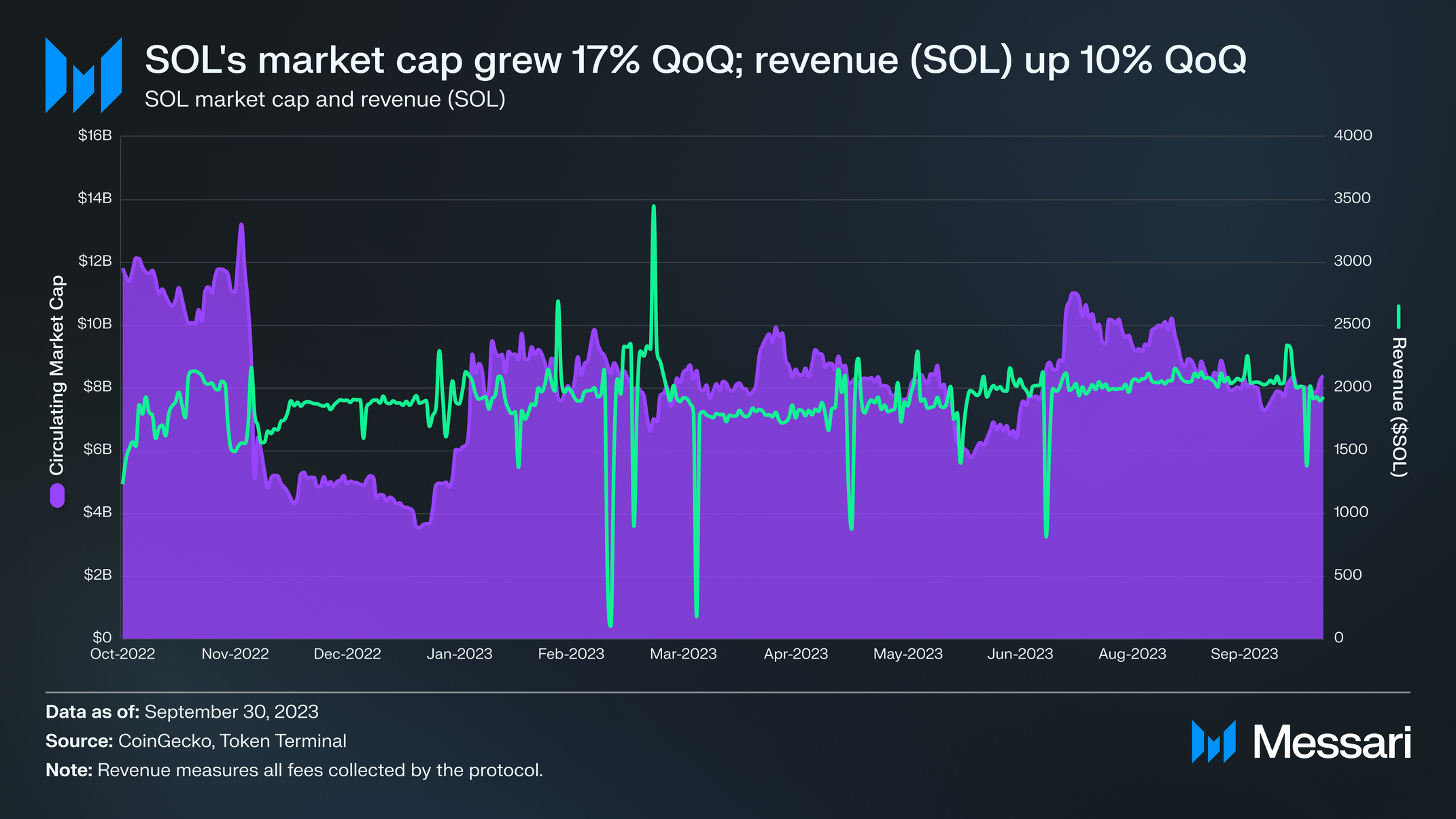
In early June, the SEC made regulatory complaints against Coinbase and Binance in Q2’23, which listed SOL as a security among other assets. These complaints spurred a negative 34% price movement of SOL. However, SOL rallied stronger than the other tokens named as securities at the end of Q2 and carried that momentum into Q3. After a brief dip likely caused by the potential liquidation of Alameda/FTX’s SOL (detailed further below), SOL finished the quarter with a $8.4 billion market cap, up 17% QoQ. Notably, SOL outperformed assets of a similar market cap — its market cap rank increased from 10 to 7 QoQ.
Revenue, measuring all fees collected by the protocol, grew 19% in USD terms to $4 million and 10% in SOL terms to 185,400. Under Solana’s system, half of these fees are burned, while the other half are distributed to the block producer. At the moment, these burned tokens have not significantly reduced inflation, which stood at 5.8% at the end of the quarter. This inflation rate strictly measures new tokens issued for validator rewards and does not consider other token unlocks.
The inflation rate is set to continue decreasing by 15% every epoch year until it settles at 1.5%. As of writing, 71.6% of the SOL supply eligible to be staked is staked, with these holders opting out of dilution from issuance. Note that tokens held by Solana Labs or the Foundation are not all counted as circulating despite not being locked. With a higher nominal yield than inflation, and not all tokens staked, SOL’s annualized real yield rate was slightly positive at the end of the quarter at 1.1%, up 31% QoQ.
While all SOL from the initial distribution is liquid, secondary transactions that re-lock tokens, such as grants or token purchases can bring inflationary pressure. Of note, Alameda and FTX bought over 57 million SOL from the Solana Foundation and Solana Labs. However, these tokens are subject to various unlock schedules, with the average unlock date in Q4’25 — though the locked accounts could be sold over the counter. FTX received approval to liquidate its cryptocurrency assets in a pretrial hearing on September 13. Leading up to the hearing, SOL experienced negative price action, especially in the derivatives market. There was a sizable increase in open interest, particularly on the short side, which drove funding rates to near lows on the year. SOL rallied right at the end of the quarter and into Q4. For more detailed and up-to-date information on this situation and general SOL staking analysis, follow ashpool on Twitter.
Network Analysis
Usage


Network activity, measured by non-vote transactions and fee payers, fell QoQ and reached yearly lows (excluding the network outage on February 25, 2023). Average daily non-vote transactions decreased 25% QoQ to 24.7 million, while average daily fee payers dropped 37% QoQ to 94,100. In cases where applications subsidize gas fees on behalf of the end user, the number of fee payers underrepresents users. Average daily signers, which would include these users, decreased less than fee payers, by 23% QoQ to 235,500.

Average daily new fee payers fell more significantly QoQ, dropping 76% to 11,400. However, Q2’s figure was elevated due to anomalous activity from an unknown program, which created a lot of new addresses in mid-May. Once activity from that program ceased, those new addresses were not active again in June, causing the May cohort’s low one-month retention rate of 2.5%. Q3’s average one-month retention rate of 17.9% was in line with the average rate from the previous year, excluding the May cohort.

Solana transaction fees remained among the steadiest and cheapest of all networks. The average non-vote transaction fee was $0.0002 in Q3’23. Priority fees reduce network spam and function with local fee markets to prevent a single popular contract from clogging the network. The percentage of non-vote transactions with priority fees has slowly dropped since many wallets and applications first integrated the feature in Q1’23.
Security and Decentralization


Total staked SOL continued to rise this quarter, up 2% to 404.9 million. At $8.2 billion, Solana is firmly in second place behind Ethereum in terms of total staking market cap. The amount of SOL staked is almost back to pre-FTX collapse figures.

Solana’s Nakamoto coefficient fell 12% QoQ to 29 but remains among industry leaders. The number of validators increased slightly, up 5.5% QoQ to 1,984. In its October validator report, the Solana Foundation noted that it plans on making changes to its delegation program to encourage more node quality and not just quantity. There are over 73 million SOL in the delegation program.

The Nakamoto coefficient is the minimum number of nodes needed to halt the network/break liveness. Beyond examining it across all nodes, it can also be measured across other dimensions important to the resilience of a validator network, including distribution of stake by location, hosting provider, and clients.
There are Solana validators in 34 countries, up 10% QoQ and 27% YoY. The United States leads with 29% of all stake. At just under the 33.3% threshold, this gives Solana a geographic Nakamoto coefficient of 2. The Solana Foundation noted in its recent validator report that it plans to address the U.S.’s increase in stake share in the past year as it approaches the ⅓ threshold.
Solana validators are hosted in 312 unique data centers, up 10% QoQ and 34% YoY. Solana has a data center Nakamoto coefficient of 6.
As detailed in the validator report, Solana has a hosting provider Nakamoto coefficient of 3, comprised of TeraSwitch, AWS, and OVH.
Solana currently has two clients: the original Solana Labs client and an MEV-optimized fork by Jito Labs. Shortly after the quarter ended, the Jito client reached over a third of stake. However, it does not offer the same client diversity as a client written from scratch. To that end, there are two upcoming clients being written from scratch: Firedancer and Sig.
Jump Crypto is developing Firedancer in C. Acknowledging that engineer timelines are difficult to give, Toly recently estimated that Firedancer will be live on testnet by the end of the year and on mainnet around six months later. Beyond client diversity, Firedancer will also likely bring performance improvements. It sustained over 1 million tps in a testing environment, while the Labs client had around 55,000 tps in a similar environment.
Sig is a newer client, announced at the end of July. Syndica is leading the development of Sig, which will be written in Zig. Sig is optimizing for RPC reads, aiming to reduce Solana’s slot lag. It’s also focused on readability and simplicity, hoping to be more accessible to developers.
Light client TinyDancer is also in active development. TinyDancer will improve the trustlessness of the network by allowing users to verify the state without having to run a full node themselves.
Lastly, while it's hard to measure, the Solana Foundation has noticed significant growth in the engagement of the validator network. Examples it pointed to include monthly community-led validator calls that began in March 2023 and Block Zero, a community-run conference for Solana validators occurring during Breakpoint in Q4.
Performance, Upgrades, and Roadmap

Validators began switching to the V1.16 upgrade at the end of August. Some small bugs appeared which were ironed out with the help of the community. By Epoch 510, which began on September 28, a supermajority of stake was running the new software. Validator operators noted significant reductions in memory after the upgrade. Beyond RAM optimizations, other new features in V1.16 include:
- Support for SPL Token22 Confidential Transfers. Confidential Transfers use zero-knowledge (zk) proofs to encrypt balances and transaction amounts of SPL transfers. Users can provide read access to other accounts, enabling confidentiality without sacrificing on auditability. Confidential Transfers will be enabled on mainnet beta in late 2023.
- Improved efficiency for verifying zk-proofs and support for 128 elliptic curve operations (equivalent to EIPs 196-198).
For more on V1.16’s upgrade process and features, refer to this Helius article.
V1.17, estimated for early Q1’24 mainnet launch, will bring even more zk support, potentially including Poseidon syscalls.
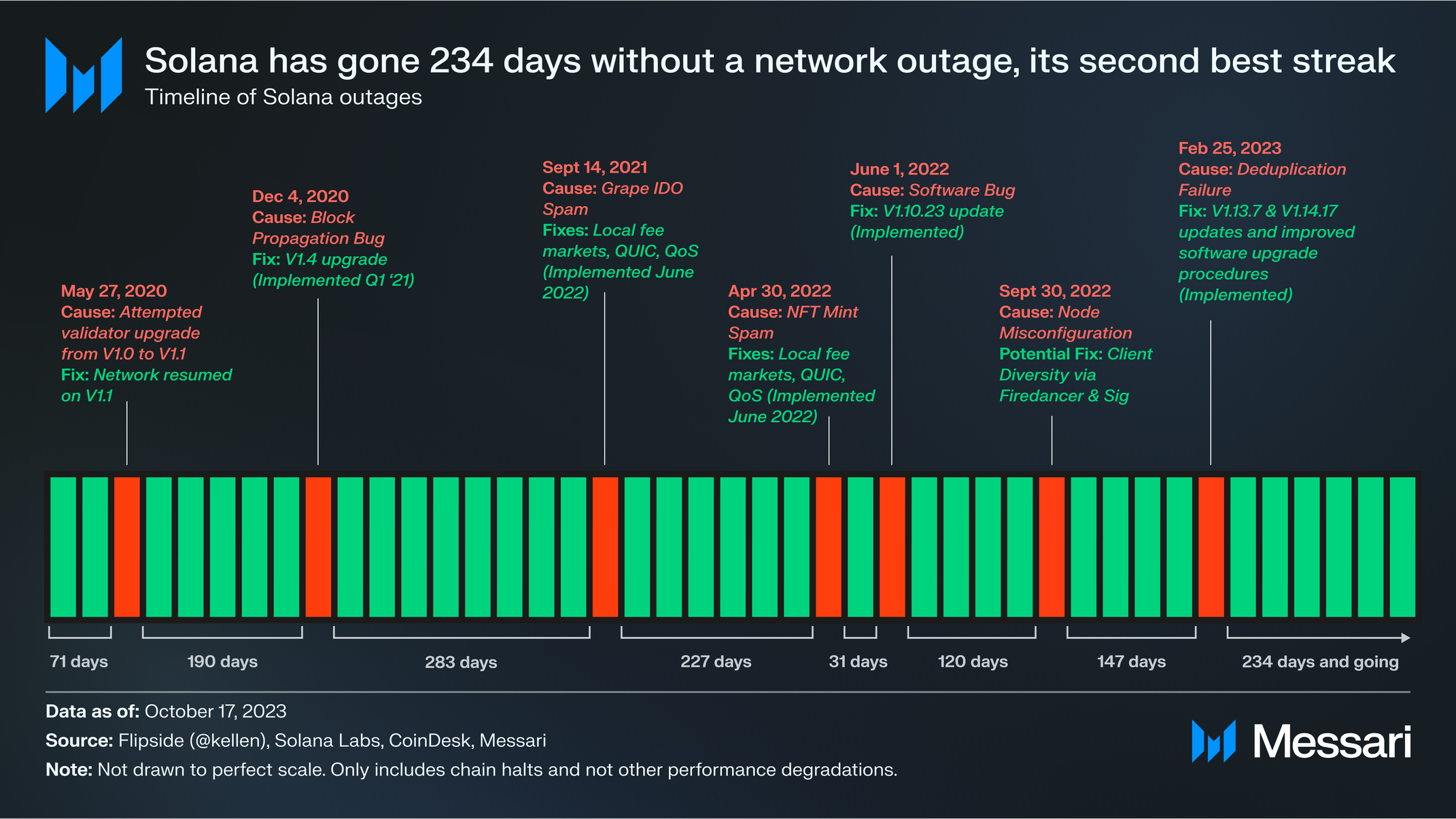
The Solana network is approaching its all-time high in days since an outage, having stayed online since February 25. This streak is the result of upgrade-process improvements and new technical features that were rolled out in the past year, such as QUIC, stake-weighted QoS, and local fee markets.
The strong performance of the SVM and Solana’s overall tech stack has caught the attention of outsiders. Adoption of the SVM beyond Solana includes:
- MakerDAO: In one of Q3’s more surprising events, MakerDAO founder Rune posted a forum proposal to explore forking the SVM to power the backend of the Maker Protocol and its subDAOs. Rune noted that after significant research, he identified Solana as the most promising codebase due to its:
- Technical quality (optimized integrated blockchain)
- Multiple client implementations
- Resilient ecosystem and thriving developer community
- History of being forked for app chains like Pyth
Any implementation of this is still very far away. Even if MakerDAO decides on a different solution, Rune’s post is a testament to Solana’s technical quality as well as its open-source nature.
- Eclipse: Eclipse was originally a rollup-as-a-service provider offering the SVM as an execution environment. In mid-September, it announced its pivot to a general-purpose L2 powered by the SVM. While some tried to label this a win for Ethereum at the expense of Solana, many Solana community members celebrated the announcement.
- Rome: Rome Protocol, a shared sequencer leveraging Solana, was introduced at the end of the quarter. The shared sequencer network will be deployed as a smart contract on Solana, with each rollup using it represented by their own Neon EVM deployment.
Neon EVM is an EVM engine deployed as a smart contract on Solana. Its mainnet launched in mid-July. The network averaged around 22,000 daily transactions, though over 80% of total transactions came from four days of spiked activity. At launch, Neon received some criticism from Solana community members for its tokenomics.
Two days after Neon launched, Solana Labs released Hyperledger Solang, a compiler enabling developers to write Solana programs in Solidity. While Neon allows developers to write EVM contracts that can then run on Solana, Hyperledger Solang allows developers to write Solana programs but just in Solidity rather than Rust or C.
Ecosystem Analysis

DeFi

In the past several quarters, there’s been a lot of growth from newer Solana DeFi protocols that categorize themselves as “Solana DeFi 2.0.” Among other things, this moniker represents a commitment to avoid the predatory, low-float tokenomics prevalent in the previous cycle. Additionally, most of these protocols have yet to launch a native token.
Lending protocol MarginFi is one of the leaders of this trend. On July 3, MarginFi launched a points system, giving users points for depositing, borrowing, and referring other users. Its TVL grew by 743% QoQ, finishing as Solana’s six-ranked protocol by DeFi TVL at $22 million. Right at the end of the quarter, MarginFi launched its own liquid-staking token, LST, which is covered in the Liquid Staking section below.
Perps exchange Cypher introduced its points system in mid-July. Cypher was one of Solana’s fastest-growing DeFi protocols before suffering an exploit worth around $1 million in early August. Partially to help make users whole, Cypher announced the fast-tracking of its CYPH IDO. Between the IDO and airdrop, over 50% of CYPH will go to the community.
Solana’s lending incumbent Solend launched a points program at the beginning of August. Rather than using its points for a potential airdrop, Solend ties points to its already-launched token SLND. Season 1 of Solend points, which will last around three months, features a minimum rewards pool of 100,000 SLND ($54,000 as of September 30, 2023). Boosted by the points system, Solend’s TVL grew 43% QoQ to $57 million.
Other notable DeFi developments include:
- Phoenix Launch: Fully onchain central limit order book Phoenix officially went live near the end of August, after a beta launch in March. The August launch came a week after the Phoenix development team, Ellipsis Labs, announced a $3.3 million seed round led by Electric Capital. Since its August launch, Phoenix has averaged over $3.4 million in daily trading volume for its most popular pair, SOL/USDC. At times, Phoenix was this pair’s most popular market by volume, despite having a much lower TVL than other exchanges. Phoenix’s TVL at the end of the quarter stood at $378,000.
- Drift Growth: Among top Solana protocols, perp DEX Drift was one of the fastest-growing in Q3. It ended the quarter with $17.3 million in TVL, up 87% QoQ and 976% YTD. Drift had several noteworthy upgrades throughout the quarter, including Drift Liquidity Provider, Market Maker Incentives, and MetaMask Snap CONNECT. The CONNECT upgrade allows users to trade on Drift and bridge from EVMs to Solana from MetaMask and has over 1,000 downloads.
- Solflare Snap: Wallet Solflare also launched a MetaMask Snap, which has almost 19,000 downloads. The Snap allows users to store Solana tokens and NFTs, bridge from EVMs to Solana (powered by deBridge), and access Solana apps that support Solflare all from MetaMask. Solflare also launched the incentives program SolScout, offering $100,000 in total prizes to users who complete daily ecosystem-related quests through Solflare or its MetaMask Snap.
- Jupiter V3: Swap aggregator Jupiter launched its V3 at the end of July. It features the new routing algorithm Metis, which offers better price discovery. Jupiter also launched limit orders, a dollar cost-averaging feature, and a bridge comparator. Jupiter was one of Solana’s top DeFi protocols by active addresses and transactions in Q3.
- Maple’s Return: After halting development on Solana post-FTX collapse, Maple Finance returned to Solana in early September, bringing its cash management solution. The product offers DAOs and high net-worth individuals the U.S. Treasuries yield minus a 0.5% management fee on USDC. Maple’s TVL on Solana reached $4.2 million by the end of the quarter.
- Circuit Launch and Raise: In August, Circuit launched the private beta of Circuit Vaults and later announced a fundraising round with participation from Multicoin among others. Circuit partnered with Drift, allowing users to deposit into the Supercharger Vault to access Circuit’s delta-neutral automated market maker strategies deployed on Drift.
- And even more developments including tBTC integration, Credix’s USDC receivables pool, Kamino Creator Vaults (Kamino also introduced Kamino Lend shortly after quarter end), Zeta V2, and EUROe stablecoin launch.
Liquid Staking

Between its high rate of eligible supply staked and its low liquid staking rate, a significant amount of SOL is not participating in the ecosystem. Liquid staking protocols have been looking to grow this through incentive programs, complementing the similar incentives trend in the DeFi ecosystem.
Liquid staking protocol Blaze has been teasing an airdrop to bSOL holders since last year. In early August, it launched its points system, which gave points to users holding bSOL, with boosted rewards for using bSOL in DeFi protocols. Soon after, Blaze launched its token BLZE and began airdropping it to users based on their points. Championing Solana DeFi 2.0, 64.5% of BLZE supply is being airdropped to users through the initial airdrop and ongoing rewards. Blaze’s TVL in SOL grew by 1,234% QoQ to 452,000 SOL ($9.2 million as of September 30, 2023).
After launching a referral program at the end of August, Jito introduced its points system in mid-September. Like Blaze, Jito rewarded JitoSOL holders and boosted their points for DeFi activities. Jito’s TVL in SOL grew 227% QoQ to 2.4 million ($48.8 million as of September 30, 2023). At the end of the quarter, around 35% of JitoSOL was held in programs rather than wallets, compared to 13% at the start of the quarter.
Similar to the DeFi ecosystem, the liquid staking incumbent Marinade, which already has a token, launched a rewards program in mid-September to try to match the growth of newer protocols. Marinade’s TVL in SOL slowly decreased throughout the quarter but reversed back upward after September 20. Marinade also launched Marinade Native at the end of July, a native staking product to compliment Marinade’s liquid staking. Marinade Native is a stake automation platform that routes stake to 100+ top-performing validators, without a performance fee or introducing any smart contract risk.
As noted above, MarginFi launched its own LST, named LST, at the end of the quarter. The LST routes stake to three validators run by the MarginFi team. It differentiates from other liquid staking providers by trading off some decentralization for a higher staking yield. The three validators use the JitoLabs client, passing on MEV-boosted rewards to LST holders with a 0% commission rate. The MarginFi team has also hinted at launching an LST-backed stablecoin in the past.
At the end of the quarter, a Lido proposal was posted to either sunset or renew funding for the development of its Solana instance. The sunset option passed after quarter end. As Lido finished the quarter with almost a 24% market share of liquid staking TVL, this will provide a big opportunity for other protocols to absorb its share.
The liquid staking ecosystem is being further enhanced by protocols like Super Stake and Sanctum. Super Stake, which launched at the end of Q2, amplifies LST yield using a recursive borrow/lend strategy on Drift. It added support for JitoSOL in Q3, joining mSOL. Both vaults are currently filled. Sanctum (formerly unstake.it) offers liquidity and stability to Solana’s liquid staking and DeFi ecosystems. It features instant liquidity for staked SOL (bypassing the staking unlock period) and a “safe haven” SOL pool for flash loans closing LST-collateralized lending positions.
While liquid staking protocols are competing against each other for market share, they are all working toward the same goal of increasing Solana’s liquid staking rate. Beyond incentive programs, a significant boost to this rate could come from the Solana Foundation moving some of its native staked SOL to liquid staked SOL, which it plans to do.
Consumer
NFTs

After a spike on the last day of Q2 from the Solana Monkey Business raffle, average daily NFT volume fell 57% QoQ to $1.1 million. Sales and unique buyers were both down QoQ as well.
Notable NFT developments from the quarter include:
- Tensorians, Meegos, Reavers, Gates of BroHalla, and VTOPIANS mints, among others.
- On September 23, virtual horse racing game Photo Finish LIVE’s over-two-year-old NFT collection became the top Solana collection by floor market cap. Activity was likely driven in anticipation of its fourth virtual Kentucky Derby (officially licensed), which occurred on September 23. However, by the end of the quarter, Mad Lads regained its position as the top collection by market cap.
- Magic Eden regained majority marketplace volume share over Tensor at the end of the quarter for the first week since mid-June. Tensor’s market share started the year at 1.2% and hit a high of over 74% in early August.

Source: Top Ledger
At the beginning of Q2, Solana introduced state compression. The upgrade provides a cost-efficient method for storing data onchain by hashing data into Merkle trees and posting its root hash onchain. Its first major use case has been the compressed NFTs (cNFTs) standard created by Metaplex. The cost to mint and store 1 million cNFTs ranges from 5.3 to 63.7 SOL, depending on the composability level, compared to 24,000 SOL without compression.
Almost 45 million cNFTs were minted in Q3, a 316% QoQ increase. DRiP accounted for the majority of these mints with an 87.5% market share. DRiP partners with artists for free NFT art mints, with collection sizes much larger than the normal 10,000. In mid-August, DRiP announced a $3 million seed round led by Placeholder.
Dialect is another leading cNFT use case. Dialect is a Web3 messaging application that uses cNFTs for Dialect stickers. At the beginning of September, Dialect launched a web app.
As noted above, Tensor launched its own Tensorian cNFT collection in August. Users needed Tensorian Shards to mint a Tensorian, which were airdropped to users as part of its Season 2 rewards. Tensorians and Tensorian Shards combined for around $7 million in total trading volume in Q3.
After launching support in May 2023, Tensor has been the primary marketplace for cNFT trading. However, Magic Eden is looking to change that, adding cNFT support in mid-September. Tensor has retained almost all market share at 97.2% of volume since Magic Eden’s cNFT integration.
A new cNFT use case came in early September when developer kiryl launched a cNFT multi-burning tool. “Burning Man” quests in September incentivized users to burn specific cNFTs for a chance at prizes.
Gaming
Beyond Photo Finish LIVE, other notable gaming developments include:
- Star Atlas SAGE Labs: Star Atlas launched early access for its SAGE Labs open-world game in late September, with users competing for $1.2 million in prizes. Since every action takes place onchain, SAGE has driven a notable portion of Solana’s overall transaction count.
- Bonk SVB: On August 1, meme coin Bonk launched Silicon Valley BONK (SVB), a sort of onchain raffle game where users compete to be the last to buy a key, receiving a portion of the funds from key purchases if victorious.
- The Heist Season 2: Popular idle game The Heist returned for its second season in mid-August, along with a new in-game currency and NFT collections. In mid-September, mobile support was added. The Heist led all NFT collections in Q3 volume.
Social
One of the biggest stories across all crypto in Q3 was friend.tech, which displayed the potential for a social app to become crypto’s breakthrough use case. Solana’s social applications include:
- Access Protocol: Access is a creator monetization platform. It onboarded 21 new creators in Q3, bringing the total to 38. The total number of subscribers doubled QoQ to 227,000.
- Solarplex: Web3 social media platform Solarplex opened its V2 for early access in mid-August, garnering initial traction.
- SolLinked: In mid-August, Solana Labs cofounder Anatoly Yakovenko tweeted about a “LinkedIn version of friend.tech”. A little over a week later, developer darksoulsfanlol built it. SolLinked allows users to set up email and calendar accounts and set a price on an email response or calendar booking, using TipLink and USDC for payments.
- Friendzy: Friendzy is a more traditional friend.tech fork, although an account’s keys can be traded before that account is initiated by the owner. After launching in mid-September, Friendzy TVL peaked at $190,000 on September 26 but ended the quarter at $76,600.
- Hub3: Hub3 is another friend.tech spinoff, with some added features like group chats, discovery tools, and NFT whitelisting services. It launched on September 24, with activity picking up after quarter end.
DePIN
Solana is becoming a hub for DePIN applications, including Helium, Hivemapper, Teleport, Render (planning to migrate to Solana), and GenesysGo.
Notable Q3 events include:
- Helium: Helium is a decentralized wireless network that migrated to Solana in April 2023. In mid-August, Helium Mobile, which leverages the network, introduced a $5 monthly unlimited phone plan, initially exclusive to Miami residents.
- Hivemapper: Hivemapper aims to create a decentralized global map. At the end of August, it launched Hivemapper Bursts, giving extra HONEY rewards for mapping hotspot areas requested by customers. Hivemapper mapped over 1 million unique road miles in Q3, bringing its total to over 3.3 million miles.
Payments
Payments are another emerging Only Possible on Solana (OPOS) use-case, with a couple of big wins this quarter, namely the Visa and Shopify integrations.
In early September, Visa announced it was expanding its USDC settlement pilot to Solana, joining Ethereum. The Visa Crypto team published a deep dive on Solana, highlighting the reasons they believe Solana can help power mainstream payment flows. The list included Solana’s cheap and predictable fees through local fee markets, parallel transaction processing, fast transaction finality, a large number of nodes, and multiple validator clients.
Near the end of August, Solana Pay integrated with Shopify, allowing Shopify merchants to accept Solana native USDC. Shopify accounts for around 10% of total U.S. e-commerce, and now merchants have an essentially fee-less alternative to the 1.5%-2.5% fee standard with credit card processing.
Other notable payment developments include:
- TipLink Gift Cards: TipLink allows users to send Solana tokens with a link. In mid-September, it added functionality for purchasing gift cards with crypto, serving as an offramp for users who receive crypto through a link.
- Beam: Offramp Beam went live in mid-August, supporting Solana along with several other networks. It then launched an SDK at the end of the month, allowing developers to easily integrate the solution into their application.
- CandyPay Mobile SDK: CandyPay allows applications to enable Solana tokens in checkouts. In mid-August it launched its mobile SDK.
- Meso SDK Early Access: Meso opened early access to its SDK, allowing developers to integrate its on-ramp product into their apps.
- Helio WooCommerce Partnership and Wallet: Multichain payments platform Helio partnered with WooCommerce in early September to power crypto payments on WordPress. A week later, it launched its own self-custody Solana wallet, which allows users to log in using their email or Web2 social accounts.
Privacy
Solana quietly has a growing number of privacy-enabling protocols. Beyond the core zero-knowledge (ZK) upgrades in V1.16, Q3 developments include:
- Light Protocol: Light Protocols is a zero-knowledge layer on Solana building Private Solana Programs (PSPs). Light Protocol takes a UTXO-based approach to privacy. It also uses private state compression so private transactions cost exactly the same as regular Solana transactions. In early August, it released the first reference implementation for PSPs.
- Elusiv: Elusiv is another privacy-enabling layer that takes a shared pool approach. Near the end of August, Elusiv launched private token swaps, using temporary keys to separate the link between a user’s public key and their transaction. Elusiv swaps use Jupiter liquidity.
Development
Ecosystem development is furthered by the resources and infrastructure built by Solana Labs and independent companies like Helius and Ironforge.
Notable releases in Q3 include:
- GameShift: Solana Labs released the GameShift API in mid-July, aiming to simplify Web3 game development.
- Helius Pyre: In mid-July, Helius launched Helius Pyre, an open-source platform that gamifies learning Solana development. Helius also released Test Drive, an open-source Postman-like tool for testing RPCs with documentation and examples.
- Solana Curriculum: freeCodeCamp released a free developer curriculum, walking developers through building 15 projects to help them get acquainted with building on Solana.
- Synthetic Assets Platform Implementation: Near the end of the quarter, Solana Labs released an open-source reference implementation of a synthetic assets platform.
- Other developments: The Graph integration, Ironforge’s Playground, four new Solana development courses, Ellipsis’ Verified Builds tool, and Magicblock’s gasless RPC API for gaming.
Growth

Ecosystem growth is furthered by grants, hackathons, accelerators, and other initiatives put together by the Solana Foundation and independent organizations like Lamport DAO and Superteam.
Notable events in Q3 include:
- OPOS Hackathon: The Only Possible on Solana (OPOS) Hackathon was a community-run hackathon in August organized by Lamport DAO. Over 600 participants competed for $100,000 in prizes from 40 sponsors across 25 tracks. It was held in person, overlapping with mtndao’s hacker house. Top prize winners were Onda Protocol ($10,000, Compression track) and Ned Finance ($10,000, Jupiter track).
- Hyperdrive Hackathon: Solana Foundation’s online Hyperdrive Hackathon began in early September. Over 5,000 builders are competing for up to $1 million in prizes and seed funding across seven tracks up until October 15.
- Hacker Houses: The Solana 2023 Hacker Houses Tour, sponsored by Jump Crypto and Circle along with the Solana Foundation, provides a place for developers to build, find collaborators, and learn from community members. Hacker Houses were hosted this quarter in Berlin, Bengaluru, and Mumbai.
- PlayGG: The Solana Foundation hosted game festival PlayGG in mid-July. The event featured demos, livestreams, tournaments, and workshops highlighting several dozen Solana-based games.
- Even more events and initiatives included quest platform Layer3’s launch, Solana Summer Fest, sessions on how to host Solana developer workshops, demo day for accelerator Solana University, and the Monacode Hackathon.
Upcoming Q4 events include Solana’s annual Breakpoint conference, the Hong Kong Hacker House, Encode Club’s Solana accelerator, Berlin Demo Day, and more.
Closing Summary
Especially considering the bear market, Q3 featured significant activity and growth in Solana’s ecosystem, spanning DeFi, liquid staking, consumer, DePIN, and privacy protocols. Compressed NFTs (cNFTs) are becoming a popular state compression use case, with almost 45 million cNFTs minted in Q3, a 316% QoQ increase. Free collectibles distributor DRiP accounted for 87.5% of these mints. Against the market trend, Solana’s DeFi TVL increased 32% QoQ to $368 million. The growth was largely driven by DeFi and liquid staking protocols launching points programs, led by MarginFi, Jito, Cypher, and BlazeStake, among others.
Solana’s underlying tech is also gaining mindshare and adoption from outsiders. Q3 examples include Rune’s post to explore a Solana fork for MakerDAO, the launch of SVM-powered L2 Eclipse, and Visa’s payments integration on Solana. In addition, Solana’s tech continued improving in the quarter. The V1.16 upgrade reduces validator memory requirements, introduces the capabilities and features needed for Confidential Transfers, and improves support for zk-proofs.
Lastly, SOL’s market cap grew 17% QoQ to $8.4 billion. The growth came despite concern over FTX liquidating its over 57 million tokens, which it received approval to do in a mid-September pre-trial hearing. FTX/Alameda’s SOL is subject to various unlock schedules, with an average unlock date in Q4 2025. That said, the locked tokens could be still sold over the counter. Nevertheless, Solana’s network and ecosystem are poised to exit the bear market stronger than they entered.
Let us know what you loved about the report, what may be missing, or share any other feedback by filling out this short form. All responses are subject to our Privacy Policy and Terms of Service.
Looking to dive deeper? Subscribe to Messari Pro. Messari Pro memberships provide access to daily crypto news and insights, exclusive long-form daily research, advanced screener, charting & watchlist features, and access to curated sets of charts and metrics. Learn more at messari.io/pro.

Peter is a Research Analyst in Protocol Services focused on Layer-1s. He recently graduated from Boston College where he studied economics and computer science and led the school's blockchain club.
Mentioned Assets