At the end of Q2, a vote passed to enact a token-based governance system using off-chain voting platform Snapshot. The system will bring greater utility to the SKL token and increase community ownership of the network.
SKALE developers announced Levitation Protocol and SKALE G, which will bring zk-rollups to the SKALE network. The protocols are estimated to launch on mainnet in Q4 2023.
PVP game CryptoBlades accounted for the majority of network usage in Q2. The game had a 67% share and 85% share of total SKALE transactions and daily active addresses, respectively.
The Nebula gaming Hub witnessed increased usage driven by the launches of games, most notably Untitled Platformer. The Hub’s average daily transactions and active addresses increased QoQ by 422% and 69%, respectively.
Primer on SKALE
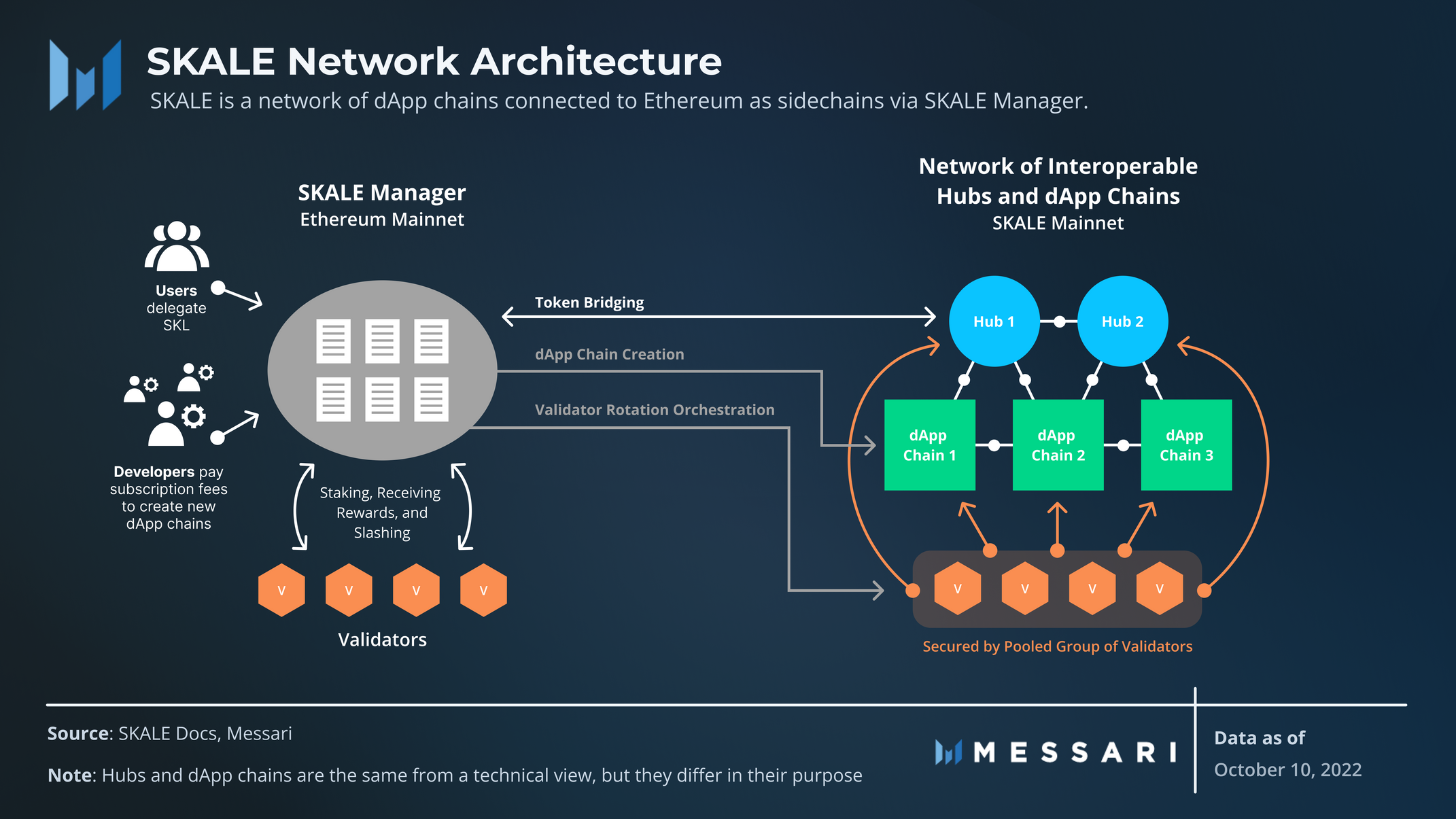
SKALE is a Layer-1 (L1) sidechain framework with pooled security. A set of Ethereum smart contracts manage several core network functions, including staking, validator orchestration, BLS key generation for each SKALE chain, and more. SKALE supports a network of configurable EVM-compatible, dapp, or general-purpose chains (SKALE chains). Each SKALE chain is secured by a rotating subset of SKALE’s pooled validator set. The SKALE V2 upgrade in Q2’22 brought interoperability between SKALE chains.
SKALE also differentiates itself by offering zero gas fees to end users. To generate fees, the protocol instead collects subscription fees from developers to create a new SKALE chain. SKALE contributors SKALE Labs and the Network of Decentralized Economics (N.O.D.E.) Foundation are specifically targeting gaming and other retail use cases via their development and growth efforts. At the end of Q2’23, SKL tokenholders passed a proposal to initiate token-based governance over protocol parameters using off-chain governance platform Snapshot. For a full primer on SKALE, refer to our Initiation of Coverage report.
Q2’23 was an up-and-down quarter for the overall crypto market. In the first half of the quarter, a meme coin craze drove up on-chain activity and prices. After a brief period of relative calm, several U.S. regulatory events, including enforcement actions against Coinbase and Binance, drove the market down. Among other claims, these enforcement actions alleged that several Layer-1 tokens are securities. BTC and ETH were not part of these allegations; thus, alt-L1 tokens generally experienced more negative price action.
Although SKL was not named in any of the claims, it was still affected by the market downturn. Following a 107% QoQ rally in Q1’23, SKL’s market cap decreased 29% QoQ to $118 million. From quarter start to end, SKL’s market cap rank among all cryptocurrencies slightly fell from 168th to 171st.
The SKL token has three primary use cases: SKALE chain subscription fees, network security (via validator staking), and, starting at the end of Q2’23, governance.
Subscription Fees
SKALE has a unique revenue model because it subsidizes gas costs rather than charging the end user. SKALE still has a gas token (sFUEL) to combat network attacks like DDoS, but it does not have any monetary value and users can receive it from token faucets. To generate fees, the protocol instead charges developers an SKL subscription fee for creating their own SKALE chain. This subscription fee is distributed to validators (and then passed down to delegators). The subscription fee model is expected to evolve in the following three phases, subject to governance:
Phase 1 emphasizes growth over revenue and is what the network’s been in since launch in October 2020. To incentivize growth in a loss leadership model, grants via the Protocol Development Fund have been utilized for the majority of chain payments. Furthermore, rather than distributing these tokens to validators, they were instead paid to a growth pool and distributed to developers and builders. Thus far, revenue has only included ETH payments made by chain owners to cover the gas costs of running a SKALE chain.
Phase 2 is planned to commence in Q3 and run for 6 months. It will introduce a temporary fixed chain cost of $3,200 per chain per month in SKL tokens. This figure aims to increase the fees distributed to validators, which can offset inflationary pressure, without creating too high of a financial burden for developers.
Phase 3 will introduce a dynamic chain cost. It targets a yearly cost at a certain network load, initially proposed at $1 million per chain per year in SKL tokens with the network at a 70% load. Network load is defined here as the percentage of total validator resources in use across every SKALE chain. A higher network load leads to a higher cost and vice versa. This is planned to launch in Q2’24, subject to governance.
Over time, subscription fees aim to replace inflation as the primary payment to validators. SKL has a fixed total supply, allocating one-third of the supply to validator rewards. So far, around 40% of this allocation has been distributed. At the end of Q2’23, SKL’s annualized inflation was at 6%, and this rate will continue to decline until all tokens are liquid.
Additionally, inflationary pressure comes from token unlocks to other buckets of SKL’s initial distribution. Genesis supply liquid measures the percentage of tokens from the initial distribution that are liquid, excluding tokens for staking rewards. By the end of Q2’23, SKALE’s genesis supply liquid was at 76.7%, with another 1.9% unlocking in Q3’23 to its core contributors.
Network Security Costs and Incentives
SKALE validator operations, including staking and rotation, occur on Ethereum via the SKALE manager smart contract. The SKALE manager runs distributed key generation (DKG) to generate Boneh–Lynn–Shacham (BLS) keys for each node. In the past five quarters, this computational cost has outweighed revenue generated, by 41 to 32 ETH.
While the vast majority of validator rewards currently comes from inflation, SKL’s real yield has still been positive since not all tokens are staked. By the end of Q2’23, SKL’s real yield was 5%, a 34% QoQ increase. The increase was driven by the 14% QoQ decrease in the percentage of SKL tokens staked to 55%.
Token-Based Governance
On the last day of Q2’23, a Snapshot vote to institute a proposed governance system passed, with 1.3 billion SKL voting affirmatively. The proposal was initially posted in SKALE’s forum by TheGreatAxios, the lead community developer for the Calypso NFT Hub. It allows SKL stakers to vote on governance proposals, whose scope will initially include network economic parameters such as subscription fees, inflation, slashing penalties, minimum stake requirements, and more. At the moment, the scope will not encompass more off-chain agendas such as grants, marketing, business development, etc., but it could be expanded to include these in the future. Beyond scope, the passed proposal also outlines the governance process and parameters. Notably, only SKL that is staked can participate in governance, which could reverse the downward trend in the percent of supply staked seen in Q2’23.
Voting will occur on off-chain voting platform Snapshot. In order to execute proposals on-chain, the plan is to use SafeSnap, a Snapshot plugin that integrates Safe (formerly Gnosis Safe) with Snapshot. With SafeSnap, passed proposals will need to be executed on-chain by the owners of the Safe multi-sig. The Safe owners also have veto power over a passed proposal.
Overall, the goal for the new system was to start simple, get it up and running, and then add in more complexities via governance as needed.
Network Analysis
Usage
The number of SKALE chains remained at 20 throughout Q2’23, with no chains created or deleted. Combined across all SKALE chains, average daily transactions decreased 33% QoQ to 211,000. However, from Q2 start to end, daily transactions gradually trended upward. Chain-level activity is covered in the Ecosystem Section below.
Security and Decentralization
The number of SKALE validators has remained steady at 53 in the past year with a current total of 125 active nodes in the network. SKL rewards are split evenly among all validators assuming they meet performance criteria. This creates an incentive for an entity to operate more than one validator. At the end of Q2, there were 34 entities running validators.
SKALE validator nodes are segmented into up to 128 virtualized subnodes via a containerized architecture. A validator can have its various subnodes acting as validators for up to eight different SKALE chains. The pool of virtualized subnodes rotates among SKALE chains, with assignments set by the SKALE manager smart contract on Ethereum. In Q2’23, there was a large increase in the number of node rotations compared to previous quarters, with the number of DKG transactions almost doubling QoQ.
Total staked (SKL) decreased 7% QoQ to 2.5 billion, but SKL staked has largely remained constant over the past year. Thus, changes in total staked (USD) have mainly been driven by SKL price action. Total staked (USD) decreased 39% QoQ to $64 million. At quarter end, four validators made up the top 33% of SKL staked.
Upgrades and Roadmap
Metaport Bridge
The SKALE V2 upgrade in Q2’22 brought interoperability between SKALE chains. But the user and developer experience was not optimal. In Q2’23, the Metaport bridge launched, offering an easy-to-use interface on top of the underlying SKALE Interchain Messaging Agent (IMA) bridge. Metaport enables token transfers between SKALE chains as well as to and from Ethereum. Developers can integrate the Metaport widget into their own application, allowing users to bridge without leaving the site.
Levitation and SKALE G
At the beginning of June, SKALE developers announced a SKALE Improvement Proposal to bring zero-knowledge rollup technology to SKALE chains. The proposal includes both the Levitation protocol and SKALE Ganymede (SKALE G). The solutions will increase the amount of security on SKALE chains derived from Ethereum, further scaling capabilities, and introduce a different revenue model with gas fees.
The Levitation protocol aims to enable zk-rollups to connect to the SKALE Architecture with rollup connectivity to the Ethereum Mainnet. SKALE chains can use the existing gas-free SKALE architecture of Levitation’s zk solution in a configurable manner. Levitation proposes an arrangement where a decentralized sequencer is implemented as a collection of smart contracts deployed on a SKALE chain. The protocol features a modular design that facilitates the integration of various zk-rollups into chains that have implemented the Levitation Protocol.
Additionally, there are plans to launch a general-purpose zk-rollup called SKALE Ganymede (SKALE G). The Ganymede protocol plans to shift SKALE's cryptographic internals, like state root computation, to zero-knowledge cryptographic algorithms. This shift aims to "enable fast ZK-proof generation" and allow the verification of these ZK proofs on the Ethereum mainnet. Ganymede Protocol will also introduce weighted consensus, whereby each node in the system would have voting rights proportional to its total validator stake rather than an equal weight across all nodes.
Ganymede will also use aggregated BLS signatures with long-term BLS keys, eliminating the need for running Distributed Key Generation (DKG) rounds each time a node joins or leaves the chain. Transaction fees for Ganymede-enabled systems are expected to be non-zero due to its execution environment where multiple dApps interact on a single chain. However, the architecture aims to "minimize transaction fees" while maintaining compatibility with Ethereum transaction fee algorithms, particularly EIP-1559.
The development schedule for the Ganymede protocol includes the initial release of the source code in the following months, followed by the launch of a public testnet. The mainnet launch is expected in Q4 2023 but is subject to change based on execution by contributors to the SKALE Project. A successful on-chain vote will be required to push the source code proposal into production.
Ecosystem Analysis
Popular Chains
CryptoBlades was the most popular SKALE chain by daily transactions in Q2, averaging 142,000. CryptoBlades is a multichain play-to-earn PVP game.
Following CryptoBlades was Web3 protocol Exorde at 47,000, a 69% QoQ decrease. Exorde is an information platform that incentivizes users to collect and submit data from social networks, which Exorde uses to create sentiment ratings, identify trends, and for other analytical tools. After launching in early October, Exorde incentivized network activity with a future airdrop, leading to spikes of high usage. In mid-April, Exorde migrated back to SKALE mainnet after several months of optimizations. Together, the two chains accounted for 90% of total SKALE transactions.
Gaming Hub Nebula’s average daily transactions increased 422% to 15,000. Nebula launched at the beginning of the year. The increase in transactions on Nebula was driven by the launches of several new games, most notably Untitled Platformer. Untitled Platformer features play-to-earn platform games. Other Q2 launches on Nebula include mobile RPG game CryptoCrusades and P2E game Mystrios. Additionally, sandbox-style game Prospectors, already live on Nebula, launched its VoxelVerse shop at the end of May.
HUMAN Protocol, a decentralized marketplace connecting freelancers and businesses, launched as its own SKALE chain at the end of Q1. It averaged 1,000 daily active transactions in Q2.
CryptoBlades averaged 11,000 daily active addresses in Q2’23, an 85% market share among SKALE chains. NFT Hub Calypso’s daily active addresses increased 68% QoQ to 97. Calypso aims to be the main liquidity and bridging layer for NFTs. Calypso development is being led by MyLilius, but plans are to eventually turn Calypso into a community-owned Hub. At the moment, the only application on Calypso is NFT marketplace NFTrade. There were no SKALE NFT sales on NFTrade in Q2.
Exorde led SKALE chains in average daily new addresses at 520. Calypso Hub followed, increasing its average daily new addresses 66% QoQ to 91. Despite its healthy lead in transaction and active address counts, CryptoBlades was third in average daily new addresses, decreasing 41% QoQ to 42.
DeFi
The Europa Hub aims to solve potential liquidity fragmentation problems that arise with app-chain ecosystems by providing a central DeFi liquidity hub. Europa development is led by the Ruby Exchange team, with plans to eventually transition to a community-owned Hub.
Ruby Exchange is an AMM-based DEX that is the sole application on the Europa Hub. Ruby Exchange features a “4Pool” consisting of stablecoins USDP, DAI, USDT, and USDC. At the end of Q2, TVL in the 4Pool stood at $545,000, a 6% QoQ decrease. SKALE does not currently support any native stablecoins; each of the four is bridged from Ethereum. The Europa bridge employs a multisig on top of the underlying IMA bridge. The IMA bridge is trustless, as it uses the same mechanisms for security as SKALE’s consensus protocol. As such, the multisig can introduce additional trust assumptions depending on the level of control the chain owner gives to the multisig. The Europa bridge uses a 3/5 multisig with the following signers:
Ruby Exchange
Impossible Finance, a launchpad not built on SKALE that facilitated the RUBY IDO on Binance Smart Chain
Boot Finance, a DeFi protocol that planned to build on SKALE prior to a hack and that has not had any activity on its Twitter or Medium account since May 19
01Node and Stakin, both staking operators on SKALE
As noted above, the Ruby Exchange team plans to move chain control to a community-owned, on-chain governance structure to minimize multisig-related attack vectors.
Beyond the 4Pool, Ruby Exchange also features pools that pair USDP with another token, including RUBY, SKL, ETH, and more. At the end of Q2, TVL in these pools stood at $710,000, a 14% decrease.
In total, SKALE TVL fell 11% to $1.3 million. Given that the majority (all of the 4Pool plus half of all other pools) are in stablecoins, SKALE’s TVL is resilient to market downturns like the one in Q2.
Since launch, Ruby Exchange has facilitated $13 million in trading volume. Near the end of June, Ruby Exchange announced an incentives campaign featuring 50,000 USDP and 1 million SKL for additional LP rewards over the subsequent month.
NFTs and Gaming
With zero-gas fees, SKALE is especially suited for retail-focused NFT and gaming use cases. As highlighted above, many of the top applications on SKALE are games, including CryptoBlades, Untitled Platformer, and VoxelVerse. At the end of June, SKALE Labs announced SKALE Summer Splash, a gaming competition with 150,000 SKL in giveaways in the last week of June. Every day, users could receive 1 giveaway entry per game and per wallet used to record an on-chain transaction with the featured games. The four included games were CryptoCrusades, SKALE Platformer, Untitled Platformer, and VoxelVerse. The campaign led to the spikes in Nebula Hub activity seen in the above charts. For a deeper dive into the almost 20 games that are currently or planned to launch on SKALE, see SKALE’s blog.
Development and Growth
Developer data is always imperfect, but Electric Capital’s Developer Report sets a foundational standard for measuring developer activity. It measures developers as authors who contribute original, open-source code to an ecosystem and full-time developers as those who do so 10+ days in a month. In May, the SKALE ecosystem had 10 full-time developers, a slight decrease from 11 in March.
Ecosystem partnerships and growth will be spearheaded mainly by the N.O.D.E. Foundation. In February 2022, the Foundation announced a $100 million ecosystem incentive program, from which it is still allocating to attract new projects and partners. In Q2, the Foundation signed up over 40 games and other Web3 products which they anticipate will go live by the end of 2023. These partnerships and new projects will be announced over time.
Closing Summary
Although overall SKALE network usage decreased in Q2, several chains and applications witnessed notable growth. The Nebula Hub’s average daily transactions and active addresses increased QoQ by 422% and 69%, respectively. The surges were spurred by several game launches including Untitled Platformer, CryptoCrusades, and Mystrios. Additionally, after launching at the end of Q1, decentralized freelancer marketplace HUMAN Protocol jumped into the top five SKALE chains with respect to transactions and new addresses.
The quarter featured two important protocol milestones: the enactment of a token-based governance structure and the announcement of Levitation Protocol and SKALE G. Token-based governance, set to occur on off-chain voting platform Snapshot, will bring greater utility to the SKL token and increase community-ownership of the network. The Levitation Protocol and SKALE G aim to bring zk-rollups to the SKALE network, furthering network scalability and its connection to Ethereum.
This report was commissioned by SKALE Labs. All content was produced independently by the author(s) and does not necessarily reflect the opinions of Messari, Inc. or the organization that requested the report. The commissioning organization may have input on the content of the report, but Messari maintains editorial control over the final report to retain data accuracy and objectivity. Author(s) may hold cryptocurrencies named in this report. This report is meant for informational purposes only. It is not meant to serve as investment advice. You should conduct your own research and consult an independent financial, tax, or legal advisor before making any investment decisions. Past performance of any asset is not indicative of future results. Please see our Terms of Service for more information.
No part of this report may be (a) copied, photocopied, duplicated in any form by any means or (b) redistributed without the prior written consent of Messari®.
Looking to dive deeper? Subscribe to Messari Pro. Messari Pro memberships provide access to daily crypto news and insights, exclusive long-form daily research, advanced screener, charting & watchlist features, and access to curated sets of charts and metrics. Learn more at messari.io/pro.
Peter is a Research Analyst in Protocol Services focused on Layer-1s. He recently graduated from Boston College where he studied economics and computer science and led the school's blockchain club.
Peter is a Research Analyst in Protocol Services focused on Layer-1s. He recently graduated from Boston College where he studied economics and computer science and led the school's blockchain club.