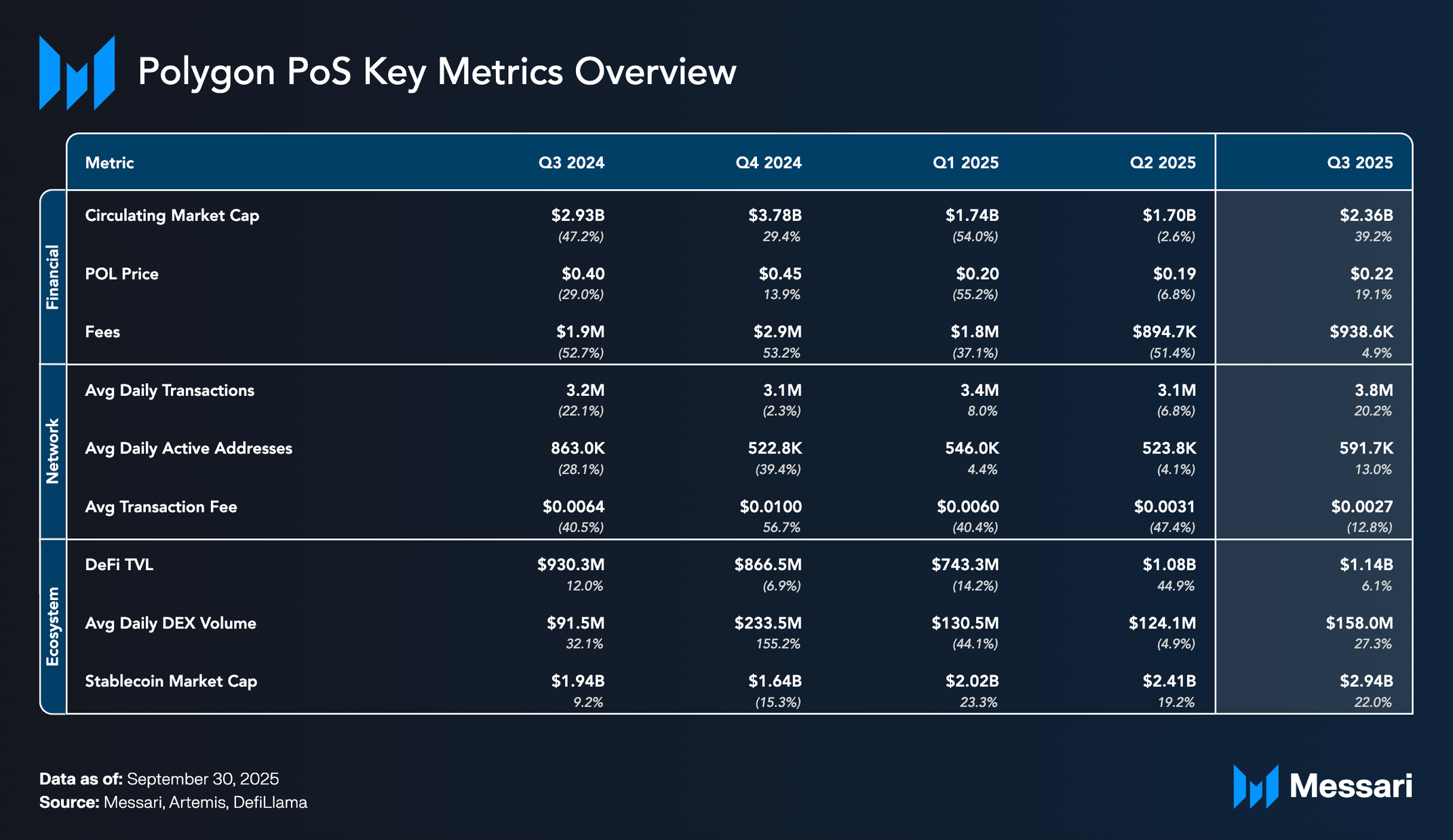
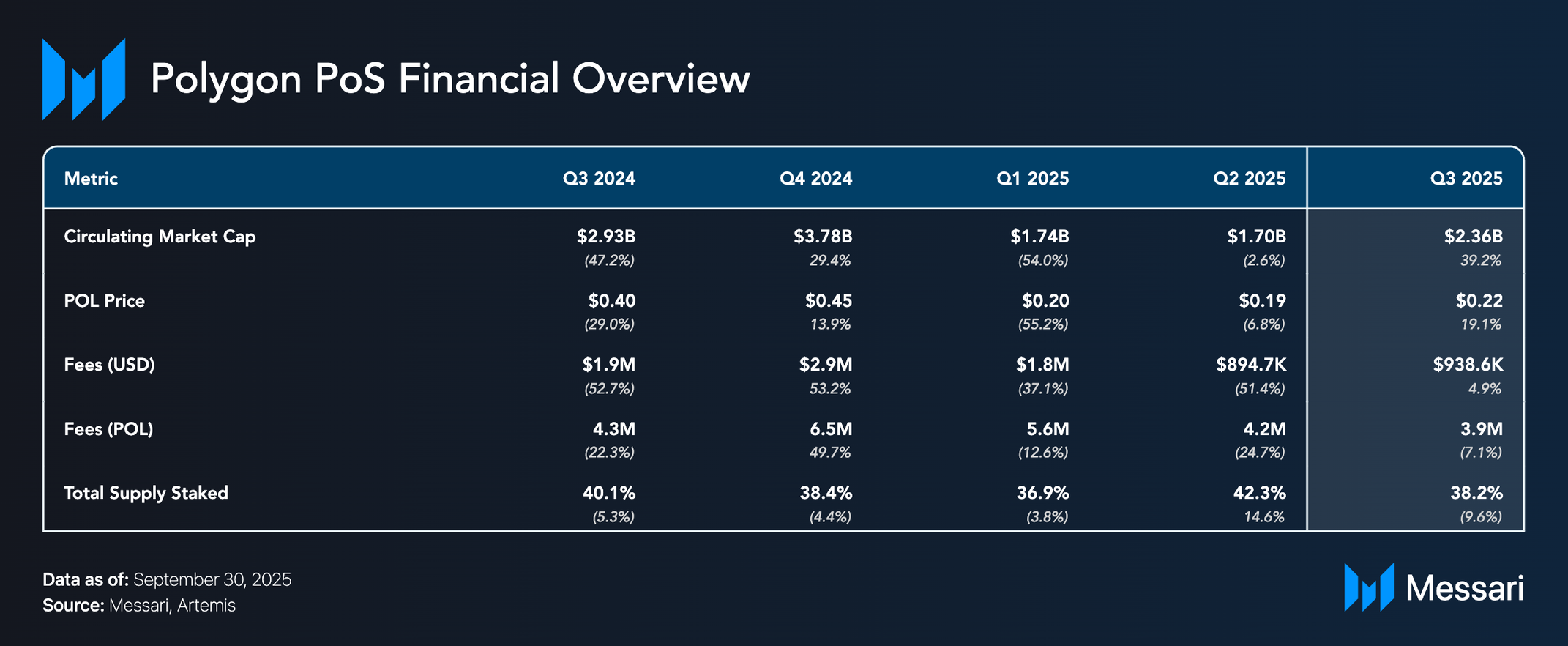
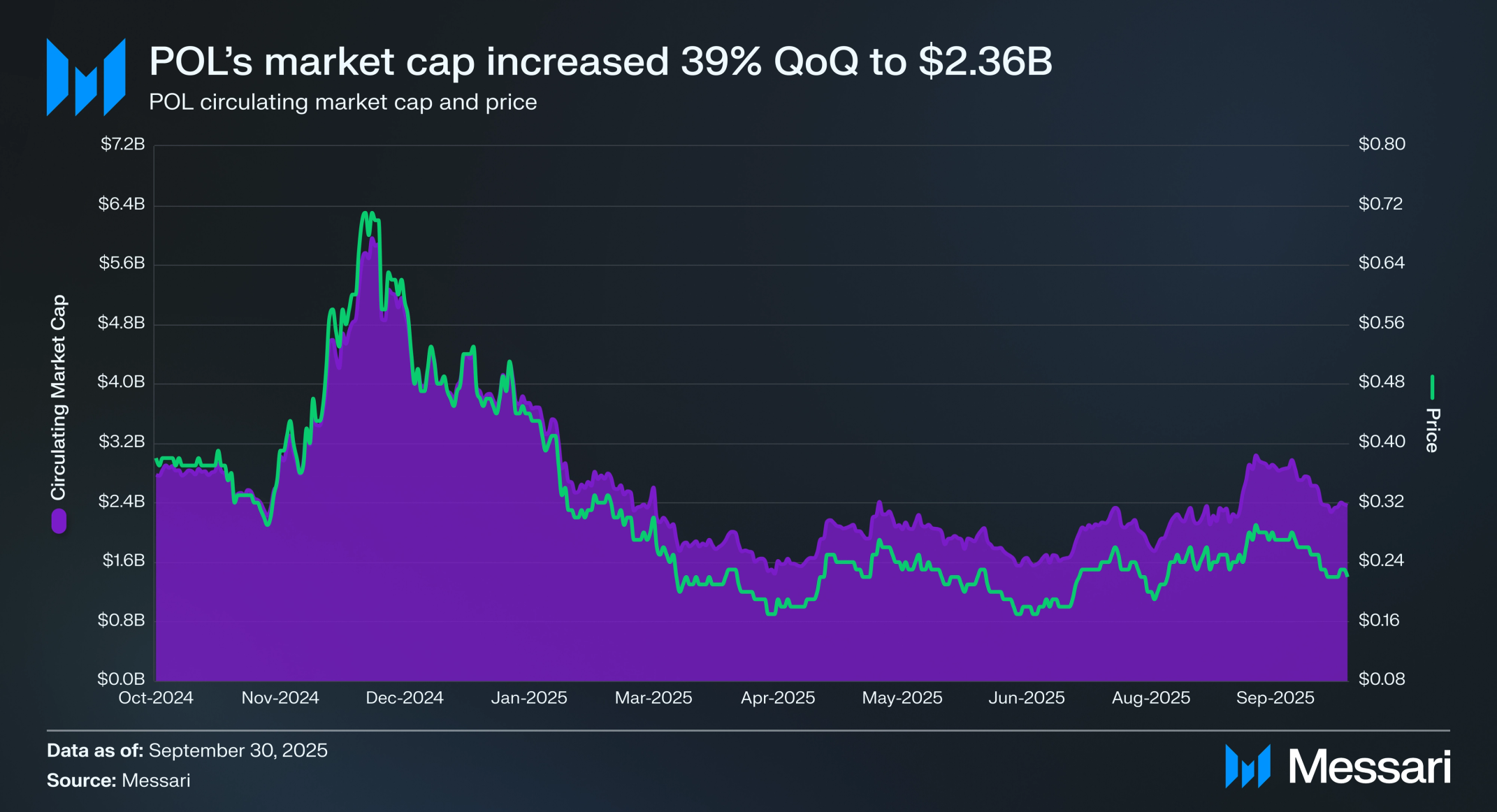
POL’s circulating market cap increased 39.2% QoQ to $2.36 billion, outperforming the broader crypto market, which rose by 20.7% over the same period.
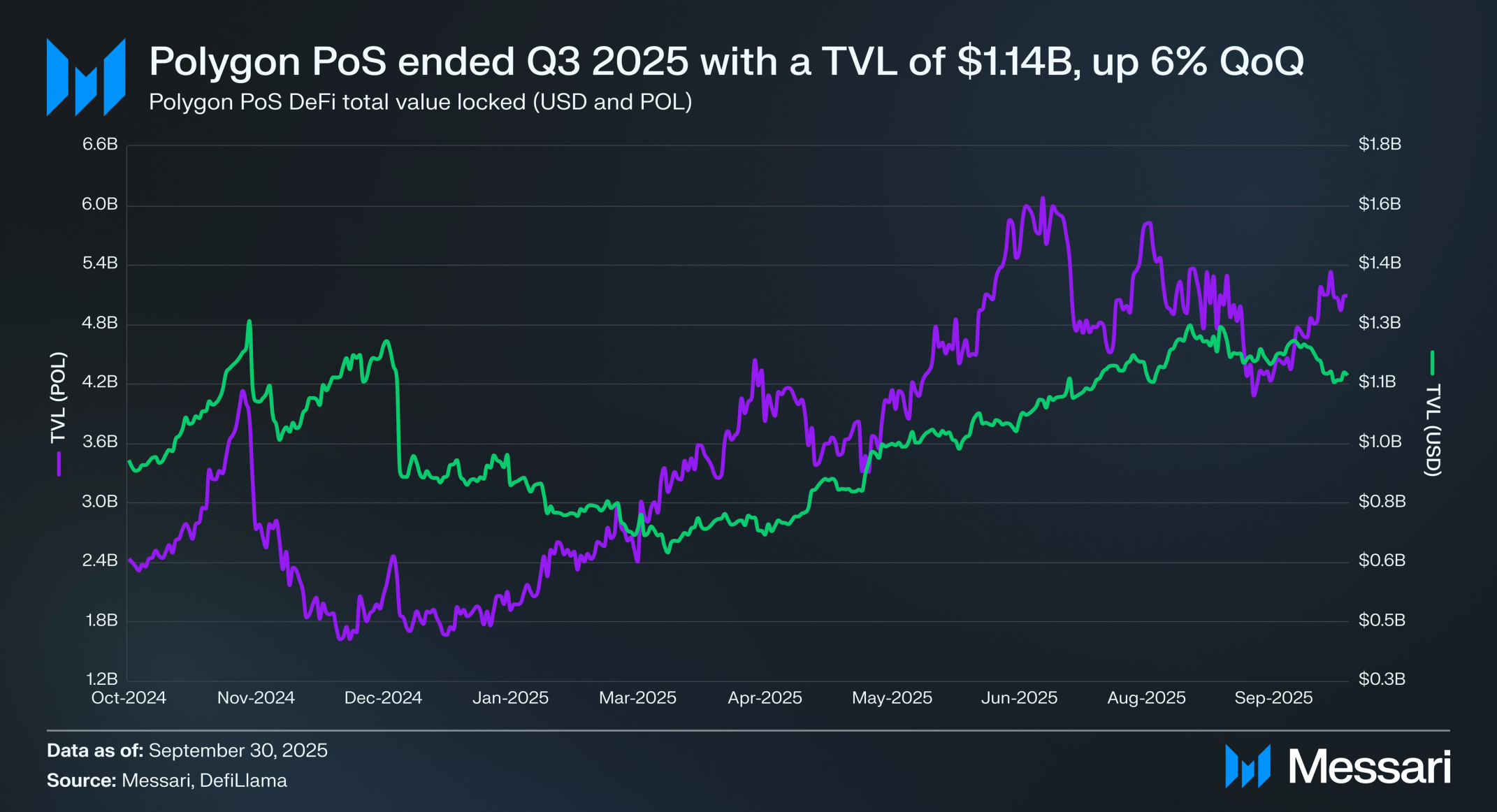
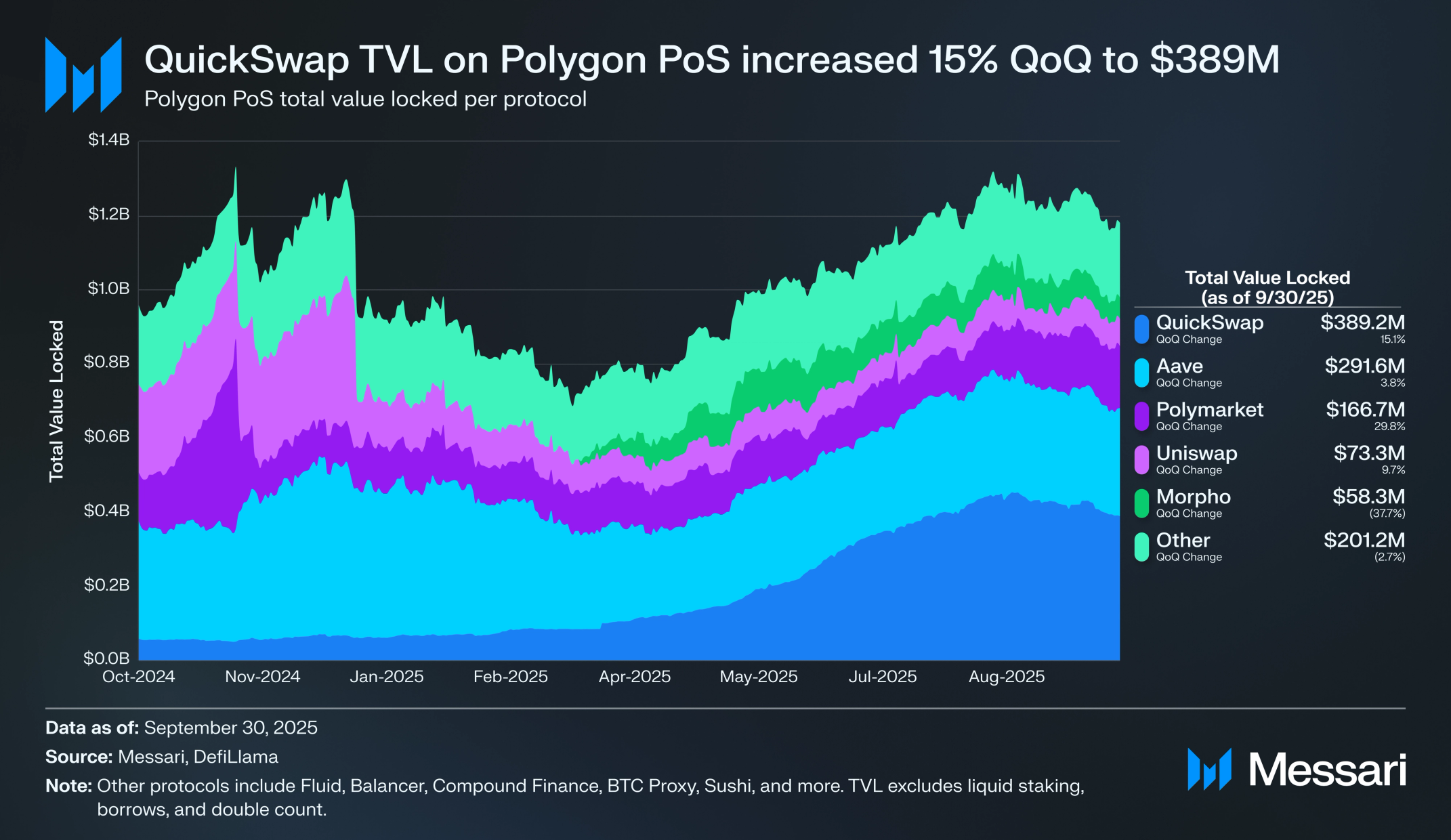
Polygon PoS DeFi TVL ended Q3 at $1.14 billion, with QuickSwap and Polymarket increasing their TVL by 15.1% and 29.8% QoQ, respectively.
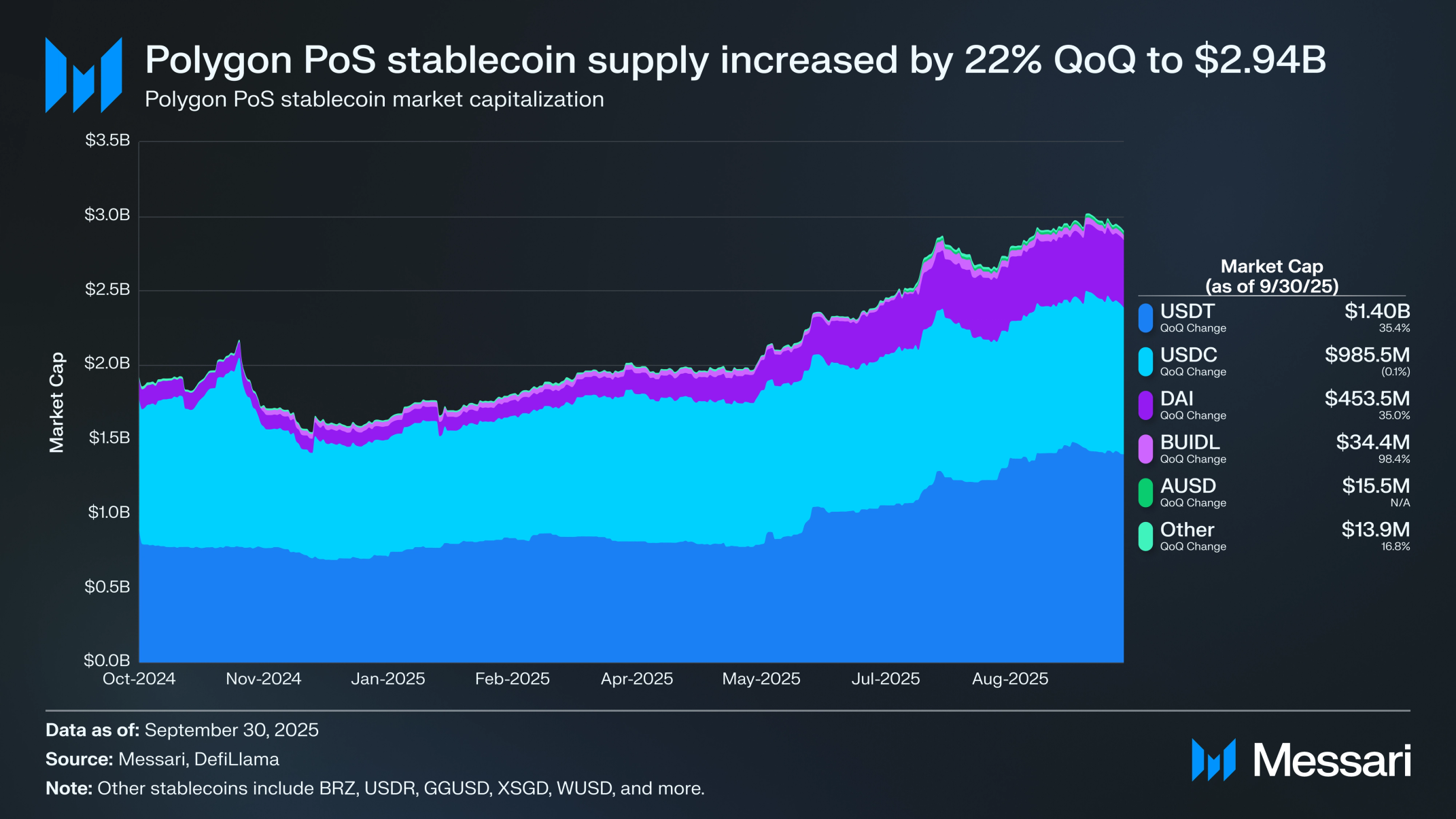
Polygon PoS stablecoin supply grew by 22.0% QoQ to $2.94 billion, driven primarily by USDT, which rose 35.4% QoQ to $1.4 billion.
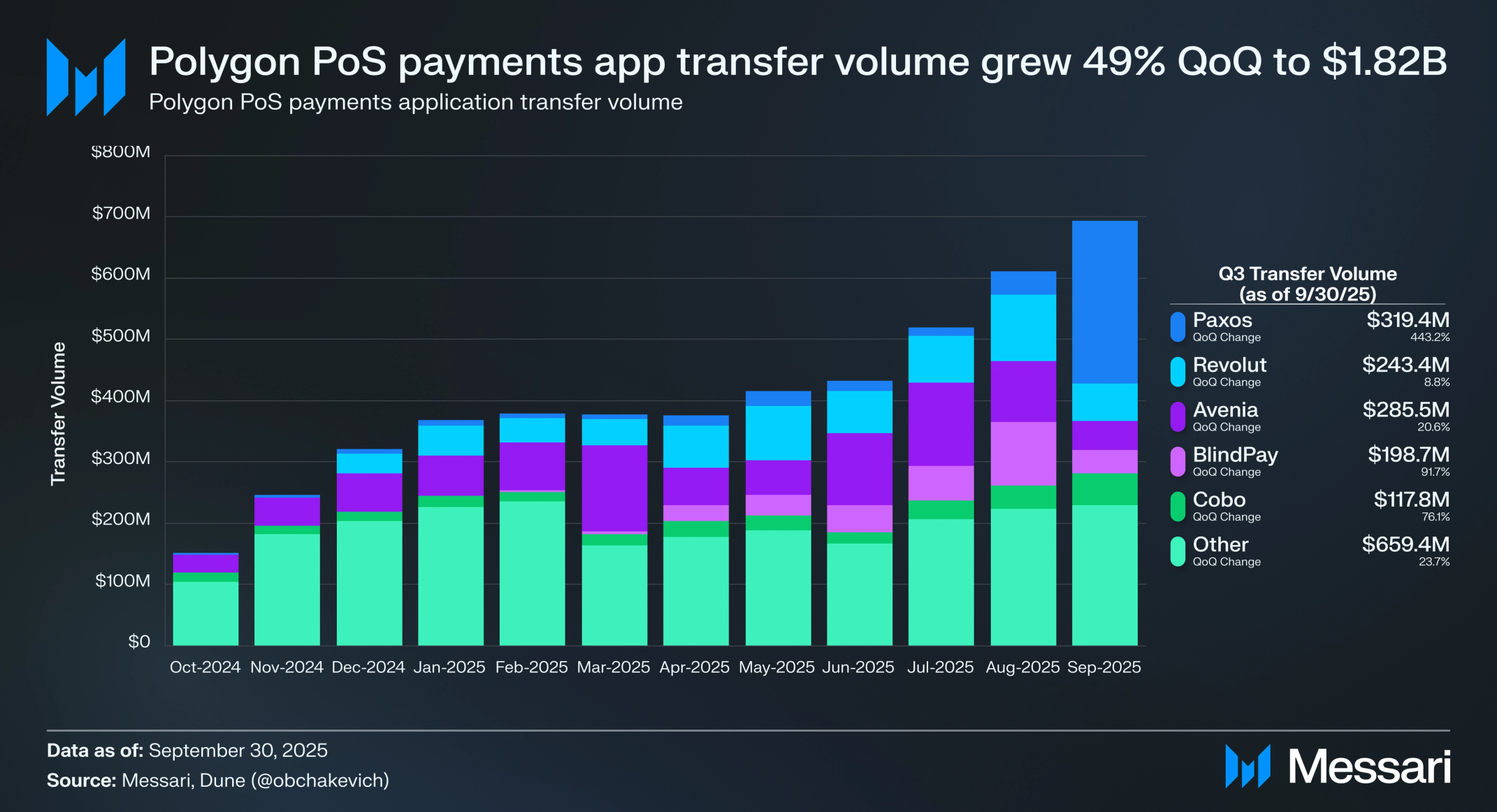
Payments-focused applications on Polygon PoS facilitated $1.82 billion in transfer volume across more than 50 platforms, up 49.2% QoQ. Stablecoin-linked crypto cards processed $322.2 million in combined Mastercard and Visa volume across ten card programs.
Real-world asset tokenization accelerated, with total RWA value on Polygon PoS reaching $1.14 billion, driven by new institutional issuances from Justoken, NRW.BANK, BeToken, and the Philippines Department of Budget and Management (DBM).
Polygon upgraded its core infrastructure, implementing the Bhilai Hardfork, Heimdall v2, and Rio Testnet. These upgrades marked major milestones on the Gigagas roadmap toward over 5,000 TPS and faster finality.
Primer
Polygon Labs is a software development company building infrastructure for Web3 applications. Its core products include Polygon Proof-of-Stake (PoS) network, a low-cost, high-throughput blockchain optimized for payments and real-world assets (RWAs), and Agglayer, a protocol designed to connect blockchains and applications within a unified cross-chain framework. Polygon PoS secures billions of dollars in stablecoins and supports a growing ecosystem of payment applications that strengthen liquidity and interoperability across the network. Polygon Labs also conducts research and development in zero-knowledge (ZK) technology, contributing to open-source advancements in scalability and privacy. Independent projects developed through the Agglayer Breakout Program, including Katana, Miden, PrivadoID, and ZisK, extend the Polygon ecosystem and advance the use of ZK-based infrastructure.
In Q3 2025, POL’s circulating market cap increased 39.2% QoQ to $2.36 billion, outperforming the broader crypto market, which rose by 20.7% over the same period. By the end of Q3, more than 99% of supply had transitioned to POL, with the remaining <1.0% still in MATIC. POL ranks as the second-largest Ethereum L2 token by market cap behind MNT, and in front of ARB, IMX, and OP.
Transaction Fees
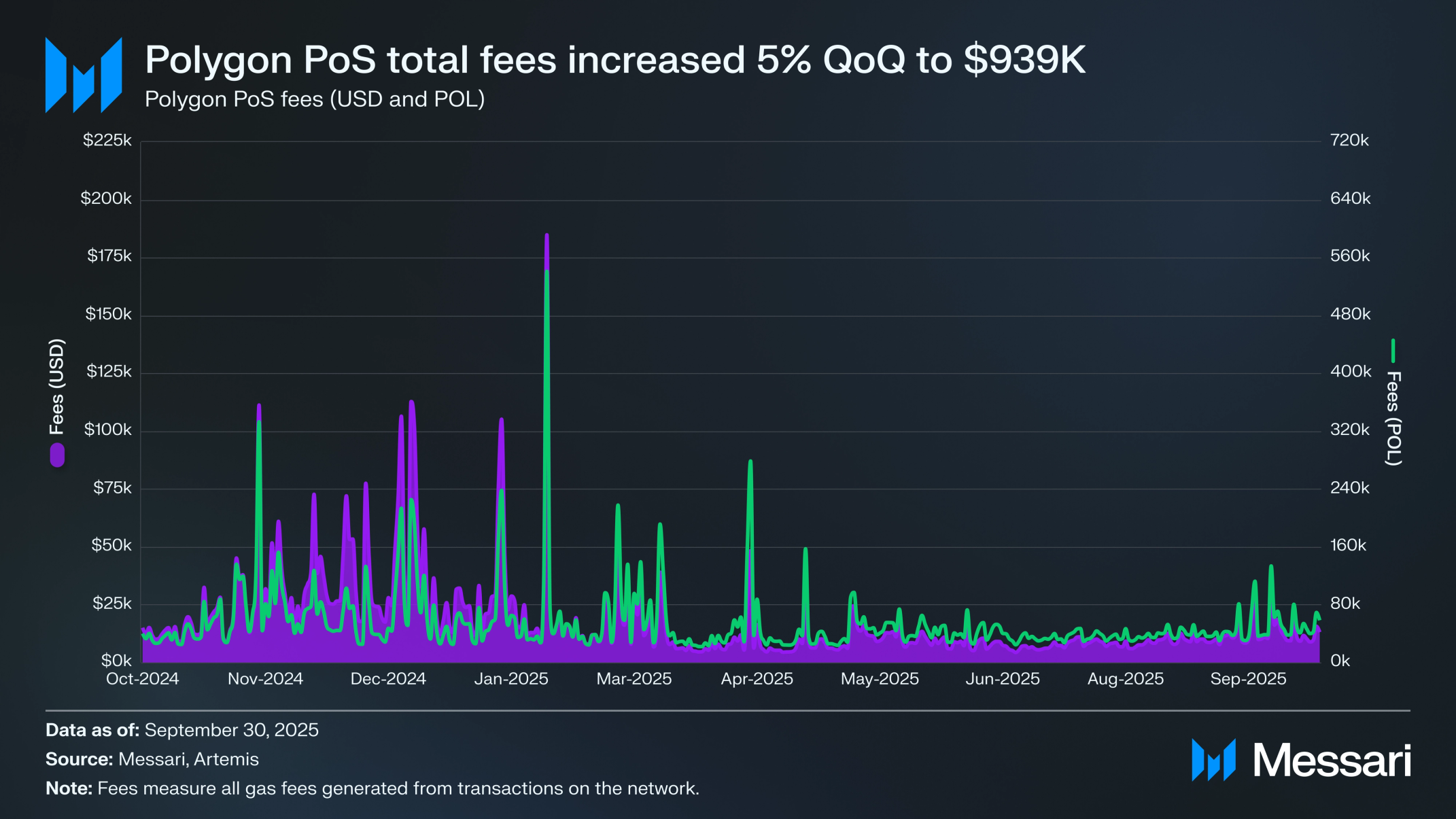
In Q1 2024, EIP-4844 was enacted on Polygon PoS mainnet, introducing blobs and significantly changing the Polygon cost structure. EIP-4844 and blobs result in cheaper posting costs to the L1, which lowers users' average transaction fees. In Q3 2025, total transaction fees (POL) decreased by 7.1% QoQ to 3.9 million, while total transaction fees (USD) rose 4.9% to $938,600.
Network Analysis
Activity
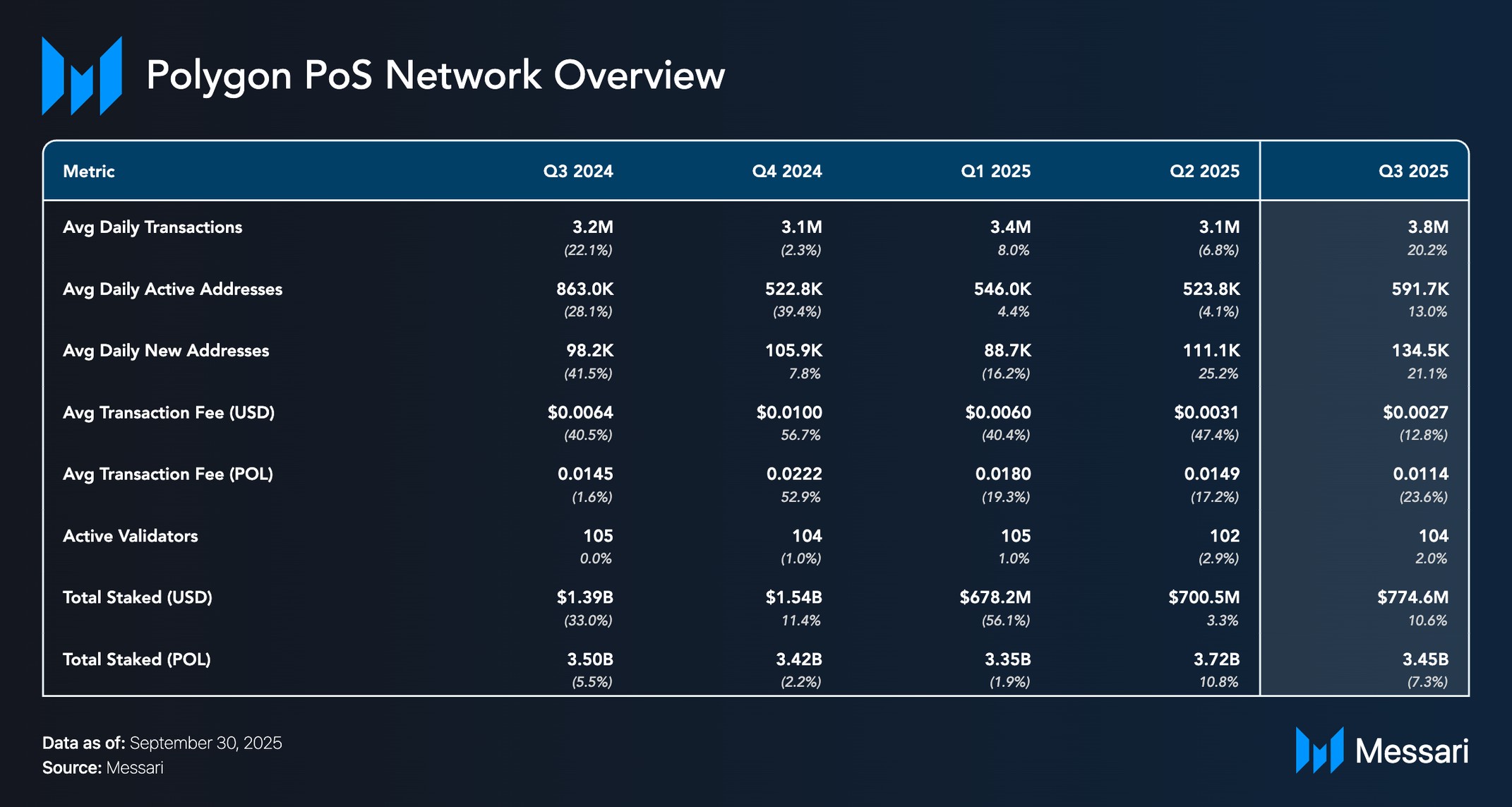
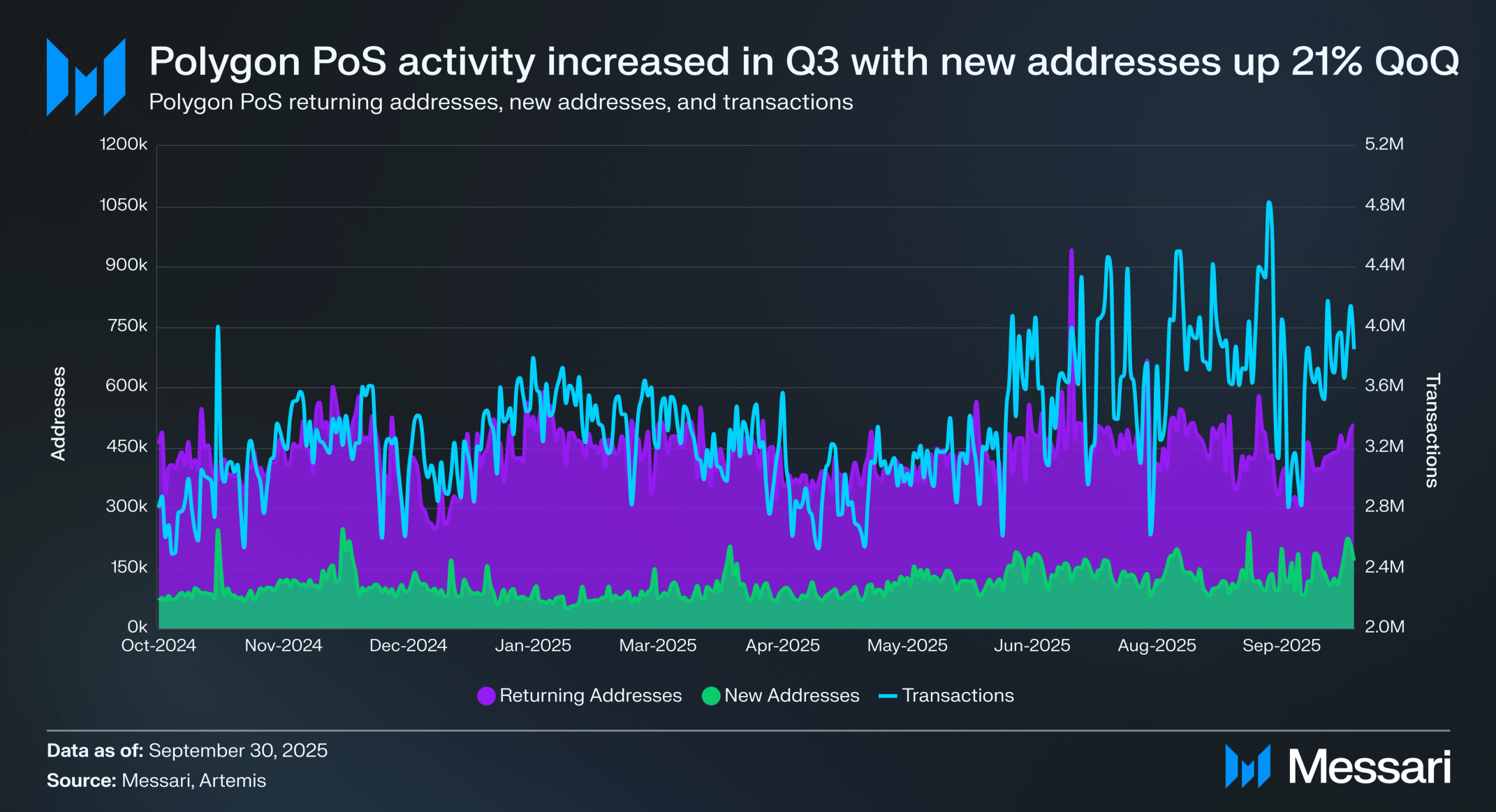
In Q3, average daily active addresses on Polygon PoS increased 13.0% QoQ to 591,700. Similarly, average daily transactions increased 20.2% QoQ to 3.8 million. The average daily number of new addresses grew the most, increasing 21.1% QoQ to 134,500.
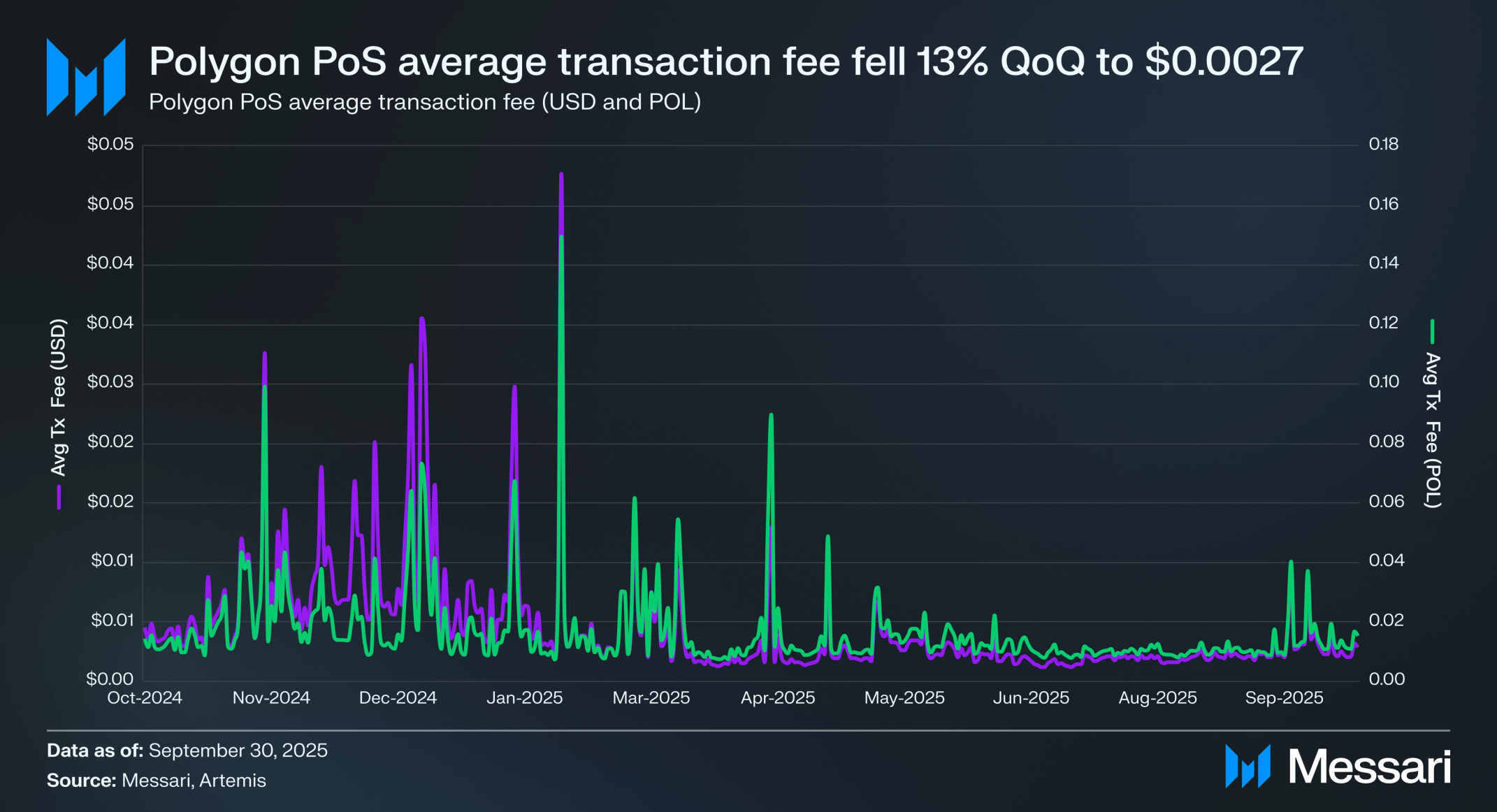
Driven by recent network upgrades, Polygon’s average transaction fee continued to decline, improving cost efficiency for users and applications. The average fee fell 23.6% QoQ to 0.0114 POL, while the USD-denominated fee decreased 12.8% to $0.0027. This reduction reflects the impact of Polygon’s throughput and gas optimizations, enhancing affordability for high-frequency activity such as payments and stablecoin transfers.
Technical Development
Polygon’s technical upgrades in Q3 continued to advance its long-term objective of becoming the default blockchain for payments and RWAs. As part of the Gigagas roadmap, which targets throughput of up to 100,000 transactions per second, these upgrades enhanced scalability, reliability, and cost efficiency. Together, they strengthen Polygon PoS as a settlement layer capable of supporting large-scale transaction flows from fintechs, payment service providers (PSPs), and peer-to-peer networks.
Bhilai Hardfork
At the beginning of July 2025, Polygon implemented the Bhilai Hardfork, marking the first milestone in its scaling roadmap. The upgrade increased Polygon PoS throughput to over 1,000 transactions per second, raised the block gas limit from 30 million to 45 million, and reduced gas fee volatility. Bhilai also upgraded Polygon’s execution layer (Bor) to Go-Ethereum v1.15.x, adding support for Ethereum’s Pectra EIPs, including EIP-7702 for account abstraction. This EIP enables developers to deliver seamless, Web2-like onboarding experiences such as gasless transactions and Passkey-based authentication.
Heimdall v2
Later in July, Polygon introduced Heimdall v2, a major consensus layer upgrade that reduces transaction finality from one to two minutes to roughly five seconds. The upgrade replacedTendermint with CometBFT v0.38.x, modernized the underlying Cosmos SDK, and deprecated legacy components of Heimdall v1. These changes improved consensus efficiency, enhanced validator coordination, and strengthened network stability without compromising decentralization. For developers, the faster consensus minimizes reorganization risk and improves user experience, while centralized exchanges can now confirm deposits and withdrawals in near real time.
Rio Testnet
Polygon deployed the Rio upgrade to the Amoy Testnet in September, with mainnet launch expected in October 2025. Rio marked the next phase of Polygon’s Gigagas roadmap, redesigning the validator set for greater efficiency and introducing stateless block verification to reduce costs and eliminate network reorgs. These changes will make validation lighter, expand participation by lowering hardware requirements, and prepare Polygon PoS to reach up to 5,000 transactions per second.
Rio introduced three key proposals: PIP-64 establishes a Validator-Elected Block Producer (VEBloP) to improve throughput and confirmation times; PIP-65 defines a new economic model that redistributes fees between block producers and validators; and PIP-72 enables witness-based stateless verification, allowing nodes to validate without maintaining full state data.
Agglayer CDK Enterprise
Polygon launched Agglayer Chain Development Kit (CDK) Enterprise, a privacy-first blockchain stack that lets institutions deploy permissioned EVM chains with financial-grade privacy and built-in interoperability with the Agglayer. The upgrade combines the performance of the Erigon client with enterprise controls such as role-based access, identity and KYC tooling, and private block explorers. CDK Enterprise offers a direct upgrade path from Hyperledger Besu. It enables confidential settlement for sensitive financial flows while maintaining selective disclosure for auditors and regulators.
Ecosystem Analysis
Payments
Polygon has established itself as a natural home for payment solutions, offering low fees, fast settlement, and an accessible development environment. In Q3, payments-focused applications on Polygon PoS facilitated $1.82 billion in transfer volume across more than 50 platforms, up 49.2% QoQ.
Peer-to-Peer (P2P) Transfers
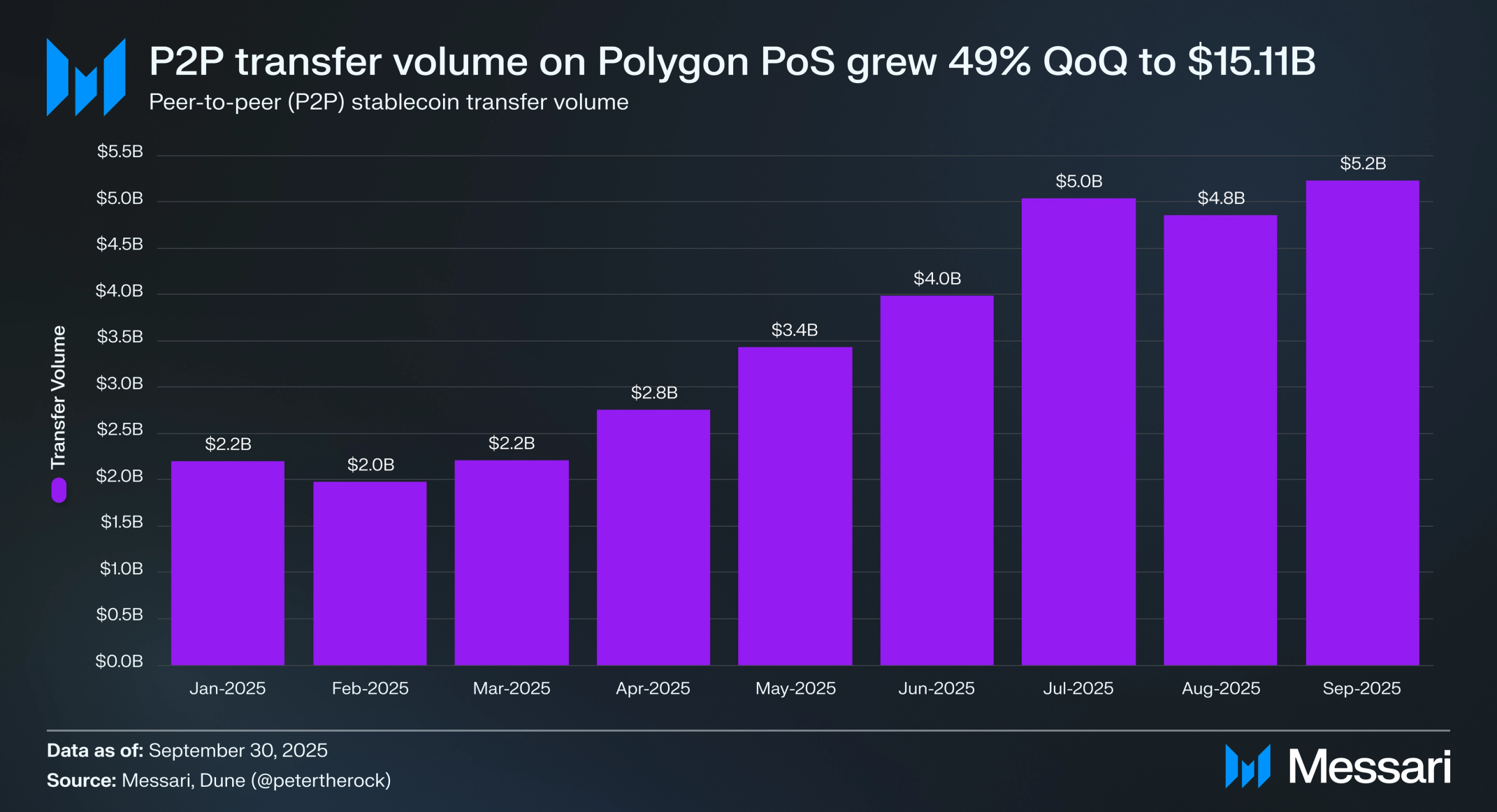
P2P stablecoin transfers on Polygon PoS totaled $15.11 billion in Q3, a 48.5% increase from $10.18 billion in Q2. Volumes have more than doubled since the beginning of 2025, reflecting strong and sustained adoption of wallet-to-wallet payments. The growth highlights consistent demand for low-cost, high-frequency stablecoin transactions, reinforcing Polygon’s position as a leading network for everyday onchain payments.
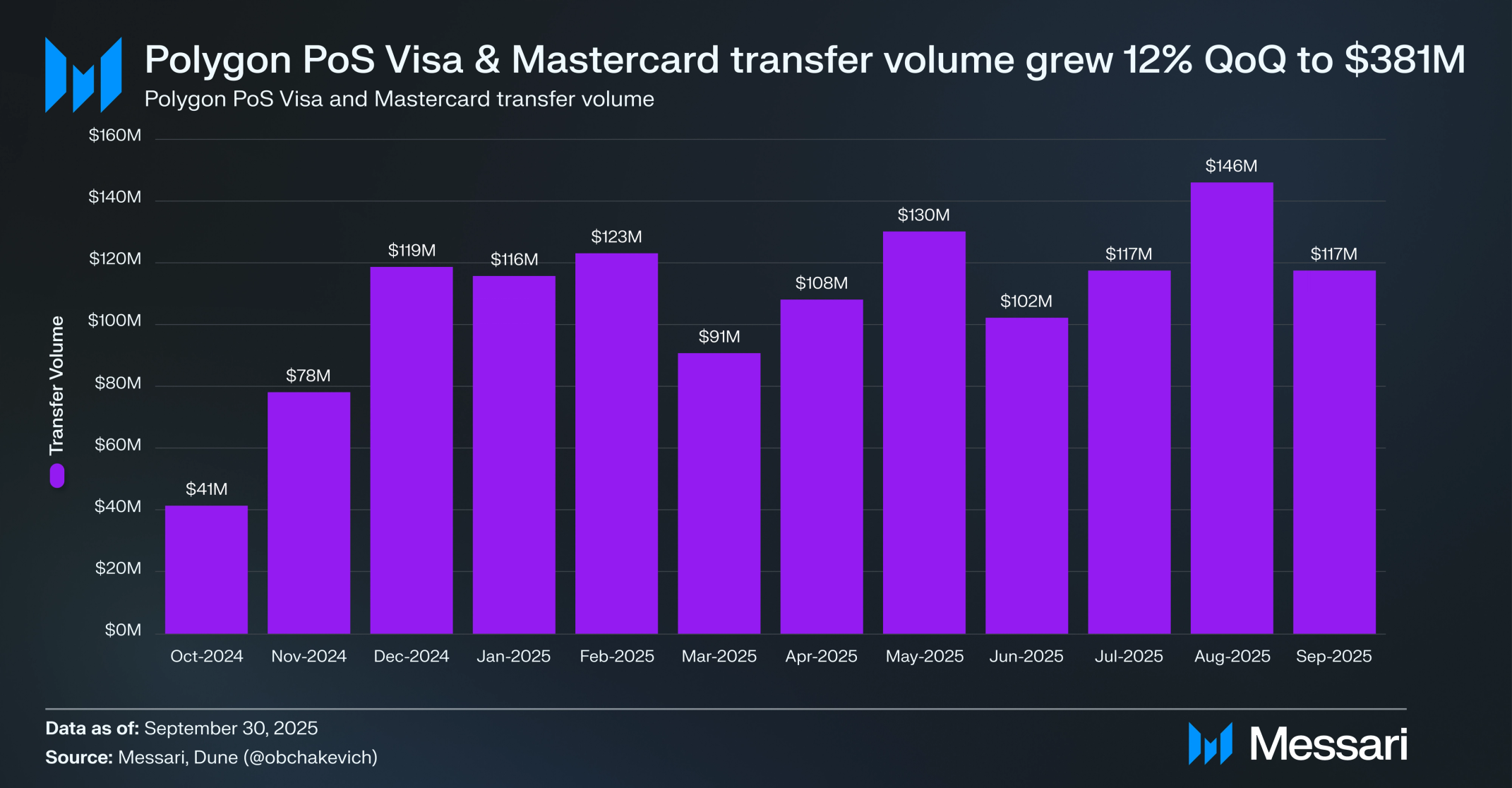
In Q3, stablecoin-linked crypto cards processed $380.8 million in combined Mastercard and Visa volume on Polygon PoS, across ten different card programs. Mastercard accounted for $84.0 million and Visa for $296.8 million, reflecting continued traction in bridging digital assets with traditional payment rails. Payment transactions highlight one of the clearest examples of large-scale real-world crypto adoption. Developments in the payments ecosystem during Q3 include:
Slashlaunched on/off-ramps for USDC on Polygon, enabling businesses to pay contractors, accept customer payments, and automatically convert between USD and USDC without using an exchange account.
Kolointegrated Polygon to power card top-ups with USDC, offering low fees, fast transactions, and instant chain-to-checkout payments for users worldwide.
Tether upgraded USDT on Polygon to native USDT0, reducing fees, deepening liquidity across more than $3.00 billion in stablecoins, and enabling seamless transfers with other USDT0 chains; the update also introduced native XAUT0, the omnichain version of Tether Gold.
Payylaunched its non-custodial Visa card powered by USDC on Polygon. The card enables users to spend stablecoins globally, deposit from multiple chains or bank accounts, and make private, compliant transactions with built-in wallet, gas, and token abstraction.
BlindPaylaunched Named Virtual Accounts with full ACH, Wire, RTP, and SWIFT support. These accounts allow users to open U.S. bank accounts with branded payment descriptors and automatically settle all payments in stablecoins on Polygon for instant global payouts.
PayAIintegratedx402 payments on Polygon, enabling instant, low-cost agentic transactions with no sign-ups or API keys required. This integration supports payments under one second and for as little as $0.001.
Real-world Assets
Real-world assets (RWAs) continued to gain momentum on Polygon in Q3 2025, reinforcing the network’s role as a core infrastructure layer for asset tokenization. Growing demand from traditional financial institutions and proven product-market fit for digitized collectibles, such as Pokémon cards on Courtyard, helped drive a notable increase in onchain RWA allocations. By the end of the quarter, Polygon ranked third by total RWA value, reaching $1.14 billion. Key RWA developments this quarter include:
Justoken launched JSOY and JSOY_OIL, each representing one metric ton of physical soybeans and soybean oil, respectively. The tokens launched on July 1, 2025, with a market cap of $453.3 million, quickly becoming the two largest RWAs on Polygon.
Germany’s state-owned development bank NRW.BANKissued a €100 million blockchain-based bond on Polygon, registered under the country’s Electronic Securities Act (eWpG) through Cashlink’s BaFin-regulated crypto securities registry. The issuance marks one of Europe’s largest public-sector tokenized bond offerings and represents a major step toward institutional adoption of digital capital markets.
BeTokenlaunched on Polygon as Spain’s first fully regulated onchain Security Token Offering (STO) under the supervision of the Comisión Nacional del Mercado de Valores (CNMV). The tokenized shares of Beself Brands, issued using the ERC-3643 standard, represent legally recognized equity with full economic and governance rights, making BeToken one of the first live, regulated equity issuances in the EU.
21X, the first EU-regulated onchain exchange for tokenized securities, integrated Chainlink oracles on Polygon to deliver real-time, verifiable post-trade data for listed equities, debt securities, and funds. The integration enables regulated tokenized assets to serve as collateral, trade in secondary markets, and unlock broader institutional use cases for transparent, compliant onchain finance.
Chain GDP
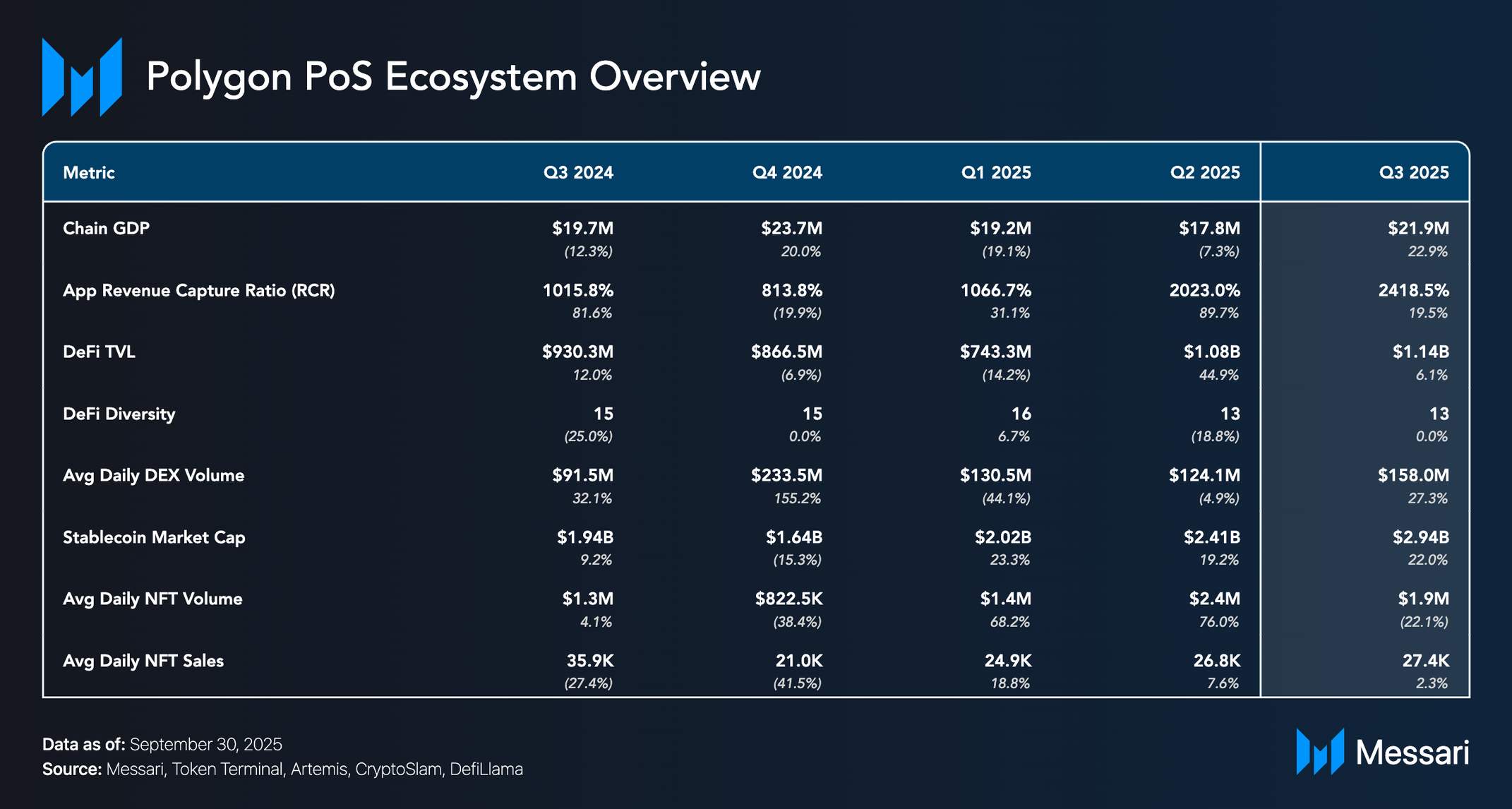
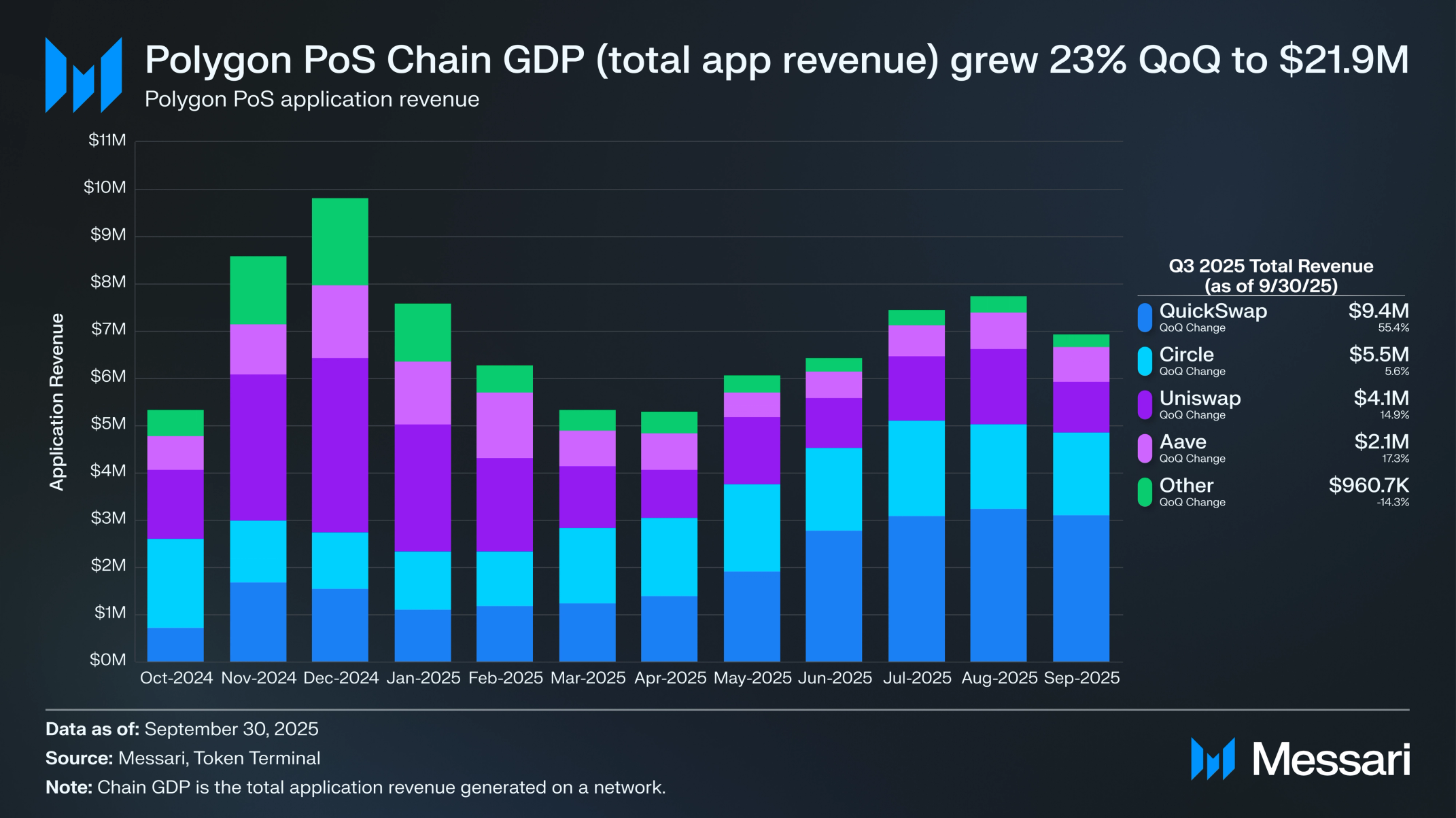
Chain GDP is defined as the total application revenue generated on a network. In Q3, Polygon’s Chain GDP grew 22.9% QoQ to $21.9 million. The top four leaders by application revenue in Q3 were:
The App Revenue Capture Ratio (RCR) measures how effectively a network’s applications capture value relative to total transaction fees. It is defined as the ratio of application revenue to network transaction fees, indicating how much of the network’s economic activity is monetized at the application layer.
A higher App RCR suggests that applications are efficiently converting onchain activity into revenue, reflecting a mature and monetizable ecosystem. Conversely, a low App RCR can signal inefficiencies in value capture or an ecosystem still developing monetization pathways. For example, an App RCR of 20% means that for every $1 of network revenue (REV) generated through transaction fees, applications earn $0.20 in revenue.
In Q3, Polygon’s App RCR was 2,418.5%, a 19.5% QoQ increase from 2,023.0% in Q2. This implies that for every $100 spent in Polygon transaction fees, applications earned approximately $2,418.50 in revenue.
DeFi
Polygon PoS DeFi total value locked (TVL) ended Q3 2025 at $1.14 billion, a 6.1% QoQ increase. Polygon fell from being the eleventh-largest network by TVL to the thirteenth.
TVL by Protocol
QuickSwap was the top protocol by TVL on Polygon PoS in Q3, ending the quarter with $389.2 million, a 15.1% QoQ increase. Aave held its position as the second-largest protocol by TVL, ending the quarter with $291.6 million (+3.8% QoQ). Polymarket remained the third largest protocol by TVL, ending the quarter with $166.7 million (+29.8% QoQ). Uniswap surpassed Morpho to become the fourth-largest protocol with $73.3 million in TVL (+9.7% QoQ), while Morpho fell to fifth as its TVL declined to $58.3 million (-37.7% QoQ).
Stablecoin Supply
Polygon PoS’s stablecoin supply ended Q3 with a total market capitalization of $2.94 billion, reflecting a 22.0% QoQ increase. USDT was a main driver of the growth as its supply increased 35.4% QoQ to $1.4 billion. USDC finished the quarter with $985.5 million, a 0.1% QoQ decrease. BUIDL grew the fastest this quarter, up 98.4% QoQ, with a market cap of $34.4 million. Polygon PoS dropped one position to the ninth-largest blockchain by stablecoin supply at the end of Q3. It also ranked fifth in monthly active addresses for USDT and second in active addresses for USDC.
Notably, during Q3, the Wyoming Stable Token Commissionlaunched its fiat-backed stablecoin, FRNT, on Polygon mainnet and several other networks. Backed by cash and U.S. Treasuries, FRNT is the first state-issued, fully reserved stablecoin in the U.S. The initiative uses LayerZero’s OFT standard for multichain interoperability. Also, in August, JPYCreceived approval to become Japan’s first fully backed stablecoin, pegged 1:1 to the Japanese yen. It will go live on Polygon and several other networks.
DEX Volume
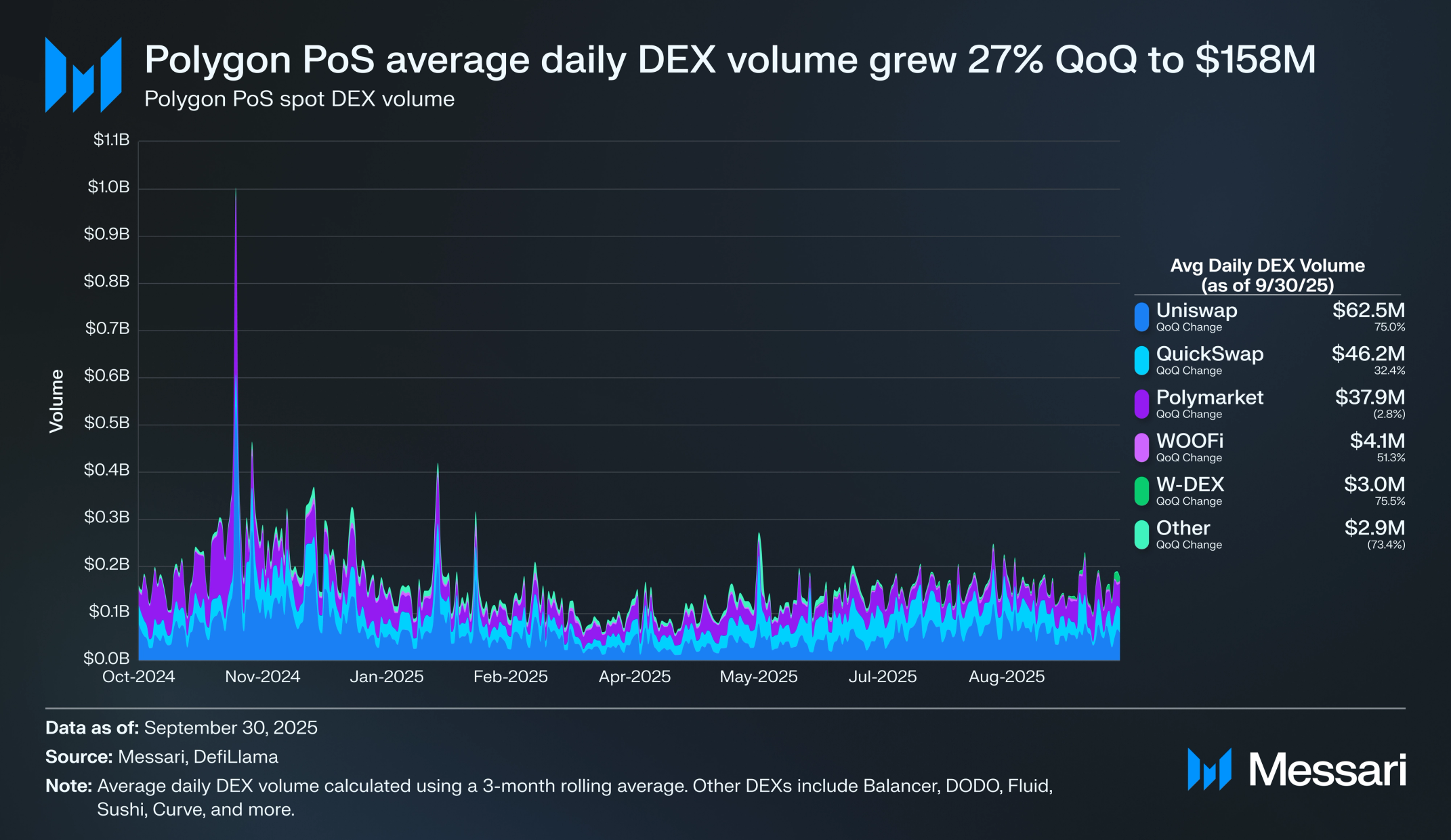
Average daily spot DEX volume rose 27.3% QoQ to $158.0 million. The top five DEXs by average daily volume are listed below:
Uniswap led the market with $62.5 million in average daily volume, up 75.0% QoQ, capturing a 39.6% market share.
QuickSwap ranked second with $46.2 million, a 32.4% QoQ increase and a 29.2% market share.
Polymarket placed third with $37.9 million, down 2.8% QoQ and a 24.0% share.
WOOFi ranked fourth at $4.1 million, up 51.3% QoQ and a 2.6% share.
W-DEX rounded out the top five with $3.0 million, up 75.5% QoQ and a 1.9% share.
Polymarket
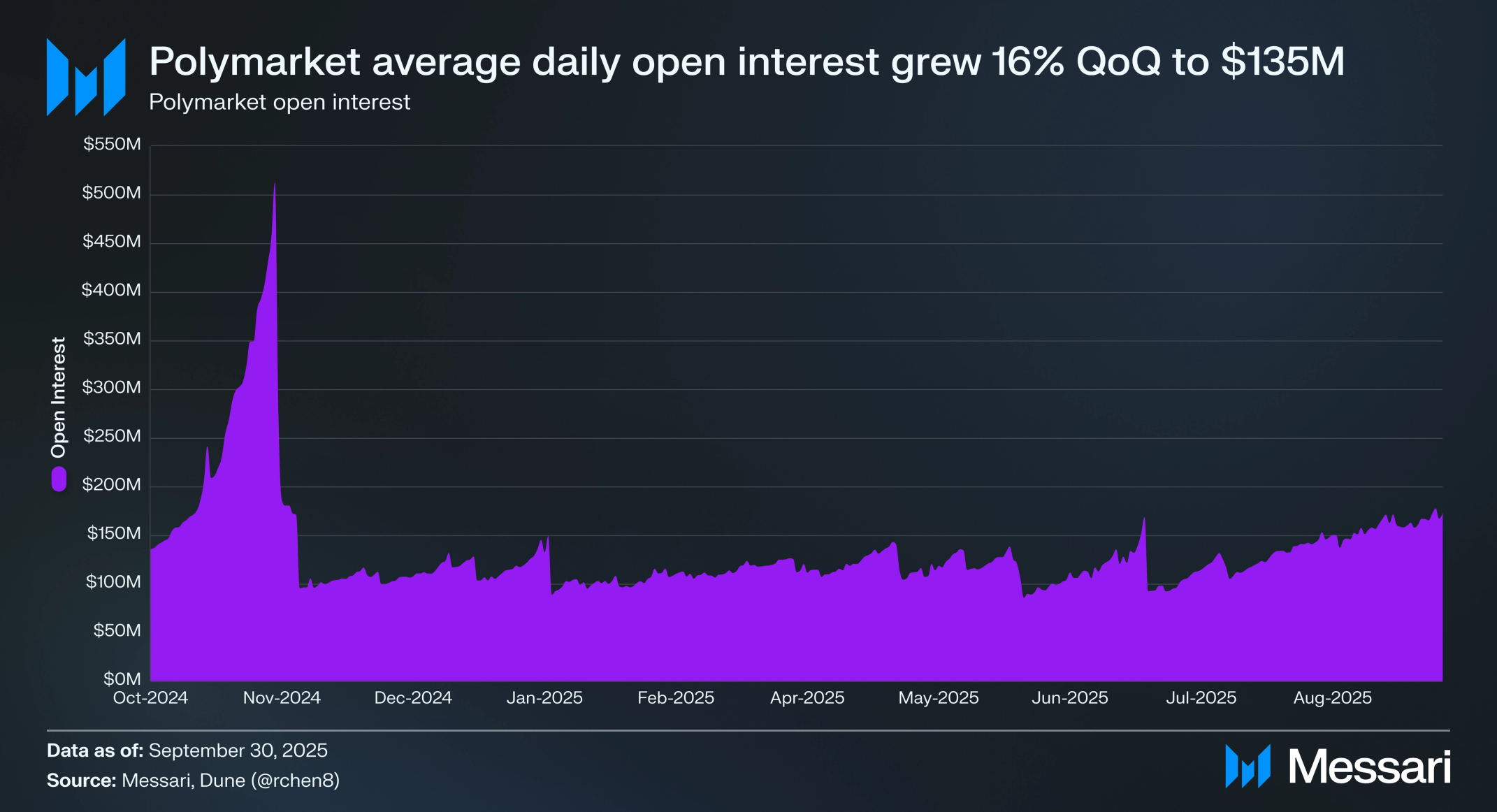
Despite falling from its peak in Q4 2024 around the U.S. presidential election, Polymarket has maintained open interest in recent quarters. Polymarket had an average daily open interest of $135.0 million in Q3, a 16.2% QoQ increase.
In July, Polymarket acquired CFTC-regulated derivatives exchange and clearinghouse QCEX for $112.0 million, enabling it to re-enter the U.S. market under a compliant framework. The deal follows Polymarket’s 2022 settlement with the CFTC, which required the prediction market to cease serving U.S. users and pay a $1.4 million fine. QCEX, which has filed to become a designated contract market, brings the regulatory infrastructure Polymarket lacked, enabling it to legally offer event-based contracts to American users. Following this acquisition, in September, Polymarket was given the green light by the CFTC to officially relaunch in the U.S.
Also in September, Polymarket partnered with Chainlink to integrate the Chainlink data standard into its resolution process. The partnership initially focuses on enhancing the accuracy and speed of asset pricing resolutions, with plans to expand into additional markets.
NFTs
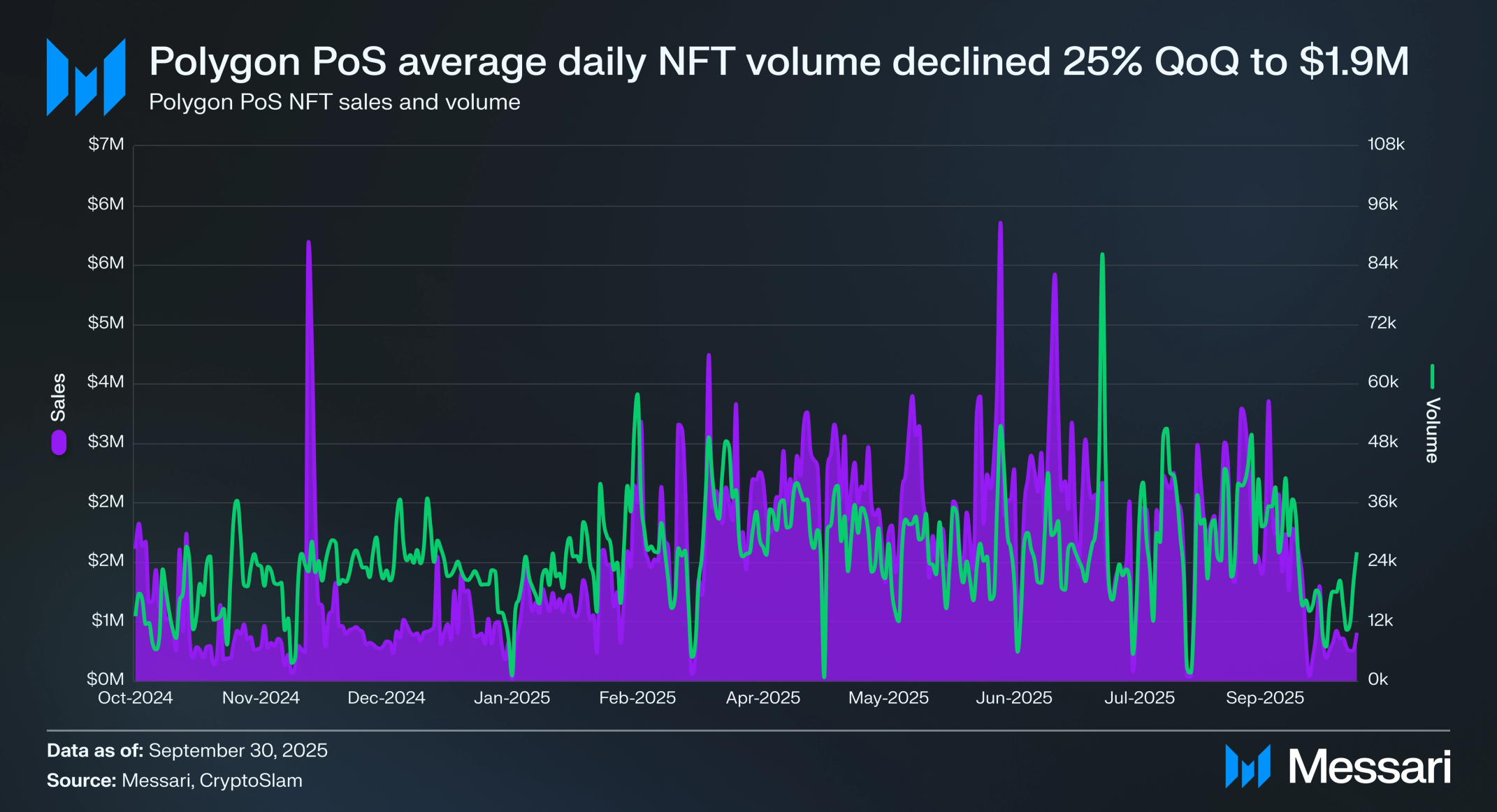
Polygon PoS experienced a decline in NFT activity during Q3 2025. Average daily NFT trading volume dropped to $1.9 million, representing a 22.1% QoQ decrease. Conversely, average daily NFT sales rose to 27,400, marking a 2.3% QoQ increase. NFT activity during the quarter was primarily driven by Courtyard, which recorded $157.8 million in sales (90.4% of total NFT volume in the quarter). Polygon experienced a quarterly peak in daily NFT trading volume of $5.5 million on July 3, 2025, fueled by demand for Pokémon NFTs on Courtyard.
Closing Summary
In Q3 2025, Polygon advanced across financial performance, infrastructure, and ecosystem growth. POL’s circulating market cap rose 39.2% QoQ to $2.36 billion, outperforming the broader crypto market’s 20.7% increase. Chain GDP expanded 22.9% QoQ to $21.9 million, driven by higher application revenue and a 19.5% improvement in the App Revenue Capture Ratio. Network activity strengthened with average daily transactions up 20.2% and active addresses up 13.0%, while average fees fell to $0.0027, improving cost efficiency.
DeFi liquidity remained resilient, with TVL increasing 6.1% QoQ to $1.14 billion, led by QuickSwap, Aave, and Polymarket. Stablecoin supply grew 22.0% QoQ to $2.94 billion, primarily from USDT, which rose 35.4% to $1.4 billion. Payments-focused applications processed $1.82 billion in transfer volume across more than 50 platforms, while crypto cards recorded $322.2 million in Mastercard and Visa transaction volume. RWA tokenization accelerated, reaching $1.14 billion in total value, with institutional launches from NRW.BANK, BeToken, DBM, and 21X demonstrating Polygon’s expanding role in regulated onchain finance.
On the infrastructure side, Polygon made major progress toward its Gigagas roadmap. The Bhilai Hardfork boosted throughput to over 1,000 TPS and added account abstraction via EIP-7702. Heimdall v2 reduced finality to about five seconds, and the Rio Testnet introduced stateless block verification and validator redesign in preparation for 5,000 TPS mainnet performance. Additionally, Agglayer CDK Enterprise launched to provide privacy-first, interoperable infrastructure for institutions building permissioned EVM chains.
Looking ahead, Polygon is positioned to scale further as Rio moves to mainnet and Agglayer integration progresses. With growing activity in payments, DeFi, and RWAs, Polygon continues to strengthen its position as a foundational layer for global onchain finance.
This report was commissioned by Polygon Labs. All content was produced independently by the author(s) and does not necessarily reflect the opinions of Messari, Inc. or the organization that requested the report. The commissioning organization may have input on the content of the report, but Messari maintains editorial control over the final report to retain data accuracy and objectivity. Author(s) may hold cryptocurrencies named in this report. This report is meant for informational purposes only. It is not meant to serve as investment advice. You should conduct your own research and consult an independent financial, tax, or legal advisor before making any investment decisions. Past performance of any asset is not indicative of future results. Please see our Terms of Service for more information.
No part of this report may be (a) copied, photocopied, duplicated in any form by any means or (b) redistributed without the prior written consent of Messari®.
Jake is a Research Analyst on the Protocol Research team. He previously worked as an Investment Analyst at an AI-driven crypto research platform and as a Venture Analyst at a digital assets venture fund. He advised multiple RWA tokenization projects on tokenomics. Jake graduated from the University of Southern California, where he studied Philosophy and Finance.
Jake is a Research Analyst on the Protocol Research team. He previously worked as an Investment Analyst at an AI-driven crypto research platform and as a Venture Analyst at a digital assets venture fund. He advised multiple RWA tokenization projects on tokenomics. Jake graduated from the University of Southern California, where he studied Philosophy and Finance.