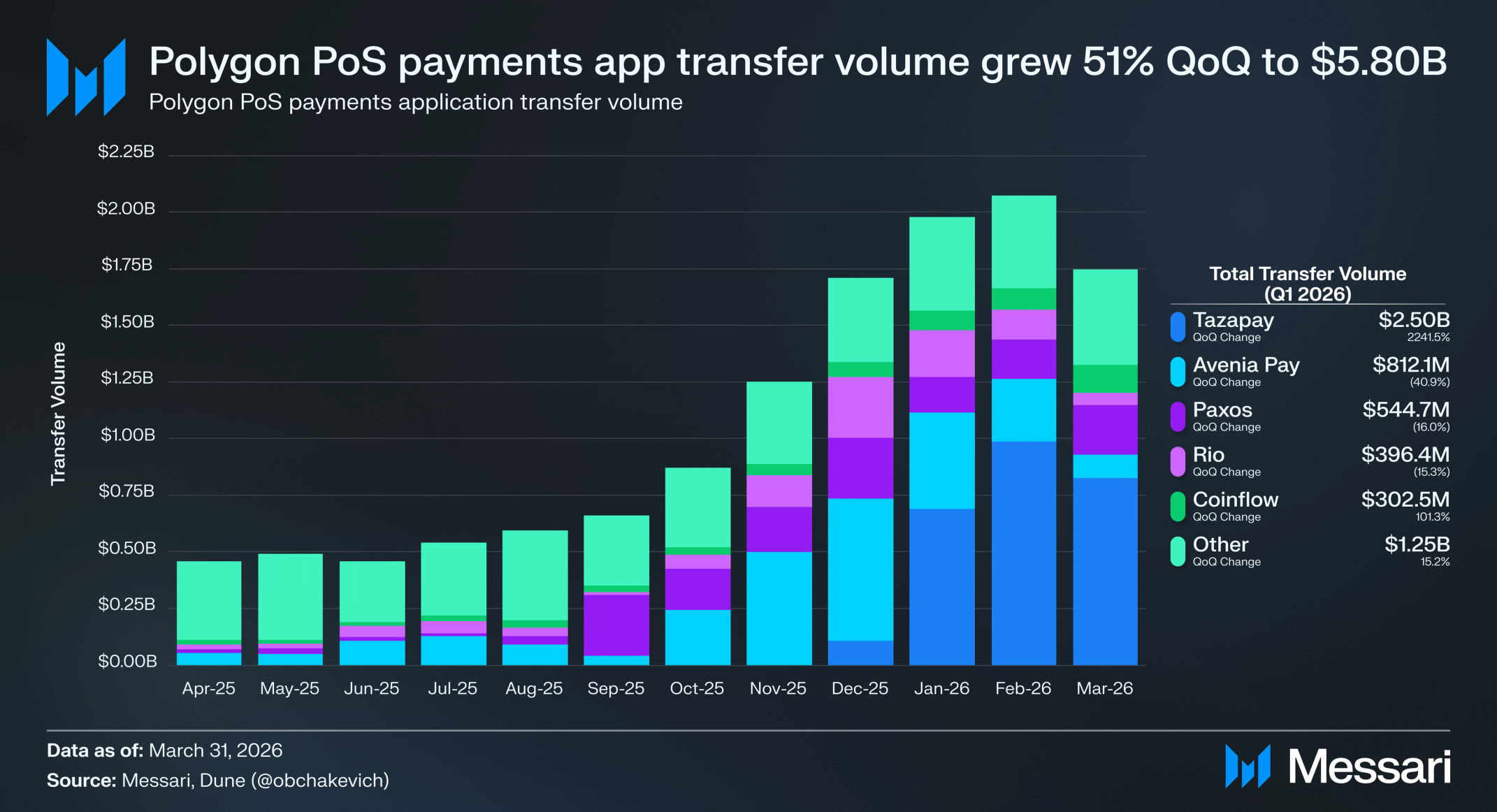
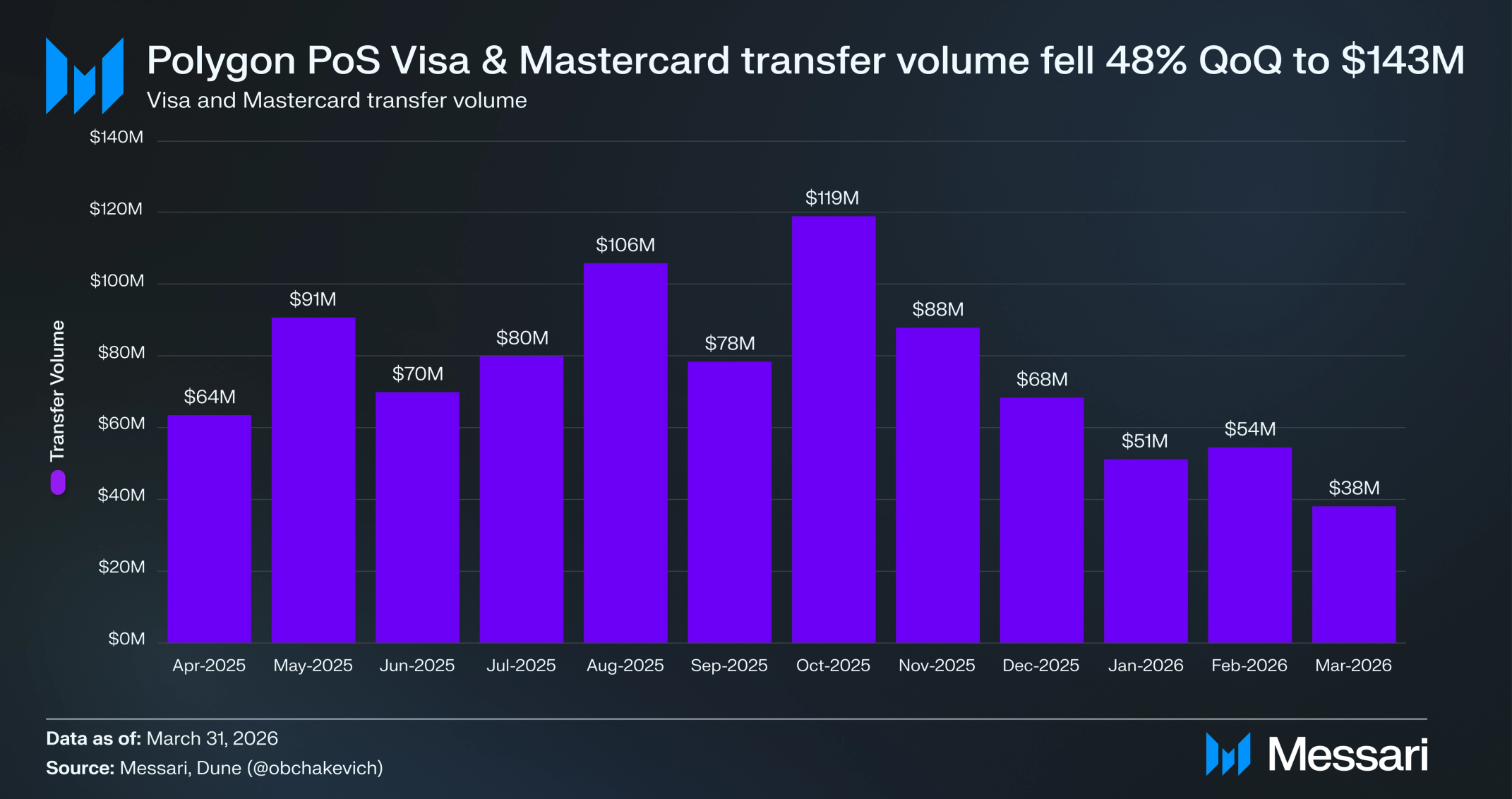
Over 50 payments-focused applications on Polygon PoS facilitated $5.80 billion in transfer volume (+51.4% QoQ), while crypto card volume declined 47.9% QoQ to $143.4 million, highlighting divergence across payment verticals.
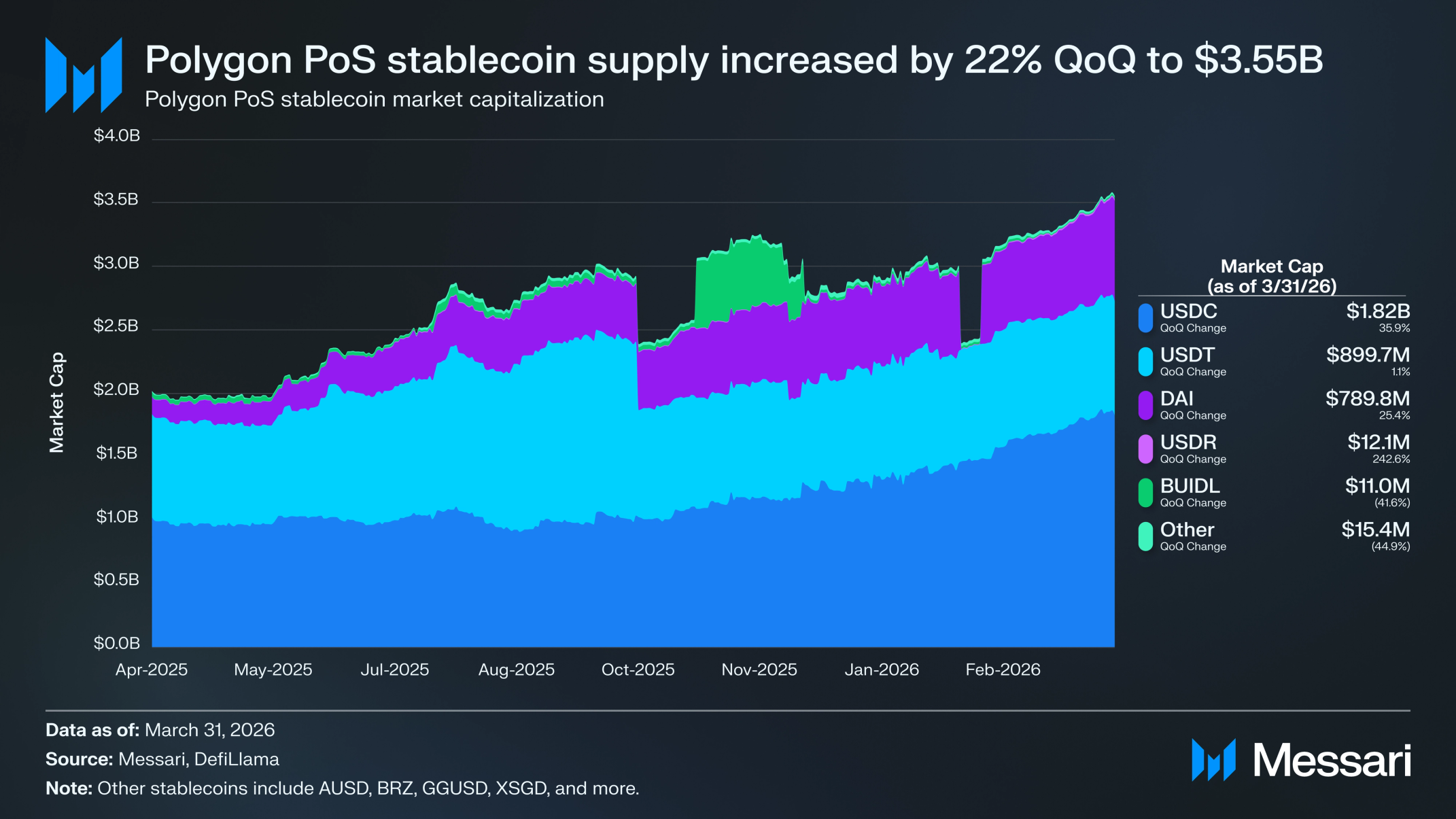
Stablecoin supply grew 21.3% QoQ to $3.55 billion, led by USDC and DAI, while non-USD activity diverged regionally, declining in LatAm but surging in APAC.
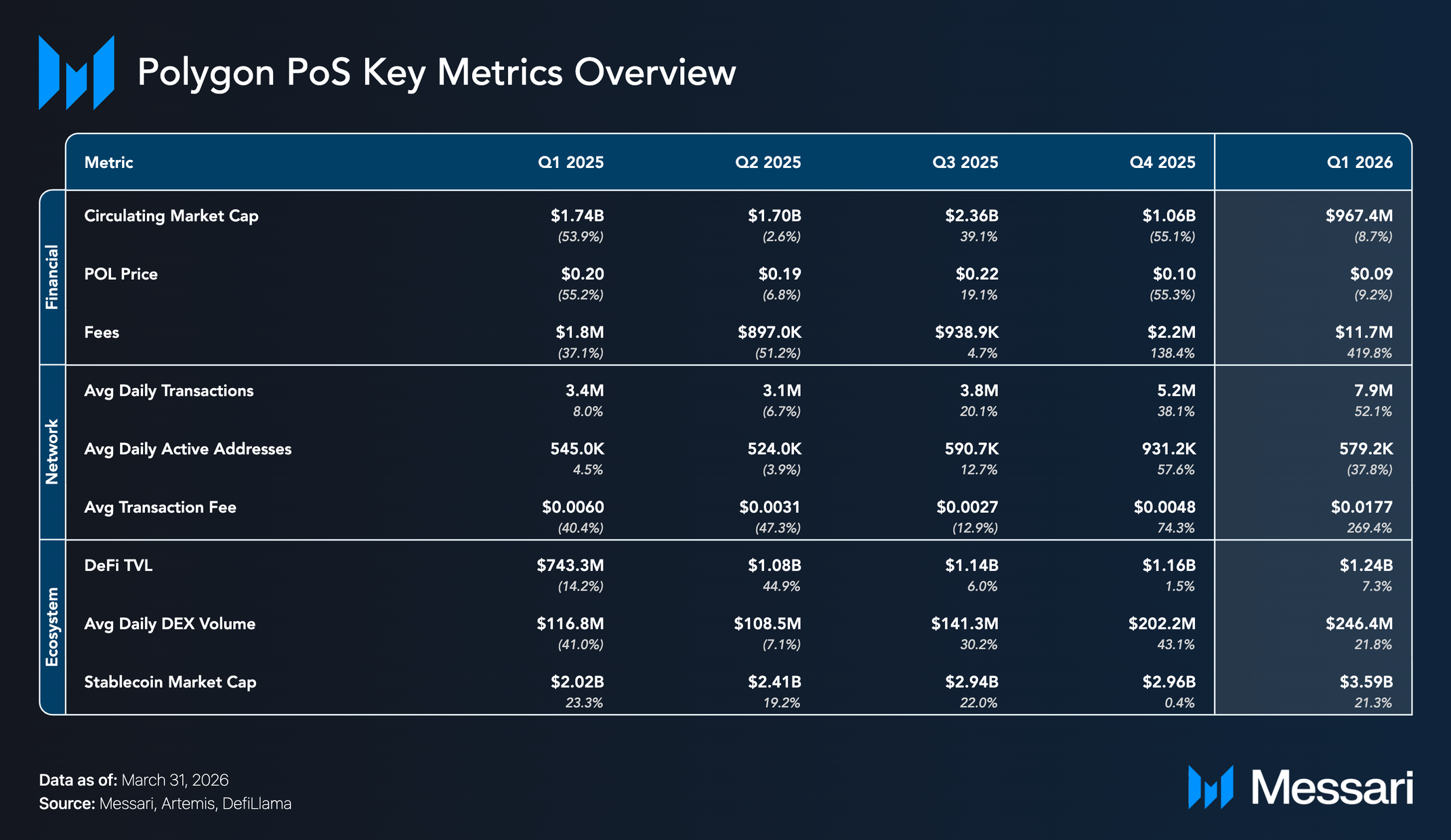
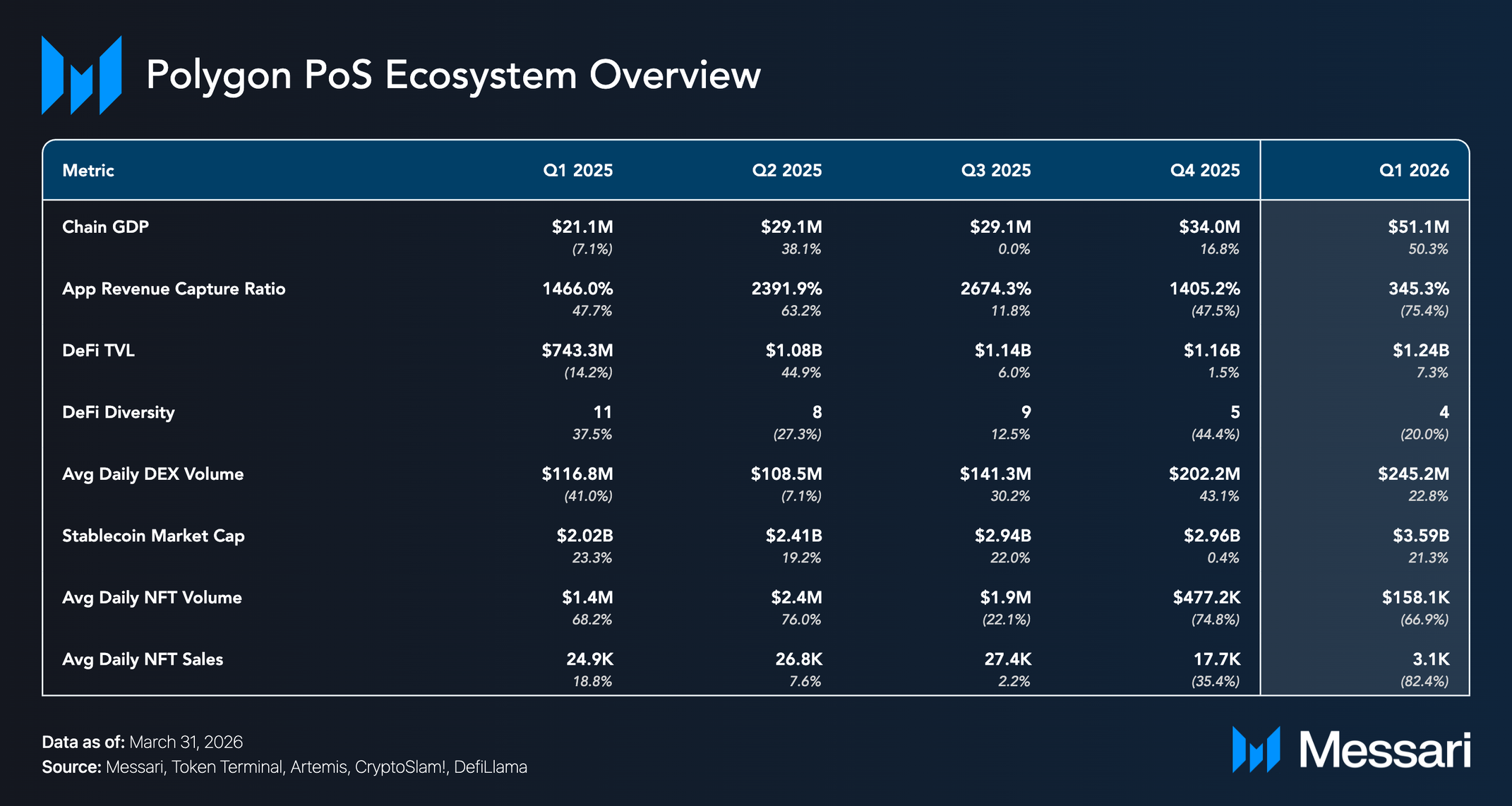
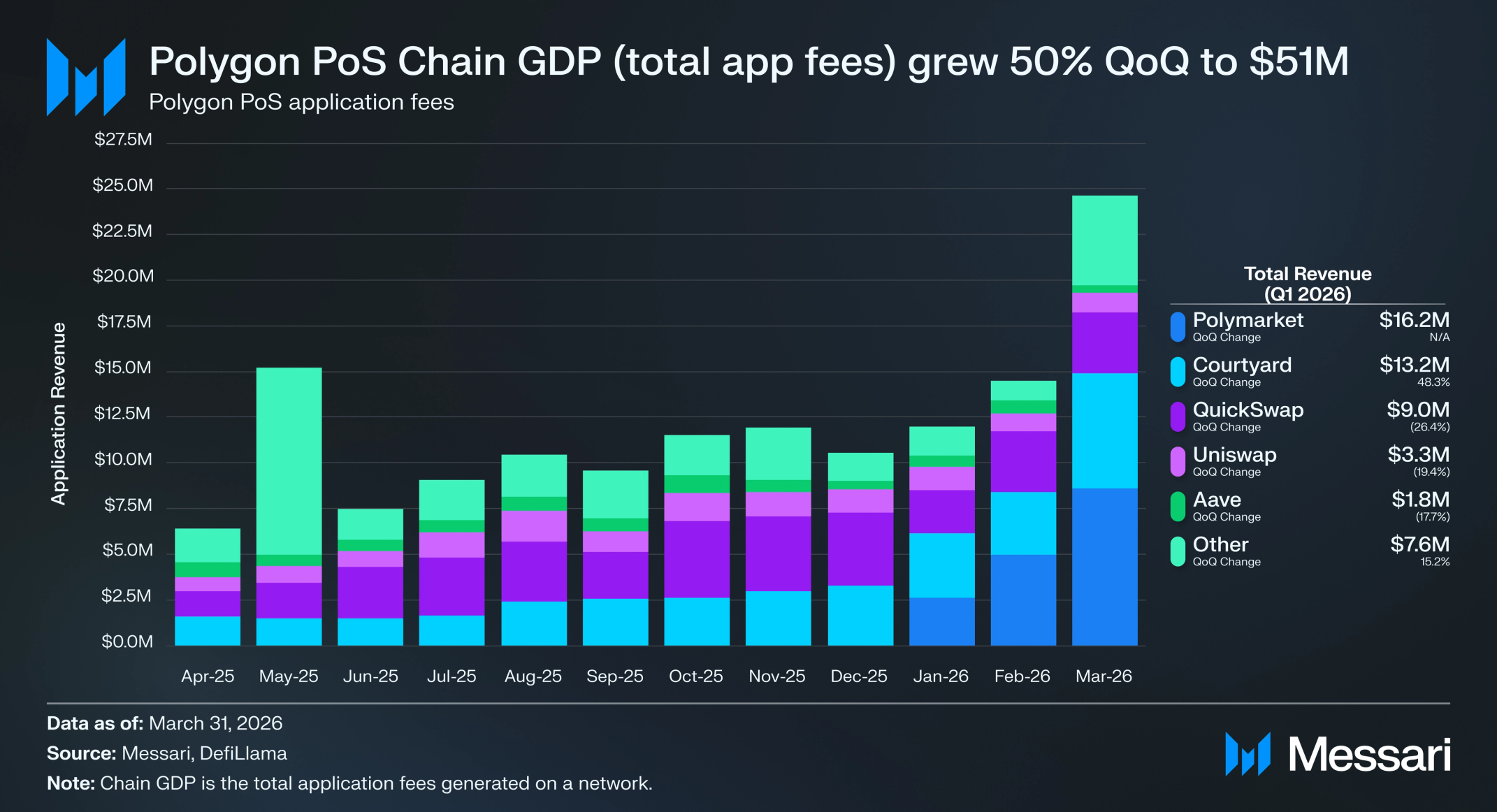
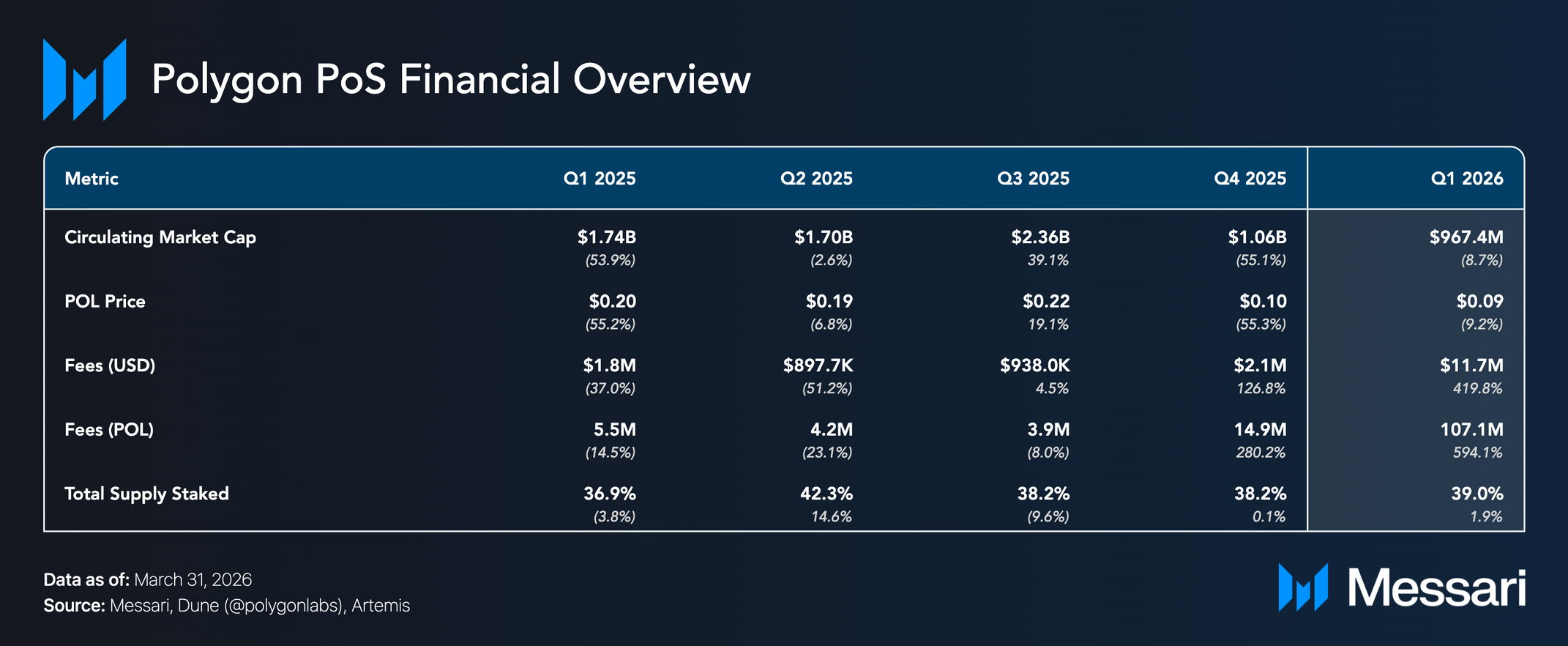
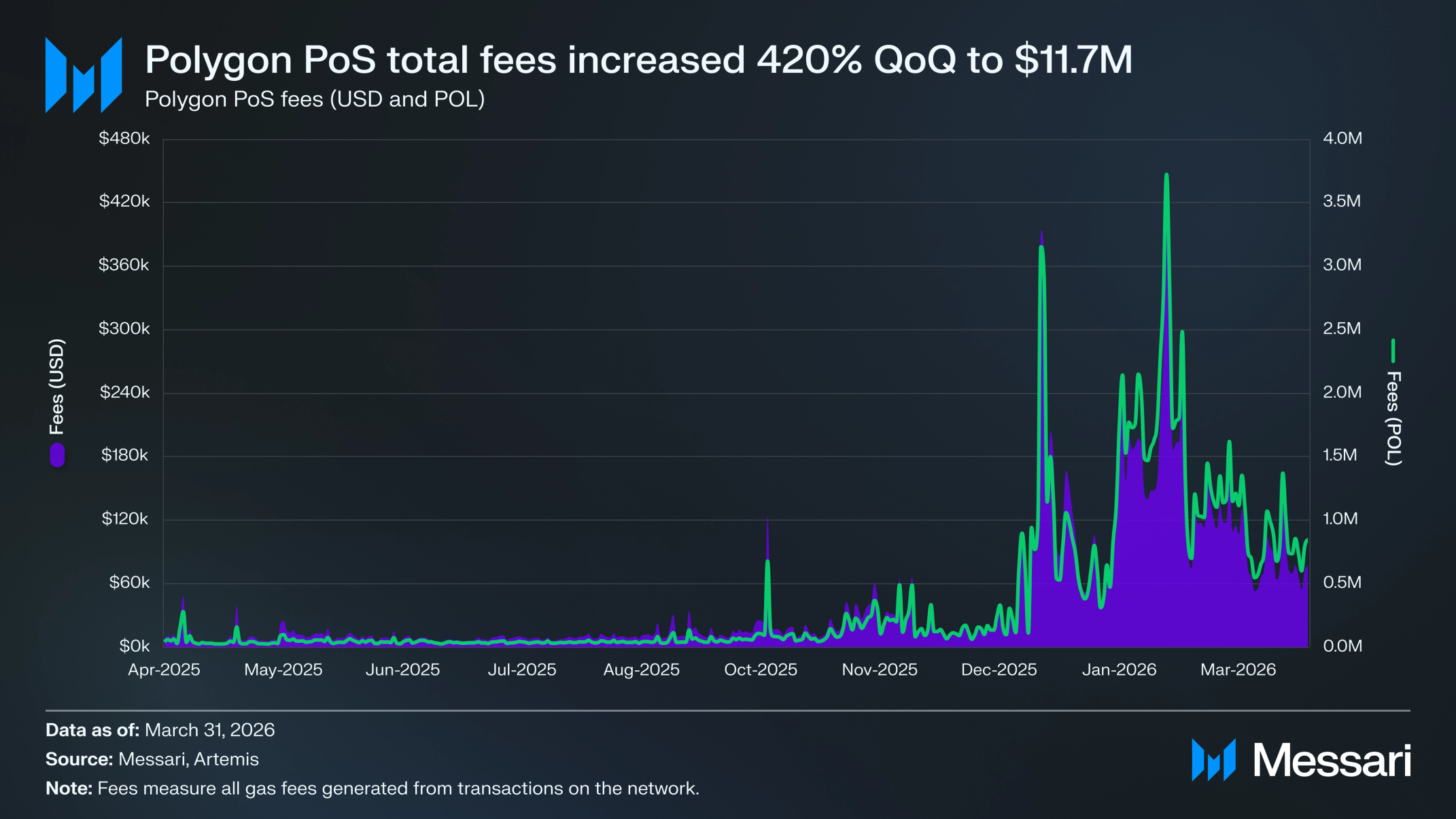
Chain fees grew 419.8% QoQ to $11.7 million, the highest quarterly value on record. Chain GDP increased 50.3% QoQ to $51.1 million, though App Revenue Capture Ratio fell 75.4% QoQ to 3.45x, signaling weaker relative value capture.
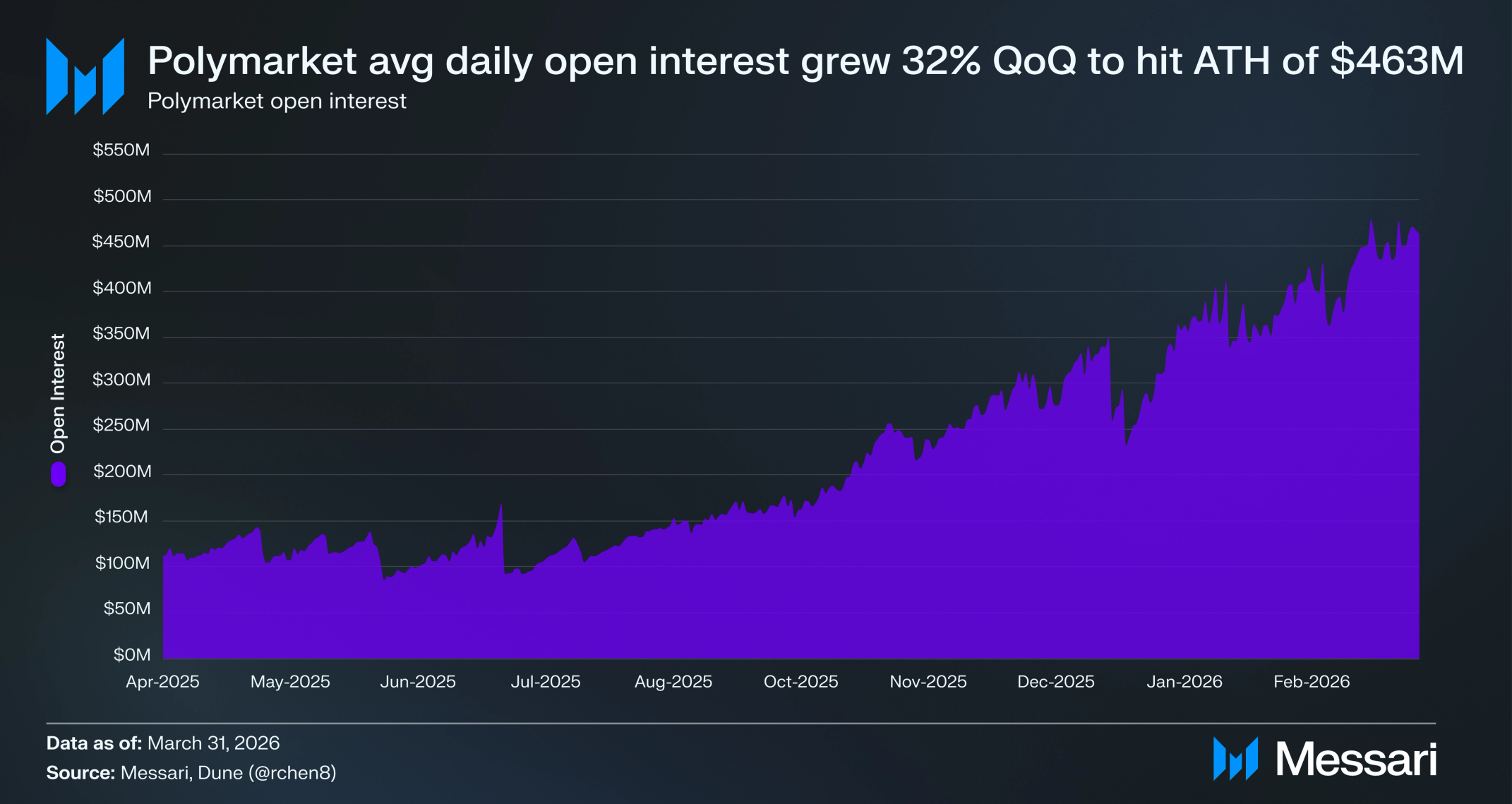
Polymarket reached a new ATH of $463.1 million in average daily open interest (+32.4% QoQ), continuing to anchor activity and revenue on the network.
Polygon doubled gas limits to 120M and surpassed 2,800 TPSthroughsuccessive upgrades and the Lisovo hardfork, improving fee dynamics and enabling agent-native payments.
Primer
Polygon Labs is a global blockchain payments company building infrastructure for stablecoin-based payments and onchain money movement at scale. Its core objective is to support faster, lower-cost, and more reliable settlement by combining blockchain rails with the orchestration and interoperability required to integrate with existing financial systems.
The Polygon Proof-of-Stake (PoS) network serves as the primary production environment for this effort, supporting large-scale stablecoin transfers, card settlement, remittances, and enterprise payment flows. To support these use cases, Polygon Labs is developing the Open Money Stack (OMS), an integrated set of blockchain networks, interoperability protocols, and supporting services designed to make onchain money usable within existing financial workflows. The OMS encompasses blockchain settlement, cross-chain coordination, wallet infrastructure, on- and off-ramps, stablecoin interoperability, and compliance tooling. While several components are already in production, others remain under active development as Polygon Labs expands its payments capabilities.
From an architectural perspective, Polygon Labs continues to invest heavily in zero-knowledge (ZK) technology as a foundation for scaling payments and interoperability. This includes the development of multiple ZK-based systems such as Polygon zkEVM and Polygon Miden, as well as the Polygon Chain Development Kit (CDK), which enables the deployment of application-specific chains. Within the OMS framework, CDK chains are intended to support institution-facing use cases while remaining interoperable with the broader ecosystem. These systems are designed to interoperate through the Agglayer, which aims to coordinate liquidity and settlement across connected chains while anchoring to Ethereum.
The Project Team Commentary section of this report was written by the Polygon Labs team and reflects the views, opinions, and forward-looking statements of Polygon Labs only. This section is included to provide additional context on the project’s strategy, priorities, and outlook and does not necessarily reflect the views or opinions of Messari, Inc.
Stablecoins processed $28 trillion in 2025, surpassing traditional payment networks in volume for the first time. Enterprise payments still demand compliant fiat access, usable wallets, cross-chain routing, and predictable settlement without stitching together a fragile stack of vendors. This is why we’re building the Open Money Stack: to bring all those requirements into a single, vertically integrated platform. Q2 is where we saw the platform grow significantly.
Between December and March, we more than doubled the Polygon network's sustained throughput, from 1,000 TPS to 2,800, across two hard forks and six gas limit increases, while Polymarket ran $3.4 billion in January volume. A hard fork in March made the fee market runtime-configurable, so the next demand surge requires a simple parameter change. An upgrade in April added faster block confirmation and fee transparency surfaced directly in block headers. Private Mempool, also live in Q2, gives any app a single-line integration to protect transactions from frontrunning, which is a baseline requirement for payments and settlement.
Polygon network is core to the Open Money Stack, one unified, open platform for moving money globally: settlement on the Polygon network, an embedded wallet that’s live, cross-chain routing that has processed over $200 million in volume since general availability in February, and Coinme (currently being acquired by Polygon Labs, pending regulatory approval) connecting the stack to fiat through 50,000+ U.S. retail locations and available in 48 states.
The same infrastructure logic applies to RWAs. T-REX Ledger, announced in March in collaboration with T-REX Network and Apex Group’s Tokeny, is a dedicated compliance blockchain built with Polygon CDK and connected through Agglayer, Polygon's cross-chain protocol unifying crypto liquidity. Apex Group, which services $3.5 trillion in assets globally, has committed to $100 billion in tokenized assets on T-REX Ledger by June 2027. The ERC-3643 standard behind it already covers more than $32 billion in tokenized securities, backed by 140+ institutions, including DTCC, Deloitte, and Fireblocks. T-REX Ledger solves a specific problem: compliance state that travels with the asset across chains, so institutions do not rebuild investor registries and transfer rules on every network they touch. It shows how the Open Money Stack can support real institutional demand.
Institutions and neobanks putting real volume on Polygon should expect headroom to keep rising underneath them, quarter after quarter.
Ecosystem Analysis
Payments
Polygon has established itself as a natural home for payment solutions, offering low fees, fast settlement, and an accessible development environment. In Q1 2026, over 50 payments-focused applications on Polygon PoS facilitated $5.80 billion in transfer volume, up 51.4% QoQ. The top five leaders by transfer volume in Q1 were:
In Q1, stablecoin-linked crypto cards processed $143.4 million in combined Mastercard and Visa volume on Polygon PoS, across ten different card programs. Mastercard accounted for $96.6 million and Visa for $46.8 million. Total transfer volume declined 47.9% QoQ, indicating a pullback in card-driven payment activity following higher levels in Q3 and Q4 2025.
Despite the quarterly contraction, Polygon PoS continues to be utilized as settlement infrastructure for stablecoin payments, with payment networks, fintechs, and enterprises leveraging the network for card programs, remittances, and merchant settlement. Developments in the payments ecosystem during Q1 include:
Polygon Labs signed definitive agreements to acquire Coinme (pending regulatory approval) and Sequence, adding regulated U.S. fiat on- and off-ramps, enterprise wallet infrastructure, and cross-chain payment orchestration to its broader stablecoin payments stack. Coinme brings operations across 48 U.S. states and licensed money movement infrastructure, while Sequence addssmart wallet and transaction-routing technology.
Tokulaunched global stablecoin payroll on Polygon, enabling compliant payroll payments across more than 100 countries. By integrating with existing enterprise payroll systems such as ADP, Workday, UKG, and Gusto, Toku allows companies to adopt stablecoin-based payroll without overhauling internal workflows, while handling compliance, tax withholding, benefits, and local filings across jurisdictions.
Polygon joinedMastercard’s Crypto Partner Program, creating a channel to collaborate on stablecoin payments and onchain settlement use cases within Mastercard’s broader payments ecosystem.
Honda Autobol and Takenoslaunched a Polygon-powered payments campaign in Bolivia, enabling customers to pay for vehicle maintenance through Takenos while receiving promotional discounts.
WalletConnect Payadded support for payments on Polygon, enabling merchants and payment service providers to accept wallet-based crypto and stablecoin payments through a single integration without changing their existing payment stack.
MoonPay launched the Open Wallet Standard with native Polygon support, enabling AI agents and developer tools to create wallets, manage keys, and sign transactions on Polygon through a common open-source interface.
Real-world Assets
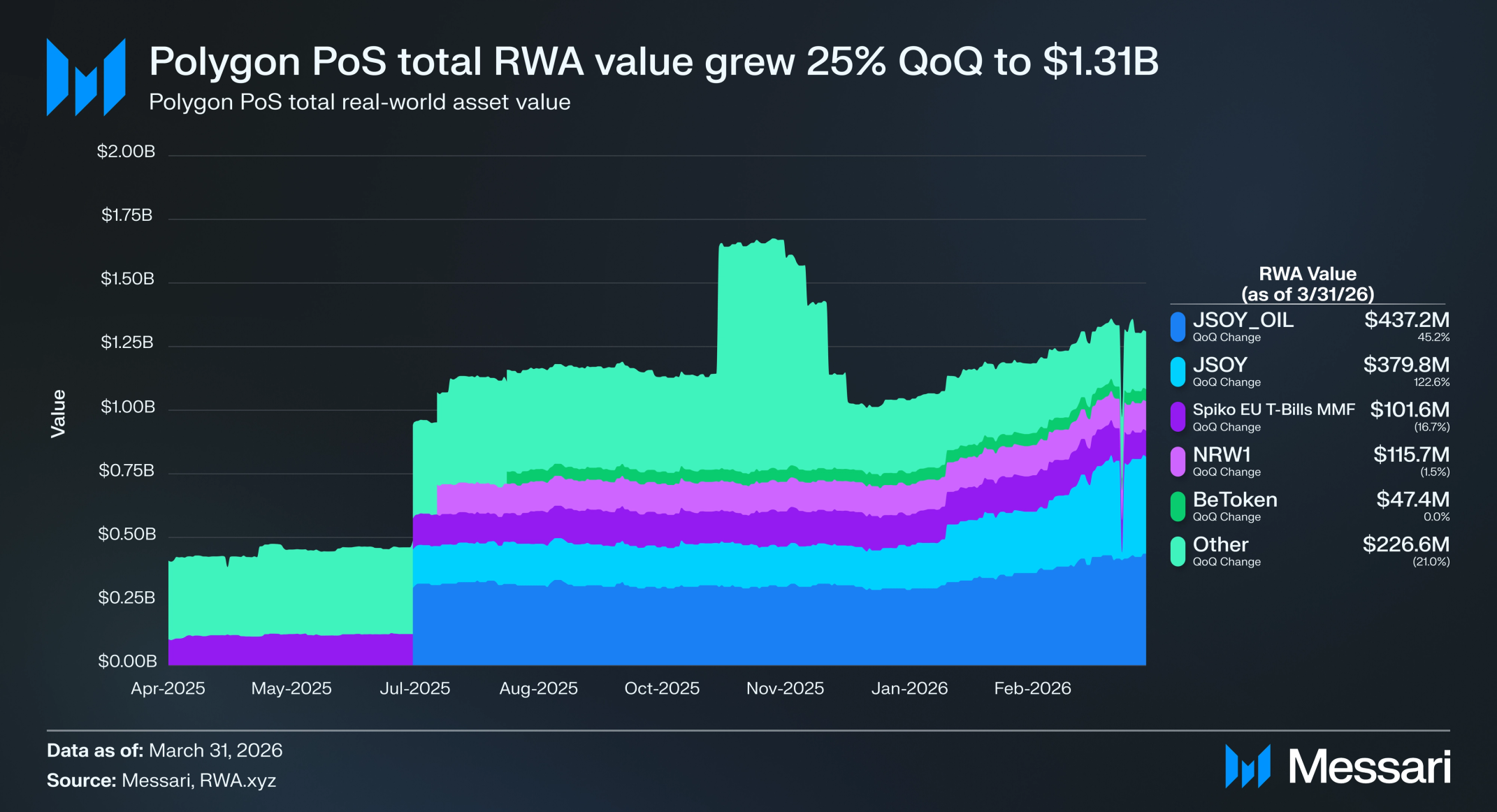
Real-world assets (RWAs) continued to gain momentum on Polygon in Q1, reinforcing the network’s role as a core infrastructure layer for asset tokenization. Growing demand from traditional financial institutions, alongside increased adoption of tokenized commodities such as soybean (JSOY) and soybean oil (JSOY_OIL), drove a notable increase in onchain RWA allocations. Polygon ranked 10th by total RWA value at quarter's end, totaling $1.31 billion, a 25.1% QoQ increase. Key RWA developments this quarter include:
Polygon Labs, Apex GroupTokeny, and T-REX NetworklaunchedT-REX Ledger, a compliance-focused blockchain for tokenized real-world assets built with Polygon CDK. Apex Group, which services $3.5 trillion in assets, will use the network as its default multichain orchestration infrastructure and committed $100 billion in tokenized assets by June 2027.
Billon Financelaunched Asia’s first leveraged vault for tokenized assets on Polygon, introducing lending infrastructure designed specifically for yield-bearing RWAs. Supported by AlloyX Group and Polygon Labs, the protocol uses isolated lending pools and curator-led risk governance to bring leverage, liquidity, and more active capital management to tokenized asset strategies onchain.
Chain GDP
Chain GDP is defined as the total application revenue generated on a network. In Q1, Polygon’s Chain GDP grew 50.3% QoQ to $51.1 million. The top five leaders by application revenue in Q1 were:
A network’s App Revenue Capture Ratio (App RCR) is the ratio of revenue generated by its applications to its Real Economic Value (REV). In the case of Polygon PoS, REV is defined as the sum of base transaction fees and priority fees. In Q1, Polygon’s App RCR was 3.45x, a 75.4% QoQ decrease. This implies that for every $100 spent in Polygon transaction fees, applications earned approximately $345 in revenue.
For context, App RCR varied across major ecosystems in Q1:
A higher App RCR suggests that application revenue is driven by lower-velocity, higher-margin activity such as lending, borrowing, or stablecoin-related flows. Conversely, a lower App RCR indicates that revenue is more closely tied to higher-velocity activity, such as trading, payments, or token launches, where economic throughput is higher, but monetization per unit of activity is lower.
DeFi
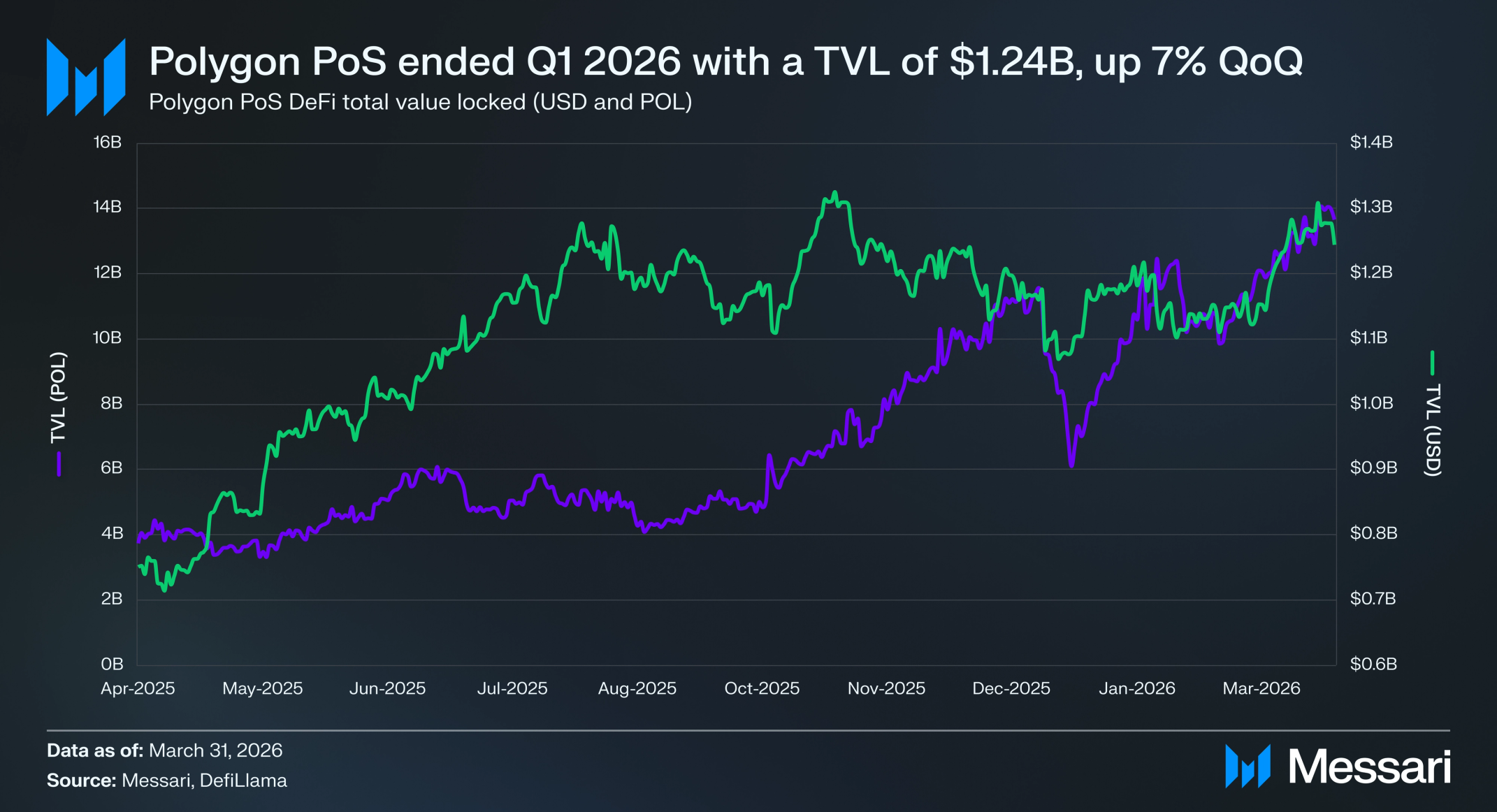
Polygon PoS DeFi total value locked (TVL) ended Q1 at $1.24 billion, up 7.3% QoQ and representing 1.4% of total DeFi TVL. Polygon remained the 11th-largest network by TVL.
TVL by Protocol
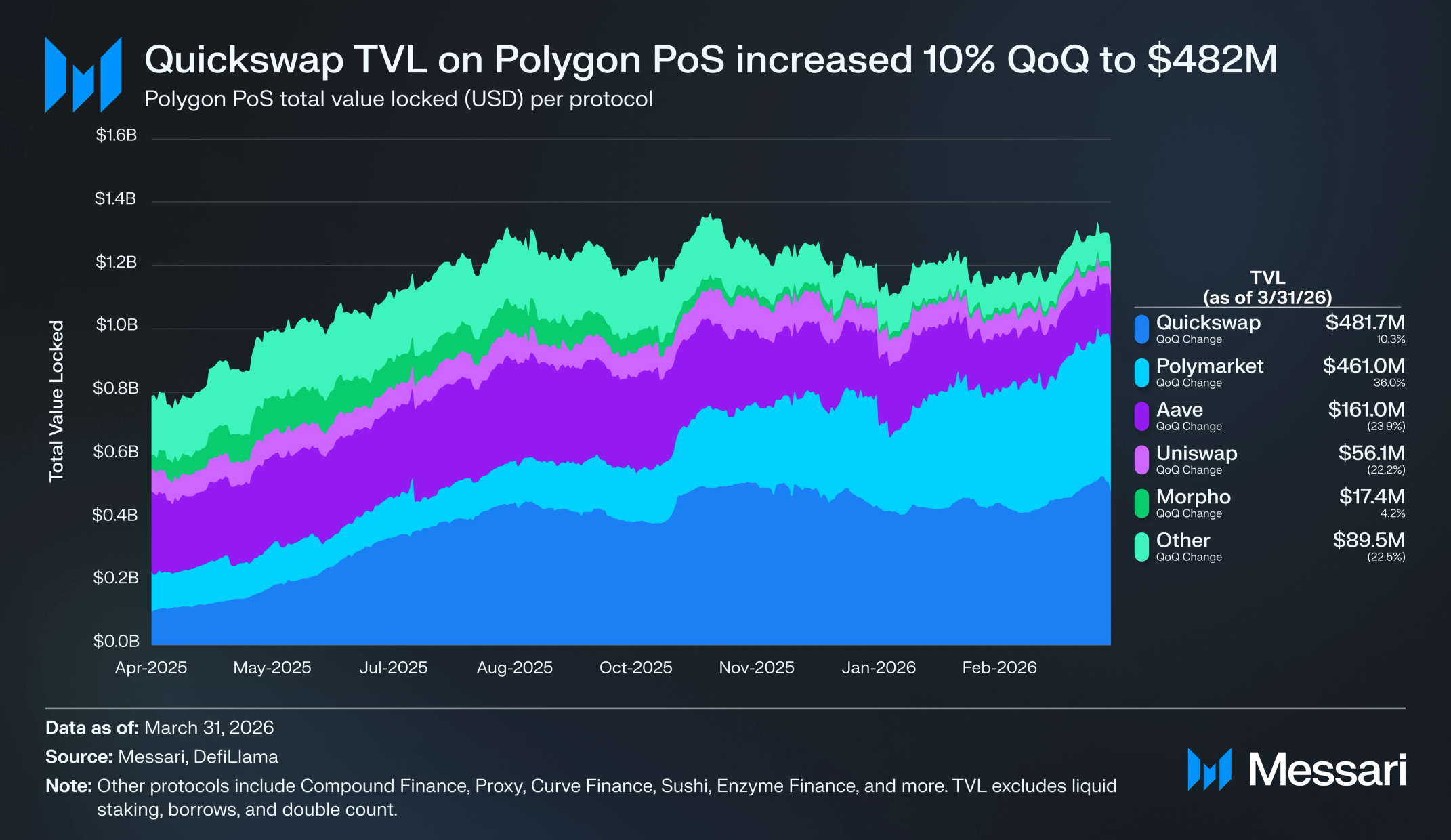
QuickSwap remained the largest protocol by TVL on Polygon PoS in Q1, ending the quarter at $481.7 million (+10.3% QoQ). Polymarket followed with $461.0 million (+36.0% QoQ), maintaining its position as the second-largest protocol. Aave ranked third with $161.0 million in TVL (-23.9% QoQ), while Uniswap held fourth at $56.1 million (-22.2% QoQ), with declines largely reflecting token price depreciation as AAVE and UNI were down around 40% over the same period. Morpho surpassed Proxy to enter the top five, ending the quarter with $17.4 million in TVL (+4.2% QoQ).
Stablecoins
Polygon PoS ended Q1 with $3.55 billion in stablecoin supply, up 21.3% QoQ. Growth was broad-based across major assets, led by USDC, which increased 35.9% QoQ to $1.82 billion, with part of the growth driven by Polymarket activity. DAI also expanded 25.4% QoQ to $789.8 million, while USDT saw more modest growth of 1.1% QoQ to $899.7 million. Among smaller assets, USDR was the fastest-growing stablecoin, rising 242.6% QoQ to $12.1 million. In contrast, BUIDL declined 41.6% QoQ to $11.0 million, partially reversing prior quarter gains.
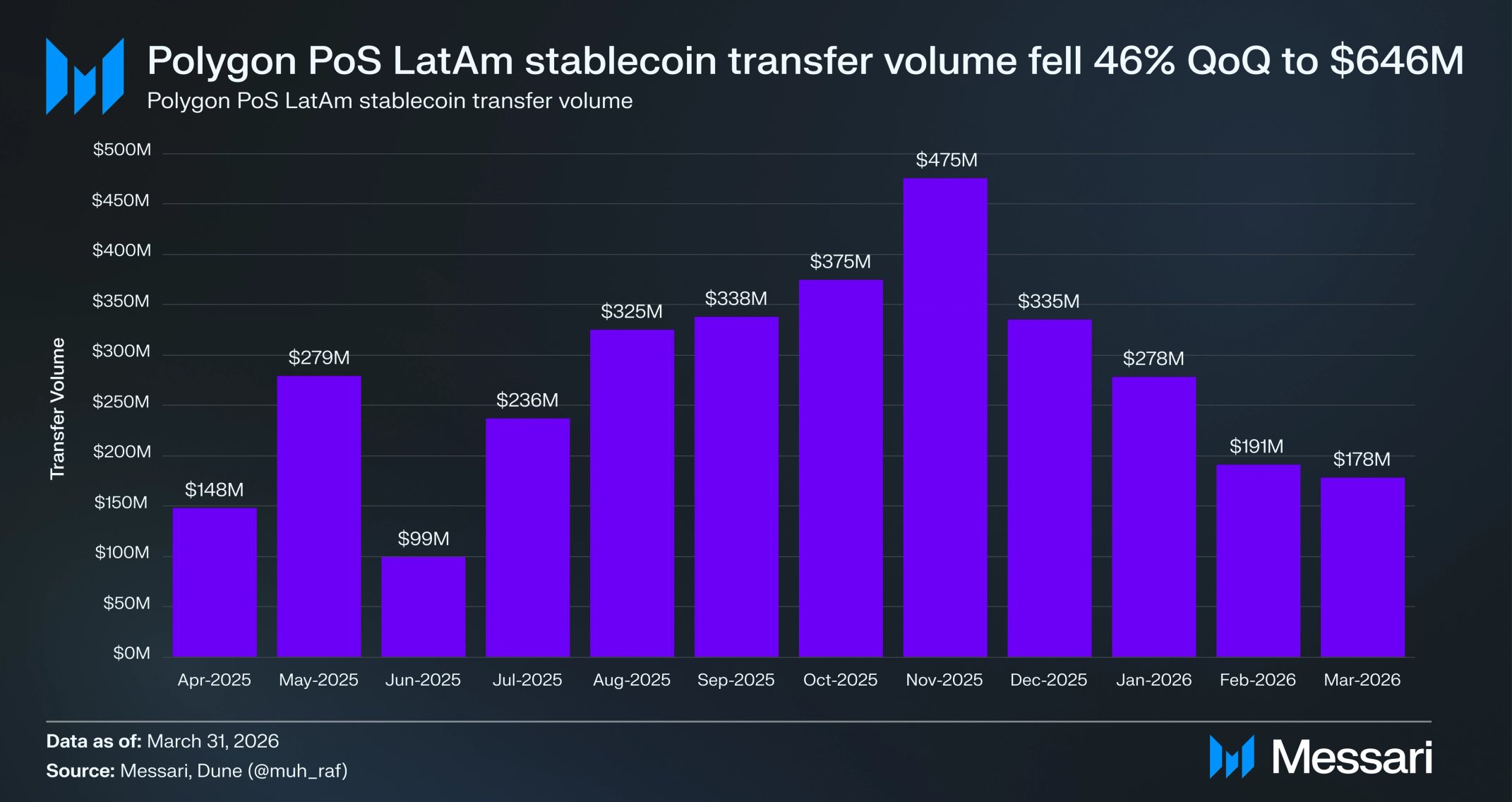
Non-USD stablecoin activity in Latin America contracted on Polygon PoS in Q1, though the network maintained its role as a key settlement layer for regional payments and cross-border transfers. LatAm stablecoin transfer volume on Polygon decreased 45.5% QoQ to $646.1 million. Despite the decline, Polygon processed approximately 69% of total LatAm non-USD stablecoin transfer volume, underscoring its continued importance in regional onchain payment flows.
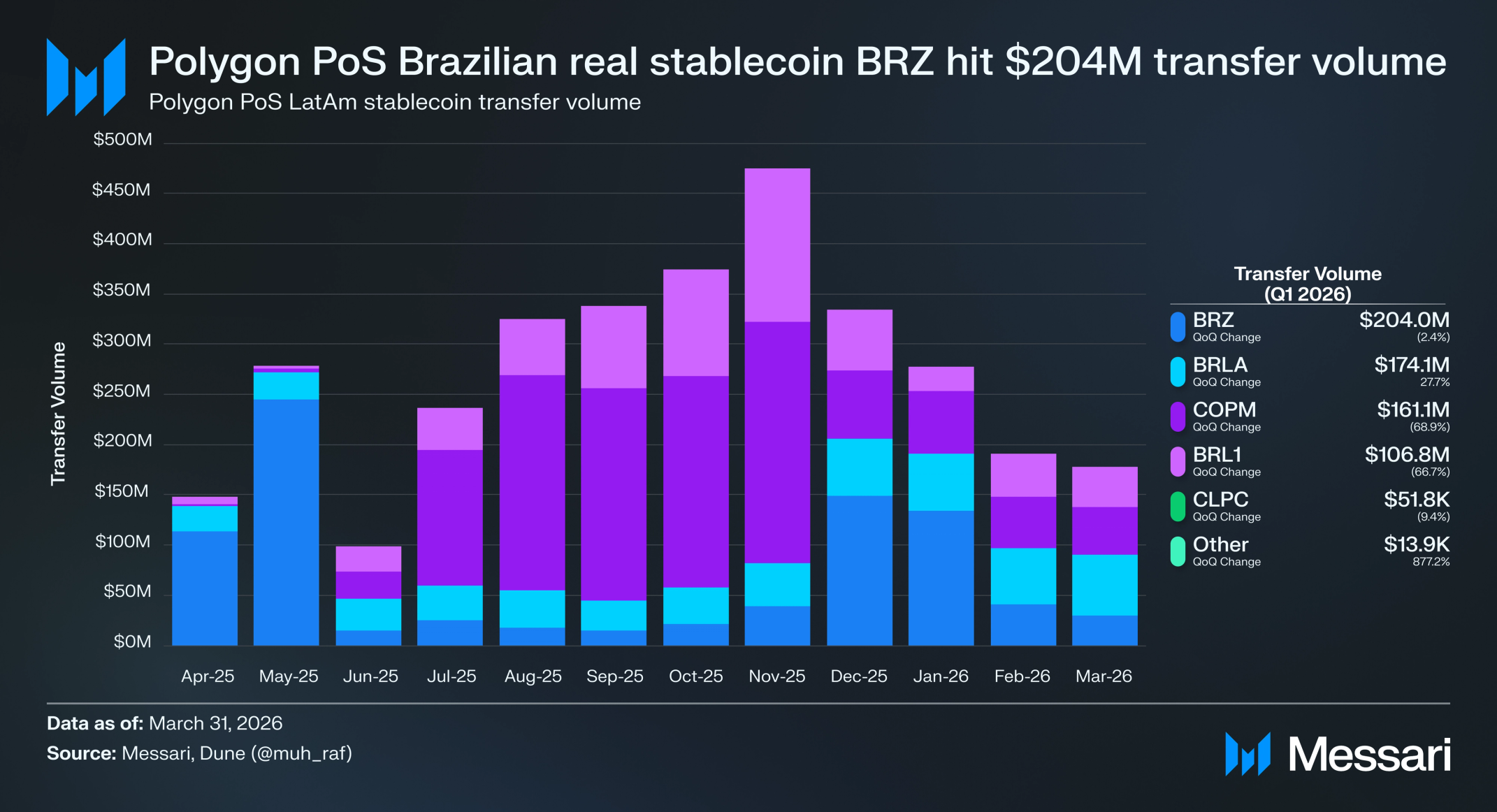
Brazilian real-denominated stablecoins accounted for the largest share of transfer activity on Polygon in Q1, with BRL-backed assets (BRLA, BRL1, and BRZ) facilitating $507.1 million in cumulative transfer volume. Colombian peso-denominated stablecoins were the second-largest category, with COPM contributing $161.1 million in Q1 transfer volume. Other regional currencies, including peso-linked stablecoins used in Argentina and Chile, contributed smaller but persistent volumes. In February 2026, Grupo Braza, Brazil’s largest foreign exchange bank, expanded its Brazilian real-backed stablecoin, BBRL, to Polygon
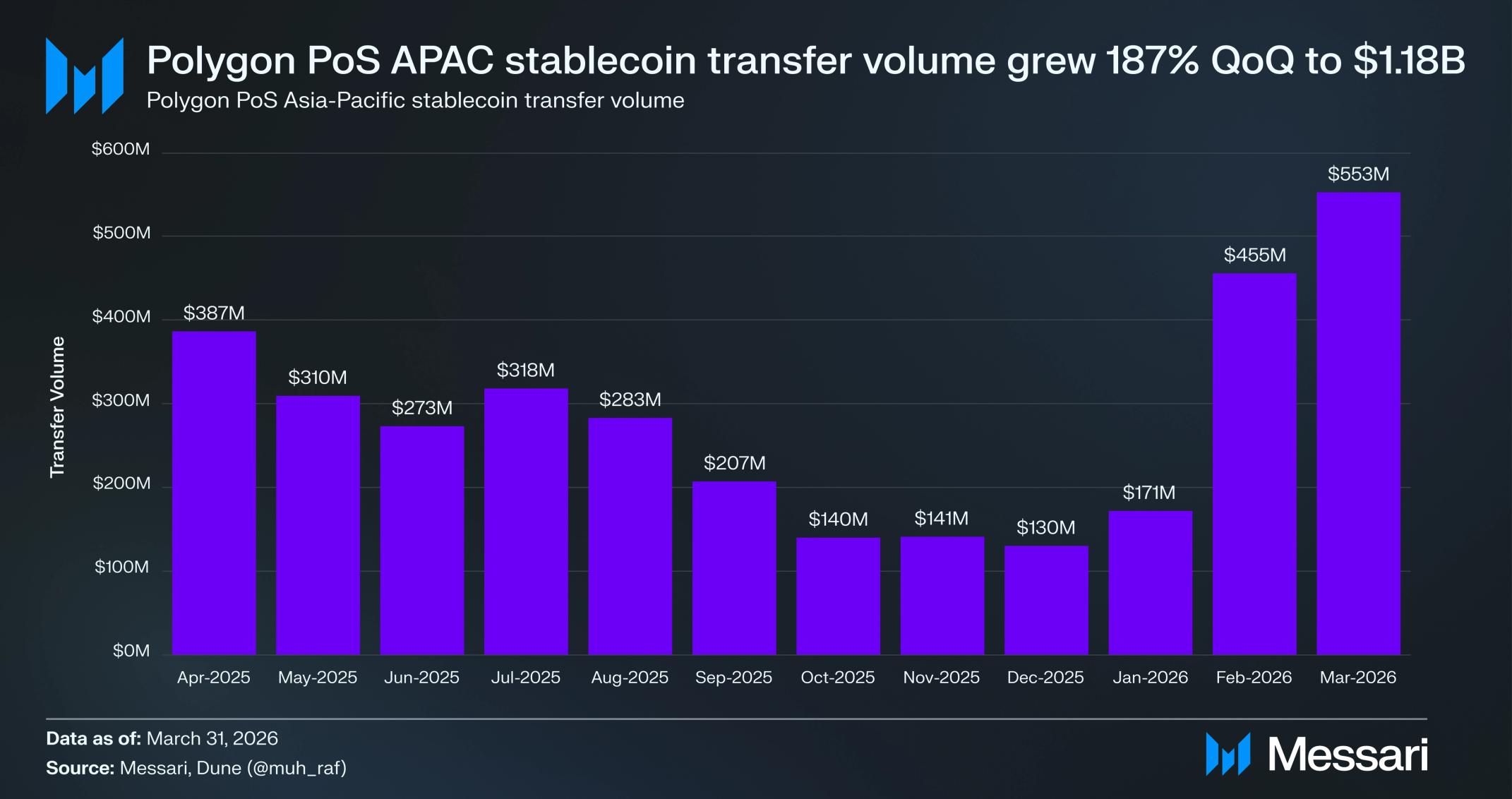
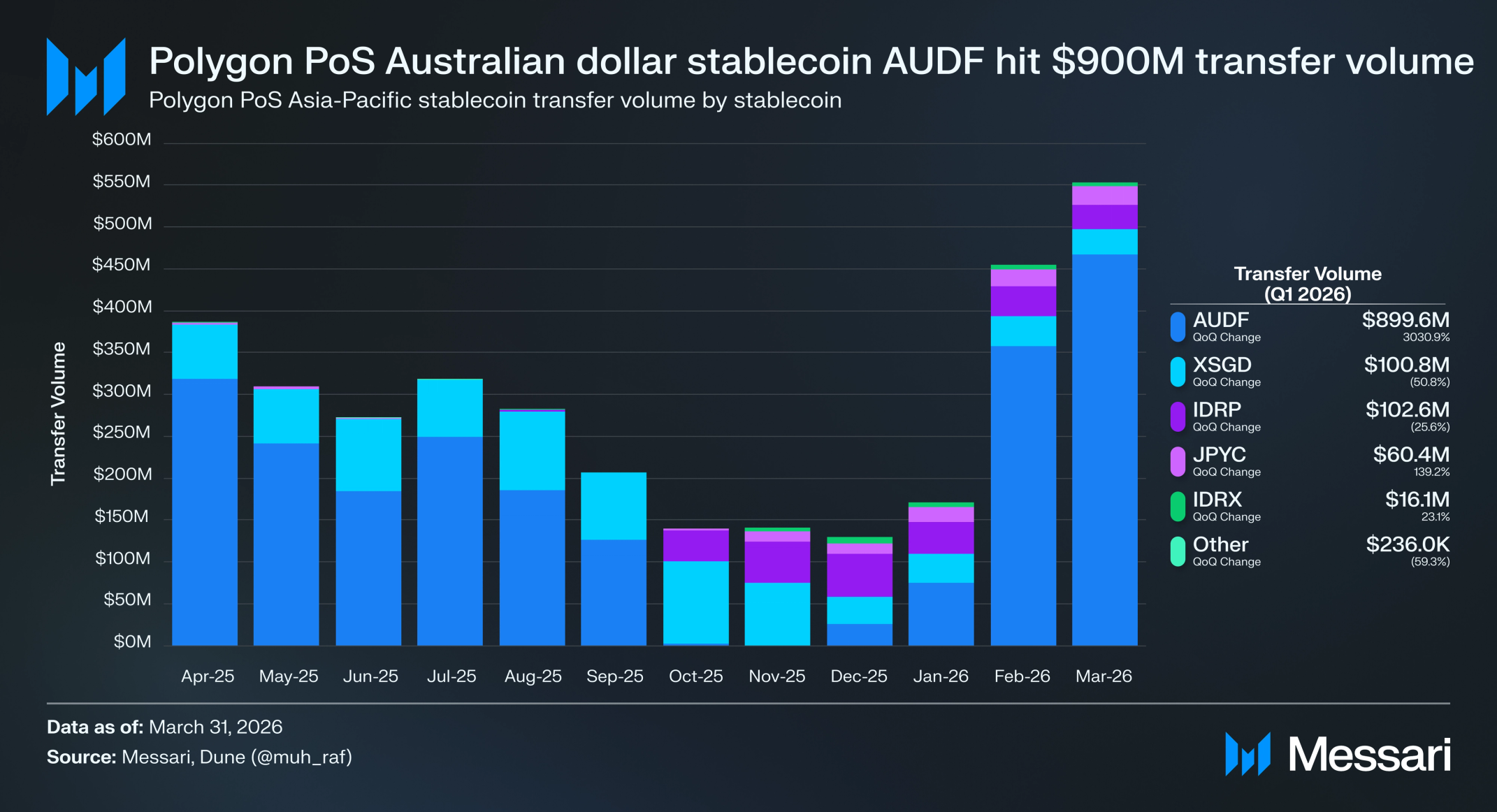
Non-USD stablecoin activity in Asia-Pacific expanded significantly on Polygon PoS in Q1. APAC non-USD stablecoin transfer volume on Polygon grew 187.4% QoQ to $1.18 billion. Polygon accounted for approximately 48% of total APAC non-USD stablecoin transfer volume during the quarter, reinforcing its role as a key settlement network for non-USD stablecoins in the region.
Australian dollar-denominated stablecoins accounted for the largest share of transfer activity on Polygon in Q1, with AUDF facilitating $899.6 million in cumulative transfer volume. Indonesian rupiah-denominated stablecoins formed the second-largest category, with IDR-backed assets (IDRP, IDRT, and IDRX combined) accounting for $118.8 million in Q1 transfer volume. Singapore dollar- and Japanese yen-denominated stablecoins contributed smaller but meaningful volumes, with XSGD processing $100.8 million and JPYC facilitating $60.4 million in transfers during the quarter. Compared to Latin America, APAC usage exhibited a more balanced relationship between outstanding balances and transfer activity, consistent with enterprise- and treasury-oriented use cases rather than high-frequency retail payments.
DEX Volume
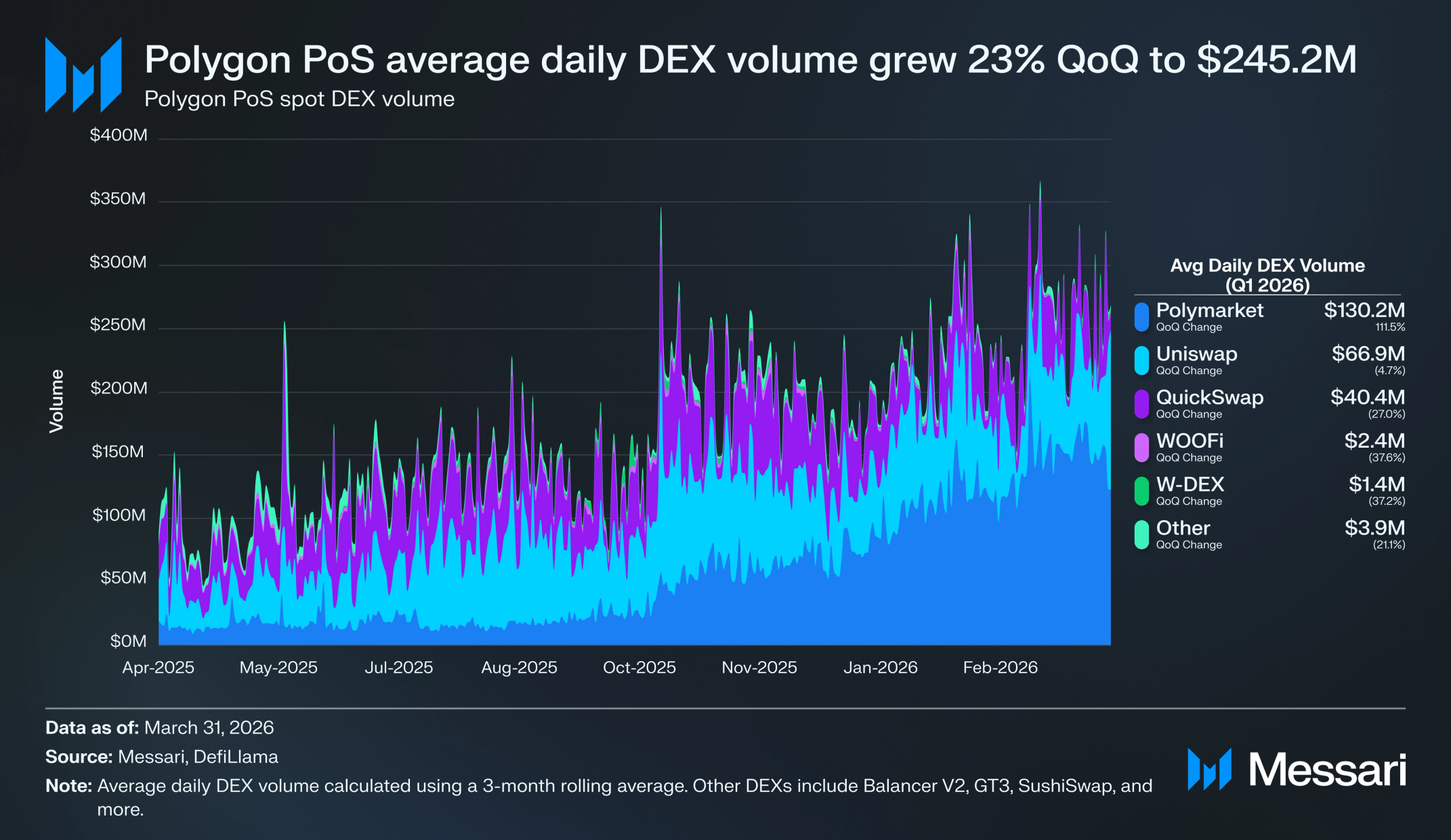
Average daily spot DEX volume rose 22.8% QoQ to $245.2 million. The top five DEXs by average daily volume are listed below:
Polymarket led the market with $130.2 million in average daily volume, up 111.5% QoQ, capturing a 53.1% market share.
Uniswap ranked second with $66.9 million, down 4.7% QoQ and a 27.3% market share.
QuickSwap placed third with $40.4 million, a 27% QoQ decrease and a 16.5% market share.
WOOFi ranked fourth at $2.4 million, down 37.6% QoQ and a 1% share.
W-DEX rounded out the top five with $1.4 million, a 37.2% decrease QoQ and a 0.6% share.
Polymarket
Polymarket recorded an all-time high average daily open interest of $463.1 million in Q1 2026, up 32.4% QoQ, surpassing its prior peak of $349.7 million in Q4 2025. Growth was supported by elevated participation in macro and geopolitical markets, especially Fed rate decision contracts and Iran-related event markets that resolved during Q1. More broadly, Polymarket continued to benefit from the growing use of prediction markets as real-time information and forecasting tools, particularly for events where traditional polling, analyst coverage, or market-based reference points are less timely or less precise.
In February, the platform also partnered with Circle to transition from bridged USDC to native USDC for collateral and settlement, improving scalability and compliance readiness. Throughout Q1, Polymarket expanded distribution and sports-market infrastructure through a series of partnerships. On March 4, the platform signed a multi-year agreement with Betr to bring Polymarket-powered prediction markets to its user base. On March 10, Polymarket partnered with Palantir Technologies and TWG AI to deploy the Vergence AI engine for real-time market integrity monitoring. On March 19, Major League Baseballnamed Polymarket its exclusive official prediction market exchange partner in a multi-year deal, providing access to official league data, logos, and branding, alongside an integrity information-sharing framework involving the CFTC.
Intercontinental Exchange (ICE), the parent company of the New York Stock Exchange, closed a $600 million direct cash investment in Polymarket on March 27 as part of its previously announced agreement, bringing its total commitment to approximately $2 billion.
NFTs
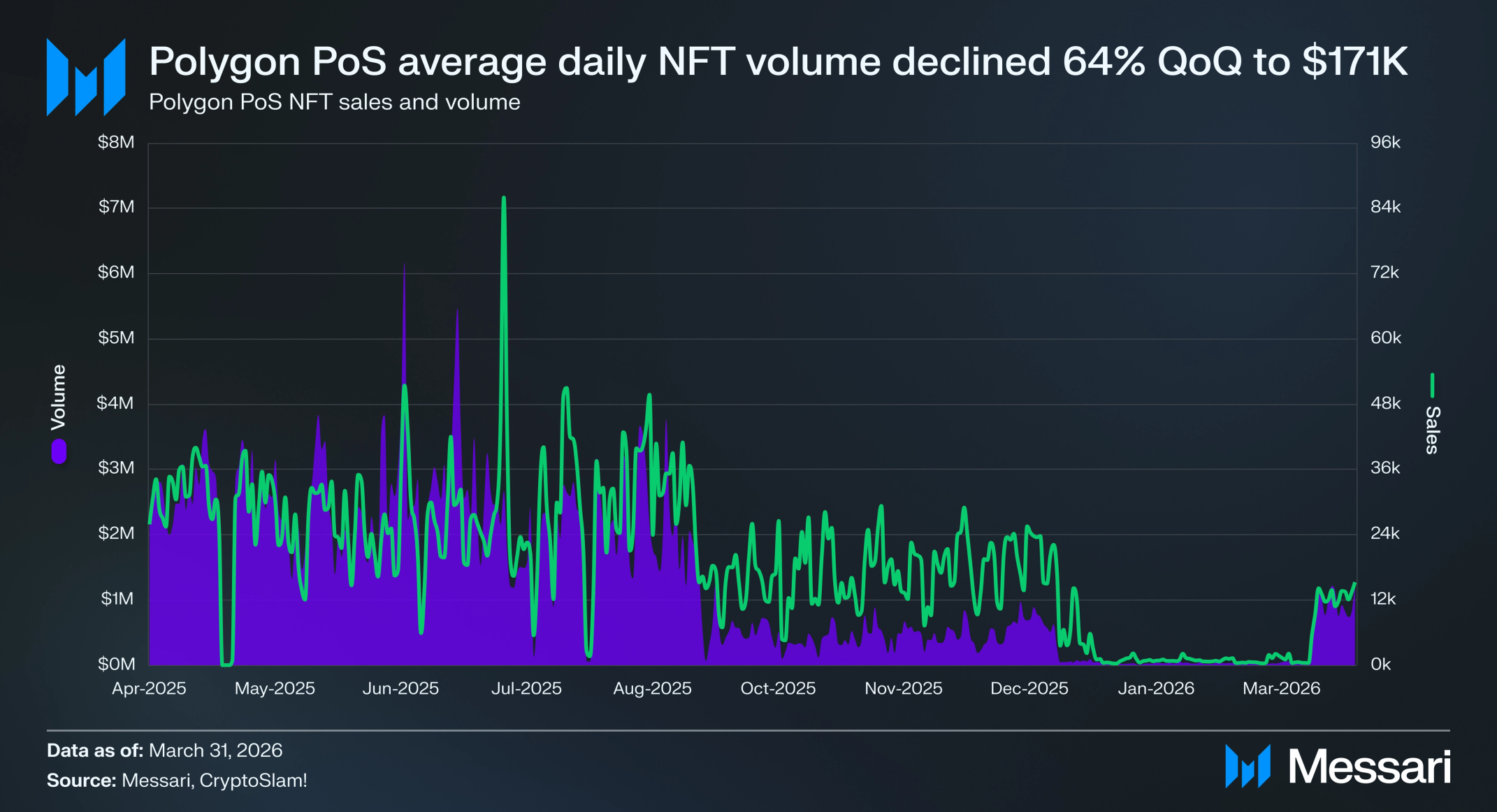
Polygon PoS experienced a decline in NFT activity during Q1. Average daily NFT trading volume dropped 64.3% QoQ to $170,500. Average daily NFT sales also declined to 3,200, marking a 81.7% QoQ decrease. NFT activity during the quarter was primarily driven by Courtyard, which recorded $12.4 million in sales (28.3% of total NFT volume in the quarter).
Financial Analysis
Transaction Fees
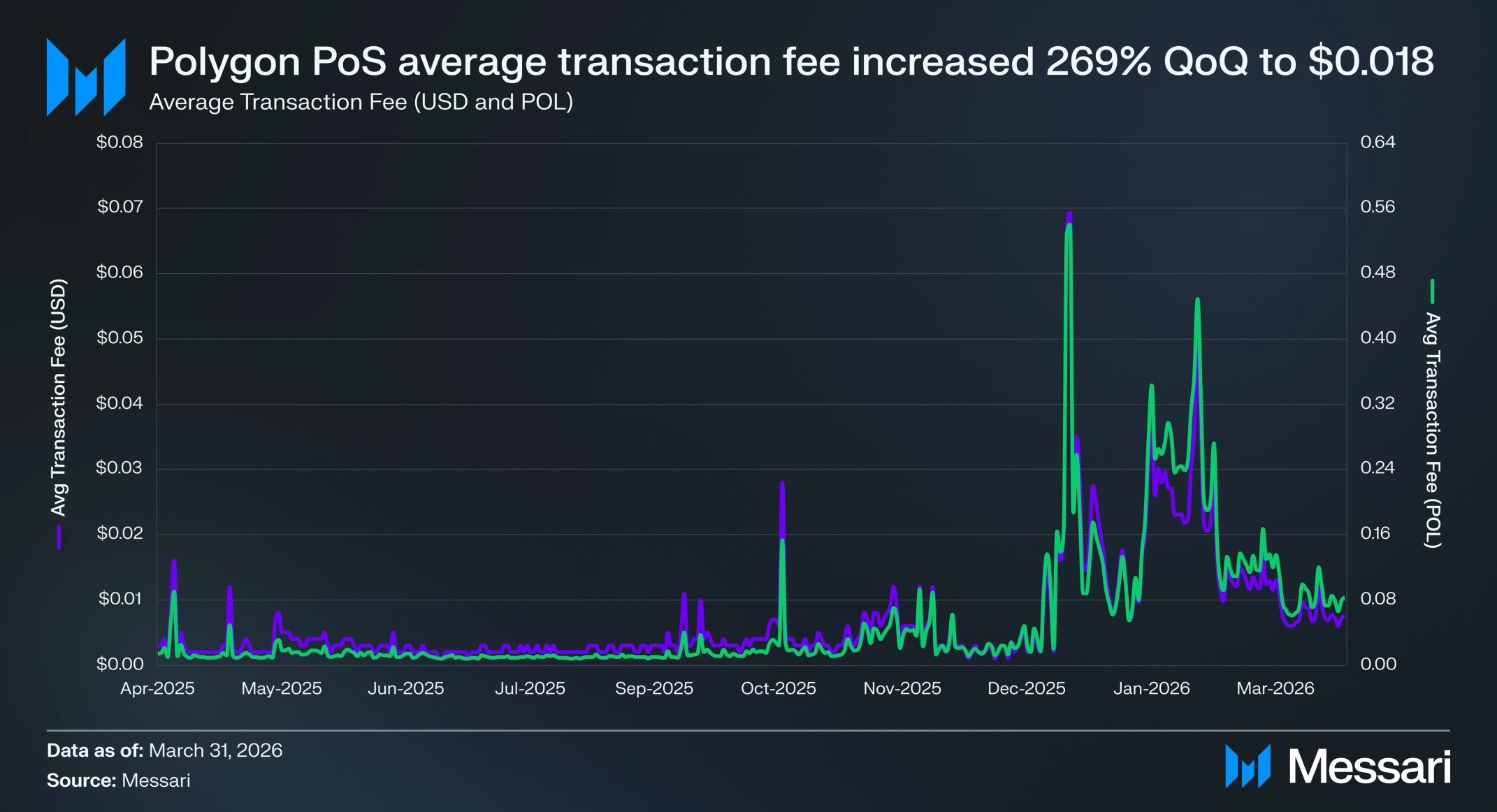
In Q1, total transaction fees (POL) increased by 594.1% QoQ to 107.1 million, while total transaction fees (USD) rose 419.8% to $11.7 million. The sharp QoQ increase was driven by higher transaction demand from Polymarket, which led to materially higher aggregate gas consumption.
Market Capitalization
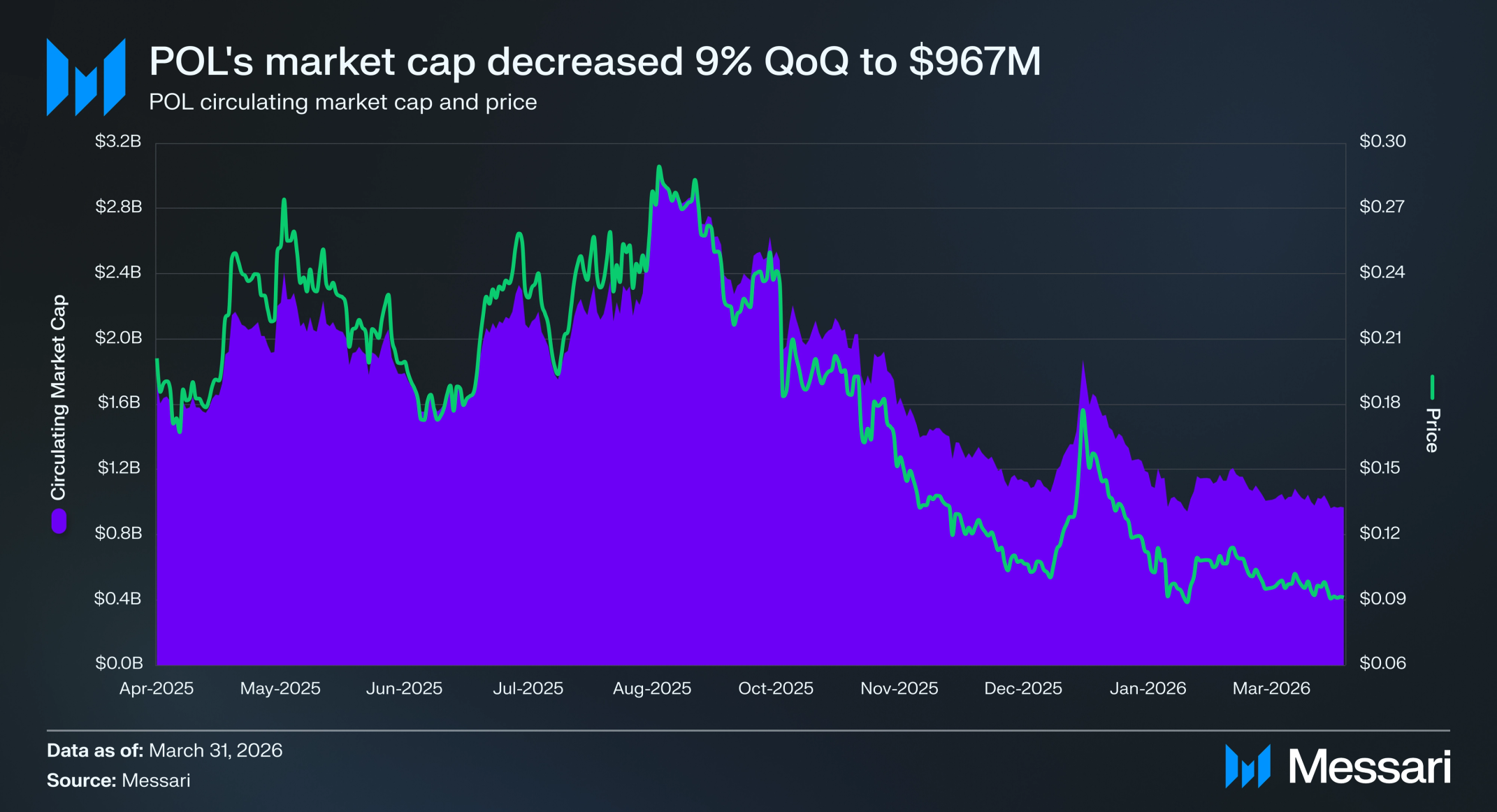
In Q1, POL’s circulating market cap decreased 8.7% QoQ to $967.4 million, outperforming the broader crypto market, which dropped by 22.7% over the same period. This relative outperformance was supported by strong application-driven activity, particularly from Polymarket, which drove higher transaction demand and fee generation on the network. POL ranks as the second-largest Ethereum L2 token by market cap behind MNT, and in front of ARB, OP, and STRK.
Network Analysis
Activity
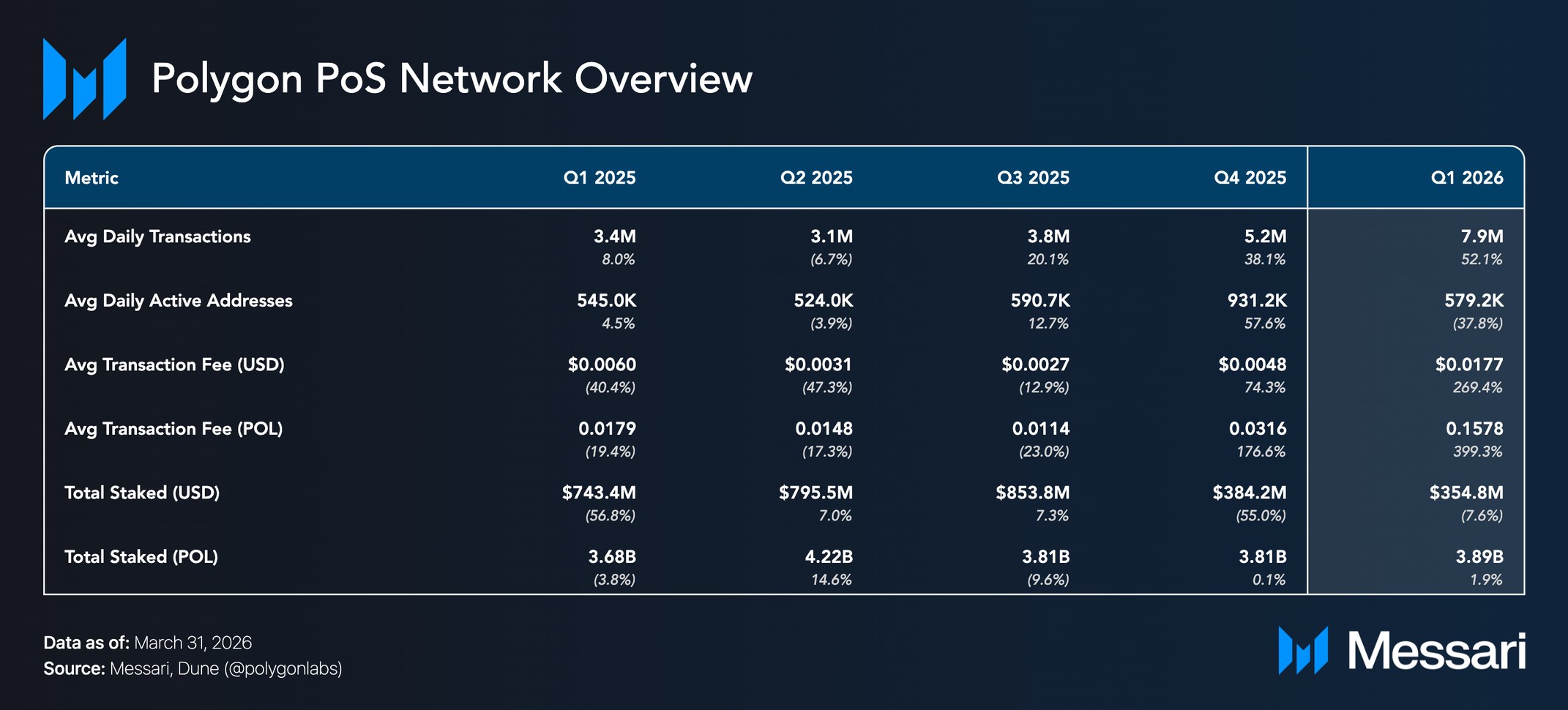
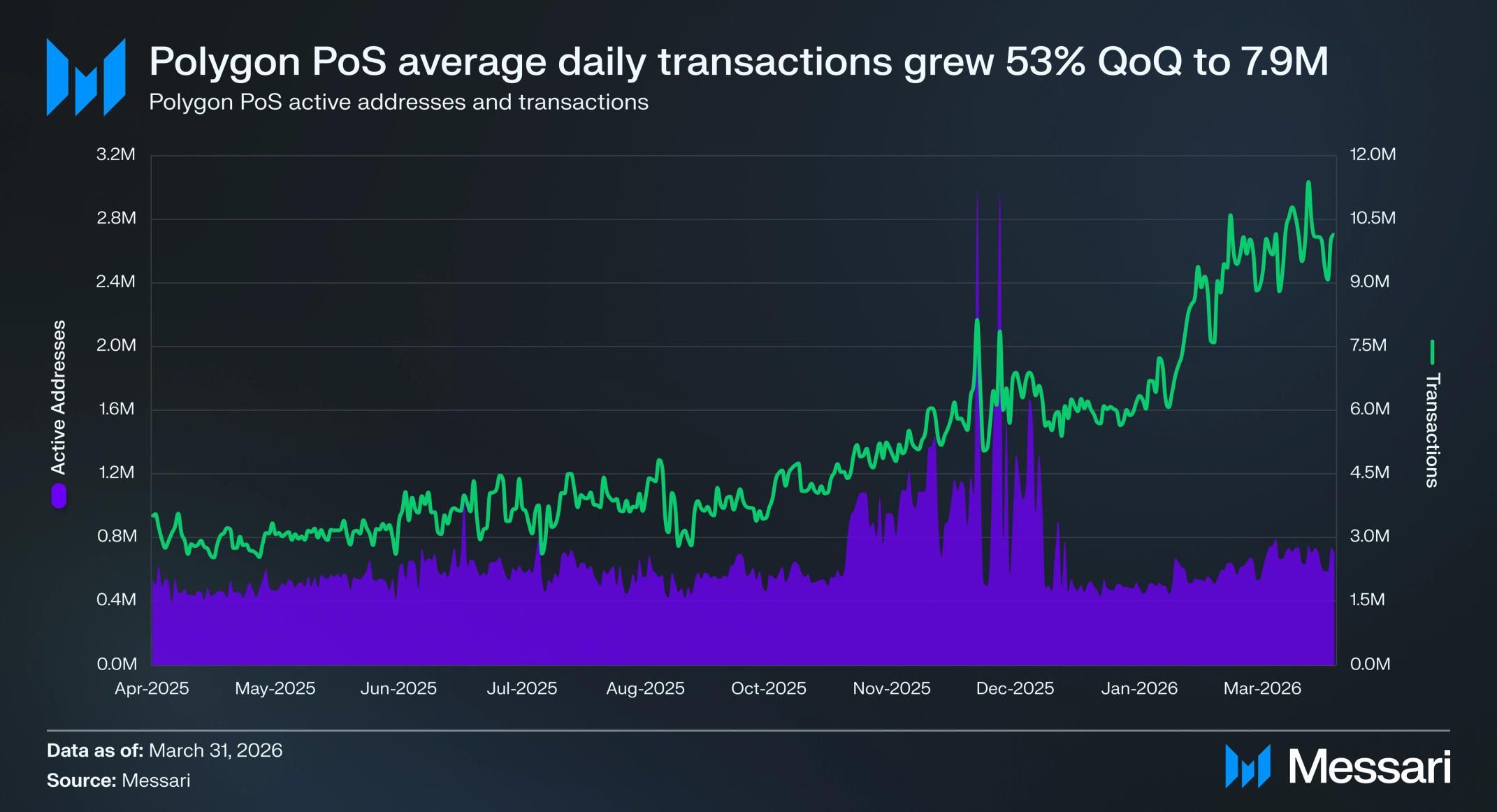
In Q1, average daily active addresses (DAAs) on Polygon PoS decreased 37.8% QoQ to 579,200, while average daily transactions increased 52.1% QoQ to 7.9 million. This divergence reflects a shift in activity composition rather than a simple change in user demand.
In Q4 2025, active addresses were temporarily inflated by a surge of low-quality activity, driven by a small number of applications generating high volumes of one-time users. These users contributed disproportionately to address counts without a corresponding increase in transactions, distorting the QoQ comparison base.
In Q1 2026, this dynamic reversed. Transaction growth persisted, but active addresses declined as activity became more concentrated among a smaller set of high-frequency participants. This shift coincided with the growing prominence of Polymarket, which uses an execution model that abstracts user interactions. Rather than requiring each user to hold POL and submit every transaction directly from an externally owned account, Polymarket uses a relayer and proxy-wallet architecture that abstracts gas payments from end users. As a result, transaction activity can increase without a proportional increase in distinct externally owned active addresses.
Taken together, these trends indicate that Polygon PoS activity is becoming more application-driven and operationally abstracted. As a result, raw address counts are a less reliable proxy for underlying user demand.
Consistent with the increase in total transaction fees, Polygon’s average transaction fee (POL) rose 399.3% QoQ to 0.1578 POL, while the average transaction fee (USD) increased 269.4% to $0.0177. As application activity intensified during the quarter, increased competition for blockspace resulted in higher gas bids, pushing up average transaction fees despite Polygon’s low absolute fee levels.
Technical Development
Capacity and Fee Mechanism Upgrades
In February and March 2026, Polygon implemented seven successive headroom upgrades, increasing the network gas limit from 60 million to 120 million, expanding theoretical throughput by 100%, and raising peak capacity to more than 2,800 transactions per second. Rather than introducing a new architectural change, these upgrades reflected Polygon’s ability to scale existing infrastructure to meet rising production demand, particularly from stablecoin transfers, payment flows, and high-frequency consumer applications. High-volume applications such as Polymarket also contributed to sustained blockspace utilization, as time-insensitive transactions increased fee pressure.
In March, Polygon also updated its fee mechanism so the network could operate at its full gas capacity continuously, rather than effectively constraining usable blockspace below the maximum during periods of demand management. This reduced artificial scarcity in blockspace and allowed fee adjustments to occur more directly through the base fee mechanism, lowering the likelihood of sharp priority fee spikes during high-activity windows.
Lisovo Hardfork
In March, Polygon deployed the Lisovo Hardfork (PIP-81), introducing upgrades to improve agent-native payments, fee stability, and wallet compatibility. The upgrade included bounded-range validation for configurable EIP-1559 parameters (PIP-79), allowing fee responsiveness to be adjusted within predefined safety bounds without requiring additional hardforks. This gives Polygon greater flexibility to adapt fee behavior as demand changes while preserving more predictable settlement costs for payment applications. Lisovo also incorporated a P256 precompile gas cost adjustment (PIP-80), aligning Polygon with Ethereum’s evolving cryptographic standards and improving support for passkey-based and embedded wallet systems.
In parallel, Polygon activated the Agentic Commerce Gas Program (PIP-82), a governance-approved subsidy that refunds 100% of gas costs, up to $1 million, for transactions routed through Polygon’s x402 facilitators, lowering the cost of early machine-to-machine payment flows where software agents transact autonomously for APIs, data, and other digital services.
Polygon Agent CLI
In March, Polygon launched the Polygon Agent CLI, a developer toolkit designed to simplify how AI agents transact onchain. The release packages wallet creation, token transfers, swaps, bridging, identity registration, and x402-based payments into a single interface, reducing the need for developers to assemble separate infrastructure components for agentic payment flows. The toolkit also integrates session-scoped smart contract wallets with spending limits, contract allowlists, and transaction preview functionality, helping mitigate operational and security risks associated with autonomous agents. In parallel, it adds native support for ERC-8004, an emerging standard for onchain agent identity and reputation, enabling agents to register verifiable identities and participate in machine-to-machine commerce with greater trust and discoverability.
Closing Summary
In Q1 2026, Polygon continued to scale as a payments and stablecoin settlement network, though activity trends diverged across the ecosystem. Payments-focused applications facilitated $4.98 billion in transfer volume (+29.9% QoQ), and stablecoin supply grew 21.3% QoQ to $3.55 billion, led by USDC and DAI expansion. At the same time, crypto card volumes declined 47.9% QoQ, and non-USD stablecoin activity showed regional divergence, contracting in Latin America while accelerating in Asia-Pacific.
Application-level activity remained a key driver of the network. Chain GDP increased 55.3% QoQ to $38.8 million, led by Polymarket and QuickSwap, while Polymarket continued to anchor usage with record open interest and expanding institutional participation. However, the App Revenue Capture Ratio declined משמעותfully, indicating that growth in application revenue outpaced the network’s ability to capture value at the protocol level.
Network-level signals were mixed. While transactions increased 52.1% QoQ and fee generation rose sharply, average daily active addresses declined 37.8%, suggesting higher transaction intensity among a smaller user base. NFT activity also weakened materially during the quarter, reflecting broader softness in consumer-driven use cases.
On the infrastructure side, Polygon continued to scale capacity and improve execution. Successive headroom upgrades doubled the gas limit to 120 million and increased peak throughput to over 2,800 TPS, while the Lisovo hardfork introduced improvements to fee stability, wallet compatibility, and agent-native payments. Together, these developments reinforce Polygon’s positioning as a production-grade settlement layer for payments, stablecoins, and emerging machine-to-machine transaction flows, though sustaining growth will depend on converting application activity into durable user and value capture expansion.
This report was commissioned by Polygon Labs. All content was produced independently by the author(s) and does not necessarily reflect the opinions of Messari, Inc. or the organization that requested the report. The commissioning organization may have input on the content of the report, but Messari maintains editorial control over the final report to retain data accuracy and objectivity. Author(s) may hold cryptocurrencies named in this report. This report is meant for informational purposes only. It is not meant to serve as investment advice. You should conduct your own research and consult an independent financial, tax, or legal advisor before making any investment decisions. Past performance of any asset is not indicative of future results. Please see our Terms of Service for more information.
No part of this report may be (a) copied, photocopied, duplicated in any form by any means or (b) redistributed without the prior written consent of Messari®.
Jake is a Research Analyst on the Protocol Research team. He previously worked as an Investment Analyst at an AI-driven crypto research platform and as a Venture Analyst at a digital assets venture fund. He advised multiple RWA tokenization projects on tokenomics. Jake graduated from the University of Southern California, where he studied Philosophy and Finance.
Jake is a Research Analyst on the Protocol Research team. He previously worked as an Investment Analyst at an AI-driven crypto research platform and as a Venture Analyst at a digital assets venture fund. He advised multiple RWA tokenization projects on tokenomics. Jake graduated from the University of Southern California, where he studied Philosophy and Finance.