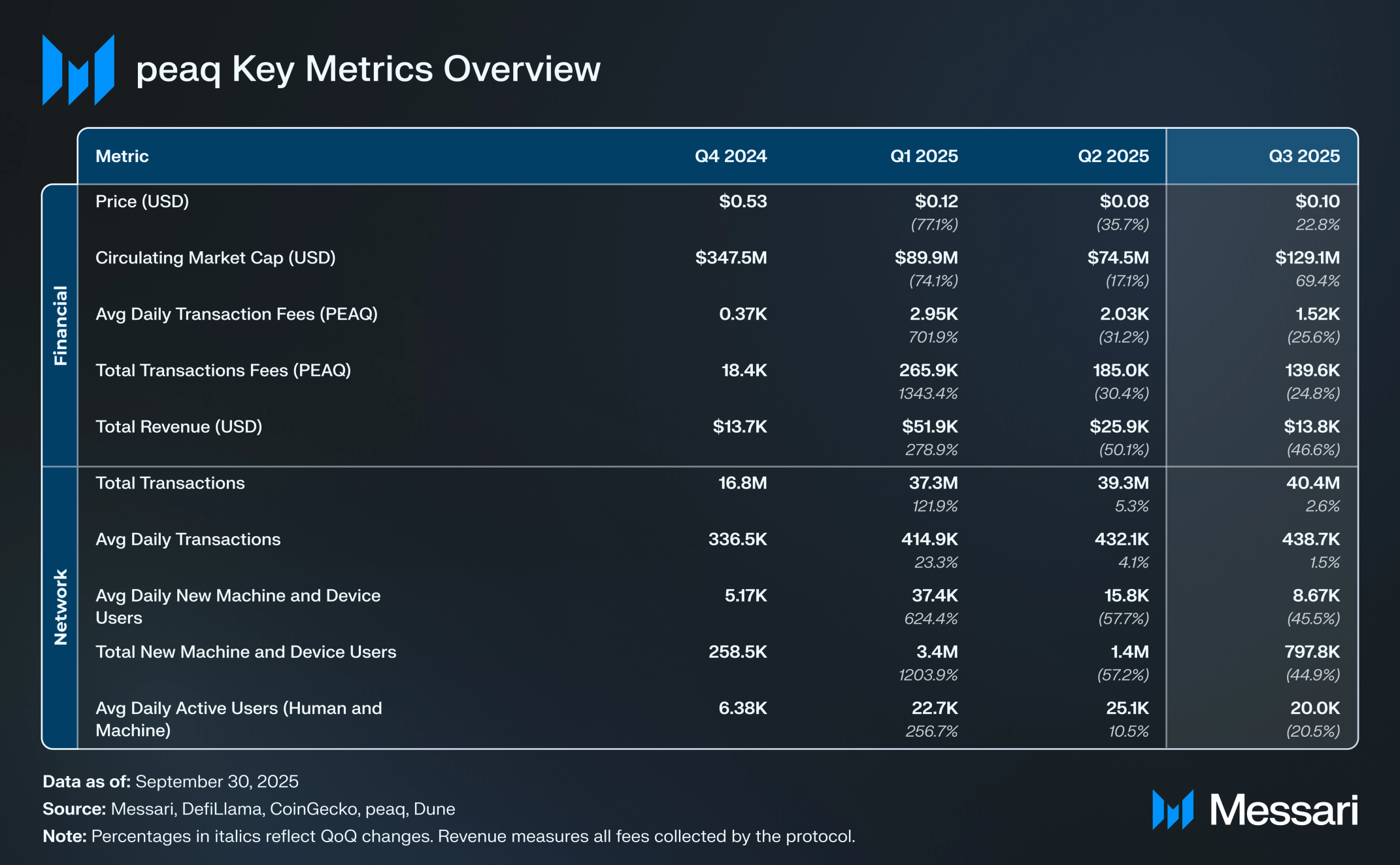
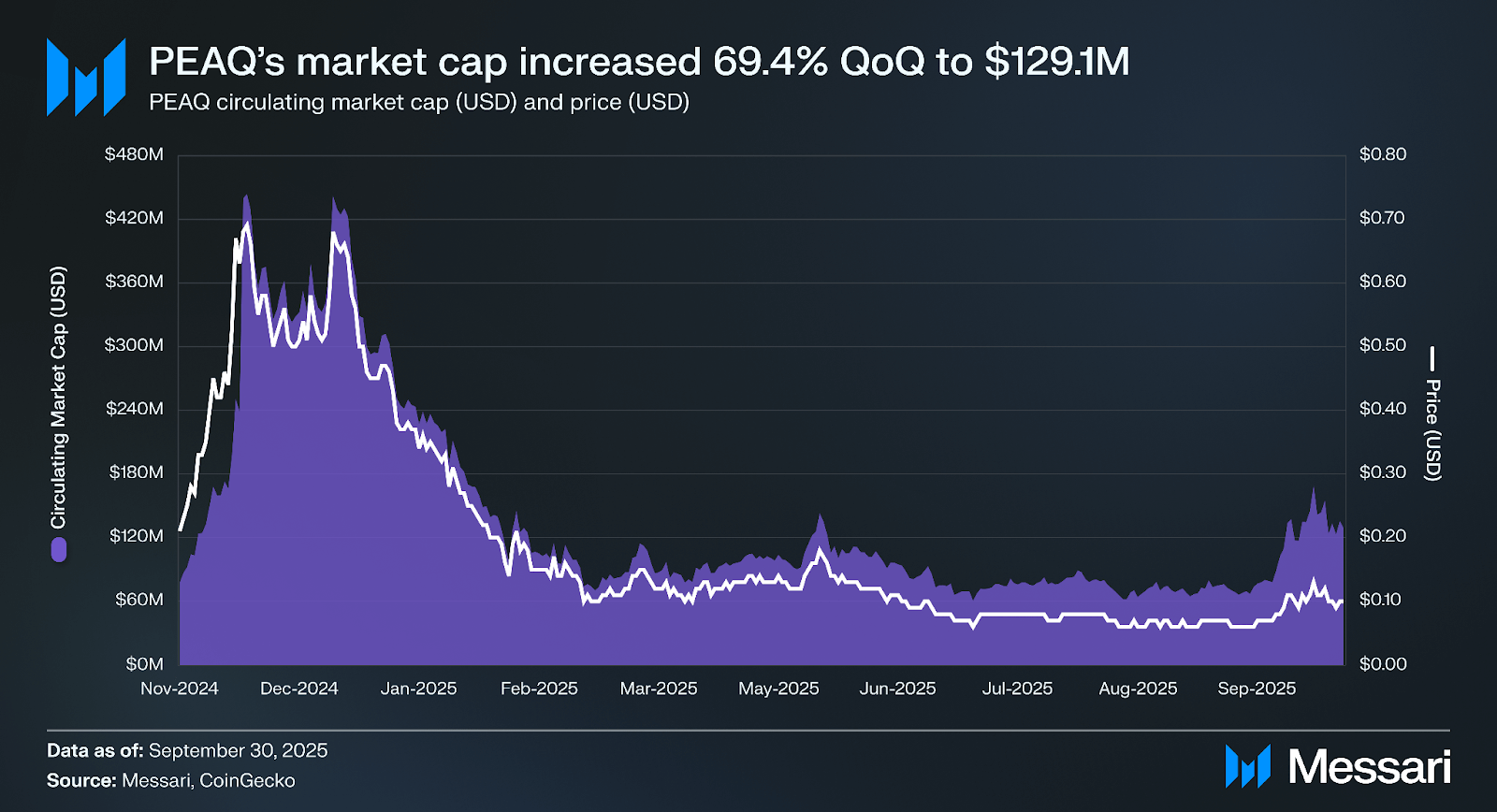
PEAQ’s market cap increased 69.4% QoQ to $129.1 million. This rise follows a broader market uptrend during Q3 and also highlights specific interest in peaq as one of the leading networks for the growing Robotics sector.
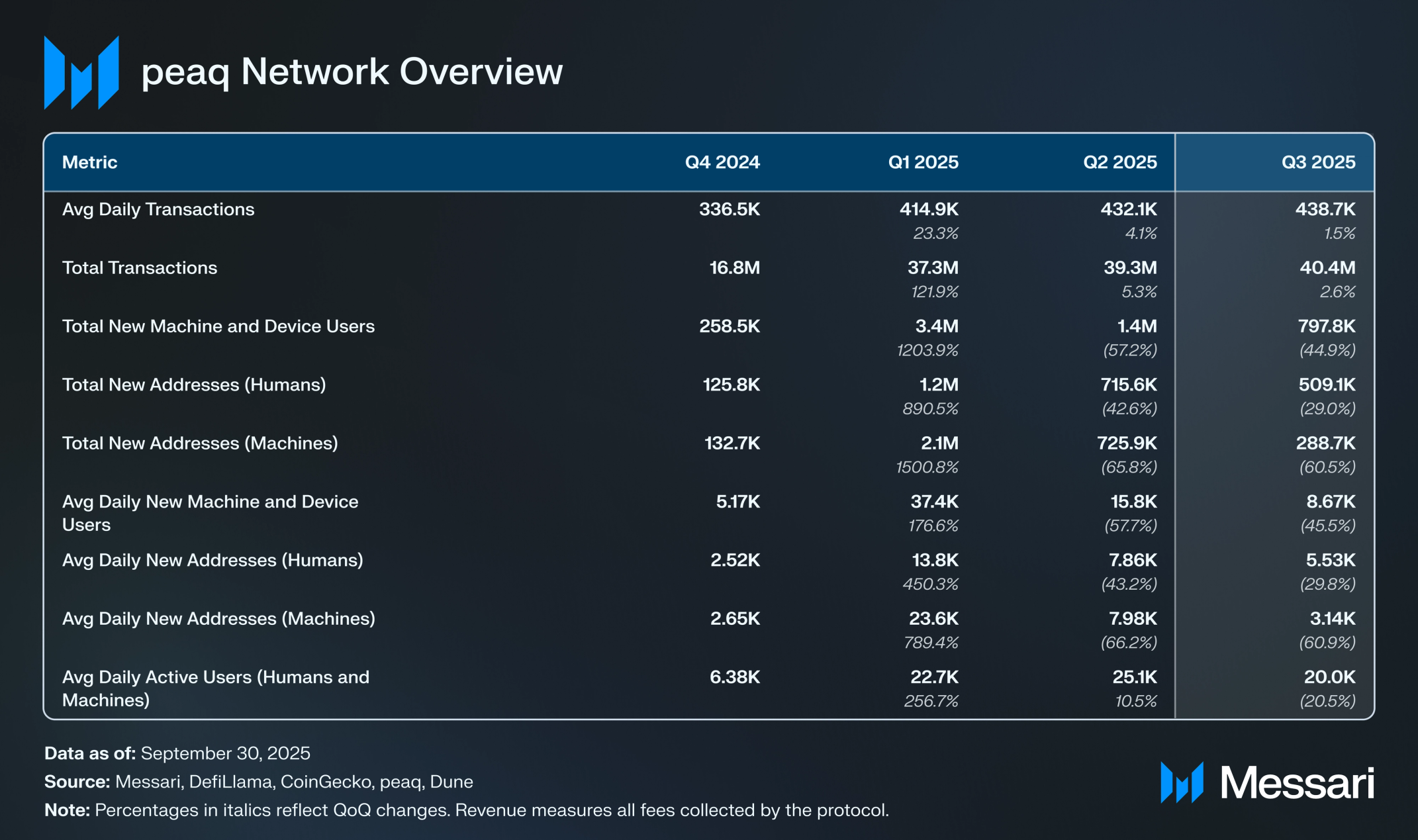
PEAQ’s total transactions for the quarter rose 2.6% to 40.4 million. The increase comes amid growing appetite for the robotics and machine real-world asset narratives as well as the restart of peaq’s community campaign driving DePIN adoption.
In July, peaq showcased Elastic Scaling on the network’s testnet. The results yielded a peak transactions per second (TPS) metric of 49,407 with a 500 millisecond (ms) block time.
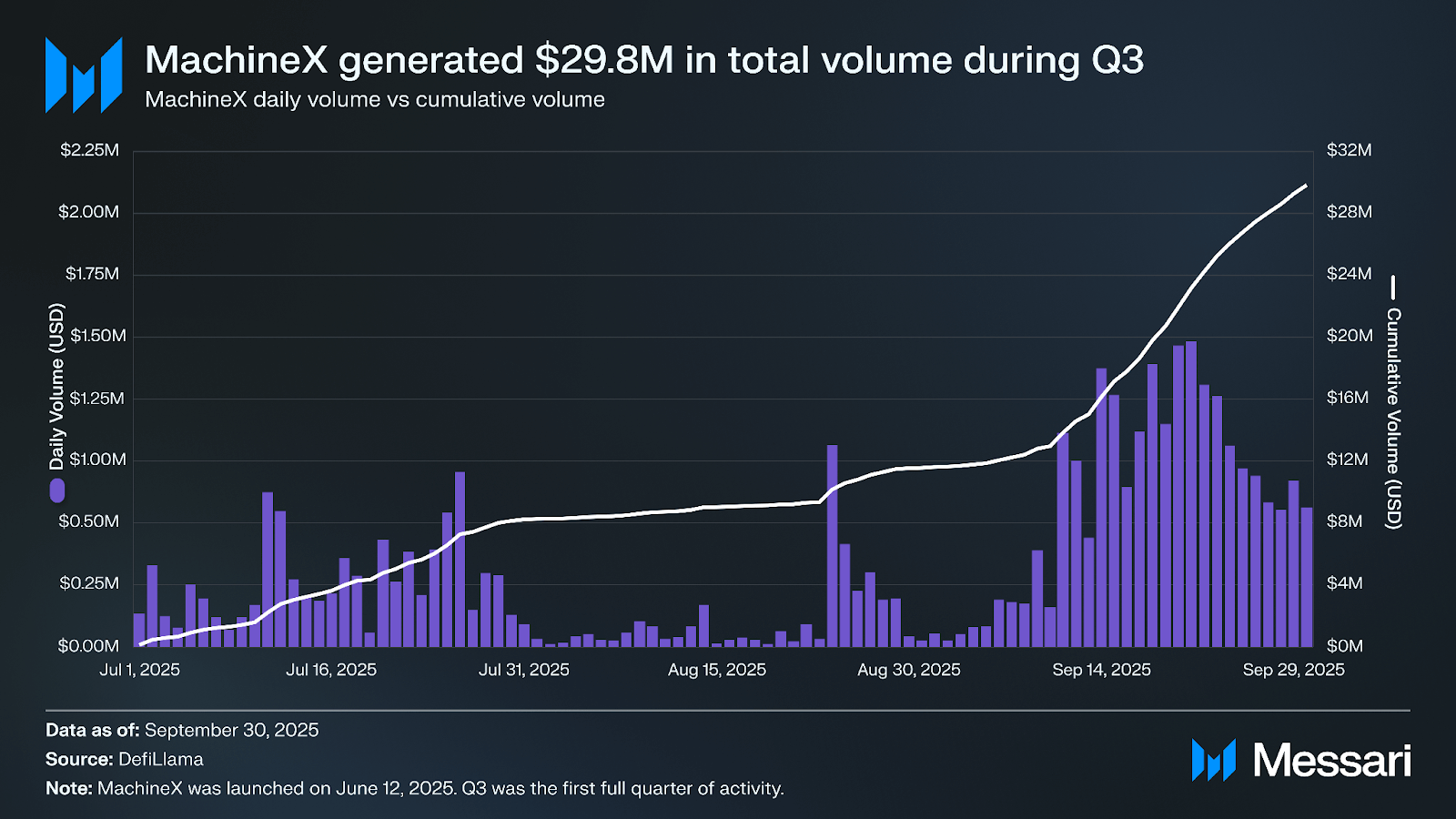
Q3 was the first full quarter for MachineX, the first DEX built on peaq for the Machine Economy. The protocol generated $29.8 million in cumulative volume during this period.
The world's first tokenized robo-farm was announced on September 23, going live on peaq on November 11. The project is a semi-automated vertical farm in Hong Kong paying its token holders on peaq, and is expected to launch in Q4.
Primer
peaq (PEAQ) is a public Layer-1 (L1) network designed to power the Machine Economy. peaq’s primary focus areas are Robotics, Decentralized Physical Infrastructure Networks (DePINs), and Machine DeFi. The network is built with scalability in mind to support a vision for the Machine Economy, where billions of autonomous machines interact and transact onchain. Built using the Substrate framework, peaq leverages a nominated Proof-of-Stake (POS) consensus mechanism. PEAQ is the network’s native token, used to pay for gas fees on the network. The token can also be delegated to active validator nodes, which secure the network and validate transactions.
The project was founded in 2017 by Till Wendler, Leonard Dorlöchter, and Max Thake. In March 2024, peaq announced it had raised $15 million in funding from leading investors, including Animoca Brands, Borderless Capital, Generative Ventures, Cypher Capital, CMCC, Fundamental Labs, HV Capital, Hashkey Capital, GSR Investments, MoonRock Capital, among others. In May 2024, peaq secured $20 million in a CoinList launch. The peaq network and token launched on November 12, 2024.
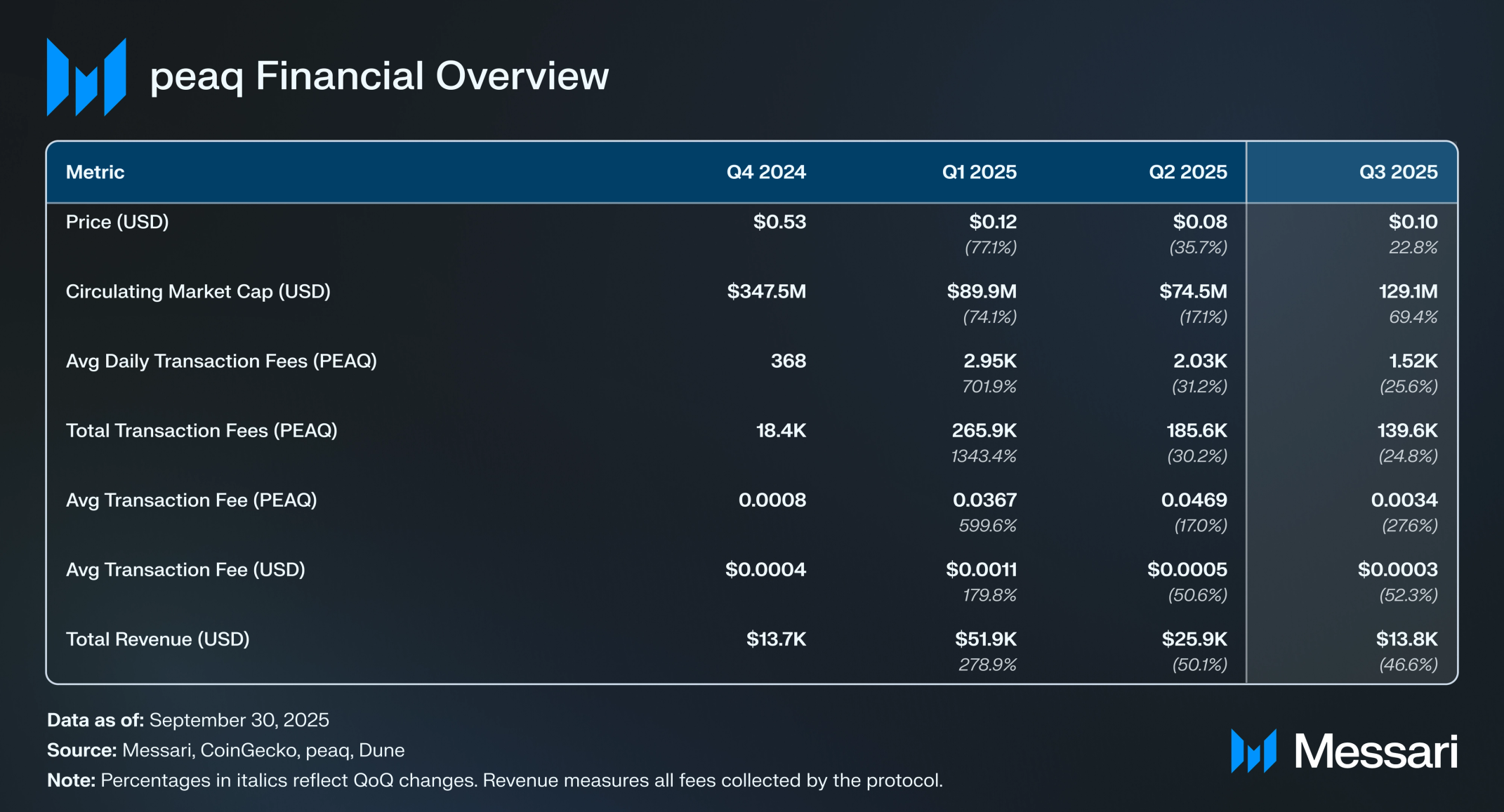
Q3 2025 was the third full quarter since PEAQ’s TGE and mainnet launch on November 12, 2024. During the quarter, PEAQ’s circulating market cap increased 69.4% to $129.1 million, and the token price increased 22.8% quarter-over-quarter (QoQ) to $0.10. The difference in the increase between market cap and price is driven by token emissions, as expanding supply means valuation rises sharper than per-token price.
PEAQ Token
PEAQ is the network’s native token and plays two primary roles in the network:
Paying for onchain resources
Securing the network through staking
Notably, the project aims to enable onchain governance in the future, allowing PEAQ tokenholders to vote on key decisions and manage funds to align incentives between the network and its stakeholders. As of Q3, all protocol treasuries are managed by the peaq Foundation.
On August 19, 2025, peaq became the latest of four projects to score a perfect 40 out of 40 on the Blockworks Token Transparency assessment, an open-source framework for token issuers. The assessment is based on the following four criteria when judging a given token:
Project and Team: A review of the people and governance structure that drive the day-to-day operations of a protocol.
Token Allocation: A review of the distribution, vesting schedule, and total supply of a protocol’s native token.
Market Structure: A review of the token’s trading liquidity, centralized exchanges (CEX) agreements, and market-maker agreements that could influence the price action of a protocol’s token.
Financial Disclosure: A review of the reporting standards of the project’s financials and operations.
peaq’s transaction fee model is designed to minimize user costs and support long-term sustainability through strategic revenue allocation. All transaction fees and a portion of newly minted tokens are distributed to network participants who actively engage in the ecosystem and meet specific contribution criteria, such as the value created by machines or liquidity provided to the network. This performance-based approach aims to ensure fairness, drive community participation, and align stakeholder incentives. As of Q3, the distribution of transaction fees is as follows:
Validators & Delegators – 40%
Security Treasury – 10%
General Treasury – 25%
DePIN Treasury – 20%
Machine Subsidization Treasury – 5%
peaq launched in November 2024 with a total genesis token supply of 4.2 billion PEAQ and an initial annual inflation rate of 3.5%. The inflation rate is designed to decrease by 10% each year until it stabilizes at 1%, with future adjustments governed by the network. Of the newly minted tokens, 40% are allocated to staking rewards for delegators and validators, while the remaining 60% is directed to the treasuries described above and remains non-circulating. During Q3, 327.1 million PEAQ, or 7.4% of PEAQ’s genesis supply, were unlocked.
The key components of the Q3’25 unlocks include:
Investors (57.4% of Q3 unlocks): 187.9 million PEAQ were unlocked to private investors.
Community (21.5% of Q3 unlocks): 70.2 million PEAQ were unlocked to the community.
Core Contributors (8.2% of Q3 unlocks): 26.8 million PEAQ were unlocked to core contributors.
EoT Labs (6.1% of Q3 unlocks): 19.8 million PEAQ were unlocked to the company building peaq.
Network Security (2.4% of Q3 unlocks): 7.9 million PEAQ tokens were unlocked for network security.
Inflation (4.5% of Q3 unlocks): 14.7 million PEAQ were minted from emissions, providing additional liquidity to the market and support for ongoing network participation.
Q3 was an important quarter for expanding access to PEAQ for both onchain and offchain users. The token was listed on CEXs like Kraken, Binance Alpha, Coinone, WEEX, Pionex, and Hibt. peaq launched on Bitget Onchain, allowing users of BNB Chain to buy and sell a bridged version of PEAQ on the network.
Network Analysis
Usage and Revenue
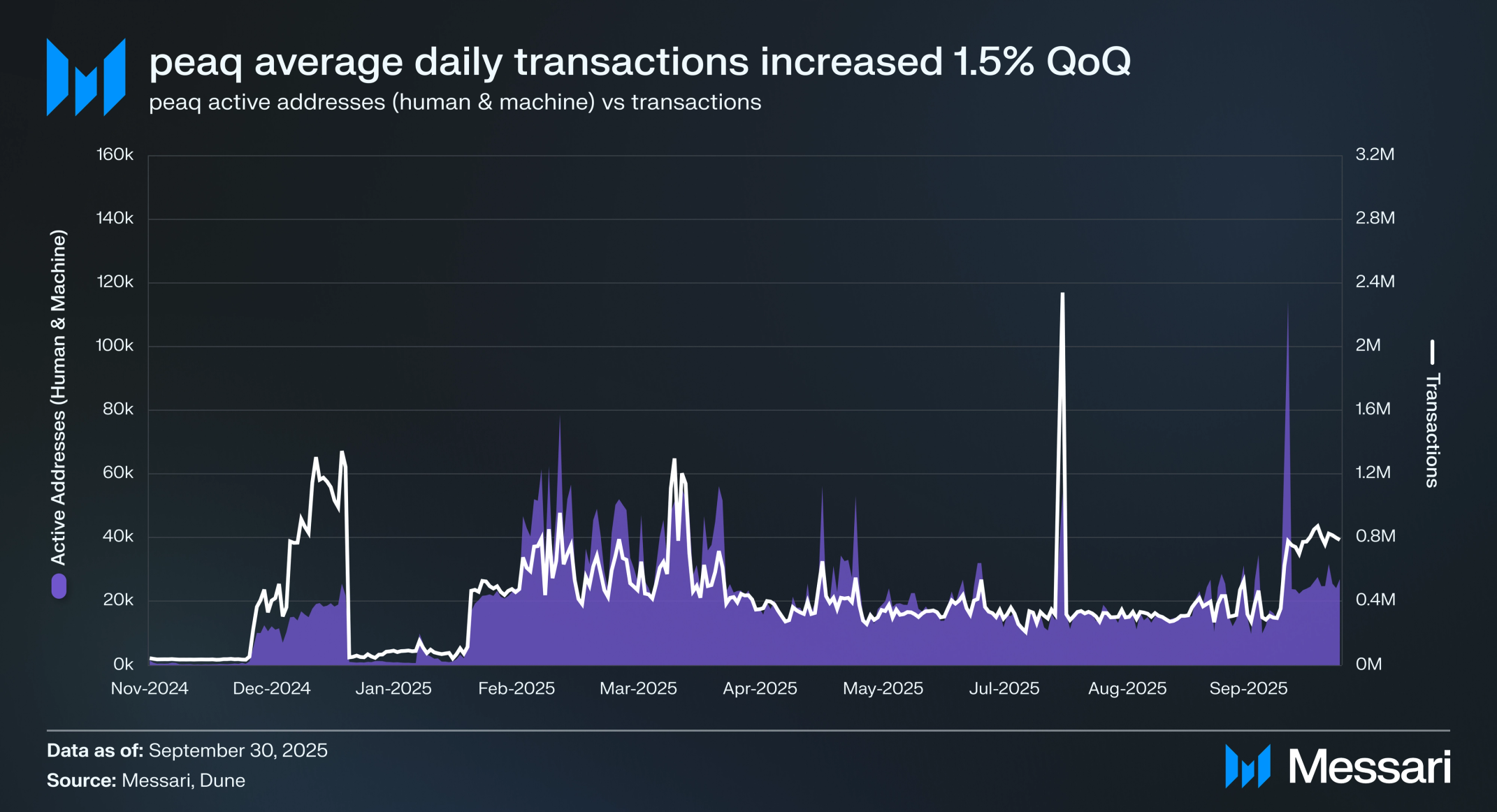
In Q3, average daily transactions increased 1.5% QoQ to 438,731, reflecting rising interest in peaq and its growing ecosystem from the wider Web3 community. However, active addresses (human and machine) decreased 20.5% QoQ to a daily average of 20,048.
The creation of new addresses, human and machine-owned, on peaq declined in Q3. Average daily new human addresses fell 29.8% QoQ from 7,881 in Q2 to 5,533 in Q3, and average daily new machine addresses fell 66.2% QoQ from 8,023 in Q2 to 3,137 in Q3. The slowdown comes as the ecosystem transitions to a more mature state, stabilizing to a less explosive, steady growth in onchain devices.
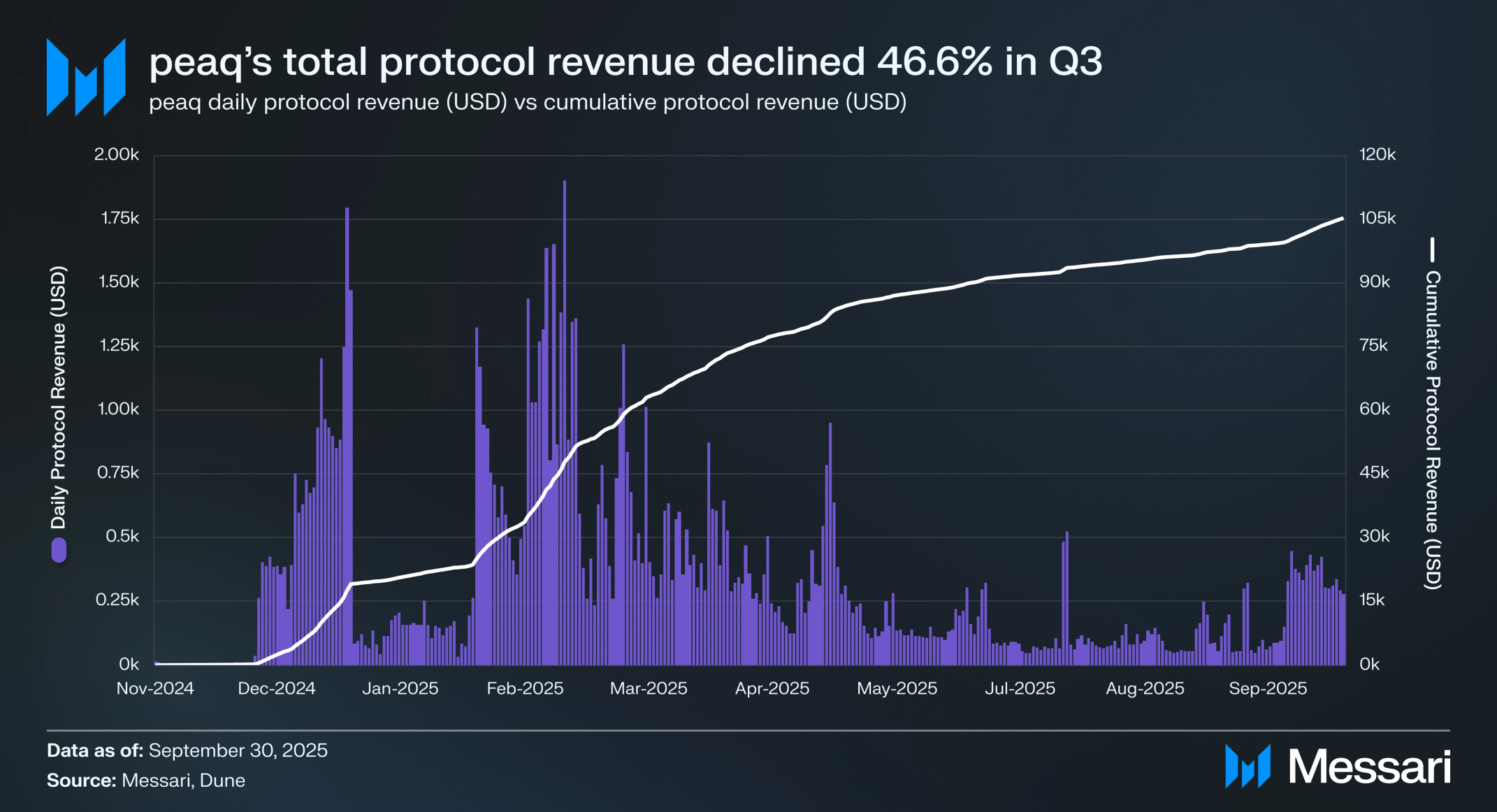
The decline in network activity and growth, as well as more streamlined transaction management in the ecosystem led to a decrease in total revenue in Q3. The network generated $13,816 in Q3, falling 46.6% QoQ. The network is designed for high-throughput and machine-to-machine interactions and employs a micro-fee model with transaction costs as low as $0.00025. These optimizations enable real-world applications to scale without prohibitive costs.
Notably, the decline in network activity and revenue over the past two quarters corresponds with the pause of peaq’s Get Real, a campaign that incentivized users to use DePINs and apps on peaq and resulted in significant network growth during Q1. On September 15, 2025, peaq announced the launch of Get Real Season Two, which aims to build on the success of the first season.
Security and Staking
peaq uses a Nominated Proof-of-Stake (NPoS) consensus model built with Substrate, similar to Polkadot. In this system, validators are selected based on the stake they receive from self-bonding and delegators. This design helps optimize decentralization while aligning incentives between validators and tokenholders.
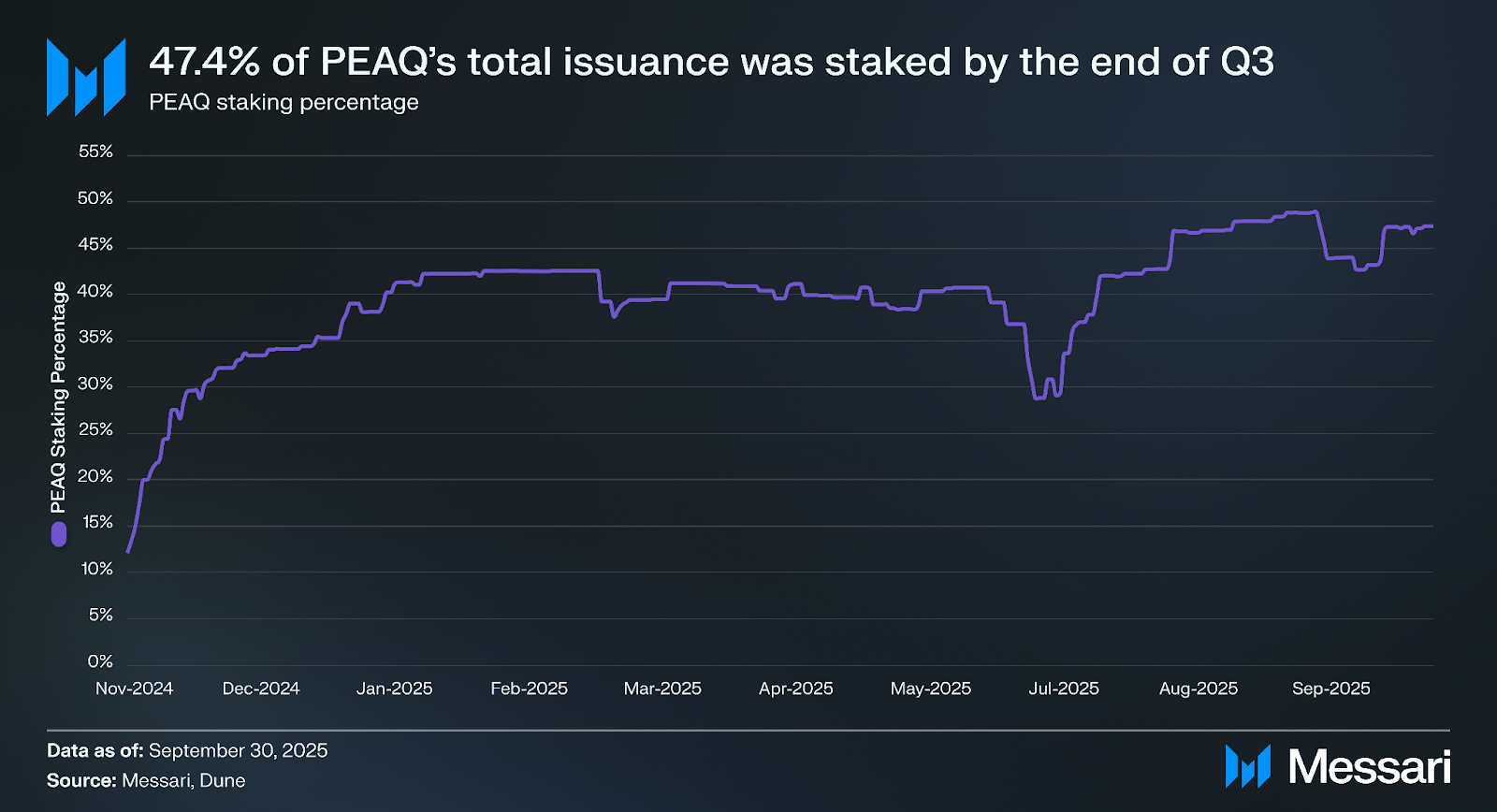
As of September 30, 2025, peaq is secured by 42 active validating nodes and 2.05 billion staked PEAQ, which accounts for 47.4% of the total PEAQ issuance. Validator participation is determined by stake-weighted selection, and rewards are distributed proportionally to both validators and delegators. Validator candidates must meet certain technical and economic requirements to join the active set, including maintaining uptime and infrastructure performance in line with network expectations. peaq uses a stake-weighted selection process, and validators are subject to removal for underperformance.
Network Scalability
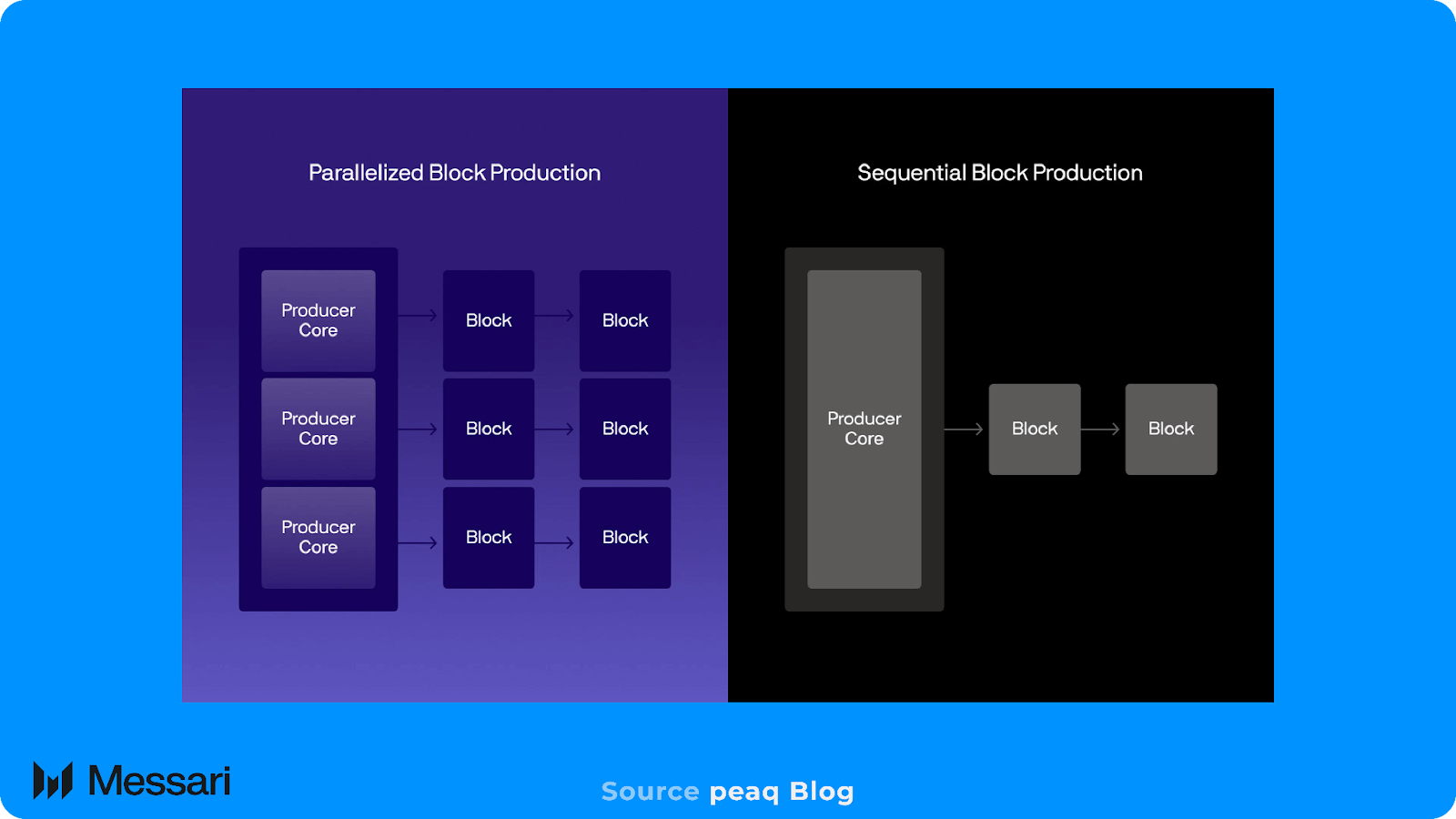
In July 2025, peaq built on its existing commitment to scaling the peaq network through an Elastic Scaling Test on the network’s testnet. The test showcased a peak TPS of 49,407 at a 500-millisecond block time. Instead of a monolithic blockchain architecture, peaq takes an elastic approach, splitting the block production process into cores. This process is known as parallelization, where multiple producer cores can produce, validate, and finalize blocks concurrently. This architecture offers more flexibility in terms of handling network demand spikes, as new cores can be added without requiring a hard fork or runtime upgrade. The elastic architecture also impacts decentralization, as changes to one component of the block production process have less impact on other components. Also, parallelized block production means that scaling capacity is a function of software orchestration. This differs from a monolithic approach, where scaling is a function of higher hardware specifications, which can price out potential block producers.
A network with comprehensive scalability features is essential for supporting peaq’s vision for a Machine Economy, where billions of machine users transact autonomously, triggering smart contracts, and submit data within the peaq network. While high TPS and low block times are currently only live on testnet as of September 30, 2025, peaq aims to bring the features to mainnet in the near future.
Ecosystem Analysis
peaq continued building out its Machine Economy network in Q3. This effort combines DePINs, DePAI (Decentralized Physical AI), Machine DeFi, and Machine RWAs. These ideas form the foundation for applications where machines and people interact through onchain services tied to real-world value.
Auki Network: The protocol aims to build a machine perception network to provide an understanding of the physical world to robots and AI systems. On July 7, AUKI was bridged by peaq and listed on MachineX to build on existing synergies between the two networks.
DualMint: The protocol facilitates the tokenization of smart robots on the peaq network. In doing so, DualMint enables onchain users to earn yield from automated machines producing real-world goods.
Robo Rumble: The protocol is the first prediction market for robot battles and is built on the peaq network. On September 28, Robo Rumble sponsored the world’s first VR-controlled robot fight between Justin Kan and Hyder Amil.
Newcoin: The protocol offers an alternative approach to agentic AI training aimed at advancing the decentralized AI industry. Newcoin leverages peaq ID to verify and reward AI agents inside the protocol’s operating system.
Machine DeFi
Machine DeFi refers to the emerging category of decentralized finance in which machines could eventually transact autonomously with protocols, using onchain data derived from their activity. Envisioned use cases include borrowing against tokenized machine revenue, automated fee flows between machine agents, and DAO-managed subsidy programs. While these remain aspirational today, peaq’s infrastructure upgrades and modular functions are designed to support such interactions as they mature.
The evolution of peaq’s Machine DeFi ecosystem was headlined by MachineX, the world’s first Machine Economy DEX. The protocol provides a liquidity marketplace for DePIN tokens, PEAQ, and, soon, Machine RWAs. By having such a marketplace, machines and users gain access to dedicated liquidity pools for assets, which is critical for financial coordination and capital allocation.
MachineX routes a portion of every swap’s fees into peaq’s Network-Level Incentive Pools. Funds in those pools incentivize the growth of DePIN’s building on peaq and subsidize the onboarding of machine RWAs. As liquidity and swap volume grow, more fees are directed into the incentive pools, and DePIN projects are encouraged to make more impactful developments. By doing this, MachineX generates a liquidity flywheel for the growth of the Machine Economy.
Following the protocol launch on June 12, 2025, Q3 marked the first full quarter of the MachineX protocol. During this period, $29.8 million in total volume was generated. Of note, there was a significant uptick in daily volume following the launch of Get Real Season 2, an incentive campaign aimed at encouraging network activity.
Robotics SDK
The announcement of peaq’s Robotics SDK on September 22, 2025, marked an important milestone for developers and the maturity of the network broadly. This launch lays the foundation for robots to join the Machine Economy and become autonomous economic agents. The SDK packages peaq’s Universal Machine Functions, which include:
Universal Machine ID: This feature provides robots with a unique cryptographic ID, allowing them to identify each other and securely authenticate across DePINs on the peaq network.
Universal Machine Access: This feature allows builders to give permissions to both robots and humans, thus controlling who can access a robot’s data.
Universal Machine Storage: This feature enables verification of robot-generated data for compliance and audit purposes, allowing robots to sell trusted data on dApps and marketplaces.
As of September 30, 2025, the SDK is available for Python developers and supports Unitree, a Chinese robotics company on the bleeding edge of robotics technology. In the future, the Robotics SDK will support ROS, a popular framework for writing robotics software. Additionally, peaq plans to expand the SDK to facilitate further Universal Machine Functions, including Universal Machine Payment, Universal Machine Verification, and Universal Machine Time (UMT). The new developer kit builds on peaq’s existing toolings for builders on the network, which include a JavaScript SDK and a Python SDK.
Get Real Season 2
On September 15, 2025, a second season of peaq’s Get Real Campaign was launched, incentivizing DePIN, Robotics, and Machine DeFi adoption on the network. Users compete for a share of 210 million PEAQ tokens by completing quests to earn XP, which corresponds to a position on the Season 2 leaderboard.
Season 2 builds on the success of peaq’s Get Real Season 1 during Q1, which led to significant network growth. While the first season surrounded the incentivization of DePINS on the network, Season 2 expands into different verticals such as Machine DeFi, rewarding participants for providing liquidity and swaps on DEXs like MachineX. The campaign also features a full system overhaul on the backend to improve UX and support growing demand for network usage. Get Real is now available on mobile, facilitating broader access to the campaign.
Project Highlights
A number of different projects building in the peaqosystem reached key milestones during Q3:
Tokenized Robo-Farm
The world’s first tokenized robo-farm was announced on September 23, 2025. The project is a semi-autonomous, AI-optimized vertical farm in Hong Kong that allows users to earn onchain yield from real-world activity. The farm grows fresh greens for the local communities in the region and is tokenized through DualMint to facilitate the co-ownership of the profits. The physical infrastructure was built by KanayaAI, the largest indoor farm of hydroponic food production in Hong Kong. The operation leverages features of peaq’s Universal Machine Function, like the ID function to bring the machine onchain.
Due to the automation of tasks facilitated by AI and robotics, the project has a projected yield of approximately 20%. Slated to launch in Q4, the waitlist is live as of September 30, 2025. RoboFarm HK is the first of multiple tokenized robots expected to launch on the peaq network.
Silencio
During Q3, Silencio announced a pivot to become the world’s ears for AI and robotics. The project is one of the largest DePINs in the peaqosystem and aims to create the first decentralized infrastructure for real-world audio intelligence. The audio data layer is critical for powering foundation models, embodied AI, autonomous vehicles, and robotics.
XMAQUINA DAO
On September 29, 2025, XMAQUINA DAO’s genesis auction sold out in under 20 minutes. The project is a decentralized ecosystem aimed at acquiring strategic physical AI assets like robotic startups, revenue-generating machines, and early allocation in decentralized networks. While the auction was conducted on Base, XMAQUINA is built on peaq to collaborate with other projects in the Machine Economy.
Combinder
Combiner, a decentralized energy network DePIN built on peaq, reached a pivotal milestone of 1,000 live devices on August 27, 2025. The protocol aims to turn everyday electrical devices into income-earning energy sources.
Teneo
The protocol is a decentralized AI agent network on peaq that allows users to earn rewards based on their contribution to the network. On August 8, 2025, the protocol announced that it had eclipsed the 6 million community node milestone.
Closing Summary
Q3 2025 marked the third full quarter of activity following peaq’s mainnet launch, headlined by infrastructure upgrades, expansion of developer tooling, major ecosystem advances, and a refreshed incentive campaign. The world’s first tokenized robo-farm was announced, facilitating the co-ownership of a fresh greens automated machine in Hong Kong. Meanwhile, four new projects joined the peaqosystem, each aimed at enabling a layer of the robotics stack on the network. PEAQ’s rise in market cap QoQ highlights growing interest for the sector and peaq’s achievements specifically.
The announcement of Get Real Season 2 exemplifies peaq’s effort to encourage participation, offering users an incentive to interact with protocols built on the network. The campaign rewards participants for using MachineX, the first DEX built for the Machine Economy. Through efforts like the Elastical Scaling Test and the launch of peaq’s Robotics SDK, peaq is building the infrastructure and tooling to support its goal of bringing a billion robots onchain.
This report was commissioned by peaq Network. All content was produced independently by the author(s) and does not necessarily reflect the opinions of Messari, Inc. or the organization that requested the report. The commissioning organization may have input on the content of the report, but Messari maintains editorial control over the final report to retain data accuracy and objectivity. Author(s) may hold cryptocurrencies named in this report. This report is meant for informational purposes only. It is not meant to serve as investment advice. You should conduct your own research and consult an independent financial, tax, or legal advisor before making any investment decisions. Past performance of any asset is not indicative of future results. Please see our Terms of Service for more information.
No part of this report may be (a) copied, photocopied, duplicated in any form by any means or (b) redistributed without the prior written consent of Messari®.
Entering crypto in 2020, Shale has experience as a trader, angel investor, and co-founder in the space. He graduated from the University of Washington, studying psychology and business. His interests include DeFi and Consumer Crypto.
Entering crypto in 2020, Shale has experience as a trader, angel investor, and co-founder in the space. He graduated from the University of Washington, studying psychology and business. His interests include DeFi and Consumer Crypto.