Mantle's community-owned treasury remained one of the largest in the industry, ending Q4 at approximately $4.2 billion. While the total value declined 25.0% QoQ, the treasury continues to anchor the ecosystem's "liquidity chain" strategy.
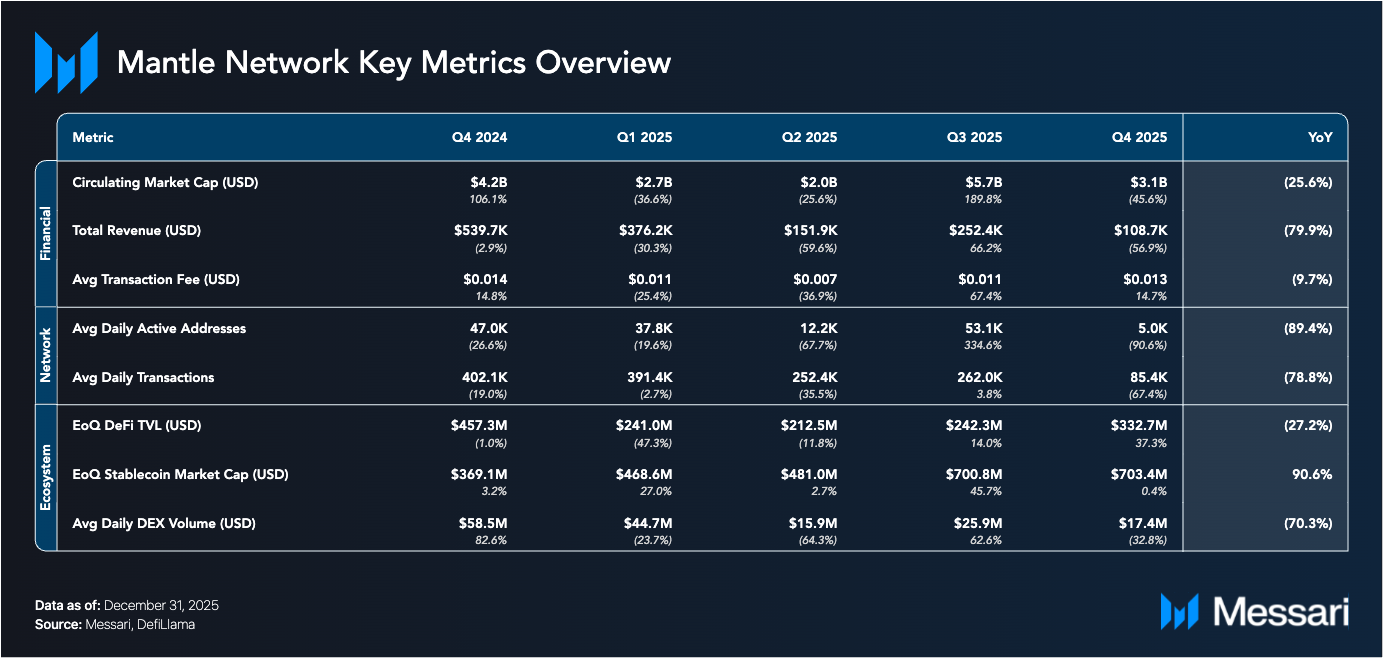
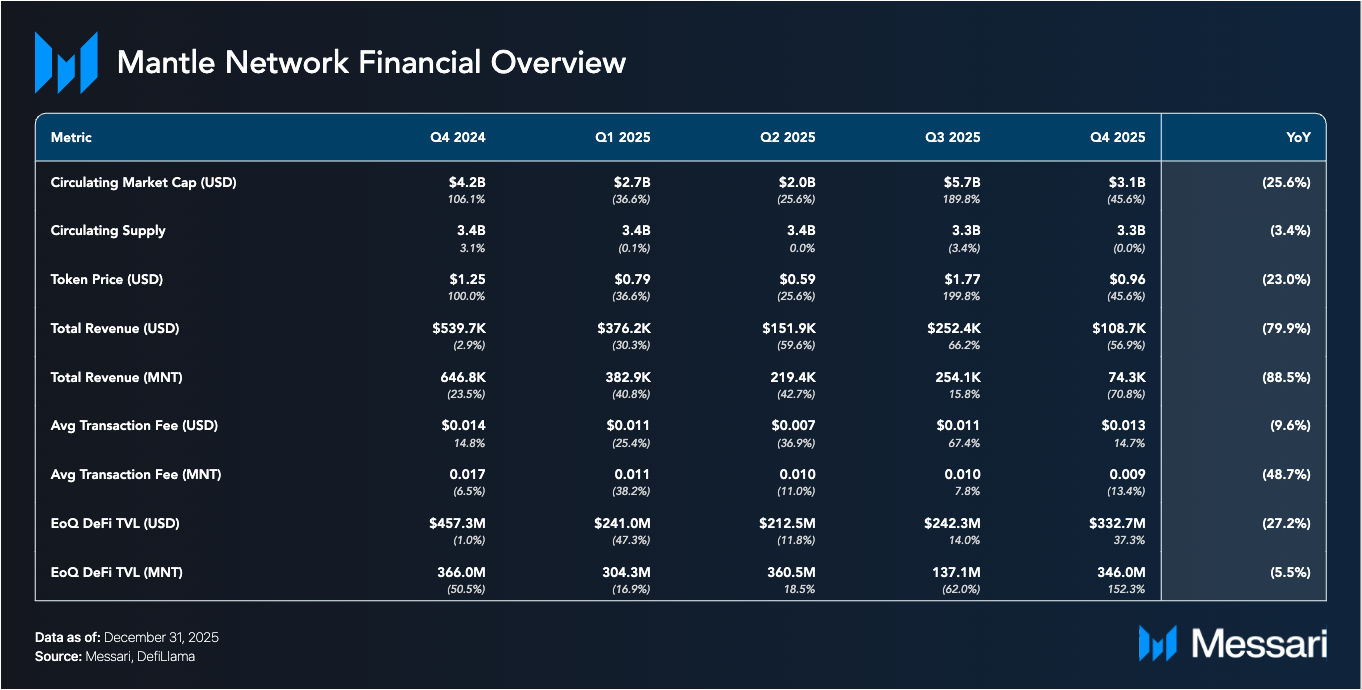
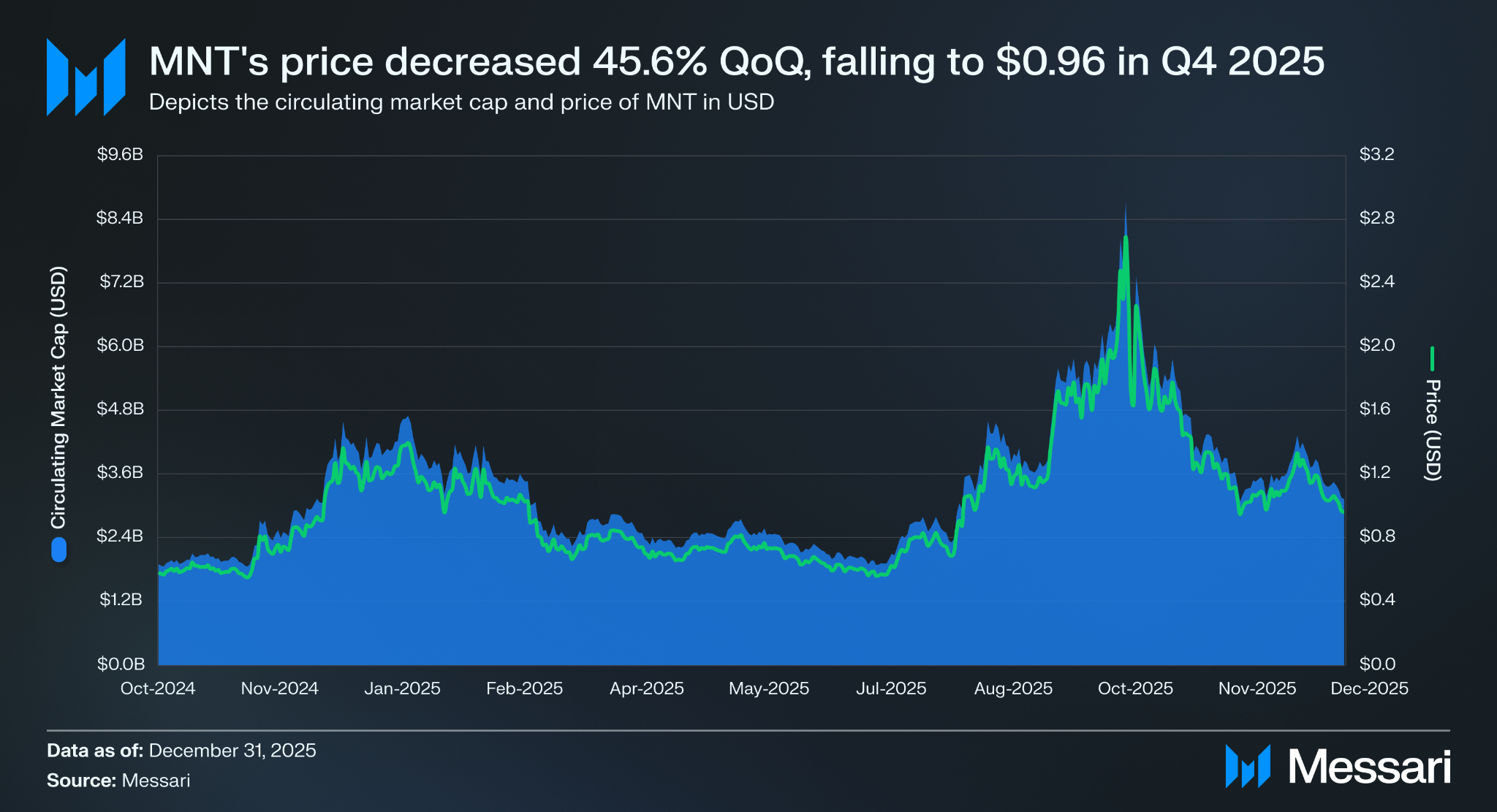
MNT's price and circulating market cap experienced a pullback following Q3's all-time highs, falling 45.6% to $0.96 and $3.1 billion QoQ, respectively.
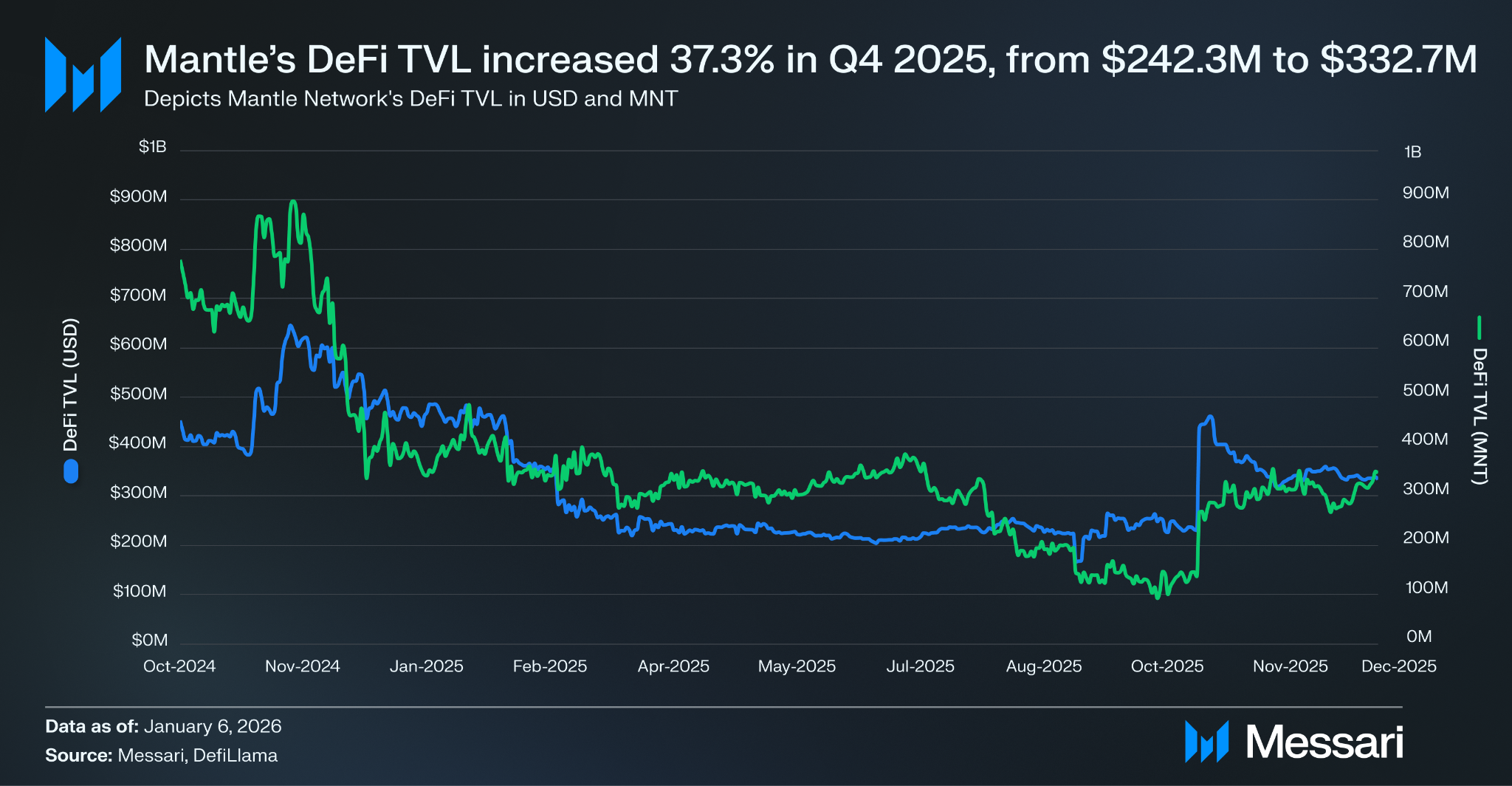
DeFi TVL on Mantle rose 37.3% QoQ to $332.7 million, driven by a $205.1 million treasury deposit into Mantle Index Four (MI4).
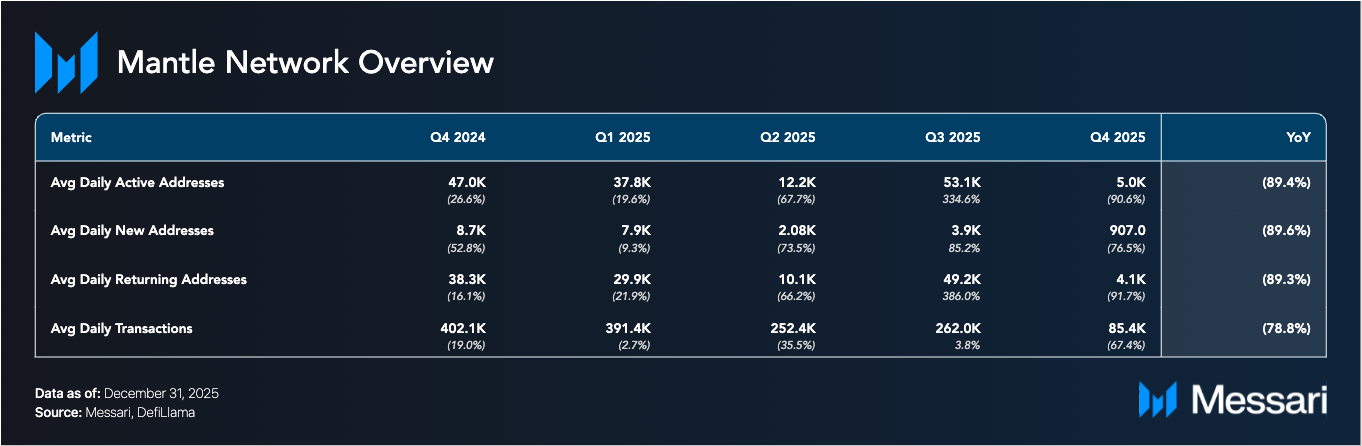
Mantle’s average daily active addresses declined 90.1% QoQ, from 53,100 to 5,000. New addresses also fell 76.5% to 907 as incentive-driven onboarding through Bybit declined.
mETH Protocol underwent a critical infrastructure upgrade on Dec. 15 with the introduction of the Buffer Pool mechanism. The upgrade allocates ~20% of protocol TVL to Aave, addressing liquidity constraints and reducing redemption window times.
Primer
Mantle is focused on building a distribution layer for onchain finance, focused on Real-World Assets (RWA). The protocol combines institutional-grade infrastructure with blockchain technology and partnerships supported by Bybit. At the heart of Mantle is its $4.2 billion community-owned treasury, which actively funds innovative products and fosters the growth of ecosystem partners. Mantle drives financial utility and liquidity through core products such as Mantle Network, mETH Protocol, Function (FBTC), and MI4, enabling solutions that enhance sustainable yield, deep liquidity, and composability across DeFi.
Mantle Network (MNT) recently transitioned from an optimistic L2 to a ZK validium powered by Succinct’s SP1 zkVM. This shift facilitates the infrastructural improvements needed to bolster the protocol’s new identity as a "distribution layer." First announced at Token2049 on Oct. 2, 2025, this marks a pivot from general L2 competition toward RWA-native infrastructure.
The project’s ecosystem primarily consists of RWAs, such as stablecoins, tokenized equities, and more, which are enhanced by RWA partners, including USDT0 integration for stablecoin settlement, Bybit’s announced xStocks tokenized equities rollout, and the deployment of QCDT. Mantle’s treasury catalyzes asset partner growth, paving the way for protocols such as Ethena USDe, Ondo USDY, Agora AUSD, and EigenLayer restaking to provide enhanced yield options and liquidity solutions. Mantle Network aims to be the "distribution layer" for RWAs, intended to drive capital efficiency onchain through modular architecture and zero-knowledge proofs.
Mantle’s other core innovation pillars include:
mETH Protocol: mETH Protocol is a liquid staking protocol operating at the intersection of the Mantle and Bybit ecosystems, with $2.19B in peak TVL, zero slashing incidents, and validator operators including Kraken Staked and P2P. Built as an on-demand access point for ETH yield, mETH enables capital-efficient liquidity at institutional scale.
Function (FBTC): Previously known as Ignition FBTC, Function is Mantle’s standard infrastructure for enhancing Bitcoin’s capital efficiency, deep liquidity, and composability. It is powered by core contributors Antalpha Prime, Mantle, and Galaxy Digital.
Mantle Index Four (MI4): An institutional-grade fund that bridges traditional and decentralized finance, providing crypto-native and traditional investors access to crypto beta and risk-return profiles.
UR: A borderless smart money app that simplifies spending and off-ramping across fiat and stablecoins. It blends self-custodial crypto workflows with intuitive TradFi usability for natives and new users. UR recently introduced its composable banking primitives for businesses powered by blockchain, and delivered under a compliant, regulatory framework.
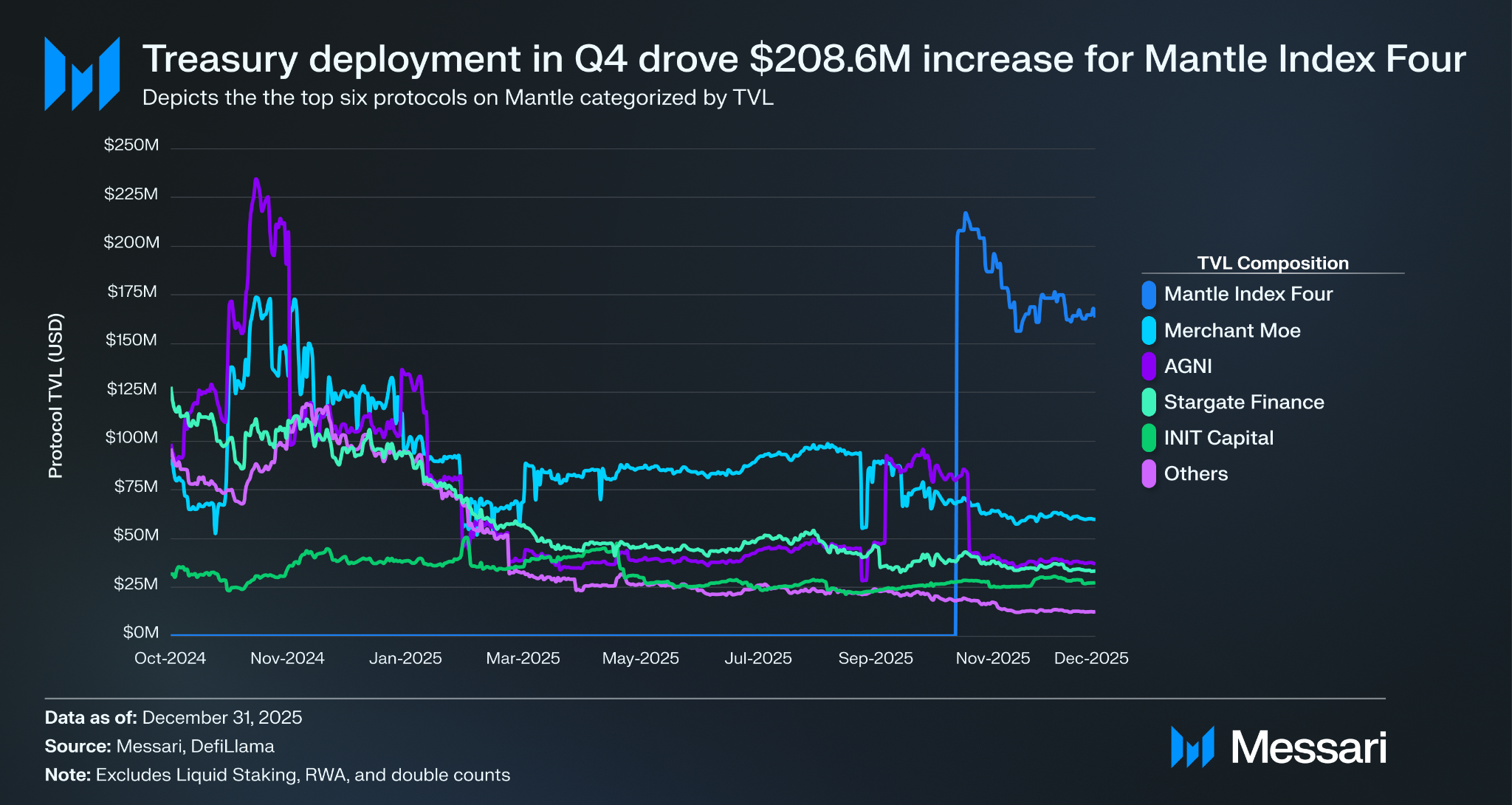
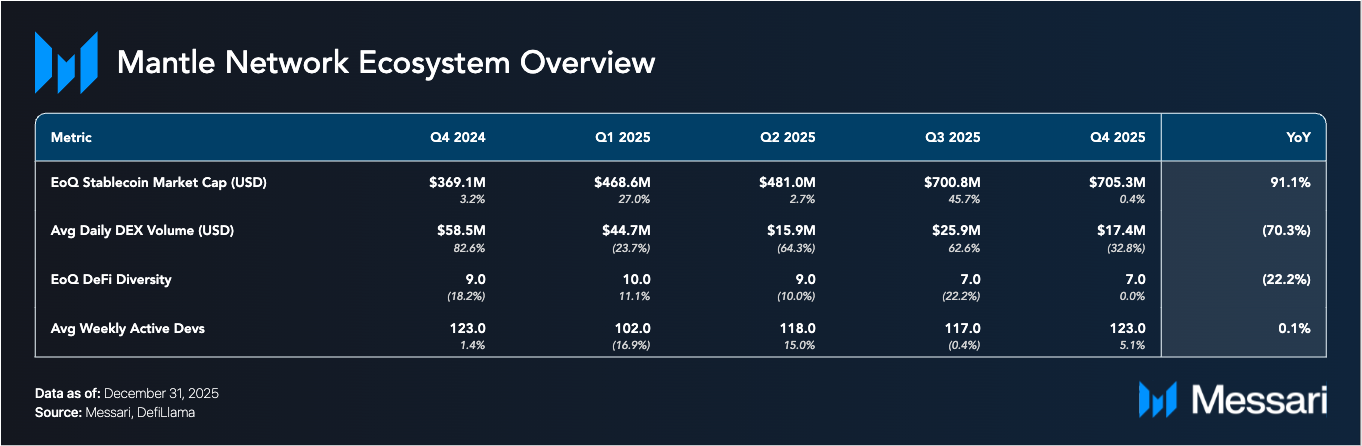
Mantle’s DeFi TVL increased 37.3% QoQ in Q4 2025, rising from $242.3 million to $332.7 million. This spike was not driven by user deposits, but by the onchain activation of the Mantle Index Four (MI4) Fund, which added approximately $205.1 million in TVL following a treasury deployment.
In Q4, the Mantle Treasury executed a proposal to migrate a portion of its previously idle assets, held in cold storage and excluded from TVL, into the MI4 product. Though MI4 originally launched in April 2025, it remained largely inactive until this deposit. The move marked a shift from passive treasury management toward an active, yield-bearing strategy, likely tied to real-world asset or DeFi yield strategies.
At the end of the quarter, MI4 held $173 million in assets under management and reported a year-to-date return of 27.9%
Additionally, the following protocols on Mantle contribute to network TVL in measurable ways:
Agni Finance is an AMM-based DEX focused on spot trading and concentrated liquidity. As of Dec. 31, 2025, it held about $37.9 million in TVL and recorded approximately $80.1 million in 30-day volume.
INIT Capital is a DeFi lending and borrowing (money market) protocol that enables users to create Liquidity Hooks. As of Dec. 31, 2025, it held approximately $10.1 million in TVL and $2.0 million in outstanding borrows.
Lendle is a money market protocol. As of Dec. 31, 2025, it held approximately $10.1 million in TVL and $1.46 million in outstanding borrowings.
Market Cap and Price
In Q4 2025, MNT’s circulating market cap decreased 45.6% QoQ, from $5.7 billion to $3.1 billion. The price of MNT also decreased 45.6% QoQ, from $1.77 in Q3 to $0.96 in Q4. This decline (23.0% YoY) coincided with a decrease in onchain activity and trading momentum following Q3’s exchange-driven expansion, as elevated volumes and incentive-supported liquidity took a hit in Q4.
Revenue
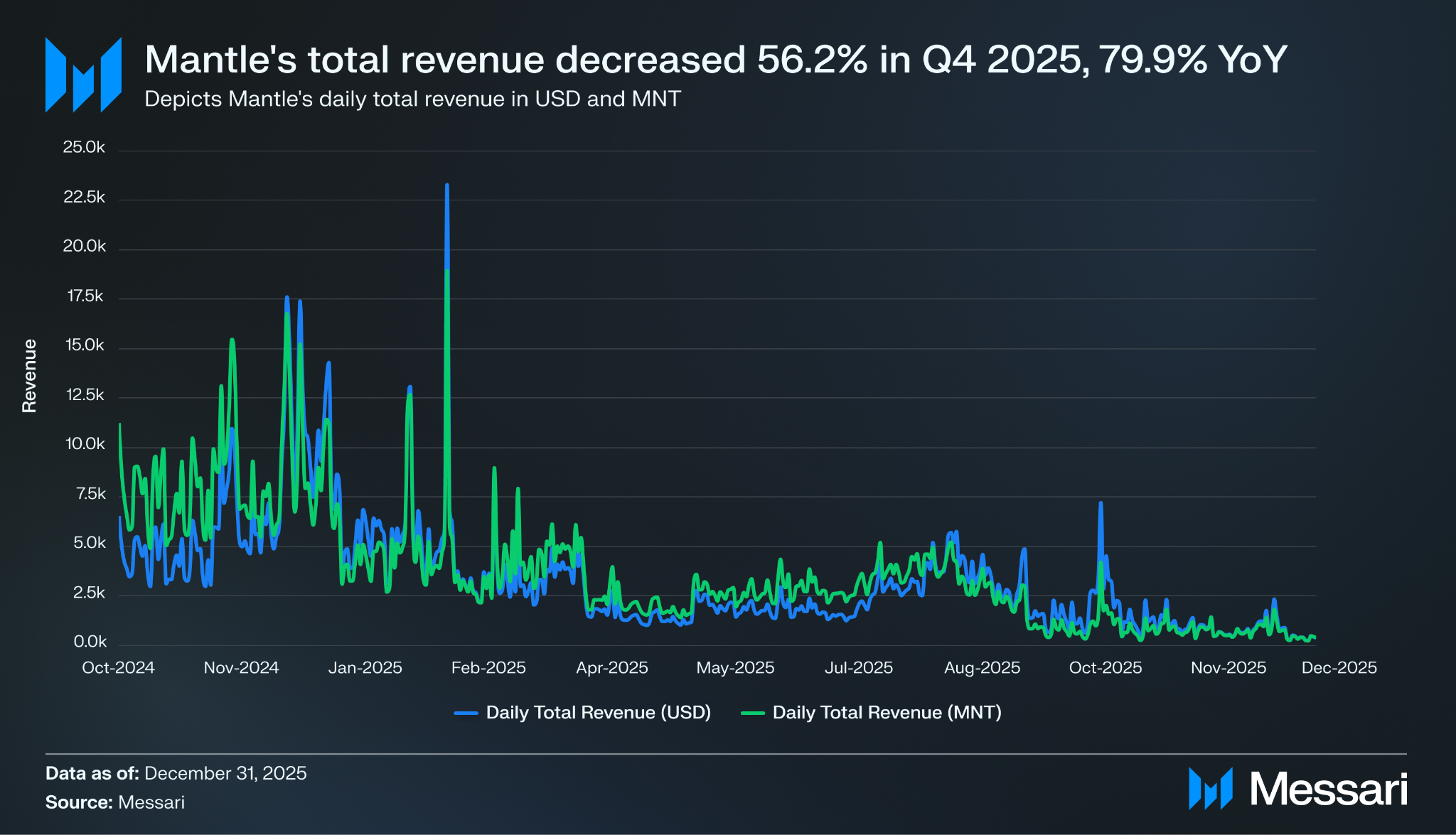
Mantle’s quarterly revenue in Q4 2025 totaled $110,535, reflecting a 56.2% QoQ decline from $252,400 in Q3 2025. This reflects a 70.1% decrease in MNT-denominated total revenue, falling from 258,439 MNT to 75,394 MNT. Year-over-year, Mantle’s total revenue (USD) decreased by approximately 79.9% (from $539,700 to $108,535).
The more amplified MNT-denominated revenue decline may be attributed to MNT price depreciation and a decline in onchain activity in Q4 2025. Despite the Q4 pullback, Bybit remains a significant long-term catalyst for revenue growth, particularly in MNT terms. MNT serves as Bybit’s core platform asset, with utility spanning across trading, VIP, and institutional products.
Network Analysis
Activity and Usage
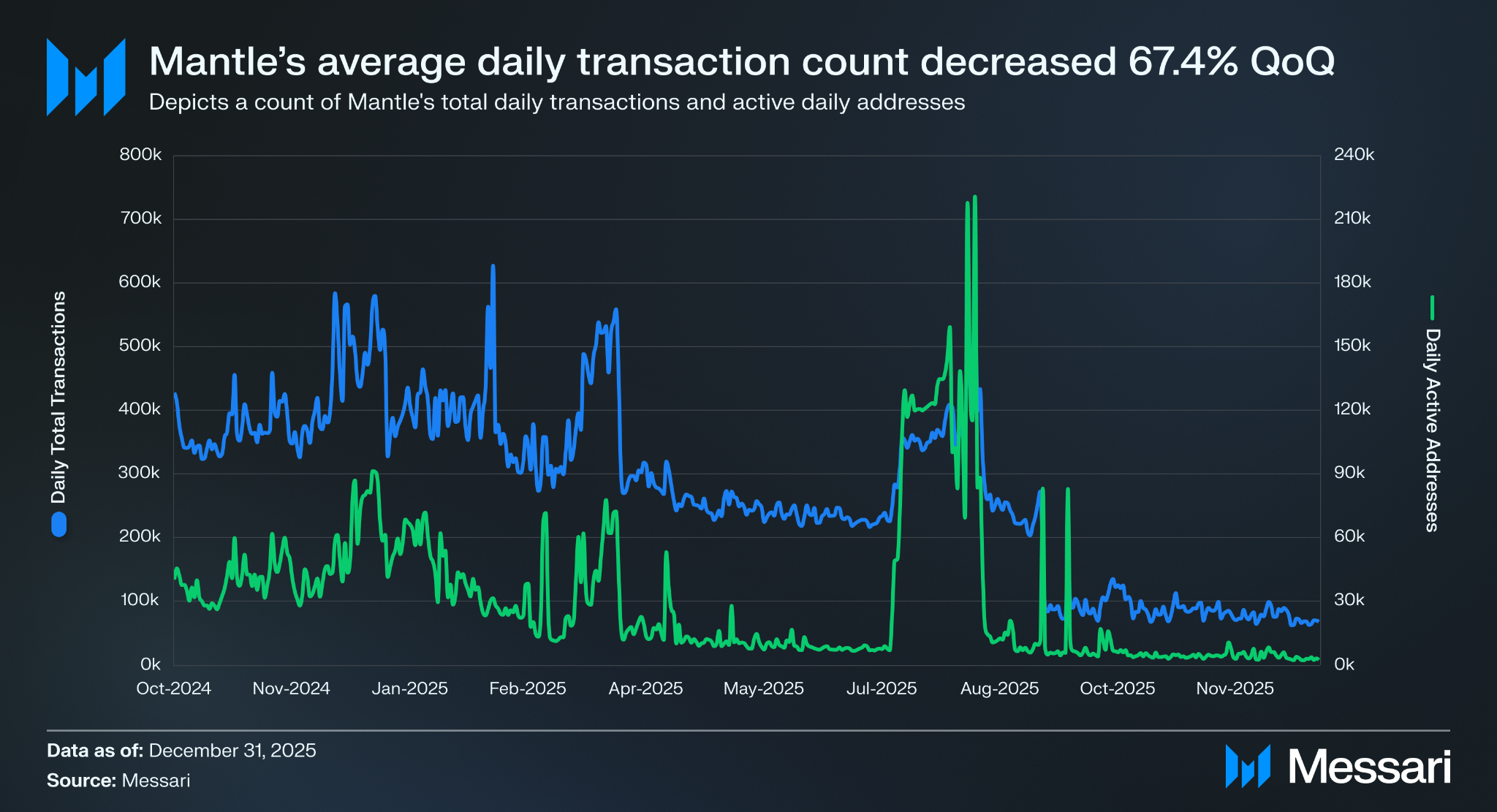
In Q4 2025, Mantle Network’s onchain activity sharply declined following the elevated levels observed in Q3. Mantle recorded 85,404 average daily transactions, experiencing a 67.4% decline from 262,000 in Q3 2025. Approximately 5,000 average daily active addresses were recorded in Q4 2025, reflecting a 90.1% decline QoQ, down from an average of 53,000 in Q3. Average daily new addresses fell to roughly 907, reflecting a 76.5% QoQ decrease from 3,860 in Q3 amid reduced onboarding activity as incentive-driven usage decreased.
Ecosystem Analysis
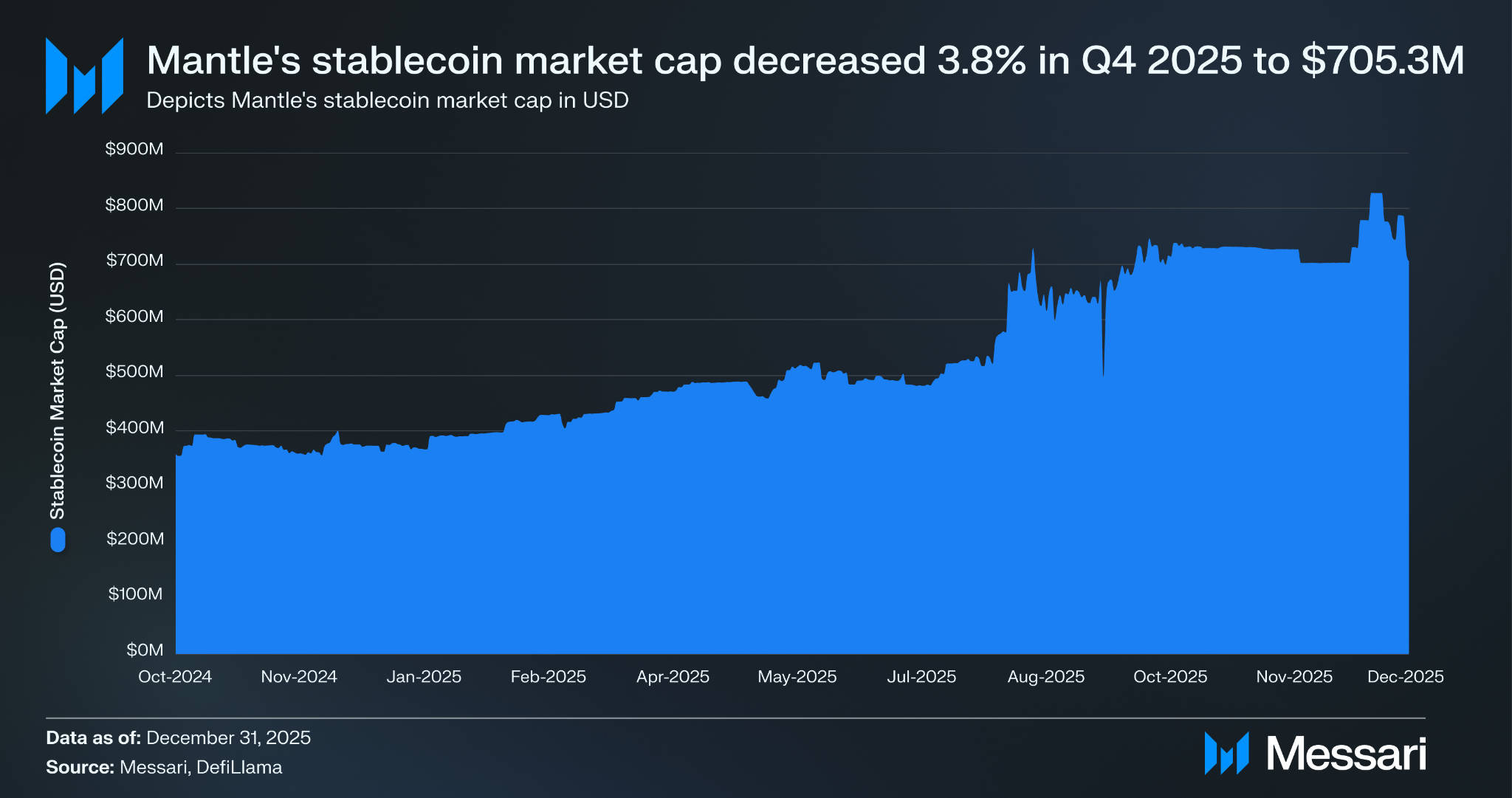
In Q4 2025, Mantle Network’s stablecoin market cap decreased 3.8% from $733.1 million to $705.3 million. Year-over-year, the protocol’s stablecoin market cap increased 91.1% (from $369.1 million to $705.3 million), primarily driven by the integration of USDT0 and the launch of yield-generating products in collaboration with Bybit.
Although the market cap of USDT increased 3.0% QoQ (from $506.6 million to $521.5 million), peer stablecoins on Mantle Network slightly declined in Q4 2025:
USDe’s market cap fell approximately 7.6% from $132.6 million to $122.6 million
USDC’s market cap fell approximately 24.4% from $36.0 million to $27.2 million
AUSD’s market cap fell approximately 5.7% from $5.5 million to $5.2 million
mETH
mETH is the core asset of mETH Protocol, Mantle’s ETH liquid staking and restaking protocol operating at the intersection of the Mantle and Bybit ecosystems. Built as an on-demand access point for ETH yield, mETH supports institutional-scale liquidity needs without compromising capital utility, positioning it as a core ETH treasury asset.
Each mETH token represents a claim on staked ETH plus accumulated rewards, with the mETH-to-ETH exchange rate gradually increasing over time as staking rewards compound (i.e., it is not a rebasing token like stETH). On December 31, 2025, the exchange rate of 1 mETH was equivalent to 1.09 ETH.
As of the end of Q4 2025, mETH holds $279.1 million in ETH, down 53.9% QoQ. mETH Protocol charges a 10% fee on staking rewards, a portion of which is paid to a curated set of professional node operators such as P2P, Blockdaemon, Stakefish, and Kraken. These node operators serve as the underlying validators responsible for running the Ethereum consensus infrastructure on behalf of mETH stakers.
A major protocol upgrade for the mETH Protocol occurred on Dec. 15, 2025, introducing a Buffer Pool mechanism to support on-demand redemptions from mETH to ETH. Enabled through a dual-liquidity pathway that allocates a portion of validator-side ETH into Aave, this upgrade addresses the liquidity bottlenecks common in Ethereum staking.
Key outcomes of the Buffer Pool upgrade include:
Targeting a <24-hour redemption window under normal buffer conditions.
Allocating approximately 20% of the protocol's TVL to Aave’s ETH market, routing smaller requests to an instant buffer and larger requests to the Aave reserve.
Maintaining a ~2.56% net protocol APY, introducing a blended yield structure that combines staking rewards with Aave supply interest to maintain competitive returns.
Continued strategic alignment with Bybit to enable mETH as trading and margin collateral, further supported by OTC support for large institutional flows.
This upgrade is foundational to COOK’s evolving role, positioning it as the capture mechanism for staking revenue, liquidity provisioning, and future treasury utility as mETH Protocol scales toward advancing its ETH treasury asset solution.
COOK
COOK is the native governance token of mETH Protocol, launched in October 2024 to govern the protocol’s key parameters, including fees, validator onboarding, staking and restaking allocations, and incentive design across both mETH and cmETH. While initial phases were characterized by the Methamorphosis incentive campaigns, the protocol has transitioned toward a long-term treasury vision, positioning COOK as the economic backbone for mETH’s expansion into institutional markets.
Formal onchain governance using COOK is not yet active; protocol decisions are currently coordinated through the Mantle Forum. As the protocol transitions away from its original incentive-driven model (e.g., Methamorphosis seasons), the emphasis has shifted toward making COOK the value-capture mechanism for mETH Protocol’s evolving treasury.
Function
Function (FBTC) is an omnichain Bitcoin asset pegged 1:1 to BTC, originally incubated by Ignition (now operating under the Function brand) with Antalpha Prime and Mantle as initial core contributors. It uses a Threshold Signature Scheme (TSS) network to custody BTC and mint or redeem FBTC on supported chains such as Ethereum and Mantle. On Mantle, FBTC functions as Bitcoin-denominated collateral for lending, borrowing, and liquidity provision.
MI4
MI4 is the tokenized share class of Mantle Index Four Fund, an institutional crypto index product launched on April 24, 2025, by Mantle in partnership with Securitize. The fund is structured as a British Virgin Islands limited partnership and is dedicated to providing market-cap-weighted exposure to leading crypto assets, such as BTC, ETH, and SOL, enhanced by staked token yields. Overall, it provides simplified access to a diversified crypto beta with traditional administration, quarterly rebalancing, and a 1% management fee. As of December 31, 2025, MI4 manages approximately $173 million in assets, with a YTD return of 27.88%.
Mantle Vault
Announced on Dec. 22, 2025, Mantle Vault is a stablecoin yield product distributed through Bybit Onchain Earn and executed on Mantle Network, with strategy design and automation coordinated by Cian. The product is positioned as a structured access point to market-neutral stablecoin yield, where users deposit USDT or USDC through Bybit and capital is deployed into onchain yield strategies across the Mantle ecosystem. Mantle Vault targets stablecoin yield without direct exposure to underlying asset price movements.
RWA Partnerships
Mantle scaled its RWA partnership ecosystem in Q4 2025, with integrations and announcements spanning stablecoin settlement infrastructure, tokenized equity exposure, and early validation of regulated institutional asset issuance onchain.
USDT0 integration: Mantle became the first exchange-affiliated network to integrate USDT0, positioning it as a stablecoin settlement rail between Bybit and Mantle DeFi. The integration supports lower-cost transfers and enables exchange liquidity to flow directly into onchain venues on Mantle.
Tokenized U.S. equities via xStocks: Mantle and Bybit announced future support for tokenized U.S. equities through xStocks in Q4 2025, including assets such as NVDAx, AAPLx, and MSTRx.
QCDT deployment: Mantle also announced the deployment of QCDT, a regulated RWA product structured around institutional-grade yield-bearing assets. QCDT is positioned as a compliant instrument that expands Mantle’s asset mix beyond stablecoins, with an emphasis on tokenized cash-equivalent yield and regulated distribution pathways.
Aave x Mantle x Bybit: Mantle announced a partnership with Aave and Bybit tied to Aave’s planned deployment on Mantle. The integration introduces standardized lending and collateral infrastructure that may support stablecoin-based liquidity and tokenized asset activity as Mantle’s RWA partnership landscape expands.
Ecosystem Partnerships
Alongside institutional-facing RWA integrations, Mantle continued to support ecosystem partners that contribute liquidity formation and distribution across Mantle-native markets.
Fluxion is a Mantle-native DEX that supports liquidity formation for assets deployed
Printr is a multichain memecoin launchpad that hosts launches tied to Bybit-affiliated community assets. The partnership reflects Mantle’s continued use of Bybit distribution to bootstrap onchain activity and broaden user entry points across the ecosystem.
Merchant Moe remained Mantle’s largest DEX by TVL during the quarter, with cumulative trading volume exceeding $5 billion. Merchant Moe remains one of the network’s primary liquidity venues for spot routing and market depth.
Treasury Value and Holdings
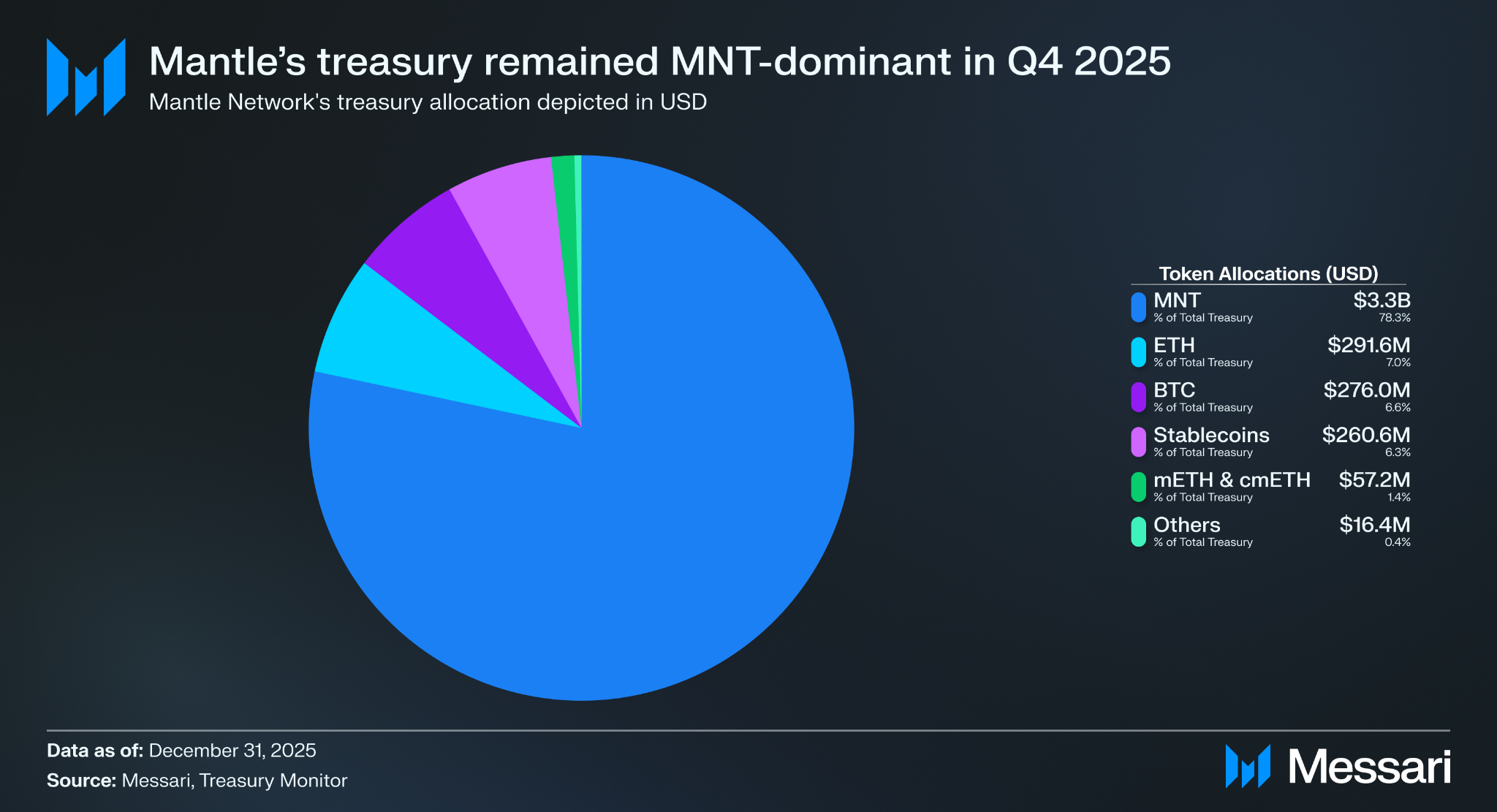
Mantle’s treasury ranked fourth among all protocols at the end of Q4 2025, according to DefiLlama, at a total value of approximately $4.2 billion. This marks a year-over-year increase of about 54.0%, up from approximately $2.7 billion in Q4 2024, largely driven by MNT’s price performance and sustained accumulation in prior quarters.
The allocation breakdown of treasury-owned token holdings at year-end proceeds as follows:
MNT ($3.3 billion in holdings): Composed 78.3% of the treasury.
ETH ($291.6 million in holdings): Composed 7.0% of the treasury.
BTC ($276.0 million in holdings): Composed 6.6% of the treasury.
Stablecoins ($260.6 million in holdings): Composed 6.3% of the treasury, and consists of tokens such as USDC, USDT, and USDe.
mETH and cmETH ($57.2 million in holdings): Composed 1.4% of the treasury.
Others ($16.4 million in holdings): Composed 0.4% of the treasury, and consists of tokens such as bbSOL and COOK.
Mantle’s total treasury token holdings amounted to $4.2 billion at the end of Q4 2025, representing a 25.0% decline QoQ from $5.6 billion in holdings in Q3 2025. The QoQ decline in Mantle’s holdings was in line with the broader market downturn, including a decline in MNT’s price, and was influenced by primary tokens such as ETH and BTC, which decreased by approximately 22.8% and 31.8%, respectively.
Closing Summary
Mantle closed Q4 2025 amid a broader market drawdown, with its circulating market cap declining from $5.7 billion to $3.1 billion and MNT falling 45.6% QoQ to $0.96. This contraction followed the post-Bybit listing stabilization in trading activity. Total protocol revenue declined in parallel, dropping 56.2% QoQ to $110,535.
Despite this pullback, DeFi TVL on Mantle increased 37.3% to $332.7 million, driven by the Q4 deployment of idle treasury assets into Mantle Index Four (MI4), the protocol’s institutional-grade index fund. While MI4 launched in Q2, the sharp spike in late October stemmed from the DAO executing a treasury proposal that activated offchain reserves, resulting in a TVL surge. As of quarter-end, MI4 held $173 million in assets.
Key ecosystem protocols continued to contribute to onchain liquidity: Merchant Moe led DEX activity with $61.6 million in TVL and $162.2 million in 30-day volume; Agni Finance and INIT Capital also maintained stable contributions across spot and money market activity. Meanwhile, the mETH Protocol’s Buffer Pool upgrade improved ETH redemption efficiency and positioned COOK as a future treasury-backed value accrual mechanism.
Mantle ended the year with a $4.2 billion treasury, ranking fourth across all protocols. Year over year, its treasury value rose approximately 54.0% to $3.0 billion in Q4 2024, primarily driven by MNT price appreciation and stronger platform integration across DeFi products. The protocol continues to prioritize sustainable growth through DAO-led capital deployment, ETH-native yield strategies, and expanding onchain infrastructure.
This report was commissioned by Mantle. All content was produced independently by the author(s) and does not necessarily reflect the opinions of Messari, Inc. or the organization that requested the report. The commissioning organization may have input on the content of the report, but Messari maintains editorial control over the final report to retain data accuracy and objectivity. Author(s) may hold cryptocurrencies named in this report. This report is meant for informational purposes only. It is not meant to serve as investment advice. You should conduct your own research and consult an independent financial, tax, or legal advisor before making any investment decisions. Past performance of any asset is not indicative of future results. Please see our Terms of Service for more information.
No part of this report may be (a) copied, photocopied, duplicated in any form by any means or (b) redistributed without the prior written consent of Messari®.